Ludisia Discolor Care Guide: Light, Water, Soil
Ludisia discolor
Learn how to grow Ludisia discolor, the black jewel orchid: filtered light, lightly moist terrestrial mix, humidity, shallow pots, propagation, and species-specific pet-safety notes.
Ludisia Discolor Care Guide: Growing the Black Jewel Orchid
Start with wateringThe most common care mistake for Ludisia DiscolorWatering guide →Ludisia Discolor care essentials
Light
Medium, filtered light or bright shade; an east- or north-facing window is often suitable
Water
Keep the terrestrial mix lightly and evenly moist while Ludisia is growing, but never leave the pot standing in water. Let the surface begin to dry between waterings, then water thoroughly with tepid water and drain the saucer. Do not let the whole root zone become bone-dry for an extended period.
Soil
Use a moisture-retentive but airy terrestrial orchid medium. A peat-free houseplant compost or loam blended with fine-to-medium orchid bark and a small amount of sphagnum suits this creeping ground orchid better than a very coarse epiphytic bark mix by itself.
Humidity
Temperature
Fertilizer
About Ludisia Discolor
Ludisia Discolor is native to Southeast Asia; RHS gives the range as the Himalaya to Java, typically reaches About 10–30 cm tall; creeping stems can spread roughly 30–60 cm in a shallow pot, depending on age and conditions indoors, with slow to moderate, spreading sideways by creeping rhizomes growth. Ludisia Discolor has a evergreen terrestrial orchid grown mainly for its velvety, veined foliage growth habit and part of the Orchidaceae family. It is also known as Jewel Orchid, Black Jewel Orchid, Golden Lace Orchid, and Tiger Orchid.
| Detail | Information |
|---|---|
| Also known as | Jewel Orchid, Black Jewel Orchid, Golden Lace Orchid, Tiger Orchid |
| Native region | Southeast Asia; RHS gives the range as the Himalaya to Java |
| Mature size | About 10–30 cm tall; creeping stems can spread roughly 30–60 cm in a shallow pot, depending on age and conditions |
| Growth rate | Slow to moderate, spreading sideways by creeping rhizomes |
| Growth habit | Evergreen Terrestrial Orchid Grown Mainly For Its Velvety, Veined Foliage |
| Scientific name | Ludisia discolor |
| Family | Orchidaceae |
How to care for Ludisia Discolor?
How much light does Ludisia Discolor need?
Medium, filtered light or bright shade; an east- or north-facing window is often suitable. Partial shade. Sheltered outdoor shade in warm weather
- Medium - Medium, filtered light or bright shade; an east- or north-facing window is often suitable.
- filtered light or bright shade - Medium, filtered light or bright shade; an east- or north-facing window is often suitable.
- an east- or north-facing window is often suitable - Medium, filtered light or bright shade; an east- or north-facing window is often suitable.
- Partial shade - Partial shade.
- Sheltered outdoor shade in warm weather - Sheltered outdoor shade in warm weather.
When should you water Ludisia Discolor?
Keep the terrestrial mix lightly and evenly moist while Ludisia is growing, but never leave the pot standing in water. Let the surface begin to dry between waterings, then water thoroughly with tepid water and drain the saucer. Do not let the whole root zone become bone-dry for an extended period.
- Touch the upper 1–2 cm of the mix. When it is starting to dry - Let the surface begin to dry between waterings, then water thoroughly with tepid water and drain the saucer.
- water the root zone and allow excess to drain. The mix should feel lightly moist below the surface - Keep the terrestrial mix lightly and evenly moist while Ludisia is growing, but never leave the pot standing in water.
- not saturated or soggy - Do not let the whole root zone become bone-dry for an extended period.
- Drain excess water - Let the surface begin to dry between waterings, then water thoroughly with tepid water and drain the saucer.
What soil works best for Ludisia Discolor?
Use a moisture-retentive but airy terrestrial orchid medium. A peat-free houseplant compost or loam blended with fine-to-medium orchid bark and a small amount of sphagnum suits this creeping ground orchid better than a very coarse epiphytic bark mix by itself.
- Start with peat-free houseplant compost or a light loam-based mix. - A peat-free houseplant compost or loam blended with fine-to-medium orchid bark and a small amount of sphagnum suits this creeping ground orchid better than a very coarse epiphytic bark mix by itself.
- Add fine-to-medium bark for air space and a small amount of sphagnum to help retain even moisture. - A peat-free houseplant compost or loam blended with fine-to-medium orchid bark and a small amount of sphagnum suits this creeping ground orchid better than a very coarse epiphytic bark mix by itself.
- Use a shallow pot with drainage holes so creeping rhizomes can spread without sitting in water. - A peat-free houseplant compost or loam blended with fine-to-medium orchid bark and a small amount of sphagnum suits this creeping ground orchid better than a very coarse epiphytic bark mix by itself.
Grower notes for Ludisia Discolor
Check the botanical name on a jewel orchid
This profile covers Ludisia discolor, also sold as the black jewel orchid or tiger orchid. “Jewel orchid” can also refer to other terrestrial orchid genera such as Macodes and Anoectochilus, whose care can differ; do not assume this Ludisia profile fits every plant sold under that name.
Grow it for patterned leaves, not a dramatic flower display
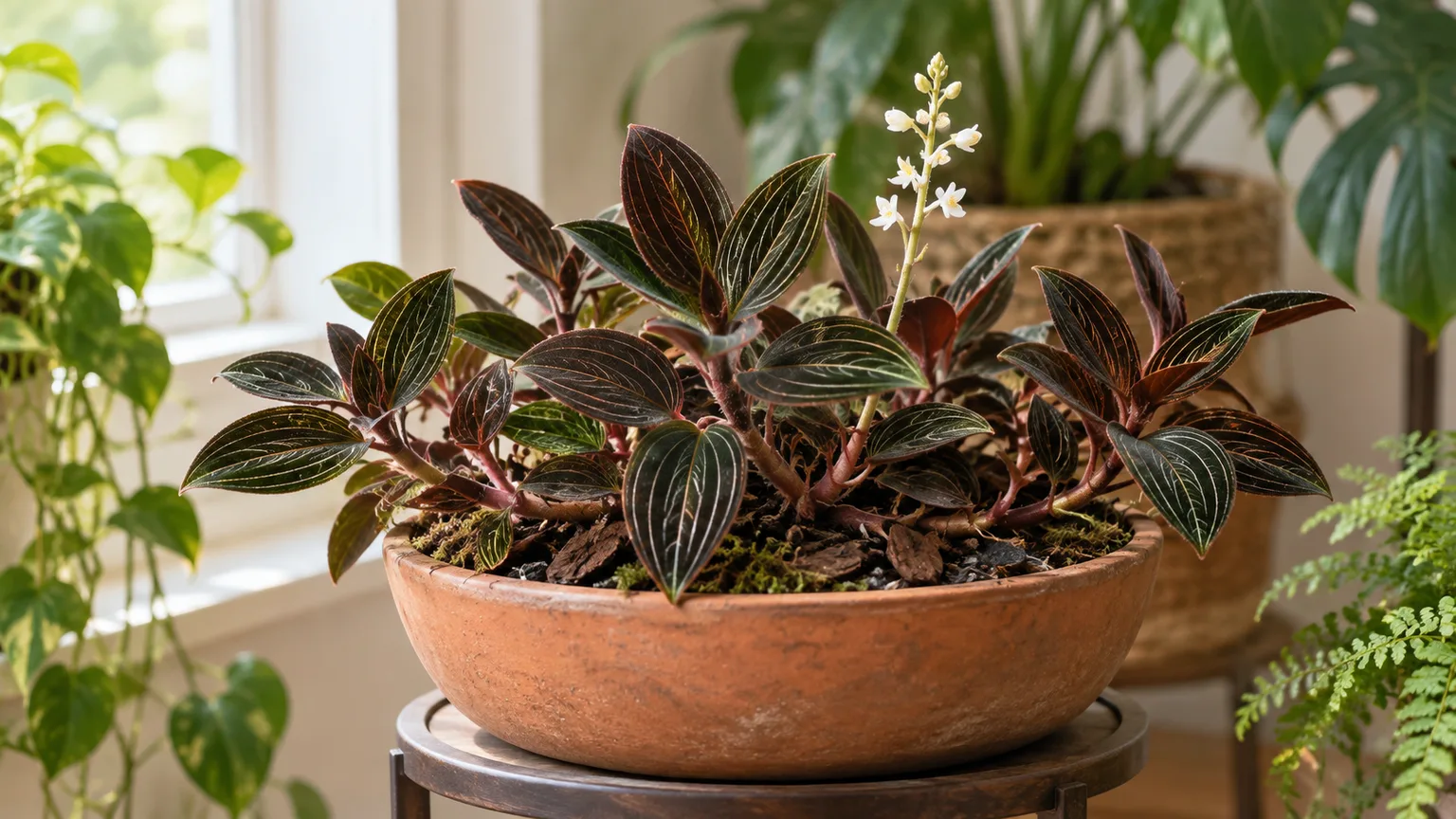
Ludisia is usually prized for its dark, velvety leaves with contrasting red, gold, or pale veins. It can also produce small white flowers on an upright spike, but its foliage is the main year-round feature.
Give the foliage filtered light
Intermediate light or bright shade supports steady growth without washing out the leaf pattern. A north- or east-facing window is a useful starting point indoors. Protect the leaves from hot direct sun, especially behind glass.
Keep the root zone moist but airy
This is a terrestrial orchid, so it wants a finer, more moisture-retentive medium than many bark-grown epiphytic orchids. Water as the surface begins to dry, but use a freely draining pot and do not leave water in the saucer; persistently wet roots and stems can rot.
Choose a wide, shallow container
Creeping rhizomes spread sideways, so a broad, shallow pot gives the plant room to fill in. Keep the pot airy and humid rather than packing the mix tightly or burying the stems deeply.
Propagate healthy stems after they root
RHS recommends setting fleshy stem pieces in sphagnum until roots form, then potting them into houseplant compost once established. Use clean tools, keep cuttings lightly moist, and wait for visible roots before moving them into a larger mix.
Is Ludisia discolor safe around pets?
NC State Extension marks Ludisia discolor as non-toxic to cats, dogs, and horses. That exact-species listing does not establish safety for rabbits, birds, turtles, or tortoises; keep it out of reach of those animals unless a species-appropriate veterinarian confirms otherwise.
The NC State Extension profile for Ludisia discolor tags the exact species as non-toxic for cats, dogs, and horses. Do not transfer that classification to other plants sold as jewel orchids or to pet species not covered by the listing.
Watering Ludisia Discolor
For Ludisia Discolor, touch the upper 1–2 cm of the mix. When it is starting to dry, water the root zone and allow excess to drain. The mix should feel lightly moist below the surface, not saturated or soggy. and water check the mix instead of following a fixed calendar. Water when the top layer begins to dry; the interval changes with room temperature, pot size, medium, and season. Reduce watering somewhat when growth slows in cool, dim weather. Keep moisture more consistent during active growth and flowering. In cooler, darker months, allow the surface to dry a little further and water less often, while avoiding prolonged complete drying.
| Detail | Information |
|---|---|
| How often | Check the mix instead of following a fixed calendar. Water when the top layer begins to dry; the interval changes with room temperature, pot size, medium, and season. Reduce watering somewhat when growth slows in cool, dim weather. |
| How to check | Touch the upper 1–2 cm of the mix. When it is starting to dry, water the root zone and allow excess to drain. The mix should feel lightly moist below the surface, not saturated or soggy. |
| Seasonal changes | Keep moisture more consistent during active growth and flowering. In cooler, darker months, allow the surface to dry a little further and water less often, while avoiding prolonged complete drying. |
Signs of overwatering
- The mix stays wet for days or the pot remains heavy between waterings.
- Stems or rhizomes soften, or leaves yellow while the medium is saturated.
- A stale smell develops around the root zone.
Signs of underwatering
- The mix is dry well below the surface and leaves begin to lose firmness.
- Creeping stems shrivel after a long dry spell.
Soil & potting for Ludisia Discolor
Use a mix of Start with peat-free houseplant compost or a light loam-based mix., Add fine-to-medium bark for air space and a small amount of sphagnum to help retain even moisture., Use a shallow pot with drainage holes so creeping rhizomes can spread without sitting in water. for Ludisia Discolor. Choose a shallow, wide pot with open drainage. The medium should hold some moisture around the shallow roots while letting excess water escape quickly; do not keep the rhizomes in waterlogged compost. Repot repot when the mix has broken down or the creeping rhizomes reach the edge of the shallow pot, often every couple of years rather than on a strict schedule., ideally in spring or when the plant is beginning active growth.
| Detail | Information |
|---|---|
| Recommended mix | Start with peat-free houseplant compost or a light loam-based mix., Add fine-to-medium bark for air space and a small amount of sphagnum to help retain even moisture., Use a shallow pot with drainage holes so creeping rhizomes can spread without sitting in water. |
| Drainage | Choose a shallow, wide pot with open drainage. The medium should hold some moisture around the shallow roots while letting excess water escape quickly; do not keep the rhizomes in waterlogged compost. |
| Repotting frequency | Repot when the mix has broken down or the creeping rhizomes reach the edge of the shallow pot, often every couple of years rather than on a strict schedule. |
| Best season to repot | Spring or when the plant is beginning active growth |
Signs it needs repotting
- Rhizomes crowd the pot edge or spill over farther than the container can support.
- The medium has compacted, decomposed, or remains wet much longer than before.
- Roots or stems decline despite appropriate light and watering.