Do Dryer Sheets Repel Mosquitoes? Evidence Explained
Do dryer sheets repel mosquitoes? See what research tested, why fragrance ingredients do not prove protection, and which bite-prevention steps are dependable.

The short answer: not reliably
A dryer sheet is not a dependable way to prevent mosquito bites. The idea has a plausible-sounding hook—some sheets release fragrant compounds that have been detected in insect research—but the evidence people usually cite does not show that putting one in a pocket, rubbing it on skin, or setting it beside a patio chair protects a person from mosquitoes.
The most relevant peer-reviewed dryer-sheet study tested adult fungus gnats, not mosquitoes. In a separate, small cage test run by a local mosquito-control district, researchers counted three mosquito landings when a dryer sheet was used and four in the no-sheet control; the district concluded the sheet was ineffective. The result is not a large clinical trial, but it gives no basis for treating a sheet as protection. If bites matter because of disease risk, use public-health-recommended measures instead.
Why the dryer-sheet mosquito tip sounds plausible
A scented sheet seems like a simple substitute for bug spray: put the fragrance close to your clothes, and perhaps mosquitoes will avoid the smell. That story also borrows credibility from real research on chemicals found in fragrances and plants. The catch is that “a chemical has insect-related activity” and “this household product prevents mosquito bites in ordinary outdoor conditions” are different claims.
The advice also circulates in a few versions. People report carrying a sheet in a pocket, pinning it to clothing, rubbing it over skin, or placing sheets around patio cushions and picnic areas. Those methods are not interchangeable: a sheet near furniture would need to influence mosquitoes across some distance, while a sheet rubbed on skin would need to protect the treated skin. Neither effect can be assumed from a pleasant or powerful smell.
Current home-and-garden coverage still repeats pocket and patio placement as possibilities, but it does not establish a tested number of sheets, a protective radius, or a reliable time window. Treat those suggestions as folk practice, not instructions validated by a mosquito trial. The practical question is not whether a sheet has a scent; it is whether that scent consistently keeps mosquitoes from landing and biting you. For example, a recent Homes & Gardens roundup presents pocket and seating-area placement as possible uses while acknowledging that evidence is limited; those ideas should not be mistaken for a tested protocol.
What the research actually tested
The phrase “research shows dryer sheets repel bugs” compresses different insects and experiments into one broad claim. To judge the mosquito advice fairly, look at the organism tested, where the sheet was placed, what outcome researchers measured, and whether the work resembles your intended use.
The peer-reviewed study was about fungus gnats
A 2010 paper in HortScience evaluated Bounce Outdoor Fresh fabric-softener sheets against adult fungus gnats (Bradysia sp. nr. coprophila) in laboratory containers. Across five experiments, a smaller share of the gnats ended up in compartments containing a sheet than in compartments without one. Chemical analysis identified linalool among the major volatile compounds, along with benzyl acetate, beta-citronellol, and hedione. The finding was specifically about fungus-gnat behavior under laboratory conditions, not mosquito bites outdoors (the study’s abstract and publication record).
That distinction matters because mosquitoes are not fungus gnats. They belong to a different insect family and behave differently around people, skin, clothing, and host cues. A result for one species can motivate a new experiment, but it cannot stand in for a test on another. The University of Missouri Extension summary of the work likewise describes the experiment as a fungus-gnat test and notes that the origin of the idea was a claim about mosquitoes; it does not report that the paper established mosquito repellency (University of Missouri Extension).
So, if you have seen the fungus-gnat result cited as proof that dryer sheets keep mosquitoes away, the insect has changed in the retelling. The original paper offers a reason to study the question, not a result that answers it.
The small mosquito trial showed no meaningful protection
A mosquito abatement district describes a small laboratory cage test using three locally collected mosquito species: Asian tiger mosquitoes (Aedes albopictus), salt-and-pepper mosquitoes (Coquillettidia perturbans), and Anopheles crucians. For its dryer-sheet condition, staff rubbed the sheet over an arm and then held it in the hand inside the cage. They counted mosquitoes that landed or attempted to feed during one-minute observations.
Across two runs combined, the control arm had four landings and the dryer-sheet condition had three. By comparison, the three labeled repellents tested in the same setup had zero landings during those observations. The district itself cautioned that the work needed more mosquitoes; it is a very small test, not a definitive estimate of how often any person will be bitten. Still, one fewer landing is not evidence of useful or lasting protection, and the test did not find a result comparable with the repellents it used (Tangipahoa Mosquito Abatement District’s methods and results).
The fair conclusion is narrow: the popular dryer-sheet claim has not been demonstrated as a dependable mosquito-control method. It is not necessary to prove that no sheet could ever change a mosquito’s behavior in any situation. For a practical decision, there is no established brand, placement, number, or duration you can rely on to prevent bites.
The direct cage test also has clear limits: it combined only two short runs, observed landings for one minute, and did not measure how long a sheet might affect mosquito behavior outside the cage. Those limits mean it cannot quantify a small effect under every possible condition. They do not turn the result into a positive recommendation, though. The right reading is that the test failed to show useful protection, while the evidence needed to specify a working method is still absent.
Why fragrant ingredients do not make a sheet a repellent
A chemical name can sound decisive, especially when the same molecule is associated with a plant or appears in pest-control conversations. But finding a volatile compound in a dryer sheet does not tell you how much reaches the air, how quickly it disperses, whether the concentration affects mosquitoes, or whether it lasts long enough to protect exposed skin. Those are product-performance questions that need tests of the finished product in the relevant conditions.
The fungus-gnat study’s chemical analysis identifies compounds in one specific brand and formulation at the time it was tested. It does not show that every dryer sheet contains the same fragrance blend, that an unscented sheet has the same compounds, or that a current version releases them at the same rate. Even if an ingredient has repellent activity in a concentrated formulation, the amount and delivery method in a laundry sheet may be very different.
A repellent also needs a clear route of exposure. A topical product is applied to exposed skin or clothing according to directions; a sheet in a pocket is separated from some skin and leaves other skin uncovered. A sheet on a table is farther away still. Mosquitoes may continue to reach uncovered ankles, wrists, or a person sitting just outside any local scent plume. None of these placements has a measured “safe radius” or protection time for dryer sheets.
This is why there is no useful conversion from “the fragrance lasts all day in the laundry drawer” to “it will protect me outdoors for an hour.” A scent can remain noticeable to a person without maintaining the concentration, coverage, or contact needed to alter mosquito landing behavior. EPA notes that the effectiveness of a labeled repellent varies with perspiration, water exposure, air temperature, and individual attractiveness to mosquitoes; a laundry sheet has not been tested against those variables or given a protection-time label. A timer invented for a sheet would be guesswork, not a safety margin (EPA guidance on repellent use).
The Centers for Disease Control and Prevention (CDC) says it does not know the effectiveness of non-EPA-registered repellents, including some products described as natural. It recommends EPA-registered products for protection against germs spread by mosquitoes. An ingredient’s natural origin or fragrance is not a substitute for evaluating the finished repellent product (CDC guidance on preventing mosquito bites).
Common dryer-sheet methods, ranked by evidence
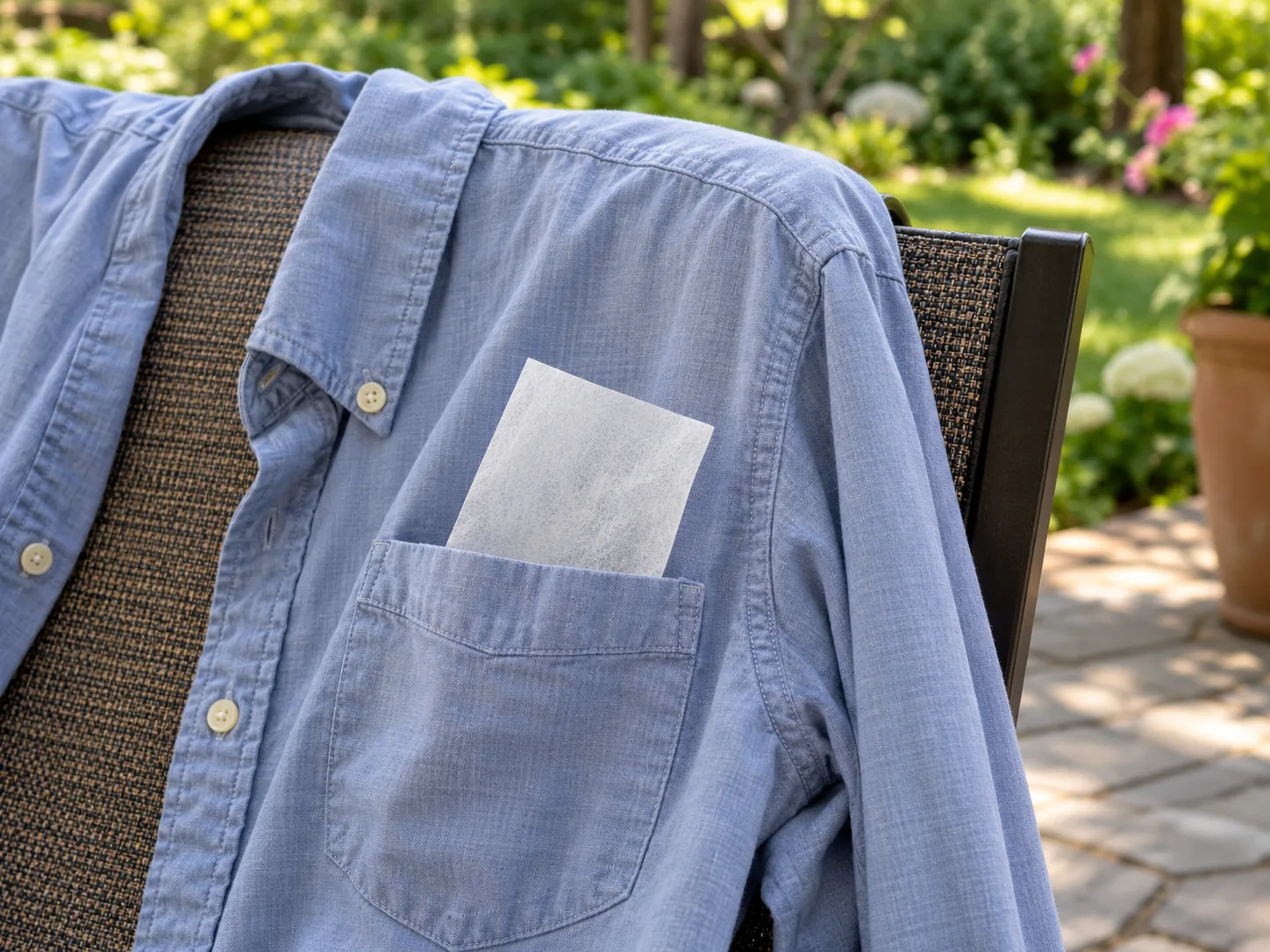
Keeping a sheet in an outer pocket does not create a tested barrier against bites.
None of the methods below has a validated mosquito-protection protocol. The ranking is about how little each method asks you to assume—not a claim that one has been proven effective. The safest decision is to use a dryer sheet only as an optional scent item while relying on tested measures for your actual protection.
Tucking a sheet into a pocket or shirt
This is the least complicated version of the folklore tip because it keeps the sheet close without spreading residue over your skin. If you choose to try it, keep a dry sheet in an outer pocket or attached to an outside layer, and do not let it rub against bare skin. But a pocket does not create a tested barrier around your body: mosquitoes can still bite exposed areas beyond the fabric, and there is no evidence-based schedule for replacing the sheet.
Avoid fastening a sheet where it may brush a child’s face, get pulled into a mouth, or be mouthed by a pet. Do not put it into a baby carrier, crib, or bedding as mosquito protection. A loose laundry sheet is not a substitute for a properly fitted mosquito net, a screened room, or a labeled repellent.
Rubbing a dryer sheet on skin
Skip this method. A dryer sheet is designed for laundry, not as a topical insect repellent; it does not provide skin-use directions, a tested dose, or a reapplication interval for mosquitoes. Rubbing fragrance and fabric-softener residues directly onto skin may irritate someone who is sensitive to them, and a small patch test would not prove the sheet can prevent bites over time.
Use products that are labeled for application to people, and follow their directions. The U.S. Environmental Protection Agency (EPA) says to apply insect repellents only to exposed skin and/or clothing, not under clothing, and not near food; its guidance also emphasizes following the product label for safe and effective use (EPA instructions for using insect repellents). A dryer sheet has no equivalent mosquito-repellent label.
Placing sheets on furniture or near food
A sheet tucked into a cushion, taped beneath a patio table, or set beside a picnic basket has no established effect on mosquitoes in the surrounding area. Open air, wind, distance, and the particular sheet all change how much fragrance reaches a person, so there is no reliable radius to plan around. A strong scent at the table may be noticeable to you without preventing a mosquito from landing on your leg.
Do not place dryer sheets on plates, in food containers, against napkins that touch food, or where children can put them in their mouths. The EPA specifically advises keeping insect-repellent products away from food; a laundry sheet is not a repellent, and putting it near food adds no demonstrated benefit. If a picnic is the setting, close food containers and use ordinary bite-prevention measures rather than scenting the serving area.
If you still want to try one, use it only as an extra
If you want to see whether a sheet makes your own patio feel more pleasant, keep the experiment separate from protection. Place one dry sheet in an outer pocket or on a side table, away from bare skin, food, children, pets, flames, and anything that could be stained. Do not interpret a single bite-free evening as proof: mosquito numbers, wind, clothing, time outdoors, and individual attractiveness all vary from day to day.
Most importantly, use your normal, proven precautions at the same time. If mosquitoes are active, apply an EPA-registered repellent as labeled, cover exposed skin with loose-fitting clothing, and move indoors or into a screened area if bites continue. In a place with a mosquito-borne disease warning, during travel where mosquito-borne disease is a concern, or when someone needs reliable protection, leave the dryer sheet out of the decision entirely.
There is no responsible instruction such as “use two sheets,” “replace every hour,” or “place one every few feet” because those amounts and intervals have not been established. If a method needs an invented dose and replacement schedule to sound practical, that is a sign the evidence is missing. Keep any personal trial low-stakes and do not use the result to advise someone else that the trick works.
Better ways to prevent bites outdoors
Think in layers, because personal protection, a comfortable seating area, and fewer mosquitoes breeding nearby are different goals. A topical repellent protects the person when used correctly; a fan can disrupt a small sitting zone; removing water and repairing screens helps reduce exposure over time. No single yard change promises a mosquito-free property.
Choose an EPA-registered skin repellent
For personal protection, look for an EPA registration number and an active ingredient CDC lists for mosquito repellents: DEET, picaridin, IR3535, oil of lemon eucalyptus (OLE), para-menthane-diol (PMD), or 2-undecanone. Registration tells you EPA has received technical information on the product’s effectiveness; the label tells you where, how much, and how often to apply it. Choose a product whose labeled protection time matches the activity rather than guessing from the ingredient name alone (CDC’s repellent guidance; EPA’s repellent-selection resources).
Apply it only where the label permits and reapply only at the labeled interval. If you use sunscreen, CDC advises applying sunscreen first and repellent second. For children, follow the product label and CDC’s age guidance; CDC says not to use products containing OLE or PMD on children under three, and not to apply repellent to a child’s hands, eyes, mouth, cuts, or irritated skin. Adults should put repellent on their own hands before applying it to a child’s face. These details are another reason a dryer sheet is not an acceptable substitute: it has no age-specific or skin-use directions.
Cover skin and use a fan at the seating area

Loose long sleeves, long pants, socks, and closed shoes reduce the amount of skin available to bite. Clothing treated with permethrin can add protection when the product is specifically labeled for treating clothing or gear; permethrin products meant for fabric must not be applied directly to skin. The CDC recommends loose-fitting covering clothing and notes that permethrin-treated clothing provides protection after multiple washes (CDC bite-prevention guidance).
For a porch or patio, aim an outdoor-rated fan across the seating zone so moving air reaches legs and exposed arms. Extension guidance recommends fans because mosquitoes are weak fliers, but treat this as a local comfort measure rather than a complete barrier: air currents vary, and a fan cannot protect someone who steps out of its flow. The University of Maryland Extension and UF/IFAS both include fans among practical outdoor mosquito measures (Maryland Extension; UF/IFAS mosquito-control guidance). Keep electrical equipment dry and use it only as its manufacturer allows outdoors.
Match the first step to the situation. For dinner on a porch, a fan over the table, covered food, and a labeled repellent for exposed skin address immediate exposure. For pulling weeds in a yard where bites are already happening, cover arms and legs and use a product whose label fits the duration of the task; do not assume mosquitoes only appear at dusk, because CDC notes they can bite day or night. For travel or a local disease advisory, rely on the official protection guidance for that destination and do not add a dryer sheet to the protection plan as if it counts as repellent.
Remove breeding sites and block entry

Once a week, walk the property and empty, scrub, turn over, or cover water-holding containers. Check buckets, toys, saucers beneath pots, clogged gutters, birdbaths, tarps, and small plastic items after rain. Emptying water works best when you also scrub container walls, because eggs can remain attached above the waterline. For a container you cannot drain, check local mosquito-control or extension guidance before choosing a larvicide; the correct product depends on the water and its intended use.
Keep window and door screens intact, repair tears, and use air conditioning where available. Mosquitoes rest in cool, shaded, humid places, so reducing clutter and standing water around the home may help, but wide-area adult mosquitoes can fly in from beyond a single yard. The EPA recommends removing habitat, maintaining screens, and covering exposed skin as complementary methods (EPA mosquito-prevention steps; CDC mosquito control at home).
Do not assume that a fragrant plant next to the chair works like a labeled repellent either. A plant can smell strong when you crush a leaf, yet the surrounding air may not contain enough of that volatile oil to protect a person. NC State Extension notes that scientific studies have not supported outdoor mosquito-control claims for plants sold as “Citrosa.” If you enjoy herbs or flowering plants, grow them for the garden; keep a separately labeled repellent for bite protection (NC State Extension).
| Situation | Practical first step | Where a dryer sheet fits |
|---|---|---|
| Brief time on a screened porch | Repair screens; use a fan if mosquitoes still enter | Optional fragrance only; it does not replace the screen |
| Outdoor meal or gathering | Cover food, direct airflow across seats, and apply a labeled repellent as needed | Keep laundry sheets away from plates and children |
| Yard work while mosquitoes are active | Wear loose covering clothing and use a repellent labeled for the activity | Do not count a sheet in a pocket as protection |
| Travel or a disease advisory | Follow CDC and destination-specific guidance; use labeled repellents and barriers | Leave the sheet out of the protection plan |
Mistakes that make a low-risk trial misleading
The most common mistake is treating the ingredient list as an efficacy result. Linalool or beta-citronellol appearing in a fragrance analysis does not tell you that a sheet repels mosquitoes, at what distance, or for how long. Another is switching insect species in the retelling: a fungus-gnat experiment cannot demonstrate a mosquito effect, even when both insects respond to odors.
A second mistake is judging the method after one outing. If you sit outside briefly on a breezy night in long pants, you may get no bites whether or not a sheet is present. On a still evening in a high-mosquito area, a single sheet may not change the outcome at all. Without a controlled comparison repeated across conditions, personal anecdotes cannot separate the sheet’s effect from weather, clothing, location, and chance.
Finally, avoid using several untested scent tricks at once and then crediting the one you prefer. A fan, repellent, long sleeves, changing seats, and a dryer sheet all at once make it impossible to know which factor mattered. You do not need to run an experiment to enjoy the scent, but you should not use that experience as evidence of protection—especially for a child, a pregnant person, or anyone in an area with disease transmission.
Conclusion
Dryer sheets may contain fragrant compounds, and a laboratory study found that one brand repelled fungus gnats. That is not proof that sheets prevent mosquito bites. The small direct mosquito test found nearly the same number of landings with a sheet as without one, and no validated dryer-sheet method tells you how much to use or how long it protects.
If you enjoy the scent, treat a sheet as a household fragrance item and keep it off skin, away from food, and out of reach of children and pets. For actual bite prevention, use an EPA-registered repellent as labeled, cover skin, place a fan over an outdoor seating area, and remove standing water around the home.