Does Bleach Kill Weeds? Safer Control Options
Does bleach kill weeds? Learn why it causes quick browning, why experts advise against it, and how to remove patio weeds without damaging soil.
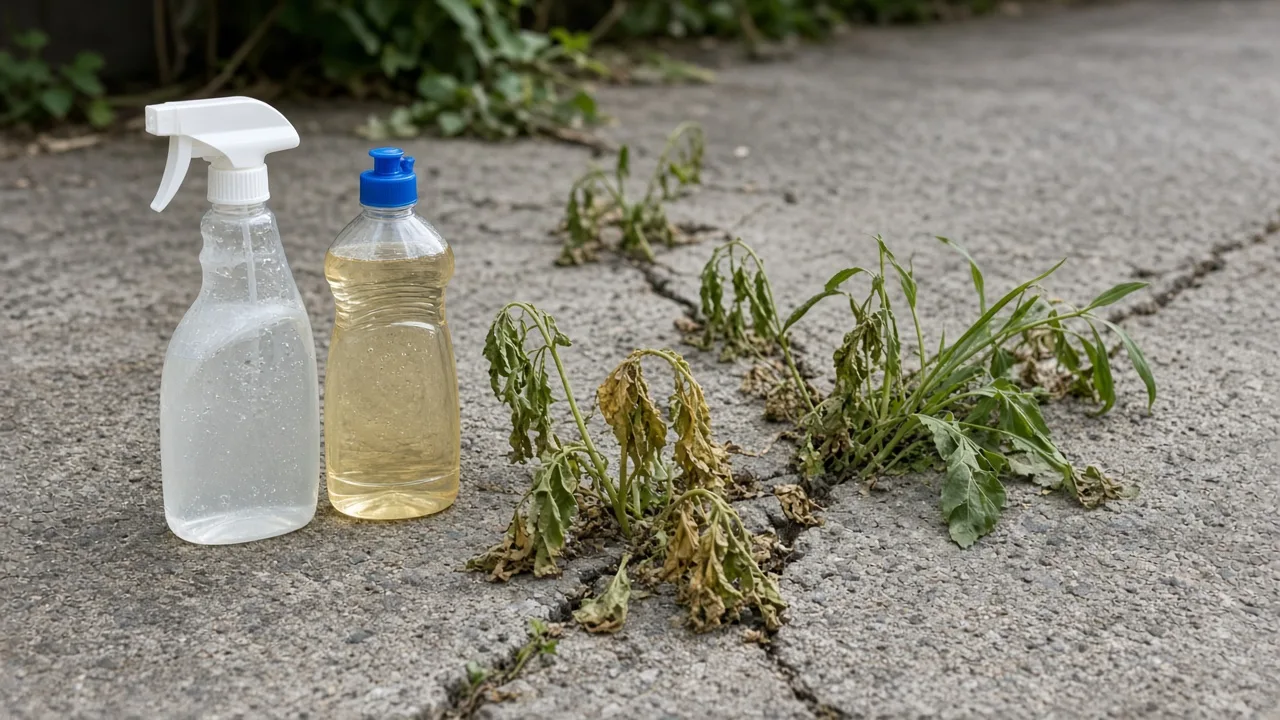
Yes, bleach can kill or badly injure weeds, especially young weeds whose leaves are thoroughly wetted. That quick brown-down is the reason the remedy keeps circulating. It is also the reason the remedy is misleading: a scorched top does not prove that a perennial weed’s crown, rhizomes, or deep roots are dead.
The better answer is not a bleach dilution. Household chlorine bleach is a nonselective, corrosive cleaner, not a universal garden herbicide. It can injure every green plant it touches, alter soil conditions, move with runoff, stain hardscape, and create a dangerous gas if mixed with another cleaner. The safest DIY solution for most home weed problems is site-specific removal followed by prevention, not a stronger bottle of bleach.
That distinction matters most when a weed is near a lawn, vegetable bed, tree, ornamental planting, storm drain, pond, or any soil you plan to use again. The NC State Extension description of nonselective postemergence herbicides makes the basic risk plain: these materials can injure any green plant they contact, so application has to be selective even when the product itself is not. (NC State Extension: Postemergence, Non-Selective Herbicides)
Short answer: yes, but do not use it as a routine herbicide
Bleach can make small weeds wilt, bleach out, and turn brown because sodium hypochlorite damages living plant tissue on contact. The visible effect may appear within hours or over the next few days, depending on the weed, weather, coverage, and strength of the product. That is a description of injury, not a promise of permanent control.
Household bleach varies by product, age, concentration, additives, and storage history. There is no universal “bleach weed-killer rate” that makes a homemade spray selective, reliably root-killing, or safe around desirable vegetation. Better Homes & Gardens reported a University of Florida Extension director’s blunt recommendation: keep bleach out of the garden because it is not labeled for weed control and can create more problems than it solves. (Better Homes & Gardens: Does Bleach Kill Weeds?)
If the weed is in a bed, lawn, container, or soil beside a planting, skip bleach. If it is in a pavement crack, start with a weeder or narrow knife and remove the crown; the fact that the surface looks separate from the garden does not mean water, roots, or soil particles are separate.
Why bleach appears to work
Bleach is an oxidizing disinfectant. When a spray coats a weed’s exposed green tissue, it can damage cell membranes and the leaf surface quickly enough to produce a dramatic collapse. A soft annual seedling with a small root system is more likely to disappear after that treatment than a mature perennial with a protected crown or underground runners.
This is the same visual trap that makes many contact weed treatments seem more powerful than they are. NC State Extension separates contact herbicides, which damage only the green tissues reached by the spray, from systemic herbicides, which move within the plant toward other growing points. Household bleach is not a carefully labeled systemic treatment for your particular weed, so do not assume that brown leaves equal a dead root system.
Coverage and timing also change the result. A hot, dry, sunny day may make foliage collapse faster, while rain can dilute or move the material before it has much effect. A weed tucked below a paving lip may survive because the spray never reaches the growing point, even if the leaves around it turn pale.
The practical test is what happens later. If green shoots return from the same crown or crack, the first application only removed top growth. Pulling the remaining crown, removing trapped soil, and closing the joint usually solves more of the problem than repeating a harsher household spray.
What makes bleach a bad weed killer
It is nonselective, so nearby plants are targets too
Bleach does not recognize the difference between a dandelion and a desirable seedling. Mist, splash, overspray, and runoff can mark lawn grass, scorch flower foliage, damage the lower leaves of shrubs, or injure roots where the liquid enters the soil. The risk is higher when weeds are threaded through ground cover, planted borders, or the edge of a vegetable bed.
This is not just a matter of being careful with the nozzle. Wind can carry droplets, a hose can move residue downhill, and a rainstorm can wash a hardscape application toward the very plants you were trying to protect. If you cannot isolate the target from living plants and from the path of water, a chemical spot treatment is the wrong first tool.
It can leave a soil and runoff problem
Bleach can change the conditions that make soil usable for plants. Reports from horticulture experts describe its alkalinity and salt residue as potential problems for soil pH, nutrient availability, and plant establishment. Homes & Gardens also warns that sodium hypochlorite can harm soil microorganisms and that runoff from paths, driveways, and patios can reach water systems. (Homes & Gardens: Does Bleach Kill Weeds?)
The “there is no soil on a patio” argument is incomplete. Paver joints contain dust, sand, organic debris, and roots, and the edge of a patio usually meets a lawn or bed. Rainwater does not stop at the property line between concrete and soil; it follows slope, joints, gutters, and drains. A treatment that is technically confined to a crack can still become a runoff problem after the next storm or rinse.
Do not try to neutralize the area by adding vinegar, fertilizer, salt, or another cleaner. Layering household chemicals creates new risks without restoring a damaged root zone. If a garden bed was accidentally soaked, stop adding products, keep people and pets away from wet residue, and follow the bleach container’s first-aid and disposal directions.
It may stain surfaces without solving the root problem
Bleach can discolor porous paving, affect nearby metals, and leave a pale or uneven mark that is more visible after the weeds are gone. The exact result depends on the surface, its sealant, the product, sunlight, and dwell time, so a small hidden test is not a guarantee for an entire patio.
More importantly, the surface may look clean while a perennial crown remains in the joint. New soil collects in the same crack, wind brings new seed, and the next wet spell creates another flush. Removing the plant and repairing the joint addresses the place where the weed keeps getting established instead of only burning the leaves you can see.
Where people are tempted to use it—and the safer boundary
Bleach seems most tempting between pavers, along a driveway edge, or in a sidewalk seam because these spots are difficult to reach with a hoe and are not meant to grow plants. A hardscape crack can be a reasonable place for a targeted weed-control product only when that product is labeled for the surface and site, the application can be kept away from desirable plants, and runoff will not reach a drain or waterway.
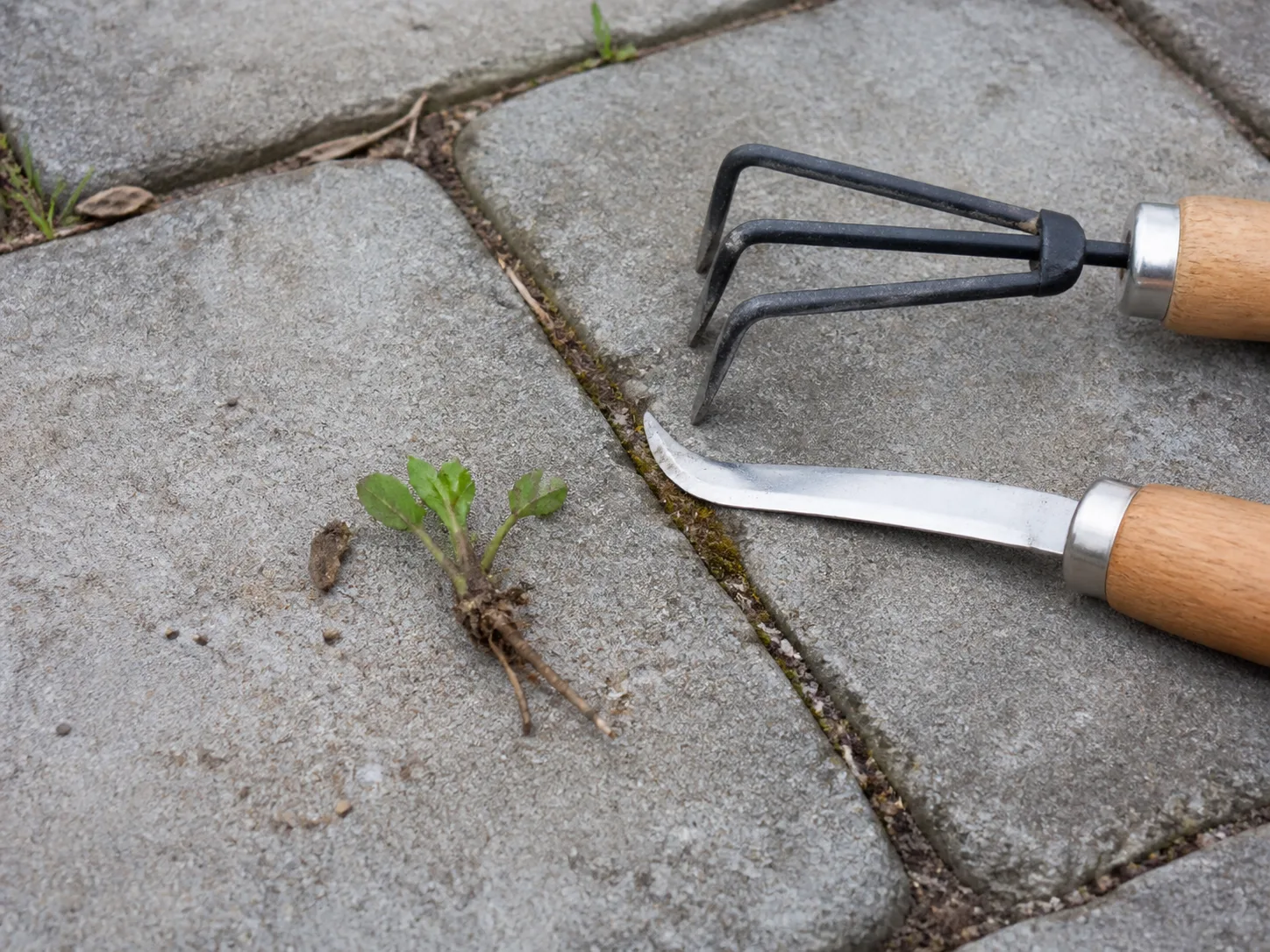
For a few weeds, mechanical removal is usually faster overall. Slide a narrow weeder into the joint, loosen the crown after the soil is damp, pull out the whole plant, and sweep the loose soil away. This also lets you see whether the crack is holding a thick mat of roots, a woody stem, or a runner that will need more than one pass.
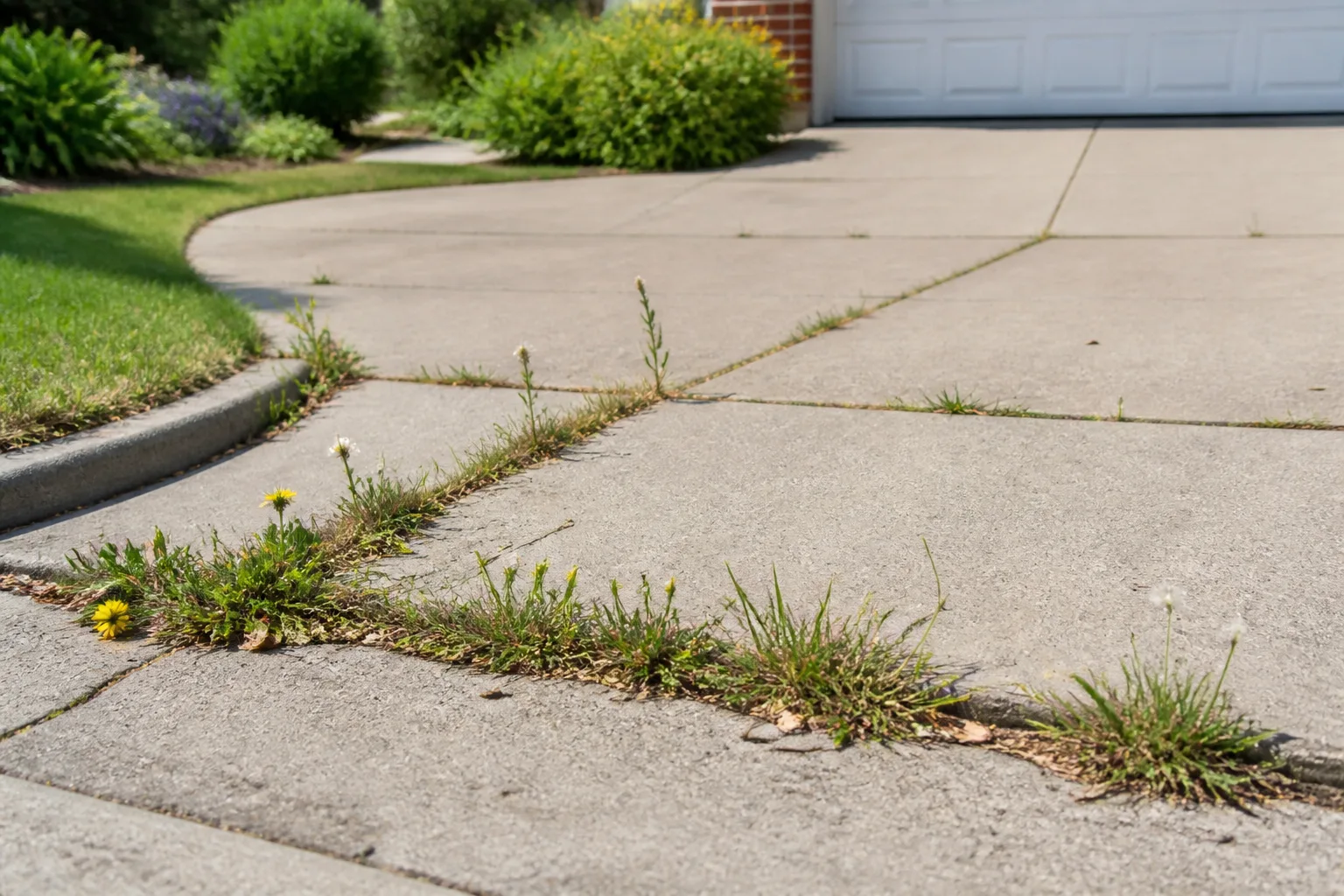
If a weed is growing beside a downspout, at the bottom of a slope, over a drain, near a pond, or beside a planted border, do not use bleach there. The right boundary is not “pavement versus garden”; it is whether you can control contact and contain the water after treatment.
Do not mix or spray bleach in the garden
Never mix household bleach with vinegar, ammonia, acids, toilet cleaners, or any other cleaning product. The CDC warns that household chlorine bleach can release chlorine gas when mixed with certain cleaners and says not to mix household cleaners. (CDC: Chlorine Chemical Fact Sheet)
That warning includes improvised “stronger” weed-killer formulas. A spray bottle, funnel, measuring cup, or garden sprayer that held another product may contain residue, and adding bleach does not make the container safe. Use household bleach only as directed on its own product label, with the ventilation and protective measures the label specifies.
Do not pour leftover bleach solution onto soil, a compost pile, a drain, or a ditch. Do not spray on a windy day, before rain, or where irrigation will carry it into a bed. If the goal is weed control, use a product whose label actually covers that job, or choose a physical method that cannot leave a chemical residue behind.
What to do if bleach hits a desirable plant
Act quickly, but do not create a second exposure while trying to fix the first. If spray lands on leaves, rinse the foliage thoroughly with clean water; if concentrate or a large amount lands in soil, prevent the liquid from moving toward a bed, drain, pond, or edible crop and follow the product label for cleanup. Do not scrub leaves, add vinegar, or pour another chemical over the area.
The damaged leaves may develop pale patches, brown edges, or collapse over the following days. You cannot rinse away tissue injury that has already occurred, so avoid pruning immediately unless a branch is broken or the label or a professional diagnosis calls for removal. Keep watching the newest growth and the soil moisture instead of assuming that every later yellow leaf came from a nutrient deficiency.
For skin or eye contact, use the first-aid directions on the product label and flush with plenty of clean water. If fumes were produced, move away from the area and seek emergency or poison-control guidance rather than trying to identify the gas yourself. The CDC chemical-safety guidance is the right level of authority for exposure decisions; a gardening recipe is not.
A safer quick plan for pavement weeds
Remove the top growth and root crown
Choose a cool, calm period when the joint is slightly damp but not actively running with water. A narrow weeding tool, old butter knife reserved for garden use, or joint scraper can loosen a small weed without broadcasting a household chemical across the surface. Wear gloves and eye protection if the joint contains sharp gravel, splinters, or unknown debris.
Work from the outside of the crown inward and lift the plant rather than tearing off only the leaves. For grasses, find the tight base where the leaves emerge; for broadleaf weeds, loosen below the crown and pull steadily. If a long root snaps, remove what you can and mark the spot for a follow-up check rather than flooding the joint with a new product.
Treat regrowth only with a labeled product
If a tough perennial keeps returning and hand removal is impractical, identify the weed and read the entire label of a product registered for your location and intended surface. Look for the site, target weed, application method, weather restrictions, protective equipment, reentry instructions, and warnings about nearby plants or water.
NC State Extension notes that contact products are better at rapidly injuring small annual weeds, while systemic products can be more useful for some established perennials because they move within the plant. That does not make any herbicide automatically safe; it gives you a reason to match the product’s mode of action and label to the weed instead of substituting bleach because it is already under the sink.
Keep the spray as close to the target as the label permits. Do not use a lawn herbicide on a patio, a farm or nursery rate in a home garden, or a product with an unlisted household mixture. Penn State Extension emphasizes that registrations can change and that pesticide users are responsible for reading and following the current label. (Penn State Extension: Controlling Weeds in Nursery and Landscape Plantings)
Repair the crack and reduce new seed sources
Once the plant and loose roots are out, sweep the joint clean and let it dry. Repair a widening mortar joint, replace missing polymeric sand where appropriate for the surface, or use a compatible crack-filling method recommended for the paver or concrete system. A repair that keeps water and windblown soil from collecting will do more for long-term control than another round of leaf burn.
Also remove the seed sources around the hardscape. Mow or hand-pull flowering weeds before they shed seed, trim vegetation that leans over the joint, clear leaves from low spots, and correct a downspout or irrigation pattern that keeps one seam wet. Penn State Extension describes weed management as a combination of prevention, physical removal, and carefully chosen chemical control because no single method handles every weed, season, and site.
Choose the alternative by site
For vegetable beds and flower borders
Use hand-pulling, a hoe on small seedlings, shallow cultivation that does not disturb plant roots, and mulch applied to weed-free soil. Organic mulch can block light and slow new seedlings, but keep it away from plant stems and avoid burying crowns. Penn State Extension notes that mulch works best against weeds germinating near the surface, while established perennial weeds can grow through it and still need removal.
Water the crop root zone rather than the entire empty bed when practical. Drip irrigation or a soaker hose will not eliminate weeds by itself, but it reduces the broad wetting that helps new seedlings establish. Dense, healthy plantings can shade soil over time; bleach cannot make that ecological improvement and can damage the plants you want to keep.
For lawns
Never spot-spray bleach into a lawn. It can damage turf as readily as it damages broadleaf weeds, and it offers no reliable selectivity between the weed and the grass. Begin by identifying the weed, mowing at the correct height for the turf, improving density, and correcting thin or compacted areas that leave bare soil available for new seedlings.
If a chemical treatment is needed, choose a product labeled for the specific turf species and weed, then follow the label’s temperature, rain, irrigation, and reentry instructions. A lawn product is formulated and tested for a use pattern that a bottle of household bleach was not. When the weed is widespread or the turf is valuable, a local extension office or qualified lawn professional can prevent a costly misapplication.
For pavers, driveways, and sidewalk cracks
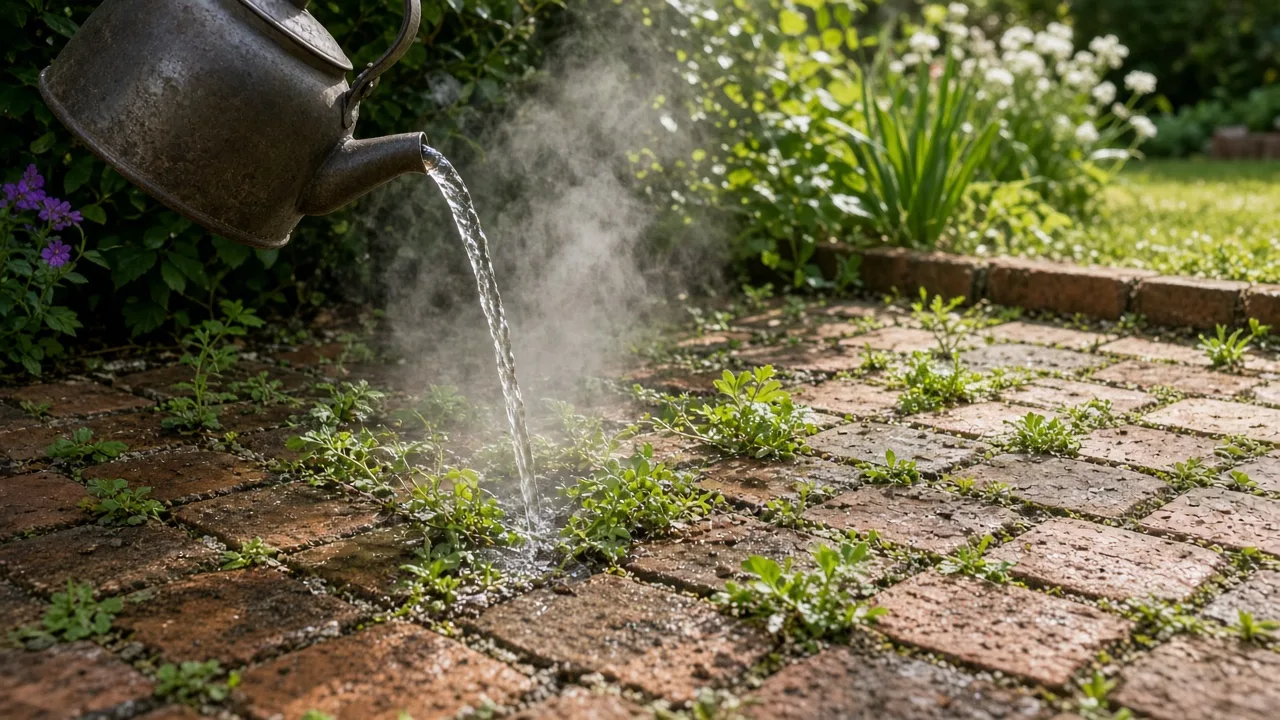
Start with the physical method because the target is usually small, visible, and accessible. A weeding knife, narrow scraper, stiff brush, or hand pull can remove the plant without putting a cleaner into soil or stormwater. Boiling water is another limited option for isolated weeds in hardscape cracks, but it can burn nearby plants, scald people, damage some surfaces, and only works where the heat reaches the plant; use it deliberately, not as a broadcast treatment.
For a large infestation, repair the joints and consider a labeled hardscape treatment only after checking the exact site on the label. Keep any treatment away from planted edges, collect or direct runoff responsibly, and avoid applications before rain. The goal is a clean, stable surface, not a chemically sterilized strip that becomes a new problem every time water moves across it.
How to decide whether a weed needs stronger control
Ask four questions before reaching for any spray. First, is the weed young and isolated, or mature and connected to a deep root, rhizome, stolon, or woody crown? Second, is it in pavement, a lawn, a planting bed, or a container? Third, can the treatment be kept away from desirable plants and water? Fourth, does the product label name that site and target?
Hand removal is usually the best answer when there are only a few seedlings, when the weed is tangled with a desirable plant, or when the site drains toward a pond or storm inlet. Mulch and planting density are better long-term tools in beds. Lawn-specific care or a labeled selective herbicide makes more sense in turf, while a persistent pavement perennial may justify a carefully chosen labeled treatment after its identity is known.
The more difficult the weed, the more important identification becomes. A dandelion, crabgrass, nutsedge, bindweed, and a woody seedling do not share the same root system or response to a contact spray. If you cannot identify the plant, photograph its leaves and growth habit, ask a local extension service, and avoid escalating from bleach to a random herbicide while you are still guessing.
Fast browning is not the same as good weed management. A good result is a target removed without collateral damage, a surface or soil left usable, and a prevention step that makes the next flush smaller.
Conclusion
Bleach can kill or scorch weeds, but that does not make it a good DIY herbicide. It is nonselective, its apparent speed can hide perennial regrowth, and its runoff, soil, plant, surface, and mixing risks outweigh the convenience of using a cleaner that is already at home.
For a few weeds in a pavement crack, remove the crown, clean the joint, and repair the place where soil collects. In a bed or lawn, use hand removal, mulch, irrigation and planting improvements, or a product labeled for that exact site and weed. That approach may look less dramatic than a bleach spray, but it is faster to recover from, easier to repeat safely, and much more likely to solve the problem rather than move it downstream.