12 Drought-Tolerant Trees for Dry Yards
Compare 12 drought-tolerant trees by climate, mature size, and water needs, including the extra care every new tree needs before it is established.
A drought-tolerant tree can make a yard more resilient, but no tree can be planted in dry ground and expected to thrive without water. Drought tolerance describes how a tree handles dry weather after it has grown a functional root system; it does not describe the weeks or months immediately after planting. That distinction changes which tree you buy, where you plant it, and how much you can expect to reduce irrigation.
The best choice depends on where you live. A prairie oak that tolerates cold winters and summer drought may fail in a humid coastal yard with saturated soil, while a desert willow can flower beautifully in the Southwest and struggle through a hard northern winter. Use the trees below as climate-matched candidates, then confirm local suitability with your county extension office or native-plant organization before buying.
What “drought-tolerant” really means
Tree tags often use “drought-tolerant,” “drought-resistant,” and “low-water” as if they mean the same thing. In practical gardening, these labels usually mean a tree can use less supplemental irrigation once established, not that it is invulnerable to heat, water restrictions, or months without rainfall. A Gardening Know How guide to drought-tolerant trees makes the important point that all trees need water and that regionally adapted native trees are usually better choices than species imported from a different climate.
There are degrees of tolerance. Strong drought specialists come from dry-summer, prairie, or desert habitats and can often rely mostly on rainfall after establishment. Moderately drought-tolerant trees can withstand a dry stretch but may still need a deep soak during extended heat or drought. The Gardenia guide to low-water trees separates trees into these two practical groups, which is more helpful than treating every species as equally drought-proof.
Even two trees of the same species can perform differently in different soil. A tree planted in deep, well-drained loam with room for roots may cope with dry weather much better than one boxed into compacted soil under pavement. A Utah State University Extension discussion of dry shade explains a common mismatch: many plants adapted to drought are also adapted to sun, so moving them into shade does not automatically solve a water problem.
Choose a tree for your region, soil, and yard
Start with climate, not a national “best tree” list. Check winter cold, summer heat, average rainfall, and whether your dry spells arrive in summer or winter. Then match the tree to soil drainage, sunlight, and the amount of root space available. Hardiness zones help estimate winter survival, but they do not tell you whether a tree tolerates months of summer drought, alkaline soil, humid summers, or waterlogged roots.
Regional extension lists can narrow the choices. Penn State Extension’s heat- and drought-tolerant plant list includes trees such as hackberry, green hawthorn, honeylocust, Kentucky coffeetree, and sassafras for its regional conditions. University of Delaware Cooperative Extension identifies drought-tolerant shade trees including hackberry, ginkgo, honeylocust, Kentucky coffeetree, and scarlet oak. These lists are useful starting points, but they are not interchangeable with a local planting plan.
Think about mature size before you plant. A 70-foot shade tree may be an excellent water-wise choice on a large lot and a poor choice under power lines or beside a foundation. Small flowering trees offer less shade but can fit a courtyard, street edge, or front yard. Also check whether a species is native or behaves aggressively in your area; climate fit matters as much as a plant’s ability to survive dry soil.
12 drought-tolerant trees by climate and landscape
The following trees range from tough, wide-ranging shade trees to smaller plants suited to hot, dry regions. Some are strong drought specialists once established; others are better described as moderate choices that can handle dry spells but still appreciate water in a prolonged drought. “Low-water” should never be read as “no-water,” especially in the first years.
Bur oak
Bur oak (Quercus macrocarpa) is a long-lived North American shade tree suited to large yards, parks, and open sites. It is a strong choice for cold winters and hot summers, and its deep-rooting habit helps mature trees reach moisture below the surface. It can grow very large, so plan for a broad canopy and do not place it where a future trunk or root zone will conflict with paving, utilities, or a small foundation bed.
Bur oak is a better drought choice than many ornamental maples, but it is not an instant shade tree or a zero-irrigation transplant. Give a newly planted oak a broad, mulched root zone and water it during dry periods while roots expand. The Gardenia drought-tolerant tree guide includes bur oak among its stronger low-water choices; local extension advice can help confirm whether it fits your region and soil.
Kentucky coffeetree
The Kentucky coffeetree (Gymnocladus dioicus) is a large deciduous tree native to the central and eastern United States. Its bold branching, large compound leaves, and open canopy suit broad lawns and parks, while its tolerance of varied conditions makes it a useful choice where some shade trees struggle. University of Delaware Extension lists it among drought-tolerant shade trees and gives a mature size of roughly 60 to 70 feet; Penn State Extension also includes it on its regional heat- and drought-tolerant list.
Give it room to grow and be prepared for its seasonal cleanup. Female trees can produce large seed pods, so ask a local nursery about sex or cultivar if pods would be unwelcome. A large tree needs an equally large root zone; a cramped tree well surrounded by hot pavement will not behave like one growing freely in open soil. Once established it is resilient, but water it consistently through early establishment.
Common hackberry
Common hackberry (Celtis occidentalis) is a durable native shade tree for the Midwest, Plains, and parts of the eastern United States. It tolerates urban conditions, a range of soils, and dry spells once established, making it useful for a large lawn or street-side planting where a more delicate tree may need frequent attention. University of Delaware Extension lists hackberry among its most drought-tolerant shade trees, and Penn State Extension includes it on its heat- and drought-tolerant tree list.
Hackberry is not a tidy, compact specimen for a small patio. It can reach 40 to 60 feet and may develop insect or disease issues depending on local conditions. Choose a locally recommended cultivar and give it enough root space; if you want a narrow evergreen screen or a decorative flowering tree, this broad-canopied native is not the right form even if its toughness is appealing.
Thornless honeylocust
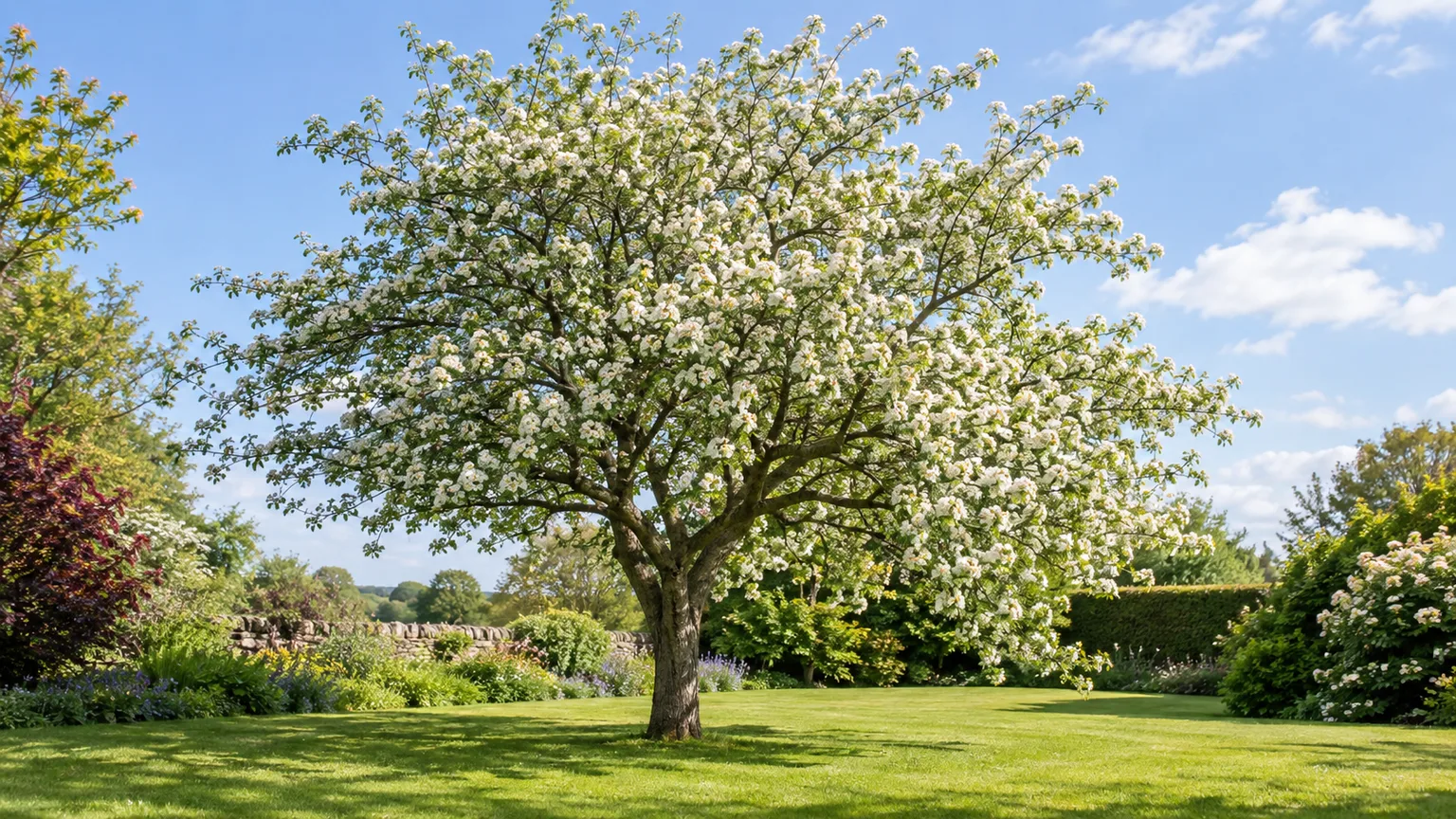
Thornless honeylocust (Gleditsia triacanthos var. inermis) is a large, airy shade tree whose fine leaves let dappled light through. It can be a practical choice for a hot lawn or urban yard because it handles heat and periods of dry soil after establishment. Both Penn State and Delaware Extension include honeylocust among trees selected for heat or water conservation, while an Epic Gardening profile of drought-tolerant trees emphasizes the value of choosing a thornless form.
Check the mature cultivar rather than assuming all honeylocusts are identical. Some forms spread broadly, and pod production can vary. Plant it where its canopy has room to develop, and keep the root zone free of turf competition while it gets established. Its open shade is useful where a dense canopy would make the yard too dark, but it does not replace a compact ornamental tree in a narrow planting strip.
Green hawthorn
For a small yard, consider green hawthorn (Crataegus viridis ‘Winter King’). It is a much smaller flowering tree than the big shade trees in this list, with spring flowers and persistent fruit that can add seasonal interest and support wildlife. Penn State Extension specifically lists this cultivar as a heat- and drought-tolerant tree, and GardeningEtc’s drought-tolerant tree guide notes that hawthorn can handle dry soil once its roots are established.
Hawthorns are not thorn-free by default, and their mature size and thorniness vary by species and cultivar. Check the plant label and ask whether the cultivar is suitable near a path or play area. Give it regular water during its first year, then reduce irrigation as roots establish; during a very long drought, a deep soak can protect flowers and fruit production better than letting the root zone become bone dry.
Jack pine
Jack pine (Pinus banksiana) is a cold-hardy evergreen associated with dry, sandy, nutrient-poor soils in northern regions. It can suit a sunny, low-water site where a pine is a better fit than a broadleaf shade tree. The broader pine family includes species that use water efficiently, but pines differ sharply in soil and climate requirements; choose a locally native species rather than assuming any pine will thrive in a dry garden. Gardening Know How’s drought-tree overview also advises matching pine and other upland species to local conditions.
Jack pine is a poor pick for a hot, humid southern yard or compacted urban soil. It wants sun and room, and its natural form can be irregular rather than the symmetrical evergreen some homeowners expect. If you want a neat screen, compare local junipers or another regionally adapted conifer with a predictable mature width before planting.
Eastern red cedar
Eastern red cedar (Juniperus virginiana) is not a true cedar; it is a juniper, and it is one of the tougher native evergreens for dry, sunny sites in much of eastern and central North America. It can work as a specimen, windbreak, or screen when the mature width fits the property. Delaware Extension includes eastern red cedar in its evergreen selection for water conservation, and the Gardenia guide also places it among the more drought-tolerant trees.
Its adaptability can be a drawback if it spreads into natural areas where it is unwanted. Check whether it is native and appropriate in your county, and do not plant it where it could crowd out open grassland or conflict with local land-management goals. As with other evergreens, keep a new tree watered through its first dry summer; winter foliage continues to lose moisture even while growth slows.
Arizona cypress
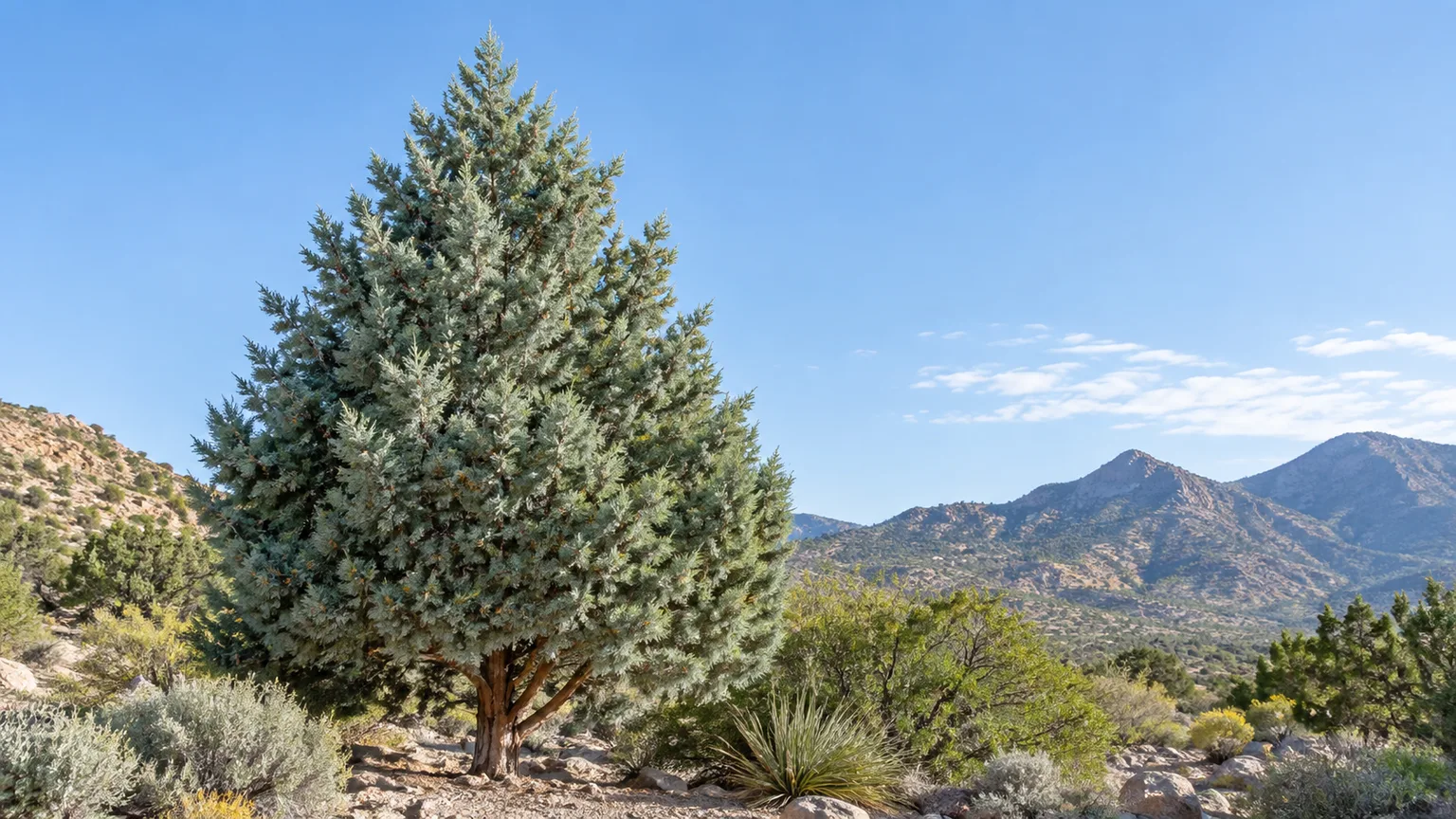
Arizona cypress (Cupressus arizonica) is a strong option for hot, dry landscapes in the Southwest and other mild-winter regions. Its blue-green evergreen foliage and conical form give year-round structure, while the species is better adapted to dry air and lean, well-drained soil than many moisture-loving conifers. The Gardenia tree guide includes Arizona cypress among its drought specialists; the plant is not interchangeable with every cypress sold at a nursery, so check the botanical name and cultivar.
Do not plant Arizona cypress in a low spot where water pools around roots or in a cold, wet climate simply because it is labeled drought tolerant. Give it full sun, good drainage, and enough room for its mature canopy. Its drought adaptation is useful after establishment, but a newly planted cypress still needs regular root-zone moisture until it can grow beyond the nursery root ball.
Desert willow
Desert willow (Chilopsis linearis) is a small deciduous tree for hot, dry climates of the Southwest. It is not a true willow; its narrow leaves and trumpet-shaped flowers create a light, open canopy suited to a courtyard, patio edge, or water-wise garden. The Gardenia guide classifies desert willow among its more drought-tolerant trees, but local climate remains decisive: it is not a choice for regions with hard, prolonged winter freezes.
Plant it in full sun and fast-draining soil. Its relatively open crown gives less dense shade than an oak, and flowering can slow under severe drought stress, so a deep soak during an unusually long dry spell may help it recover. Expect seed pods and some leaf drop as part of its seasonal cycle rather than treating every dropped leaf as a water emergency.
Blue palo verde
Blue palo verde (Parkinsonia florida) is a desert-adapted small tree for hot, dry parts of the Southwest. Its green trunk and branches can photosynthesize when it sheds leaves during stress, an adaptation that helps it conserve water. It offers filtered shade and bright spring flowers, but it has a more open, sculptural shape than a conventional lawn shade tree. Gardenia lists palo verde among its true drought-tolerant trees.
This is a regional specialist, not a universal low-water tree. Choose it only where winters, soil drainage, and summer heat suit the species, and be aware that stems can be thorny. The tree’s sparse canopy is part of its adaptation to an arid landscape; if you need deep shade over a large seating area, choose a different form rather than expecting a desert tree to provide the same coverage as an oak.
Crape myrtle
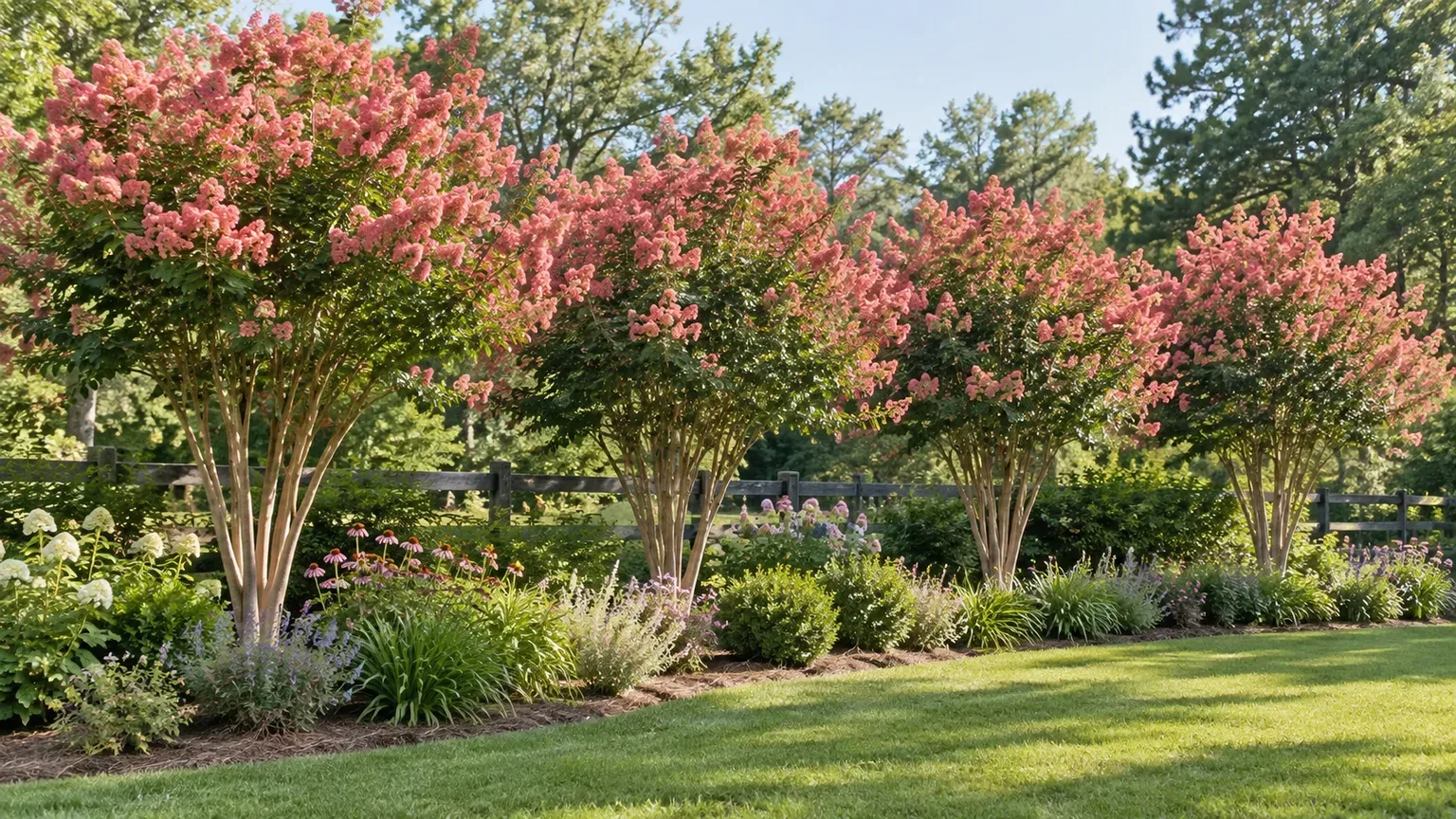
Crape myrtle (Lagerstroemia species and hybrids) is a heat-loving small tree that flowers through summer in warm regions. The botanical name is not the same as the one sometimes repeated in garden lists: crape myrtles belong to Lagerstroemia, not Gymnocladus. Choose a cultivar with winter hardiness proven in your area, since varieties differ in mature height, flower color, and cold tolerance. Epic Gardening’s reviewed tree guide describes crape myrtles as needing water to establish before irrigation is reduced.
Crape myrtle is a moderate drought choice, not a plant to leave dry from the day it goes into the ground. It performs best with full sun and well-drained soil, and hot, humid regions may still require occasional deep watering in a prolonged dry spell. A dwarf cultivar can fit a small garden, while a tree-form cultivar needs more canopy room. Avoid pruning it into a hard, repeatedly cut stump to control a size that is too large for the site.
Eastern redbud
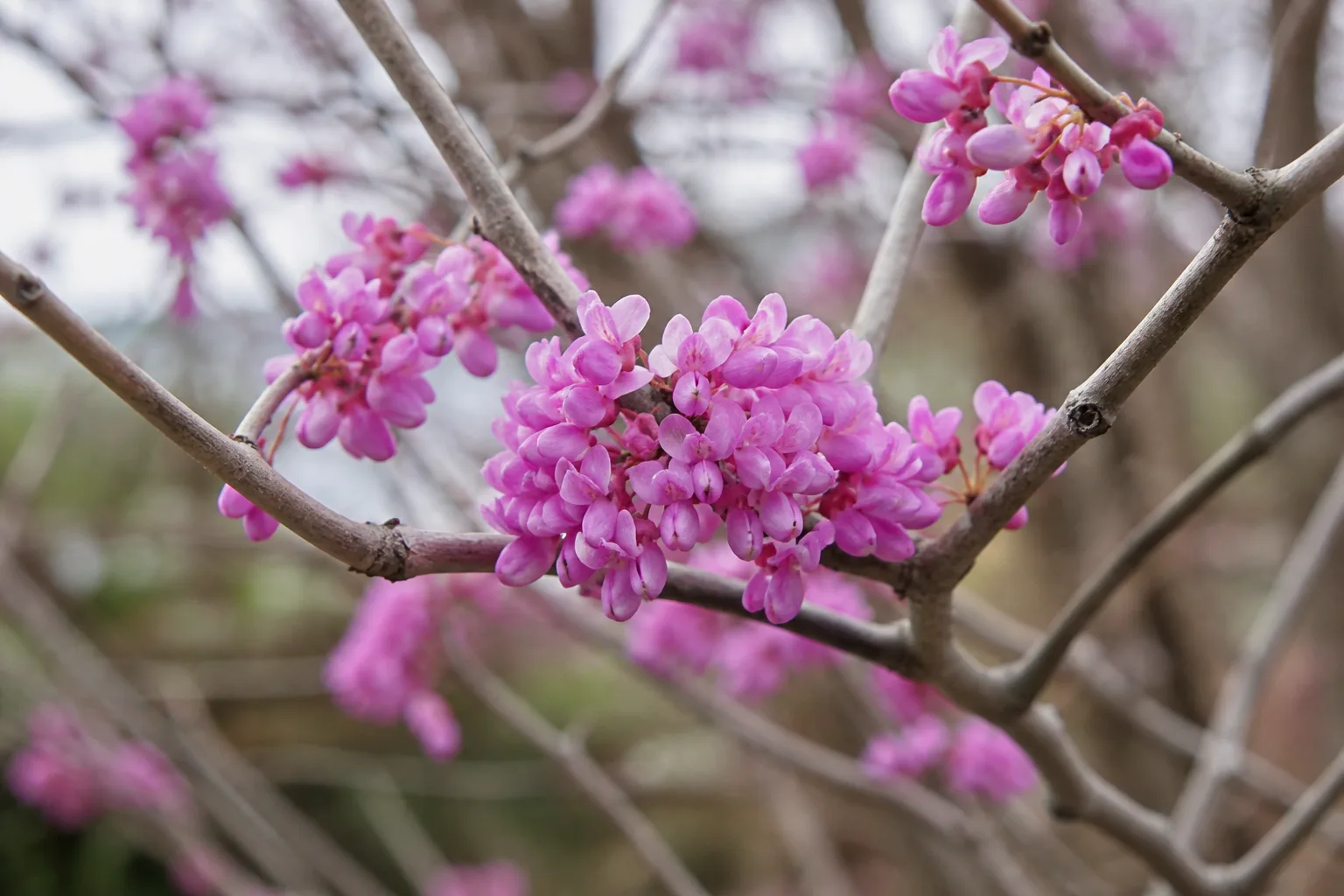
Eastern redbud (Cercis canadensis) is a small understory tree valued for pink-purple spring flowers and heart-shaped leaves. It works well in an eastern or central yard that needs a compact ornamental tree rather than a large canopy. It can handle some dry weather once established, but it is a moderate choice: prolonged drought, reflected heat, and shallow soil can scorch leaves or reduce flowering. A reviewed Epic Gardening redbud profile notes that the American redbud belongs in eastern regions, while the western redbud is a better regional fit along parts of the West Coast.
Plant redbud where it receives sun or light shade and where roots can spread into unpaved soil. Water the root ball consistently during its first growing seasons and do not wait for severe wilting before helping it through an extended dry period. The existing image library includes a landscape profile of the flowering eastern redbud; use that to judge its smaller scale beside the taller shade trees above.
Give a new tree a careful first two years
The first years are when a supposedly low-water tree is most vulnerable. Nursery trees have a root system confined to a pot or root ball, and it takes time for new roots to move into surrounding soil. A species that needs little supplemental water as a mature tree may still need consistent moisture while it establishes. A one-time soak on planting day is not enough if the following weeks are hot, windy, or rain-free.
Water slowly and deeply at the root ball so moisture reaches the roots rather than running off the surface. Check the soil before watering: if it is still damp below the surface, wait; if the root ball is dry, soak it and check again later. Sandy soil dries quickly, clay may hold water longer, and container-grown root balls can dry at a different rate from the surrounding native soil. Adjust to those conditions instead of following a rigid daily schedule.
Spread two to three inches of organic mulch over the root zone to slow evaporation and reduce competition from turf. Keep it several inches away from the trunk so bark stays dry and visible. Avoid “volcano” piles; mulch should widen across the ground, not bury the trunk flare. Local drought guidance from Garden Style San Antonio recommends applying water around the root ball and beneath the canopy rather than wetting the trunk, a useful reminder for both new and mature trees.
Water mature trees through a long dry spell
A mature drought-tolerant tree can still show stress during an unusually long heat wave. Look for early leaf curling, dull color, scorched edges, premature leaf drop, or a thinning canopy; these symptoms can also come from root damage, pests, or poor drainage, so check the site before assuming drought is the only cause. Newly planted trees should be prioritized over mature trees because their roots reach a smaller volume of soil.
When a mature tree needs help, water over the root zone rather than at the trunk. For a broad-canopy tree, that means moistening soil from near the edge of the canopy inward, not pouring a quick splash against the bark. Apply water slowly enough that it soaks in, and stop if the ground is saturated or water is pooling. Avoid fertilizer during severe drought, since it can push growth when roots and leaves are already short of water.
Water restrictions change what is possible. If your area limits irrigation, focus on trees that are young, recently transplanted, or visibly stressed, and follow local watering rules. A water-wise landscape is not maintenance-free; it is a landscape where species, soil, shade, and irrigation choices work together to lower routine demand.
Water-wise planting choices and mistakes to avoid
Choose a tree whose mature water needs and size fit the whole site, not just the hole you dig today. If your soil drains poorly, select a species that tolerates those conditions or improve a broader area before planting. Adding a small amount of compost to a single planting hole will not turn a water-loving tree into a drought specialist and can create a pocket with different drainage from the surrounding soil.
Find the root flare before setting the tree. Dig a hole wider than the root ball but no deeper, place the root flare at or slightly above grade, and backfill with the native soil unless a soil test or local extension recommendation says otherwise. A tree planted too deep may develop root and trunk problems that look unrelated to drought years later. Keep lawn and weeds away from the root zone so they do not compete for water while the tree establishes.
Group trees and plants with similar water needs together. A desert willow beside a moisture-loving hydrangea can lead to either overwatering or stress, while a small group of regionally adapted trees can share an irrigation zone. Shade itself can reduce soil evaporation, but roots from mature trees can also take up water quickly; do not assume that a spot under a canopy is automatically moist.
The biggest mistake is treating a drought-tolerant label as a promise that the tree needs no water. The label usually describes performance after establishment, and the establishment period may last more than one growing season. Keep checking moisture after planting, especially during a hot spell when rainfall misses the root ball.
Another mistake is choosing a tree from a different climate because it appears on a national list. Arizona cypress and blue palo verde are sensible candidates in parts of the Southwest, while a jack pine is for cooler northern sites and a crape myrtle fits warmer regions. A tree can be drought-tolerant in its native climate and still fail in an unsuitable hardiness zone, humid summer, heavy clay, or winter-wet site.
Do not ignore mature size, root space, and maintenance. Large trees need room away from pavement and utilities; some produce pods, fruit, thorns, or litter; some spread beyond the intended planting area. Nor should you overwater a tree simply because it is new—poor drainage and constantly saturated soil can suffocate roots. Match the species, water only when the root zone needs it, and mulch correctly.
Conclusion
A drought-tolerant tree is a climate-matched tree that can handle dry weather after it has established roots. Bur oak, Kentucky coffeetree, hackberry, honeylocust, and eastern red cedar offer resilient choices for many central and eastern landscapes; Arizona cypress, desert willow, and blue palo verde serve hot, dry Southwestern sites; flowering trees such as hawthorn, crape myrtle, and redbud bring smaller-scale options with different limits.
Choose for your region, soil, sun, and available root space, then water the tree carefully while it establishes. A low-water tree can reduce irrigation over time, but the right species and first-year care—not the label alone—are what help it survive a dry yard.