29 Flowering Succulents for Indoors and Outdoors
Compare 29 flowering succulents by bloom color, light, water, size, and indoor or outdoor fit, with honest notes on monocarpic plants and pet safety.
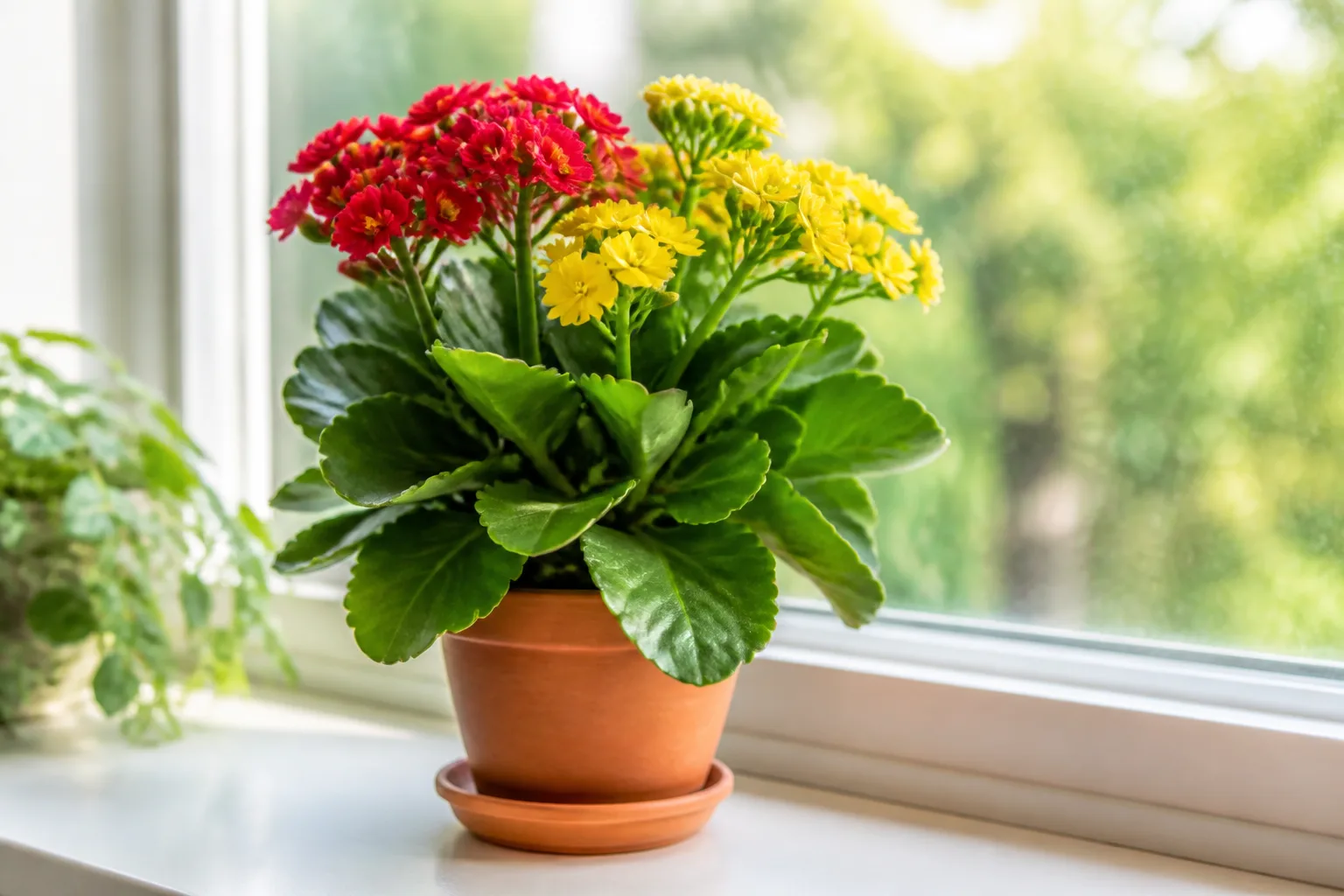
Succulents are not one uniform plant group, and their flowers are just as varied as their leaves. A kalanchoe can carry a long-lasting cluster of color indoors, a living stone can open one daisy-like flower from a two-lobed body, and an agave can spend years building toward one enormous bloom stalk. Cacti, holiday cacti, and a few semi-succulent vines belong in the conversation too, even though they do not all want desert conditions.
The most useful way to choose a flowering succulent is to start with the place you can provide, not the flower color you like. A sunny windowsill, a frost-free patio, a dry rock garden, and a humid summer climate call for different plants. The UF/IFAS guide to succulents also warns that common names such as “hens and chicks” can refer to several genera, so the scientific name on the label is part of the care information, not botanical decoration.
Choose a flowering succulent by location and bloom goal
Before buying, decide whether you want a reliable indoor display, a hardy outdoor carpet, a hanging plant, or a dramatic once-in-a-lifetime flower. Then match the plant to its light and winter limits. A succulent that survives a dim room may stay alive without ever receiving the energy needed to flower, while one that thrives outdoors in a dry climate may decline quickly in a rainy or freezing garden.
Best indoor bloomers and bright-window plants
For an indoor collection, start with Kalanchoe blossfeldiana, holiday cactus, Echeveria, Haworthiopsis, Hoya, and jade. These plants are widely grown in containers, but “easy indoors” does not mean “happy in a dark corner.” Put sun-loving rosettes close to the brightest window you have, use a grow light when winter daylight is weak, and give epiphytic holiday cactus and hoyas bright filtered or indirect light rather than harsh midday exposure.
If you want flowers during the darker part of the year, holiday cactus is a strong choice because its short-day response can be used to your advantage. A plant exposed to long, bright evenings from a lamp may delay flowering; a naturally dark room at night gives it a clearer seasonal cue. Kalanchoe is another good indoor candidate, especially when you want a compact plant sold in bloom, but it needs strong light and a dry-down between thorough waterings to stay healthy after the flowers fade. For a useful second opinion on indoor bloomers, Epic Gardening’s flowering-succulent overview compares light and watering patterns across a broad list.
Best outdoor, patio, and rock-garden performers
Warm, dry gardens open the door to Agave, Cape aloe, ice plant, stonecrop, Bulbine, moss rose, dragon fruit, crown of thorns, and Adam’s needle. These plants can make a hot border look lively without the weekly watering that thirsty annuals demand. They still need a rooting zone that drains quickly, and many are less tolerant of cold rain than they are of summer drought.
In a wet or humid climate, grow vulnerable succulents in containers or raised, gritty pockets rather than assuming a sandy label will overcome heavy soil. UF/IFAS specifically recommends containers as a way to control irrigation and soil in rainy Florida, and that logic applies to any site where rainfall outpaces evaporation. Use a pot with a drainage hole, keep it off a saucer of standing water, and shelter plants that need a winter dry period.
Small, trailing, and low-water curiosities
Living stones, Haworthiopsis, Tiger jaws, Echeveria, Mexican snowball, blue chalksticks, string of pearls, and trailing hoyas are useful when space is limited. They bring flowers at a smaller scale, but they are not interchangeable: Lithops has a very particular leaf-renewal and dormancy cycle, while a Hoya may want a brighter, warmer growing season and more regular moisture than a desert rosette.
For a hanging basket, choose a plant whose top growth also receives light. A trailing stem can look bright at the edge of a window while the crown sits in shade, producing long bare growth instead of flowers. Move the basket high enough to display it but not so far from the light that the source of new growth is hidden.
What makes a succulent flower?
Flowering is a maturity-and-season event, not a reward for keeping the soil wet. A plant needs enough stored energy to make a bloom, a light level that supports photosynthesis, and—depending on the species—a change in day length, temperature, or watering. A nursery plant in full flower may also be responding to commercial conditions that your home has not reproduced yet.
Light is the first bloom trigger
Most flowering succulents need more light to bloom than they need to merely remain green. Echeveria, ice plant, agave, many aloes, Portulaca, and most desert cacti prefer several hours of direct sun after a gradual acclimation. Hoya, holiday cactus, Haworthiopsis, and many forest cacti are safer with bright indirect light or gentle morning sun.
Increase light in stages when a plant has been indoors or shaded. Moving a pale, stretched succulent directly into hot afternoon sun can scorch tissue even though the long-term goal is brighter light. Watch the newest growth: compact spacing, stronger color, and a developing stalk are better signs than a rigid hour-count copied from another climate.
Water, season, and temperature must agree
Succulent leaves store water, but roots still need oxygen. Water thoroughly when the mix is dry enough for that species, let excess drain, and then wait for the appropriate dry-down. During active growth or bud formation, some plants need water more often than they do in winter; that does not mean the pot should stay constantly moist.
RHS profiles show the range clearly. Aeonium spathulatum is watered moderately in growth and not at all while dormant, while Senecio haworthii is kept barely moist in winter. Lithops is even more specialized: Savvy Gardening’s Lithops guide describes an autumn flowering period and a summer and winter slowdown when watering should be sharply reduced. Read the plant’s seasonal rhythm before reaching for a calendar.
Monocarpic succulents flower once, then continue through offsets
Some rosette-forming succulents are monocarpic, meaning an individual rosette flowers once and then dies. That is not the same as the whole clump disappearing. Agave often leaves pups or offsets, and Sempervivum produces chicks around the flowering rosette. The plant is completing its life cycle, not failing because you watered incorrectly.
The transition can look dramatic: a central stalk elongates, the rosette changes shape, and the original plant declines after seed production. Enjoy the bloom, keep the offsets growing, and remove a spent rosette only when it has clearly finished. RHS notes the same pattern for Rosularia chrysantha, whose individual rosettes die after flowering; it also recommends sharply drained soil and protection from winter wet.
29 flowering succulents with beautiful blooms
The list below is intentionally mixed, but each entry has a job. Use the notes to narrow the field by light, climate, size, and flowering behavior rather than treating every plant as an identical “low-water succulent.” Mature size and bloom timing vary by species, cultivar, pot size, and growing conditions.
Indoor-friendly flowering succulents
-
Flaming Katy (Kalanchoe blossfeldiana): This compact Madagascar succulent produces clusters of red, orange, yellow, pink, or white flowers and is one of the easiest flowering succulents to find in garden centers. Give it the brightest practical light, a porous mix, and a full dry-down before watering again. Cut spent clusters back to keep the plant tidy, but do not expect a new flush in a dark room.
-
Crown of thorns (Euphorbia milii): Its colorful bracts can appear for much of the year in warmth and strong light, while the thorny stems make it a better choice for a protected shelf than a child’s reach. Treat the milky sap and spines as safety issues, and use gloves when pruning or repotting. It needs excellent drainage and less water in cool, dim conditions.
-
String bean hoya (Hoya shepherdii): This trailing, semi-succulent hoya bears fragrant clusters of star-shaped flowers when mature. Give the vines bright indirect light, an airy mix, and a little more moisture during active growth without leaving the pot waterlogged. Avoid cutting off old flower spurs; hoyas can rebloom from them.
-
Desert rose (Adenium obesum): A swollen caudex and pink, red, or rose flowers make this a natural bonsai-style container plant. It needs a very bright, warm growing season and a sharply draining mix, then a much drier winter rest in climates where growth slows. Move it before frost, and remember that a dormant desert rose should not be treated like a thirsty tropical.
-
Orchid cactus (Epiphyllum and related hybrids): These epiphytic cacti produce large, dramatic flowers in many colors from flattened, arching stems. They prefer bright filtered light, an airy mix with more organic material than a desert cactus mix, and regular but controlled moisture during growth. Protect them from cold and from a pot that stays saturated.
-
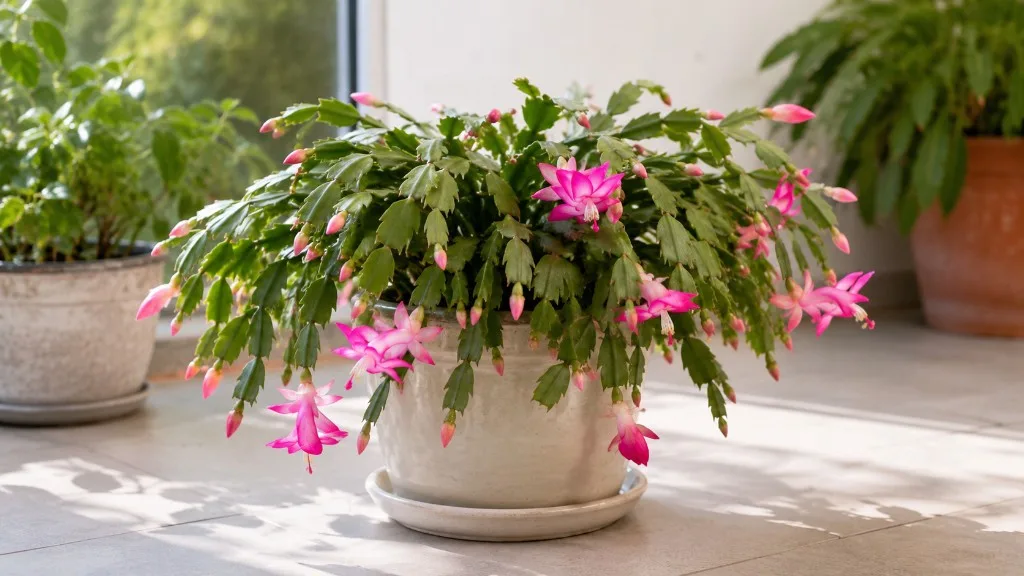
Christmas cactus (Schlumbergera): Flat segmented stems and winter flowers make it one of the most dependable indoor bloomers. Bright indirect light, even moisture while buds are forming, and long uninterrupted nights help it set flowers. Do not move it repeatedly once buds appear; sudden changes in light, temperature, or watering can cause bud drop.
-
Dwarf jade (Portulacaria afra): This small-leaved, branching succulent can produce delicate white or pink flowers when mature and grown in strong light. Let the mix dry before watering, prune after active growth rather than constantly pinching it, and be patient: a young indoor plant may spend years building the woody structure needed to bloom.
-
Echeveria: The familiar rosettes send up arching stalks of orange, pink, red, or yellow bell-shaped flowers. A bright south- or west-facing window or a grow light keeps the rosette compact and improves the odds of bloom, but acclimate gradually to direct sun. Water the soil, not the center of the rosette, because trapped moisture can encourage rot.
-
Mexican snowball (Echeveria elegans): This blue-green Echeveria forms offsets and sends up pink-to-yellow flowers above the pale rosette. It is an excellent small-container plant for a sunny window, provided the pot drains freely and the plant is not crowded in a wet decorative cachepot. Remove dead lower leaves so pests and moisture do not hide at the base.
-
Ghost plant (Graptopetalum paraguayense): Powdery gray rosettes can blush pink in stronger light, then produce small yellow starry flowers. It is forgiving of dry periods, but low light causes stretching and weakens the flowering display. Let the stems trail over a pot or rock edge, and propagate fallen leaves only after the cut end has callused.
-
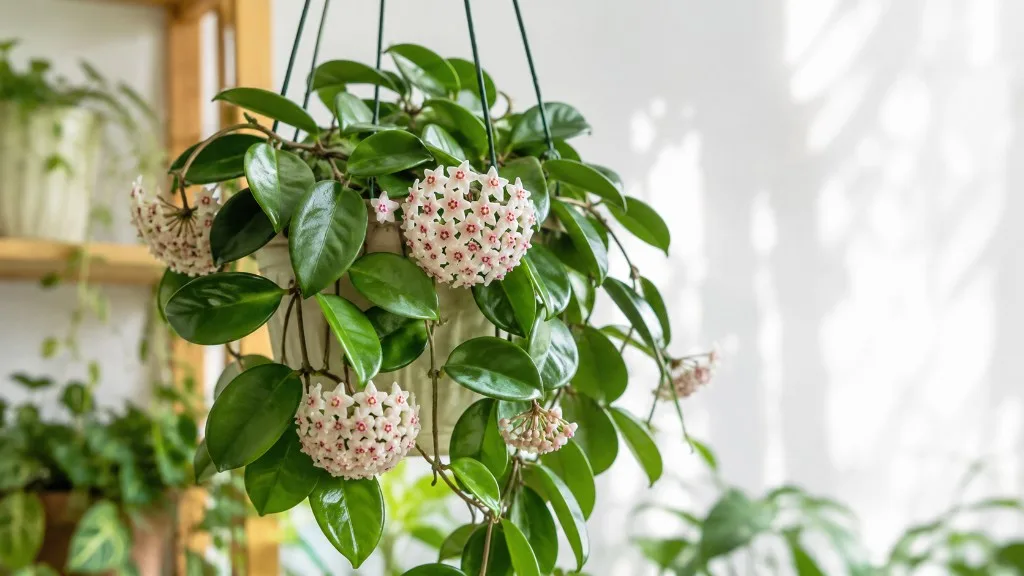
Hindu rope hoya (Hoya carnosa ‘Compacta’): Curled, waxy leaves and pink-and-white star flowers make this slow-growing vine a good hanging specimen. Bright indirect light, a chunky, fast-draining mix, and patience are more useful than frequent feeding. Keep the long flowering spurs intact, because new clusters can emerge from the same points.
-
Hoya kerrii: Heart-shaped leaves are the attraction before the plant produces pink or white starry flower clusters. It grows slowly, so a single rooted leaf may take a long time to become a flowering vine; buy a plant with a visible stem if flowers are a near-term goal. Bright light and a dry surface between waterings reduce the risk of root trouble.
-
Haworthiopsis attenuata (zebra plant): Small rosettes with white bands send up thin stalks of pale tubular flowers in bright spring or summer conditions. It tolerates brighter indirect light than many large rosette succulents and suits a small windowsill. Avoid baking it behind hot glass, and use a shallow pot only if the mix dries at a reasonable rate.
-
Flapjack (Kalanchoe luciae): Broad paddle leaves flush red at the edges in strong light, and mature plants produce a tall stalk of pale flowers. It is drought-tolerant but not wet-soil tolerant, so use a gritty mix and water deeply only after drying. The leaves are the show for most of the year; the flower stalk is a seasonal bonus.
-
Easter cactus (Rhipsalidopsis gaertneri): This epiphytic holiday cactus has flatter, more scalloped segments and spring flowers. Give it bright indirect light, a pot that drains freely, and more consistent moisture during active growth than a desert rosette would receive. A cool, stable period and shorter days can help initiate buds, but avoid a cold draft.
Outdoor and warm-climate flowering succulents
-
Cape aloe (Aloe ferox): A mature, tree-forming aloe sends up tall spikes of orange-red flowers and makes a strong focal point in a hot, dry landscape. It needs room, full sun, drainage, and protection from hard freezes. In a container, move it before frost rather than trying to keep a large aloe in a dim winter room.
-
Agave: Agaves offer architectural rosettes and, eventually, a towering flower stalk. Many are monocarpic, so the flowering plant will decline afterward, but pups may carry on the clump. Choose a species that fits your climate and mature width, and keep sharp leaves away from paths and play areas.
-
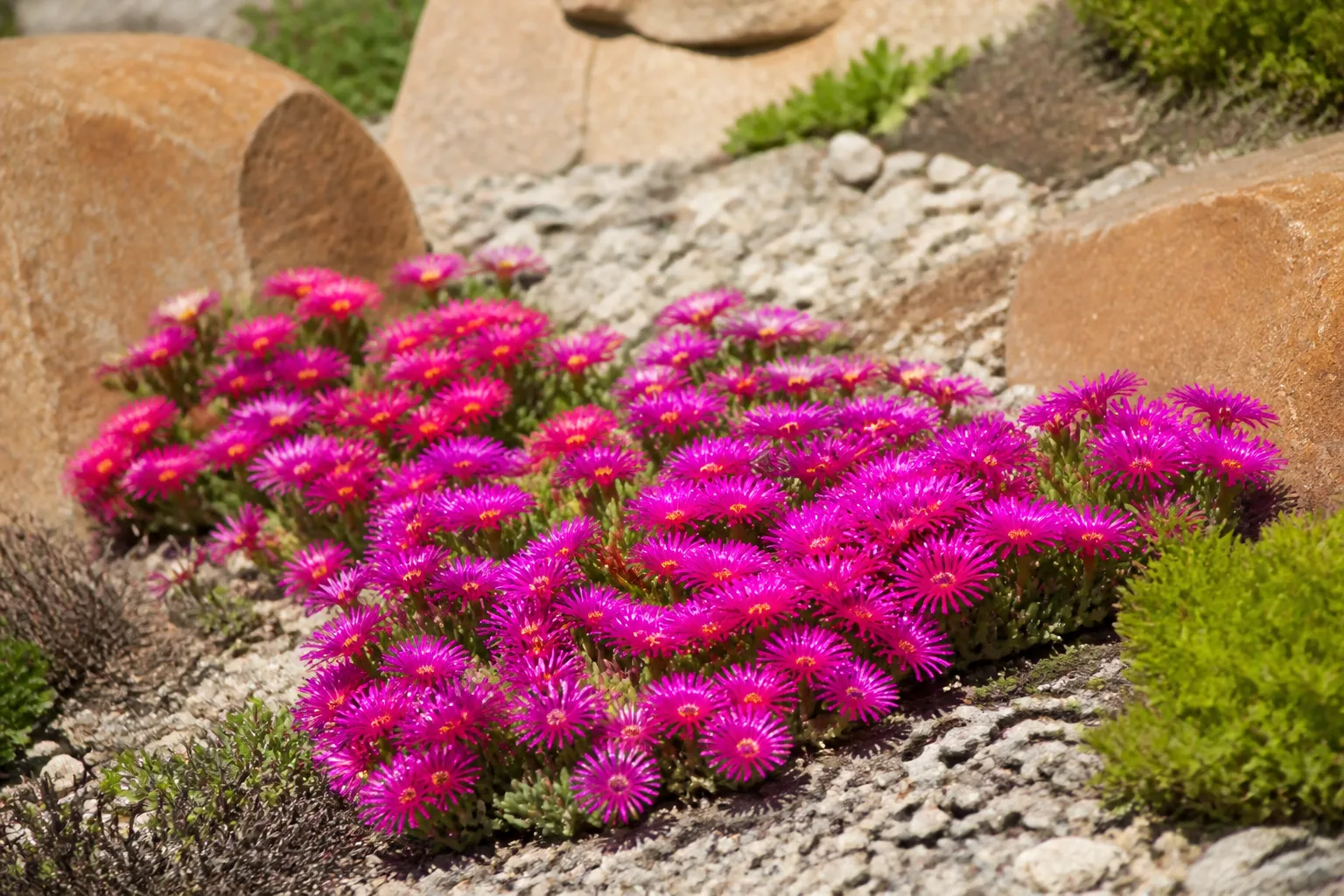
Ice plant (Delosperma): Low mats of fleshy leaves open vivid pink, purple, orange, or yellow flowers in bright weather. It is ideal for a sunny rock garden or a dry slope where water can escape quickly. Check winter hardiness for your cultivar, and do not plant it in a low pocket where cold, wet soil lingers.
-
Stonecrop (Sedum ‘Angelina’ and other flowering Sedum): Sedums range from low trailing mats to upright clumps with starry yellow or pink flowers. ‘Angelina’ is valued for chartreuse foliage and low ground-cover habit, while upright forms offer a stronger summer-to-fall flower display. Use the mature form to decide spacing; a mat and a clump need different places in the border.
-
Rainbow elephant bush (Portulacaria afra ‘Variegata’): Cream-edged foliage and reddish stems provide color even when the small flowers are absent. In warm climates it can become a shrub; elsewhere grow it in a container and shelter it from frost. Bright light brings better color, while overwatering in a cool room can quickly damage the roots.
-
Moss rose (Portulaca grandiflora): This low annual or short-lived perennial opens rose-like flowers in sun and handles poor, dry soil better than many bedding plants. It is an easy choice for a hot container edge, rock pocket, or summer window box. Flowers close in cloudy or late-day conditions, so a plant can look “flowerless” when the weather is simply not bright.
-
Bulbine (Bulbine frutescens): Narrow, grass-like foliage forms clumps topped with yellow or orange flowers, making Bulbine useful in hot borders and containers. It appreciates full sun and sharply drained soil, but can handle more regular moisture than many desert rosettes if the bed drains well. Cut old stalks to encourage a cleaner repeat display.
-
Adam’s needle (Yucca filamentosa): This rosette produces a tall stem covered with creamy white, bell-shaped flowers. It is a dramatic, drought-tolerant landscape plant for sun and well-drained soil, with fibrous leaf edges that deserve space from walkways. Remove old flower stalks after they finish, but do not strip healthy evergreen foliage.
-
Dragon fruit (Selenicereus undatus): This climbing cactus produces large, fragrant white flowers that open at night and may become fruit after pollination. It needs warmth, support, drainage, and protection from intense reflected heat in the hottest climates. Give it a trellis or sturdy post; a sprawling plant is harder to protect and pollinate than one trained upright.
-
Blue chalksticks (Curio repens, formerly Senecio serpens): Blue cylindrical leaves form a low, spreading carpet with small white flowers. Use it as a sunny container spiller or dry-climate ground cover, and let the mix dry before watering. It is a poor choice for heavy clay or a shaded, rain-soaked corner even though the plant looks nearly indestructible in photographs.
Tiny, trailing, and unusual flowering succulents
-
Living stones (Lithops spp.): Each plant looks like a pair of patterned pebbles, then produces a white, yellow, or orange daisy-like flower from the central fissure, often in autumn. Give it intense light, very fast drainage, and a species-appropriate watering cycle. Savvy Gardening emphasizes that summer and winter dormancy are normal; watering through leaf replacement or dormancy is a common way to lose Lithops.
-
String of pearls (Curio rowleyanus): Pea-shaped leaves spill from a hanging pot, and mature plants can produce small white flowers with a cinnamon-like scent. Bright morning light and a dry-down between waterings are more important than high humidity. Water at the soil surface rather than repeatedly misting the beads, and keep the plant where pets cannot chew it.
-
Tiger jaws (Faucaria tigrina): Triangular, tooth-edged leaves form compact rosettes topped by brilliant yellow flowers. It likes strong light and a gritty mix, but a gradual transition is still wise after a shaded nursery bench. The flexible “teeth” are more of a visual adaptation than a reason to handle the plant roughly.
-
Ox tongue Gasteria: Gasteria’s thick, spotted leaves and arching tubular pink, orange, or green flowers make it a better true succulent choice than the frequently misidentified plant sold under “ox tongue.” It handles bright indirect light, some morning sun, and a long dry-down between waterings. Use the botanical name when buying, because common names are especially unreliable in succulent displays.
Why a healthy succulent may not be flowering
Leaves can look attractive while the plant is still receiving too little light, growing in a container that stays wet, or moving through a seasonal rest. Diagnose the pattern before adding fertilizer. More fertilizer cannot compensate for weak light or damaged roots, and extra water often makes both problems worse.
Stretching, pale color, or a missing bloom stalk
Long gaps between leaves, pale new growth, one-sided leaning, and a rosette that opens widely usually point to insufficient light. Move the plant closer to the brightest window, rotate it, or add a grow light on a timer. Increase exposure gradually if the leaves have been shaded, and do not confuse a red stress color with proof that a plant is healthy or ready to flower.
If the plant is compact but still refuses to bloom, check age and season next. Jade, Hoya, desert rose, and many aloes need maturity; Lithops, Haworthiopsis, and Echeveria may flower on a different calendar than a holiday cactus. Some plants simply need another growth cycle before they have enough reserves.
Soft stems, yellow leaves, or soil that stays wet
Soft stems, a sour-smelling mix, yellowing that begins at the base, or leaves dropping while the pot remains damp are more urgent than a missing flower. Stop watering, inspect drainage, and slide the root ball out if the plant continues to decline. Trim away dead roots with a clean tool, repot into a fresh, fast-draining mix, and keep the plant in bright, gentle light while it recovers.
Missouri Botanical Garden notes that overwatering is behind many bacterial and fungal problems in indoor cacti and succulents. Its pest guidance also identifies scale, mealybugs, root mealybugs, fungus gnats, and spider mites as occasional problems. Quarantine new plants, inspect leaf joints and the soil surface, and test any soap or alcohol treatment on a small area first because waxy succulent skins can be sensitive.
Bud drop, pests, and seasonal surprises
Bud drop often follows a sudden change rather than a single missing ingredient. A flowering plant moved from a greenhouse to a dry heated room, a holiday cactus placed beside a lamp, or a pot left cold and wet can abort buds. Keep conditions steady while buds develop, and remove only clearly spent flowers.
Inspect flowers and leaf joints for cottony clusters, scale shells, sticky residue, webbing, or black mold. Treat the pest and correct the growing conditions that made the plant vulnerable; do not spray a harsh product automatically. Always follow the product label, especially around flowers, pollinators, pets, and edible fruit.
Pet safety also varies by species. ASPCA lists jade as toxic to dogs, cats, and horses, and Kalanchoe as toxic to dogs and cats. Keep those plants away from animals that chew, and identify an unfamiliar succulent before bringing it into a pet-accessible room. “Succulent” is a growth strategy, not a safety category.
Conclusion
The best flowering succulent is the one whose bloom requirements fit the space you actually have. Choose Kalanchoe, holiday cactus, Hoya, Echeveria, or Haworthiopsis for bright indoor growing; choose ice plant, Sedum, Bulbine, aloe, agave, Portulaca, or Yucca for a suitable outdoor climate; and reserve Lithops, string of pearls, Tiger jaws, and Gasteria for gardeners who enjoy a more specific seasonal rhythm.
Give every plant drainage, enough light, and a watering pattern that follows active growth and dormancy. If a succulent is not blooming, test light, maturity, season, and root health before feeding it more. Flowers are the visible result of a functioning plant system, so the most reliable route to beautiful blooms is to make the leaves, roots, and growing conditions work first.