How to Get Rid of Clover Mites (Tiny Red Bugs)
Clover mites swarm sunny windows in spring—but they don't bite. Learn ID, indoor vacuum control, barrier strips, and perimeter miticide timing.
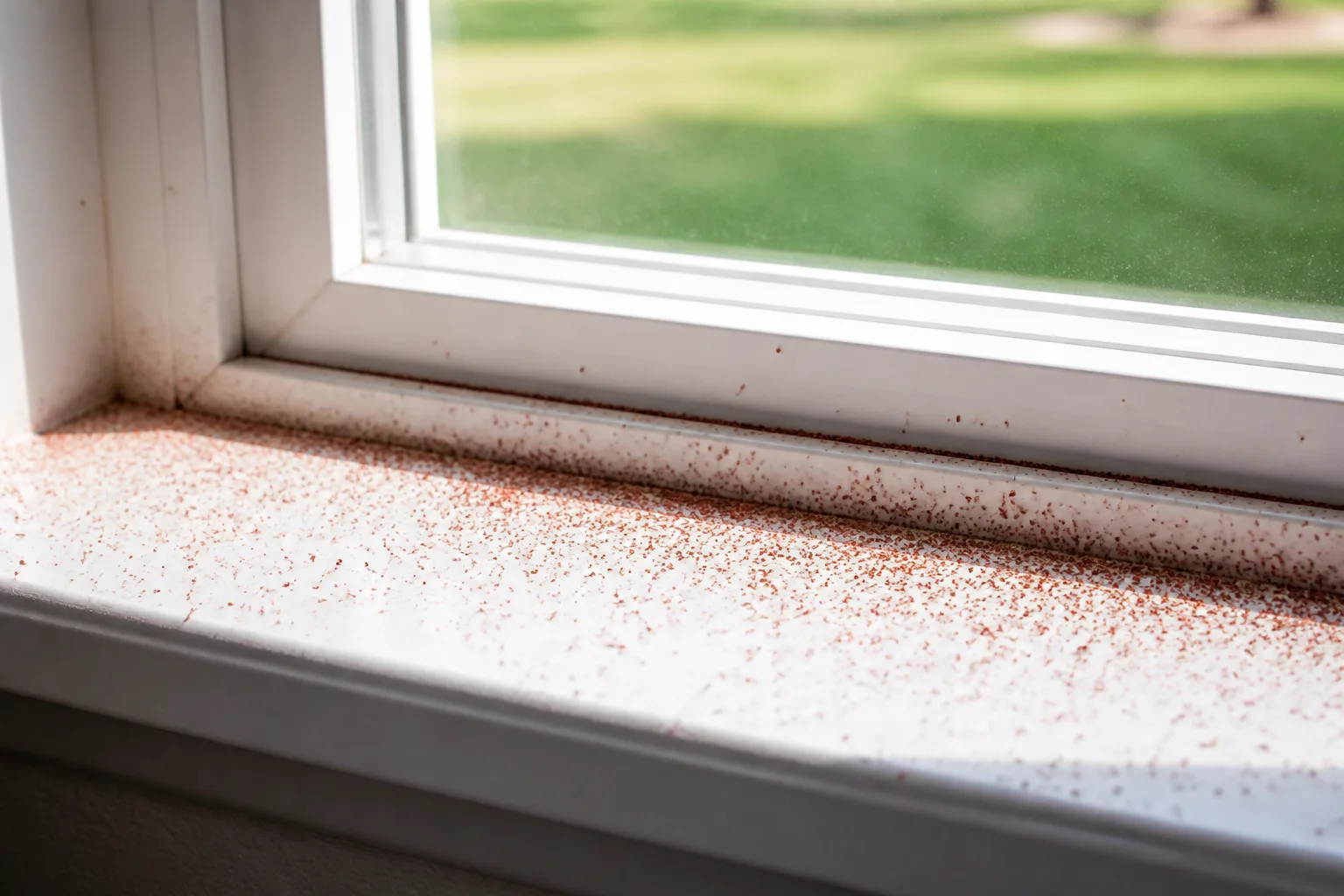
Thousands of pinhead-sized red specks crawling across a sunny window frame look like a horror-movie prop. In most cases they are clover mites (Bryobia praetiosa Koch)—plant-feeding arachnids that wander indoors by accident, not blood-feeding parasites hunting you. They do not bite, do not spread disease, and cannot establish breeding colonies inside a dry house. What they can do is stain curtains, paint, and upholstery when crushed, which is why the first rule is identification, not panic spraying.
Penn State Extension describes clover mites as occasional home invaders that will not reproduce under indoor conditions and perish within days from dehydration. Your job is to stop the seasonal march at the foundation, clean up what’s already inside without smearing red pigment, and fix the lush lawn conditions that drew them close in the first place.
What Clover Mites Actually Are (and What They Are Not)
Clover mites are mites, not insects—eight legs, no antennae, no wings. Adults measure about 0.75 mm (roughly 1/30 inch), smaller than a pinhead. Populations can number in the thousands on exterior walls, yet each individual is easy to miss until they cluster and move together like drifting dust.
They feed by piercing plant cells and sucking sap from grasses, clover, weeds, and many ornamental plants. Damage is usually cosmetic: silvery or bronzed patches on turf or leaves when numbers are high, but clover mites rarely kill established plants. The nuisance is structural invasion and the red stain left when they are squashed—not garden devastation.
Size, color, and the famous red stain
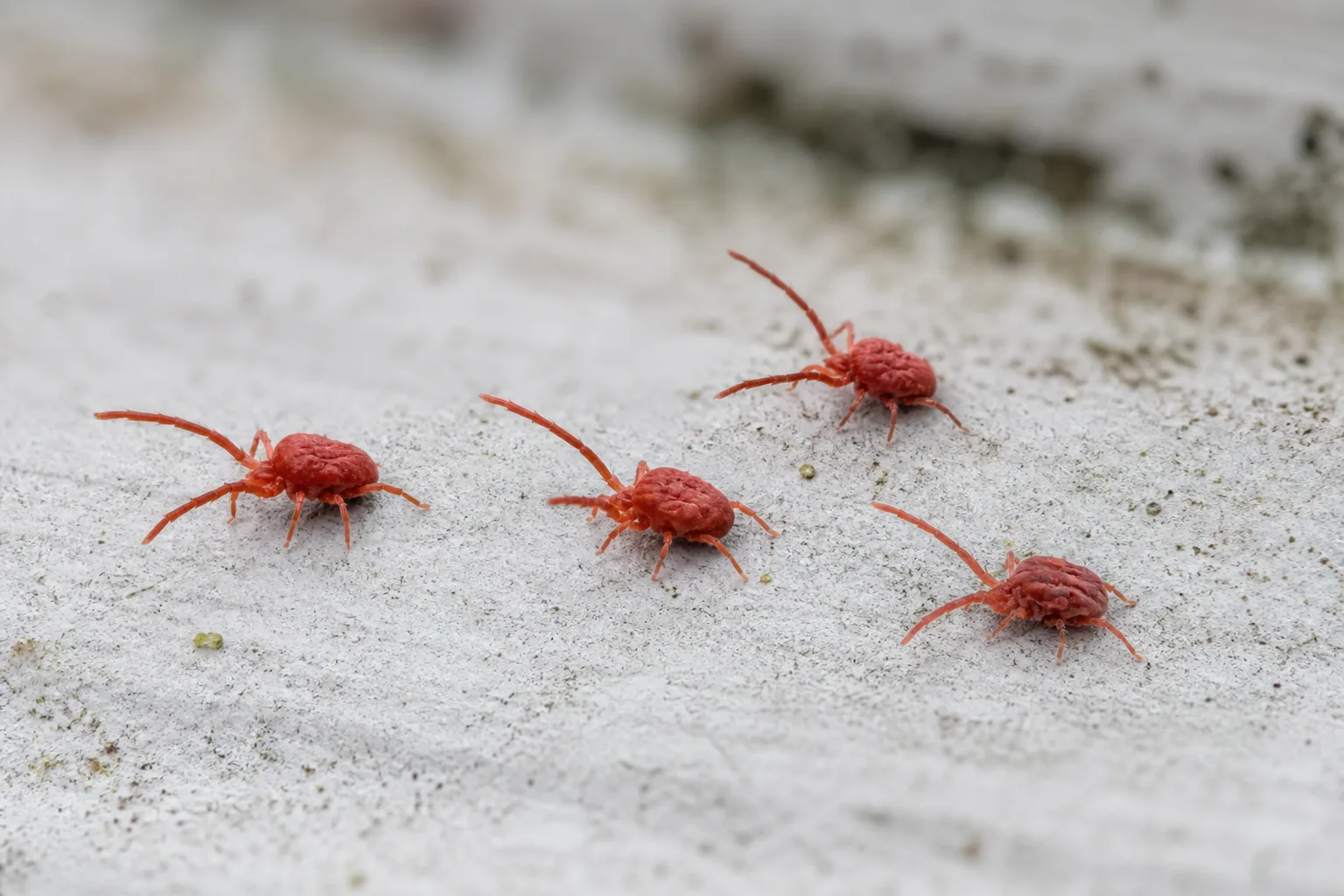
Adult clover mites are reddish-brown to greenish-brown with pale orange legs—not the screaming scarlet of internet photos. The six-legged larval stage is bright red, which confuses identification. So does the unrelated velvet mite, a much larger predatory mite that people often mislabel as a clover mite.
The crush test is famous for a reason: smear a few mites on white paper and you get a bright red spot. That pigment comes from their body contents, not blood—they are not feeding on you. UConn’s Home & Garden Education Center warns that crushing them indoors stains fabrics and painted surfaces. Use the test once for ID, then switch to vacuuming.
Life cycle: when they hatch, peak, and disappear
Clover mites are parthenogenetic: females reproduce without males, laying up to 70 eggs per batch. Eggs overwinter in dry, protected cracks—sidewalk joints, foundation gaps, under bark, window channels—and hatch when temperatures rise above roughly 45°F, often in early spring (Penn State Extension).
Generations complete in about 30 days, with five to six cycles possible per year in favorable conditions. Activity peaks in cool spring and fall weather; mites go dormant during hot summer (above about 80°F) and again in deep cold (Purdue Extension). Late-summer or fall eggs overwinter and restart the cycle the following spring—so a window swarm in March and another in October can be the same species at different migration points, not a “new” pest.
Identify Clover Mites Before You Treat Anything
Misidentification wastes money. Spider mites need horticultural oil on infested plants; chiggers are outdoor biting larvae; bird or rodent mites point to a dead animal in a wall. Clover mites need exclusion and perimeter work. Treating the wrong pest with indoor repellent sprays won’t stop tomorrow’s hatch.
The front-leg field test
Clover mites are best identified by anatomy, not color alone. Their first pair of legs is about twice as long as the other three pairs and held forward like antennae (Purdue Extension). Under magnification they look front-heavy; to the naked eye they resemble slow-moving dots that drift in groups on sunny masonry or glass.
Gather clues before you kill specimens: location (sunny window sill vs. houseplant leaf), season (cool spring morning vs. hot July), host plants nearby (lush fertilized turf against the foundation), and movement pattern (crawling on walls toward cracks, not web-spinning on foliage).
Clover mites vs. spider mites, chiggers, and velvet mites
| Pest | Size / color | Key ID clue | Host / habitat | Bites people? | Plant damage |
|---|---|---|---|---|---|
| Clover mite | ~0.75 mm; brown-green adults; red larvae | Extra-long front legs | Lawn, clover, weeds; sunny walls | No | Minor sap stippling on grass |
| Two-spotted spider mite | <1 mm; green-yellow with dark spots | Fine webbing on leaf undersides | Garden plants, houseplants in dry heat | No | Serious leaf bronzing, defoliation |
| Velvet mite | Several mm; bright red | Large, velvety, solitary | Soil surface outdoors | No | Predator; not a lawn pest |
| Chigger (larva) | Microscopic; red-orange | Intense itchy bites after lawn contact | Tall grass, brush | Yes (larvae) | None on structures |
| European red mite | Tiny; reddish on fruit trees | Eggs on bark, bronzed apple leaves | Apples, stone fruit | No | Significant orchard damage |
If mites are on houseplant leaves with webbing, suspect spider mites, not clover mites. If you have itchy welts after sitting in grass, look at chiggers. Clover mites on exterior paint and windows in spring are the classic indoor-invader scenario.
Are Clover Mites Dangerous to People, Pets, or Your Home?
No—and that matters for how aggressively you should treat. Clover mites do not bite humans or pets and do not transmit disease (Penn State Extension). They do not chew wood, wiring, or stored food. Indoors they are a nuisance and staining risk, not a health emergency.
They also cannot breed indoors. Central heating and air conditioning dry them out; survivors die within a few days (UConn HGEC). Heavy indoor insecticide fogging is rarely justified for a pest that was leaving anyway. Focus on blocking entry and cleaning up without crushing.
The real “damage” is cosmetic: red smears on window sills, blinds, and light-colored walls. Treat stains promptly with mild soap and water on paint-safe surfaces; test fabric cleaners on a hidden hem first.
What Causes Clover Mites to Show Up
Clover mites appear when outdoor conditions favor population explosions and something steers them toward your siding. You cannot trace a single “nest” indoors—they are coming from eggs and adults in lawn and landscape debris next to the structure.
Heavy, succulent turf is the biggest driver. New lawns, over-fertilized grass, and nitrogen-rich growth attract large mite populations (Penn State Extension). Homes with grass planted flush against the foundation—common in new construction—see the worst spring invasions because mites can walk directly from food to wall.
Weather triggers migration. Cool spring warm spells wake overwintering eggs; mites climb sunny south- and west-facing walls seeking warmth or egress. In fall, cooling temperatures push mites toward protected cracks again. Drought can also send mites toward buildings until outdoor plants recover (UConn HGEC).
Moisture and cover matter for egg survival. Leaf litter, mulch piled on siding, and dense shrubs touching windows give mites highways and hiding places. Excess nitrogen in the lawn links to higher populations—not because mites “love fertilizer,” but because fast, tender growth is easier to pierce and supports more offspring per square foot.
When to Act: Yard-Only, Window Swarm, or Full Invasion
Not every clover mite sighting needs a pesticide contract. Use this decision ladder:
Yard-only, no interior sightings: Monitor and implement prevention—barrier strip, prune shrubs back, reduce spring nitrogen, mow appropriately. Turf stippling alone is usually temporary. Skip indoor chemicals entirely.
Mites on exterior walls or windows but few indoors: Act within the week. Caulk gaps, vacuum any stragglers inside, and plan an exterior perimeter miticide application on the next dry, calm day when mites are active (spring or fall, not midsummer dormancy).
Heavy indoor numbers on multiple sills: Vacuum daily while executing exterior barrier + foundation treatment. If mites persist weekly through the season after exclusion work, consider a pest management professional for targeted wall-void and channel treatment (Purdue Extension).
Plant damage spreading in lawn: Combine cultural fixes (fertilizer audit, irrigation adjustment) with labeled outdoor miticide on affected turf zones—not broadcast indoor spray.
How to Get Rid of Clover Mites Indoors
Indoor control is cleanup and patience, not eradication chemistry. Remember: new mites keep walking in until outdoor pressure drops, and indoor survivors dehydrate on their own.
Vacuum without crushing (the stain-safe method)
Penn State Extension recommends a strong vacuum as the best indoor tool—it removes live mites and prevents stains better than wiping. Use a soft brush attachment on window tracks, sills, and baseboards where mites congregate (UConn HGEC).
Work top to bottom on affected windows so fallen mites get picked up in one pass. Do not press the hose nozzle flat against clusters; suction alone is enough. Empty the bag or canister outside immediately so mites cannot crawl back out. If you use a bagless vac, rinse the cup outdoors.
For window channels, loosen mites first with a dry paintbrush, then vacuum the debris. This beats chemical sprays in channels where residue can gum up sash movement.
Why indoor insecticide sprays usually fail
Synergized pyrethrin sprays can kill mites on direct contact, but they do not stop new migrants (Purdue Extension). Worse, broad indoor spraying contaminates surfaces where you eat and sleep for a pest with no medical risk.
Penn State Extension states plainly that chemical treatment inside the home is not necessary because mites die from dehydration within days. Reserve indoor pesticides for rare situations where a professional targets a known harborage—not for general window-sill maintenance.
If you already sprayed indoors, ventilate well and switch to exterior prevention rather than repeat applications.
Outdoor Control That Stops the Next Wave
Lasting relief means making the foundation harder to reach and less attractive than the open lawn. Exterior work addresses the source; vacuuming handles the symptom.
Barrier strips, pruning, and caulking
Purdue Extension recommends a 18- to 24-inch-wide band without grass along the foundation—bare soil, flower bed, pea gravel, or fine sand. Clover mites struggle to cross hot, dry mineral barriers compared with continuous turf.
Penn State Extension cites 6 to 24 inches of grass-free zone as effective; wider is better on problem exposures. Remove leaf litter and mulch touching siding; keep organic mulch several inches away from wood and stucco.
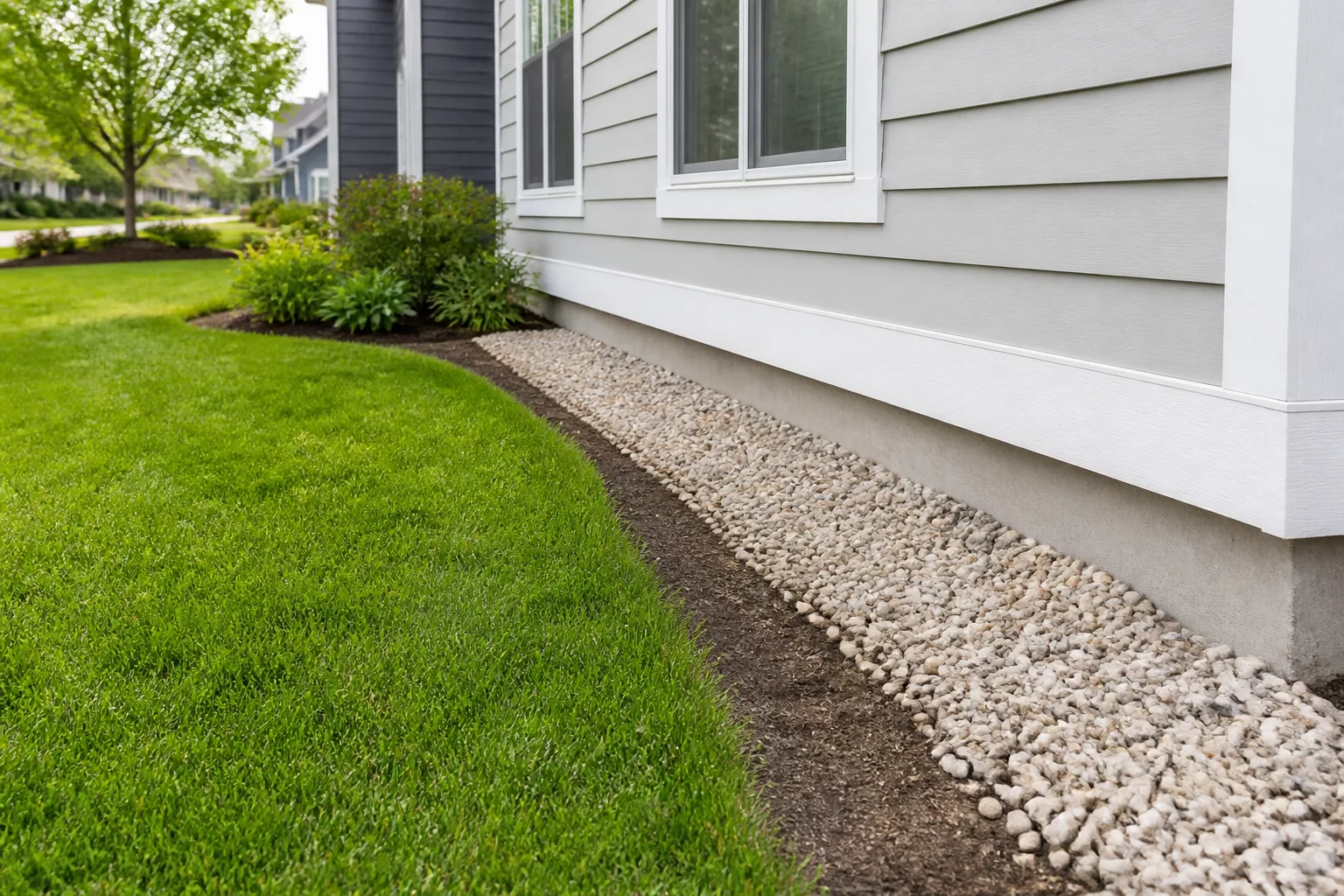
Prune shrubs and tree limbs so nothing bridges from lawn to wall. Plant new woody plants at least half their mature width from the foundation—a 20-foot shrub belongs ten feet out, not tucked under the eaves.
Caulk cracks in foundation, siding joints, and window frames. Basement and ground-floor window channels are favorite egg sites (UConn HGEC). Remove storm windows seasonally and brush-vacuum channels before reinstalling.
Perimeter miticide timing and label rules
When populations overwhelm cultural fixes, treat outside only with a product labeled for mites on the specific sites you will spray—lawn, shrub, house exterior, or combination (Penn State Extension). Many “general insecticides” are weak on mites; read the miticide panel on the label.
Apply to:
- Foundation walls from grade to bottom of first-floor windows
- Barrier strip surface (gravel, bare soil, or bed)
- Turf 10 to 20 feet outward on heavy exposures (Purdue Extension)
- Door and window perimeters to runoff, per label
Timing: Treat during active spring or fall migrations when mites crawl walls—not during midsummer dormancy. Eggs often hatch after rain, so one application may not last the season; monitor and repeat per label intervals.
Safety: Misapplication can stain siding or burn shrub foliage (Penn State Extension). Keep sprays off blooming plants when bees are active. Store pesticides locked away from children and pets; never exceed labeled rates.
Paint or spray window channels and exterior frames at first sign of invasion, repeating as the label allows—this targets entry points more precisely than fogging the whole yard.
Long-Term Lawn and Landscape Prevention
Think of clover mites as a lawn-edge problem, not a mysterious indoor plague. Steady landscape habits reduce pressure year over year.
Fertilize thoughtfully. Heavy spring nitrogen produces the succulent grass clover mites prefer. Soil-test before blanket feeding; shift toward fall fertilization where turf programs allow, and avoid overfeeding narrow strips along the foundation.
Mow for turf health, not bare scalping. Many guides cite 3 to 4 inches for cool-season lawns to support deeper roots and moderate top growth—healthier grass tolerates occasional mite stippling. The more important mow rule for mites is don’t let grass touch the wall.
Choose less-favored plants near the house if you have chronic issues. Clover mites avoid some ornamentals—marigolds, petunias, zinnias, salvia, roses, barberry, juniper, spruce, arborvitae, and yew are commonly cited as relatively unattractive hosts. This is not a guarantee, but swapping heavy clover or weedy lawn margins for a gravel bed and resistant shrubs can shrink populations noticeably.
Manage moisture and debris. Rake leaves away from the foundation each fall. Divert downspouts so splash zones do not grow rank, wet grass against the basement wall. Fix irrigation overspray that keeps foundation plantings constantly damp.
New homes need extra vigilance. Fresh sod, construction dust in cracks, and zero barrier strip are a perfect storm for the first one to three springs. Install gravel bands early; caulk before the first warm spell in late winter.
If you maintain a clover lawn for pollinators, expect clover mites as a seasonal neighbor—they share the same host plant. Population surges are still manageable with foundation exclusion; you do not need to eliminate clover from the entire property to keep them out of the living room.
Conclusion
Clover mites win the fear factor on looks alone—thousands of tiny red specks on a sunny window will test anyone’s calm. Biologically they are harmless plant feeders that wander inside, stain surfaces when crushed, and die indoors within days without reproducing. Your control sequence is straightforward: confirm ID with the long front legs and crush-stain test once, vacuum indoor clusters without smearing, then block the foundation with a grass-free gravel band, caulking, and prudent fertilizer while timing exterior miticide for cool-season activity.
Yard-only sightings deserve prevention, not panic. Full window invasions need exterior work first; indoor sprays are a last resort. Fix the lush lawn highway against your siding and the red bugs stop treating your house like a solarium. Next spring, you’ll still see a few dots outdoors—but they should stay on the other side of the gravel.