How to Get Rid of Wild Violets in Your Lawn Safely
Learn how to identify wild violets, dig out small colonies, choose a label-approved selective herbicide, and reduce regrowth without damaging healthy turf.
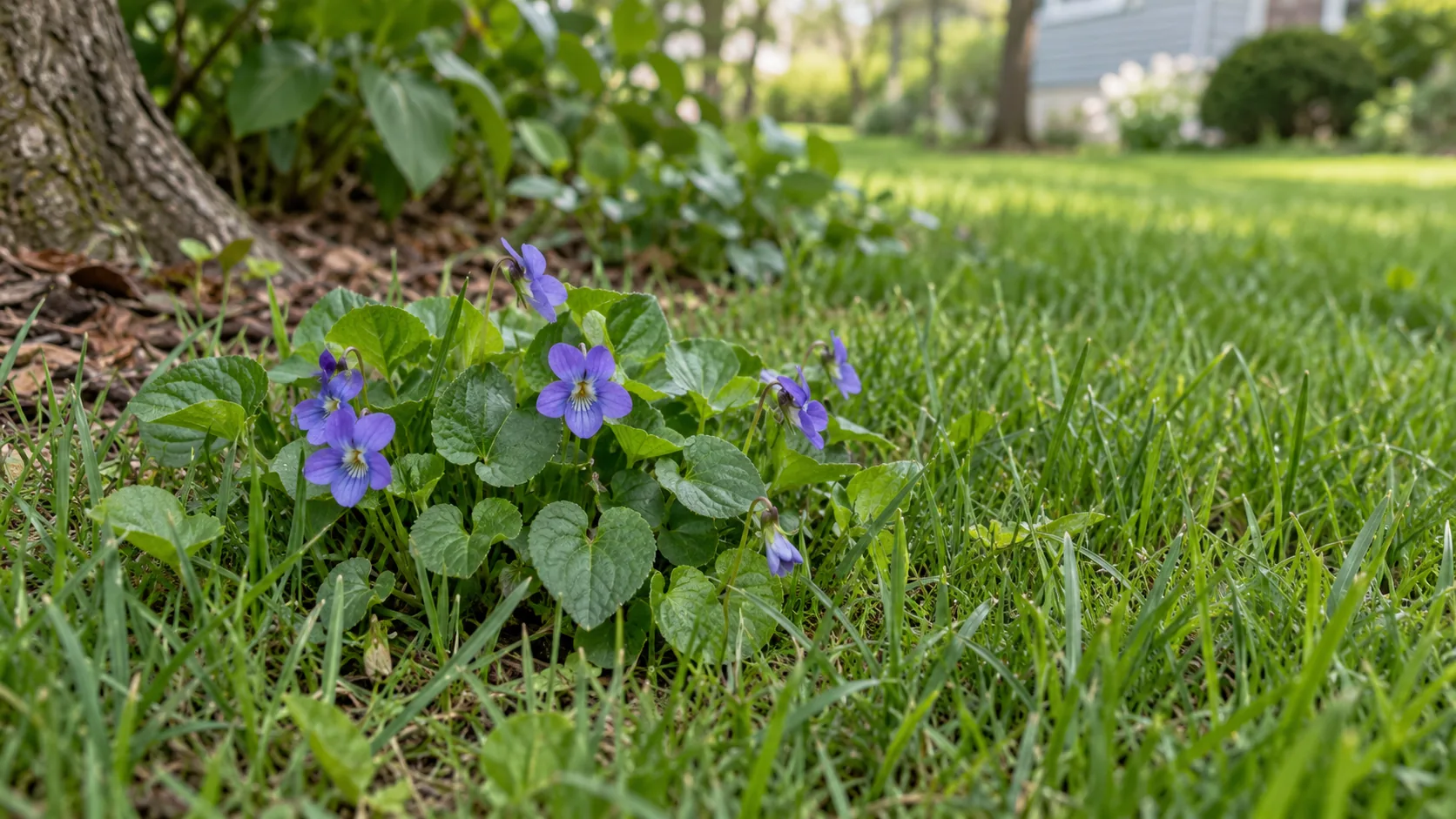
To get rid of wild violets, match the method to the patch: dig out isolated plants and as much of the rhizome system as you can; for a widespread infestation, consider a selective broadleaf herbicide only if its current label permits use on your exact grass and site. Neither method is instant. Wild violets can rebound from underground stems, and waxy leaves make some sprays less reliable, so a realistic plan includes follow-up and lawn repair.
First decide whether you actually want every violet gone. Common blue violet (Viola sororia) is native in much of eastern North America and supports pollinators and fritillary caterpillars, but “wild violet” includes multiple species whose status varies by region. If you want a uniform turf lawn, control is reasonable; if the plants are confined to a shaded edge where grass struggles, keeping a defined patch may save repeated work and preserve useful habitat.
Decide what “gone” means for your lawn
A lawn can be a single grass species cut to a consistent height, or a mixed groundcover that includes low-growing flowers. The practical question is not whether violets are universally good or bad; it is whether they fit the way you use this particular area. A small patch outside a play area may be easy to tolerate, while violets in a formal lawn, sports surface, or newly seeded section may be worth controlling.
Consider the location before you choose a product. Wild violets are common in moist, partly shaded turf, where the grass may already be thin. If you remove the violet without changing the conditions that favored it, bare soil can invite the same plant—or another weed—back. In a deeply shaded strip under a mature tree, a shade-tolerant groundcover or a clearly edged naturalized area may be more sustainable than trying to maintain dense sun-loving turf.
There is an ecological reason to pause, too. Early violet blooms offer pollen and nectar, and the leaves host larvae of several fritillary butterflies. Iowa State Extension describes violets as useful native groundcover in appropriate settings, while Fine Gardening highlights their role as host plants for fritillaries. Those benefits do not obligate you to keep violets in a lawn, but they make blanket treatment a choice rather than an automatic first step. Iowa State University Extension and Fine Gardening provide useful regional and habitat context.
Confirm you have wild violets before treating
Common lawn violets form low clumps of leaves on individual stalks emerging near the soil surface. The leaves are usually heart-shaped, with rounded or softly scalloped edges; the flowers have five petals and may be blue-violet, purple, white, or yellow depending on species. Flower color alone is not enough for identification, and the common name covers more than one Viola species.
Look for the whole pattern: a basal cluster, long leaf stalks, heart-shaped blades, and flowers held above the foliage in spring. Violets can also make inconspicuous flowers later that self-pollinate and produce seed. This matters because a patch can spread even when showy blooms are no longer visible. The University of Minnesota Extension’s wild violet guide includes descriptions of wild violet and look-alikes.
Do not confuse violets with creeping Charlie (ground ivy), whose rounded leaves grow in opposite pairs along creeping stems and whose stems are often square, or with lesser celandine, which can have glossy leaves but is a different plant. If you are not certain, take a clear photo of the leaf, flower, and growth habit to a local extension office before applying anything. A wrong identification can turn a manageable patch into damaged turf or a larger control problem.
Why wild violets return after pulling
Wild violets are perennial broadleaf plants. In addition to seed, they spread through short, thick underground rhizomes—horizontal stems that can produce new shoots and roots. Pulling the leaves or breaking off the crown removes what you see but may leave living pieces below the surface. A surviving rhizome can send up another cluster, so “it came back” often means the first removal did not reach the plant’s underground parts.
The foliage adds a second obstacle to chemical control. Violet leaves have a waxy surface that can make spray droplets bead or run off instead of staying on the leaf long enough to be absorbed. Penn State Extension notes both the waxy cuticle and the rhizomes as reasons post-emergence herbicides can give poor control; Minnesota Extension likewise warns that extensive rhizomes and waxy leaves reduce effectiveness. This is why a single application or a quick tug rarely settles an established colony.
Violets also tolerate mowing. Cutting the tops may remove flowers for a time, but the low rosette and underground stems remain. Mowing can help keep a lawn at its normal height and may reduce some seed production if it happens before seed is set, but it is not a dependable stand-alone way to eliminate an established patch.
Map the patch and choose the right control
Before digging or spraying, sketch where the violets grow and note whether the patch is expanding, isolated, or scattered through the lawn. A simple phone photo from the same spot each month is often enough to tell whether a treatment is working. Mark nearby trees, shrubs, garden beds, drains, and flowering plants; these affect whether selective herbicide is an option and where careful hand removal is safer.
Use the size and distribution to make a practical choice. A few separate clumps are usually worth digging because you can work around the turf and inspect what comes out. A continuous patch that covers a large part of the lawn may take repeated digging and reseeding; compare that labor with either tolerating the patch, redesigning the area, or using a properly labeled lawn treatment over several growing periods. The point is to choose a method you can repeat carefully, not to promise complete eradication in one weekend.
If the violet patch is under a tree, do not assume the tree is the cause of every problem, but inspect the site. Shade, compacted soil, heavy foot traffic, poor drainage, and a grass variety that needs more sun can all leave open niches. Correcting a condition may help the turf compete, but it will not pull rhizomes out of the soil or guarantee that violets disappear.
Dig out a small or isolated patch
Hand removal is most worthwhile when the colony is small enough to excavate thoroughly. Water the area the day before or work after gentle rain, when soil is moist but not soupy. Moist soil releases roots more readily; dry, hard ground encourages you to snap off the leaves and leave the underground network behind.
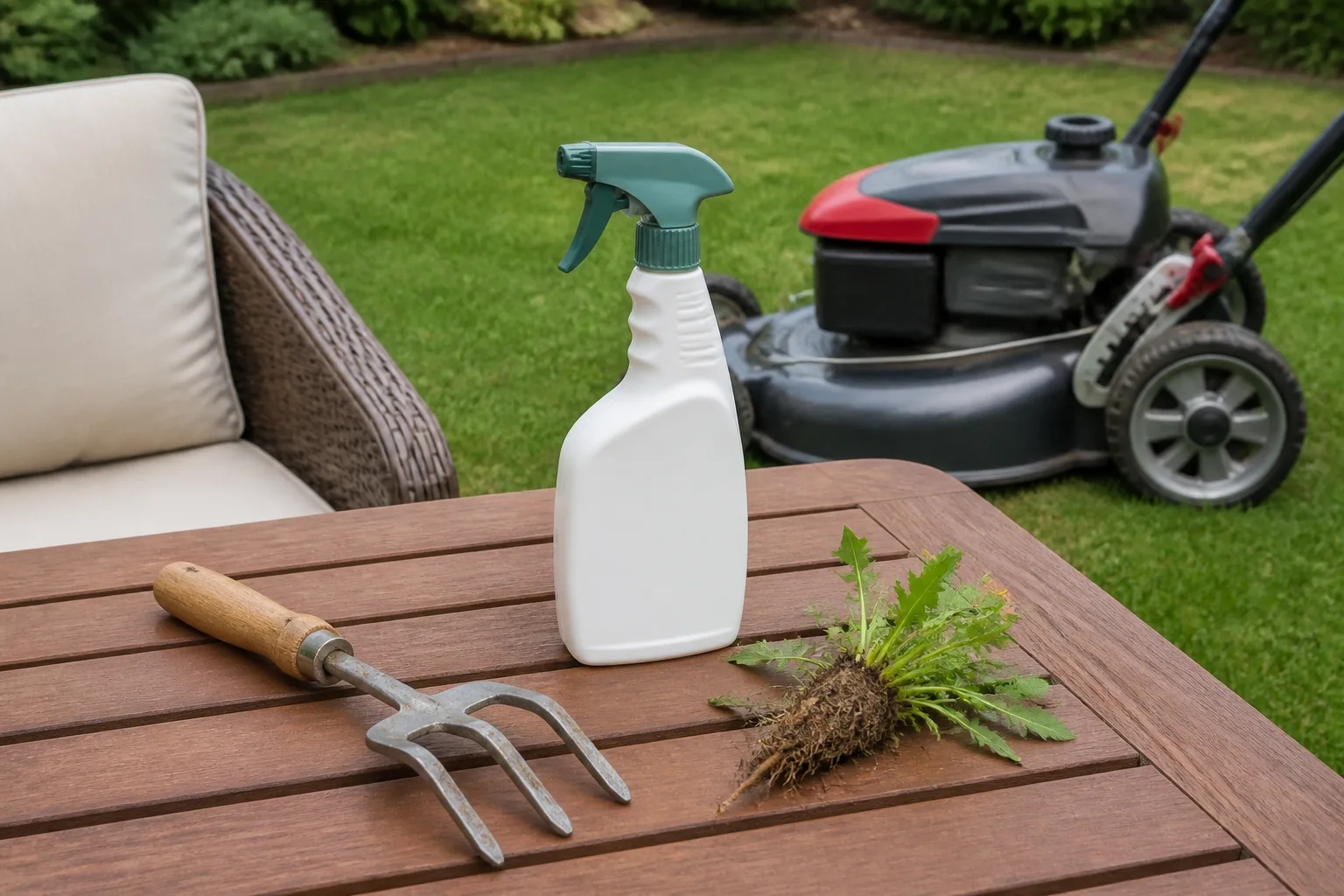
Use a narrow garden fork, hori-hori, or sturdy hand weeder to loosen a circle around the clump. Slide the tool under the crown and lift the soil rather than pulling upward on the leaves. Work outward from the visible edge because rhizomes may extend beyond the foliage. Shake loose soil back into the hole so you can see what plant material remains, and remove the crown, roots, and rhizome pieces you can find without tearing up a large area of healthy grass.

Do not expect a single pass to get every fragment in a dense colony. Check the disturbed patch after new growth appears, and dig the remaining shoots while they are still easy to locate. Put removed plants where they cannot re-root; do not leave flowering or seed-bearing material on the lawn. If excavation leaves bare soil, refill and repair it promptly rather than waiting for weeds to colonize the opening.
Hand digging is a poor fit when the patch is interwoven with shallow tree roots, fills a large part of the lawn, or is so dense that excavation would leave more bare soil than grass. In that situation, choose a different lawn plan rather than repeatedly slicing through roots or leaving fragments behind. For extensive violets, Minnesota Extension recommends repeated control efforts and stresses removing roots and rhizomes when using hand methods.
When a selective lawn herbicide makes sense
If violets cover too much area for careful digging and you want to preserve the grass, a post-emergence selective broadleaf herbicide may be an option. Extension guidance commonly identifies products containing triclopyr as among the more effective choices for wild violet in turf. Some products with combinations of broadleaf active ingredients—such as 2,4-D, dicamba, or MCPP/MCPA—may provide control, but results vary; do not assume that a bottle labeled “lawn weed killer” is effective on violets just because it controls dandelions or clover. Penn State Extension and Illinois Extension describe triclopyr’s relative effectiveness and the difficulty of control.
“Selective” does not mean harmless to every grass or nearby plant. A product may be safe on one turf species and injure another; Kansas State Extension, for example, warns that some triclopyr products can severely injure bermudagrass. The label on the exact formulation must list the site and grass you intend to treat, the target weed or applicable weed group, and the application method. If the label does not clearly permit your use, do not improvise with a similar product or a rate found online.
Pre-emergent products are designed to prevent certain seeds from establishing; they do not remove established perennial violets connected to rhizomes. Non-selective products can kill grass along with the violet and are generally unsuitable for spot treatment in an intact lawn. Do not add dish soap or an unlisted surfactant to make a spray “stick.” Only use an adjuvant if the product label specifically permits it, and follow its instructions exactly.
Time treatment for active growth
There is no single calendar date that works across climates, turf species, and formulations. Extension recommendations place applications in different windows: some advise spring or fall, while others emphasize early spring or late summer. A useful common rule is to treat healthy, actively growing violets when the product label allows it. Fall can be favorable for systemic products because perennial plants are moving resources toward underground storage, but it is not a license to spray dormant, drought-stressed, heat-stressed, or frost-damaged plants.
Check your local extension guidance and the exact label for temperature limits, rain-free interval, mowing and irrigation timing, repeat interval, annual maximum, and reseeding restrictions. The label’s directions override a generic seasonal rule. If the violets are flowering, consider delaying treatment or selecting another method so you do not spray blooming plants visited by pollinators; do not spray any flowers or habitat beyond the label’s permitted site.
A second application may be allowed or needed, but only after the label’s specified interval and only if living violets remain. Iowa State Extension notes that two treatments spaced several weeks apart may be needed; Penn State notes that repeated applications across a growing season and multiple years can be necessary. Those are expectations, not a prescription for every product. Never shorten intervals or increase a rate to compensate for a weak first result.
Spot-treat without exposing the whole yard
When a product is appropriate, target the violet leaves rather than broadcasting over the lawn by default. Use only label-approved equipment and application directions, and choose a calm day within the product’s temperature and weather limits. Drift can contact shrubs, flowers, vegetable beds, or neighboring property; an apparently small spray cloud can travel farther than the patch you intend to treat.
Read the entire label before mixing. It specifies personal protective equipment, dilution, coverage, maximum rates, weather restrictions, re-entry timing, and precautions around water, children, and pets. The U.S. Environmental Protection Agency explains that pesticide labels are legally enforceable directions; use the product only in the manner allowed on the container and in your state. Keep the original label available and do not reuse a sprayer for other purposes unless its label and cleaning directions allow it.
Spot treatment is not a guarantee of zero off-target exposure. University of Maryland Extension advises targeting weeds rather than treating the entire lawn when practical and notes that “organic” or household-derived herbicides are not automatically harmless or selective. Vinegar, salt, boiling water, and dish-soap mixtures can burn grass and nearby plants; they do not selectively remove violets while preserving turf. If you cannot direct a labeled product safely around desirable plants, dig the patch or accept it instead.
What to expect after treatment
Do not judge success the next morning. Treated leaves may take days to show symptoms, and a browned top does not prove that every rhizome has died. Conversely, a few green leaves after the label’s stated response period do not justify an immediate extra dose. Wait the required interval, inspect the entire patch, and distinguish surviving violets from new seedlings or another broadleaf weed before deciding what to do next.
Violets can need repeated treatments over more than one season. Penn State describes them as difficult turf weeds partly because the waxy surface interferes with uptake and rhizomes support recovery. Plan for a sequence: one label-compliant application when conditions are right, an assessment after the label’s interval, and a later treatment only if both the label and the remaining growth support it. Hand-dig a few survivors if they are isolated; avoid spraying the same spot indefinitely without addressing why the turf is thin.
If you see scattered new plants, map them and remove or treat those small patches before they merge into a colony. New seedlings and shoots from rhizomes can look similar, so inspect the basal crown and roots when uncertain. A record of the product, date, weather, and treated area helps prevent accidental over-application and makes it easier to tell whether the plan is improving the lawn.
Repair the lawn and close the opening
Once a patch is removed or controlled, restore the turf instead of leaving bare soil. Rake out loose dead material without disturbing the soil more than needed, then seed or sod with grass suited to the site and region. For many cool-season lawns, early fall is a common establishment window; warm-season lawns follow a different calendar. Local extension recommendations and the seed label should guide timing, especially if a herbicide label restricts how soon you may seed.
Prepare the surface so seed contacts soil, not a thick layer of thatch. Use the rate and method on the seed package, keep the surface evenly moist during germination, and protect the area from heavy traffic until the grass is established. Do not apply a broadleaf herbicide to young seedlings unless the product label explicitly permits that timing and turf stage. If the site is too shady or dry for the chosen grass, resodding alone will repeat the same failure.
For a tiny hole, a small amount of screened soil and seed may be enough. For a broad colony, remove dead or loose material, smooth the surface, and reseed in workable sections so you can water and protect each one. If the area is under dense tree shade, consider a shade-tolerant groundcover or a mulch bed with a defined edge rather than paying to establish grass that cannot persist there.
Make turf more competitive
A thick lawn is a useful barrier against new weed seedlings, but it cannot reliably smother an established violet rhizome network by itself. Focus on conditions grass can use: mow at the recommended height for your turf species instead of scalping; keep mower blades sharp; water deeply enough to support roots rather than giving frequent shallow sprinkles; and fertilize according to a soil test or local lawn guidance. Too much fertilizer does not selectively harm violets and can create runoff or other lawn problems.
Where shade is the main constraint, choose a grass cultivar or lawn alternative that tolerates the actual light level. Fine fescues are used in some cooler-region shade lawns, but no grass thrives in every degree of shade or under every tree. Reduce avoidable compaction, keep foot traffic off wet soil, and address drainage if the site stays soggy. Correcting these factors improves turf conditions; it is not a promise that all violets will vanish.
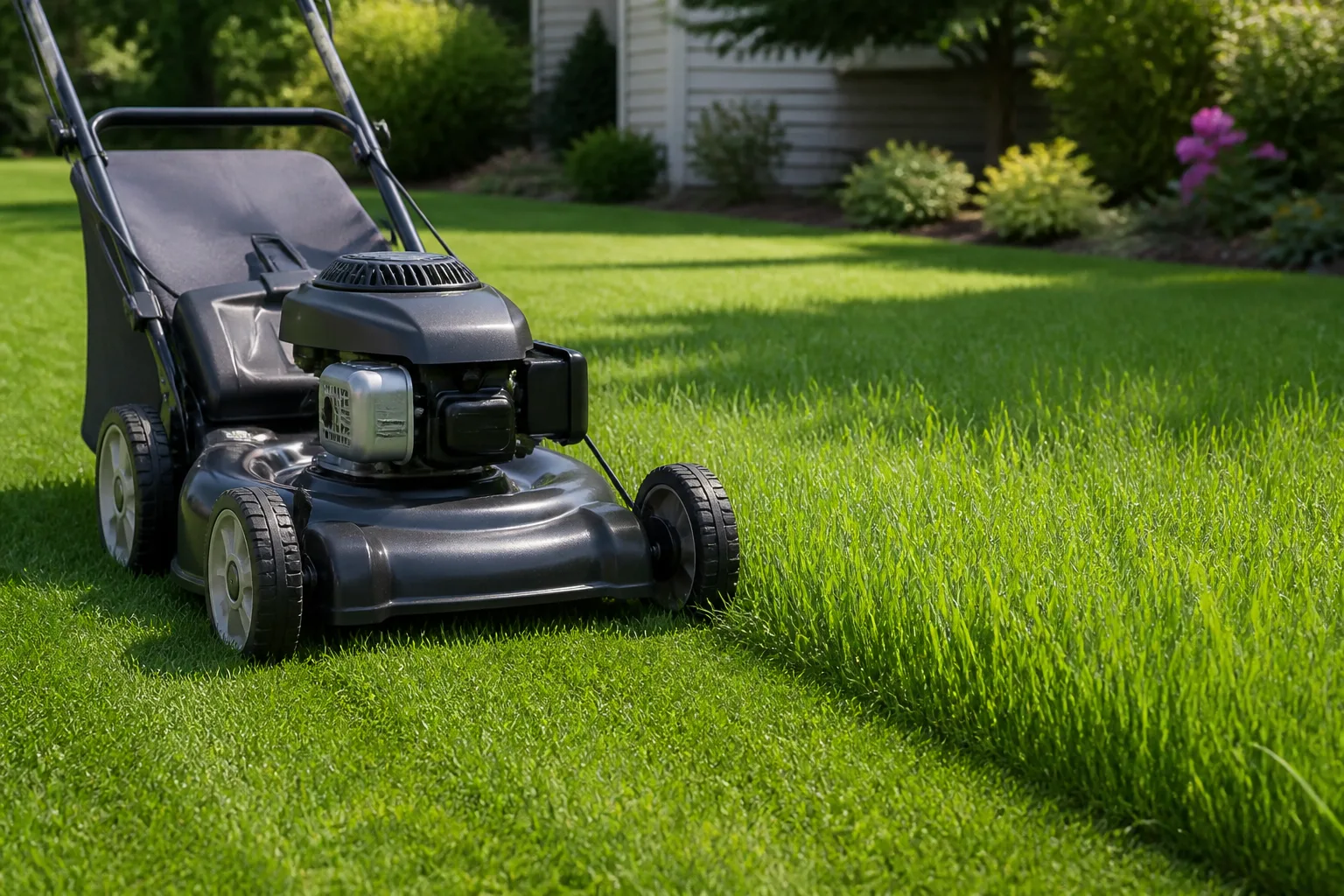
Mowing higher and maintaining suitable turf can slow encroachment, as Illinois Extension recommends, but violets may adapt by staying low. Keep the goal realistic: reduce the open space where new plants establish and make the remaining patch easier to monitor. A lawn that is naturally too shady for grass may be better redesigned than repeatedly treated.
When tolerating violets is the better choice
If the patch is stable, does not interfere with how you use the lawn, and is not a locally regulated invasive species, leaving some violets can be a sound decision. You can keep a clean boundary around a patch, mow a narrow edge, and let a small shaded zone function as a low-growing mixed lawn. This retains flowers without requiring the entire yard to become an unmanaged meadow.
Check regional identity before assuming a violet is native or beneficial. Common blue violet is native in much of the eastern United States, but not every plant called a wild violet has the same origin or ecological value in every location. Local native-plant societies, herbarium resources, or extension services can help identify it. University of Maryland Extension recommends reconsidering whether locally native lawn plants need to be removed and prioritizing species that actually threaten the landscape; Kansas State Research and Extension likewise frames treatment as a homeowner choice based on lawn goals.
Tolerating a violet patch is not the only wildlife-friendly option. You can remove it from a play area or formal front lawn while retaining a separate native planting, flowering edge, or no-spray corner. If you decide to keep the violets, avoid herbicide drift into the patch and do not treat it as a disposable “weed zone” while flowers are open.
Methods that waste effort or cause new damage
Pulling only the leaves is the fastest way to get a temporary tidy appearance, not dependable control. A string trimmer or mower can remove blooms but leaves the crown and rhizomes, and mowing very short can weaken the turf you want to favor. Digging dry soil is another common failure: it breaks roots and leaves fragments behind, so moisten the soil and loosen it before lifting.
A broad “weed and feed” application can be a poor match because the fertilizer and herbicide may need different timing, and a broadcast treatment exposes more lawn and nearby plants than a violet patch requires. Check the label rather than assuming a product controls violets or is safe on your grass. Avoid non-selective herbicide on green turf unless you intend to kill the grass and renovate the area.
Household vinegar, salt, boiling water, and dish soap do not solve the rhizome problem selectively. They can burn exposed leaves and turf, injure soil-side plants, and leave underground growth alive. A concentrated household or horticultural vinegar is not automatically a safe lawn treatment. Likewise, do not increase the herbicide dose, mix products, or add an improvised surfactant when a first pass disappoints; repeat only as the label allows.
Conclusion
The most reliable way to get rid of wild violets in a lawn is to identify the patch, decide whether it truly needs removal, and then match the control to its size and your grass. Dig isolated colonies thoroughly when the soil is moist; for larger areas, consider a selective post-emergence product only when its current label permits use on your turf and location. Triclopyr often gives better control than generic broadleaf mixes, but repeat treatment may take more than one season and can injure some grasses.
Close the bare spots with suitable turf, improve the conditions that weakened it, and inspect the area again as new growth appears. If violets are locally appropriate and the patch works for your yard, keeping a defined mixed-lawn area is also a valid outcome. Success means ending with a lawn you can maintain—not promising that every rhizome disappears after one pass.



