How to Grow and Care for Nerve Plant (Fittonia)
Fittonia care made practical: choose the right spot, water without root rot, raise humidity safely, propagate cuttings, and diagnose leaf problems.
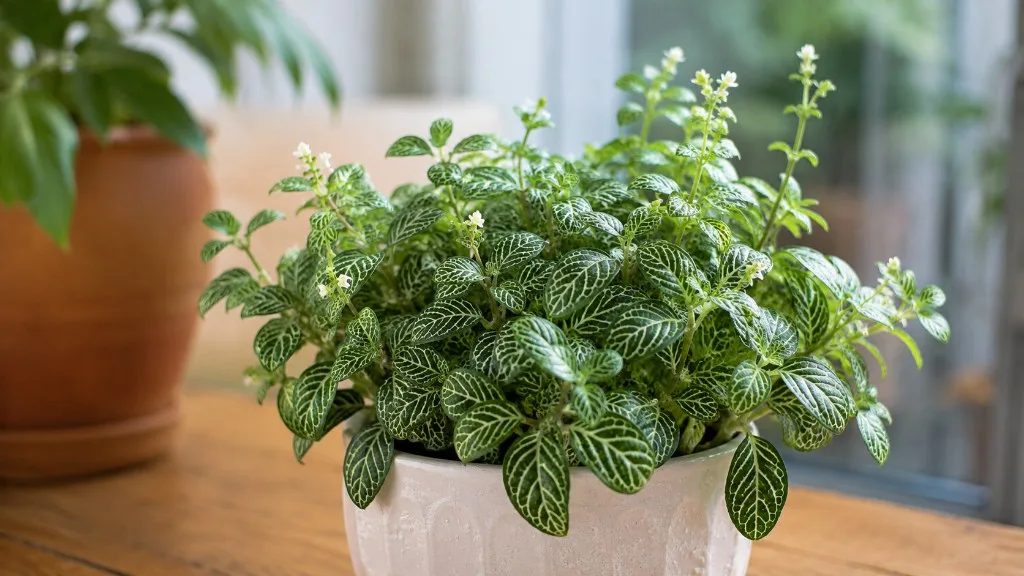
Nerve plant, or Fittonia albivenis, is a small tropical foliage plant with leaves traced in white, pink, or red. It stays low and spreads rather than growing into a tall specimen, which makes it excellent for a desk, plant shelf, hanging basket, dish garden, or terrarium. Its compact size is not a sign that it wants neglect, though. Fittonia is quick to show stress when its soil dries, its window is too bright, or cold air passes over the leaves.
The famous “fainting” response is useful information, but it is not a care schedule. A wilted Fittonia may recover after one thorough watering; repeated dry-outs can still cost leaves and vigor. The reliable approach is to give it bright filtered light, a potting mix that holds moisture without staying airless, and a watering routine based on the root ball rather than the day of the week.
Nerve Plant at a Glance: Fittonia’s Needs
Fittonia is a creeping evergreen perennial from the tropical rainforests of South America. Missouri Botanical Garden describes the plant as a low, spreading ground cover that can reach roughly 8 inches tall and spread about 18 inches in favorable conditions. NC State Extension lists it as a small, spreading houseplant with shallow roots and notes that it is commonly grown in bright to medium light indoors. Missouri Botanical Garden’s Plant Finder and NC State Extension’s Fittonia profile are useful references for those basic identity and culture details.
| Need | Practical target |
|---|---|
| Light | Bright, indirect light; gentle morning sun may be acceptable, but shield hot midday or afternoon rays. |
| Water | Keep the mix evenly moist, never permanently saturated; water when the upper layer begins to dry. |
| Humidity | Aim for moderate-to-high humidity, especially when the room is heated, air-conditioned, or drafty. |
| Temperature | Warm, stable room conditions; avoid cold windows, blasts from vents, and sudden changes. |
| Soil | Moisture-retentive indoor potting mix amended for air space and drainage. |
| Pot | A shallow or standard pot with drainage holes, only slightly wider than the root ball. |
| Habit | Low, creeping, and naturally spreading; pinch stems to keep the plant dense. |
This is a moderate-care plant, not because every task is difficult, but because several small conditions interact. A Fittonia in brighter light uses water faster. A large pot dries more slowly than a small one. A warm room with moving air can dry leaves even while the center of the pot remains wet. Adjust the routine to those variables instead of copying a universal “twice a week” instruction.
Choose a Location Before You Water
Start by choosing the right place. Set the plant near an east- or north-facing window, or a few feet back from a brighter south- or west-facing window where a sheer curtain softens the sun. A bathroom can be a good home only if it has enough useful light; steam alone cannot compensate for a dark room. If the bathroom window is tiny or frosted, use a small grow light on a timer rather than assuming humidity will solve the light shortage.
Keep the pot away from exterior glass that becomes cold at night, heat pumps, radiators, ceiling vents, and doors that open onto hot or cold outdoor air. Fittonia’s leaves are thin and quick to lose water. A plant that looks “humid enough” on a shelf can still suffer if a fan or vent continuously strips moisture from the foliage.
How to Read Light in Your Home
Bright indirect light means the room is bright enough to cast a distinct soft shadow, but the leaves are not being hammered by strong direct sun for hours. In very low light, a nerve plant may survive while producing longer spaces between leaves, duller coloration, and weaker stems. In excessive light, the pattern is different: bleached patches, crisp margins, or a dry side facing the window.
Move the plant gradually. If it has been living in a dim shop or a covered terrarium, placing it directly in a sunny window can scorch it even if the final location is technically bright. Shift it closer over a week, or add a curtain, and watch new growth rather than expecting already damaged leaves to regain color.
Build a Moisture-Holding but Airy Pot
Use a quality indoor potting mix that stays lightly moist after watering but does not collapse into a dense, muddy mass. A peat- or coco-coir-based mix is a workable starting point. If it feels heavy or remains wet for many days, blend in perlite, fine orchid bark, or another clean aerating amendment. The goal is not a dry, gritty succulent mix; Fittonia needs a dependable moisture reserve around fine roots. The goal is also not a waterlogged cache where oxygen disappears.
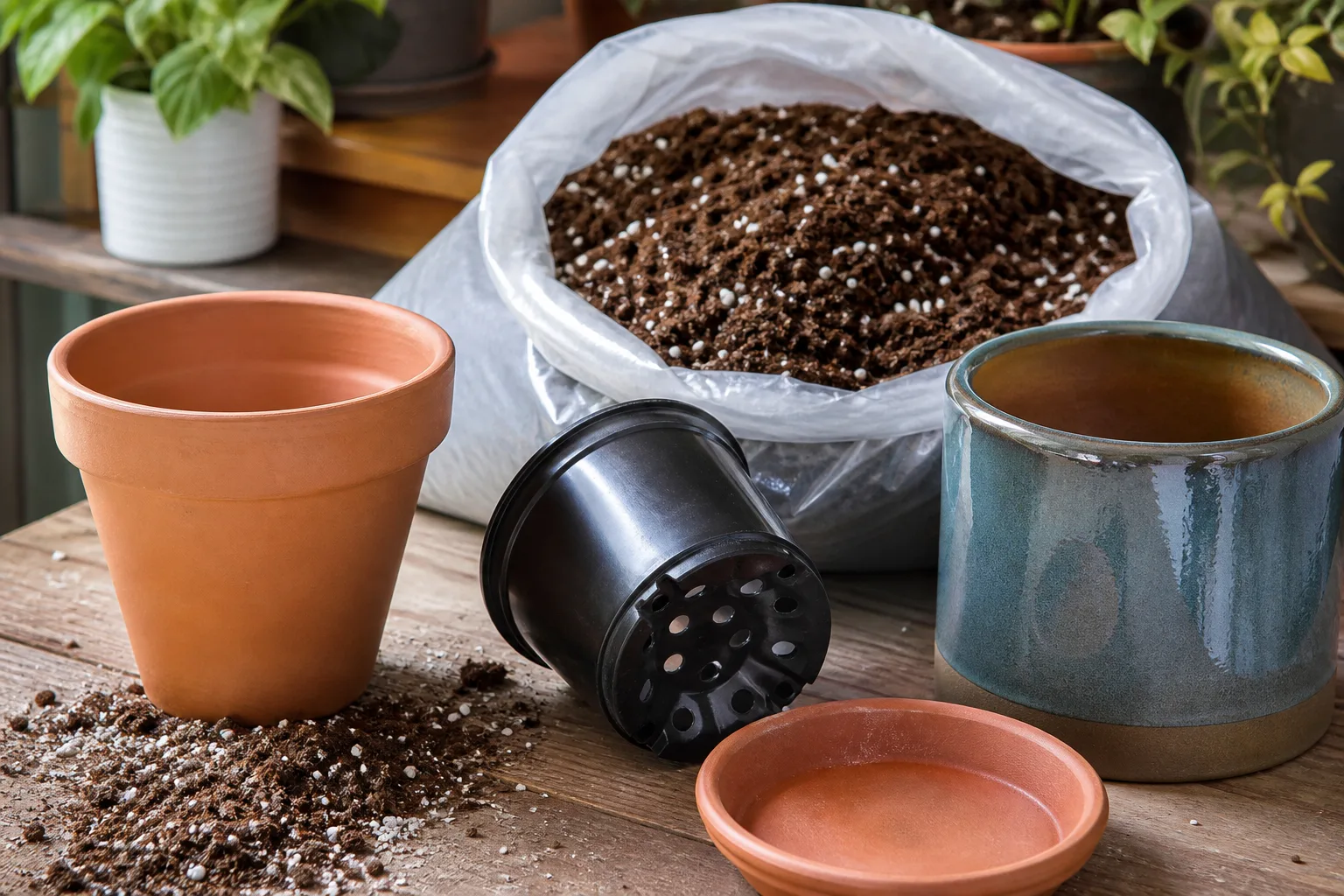
Choose a container with an open drainage hole. A decorative cachepot is fine as an outer cover, but lift the nursery pot out to water and empty collected water before returning it. Do not create a false drainage layer of gravel beneath the soil. It reduces the depth available for roots without fixing a pot that cannot drain through its base.
Because Fittonia has shallow roots and a spreading habit, a broad, low container can work well, especially for a mixed dish garden. A deep pot is not automatically better. Extra unused soil stays wet longer, making the plant harder to water accurately and increasing the chance that the center of the root ball remains saturated after the surface looks dry.
Water Fittonia Without the Fainting Cycle
Water when the top portion of the mix has begun to dry, not the instant the surface looks slightly lighter and not after the entire root ball has become bone dry. For a small pot, insert a finger about an inch into the mix or lift the container to learn its light, dry weight. If that layer feels dry but the lower mix is still cool and damp, wait a little longer. If the pot is light and the plant is beginning to soften, water now.
When it is time, water slowly over the entire surface until a little drains from the bottom. This re-wets the full root ball instead of leaving a dry pocket in the center. Let the pot drain fully, then empty the saucer or cachepot. A few minutes of drainage is healthy; leaving the base standing in water for hours is not.
Fittonia can wilt dramatically when it is thirsty because its soft stems and leaves lose turgor quickly. That visual alarm can tempt you to water on a fixed, overly frequent schedule. Resist that reflex: a plant that is watered every few days in a cool, dim room may develop yellow leaves and root damage, while the same interval might be reasonable for a small pot in warm, bright, moving air.
The Two-Minute Watering Check
Use the same short sequence each time:
- Check the plant: Are leaves limp and soft, or are they yellow, translucent, and accompanied by wet soil?
- Check the mix: Feel below the surface, not just the top crust. If it is still saturated, do not add more water.
- Check the pot: Is it noticeably lighter than after watering? Are roots or soil emerging from the drainage hole?
- Water thoroughly if needed: Apply enough to moisten the root ball and produce drainage.
- Reset the saucer: Pour away runoff and note how many days the plant takes to reach the same moisture point.
If a mildly wilted plant perks up within a few hours of watering and the mix dries at a reasonable pace, you have probably identified ordinary drought stress. If the leaves remain limp while the pot is heavy and wet, adding more water is the wrong first move. Move to a root inspection instead.
Humidity, Temperature, and Airflow
Nerve plant appreciates humid air, but “more humidity” is not a substitute for good root care. Garden Design places Fittonia in warm conditions around 60 to 85°F and recommends humidity of 50 percent or higher, while Missouri Botanical Garden emphasizes high humidity and stable room temperatures above 55°F. Treat those numbers as useful boundaries, not a command to turn the whole room into a greenhouse. Garden Design’s Fittonia guide provides practical placement and container guidance; Missouri Botanical Garden’s culture notes explain why humidity and temperature matter.
Measure near the plant with a small hygrometer if the room feels dry. Grouping plants can modestly improve the air immediately around their leaves, and a room humidifier gives a larger, more consistent effect when it is used safely and cleaned according to its instructions. Keep enough space for airflow; a humid, stagnant pocket around constantly wet leaves encourages leaf spots and mold.
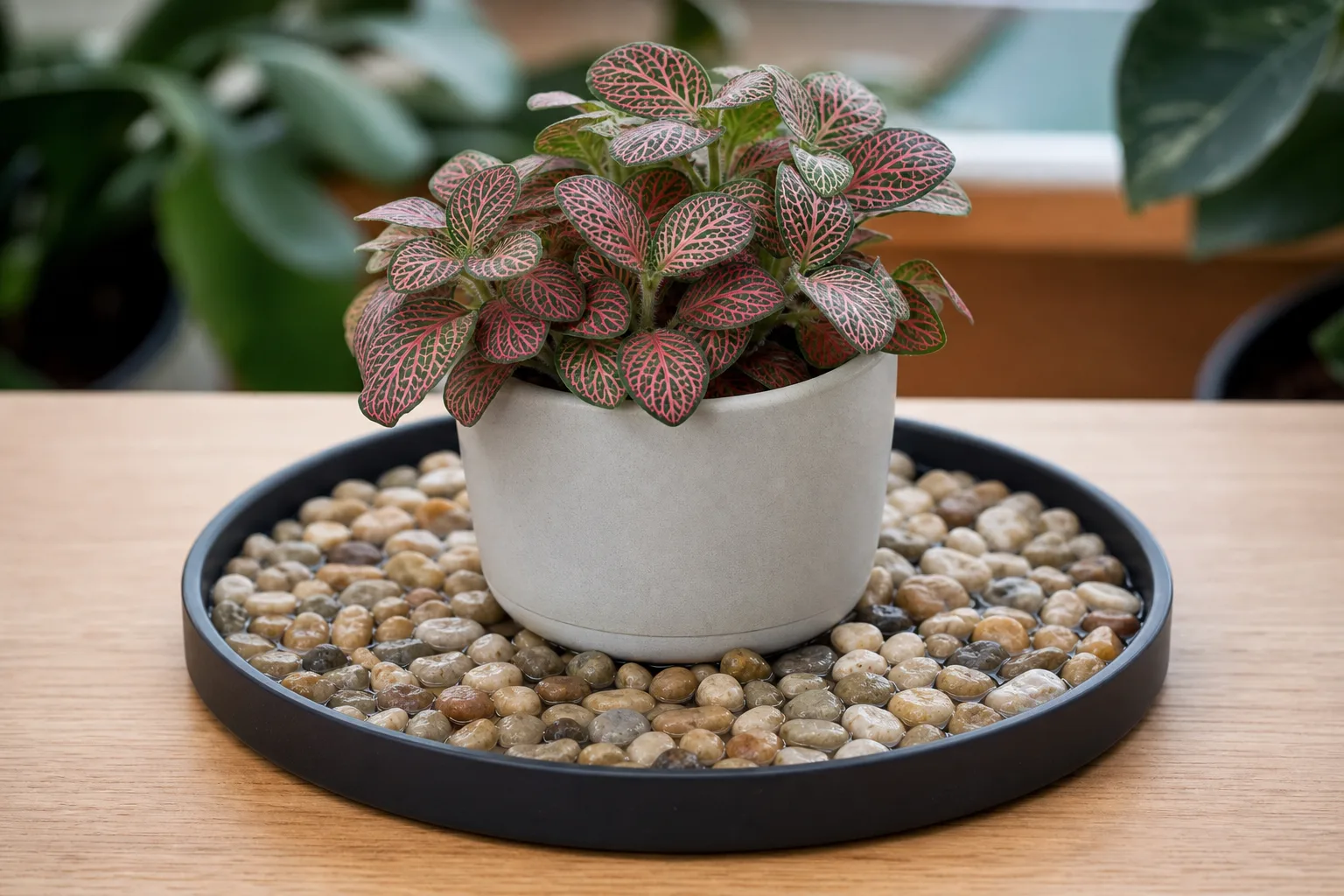
A pebble tray can be a pleasant local support, but it should be built correctly: the pot rests on pebbles above the water line, the tray is wider than the pot, and the water never reaches the drainage hole. It may help the immediate microclimate, but it will not rescue a Fittonia in a dry blast from a heater or make a dark room suitable. Misting raises humidity only briefly and can leave foliage wet without changing the room’s average humidity, so do not rely on it as the central solution.
Fertilize for Leaves, Not Just Fast Growth
Feed during active growth with a balanced liquid houseplant fertilizer diluted according to the label, or weaker if the product is concentrated and the plant is in a small pot. A monthly application is a reasonable conservative starting point; a faster-growing plant in bright light may use more, while a dim, cool plant needs less. Moffatt’s practical Fittonia guide suggests feeding weekly or fortnightly during the growing season, which can work only when the product is used at its label strength and the plant is actively growing. Moffatt’s Fittonia care guide is best read as a practical schedule, not proof that every indoor Fittonia needs weekly fertilizer.
Never fertilize a bone-dry root ball. Water first, then feed the next time or apply diluted fertilizer to already moist soil. Pause feeding after repotting until the plant resumes growth, and reduce or stop in a dim winter period. Brown edges, a white crust on the soil, or a sudden decline after feeding are reasons to flush the mix with plain water and reassess, not reasons to add more fertilizer.
Prune for a Low, Full Carpet
Fittonia naturally creeps, but indoor plants can become open and leggy when light is insufficient or when old stem tips are never pinched. Use clean, sharp scissors to cut just above a leaf node. Removing the growing tip encourages side shoots below the cut, so several light pinches over time are usually better than one severe haircut.
Prune when the plant is actively growing and hydrated. Remove yellow, dead, or damaged leaves at their base, but do not strip healthy foliage just to force a shape. Rotate the pot every week or two so one side does not stretch toward the window. If stems are long and thin again soon after pruning, solve the light problem before cutting more; pruning cannot supply the energy that weak light withholds.
Small flower spikes may appear in very good conditions. They are not a sign that the plant is failing. The blooms are modest compared with the foliage, so you can pinch the spike when it emerges if your priority is a dense leaf carpet, or leave it if you want to observe the plant’s full growth cycle.
Repotting: Timing, Container, and Root Check
Repot when roots circle the container densely, emerge from the drainage hole, the mix has become compact and difficult to re-wet, or the plant dries far faster than it used to. Do not repot merely because the calendar says spring has arrived. A healthy Fittonia with a stable root ball can remain in the same pot while you refresh the top layer and correct the watering routine.
When repotting is justified, move up only one container size—roughly 1 to 2 inches wider than the root ball or current pot. A giant upgrade creates a large wet volume around a small root system. Slide the plant out, inspect the roots, loosen only the outermost circling roots, and remove mushy brown tissue with sterilized scissors. Set the crown at the same height as before, fill around it with fresh mix, and water once to settle the soil.
Repot in spring or early summer when the plant is making new growth, unless there is an urgent root problem. Afterward, return it to bright indirect light, keep the mix evenly moist but not saturated, and hold fertilizer until you see fresh growth. Some leaf droop after the move is normal; persistent decline combined with wet soil means the new pot or mix may be too large or too slow-draining.
Propagate from Stem Cuttings
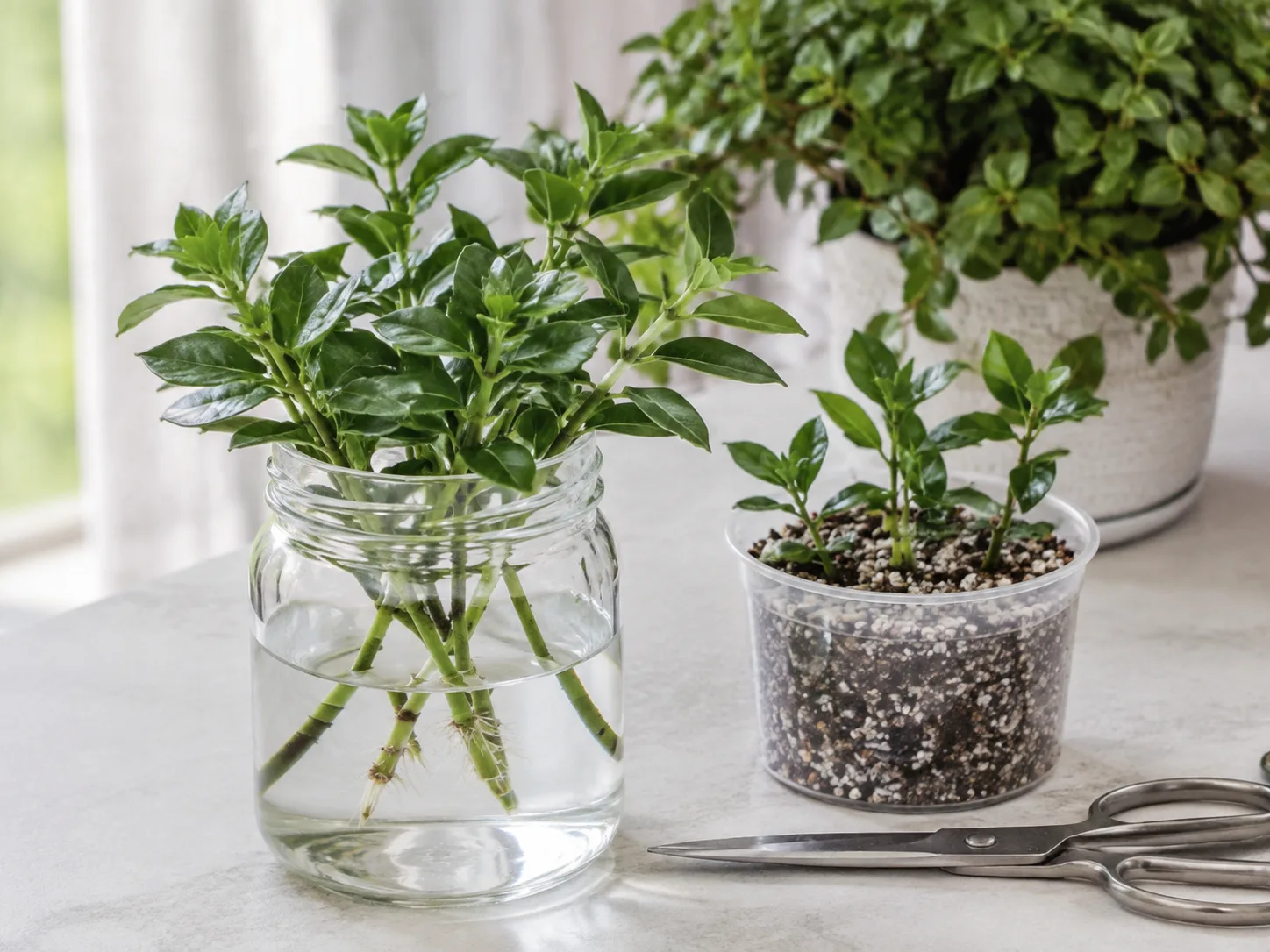
Stem cuttings are the simplest way to make more Fittonia. Select a healthy, non-flowering stem tip with several leaves. Using clean scissors, cut just below a node—the small joint where a leaf joins the stem—because roots form most reliably from that area. Remove the lowest leaves so none will be buried or sit in water.
Use a small pot of pre-moistened, airy mix for soil propagation. Insert one node below the surface, firm the mix gently, and cover the pot with a clear bag or place it in a naturally humid enclosure. Keep it warm and bright but out of direct sun. Open the cover briefly each day if condensation is heavy. New growth and gentle resistance when you tug the cutting are better signs than a fixed number of days.
Garden Design notes that creeping Fittonia stems may root where they touch soil, so a rooted section can sometimes be separated and potted. This is especially useful when a spreading plant has already formed roots at several nodes. Its propagation guidance also flags an important legal edge case: check the plant tag for patent or trademark information before propagating a named commercial cultivar, because some plants are protected from unlicensed reproduction.
Soil vs. Water Rooting
Water rooting lets you see roots develop and can be a good teaching method, but the cutting must be transferred to soil without delay once it has a useful cluster of roots. Keep only the node underwater; leaves and most of the stem should stay above the jar. Change the water when it becomes cloudy and keep the jar in bright indirect light.
Soil rooting is less visually dramatic but produces roots that are already adapted to the medium where the plant will live. It also avoids the shock of moving delicate water roots into potting mix. For either method, the parent plant should be well hydrated and actively growing, and the cutting should not be so large that it loses water faster than it can root.
Fittonia Cultivars and Display Ideas
Most houseplant Fittonias are forms or hybrids related to F. albivenis, with the same low, spreading habit but different vein colors and leaf sizes. The Argyroneura group is associated with white or silvery venation; the Verschaffeltii group is associated with pink or red venation. Cultivar names change across growers, so judge a plant by its current leaf pattern, vigor, and size rather than assuming every label represents a distinct species.
Small-leaved forms suit a closed or semi-closed terrarium, where humidity is naturally high and the scale looks intentional. Larger-leaved or strongly colored forms make a better focal point in a shallow pot or as a trailing edge on a shelf. Place different colors together only when their light and watering needs match. A pink-veined Fittonia that is kept too dim may lose intensity, while a variegated form exposed to hot sun can scorch more quickly than a darker green plant.
Outdoors, use nerve plant only in a frost-free, shaded climate where soil stays consistently moist and the plant can be protected from harsh sun. Missouri Botanical Garden and NC State Extension place its outdoor perennial use around USDA Zones 11–12. In colder climates, treat it as an indoor plant rather than gambling on a brief summer planting that will be damaged by the first cold night.
Flowers, Leggy Growth, and Other Normal Changes
Nerve plant is grown primarily for its patterned leaves. It may produce short spikes of small, pale flowers, but indoor flowering is uncommon and the display is usually less impressive than the foliage. Removing the spike is optional and mainly a shape-and-energy choice, not a treatment for disease.
Older leaves may yellow and drop as part of normal turnover, especially when a dense plant shades its own lower stems. One aging leaf with firm surrounding growth is different from several leaves yellowing while the mix stays wet. Similarly, a little trailing is normal; long gaps between leaves, weak stems, and fading color point more strongly to insufficient light.
The plant can also look temporarily worse after relocation, repotting, or a sudden humidity change. Give it stable conditions for a couple of weeks before making another major adjustment. Constantly moving a stressed Fittonia from window to bathroom to grow light makes the diagnosis harder and adds more stress than the original problem.
Diagnose Yellow, Brown, or Drooping Leaves
Read the whole pattern rather than assigning every symptom to one cause:
- Soft, limp leaves with dry mix: Water thoroughly and check the plant again after a few hours. If it repeatedly collapses, shorten the interval by improving light and using a smaller, more evenly drying pot—not by keeping the pot permanently wet.
- Yellow leaves with wet, heavy soil: Pause watering and inspect the roots. Poor drainage, a pot that is too large, or a saucer holding runoff can keep the root zone oxygen-poor.
- Crisp brown edges or bleached patches: Check direct sun, heater drafts, and dry air. Move the plant away from the stress source and remove only tissue that is fully dead.
- Leaf drop after a move: Check cold glass, vents, and abrupt changes before changing fertilizer or soil.
- Pale color and stretched stems: Increase usable light gradually. Do not compensate for low light with extra fertilizer; that often produces weak growth rather than a compact plant.
Brown tips rarely turn green again. Judge the correction by the next leaves: healthy new growth shows that the environment is improving, while continued damage means the first diagnosis or the most obvious fix was incomplete.
When the Problem Is Probably Roots
Unpot the plant if yellowing is spreading, the soil remains wet much longer than before, the pot smells sour, or wilt persists despite moist soil. Healthy roots are generally firm and pale to tan. Rotten roots are soft, dark, and may shed their outer tissue when touched.
Trim only clearly rotten sections with sterilized scissors. Repot into a clean container with drainage and fresh, airy mix; do not reuse the saturated mix around damaged roots. Afterward, water lightly enough to settle the mix, then follow the moisture check rather than keeping the new pot soaked. If most roots and the crown are mushy, recovery is uncertain; take healthy stem cuttings as insurance before discarding the failing base.
Pests and Safe First Responses
Inspect stems, leaf undersides, and the tight center of the plant when you bring it home and whenever growth changes. Fittonia can attract aphids, mealybugs, scale, thrips, and spider mites; moist soil can also support fungus gnats. Missouri Botanical Garden lists mealybugs, scale, spider mites, slugs, rot, and leaf spots among problems to watch for, while Garden Design highlights common sap-feeding houseplant pests. The Missouri Botanical Garden problem notes are a useful primary reference for this list.
Isolate an infested plant. Wipe visible mealybugs or scale with a cotton swab dampened with rubbing alcohol, testing a small area first, and rinse or shower foliage only when the plant can dry quickly afterward. Sticky traps can help monitor adult fungus gnats, but they do not address larvae in the mix; let the upper layer dry slightly between waterings without allowing the Fittonia’s entire root ball to become desiccated.
Use only a product labeled for the pest and plant, following its current label. “Natural” does not automatically mean harmless to foliage, beneficial insects, pets, or people. The NC State profile tags Fittonia as non-toxic for cats and dogs, but non-toxic is not the same as edible, and any plant material can still cause stomach upset if a pet eats a lot. Keep treated plants away from pets and children until the product label says it is safe.
Seasonal Routine for a Healthy Nerve Plant
In spring and summer, check moisture more often as brighter light and faster growth increase water use. Pinch new growth after the plant has settled into its location, feed modestly during active growth, and propagate cuttings when stems are vigorous. This is also the best time for a planned repot if the roots truly need more room.
In autumn and winter, the room—not the calendar—determines the adjustment. Heating can make the air drier while shorter days slow root uptake, so a plant may need more humidity but less frequent watering. Move it away from cold panes and hot vents, keep the light bright and indirect, and allow the upper mix to dry slightly more if the pot is staying wet. Never continue a summer feeding schedule in a cool, dim room simply because the label says “weekly.”
Once a month, rotate the pot, inspect for pests, look at the drainage hole, and check whether the soil still absorbs water evenly. If water races down the sides or pools on top, the mix may have become hydrophobic or compacted. If the pot never seems to dry, inspect the roots and container size. These small checks prevent the dramatic collapse from becoming the plant’s regular rhythm.
Conclusion
Good nerve plant care is a balance: moist soil without stagnant roots, humidity without wet foliage and dead air, and bright light without leaf scorch. Put Fittonia in filtered light, use a small draining pot with an airy moisture-holding mix, water when the upper mix begins to dry, and empty runoff every time.
When the plant faints, check the soil before reaching for the watering can. When leaves yellow, treat wet soil as seriously as dry soil. Pinch above nodes to keep the plant full, propagate healthy stems, and make seasonal changes gradually. With those decisions in place, the plant’s dramatic habits become useful signals—and its patterned leaves can stay dense, colorful, and healthy for years.