How to Transplant Trees and Shrubs Safely
Learn when to transplant trees and shrubs, how to size and protect the root ball, and what to do during the first year so roots can reestablish.
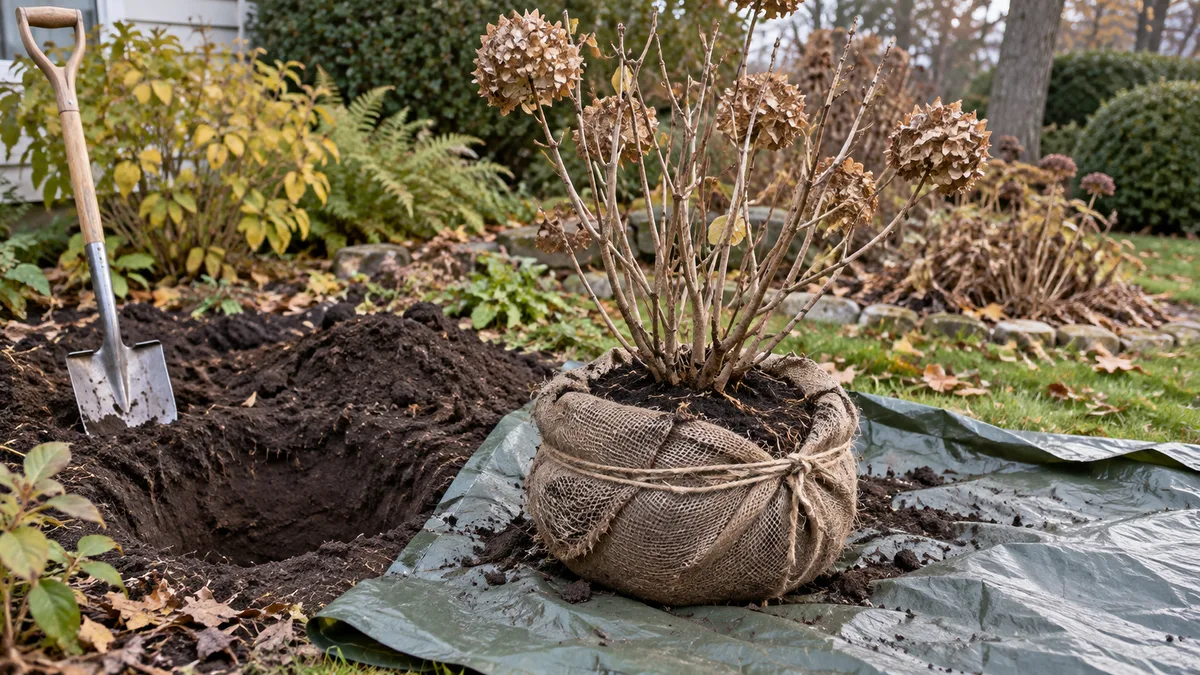
Moving a tree or shrub is possible when you can preserve enough of its roots, move the root system without letting it dry, and place it in a site that suits its mature needs. Those conditions are much easier to meet for a young shrub than for a mature shade tree. Before you pick up a shovel, decide whether this is a hand-movable garden task, a move to prepare for months ahead, or a job for an arborist or landscape contractor with lifting equipment.
Quick answer: timing, site, and root protection
For most established woody plants, plan the move while the plant is dormant or just before active growth begins, choosing a cool period when the soil is workable and not saturated. The best date varies with plant type and climate: a shrub that can be moved in fall in a mild region may be safer in spring where winter arrives quickly, and some species are especially sensitive to fall root loss. Confirm the needs of the plant you have before setting a date.
The work is successful when you retain a practical root ball, keep it shaded and moist from lifting through replanting, and set it at the same depth it grew before. Prepare the new hole first. Afterward, maintain steady moisture through establishment without leaving the roots waterlogged. These are linked decisions: an oversized root ball may be safer for the plant but too heavy to handle; a smaller ball is not a safe shortcut if it removes most of the fine roots.
Decide whether to move it yourself or hire help
Start with the plant’s actual dimensions and access route, not just how tall it looks. Measure the trunk diameter a few inches above the ground for a tree, note its height and spread, and consider how far it must travel. The soil ball can weigh hundreds of pounds even when it appears compact; Clemson Extension notes that a soil ball only 15 inches across and deep can weigh 200 pounds or more. A tarp helps drag a manageable ball, but it does not make an unsafe lift safe.
When a small transplant is manageable
A young shrub or small tree with a root ball you can lift without straining is the best candidate for a do-it-yourself move. You also need a clear path between locations, a new hole prepared in advance, and soil that is moist enough to hold together but not so wet that it collapses or smears. A helper can guide the root ball and keep the trunk upright, but the root ball—not the trunk—should bear the lifting force.
Container-grown shrubs and small bare-root dormant plants are often simpler than digging a mature specimen from the ground, though each has its own root-handling requirements. If the plant is valuable, unusually old, difficult to transplant, or growing in loose sandy soil with roots spreading far beyond its canopy, assume the root ball will be larger than a quick estimate suggests. A plant that has been in place for years can still be moved, but its chances depend on how much functional root system you can safely retain.
When to pause or call an arborist
Hire a qualified arborist or experienced landscape contractor when the trunk is large, the root ball is beyond safe manual handling, overhead limbs or tight access complicate the move, or the plant is near a building, retaining wall, septic system, or utility corridor. Some trees need mechanical spades, rigging, or staged root pruning. The right equipment protects the plant and prevents crushed limbs, back injuries, and damage to hardscape.
Before digging anywhere in the United States, request utility marking through 811 or the appropriate local service and wait for marks to be completed. The service identifies many public underground lines, but it may not locate private irrigation, lighting, drains, or other owner-installed services. Check those separately. If utilities cross the planned route, the plant is protected by a preservation order, or the move could affect a neighbor’s property, stop and get local professional guidance.
Choose a new site before digging
The new location should be ready before the plant leaves the ground. Check mature height and width, sunlight, drainage, soil pH needs, wind exposure, and clearance from buildings, pavement, overhead wires, and underground infrastructure. A shrub that needs reliably moist soil should not be moved into a hot, dry strip beside a foundation simply because that spot is open. Matching the site to the plant reduces future stress after the inevitable root loss of moving.
Look at how water behaves after a heavy rain. If the proposed hole stays flooded or has a compacted layer below it, planting the root ball there may leave it sitting in water; loosening a deep layer only at the bottom can create a settling pocket that drops the plant below grade. Instead, choose a better-drained site or correct the broader drainage problem. For a tree, preserve a broad, stable root zone and avoid placing the trunk flare where soil or paving will later bury it.
Mark the current north-facing side of the trunk if orientation matters for a wind-exposed or sun-sensitive plant, and make a quick sketch of its position before digging. Replanting with the same side facing a similar exposure can reduce abrupt changes in sun and wind. It is a useful precaution, not a substitute for choosing an appropriate site or protecting the roots.
Pick the least stressful season
Cool weather lowers water demand while the plant repairs and replaces roots. For many deciduous trees and shrubs in temperate climates, the dormant period after leaf drop in fall or before bud break in early spring is a practical window. Avoid digging into frozen ground, and avoid moving a plant into heat, drought, or a period when new growth is expanding rapidly unless there is an urgent reason and you can provide the extra care it needs.
Timing is not a simple “fall is best” rule. The amount of time a plant has to reestablish roots before hard freezes, the soil’s drainage and temperature, local rainfall, and the species all matter. In cold-winter areas, an early spring move often provides a longer rooting season. In milder climates, fall may work well if the soil stays warm and moist long enough for new roots to form. University extension guidance should take precedence over a generic calendar for locally sensitive plants.
Deciduous trees and shrubs
Deciduous plants have no leaves during dormancy, so they lose less water through foliage while their disturbed roots recover. Move them after leaf fall, once the plant is dormant, or in early spring before buds swell. A newly moved plant still needs monitoring: dormancy reduces demand but does not make bare roots or an exposed root ball immune to drying.
Some plants with thick or fleshy roots, including several species commonly cited by extension services such as magnolia, oak, birch, dogwood, rhododendron, and hemlock, may be less forgiving of fall root disturbance. Clemson’s regional guidance favors spring for a number of these plants. Treat that list as a reason to check species-specific recommendations, not as a universal rule for every cultivar, climate, or locally adapted plant.
Evergreens and species-specific exceptions
Evergreens continue losing water through their foliage, including in winter when soil is cold or frozen and roots cannot replace that moisture. This makes an exposed root ball especially risky. Early spring is often a sensible choice in cold regions; late summer or early fall can work in some climates if the plant has time to establish before freezing weather. Protect foliage and roots from wind during the move, and do not leave an evergreen sitting bare-root while you finish preparing the site.
Broadleaf evergreens such as rhododendrons and narrowleaf evergreens such as arborvitae do not have identical root systems or tolerances. Likewise, a shallow-rooted small shrub is not equivalent to an older taprooted tree. Check a local extension service, botanical garden, or knowledgeable nursery for the species, and move only when the ground is workable and the forecast offers a reasonable recovery period.
Prepare large plants with root pruning
For a substantial tree or shrub that must be moved later, root pruning is advance preparation—not a last-minute step on moving day. Roots often extend far beyond the soil ball a person can lift. Cutting selected roots months beforehand encourages new feeder roots to form nearer the trunk, so more of the plant’s functioning root system can travel with it. The timing and method matter; a poorly timed or overly aggressive cut can add stress instead of reducing it.
Clemson Extension describes root pruning in the season opposite the planned move for dormant deciduous plants: for example, pruning in spring before an autumn move, or in fall after leaf drop before a spring move. UF/IFAS guidance for field-grown trees similarly describes staged pruning, keeping the cut trench backfilled and the root zone moist, then completing the root-ball cut after a period of regrowth. The UF/IFAS schedule is tailored to field-grown tree relocation and should not be applied mechanically to every backyard shrub.
If the specimen is large enough for staged root pruning to be worthwhile, ask an arborist to size and plan the root ball. Root-ball dimensions vary with species, trunk caliper, soil texture, and nursery or industry standards; one universal “feet from the trunk” radius is not reliable. Do not sever a whole circle of major roots at once on a mature tree without a plan for stability, moisture, and the final lift.
Get the tools and protect the work area
For a manageable plant, prepare a sharp spade, pruning saw or loppers for roots within your capacity, sturdy tarp, measuring tape, gloves, hose, mulch, and clean water. A sharp blade makes cleaner cuts than repeated chopping. Twine can gather flexible branches for access, but wrap loosely enough not to damage bark, and remove it as soon as the plant is replanted. If the root ball is too heavy to lift with help, use the right equipment or hire someone; do not improvise with a vehicle or lift by the trunk.
Water the plant and surrounding soil the day before if the ground is dry, aiming for a moist, cohesive ball rather than mud. Clear the route and set the tarp where it can slide close to the plant. Have the destination hole finished, the extracted soil organized for backfill, and helpers ready before the final roots are cut. The less time the plant spends exposed, the less chance its small absorbing roots dry out.
Transplant in a sequence that keeps roots moist
Water and size the root ball
Use plant height and trunk caliper, known species guidance, soil, and the plant’s history to estimate a root-ball size. A broad, shallow root system often extends laterally, while dense clay or compacted ground can concentrate roots differently from loose soil. A quick exploratory cut on one side can reveal where roots begin, but do not dig a narrow trench around the plant and assume you have found the entire root zone. When a table or professional standard gives a minimum, treat it as a minimum, not a guarantee of recovery.
The new hole should generally be wider than the root ball—often about 1.5 to 2 times its width in tree-planting guidance—so roots can encounter loosened soil beyond the original ball. Depth is more important to get right than extra depth: the bottom should be firm and undisturbed so the root ball will not settle. Do not make a deep hole and then fill the bottom with loose amended soil; that is a common route to a tree that sinks below the proper grade.
Dig, lift, and move without breaking it
Tie back low branches only if needed to prevent breakage. Mark the original soil line on the trunk, then dig around the planned ball with the shovel’s back facing the plant where practical, making controlled cuts through small roots. For larger roots, use a sharp saw within a manageable size range; if you encounter major roots that make the ball too large or unstable, stop and reassess rather than cutting indiscriminately. The aim is a coherent ball with as many fine roots intact as you can retain.
Undercut the ball gradually and use the shovel to loosen it from below without prying against the trunk. Slide burlap or a tarp beneath a ball that can be lifted safely, then raise it from the support—not by pulling on branches or the trunk. Keep the ball shaded and covered, and moisten it if the soil begins drying. If the plant cannot be replanted promptly, secure the root ball against breakup and keep it cool and evenly moist; do not leave exposed roots in sun or wind.
Set the plant at the correct depth
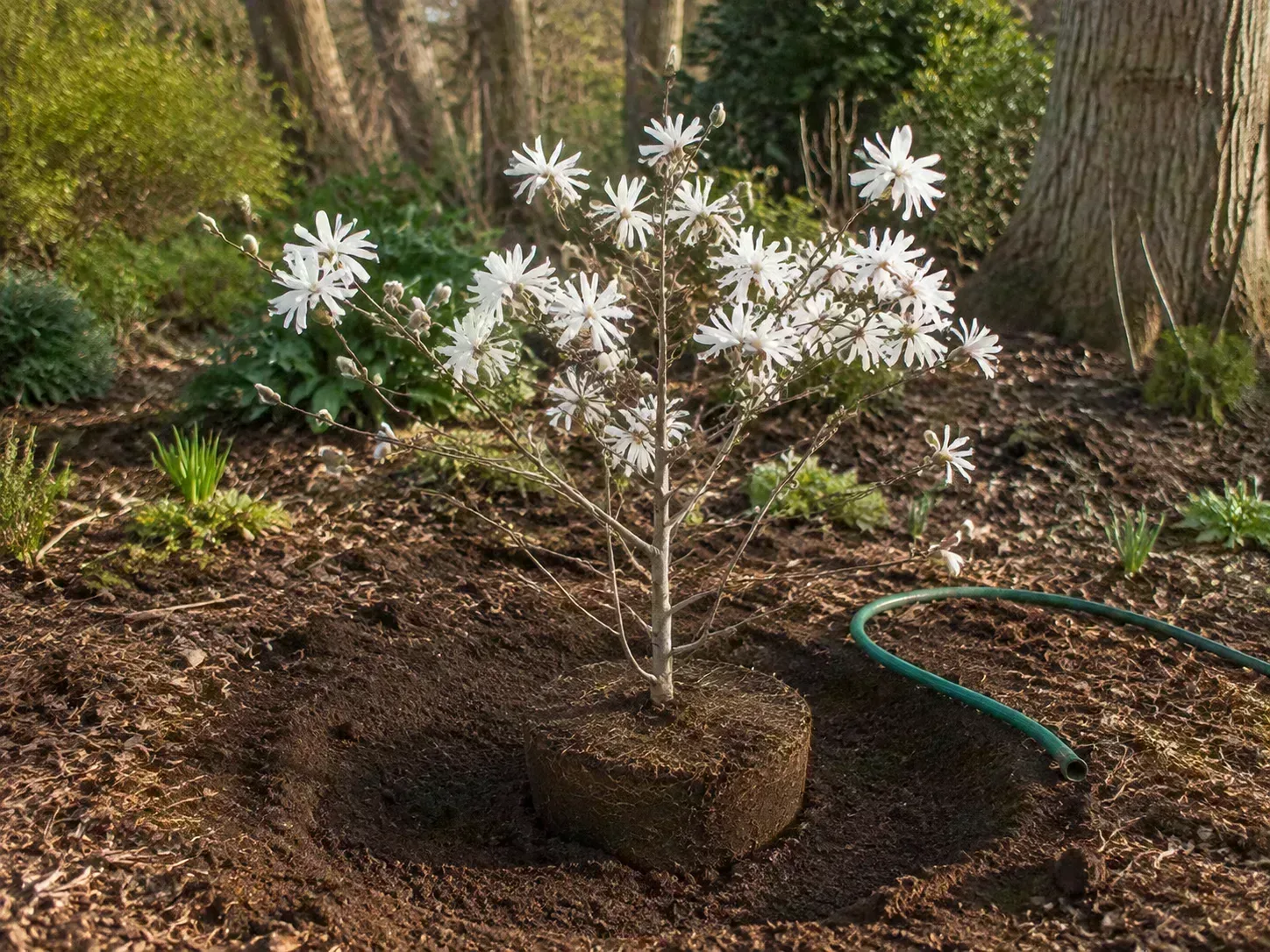
Position the plant upright over firm soil and check the old soil mark and the trunk flare before backfilling. The root flare—the widening point where the trunk transitions into the main roots—should remain visible at the soil surface or slightly above finished grade, allowing for modest settling. For a balled plant, make the hole only deep enough that the root ball sits at the appropriate level. An overly deep hole cannot be fixed by piling mulch against the trunk.
For a container-grown plant, inspect for circling or matted roots and correct them only when necessary and with care; do not pull apart a fragile root ball just because it is exposed. With balled-and-burlapped stock, follow local expert guidance on packaging: remove synthetic materials, rope, and wire that could constrict roots or trunk; peel natural burlap away from the top and sides where accessible, while avoiding tearing apart the ball. If a wire basket supports a heavy ball, cut back or remove the accessible upper portion once the ball is secure. Clemson Extension notes that pulling fabric from beneath a heavy ball can injure roots.
Backfill with the soil you excavated unless a soil test or broader site plan indicates otherwise. Add soil in stages and settle it with water or gentle hand pressure so large voids close without compacting the planting zone. Do not stomp hard or tamp until the soil becomes dense; roots need air as well as moisture. Water once after the first backfill, finish filling, and water again if the soil settles, keeping the trunk flare uncovered.
Water and mulch through establishment
Water immediately after planting to settle soil around the root ball. Then check moisture at the root ball itself, not only at the surface or several inches away: the old root-ball soil and the surrounding backfill can dry at different rates. If the root ball is dry, water slowly so moisture reaches its full depth. If it is still damp or the site drains poorly, wait; continually saturating the roots can be just as damaging as letting them dry.
There is no single weekly schedule that fits every transplanted tree. Sandy soil, windy weather, full sun, small root balls, and warm spells can shorten the interval; clay, shade, rain, or low spots can lengthen it. During the first growing season, inspect often and adjust to actual conditions. Keep checking after rain because a brief shower may wet the lawn without soaking the root ball, while repeated storms may leave the deeper soil waterlogged.
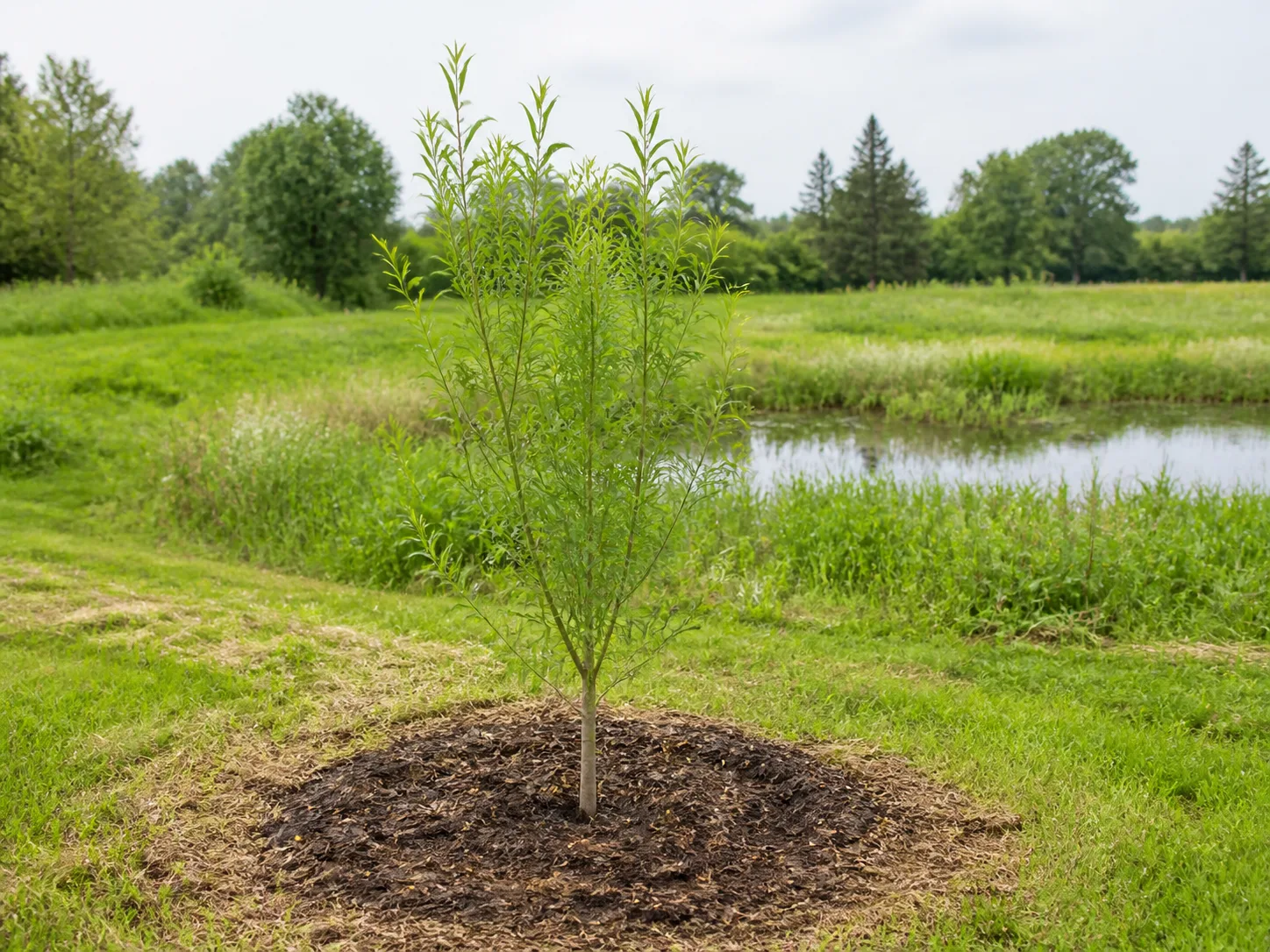
Spread a 2- to 3-inch layer of organic mulch over the root zone to moderate soil temperature and slow moisture loss, extending it beyond the immediate trunk where practical. Leave a clear gap around the trunk and root flare; piled mulch traps moisture against bark and conceals planting depth problems. Renew mulch only when it has thinned rather than building a deep mound each season.
Avoid pruning, fertilizer, and unnecessary staking
Do not compensate for root loss by cutting back a healthy canopy heavily. Leaves supply energy for root recovery, and drastic pruning removes that source while creating additional wounds. Remove only branches that are broken, dead, diseased, or dangerous, using appropriate clean cuts. Save routine shaping for after the plant has recovered, and follow the species’ normal pruning calendar so you do not sacrifice next season’s flowers.
Skip high-nitrogen fertilizer at planting unless a soil test and local recommendation call for a specific nutrient correction. Fresh fertilizer is not a transplant-shock remedy; encouraging top growth before a reduced root system can support it may worsen imbalance. Fine Gardening’s planting guidance also cautions against early fertilizing and routine pruning while roots reestablish. Compost or amendments should not be placed as a concentrated layer in the hole without a soil-based reason, because a sharp difference between amended fill and native soil can interfere with water movement.
Stake only if the root ball rocks, the site is exposed, or the plant cannot remain stable. Stakes should hold the base steady while allowing some trunk movement; rigidly tying the crown can reduce natural movement that helps the trunk strengthen. Check ties regularly for rubbing and remove supports once the plant is anchored—often by the end of the first growing season, though site conditions may justify a different interval. Do not stake a stable shrub simply because it has been moved.
Diagnose transplant shock without overreacting
Temporary wilting, a few yellowing leaves, or slowed growth can follow root loss, especially during the first hot or dry period. These signs do not by themselves prove the plant is dying. Check the root ball for moisture first, then examine whether leaves are scorched on the sun- or wind-exposed side, whether the planting site drains, and whether the root flare is buried. Correct the condition you find instead of giving fertilizer, extra pruning, or daily soaking as a reflex.
A plant that repeatedly wilts while the root ball is wet may have damaged roots or poor drainage; adding more water can make the problem worse. A plant that wilts by afternoon but recovers overnight may be showing temporary water stress, while persistent browning or progressive dieback deserves closer inspection. Keep foot traffic, lawn equipment, and competing weeds away from the disturbed root area, and protect the root zone from drought while avoiding soil compaction.
Recovery is measured in seasons, not just a few days. Some woody plants produce little top growth while rebuilding roots, and a transplanted shrub may take months to look settled. Watch for firm buds, healthy new leaves, and stable moisture rather than expecting immediate flowering or a growth flush. If the trunk leans, the root ball lifts when the plant moves, or dieback spreads despite appropriate moisture and depth, consult a local arborist or extension office for diagnosis.
Conclusion: let the roots catch up
The safest transplant begins with an honest size assessment and a prepared destination. Move a small, manageable plant in a cool, species-appropriate window; preserve a broad, intact root ball; set it at its original depth; and keep the root zone evenly moist without saturating it. A large or valuable tree needs advance planning and often professional equipment, particularly if it requires staged root pruning.
Before you dig, locate utilities, confirm the new site fits the plant, and decide who can safely handle the root ball. If any of those pieces is uncertain, pause and get local advice. Once the plant is in place, protect the roots from drying and give them time to reestablish before asking for new growth.
Sources: Clemson Cooperative Extension, Transplanting Established Trees and Shrubs UF/IFAS Extension, How to Root Prune and Transplant Field-Grown Trees and Shrubs Fine Gardening, Planting Trees and Shrubs the Right Way Go Gardening, Transplant Shrubs and Small Trees



