How to Grow and Care for Creeping Fig
Keep Ficus pumila lush and compact with practical advice for light, watering, humidity, training, pruning, propagation, and leaf-drop problems.
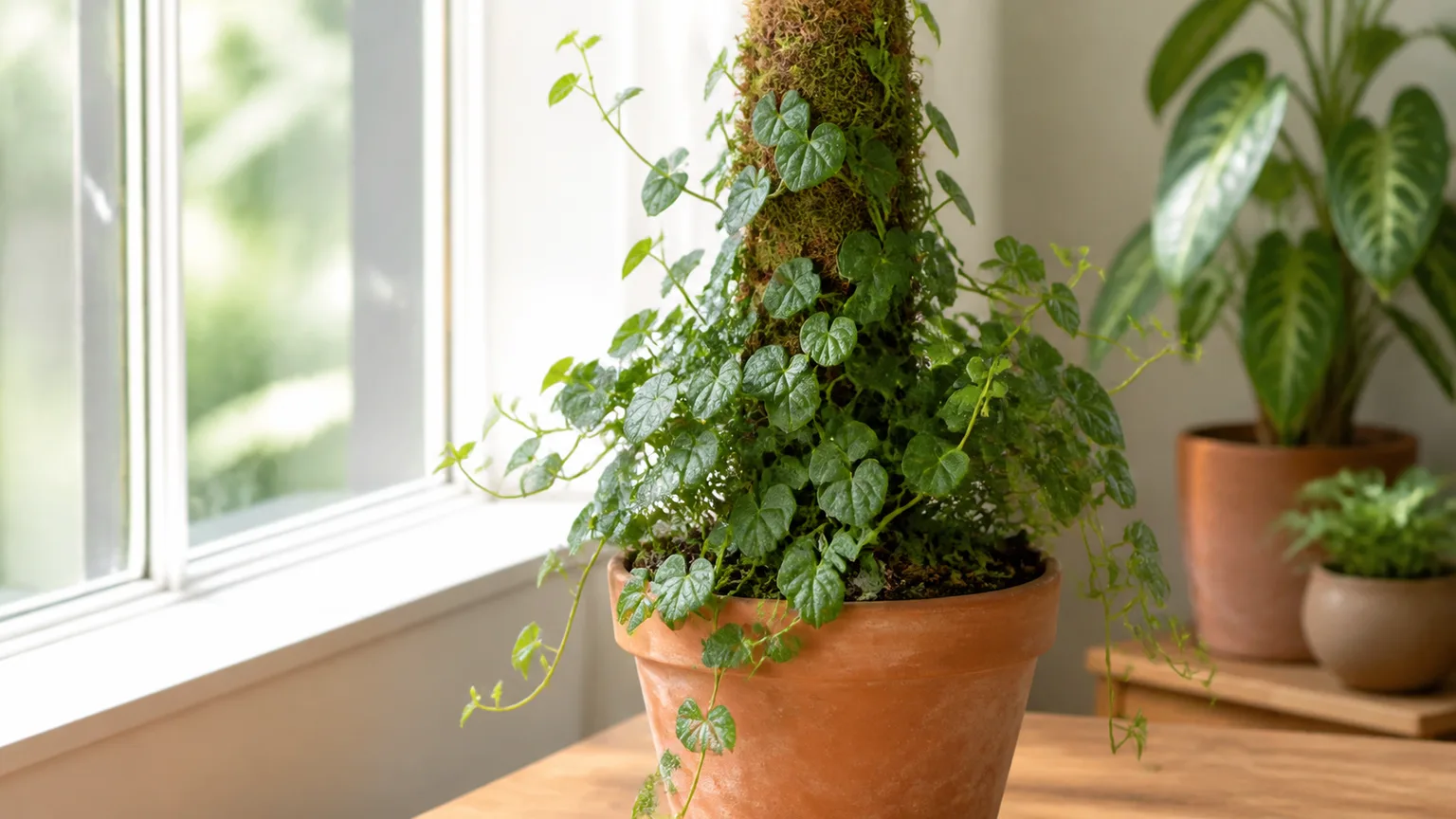
Creeping fig (Ficus pumila) is easiest to keep attractive when you treat it as a moisture-loving juvenile vine, not as a drought-tolerant tree fig. Give it bright filtered light, a pot with a real drainage hole, soil that stays lightly moist but airy, and enough humidity to prevent rapid swings. Then decide whether you want the stems to trail, climb a removable support, or stay compact through regular tip pruning.
The plant rewards consistency, but it is not perfectly forgiving. A dry root ball, hot direct sun, a draft, or a pot that stays wet can all trigger brown leaves and leaf drop. The details below are designed to help you read those signals and correct the cause without piling on several changes at once.
Creeping Fig at a Glance
| Need | Practical target |
|---|---|
| Light | Bright, filtered or indirect light; gentle morning sun is usually safer than hot afternoon sun |
| Water | Keep the root zone lightly and evenly moist; let only the surface begin to dry |
| Soil | Soil-based, moisture-retentive mix amended for drainage |
| Humidity | Stable moderate-to-high humidity; around 50% or higher is a useful indoor target |
| Temperature | Stable household warmth, away from drafts and heating or cooling vents |
| Feeding | Light feeding during active growth; pause or greatly reduce in winter |
| Shape | Trail, or train onto a mossy support or trellis; prune tips to maintain density |
| Safety | Keep away from pets and handle the milky sap carefully |
The plant is a broadleaf evergreen woody climber in the mulberry family. North Carolina State Extension describes it as a vigorous vine native to eastern Asia that can climb and spread substantially outdoors, while the Missouri Botanical Garden Plant Finder lists it as a part-shade vine that is rarely flowering indoors. Those outdoor dimensions are useful context, not a prediction that your potted houseplant will reach them.
Understand Juvenile vs Adult Growth
The small puckered leaves sold as “creeping fig” are juvenile foliage. They are typically small, heart-shaped, and packed closely along flexible stems. This is the form that looks good trailing from a shelf, filling a terrarium, or covering a small topiary frame. NYBG explains that indoor plants are usually immature and that their care reflects the moist, protected conditions of a tropical canopy. New York Botanical Garden’s creeping-fig guide is especially helpful for understanding why an indoor specimen can be more demanding than other fig houseplants.
With maturity, some stems change character. Adult shoots become woodier, extend away from the support, and carry larger, thicker leaves; outdoor plants may also flower and produce fig-like fruit. The mature form is not a sign that you suddenly did something wrong. It is a normal life-stage shift, although many indoor growers prefer the juvenile look and renew the plant from cuttings when older growth becomes coarse.
This growth pattern changes how you prune. A light trim that keeps young tips branching can preserve a compact display, while allowing a vigorous stem to run for years may encourage larger adult growth. If your goal is a small-leafed houseplant, prune early and propagate healthy juvenile tips rather than trying to force every old branch back into its original form.
Choose the Right Indoor Location
Place creeping fig in a bright room where direct midday or afternoon sun does not strike the leaves. An east-facing window is often an easy fit; a south-facing window can work if the plant is set back or filtered by a sheer curtain. The best location is not the brightest-looking spot for five minutes at noon but the place that gives steady light for much of the day without a hot glass-and-leaf temperature spike.
Keep the pot away from air-conditioning outlets, radiators, forced-air heat, frequently opened exterior doors, and cold window glass. Sudden changes in temperature and humidity can cause leaf drop even when the room’s average temperature seems acceptable. If you move the plant from a dim shop or nursery into a much brighter home, give it several days to acclimate rather than placing it immediately in the strongest available light.
Adjust Light for Green and Variegated Plants
A green creeping fig can make a good adjustment to bright filtered light and may survive in a somewhat dimmer room, but growth will slow and the vine can become sparse. Stretching between leaves, small new leaves, and a plant that is green only at the window-facing side are stronger evidence of insufficient light than a single leaf turning yellow.
Variegated forms need a little more light to hold their pale markings. In a dark room, new growth may lose variegation or revert toward green. More light does not mean baking the leaves in direct summer sun: increase brightness gradually, watch for bleached or crisp patches, and use a curtain or a greater distance from the window if the leaves heat up.
Build a Moisture-Managed Root Zone
Creeping fig wants moisture, but its roots still need air. Use a conventional soil-based houseplant mix with enough organic matter to hold water, plus perlite or another coarse component to keep excess water moving through. Avoid dense garden soil in a container; it can compact around the roots and remain wet far longer than the foliage suggests.
The container matters as much as the recipe. Choose a pot with at least one open drainage hole, and never treat a decorative cachepot without a hole as the plant’s permanent growing pot. You can use a nursery pot inside a decorative cover, but remove the inner pot for watering, let it drain fully, and empty any water that collects in the cover.
Do not add a thick layer of gravel to the bottom as a substitute for drainage. It reduces the depth of usable soil without fixing a perched water table. A free-draining mix, a properly sized pot, and a place where the pot can drain are the useful controls.
Water by Soil, Not Calendar
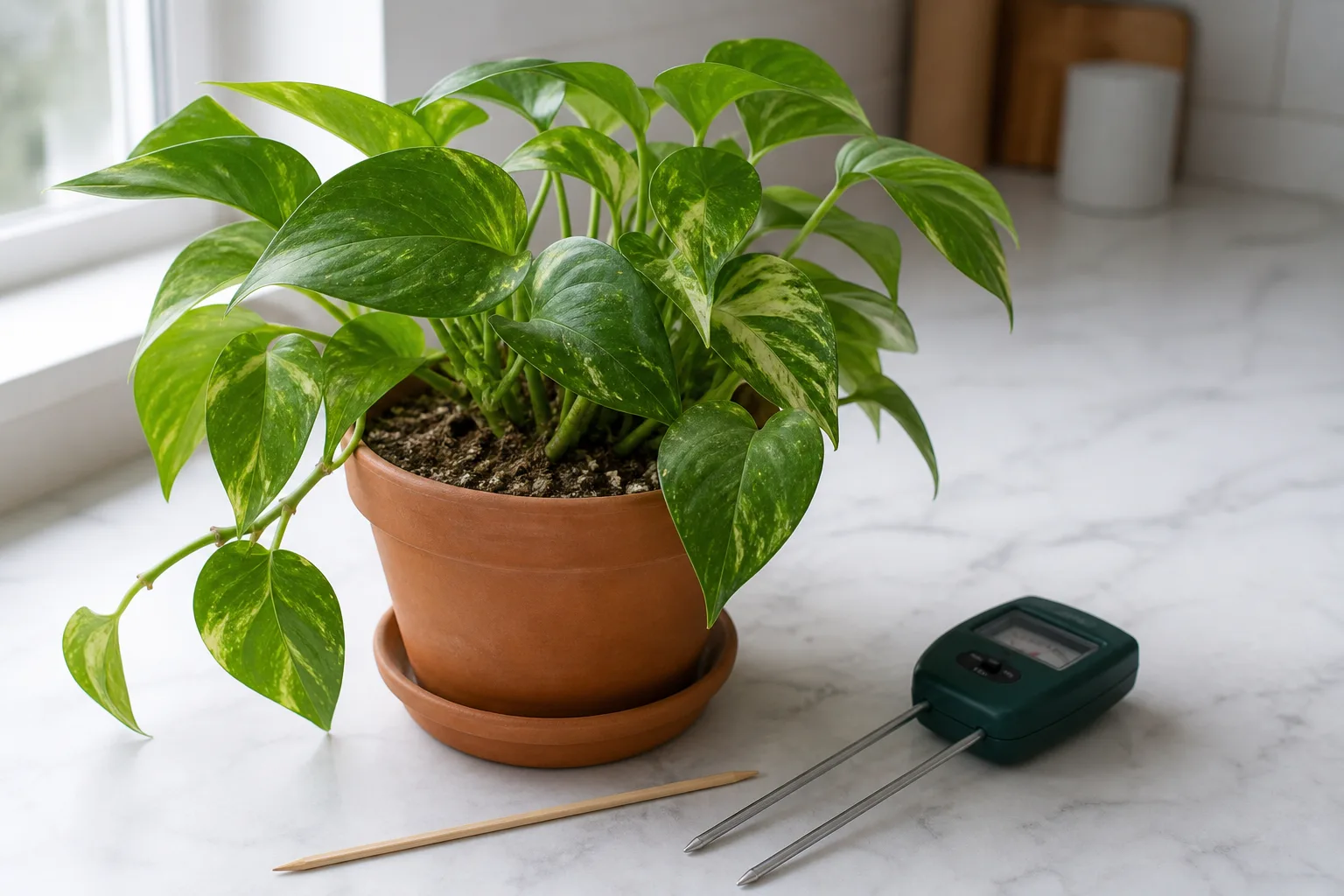
Check the top half-inch to inch of mix with a finger or a wooden skewer, then lift the pot if you can. Water when the surface has just begun to dry and the container feels lighter, not automatically every seven days. The interval may be several days in bright summer light and considerably longer in a cool, dim winter room.
When it is time to water, saturate the mix slowly until water exits the drainage hole. This wets the whole root ball and helps flush accumulated fertilizer salts. Wait about 10 to 15 minutes, then empty the saucer or cachepot. Repeatedly adding a small splash to a dry surface can leave the inner root ball dry while the top looks damp.
Use the leaves as a secondary clue, not as the watering schedule. Crisp edges, a light pot, and soil pulling from the pot wall point toward dryness or dry air. Persistently wet mix, a sour smell, yellowing combined with wilting, or a plant that stays heavy for many days point toward a root-zone problem. A moisture meter can help with a large pot, but verify it in more than one spot because roots and pot edges do not dry evenly.
Keep Humidity Stable Without Wet Soil
Stable humidity helps creeping fig hold moisture in its small leaves while the root zone remains airy. NYBG recommends maintaining humidity above 50% when possible and notes that winter heating and summer air-conditioning can make the plant’s environment fluctuate quickly. A small hygrometer near the foliage is more useful than guessing from how humid the room feels to you.
A cool-mist humidifier is the most dependable option for a very dry room, provided you clean and maintain it according to the manufacturer’s instructions. Grouping plants can soften dry air locally. Misting may briefly wet the leaves, but it is not a lasting humidity system and repeated wet foliage in stagnant air can create a less favorable environment.
A pebble tray can modestly raise humidity immediately around the pot if the pot sits above the waterline on the stones. The root pot should never stand in water. Think of the tray as a small buffer, not a cure for a room that is extremely dry or a plant sitting beside a heat vent. Moving the plant to a naturally stable location is often the better first fix.
Feed for Steady Vines
Feed only when the plant is actively growing and the root zone is already healthy. A balanced liquid houseplant fertilizer diluted to the label’s maintenance rate, or weaker if your plant is sensitive, is sufficient. Apply it to moist soil rather than to a bone-dry root ball, and do not feed a plant that is wilted from drought, freshly repotted, or suspected of having root rot.
There is no prize for the fastest vine. Too much fertilizer can cause salt buildup, scorched roots, and leaf drop, while low light means the plant cannot use extra nutrients efficiently. Plantura’s creeping-fig guide recommends feeding established plants during summer growth and notes that many newly purchased plants already have nutrients in their substrate. That is a useful reason to wait before adding fertilizer to a new purchase: observe its light and water response first.
Reduce feeding sharply in late fall and winter when growth slows. Resume gradually when you see fresh growth and brighter seasonal light. If the soil surface develops a crust or the leaves brown soon after feeding, flush the pot thoroughly with plain water on the next appropriate watering and review both fertilizer strength and drainage.
Train or Trail the Vines Safely
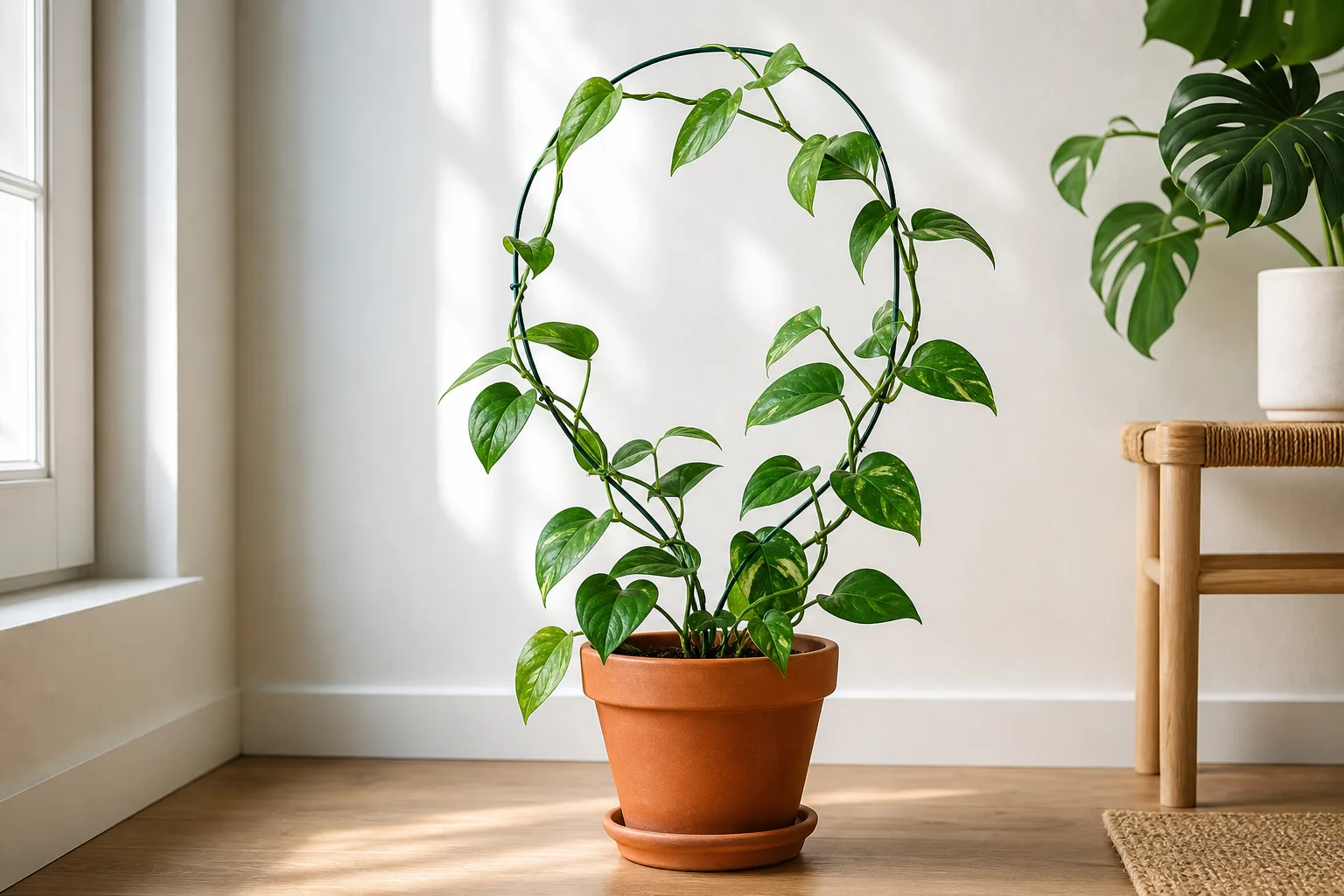
Choose the display before the stems become tangled. For a trailing plant, let vines spill over a shelf or hanging pot, but keep them away from pets and from surfaces that could be stained by sap. For a climbing plant, use a removable trellis, a moss pole, or another rough support that can be repositioned with the pot.
Young aerial roots can grip a textured, damp support. Guide stems gently and use soft ties when needed; do not pull adhesive roots off a wall to force a new direction. A support that is secured to the pot or a free-standing frame is safer than attaching the vine directly to painted drywall, wood trim, or masonry you may later need to repair.
The plant’s own grip is strongest where it can stay in contact with a surface. That is a strength for a conservatory or dedicated garden wall and a liability in a rental or around windows, vents, and painted finishes. Keep the support accessible so you can prune and inspect the underside of leaves instead of allowing a dense mat to become a blind spot.
Prune for Shape and Juvenile Foliage
Prune creeping fig whenever a stem is crossing a window, dragging on the floor, or making the pot look one-sided. Use clean, sharp scissors and cut just above a leaf node. A node is the point where a leaf or side shoot joins the stem; cutting near one gives the remaining stem a place to branch.
Light, repeated tip pruning usually gives a fuller result than one severe cut. Step back after every few cuts so you do not create a flat edge or remove all the plant’s active leaves at once. Thin congested areas enough for light and airflow to reach the interior, and remove fully dead or damaged growth.
Wear gloves if the sap irritates your skin, and protect fabric and furniture from the white latex that can seep from fresh cuts. NYBG specifically recommends sterile tools and notes that the latex may stain; a rinse of cool water over a fresh cut can reduce dripping. Wash tools after use and wash your hands before touching your eyes or face.
If an old plant has shifted into larger adult foliage, pruning may improve shape but may not return every stem to the tiny-leaf juvenile form. Take several healthy tip cuttings before a major renovation. This gives you a backup plant and lets you restart a denser display while the original recovers.
Repot Without Overpotting
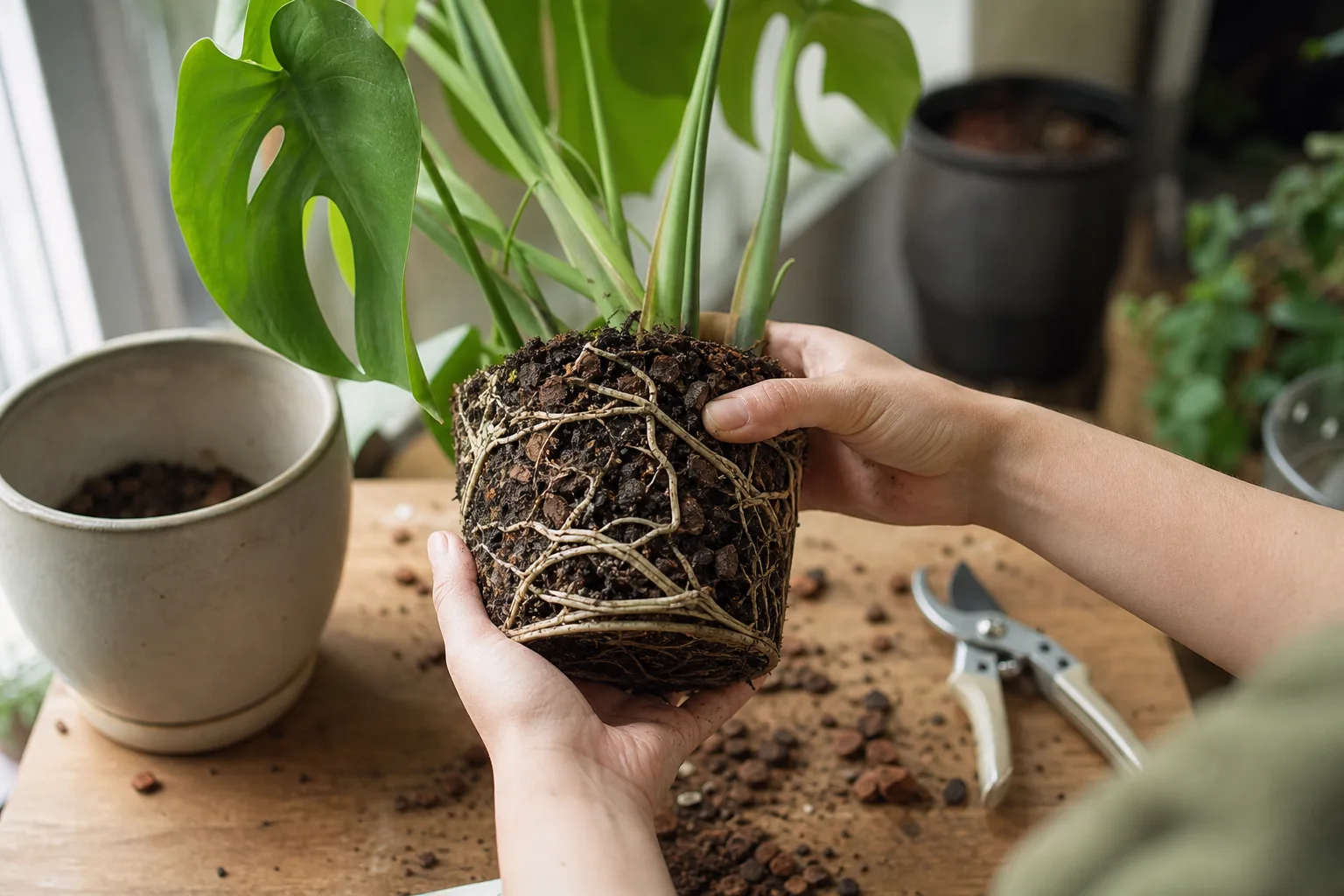
Repot in spring when possible, or when the root system is clearly limiting the plant. Roots circling densely, roots emerging from drainage holes, water running straight through the sides of a tightly packed root ball, or soil that dries immediately after a thorough watering are stronger signs than a date on the calendar.
Use a pot only one size larger, or keep the same pot and refresh the mix after trimming a crowded root ball. Creeping fig tolerates being somewhat root-bound, and an oversized pot holds more wet soil than a small root system can use. NYBG recommends a soil-based mix with added perlite, a drainage hole, and a modest increase in pot size.
Before repotting, water enough to make the root ball hold together but not so much that it is saturated. Slide the plant out, inspect the roots, and remove only roots that are dead, mushy, or clearly collapsing. Set it at the same depth, fill around it with fresh mix, and water once to settle the roots. Keep it in bright indirect light for several days and delay fertilizer while it re-establishes.
Propagate from Stem Cuttings
Stem cuttings are the simplest way to renew a creeping fig and preserve desirable juvenile foliage. Propagate during active growth, ideally in spring or early summer, when the parent plant is making flexible new stems.
- Choose a healthy 4- to 6-inch tip with several leaves and cut just below a node.
- Remove leaves from the lower portion, leaving a small leafy top.
- Insert the node into a small pot of evenly moist, airy propagation mix, or root it in water while keeping leaves above the waterline.
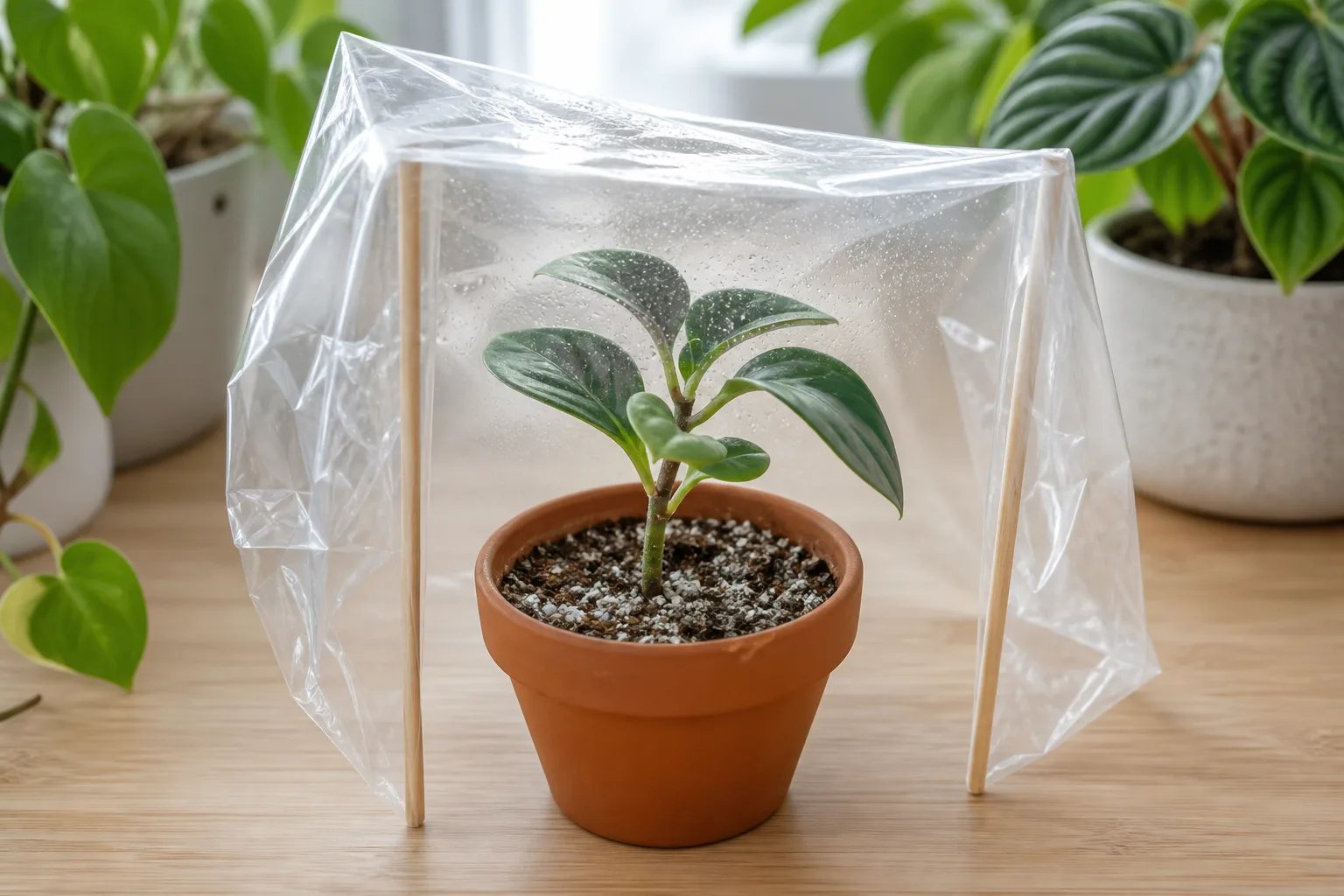
- Cover the pot loosely with a clear bag or place it in a clear propagation chamber, then give it bright filtered light and warmth.
Keep the medium moist but not swampy and open the cover briefly if condensation is constant. New leaves are encouraging, but a gentle tug after several weeks gives a better check for roots. Once the cutting resists, acclimate it to normal room air over several days rather than removing the humidity cover abruptly.
Water propagation makes roots easy to see, but those roots still need to transition into a potting mix. Plant once the roots are a few centimeters long, keep the mix evenly moist at first, and then begin using the same surface-dryness check as an established plant. Soil propagation avoids that transition but requires more patience and careful moisture control.
Try Layering for an Easier Start
Layering is useful when you do not want to risk cutting a valuable parent. Bend a flexible stem into a neighboring pot of moist mix, pin one node against the surface, and leave the stem attached to the parent. Keep that small pot evenly moist and check for resistance after several weeks. Once the node has rooted, cut the connection and let the new plant establish on its own.
Plantura describes layering as a reliable alternative to cuttings because the developing plant continues receiving water and nutrients from the parent while roots form. It is especially convenient for a long trailing stem and avoids placing a fresh cutting in a separate humidity setup. Its propagation guidance makes the same cuttings-and-layering distinction.
Diagnose Common Creeping Fig Problems
Start with the order of events. Ask what changed first: was the plant moved, repotted, pruned, exposed to sun, left dry, or placed near a vent? Then check the root zone and the undersides of leaves before adding fertilizer or spraying anything. Multiple simultaneous treatments make it harder to tell which correction worked.
Brown Leaves and Leaf Drop
Brown, crisp edges on many leaves at once usually point first to a drying problem: the root ball dried too far, the air is very dry, direct sun heated the foliage, or a draft increased water loss. Move the plant out of harsh rays and vents, measure humidity, and check the mix several inches down. Rewater thoroughly if the root ball is dry, but do not keep adding water to a pot that is already heavy and wet.
Whole leaves dropping soon after a move can be environmental shock. Stabilize the plant in one bright location for a few weeks instead of moving it from window to window. If leaf drop continues while the soil stays wet, inspect the roots; a plant can wilt from damaged roots even when the pot contains plenty of water.
Small pale leaves and long gaps between them suggest inadequate light. Improve light gradually, then prune the weakest, barest sections after new growth resumes. Do not fertilize a dim plant in an attempt to make it grow faster; nutrients cannot replace the energy it is missing.
Pests, Root Rot, and Weak Growth
Inspect new growth, leaf joints, and stem crevices for scale, aphids, mealybugs, thrips, and spider mites. NC State Extension lists these pests as problems to watch on Ficus pumila. Isolate a suspect plant, remove visible insects with a careful wipe or water rinse where appropriate, and use only a product labeled for the plant and indoor use, following its directions. Repeat monitoring matters because a single treatment rarely removes every life stage.
Root rot is more likely when the pot has no drain hole, the mix stays wet, or the plant was placed in an oversized container. Unpot it and look for roots that are brown, mushy, or foul-smelling rather than assuming every yellow leaf means rot. Trim only clearly dead tissue with clean tools, move the plant into fresh airy mix in a properly sized pot, and correct the watering interval. If very little healthy root remains, take cuttings as insurance.
Sparse growth can mean low light, root crowding, a recent shock, or the normal transition toward adult growth. Compare the newest leaves with older ones, check whether roots fill the pot, and look for a clear change in the environment. A slow but steady plant in winter is not automatically failing; a spring plant that remains sparse despite good light and correct moisture deserves a root and pest inspection.
Outdoor Growing and Wall-Damage Warnings
Outdoor creeping fig belongs in a separate decision category from a houseplant. It is a warm-climate vine that can cover walls and ground quickly, but cold tolerance and environmental risk vary by region. Missouri Botanical Garden lists it for USDA Zones 9 to 11 and recommends it as an indoor plant or outdoor annual in colder St. Louis conditions; North Carolina State Extension likewise notes that it is not reliably winter-hardy across much of North Carolina.
Before planting it in the ground, check your local extension guidance and invasive-plant assessment. Florida Natural Areas Inventory rates Ficus pumila as a high invasion risk in Florida and reports that it can form dense groundcover and be difficult to control completely. That does not mean every climate should treat a potted indoor specimen as invasive, but it does mean warm-region gardeners should not plant it casually near natural areas or let runners escape a container.
The adhesive aerial roots and pads can cling tenaciously to porous surfaces. UF/IFAS warns that rapid growth and adhesive pads make removal difficult and can damage wooden structures; a house wall, painted siding, or fragile mortar is a poor support. If you grow it outdoors, use a dedicated trellis, sturdy privacy wall, or other surface you are prepared to maintain, keep the planting away from building envelopes, and prune the edges before they reach windows, rooflines, or neighboring plants.
Finally, treat the plant as unsafe for curious pets and children. NC State Extension flags it as a problem for cats, dogs, and horses, and the milky sap can irritate skin. Keep prunings and dropped leaves out of reach, wear gloves if you react to latex, and contact a veterinarian or poison-control professional promptly if a pet may have ingested plant material.
Conclusion
The reliable creeping fig routine is simple to describe but precise to practice: bright filtered light, a draining pot, evenly moist—not waterlogged—soil, stable humidity, restrained feeding, and regular training or tip pruning. Check the soil before watering, inspect roots and leaf undersides when the plant declines, and make one correction at a time.
The plant’s juvenile and adult phases explain many surprises. If you want a compact houseplant with small leaves, keep young stems pruned and propagate fresh tips before the old plant becomes woody. If you want an outdoor wall cover, confirm the climate and local risk first, then give the vine a support you can safely maintain rather than allowing it to attach to your home.



