Mulberry Care Guide: Grow Morus alba in Pots & Gardens
Morus alba
Grow Morus alba in full sun and moist, well-drained soil. Learn white mulberry watering, potting, pruning, ripe-fruit safety, and milky latex cautions.
Mulberry Care Guide: Grow Morus alba in Pots & Gardens
Start with wateringThe most common care mistake for MulberryWatering guide →Mulberry care essentials
Light
Water
Water deeply when the top 3–5 cm of soil is dry. Keep young and container trees evenly moist during active growth, but let excess drain; established ground-grown trees tolerate drought better than potted trees.
Soil
Fertile, moisture-retentive but well-drained loam in full sun. Morus alba adapts to clay, sand, and a broad pH range, but containers need an airy mix that does not remain saturated.
Humidity
Temperature
Fertilizer
About Mulberry
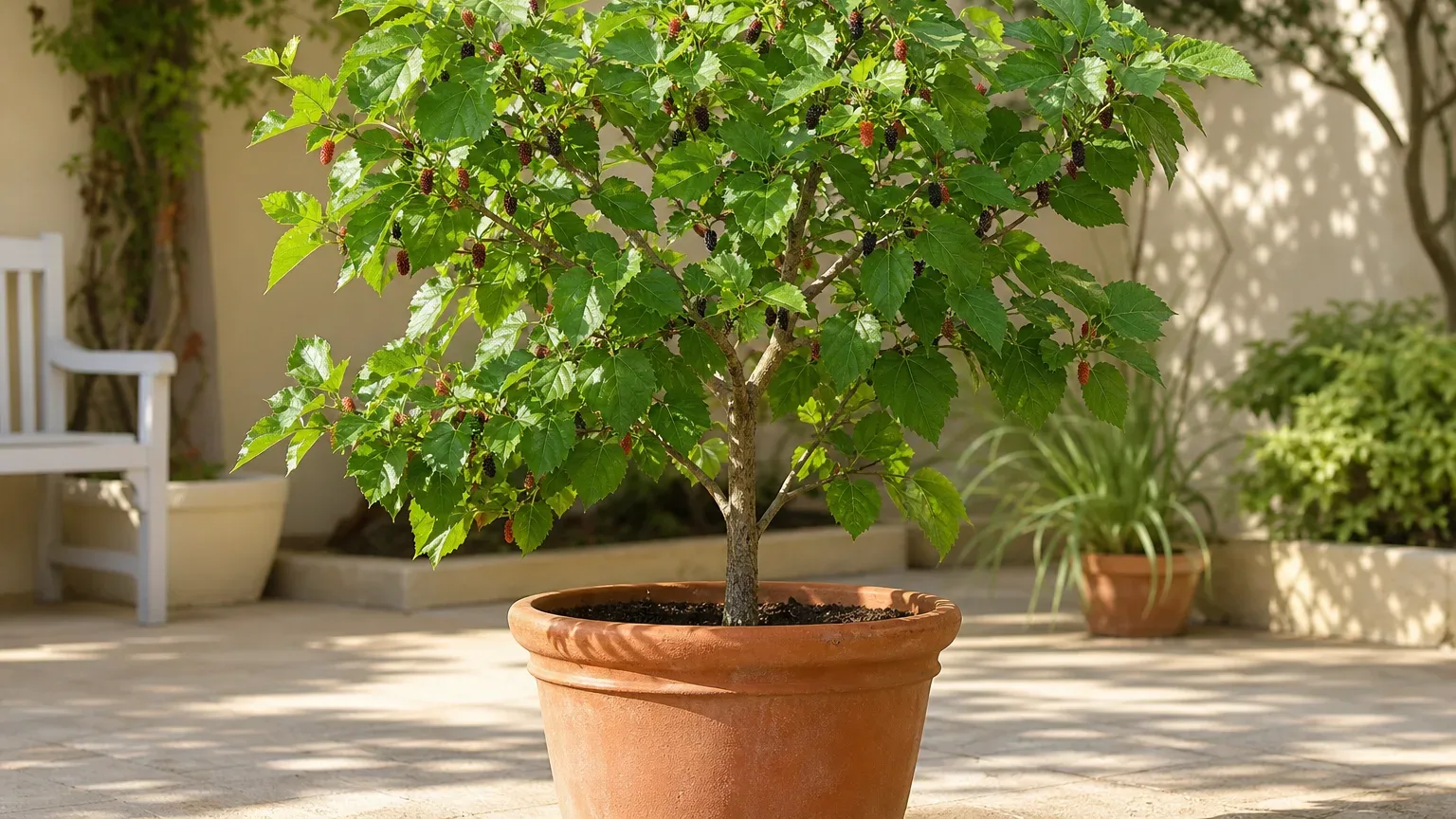
Mulberry is native to China and temperate East Asia; widely cultivated and naturalized elsewhere, typically reaches 9–18 m (30–60 ft) tall and 9–15 m (30–50 ft) wide in the ground; smaller with regular pruning or as a dwarf cultivar indoors, with rapid in warm weather with full sun and adequate root space growth. Mulberry has a tree like growth habit and part of the Moraceae family. It is also known as White Mulberry, Common Mulberry, Silkworm Mulberry, Russian Mulberry, and Shahtoot.
| Detail | Information |
|---|---|
| Also known as | White Mulberry, Common Mulberry, Silkworm Mulberry, Russian Mulberry, Shahtoot |
| Native region | China and temperate East Asia; widely cultivated and naturalized elsewhere |
| Mature size | 9–18 m (30–60 ft) tall and 9–15 m (30–50 ft) wide in the ground; smaller with regular pruning or as a dwarf cultivar |
| Growth rate | Rapid in warm weather with full sun and adequate root space |
| Growth habit | Tree Like |
| Scientific name | Morus alba |
| Family | Moraceae |
Mulberry Care Guide: Grow Morus alba in Pots & Gardens
Mulberry is a fast-growing deciduous fruit tree, not a foliage plant for a dim room. Morus alba — white mulberry, shahtoot, or Russian mulberry — belongs to the Moraceae family and is native to China, where its leaves have fed silkworms for millennia. In a warm Indian garden or large terrace tub it can produce sweet summer fruit, shade, and vigorous new growth; in the wrong spot it becomes a staining, root-spreading tree that outgrows the space within a few seasons.
The first priorities are simple: place it outdoors in strong sun, use a container or planting hole with dependable drainage, water deeply after the upper mix begins to dry, and accept that mature size and fallen fruit are part of the deal. Fruit is never guaranteed by care alone — especially if you own a male or fruitless tree — but good light, active roots, and a balanced canopy give a suitable female cultivar the conditions it needs to flower and hold a crop.
Mulberry care at a glance
Give mulberry full sun for the strongest structure and heaviest fruit set. The Missouri Botanical Garden recommends rich, moist, well-drained soils in full sun to part shade, with best performance in full sun. A bright indoor window is not equivalent to an open terrace because glass, walls, and roof overhangs cut usable light sharply.
Water until the full root ball is wet and excess drains, then check again only after the upper 3–5 cm has started to dry. Use fertile, free-draining soil rather than dense garden clay in a pot. Feed modestly during warm active growth, prune in late fall or winter to limit sap bleeding, and plan for a spreading shallow root system that can lift paving if planted too close to hardscape.
Know the tree you are growing
White mulberry is a rounded, fast-growing deciduous tree with a wide-spreading crown and shallow roots. NC State Extension describes a mid-size flowering tree with a short, crooked trunk, yellowish-green spring catkins, and fruit produced only on female plants. The species naturalized widely after colonial-era silkworm trials in North America and now appears in fields, roadsides, and forest margins — a useful warning that vigour and seed spread are real management concerns, not abstract labels.
In India, shahtoot is a familiar summer fruit, but the same species still behaves like a tree: it drops leaves in cool or dry winter weather, pushes long shoots in spring, and can stain paving, cars, and outdoor furniture when fruit ripens. Treat it as an orchard or terrace specimen with outdoor light, not as a permanent living-room plant.
White mulberry vs red and black mulberries
Morus alba is the white or pale-fruited species most often sold as shahtoot in Indian nurseries, though ripe fruit on some cultivars turns pink, red, or near-black. Morus rubra (red mulberry) is native to eastern North America and can hybridize with white mulberry where both grow. Morus nigra (black mulberry) is slower, often more shrubby, and prized for darker, intensely flavoured fruit. Leaf shape alone is unreliable for ID because white mulberry leaves may be lobed or unlobed on the same tree.
Buy for labelled cultivar habit and fruiting type, not colour alone. A fruitless male selection such as ‘Chaparral’ solves staining where you want shade without berries; a weeping or contorted form such as ‘Pendula’ or ‘Unryu’ solves space differently from a standard upright tree.
Growth habit and realistic size
Unpruned white mulberry is a real tree, not a naturally miniature patio shrub. The Missouri Botanical Garden notes typical landscape dimensions of 30–50 feet tall and as wide, with a broad crown developing with age. NC State gives 50–60 feet with equal spread for mature specimens, while the RHS lists 8–12 metres height for the species in British gardens. Dwarf, weeping, and heavily pruned container specimens stay far smaller, but only if you choose the right cultivar and renew pruning wood regularly.
Expect rapid extension growth in warm weather. White mulberry tolerates heat, drought, pollution, and a wide soil range once established, yet relative toughness does not shrink a standard tree to bonsai scale without deliberate root and canopy control.
Choose a sunny outdoor placement
Place mulberry on an open terrace, sunny balcony edge, courtyard, or garden bed where it receives at least six hours of direct sun and airflow around the foliage. The RHS advises full sun with shelter from cold, dry winds in marginal climates; in most of peninsular India the practical constraint is reflected heat on a root-bound container, not lack of warmth.
Keep the canopy away from doorways, parked vehicles, and light-coloured paving if you grow a fruiting female. Birds relish ripe berries, but dropped fruit causes maintenance headaches NC State flags explicitly. Rotate a container every week or two if one side faces a wall so the canopy does not lean permanently toward the brightest exposure.
Acclimate nursery foliage over several days when moving from shade net to harsh terrace sun. Begin with morning exposure, then lengthen hours while watching new leaves for pale, crisp scorch patches. Established leaves tolerate strong tropical light better than tender shoots formed under nursery shade.
Can mulberry grow well in a container?
Yes, but only with a managed root zone and realistic cultivar choice. Start one pot size wider than the nursery root ball, ensure several unobstructed drainage holes, and step up gradually as roots fill the mix. A huge pot around a small root system stays wet too long; a severely rootbound pot can dry within hours and shed leaves or abort fruit.
A dwarf, weeping, or contorted cultivar is easier to keep on a terrace than an unknown vigorous seedling destined for 15 m. Use a heavy stable container that will not topple as the canopy broadens, and plan for periodic Mulberry repotting or root pruning once the largest movable size is reached. If the terrace receives less than six hours of direct light, treat the plant as an ornamental foliage tree rather than expecting reliable fruit.
Water by the root zone, not the calendar
Check 3–5 cm into the mix with a finger or wooden skewer. If that layer is dry and the pot feels noticeably lighter, soak slowly until water runs from every drainage hole, then empty the saucer. Do not respond to a hot afternoon wilt automatically: first confirm whether the deeper mix is dry, because wilt above wet soil can indicate damaged, oxygen-starved roots.
Young trees and fruiting container plants need closer attention than established landscape specimens. The Missouri Botanical Garden lists medium water needs and drought tolerance for established plants, but a confined root ball has far less reserve than ground soil. Steady moisture during spring growth, flowering, and fruit swelling matters more than a rigid daily schedule.
In hot pre-monsoon weather a rooted container may need checking every two or three days, though not necessarily watering each time. During monsoon, move pots away from roof runoff and pause irrigation while rain keeps the root zone wet. After leaf fall, growth and water use drop sharply — reduce frequency while preventing the entire root ball from drying rock-hard. The Mulberry watering guide covers diagnostic checks and seasonal examples in more detail.
Build a fertile but airy soil mix
White mulberry adapts to clay, sand, and alkaline ground soils in the landscape, but containers are less forgiving because roots cannot escape a wet or compacted pocket. A practical blend is roughly half loam-based potting mix, one-quarter mature compost, and one-quarter coarse perlite, pumice, or pine bark — the same logic as the plant-detail hub recipe. The goal is a mix that wets evenly, drains promptly, and still holds enough moisture to prevent the root ball from lurching from soaked to dust-dry.
The RHS recommends moist but well-drained, humus-rich, fertile soil. NC State and Missouri Botanical Garden both stress moist, well-drained conditions and note tolerance of alkaline soils in the ground — but tolerance in a field does not make a waterlogged pot safe. Persistent wetness, sour odour, and yellowing leaves while the mix stays damp point to a root-zone problem, not a nutrient shortage. See the Mulberry soil guide for mix adjustments and drainage warning signs.
Feed for steady growth, not rank shoots
Feed only a rooted, actively growing tree during warm months when new leaves and shoots are expanding. In a container, use a balanced fruit-tree fertilizer at the label’s container rate, divided into modest applications through the growing season rather than one heavy dose. Flush the pot with plain water periodically, because fertilizer salts have nowhere else to move in a confined root zone.
Landscape trees in rich garden soil may need little supplemental feeding, while a hungry container tree on a sunny terrace can show pale new growth or small leaves after repeated fruiting. Avoid stacking repotting, hard pruning, and heavy feeding in the same week — each intervention shifts the root-to-shoot balance. The Mulberry fertilizer guide covers product choice and deficiency signs before you correct a suspected problem.
Prune to manage size and sap bleeding
Train a young tree around a few well-spaced main branches, then remove dead, crossing, inward-growing, and excessively upright water shoots. NC State and the Missouri Botanical Garden both recommend pruning in late fall or winter because cuts made during active growth can bleed milky sap. The RHS similarly advises pruning group 1 cuts from late summer to early winter to reduce bleeding.
Wear gloves if latex irritates your skin and clean tools after working on diseased wood. White mulberry responds to pruning with vigorous regrowth, so repeated light structural cuts are easier to manage than one rare drastic reduction that triggers a wall of water sprouts. For cut placement, timing, and size control on fruiting wood, use the Mulberry pruning guide.
Start with the right planting material
White mulberry is usually dioecious — male and female flowers on separate trees — although some plants carry both sexes. Only trees with female flowers set the sweet blackberry-like fruit described by the Missouri Botanical Garden; male or fruitless selections provide shade without staining berries. If fruit is the goal, confirm sex or choose a known fruiting cultivar from a reliable nursery rather than assuming a roadside seedling will behave predictably.
Reject plants with tightly circling woody roots, trunk cankers, scale colonies, or sour-smelling mix. A firm healed graft union and flexible young shoots are better quality signals than height alone. Vegetative propagation preserves named traits more reliably than seed; the Mulberry propagation guide compares cuttings, layering, and grafted stock when cultivar identity matters.
Support flowering and fruit development
Sun, mature new growth, and a functioning root system matter more than any “flower booster.” Avoid drought while female catkins set and fruit enlarges, but do not keep the pot wet in an attempt to prevent natural fruit drop. Some drop is normal; repeated drop alongside pale leaves, stalled shoots, or saturated soil calls for root-zone diagnosis instead of more fertilizer.
Ripeness is not reliably judged by colour alone. NC State notes fruit can ripen white, pink, red, or purple-black depending on the tree. Wait until berries are soft, sweet, and detach with a gentle tug rather than picking firm or tart fruit. Eat only fully ripe berries; NC State’s poison profile reports stomach upset and hallucinations from unripe fruit and milky sap. Do not combine repotting, hard pruning, and heavy feeding when a tree is flowering — stack one major intervention at a time.
Adjust mulberry care through Indian seasons
During hot pre-monsoon weather, check pots frequently, shade only the container wall if the root ball overheats against dark plastic, and mulch lightly without piling material against the trunk. During monsoon, prioritise drainage and airflow, remove fallen diseased leaves, and withhold irrigation until the mix actually begins to dry. Stagnant saucer water around shallow roots is a common container failure in wet months.
During a cooler or drier winter, leafless dormancy sharply reduces water needs — lengthen the interval between watering and pause feeding until warm new growth returns. In frost-prone north Indian locations, move a portable tree beside a warm wall under cover and protect the root ball overnight. Resume structural pruning and stronger feeding only when buds swell and fresh shoots appear.
Read common warning signs correctly
Yellow leaves plus slow-drying, sour-smelling soil point first toward excess moisture or poor aeration around shallow roots. Wilted or curled leaves in genuinely dry soil suggest drought, while wilt above a wet root ball requires inspection before any more water. Brown leaf margins can follow severe dry-down, salt accumulation, or hot desiccating wind on a exposed terrace.
A tree that grows vigorously but bears no fruit may be male, too young, heavily shaded, or repeatedly pruned at the wrong stage. Sticky honeydew, distorted leaves, or fine webbing under foliage can indicate scale, whiteflies, or mites — common on stressed or crowded plants. Diagnose the whole pattern — soil moisture, light, recent treatment, and which leaves are affected — rather than treating one symptom in isolation.
Fruit, latex, and pet-safety basics
Ripe mulberry is a familiar human food, but the whole plant is not a casual snack. NC State classifies Morus alba as non-toxic to cats, dogs, and horses while separately reporting low human toxicity from unripe berries and milky sap, with stomach upset and hallucinations possible after unripe fruit is eaten. Leaves and young shoots contain mildly toxic white latex.
Supervise children around fruiting trees, wear gloves when pruning if sap irritates you, and wash tools and skin after contact. That non-toxic pet classification does not turn fallen leaves or unripe berries into safe forage — discourage chewing and remove fermenting fruit from pet access. Safety for rabbits, pet birds, turtles, and tortoises was not verified for this species hub, so use cautious placement around those animals.
Invasive spread and responsible placement
Vigorous seed production and bird-dispersed fruit make white mulberry weedy in parts of its introduced range. NC State notes Wisconsin classifies the plant as a noxious weed and restricts planting or movement, while the Missouri Botanical Garden links to invasive-range maps for the United States. In India the species is long cultivated rather than novel, but volunteer seedlings beneath fruiting trees still require management if you do not want a second tree in the paving crack.
Choose fruitless or sterile cultivars where local guidance recommends them, pull young seedlings promptly, and avoid planting standard fruiting trees where roots can undermine walls or sidewalks. Shallow, spreading roots and a broad canopy are features of the species, not failures of your care.
When to use this page vs other Mulberry guides
- Use this overview to understand mulberry’s whole growing system and decide whether your site can support a sun-loving deciduous tree.
- Use Mulberry light to assess a terrace, garden edge, or courtyard position and acclimate foliage safely.
- Use Mulberry watering when leaves wilt, soil stays wet, or seasonal frequency is unclear.
- Use Mulberry soil for container recipes, drainage problems, and pH-related issues.
- Use Mulberry fertilizer before choosing a product or correcting a suspected nutrient deficiency.
- Use Mulberry repotting when roots circle, the tree becomes unstable, or the pot dries within a day.
- Use Mulberry propagation to compare seed, cuttings, and grafted plants.
- Use Mulberry pruning for detailed size control, sap-bleeding timing, and renewal cuts.
Related Mulberry guides
- Mulberry plant hub — species profile, key care facts, and the complete care cluster.
- Mulberry pruning — size control, sap bleeding, and structural decisions.
- Mulberry light — direct-sun targets and sun-stress diagnosis.
- Mulberry watering — root-zone checks for pots, gardens, and monsoon weather.
- Mulberry soil — free-draining mixes and wet-root prevention.
- Mulberry fertilizer — feeding through active growth and fruiting.
- Mulberry repotting — pot sizing and aftercare.
- Mulberry propagation — methods that preserve cultivar traits.
Conclusion
Successful mulberry care begins with accepting what the plant is: a fast-growing deciduous fruit tree that wants open sun, active roots, and room for a spreading canopy. In the ground, choose a non-flooding site away from paving you care about; in a container, make drainage, gradual pot sizing, and regular pruning non-negotiable. Water deeply after the upper root zone begins to dry, then adjust the interval to heat, rain, pot size, and fruit development.
For an Indian terrace or garden, the biggest seasonal shift is from rapid dry-down before monsoon to prolonged moisture during it. Watch the root zone instead of the calendar, choose a cultivar that matches your space and fruiting expectations, and make only one major intervention at a time. With realistic size planning and responsible placement, white mulberry can deliver shade, vigorous growth, and sweet summer fruit without becoming a maintenance problem you did not see coming.
How to care for Mulberry?
When should you water Mulberry?
Water deeply when the top 3–5 cm of soil is dry. Keep young and container trees evenly moist during active growth, but let excess drain; established ground-grown trees tolerate drought better than potted trees.
- Finger-test at 3–5 cm and lift the pot - Water deeply when the top 3–5 cm of soil is dry.
- soak thoroughly only when the upper mix is dry and the container feels lighter - Keep young and container trees evenly moist during active growth, but let excess drain; established ground-grown trees tolerate drought better than potted trees.
- Drain excess water - Keep young and container trees evenly moist during active growth, but let excess drain; established ground-grown trees tolerate drought better than potted trees.
What soil works best for Mulberry?
Fertile, moisture-retentive but well-drained loam in full sun. Morus alba adapts to clay, sand, and a broad pH range, but containers need an airy mix that does not remain saturated.
- 50% loam-based potting mix - Fertile, moisture-retentive but well-drained loam in full sun.
- 25% finished compost
- 25% coarse perlite, pumice, or pine bark - Morus alba adapts to clay, sand, and a broad pH range, but containers need an airy mix that does not remain saturated.
Grower notes for Mulberry
What matters most with Mulberry
Mulberry is a rapid-growing deciduous fruit tree, not a permanent indoor foliage plant. Give Morus alba full sun, generous root room, and moist but well-drained soil while it is in leaf. Established landscape trees tolerate drought, but a container has far less water reserve. The easiest routine is to check the root zone, water deeply when the top 3–5 cm dries, and avoid keeping the shallow roots continuously saturated.
Best placement in a real home
Place Mulberry outdoors in at least 6 hours of direct sun, with enough clearance for a spreading canopy and shallow roots. Fruiting trees can stain paving, cars, and furniture, so keep them away from walkways and entrances or choose a fruitless cultivar. In regions where Morus alba is invasive, use a locally approved sterile or non-fruiting selection and remove volunteer seedlings.
Before you buy this plant
Confirm the label says Morus alba and ask whether the tree is a named fruiting, fruitless, dwarf, or weeping cultivar; mature size and fruit production differ greatly. Choose a tree with flexible shoots, clean leaf undersides, and no cankers or circling surface roots. A graft union should be firm and healed, and the pot should drain without smelling sour.
First month after bringing it home
Acclimate nursery foliage to intense sun over several days, then learn how quickly the pot dries before changing the container. Keep moisture steady while new roots establish, but do not leave a saucer full of water. Inspect for scale, mites, whiteflies, borers, and bacterial dieback. Quarantine the tree before placing it near other container plants.
Fruit and latex safety
Eat only fully ripe mulberries. NC State reports low toxicity from unripe berries and the milky sap, with stomach upset and hallucinations possible after unripe fruit is eaten; leaves and young shoots contain mildly toxic white latex. Avoid tasting green fruit, supervise children, wear gloves when pruning if sap irritates you, and wash sap from skin and tools.
How Mulberry grows and fruits
White mulberry may bear male and female flowers on separate trees, although some trees carry both. Only trees with female flowers set fruit, and fruit colour can ripen from white or pink to red or purple-black, so colour alone is not a universal ripeness test. Wait for fruit to become soft, sweet, and easy to detach. Prune in late fall or winter to reduce sap bleeding, and expect vigorous regrowth.
Is Mulberry safe for pets?
NC State tags Morus alba as non-toxic to cats, dogs, and horses. Still prevent chewing and keep pets away from unripe fruit and milky latex, which NC State identifies as low-toxicity hazards for people.
NC State classifies Morus alba as non-toxic to cats, dogs, and horses, but separately reports low human toxicity from unripe berries and milky sap. Unripe fruit may cause stomach upset and hallucinations; leaves and young shoots contain mildly toxic white latex. Eat only fully ripe fruit, supervise children, and avoid contact with sap if sensitive.
Watering Mulberry
For Mulberry, finger-test at 3–5 cm and lift the pot; soak thoroughly only when the upper mix is dry and the container feels lighter and water check every 2–3 days in hot weather and water when the top 3–5 cm is dry; check less often after leaf fall and during cool weather. Water most during spring growth, flowering, and fruit development; reduce after leaf fall, without allowing a container root ball to become bone-dry.
| Detail | Information |
|---|---|
| How often | Check every 2–3 days in hot weather and water when the top 3–5 cm is dry; check less often after leaf fall and during cool weather |
| How to check | Finger-test at 3–5 cm and lift the pot; soak thoroughly only when the upper mix is dry and the container feels lighter |
| Seasonal changes | Water most during spring growth, flowering, and fruit development; reduce after leaf fall, without allowing a container root ball to become bone-dry |
Signs of overwatering
- persistent yellowing while soil remains wet
- weak or stalled new growth
- sour-smelling mix
- dark, soft feeder roots
Signs of underwatering
- wilted or curled leaves in heat
- dry brown leaf margins
- premature leaf or fruit drop
- pot pulling away from the root ball
Soil & potting for Mulberry
Use a mix of 50% loam-based potting mix, 25% finished compost, 25% coarse perlite, pumice, or pine bark for Mulberry. Moist but freely draining; avoid stagnant water around the shallow root system. Target soil pH around 5.5–7.5 preferred; tolerant of more acidic or alkaline ground soils. Repot every 1–2 years while young; every 2–3 years for an established container tree, with root pruning if size must be restricted, ideally in late winter or early spring, before strong new growth.
| Detail | Information |
|---|---|
| Recommended mix | 50% loam-based potting mix, 25% finished compost, 25% coarse perlite, pumice, or pine bark |
| Drainage | Moist but freely draining; avoid stagnant water around the shallow root system |
| Soil pH | 5.5–7.5 preferred; tolerant of more acidic or alkaline ground soils |
| Repotting frequency | Every 1–2 years while young; every 2–3 years for an established container tree, with root pruning if size must be restricted |
| Best season to repot | Late winter or early spring, before strong new growth |
Signs it needs repotting
- roots circling or emerging from drainage holes
- pot drying within a day in warm weather
- growth stalling despite full sun
- tree becoming unstable or top-heavy
Humidity & temperature for Mulberry
Fertilizer & pruning for Mulberry
Common problems on Mulberry
Yellow Leaves
MediumLikely cause: Common on this plant type; confirm with recent watering, light, and root checks.
Quick fix: Inspect the plant and correct the most likely care stressor before stacking treatments.
Full fix guide →Brown Tips
MediumLikely cause: Common on this plant type; confirm with recent watering, light, and root checks.
Quick fix: Inspect the plant and correct the most likely care stressor before stacking treatments.
Full fix guide →Root Rot
MediumLikely cause: Common on this plant type; confirm with recent watering, light, and root checks.
Quick fix: Inspect the plant and correct the most likely care stressor before stacking treatments.
Full fix guide →Overwatering
MediumLikely cause: Common on this plant type; confirm with recent watering, light, and root checks.
Quick fix: Inspect the plant and correct the most likely care stressor before stacking treatments.
Full fix guide →Underwatering
MediumLikely cause: Common on this plant type; confirm with recent watering, light, and root checks.
Quick fix: Inspect the plant and correct the most likely care stressor before stacking treatments.
Full fix guide →Spider Mites
MediumLikely cause: Common on this plant type; confirm with recent watering, light, and root checks.
Quick fix: Inspect the plant and correct the most likely care stressor before stacking treatments.
Full fix guide →Mealybugs
MediumLikely cause: Common on this plant type; confirm with recent watering, light, and root checks.
Quick fix: Inspect the plant and correct the most likely care stressor before stacking treatments.
Full fix guide →Aphids
MediumLikely cause: Common on this plant type; confirm with recent watering, light, and root checks.
Quick fix: Inspect the plant and correct the most likely care stressor before stacking treatments.
Full fix guide →Leggy Growth
MediumLikely cause: Common on this plant type; confirm with recent watering, light, and root checks.
Quick fix: Inspect the plant and correct the most likely care stressor before stacking treatments.
Full fix guide →Slow Growth
MediumLikely cause: Common on this plant type; confirm with recent watering, light, and root checks.
Quick fix: Inspect the plant and correct the most likely care stressor before stacking treatments.
Full fix guide →Wilting
MediumLikely cause: Common on this plant type; confirm with recent watering, light, and root checks.
Quick fix: Inspect the plant and correct the most likely care stressor before stacking treatments.
Full fix guide →Drooping Leaves
MediumLikely cause: Common on this plant type; confirm with recent watering, light, and root checks.
Quick fix: Inspect the plant and correct the most likely care stressor before stacking treatments.
Full fix guide →Low Humidity
MediumLikely cause: Common on this plant type; confirm with recent watering, light, and root checks.
Quick fix: Inspect the plant and correct the most likely care stressor before stacking treatments.
Full fix guide →Not Enough Light
MediumLikely cause: Common on this plant type; confirm with recent watering, light, and root checks.
Quick fix: Inspect the plant and correct the most likely care stressor before stacking treatments.
Full fix guide →Fungus Gnats
MediumLikely cause: Common on this plant type; confirm with recent watering, light, and root checks.
Quick fix: Inspect the plant and correct the most likely care stressor before stacking treatments.
Full fix guide →Mold on Soil
MediumLikely cause: Common on this plant type; confirm with recent watering, light, and root checks.
Quick fix: Inspect the plant and correct the most likely care stressor before stacking treatments.
Full fix guide →