20 Best Types of Weeping Trees for Every Yard
Compare 20 types of weeping trees by mature size, flowers, water needs, climate, and maintenance before you plant one in your yard.
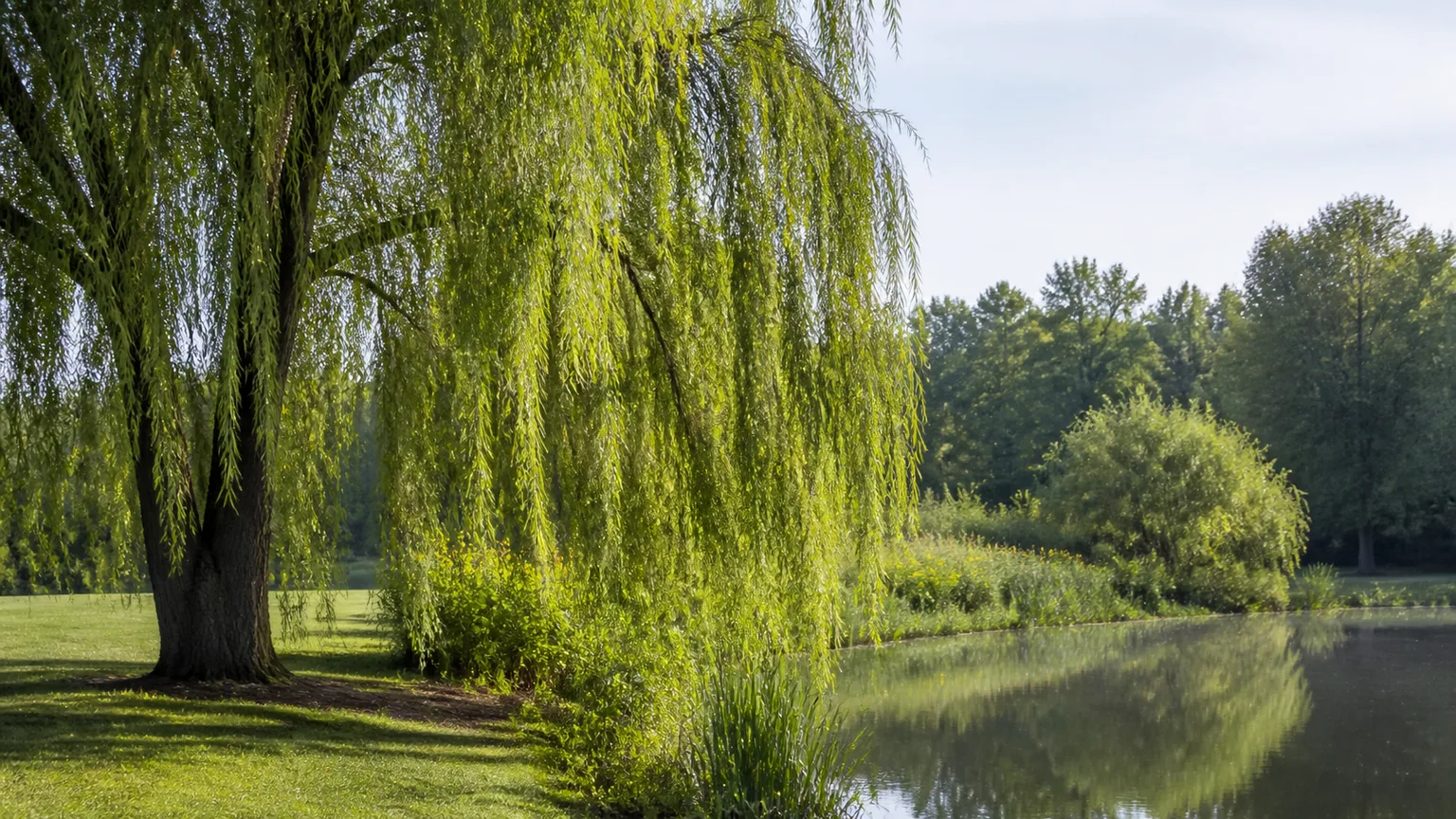
Weeping trees are defined by branch direction, not by one shared family or care routine. Some are broad, water-loving trees for a pond edge; others are compact grafted specimens for a front border, narrow evergreens for a cold-climate garden, or deciduous conifers that turn gold and drop every needle in fall.
The most useful way to compare them is to start with the site. A 6-foot Japanese maple and a 50-foot willow may both be sold as weeping trees, but they differ radically in root reach, storm exposure, water demand, pruning, and the amount of open ground they need. Use the botanical names in this guide when shopping, because common names such as “weeping cherry,” “pussy willow,” and “weeping cedar” can cover several different plants.
What “weeping” means in a tree
A weeping tree has branches or shoots that grow downward, often arching all the way to the ground. In many garden cultivars, the form is created by selecting a naturally pendulous mutation and grafting it onto a straight trunk or another rootstock; the rootstock supplies roots, while the scion supplies the named canopy. That is why a seed from a weeping cultivar usually does not produce a reliably weeping tree.
The biology is more interesting than the nursery label suggests. Plant Physiology research describes weeping as a growth response tied to gravity sensing, auxin distribution, cell elongation, and wood formation, with the details varying among plants. Work on peach and related species has identified the WEEP gene as part of that process, but a gene explanation does not make every weeping plant genetically identical or interchangeable; a separate comparative study of weeping phenotypes also shows why the habit should not be treated as one simple mechanism.
“Pendula” or “Pendulum” in a botanical name often signals a hanging habit, but it does not tell you the mature size. A grafted tree may be only 4 feet tall when sold and still develop a canopy 15, 30, or 50 feet wide. The trunk height of a graft is also not the tree’s eventual height; the canopy’s growth and the training method determine how much vertical space it uses.
Choose by site before you choose by silhouette
The graceful outline is the reason to want a weeping tree, but the wrong site can turn that outline into a constant maintenance problem. Before you compare flower color or fall foliage, compare the tree’s mature dimensions, water tolerance, wind exposure, light, and relationship to structures.
The four checks that prevent a bad planting
First, measure the open root zone. Look beyond the canopy’s future drip line to foundations, paving, septic fields, sewer lines, irrigation pipes, retaining walls, and neighboring trees. Large, moisture-seeking trees such as willows should not be used as a narrow foundation planting simply because the young plant looks small. Locate utilities before digging and follow local setbacks; a root barrier is not a substitute for adequate space.
Second, describe your moisture honestly. Moist, well-drained soil stays damp but still has air around the roots. Wet soil drains slowly, while standing water can exclude oxygen and kill trees that are not adapted to saturated conditions. Willows tolerate much more moisture than Japanese maples, pines, or most cherries, but a low spot that stays flooded is not automatically a good planting hole.
Third, check the climate at the cultivar level. Hardiness zones are useful for winter minimums, not a guarantee of summer performance, flowering, or storm resistance. A birch that thrives in a cool summer climate can struggle in hot, dry conditions even if its zone range looks acceptable; a Japanese maple may handle full sun in a cool region but scorch in a hot, exposed yard.
Fourth, decide how much management you will actually provide. Grafted trees may need rootstock suckers removed, trained trees may need a stake or leader, and fast-growing willows can produce litter and weak branches. A tree that requires annual corrective pruning is not low maintenance just because it is disease resistant.
Cal Poly’s SelecTree selection guide is a good model for this process because it treats mature height and width, water use, wind resistance, shade tolerance, salt tolerance, and utility friendliness as separate characteristics. Use the nursery tag the same way: as a set of constraints, not just a decorative description.
Match the tree to the landscape job
For a pond edge or rain garden, start with a locally appropriate willow or another species adapted to damp soil. The RHS willow guide describes willows as large, graceful trees for deep, fertile, moist but well-drained soil, which is a useful reminder that “wet-tolerant” does not mean “suitable for every low spot.” For a small focal point, look at dissected Japanese maple, weeping redbud, compact crabapple, or a trained small conifer. For year-round structure, compare white pine, hemlock, Norway spruce, white spruce, and Nootka cypress by climate and mature width.
For spring flowers, cherries, flowering apricot, crabapple, and redbud give more reliable color than most conifers. Established horticulture coverage from Savvy Gardening and BHG is useful for comparing these flowering, deciduous, and evergreen forms, but the nursery’s exact cultivar still controls the final size and performance. For fall interest, Japanese maple, katsura, larch, birch, and crabapple bring foliage or fruit, while corkscrew willow, copper beech, and golden-stem willows keep their structure after leaf drop. The best tree is the one that performs the job you need without asking the site to become something it is not.
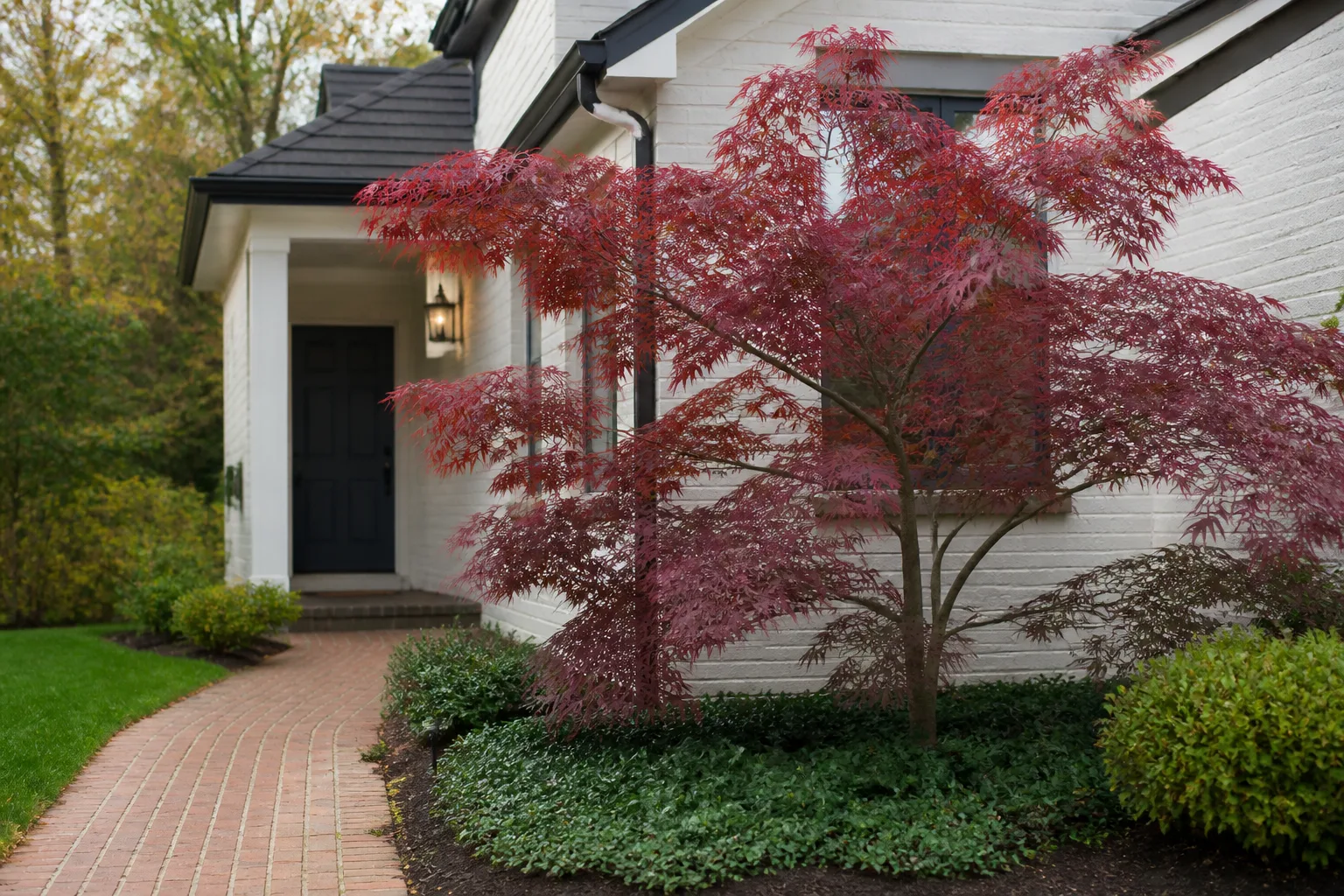
20 best types of weeping trees
This is a practical shortlist, not a claim that one tree is best for every garden. Mature dimensions vary by cultivar, rootstock, climate, and training; confirm the exact selection with a local nursery before you buy.
Flowering focal trees
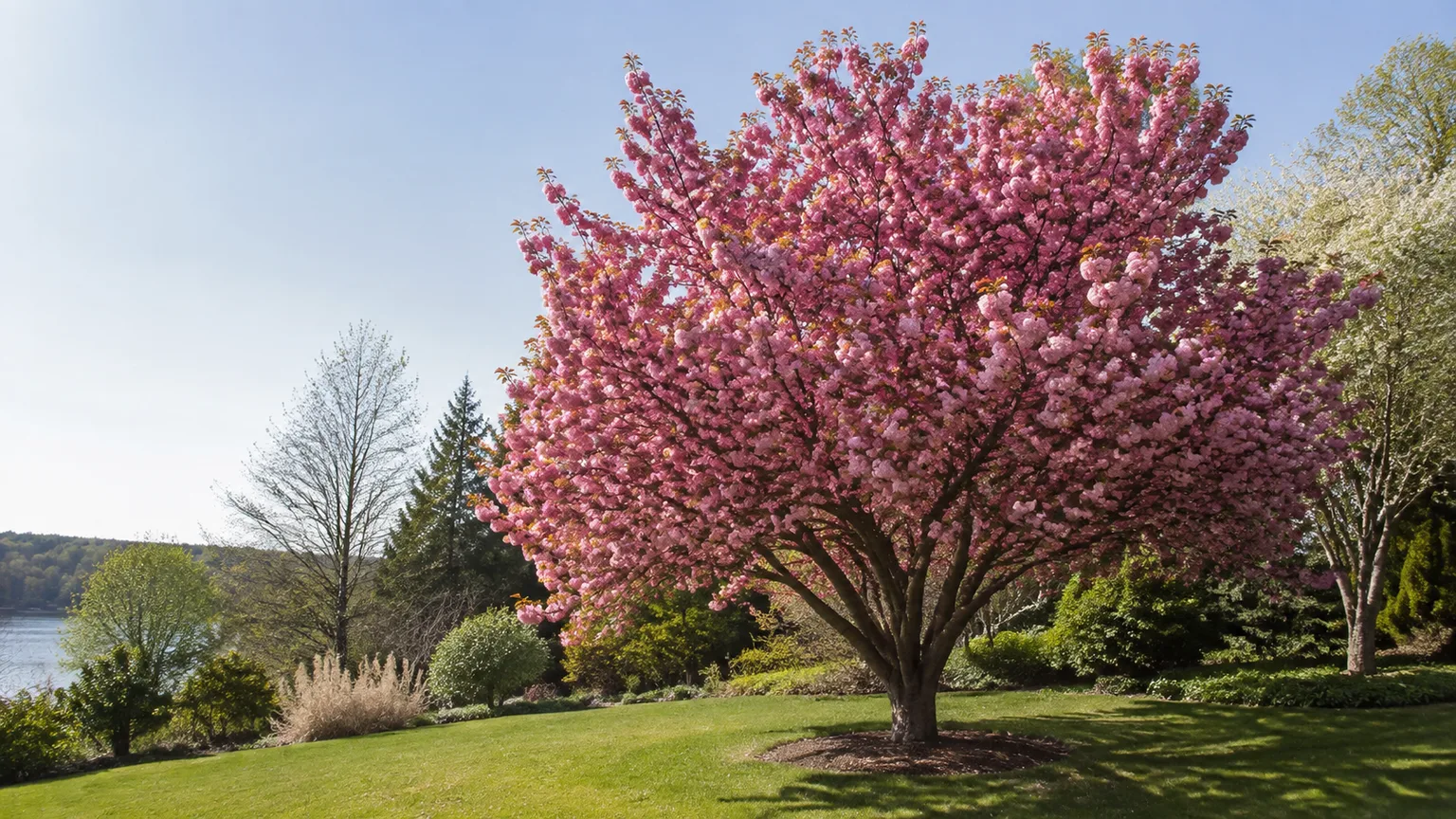
1. Weeping cherry (Prunus pendula ‘Pendula Rosea’). This is the classic spring specimen, with pink flowers on cascading branches and a strong umbrella shape when grafted to a clear trunk. Give it full sun, excellent drainage, and room for a roughly 15- to 25-foot canopy; it is a poor choice for a damp hole or a site where falling petals and fruit will be a nuisance.
2. Higan cherry (Prunus subhirtella ‘Pendula’). Higan cherry offers delicate pink or white flowers and a somewhat more relaxed, arching habit than many tightly trained weeping cherries. It works best as a lawn or border specimen in sun to part shade, but branch structure and disease pressure vary, so buy a named, locally proven cultivar rather than an unlabeled “weeping cherry.”
3. Weeping flowering apricot (Prunus mume ‘Pendula’). Early, fragrant flowers make this a standout for a garden that needs interest before most fruit trees bloom. It prefers a sunny, well-drained position and is better treated as an ornamental blossom tree than as a dependable fruit producer; cold pockets and late frosts can reduce the display.
4. Weeping redbud (Cercis canadensis ‘Ruby Falls’ or another named selection). Redbuds combine a manageable scale with spring pink-purple flowers and heart-shaped leaves, and ‘Ruby Falls’ adds burgundy foliage. Many stay around small-tree size, but the graft union still needs inspection for suckers and the crown needs enough width to develop without rubbing a wall or walkway.
5. Weeping crabapple (Malus selections such as ‘Louisa’). Crabapples offer spring flowers, fall color, and small fruits that can feed birds, making them one of the most seasonally complete choices. Choose a disease-resistant cultivar when available and accept that fruit may drop on paving; pollination benefits depend on the cultivar and nearby compatible apples, not simply on the word “crabapple.”
Deciduous trees for foliage and bark
6. Weeping Japanese maple (Acer palmatum var. dissectum). Finely cut leaves and a low, layered canopy make dissected Japanese maples the strongest choice for many small yards, courtyards, and patios. Morning sun with afternoon protection is safer in hot climates, while cooler regions may support more sun; plant in moist, well-drained soil and protect the shallow root zone from compaction and drought.
7. Weeping katsura (Cercidiphyllum japonicum ‘Pendula’). Katsura develops a broad, elegant canopy and heart-shaped leaves that turn yellow in fall; fallen leaves can have a sweet, caramel-like scent. It needs more room than a Japanese maple and consistent moisture while young, so reserve it for an open lawn, woodland edge, or spacious border rather than a narrow foundation bed.
8. Weeping birch (Betula pendula ‘Youngii’). Young’s birch creates a small umbrella of foliage above its grafted trunk, with white bark and yellow fall color. Birch generally performs best with cool roots, reliable moisture, and good drainage; hot, dry urban sites can be stressful even where winter hardiness is excellent.
9. Weeping copper beech (Fagus sylvatica ‘Pendula’). Its dark foliage and heavy, ground-reaching branches create a dramatic mushroom-like form, especially when trained with a central leader. This is a slow-growing, large-space tree with dense shade and substantial eventual width; purple-leaved forms need more sun, while yellow-leaved forms often benefit from lighter shade.
10. Camperdown elm (Ulmus glabra ‘Camperdownii’). The dense, umbrella canopy can make a memorable garden room over a lawn or sitting area, usually at a smaller scale than a full elm. It should be planted with attention to Dutch elm disease risk, branch structure, and air circulation; avoid unnecessary large cuts and confirm the cultivar’s performance with a local tree professional.
11. Weeping mulberry (Morus alba ‘Pendula’). This grafted small tree has glossy leaves and branches that can reach the ground, but the female form may produce abundant fruit and litter. Select a fruitless male cultivar if that trait matters, check local guidance because white mulberry can naturalize in some regions, and remove vigorous rootstock shoots before they overtake the canopy.
12. Weeping golden ash (Fraxinus excelsior ‘Aurea Pendula’). Yellow young branches and gold fall color make this a winter-friendly specimen where ash is a sound local choice. Ash pests and diseases, including emerald ash borer in affected regions, make local availability and municipal guidance important; do not choose it solely for its unusual branch color.
Evergreen conifers
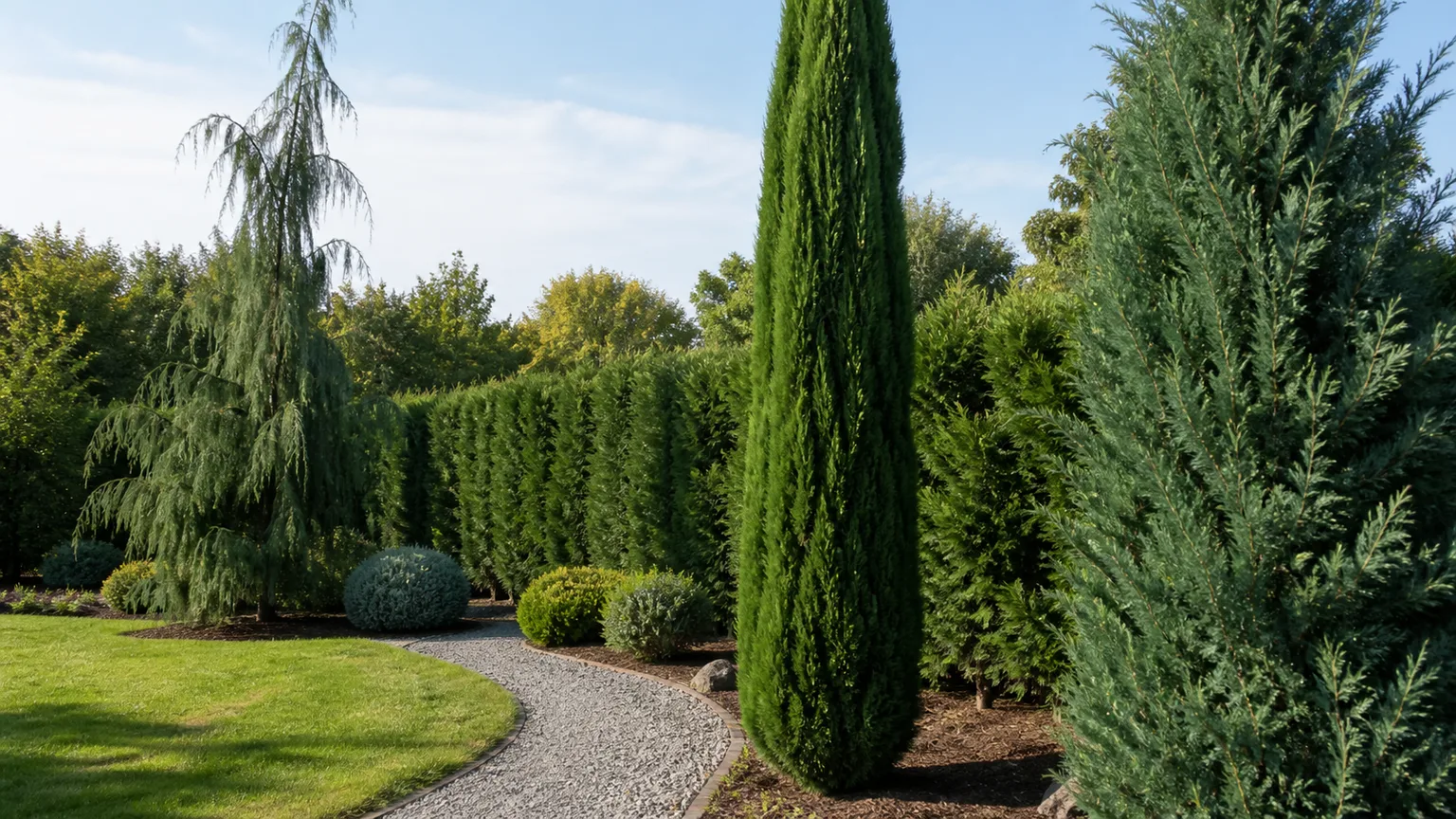
13. Weeping white pine (Pinus strobus ‘Pendula’). Long, soft needles remain attractive through winter, and the irregular cascading shape can be trained into a tree or allowed to develop as a broad, multi-stemmed form. It prefers sun to part shade and moist, well-drained soil, but its mature spread and sensitivity to urban pollution make it a better fit for an open, cleaner-air landscape than a cramped street tree.
14. Inversa Norway spruce (Picea abies ‘Inversa’). This is one of the most flexible weeping conifers: without support it may crawl, while a staked leader creates a narrow, upright specimen with hanging branches. Use it for a cold-climate focal point, inspect the leader and support as it grows, and do not assume the nursery plant’s current height predicts its final silhouette.
15. Weeping white spruce (Picea glauca ‘Pendula’). Its narrow, tiered form suits a site with vertical room but limited horizontal space, and blue-green needles provide year-round color. It favors full sun and drainage and is especially useful in cold regions; warm, humid climates can produce poorer growth and more pest pressure.
16. Nootka cypress (Xanthocyparis nootkatensis ‘Pendula’, also sold under Cupressus nootkatensis). This tall, pyramidal evergreen has strongly pendant sprays and a quiet, architectural presence. It is a cooler-climate tree for a spacious site with moisture but drainage, not a compact conifer for a hot foundation border; verify the accepted botanical name and mature dimensions on the label.
17. Weeping hemlock (Tsuga canadensis ‘Pendula’ or ‘Sargentii’). Hemlock provides soft, dark evergreen foliage and tolerates more shade than most trees on this list. Its final shape depends heavily on training, and it needs protection from drought, heat, and hemlock woolly adelgid where that pest is present, so a cool, sheltered garden is a better match than an exposed parking strip.
18. Weeping Japanese larch (Larix kaempferi ‘Pendula’). Larch looks evergreen during spring and summer, then turns gold and drops its needles in autumn. That deciduous-conifer habit gives it more seasonal movement than a spruce, while its pendulous stems can be trained into a mound or small tree; provide sun, moisture, and room for the lower branches.
Specialty and space-saving forms
19. Corkscrew willow (Salix matsudana ‘Tortuosa’). Twisted branches and curled leaves make this willow especially valuable for winter structure and cut stems. It is still a fast-growing willow with moisture-seeking roots and breakable wood, so place it well away from utilities and structures and plant it only where a large, somewhat untidy tree is acceptable.
20. Weeping pagoda tree (Styphnolobium japonicum ‘Pendula’). This grafted form offers a sculptural, often broad canopy and attractive winter branching, but the common name can mislead buyers because the species is not a true pagoda or “Sophora” in current classification. It prefers sun to part shade and well-drained soil; treat mature width and the graft union as more important than a small nursery specimen’s neat shape.
How to plant a weeping tree for long-term stability
Planting a weeping tree is mostly a spacing and establishment exercise. A beautiful crown cannot compensate for a root ball buried too deeply, a trunk surrounded by mulch, or a tree forced into a space it will outgrow.
Site preparation and spacing
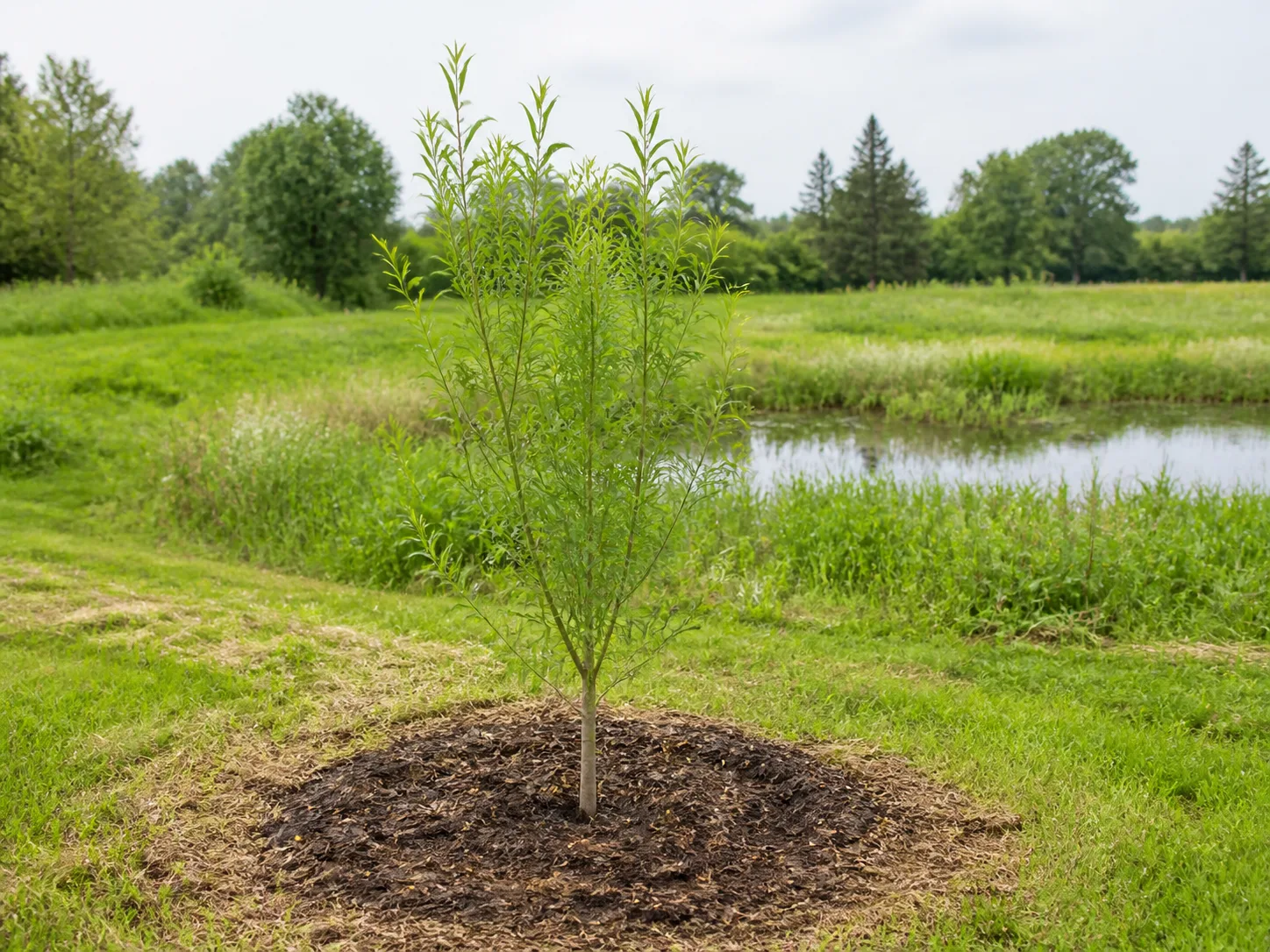
Choose the site from the tree’s mature width outward. The future canopy should not be planned around the nursery container, and a pond-edge willow should not be squeezed between water, a septic field, and a fence. If the roots will compete with utilities or the branches will hang over a roof, change the tree or change the site before digging.
Dig a hole about two to three times wider than the root ball and no deeper than its height. Find the root flare—the place where the trunk begins to widen—and set it at or slightly above surrounding grade, especially in heavy soil. Backfill with the excavated soil unless a soil test or local recommendation identifies a specific amendment; rich compost packed into a hole can create a moisture boundary that roots struggle to cross.
Remove containers, circling roots, and synthetic wrapping as appropriate, then water slowly to settle the soil. Stake only when the tree cannot stand on its own or the site is windy; flexible movement helps trunk development, while tight, permanent ties can girdle the trunk.
Watering, mulch, and establishment
For the first growing season, water deeply when the root ball begins to dry rather than sprinkling the canopy every day. The interval depends on soil, weather, tree size, and season, but the test is consistent moisture with drainage—not a permanently saturated hole. Continue monitoring through the second summer, when a newly planted tree may still have a small root system despite putting on visible top growth.
Apply a 2- to 3-inch layer of organic mulch across the root zone, keeping it several inches away from the trunk. Mulch should reduce evaporation and mower damage, not form a wet volcano around the graft union or root flare. Skip routine fertilizer unless a soil test or visible deficiency supports it; fast-growing trees can produce weak, difficult-to-manage shoots when pushed with excess nitrogen.
Pruning, training, and sucker control
Prune to preserve the tree’s intended structure, not to make a large tree permanently small. Start while branches are young: remove dead, crossing, rubbing, or weakly attached wood, preserve a sound central leader when the cultivar is meant to be upright, and establish clearance over paths before branches become thick.
Grafted trees can send up rootstock suckers from below the graft or from the soil. These shoots usually grow more upright and vigorously than the weeping canopy; remove them at their point of origin while they are small, and never let them become a competing trunk. A sucker is not a new weeping branch, so bending or topping it will not restore the cultivar’s form.
Pruning timing depends on the plant and the goal. Dormant-season structural work is common for many deciduous trees, but flowering trees may lose a season’s display if pruned at the wrong time, and spring-flowering shrubs can be stripped of flower buds. The RHS profile for weeping willow specifically notes its preference for deep, moist soil and its susceptibility to brittle branches and wind damage; for large limbs, utility clearance, or storm-damaged trees, use a qualified arborist rather than climbing with a chainsaw.
Common mistakes to avoid
Buying by the graft height. A 4-foot plant is not a 4-foot tree at maturity. Read the cultivar’s mature height and width, then calculate the open space around the trunk.
Planting a willow because the soil is wet. Willow roots may tolerate wet ground, but a saturated hole beside a foundation or septic system remains a structural and sanitation risk. Use a locally appropriate plant for a designed rain garden, and get professional advice for erosion or drainage failures.
Assuming “weeping” means shade tolerant. Many flowering trees and conifers need strong light, while Japanese maple and hemlock are more forgiving in filtered shade. Match light to the species, not to the silhouette.
Buried graft unions and mulch volcanoes. Soil or wet mulch over the graft can encourage rooting above the rootstock or decay around the trunk. Keep the union and root flare visible.
Topping to control height. Topping creates weak regrowth and ruins the branching framework that makes a weeping tree attractive. Choose a smaller cultivar at the start and make reduction cuts to appropriate laterals when pruning is needed.
Ignoring local status and storm exposure. Some species behave differently outside their native range, and a brittle tree over a driveway is a poor design even if it grows well. Check regional invasive-plant lists, wind exposure, ice loading, and nearby targets before planting.
Quick comparison: which weeping tree fits your yard?
| Your priority | Strong starting choices | Main caution |
|---|---|---|
| Pond edge or consistently damp soil | Weeping willow, golden willow, locally native willow | Large roots, brittle wood, litter, and utility conflicts |
| Small focal tree | Japanese maple, weeping redbud, compact crabapple | Confirm graft height, mature width, and sun exposure |
| Spring flowers | Weeping cherry, Higan cherry, flowering apricot, crabapple | Short bloom window, late frost, drainage, and disease pressure |
| Fall color or scent | Japanese maple, katsura, birch, larch, crabapple | Heat, drought, and cultivar-specific performance |
| Year-round foliage | White pine, hemlock, Norway spruce, white spruce, Nootka cypress | Climate, mature spread, drought, and pest suitability |
| Winter stems and structure | Corkscrew willow, golden willow, larch, pagoda tree | Pruning, branch breakage, and eventual scale |
| Narrow vertical accent | Weeping white spruce, trained Inversa spruce | Needs vertical space and careful early training |
If two trees seem equally attractive, choose the one with the smaller mature root-zone demand and the stronger local track record. A tree that fits the site will show better growth and need less corrective pruning than a more dramatic tree planted under constant stress.
Conclusion
The best types of weeping trees are not interchangeable ornaments. Weeping willow and related willows belong in spacious, moisture-rich settings; Japanese maple, redbud, and compact crabapple are more useful for small focal spaces; flowering cherries and apricots trade a short, spectacular bloom for stricter site requirements; and conifers such as white pine, hemlock, spruces, cypress, and larch supply structure suited to different climates.
Before buying, verify the botanical name, mature height and width, graft union, light, soil moisture, and regional status. Locate utilities, plant the root flare at the correct depth, water consistently during establishment, and remove rootstock suckers early. Those decisions—not a fertilizer schedule or aggressive pruning—determine whether the tree’s graceful habit remains an asset for decades.



