6 Messy Trees That Stain Driveways and Sidewalks
Mulberry, crabapple, black walnut, sweetgum, oak, and black olive can stain pavement. Compare the mess, spacing, cleanup, and safer planting choices.
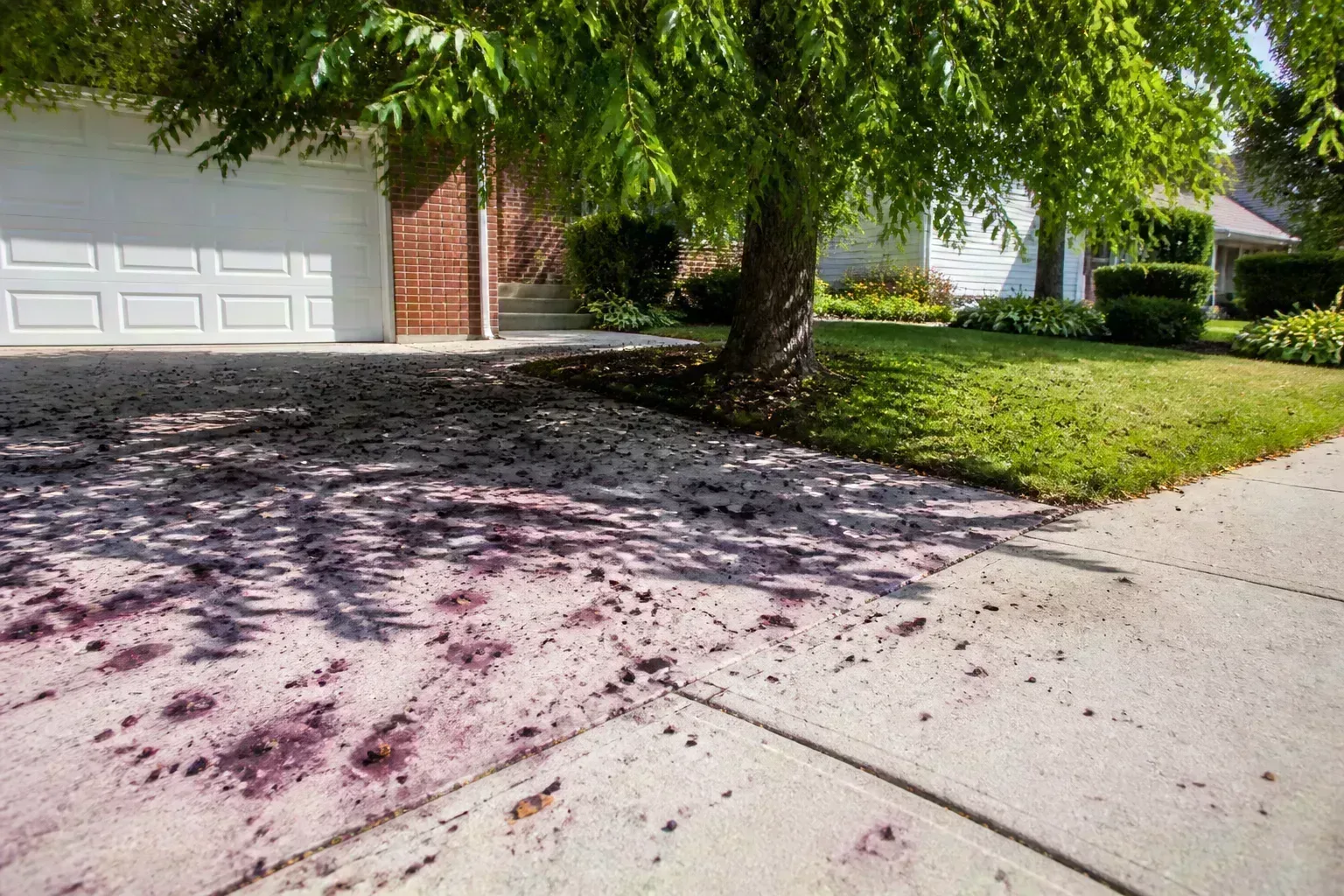
A beautiful tree can still be the wrong tree for the strip of lawn beside your driveway. The problem is rarely “leaves” in the abstract. It is what those leaves, berries, nuts, seed balls, or pest droppings become after they land on a surface you need to walk across or park on.
The six trees below are not bad landscape plants. Several offer food, shade, fall color, or wildlife habitat. The useful question is whether you can place each one so its predictable drop zone lands on lawn or planting bed instead of porous concrete, pavers, a car, or a busy path.
Before planting, decide which kind of mess you can live with
There are four different nuisances hiding under the word messy. Soft fruit is the most likely to stain shoes and pavement. Hard nuts and spiky pods create a physical hazard and can damage a mower or car. Leaf and twig litter is usually manageable in a bed but becomes a recurring chore on a clean driveway. Pest-related residue is the least predictable because it can appear only when a particular insect or mite is active.
That distinction matters when you compare trees. A tree that drops dry leaves into a mulched bed may be easier to manage than a smaller tree that drops juicy fruit onto the front step every day for three weeks.
Run a four-part site audit
Before buying a tree, stand at the proposed planting spot and answer these questions:
- What is underneath it? Lawn and mulch absorb or hide some litter. Light-colored concrete, natural stone, pavers with joints, and a car show it immediately; porous materials also hold pigment more readily.
- How much traffic passes through? A nut that is harmless in a back corner can be painful or slippery on a walkway used by children, older adults, guests, or pets.
- Where will wind carry the drop? The future canopy may be over the driveway even if the trunk is not. Wind can also move berries, leaves, and seed pods well beyond the dripline.
- What happens in the tree’s peak season? Check the fruiting, nut-drop, or seed-pod period—not just the spring bloom or summer appearance shown on a nursery tag.
Use the tree’s mature height and spread when making this decision. A young tree in a five-gallon pot tells you almost nothing about the area you will eventually need to sweep.
The six trees most likely to create hardscape headaches
The list is organized by the material that creates the problem, not by a claim that every tree in a genus behaves identically. Cultivar, climate, sex of the plant, pest pressure, and maintenance can change the amount of litter considerably.
Mulberry (Morus spp.)
Mulberry is the clearest example of a tree that is productive in the wrong place. Its thin-skinned berries ripen quickly, soften on the ground, and can be tracked onto a porch or car by shoes, tires, birds, and other wildlife. UF/IFAS Extension describes mulberries as fast-growing, heavy-fruiting trees whose ripe fruit can stain driveways and sidewalks; it also notes that many types produce fruit very early in the tree’s life (UF/IFAS Extension).
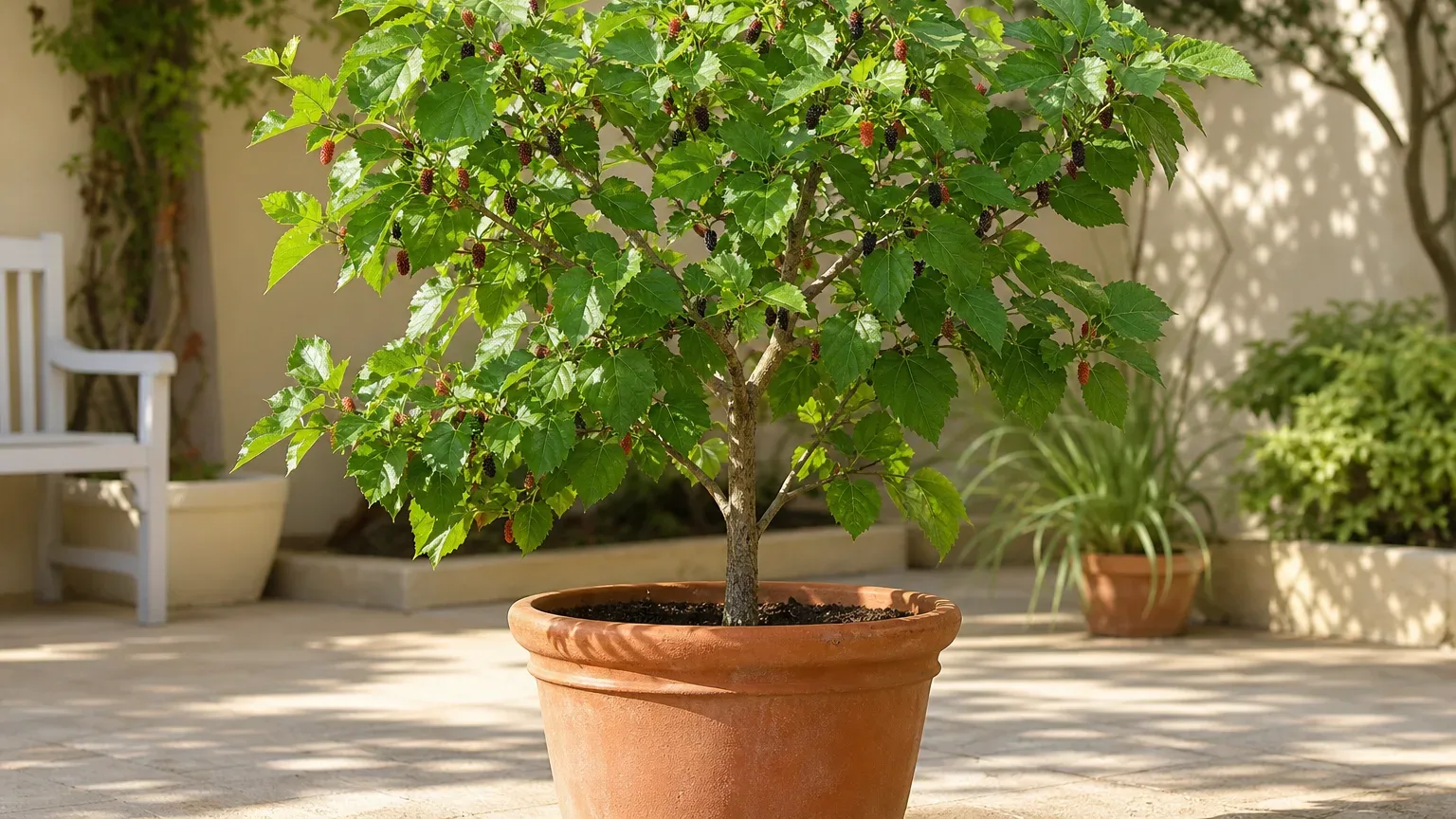
The mess is not identical across all mulberries. Red, black, white, and Pakistan mulberries differ in fruit and growth, and an “everbearing” type can extend the cleanup season. A dwarf plant may be easier to harvest, but dwarf does not mean fruitless.
If you want fruit, put a fruiting mulberry in an open lawn or orchard-like spot where a sheet, net, or quick harvest is practical. If you want the form and shade without a berry-stained walkway, look for a named fruitless selection and confirm its mature size. Oregon State University lists fruitless selections such as ‘Chaparral’ and warns that white mulberry has naturalized in parts of North America, so local recommendations matter (Oregon State University).
Verdict: high stain and tracking risk beside pavement; worthwhile in a harvestable, open location.
Fruiting crabapple (Malus spp.)
Flowering crabapples are often planted beside drives for their spring display, but a fruiting tree can create a second season of work. Small pomes may fall over several weeks, become soft under the canopy, and attract insects or wildlife. Fruit that is merely unattractive on grass becomes slippery and conspicuous when crushed on a path.
The key word is fruiting. Some ornamental crabapples are selected for little or no fruit, while others carry a heavy crop or hold fruit into winter. Ask the nursery for the named cultivar and its typical fruiting habit rather than relying on a generic “crabapple” label. A smaller rootstock controls tree vigor and eventual size in many grafted fruit trees, but it does not automatically remove the fruit; the Royal Horticultural Society explains that rootstock and cultivar both influence the final tree (RHS guide to choosing fruit trees).
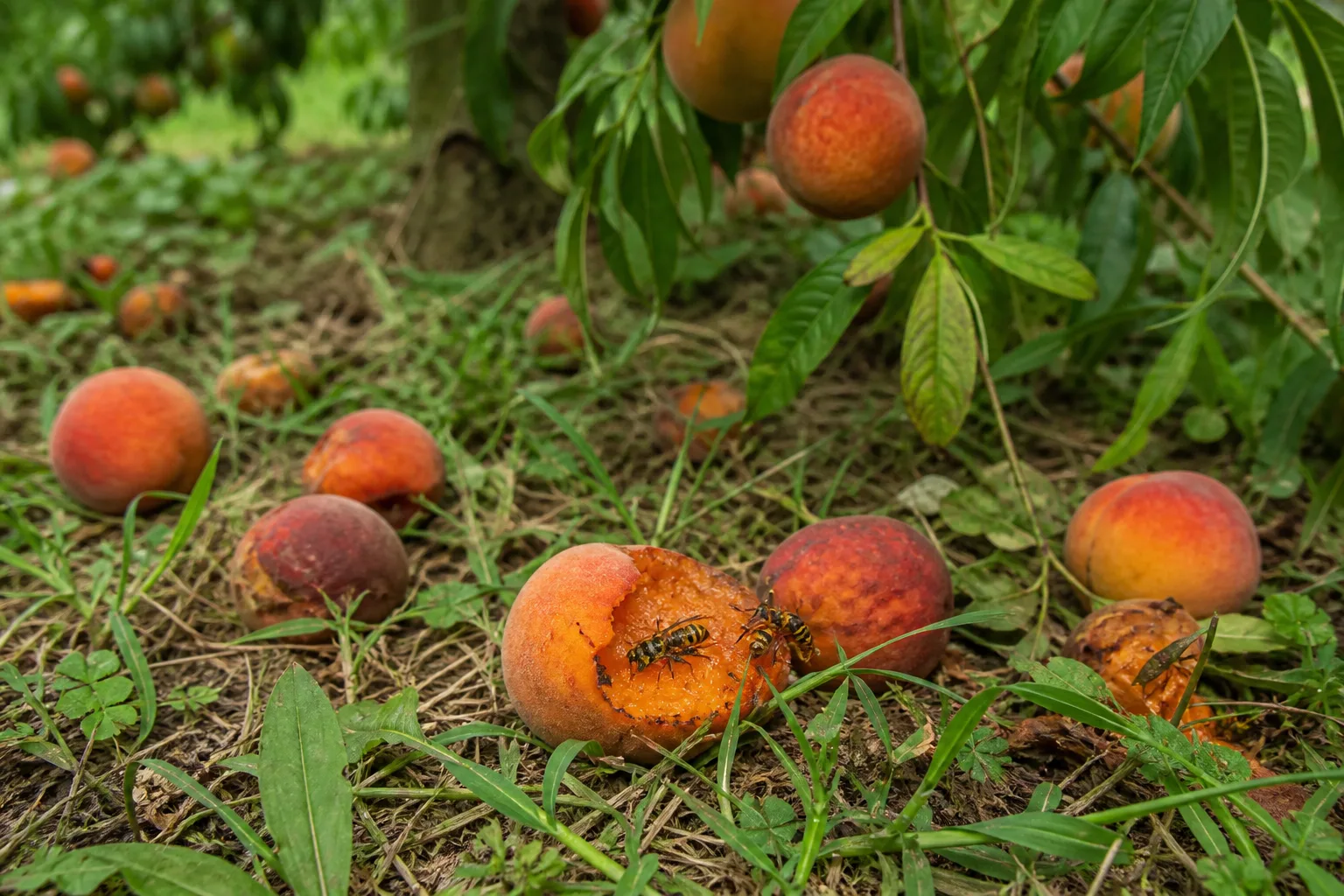
Fallen fruit becomes a different maintenance problem once it is soft, crushed, and attracting insects beneath the canopy.
Even a low-fruiting crabapple will still drop petals, leaves, and twigs. That is normal maintenance, not a failure of the selection. Put a fruiting type in the center of the lawn where fruit can be gathered, or choose a lower-fruiting ornamental if the main goal is blossom near a walkway.
Verdict: moderate to high seasonal fruit mess; the cultivar makes a major difference.
Black walnut (Juglans nigra)
Black walnut combines three problems: heavy nuts, staining hulls, and a chemically challenging root zone. The green outer hulls and nut material can leave dark marks when crushed, while the nuts themselves can dent surfaces, damage a mower blade, or hurt someone who walks beneath a mature tree during drop.
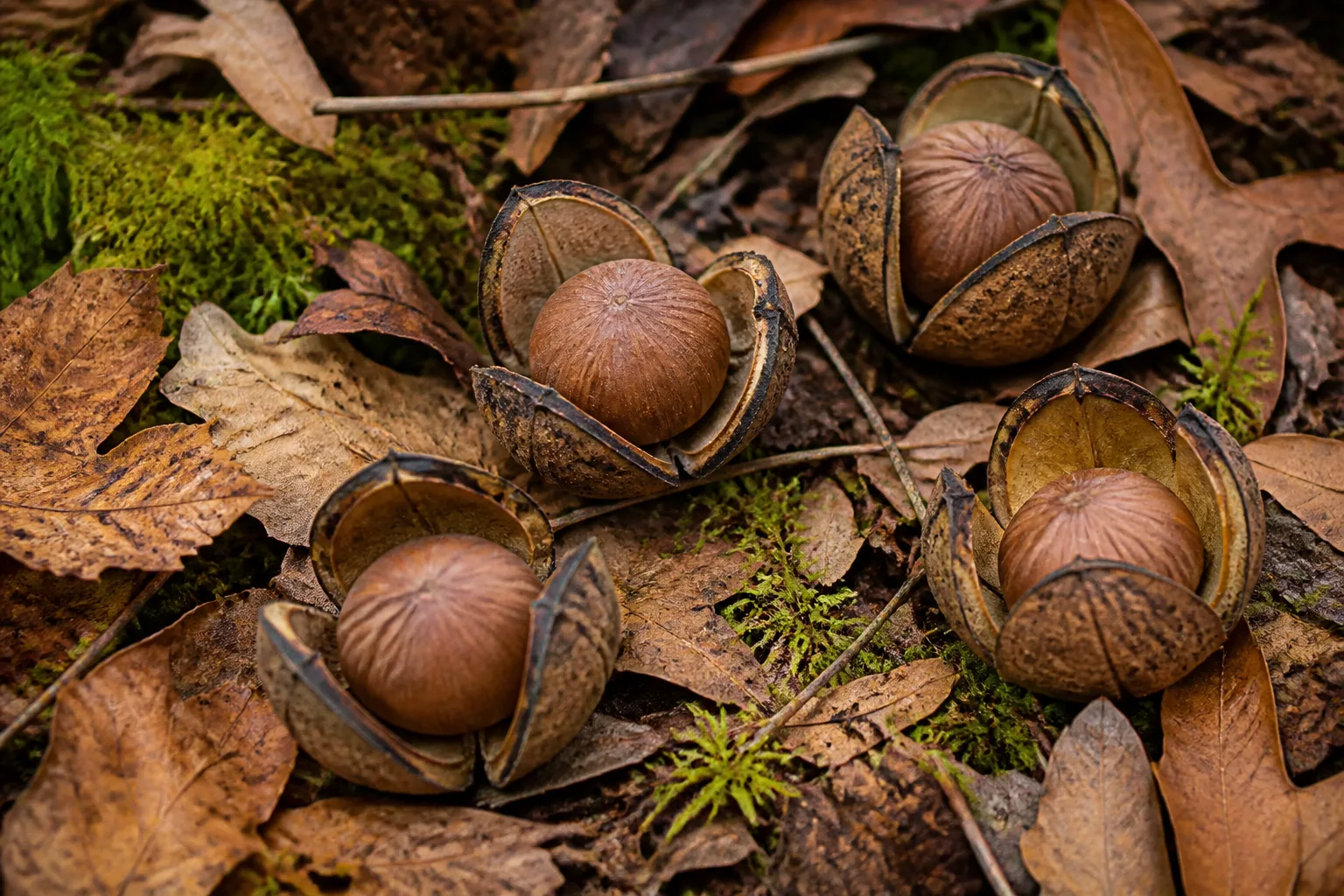
A hard-nut drop zone creates a different cleanup problem from soft fruit: collect it before mowing or before it becomes a hazard on a walkway.
The less visible issue is juglone. Penn State Extension reports that black walnut and butternut contain the highest concentrations of juglone and its precursor in buds, leaves, stems, nut hulls, and roots. It also explains that the compound is poorly soluble in water, is most troublesome with direct root contact or decomposing litter in poorly aerated soil, and can persist after roots from a removed tree decay (Penn State Extension).
That does not make black walnut a tree to condemn. It is a valuable native shade and wildlife tree, and its nuts feed both people and animals. It does make it a poor choice for a narrow planting bed beside a driveway, especially if you plan to grow sensitive vegetables or ornamentals under the canopy. Wisconsin Extension lists apple and crabapple, tomato, pepper, eggplant, potato, rhododendron, azalea, lilac, and several other plants among those that can be sensitive, while cautioning that tolerance lists are observational and not complete (Wisconsin Horticulture).
Give a black walnut a large open site where nuts can fall without striking people, cars, or paving. Keep walnut leaves, hulls, bark, and wood out of mulch intended for sensitive plants, and do not assume that a raised bed alone solves every root-contact problem.
Verdict: very high nuisance potential near high-traffic hardscape, plus a root-zone planning issue.
Sweetgum (Liquidambar styraciflua)
American sweetgum earns its reputation from the hard, spiky seed balls commonly called gumballs. They drop in late fall and winter, roll into walkways, hide in grass, and hurt when stepped on barefoot. Once crushed by a shoe, tire, or mower, the broken pod can leave a dark, resinous residue that is much harder to ignore than a dry leaf.
The tree’s brilliant fall color is real compensation, but it does not change the drop pattern. A sweetgum is best used where the seed balls can remain in a lawn or naturalized area and where nobody needs to rake a spotless path every day. Keep them away from playground routes, narrow sidewalks, and the turning area of a driveway.
If you are shopping for a sweetgum, ask specifically about a non-fruiting or reduced-fruiting selection suited to your region. Treat that trait as a reduction in seed-ball load, not a promise of zero litter; all trees still shed leaves, twigs, and flowers.
Verdict: high physical and cleanup risk; especially poor beside walking surfaces.
Oak (Quercus spp.)
Oak is a broad group, so the amount and timing of litter vary by species. The recurring nuisances are acorns, persistent leaves, twigs, and—in some seasons—small flower structures. Acorns can be hard underfoot, slippery when wet, and difficult to rake out of paving joints. Wet oak litter can also discolor porous concrete or stone as plant compounds leach out and the material is crushed.
The honest trade-off is that oak litter is not simply waste. Oak trees support wildlife, provide shade, and create valuable habitat. Fine Gardening’s practical guidance on fallen leaves recommends leaving suitable leaf litter in garden areas where it can break down and shelter organisms, while shredding or composting excess material when a tidier surface is needed (Fine Gardening). The better rule is to clear high-traffic hardscape and manage leaves in beds, not to sterilize the entire yard.
Oaks also deserve more room than their nursery size suggests. The RHS notes that mature oaks have high water demand and that tree-related building risk depends on soil, foundation depth, tree size, and distance; most trees near buildings do not cause damage, but site conditions can raise the stakes (RHS guide to trees near buildings). Put an oak in a spacious lawn or woodland edge, not in the small square between a drive and a foundation simply because the sapling fits there today.
Verdict: high litter volume but usually manageable in a large yard; a poor fit for pristine paving and small sites.
Black olive (Terminalia buceras)
Black olive is not a true olive tree. In warm climates it is usually Terminalia buceras, also called oxhorn bucida, and the staining problem can be more complicated than falling black fruit or bark alone.
A 2017 study in Florida Entomologist linked staining beneath these trees to two pests: an eriophyid mite that contributes to galls on the fruiting structures and a caterpillar whose droppings, or frass, can add tannin-rich residue. When wet, the galls can release an oily, rusty material that spreads across the surface below (Florida Entomologist study). The result is a localized, climate-dependent problem rather than a guaranteed feature of every black olive tree.
That distinction changes the response. If a black olive suddenly starts staining after years of being tolerable, inspect the canopy and the surface below for unusual galls or caterpillar residue and have an arborist identify the cause. Do not copy a pesticide rate from a general article or attempt a trunk injection yourself; treatment must be based on a current label, local rules, tree condition, and professional diagnosis.
Verdict: variable but potentially severe staining in warm-climate sites; pest identification matters more than a generic cleaning routine.
Compare the mess before you choose a tree
The table below is a planning shortcut, not a scientific ranking. “High” means the material is likely to be a recurring problem if it lands on busy or porous hardscape; the same tree may be easy in an open back lawn.
| Tree | Main material dropped | Typical nuisance window | Best placement |
|---|---|---|---|
| Mulberry | Soft dark berries | Ripening season; longer for everbearing types | Open lawn or harvest area away from cars and paths |
| Fruiting crabapple | Small fruit, then leaves and petals | Late summer through fall, sometimes longer | Lawn or bed where fruit can be collected |
| Black walnut | Nuts, green hulls, leaves, twigs | Heavy fall drop; litter afterward | Large open space away from paving and sensitive plantings |
| Sweetgum | Hard spiky seed balls | Late fall and winter | Broad lawn or naturalized area, away from foot traffic |
| Oak | Acorns, leaves, twigs | Fall and wet-weather cleanup | Spacious yard or woodland edge |
| Black olive | Pest frass and wet galls | Warm-climate pest activity; variable | Away from critical paving, with arborist oversight if staining starts |
If your priority is a clean driveway, eliminate soft-fruit trees first. If safety underfoot is the concern, put sweetgum and black walnut at the top of the caution list. If you want a native wildlife tree and can accept leaf and acorn work, oak may be a better fit than the word “messy” suggests.
How far from a driveway or sidewalk should a tree go?
There is no single distance that makes every tree safe for every driveway. A small ornamental tree, a 100-foot oak, a fruiting mulberry, and a pest-affected black olive do not share one useful setback number.
Instead, plan from the mature canopy and drop zone. The trunk should be far enough away that the mature crown does not routinely shade the entire hardscape, and the main fruit, nut, or seed drop should land where you can tolerate it. Add room for wind, the driveway’s turning area, gutters, overhead wires, underground utilities, and the people who will use the path.
The RHS points out that roots can extend well beyond the canopy and that tree-related damage depends on soil and construction, not merely on whether a root is visible. That is a reason to check local planting guidance and utilities before digging—not a reason to panic about every tree near a building.
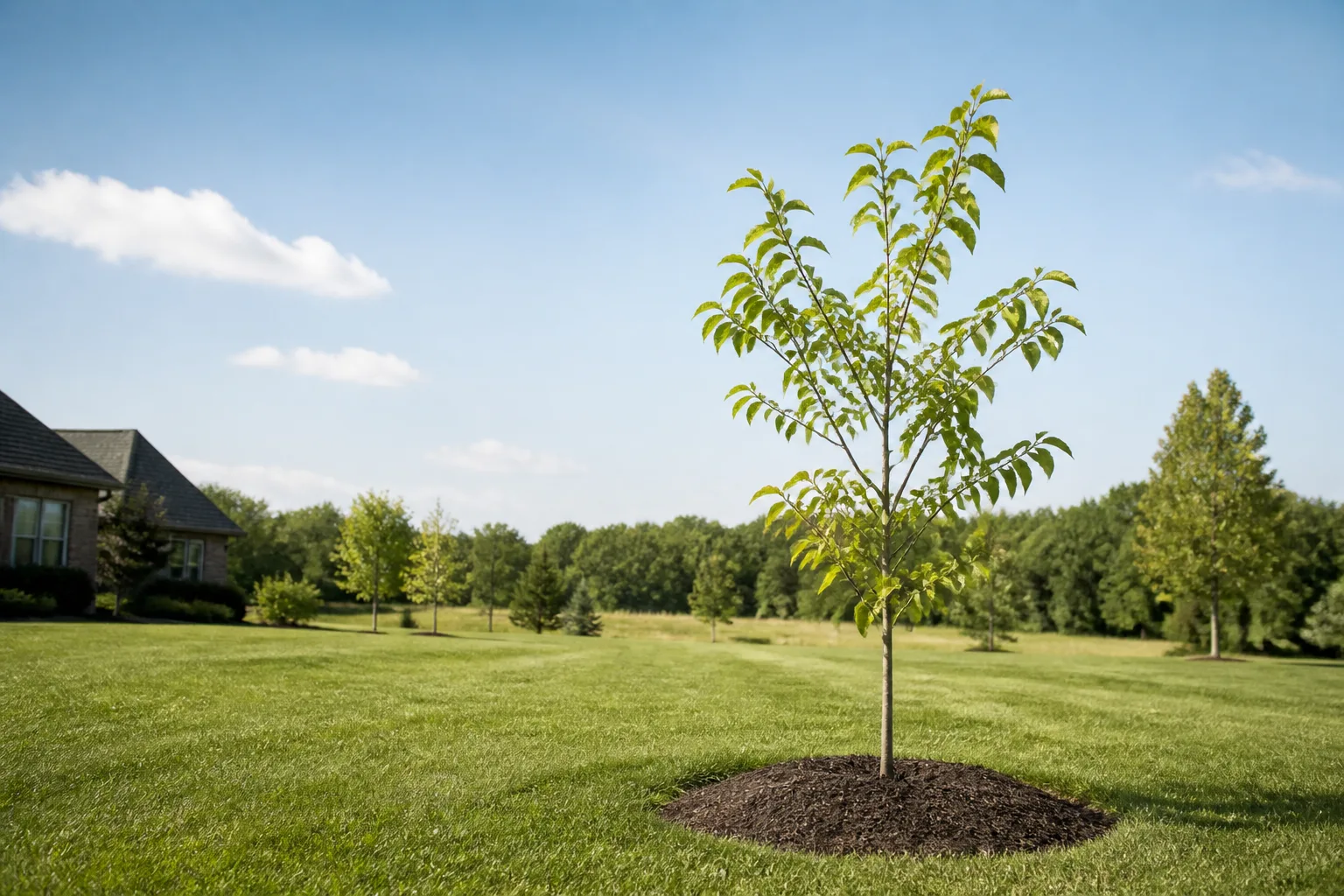
A young tree needs open growing room that matches its mature size, including a drop zone that is not the only route across the property.
Plan for mature canopy, wind, and the root zone
Read the mature spread on the plant tag, then compare it with the width of the open site. If the tree’s eventual crown would sit directly over the only walkway, move the planting location before you plant. If the tree is already there, use a qualified arborist for structural assessment rather than cutting large roots or topping the canopy.
Do not confuse a dwarf tree with a low-mess tree. Dwarfing usually changes size or vigor; it does not necessarily change whether the plant produces fruit, nuts, or seed pods. For fruit trees, a named cultivar and rootstock give you much more useful information than a label that only says “small.”
A cleanup routine that prevents the worst stains
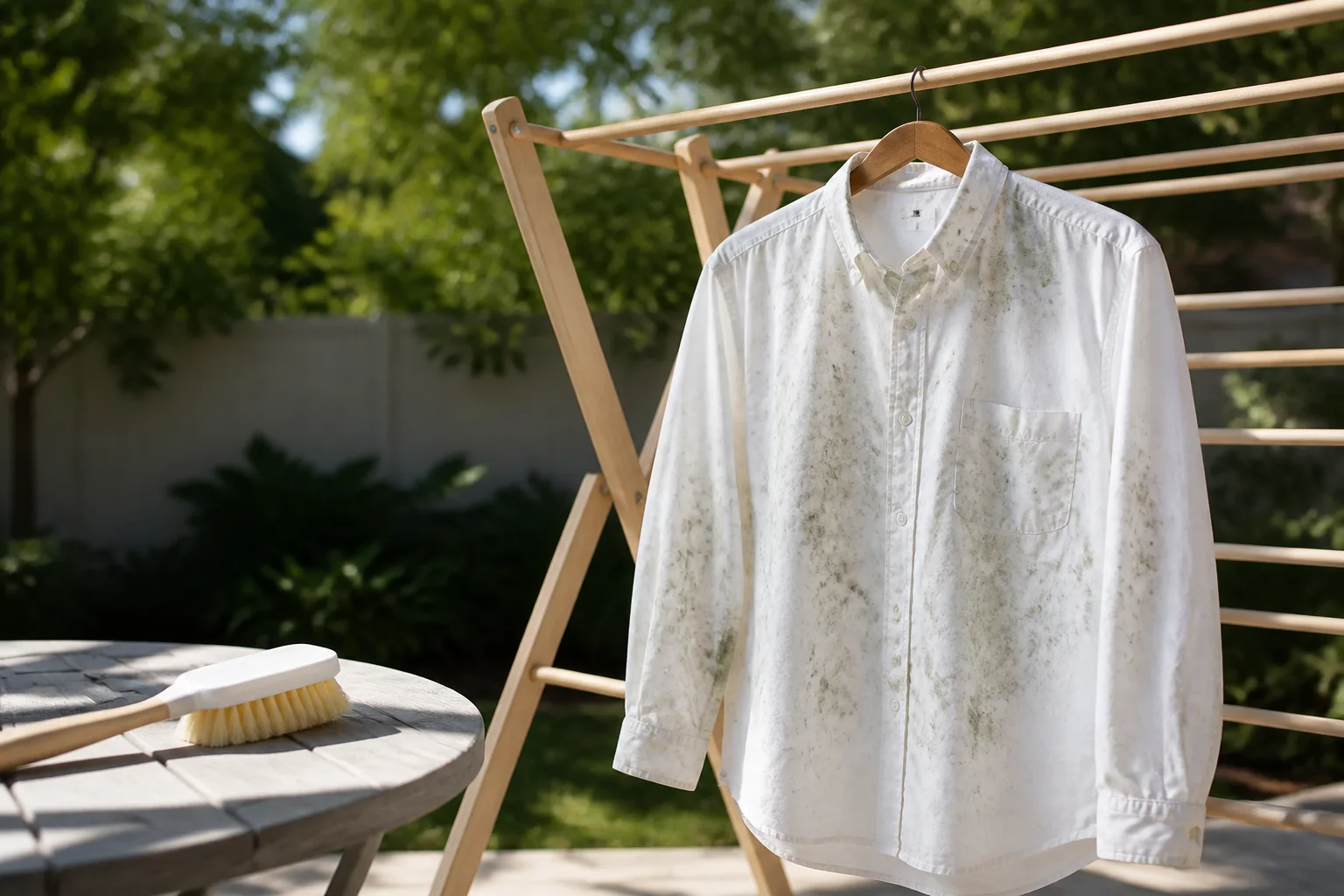
Timing does more work than harsh chemistry. When fruit, nuts, or seed balls land on a driveway, remove them before rain, foot traffic, or tires crush them into the surface. Sweep or pick up solid debris first, then clean the remaining film with a surface-appropriate cleaner and a soft brush; test any product on a hidden area and follow the paving or vehicle manufacturer’s guidance.
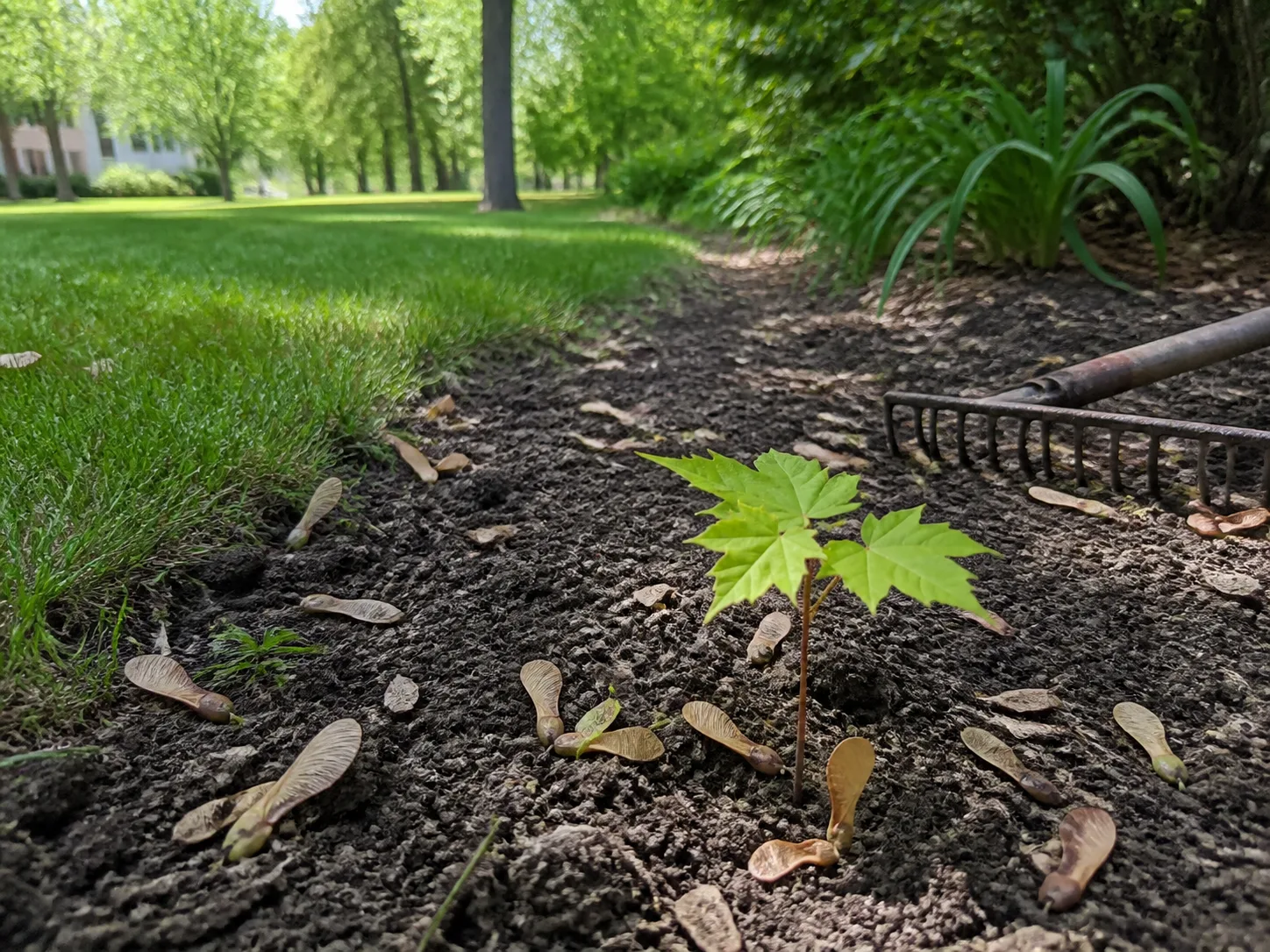
The before-rain collection habit works for berries, nuts, seed pods, and leaf litter alike: remove the material while it is still loose.
For fruiting mulberries and crabapples, harvest or gather ripe fruit frequently during the peak drop. For walnuts and sweetgum, collect hard material before mowing so it does not become fragments or projectiles. A driveway broom, rake, tarp, or leaf vacuum can make this a short routine if you do it on a schedule instead of waiting for a thick, wet layer.
Treat concrete, pavers, cars, and turf differently
Porous concrete and pavers deserve the fastest response. Pigment and decomposing plant material can settle into pores or joints, and aggressive pressure washing can spread residue into places a broom would have left clean. Start gently, use a cleaner labeled for the material, and accept that an old stain may lighten rather than disappear.
Cars need a no-scrub-first approach. Rinse away loose grit and organic material, then use a car-safe wash solution; rubbing dry berry or hull residue across paint can create a larger problem than the original drop.
Turf and planting beds are where much of the litter can stay. Fine Gardening’s leave-the-leaves guidance supports letting suitable leaf litter break down in garden areas, lightly raking apart dense piles, mowing or shredding leaves where appropriate, and composting excess. Do not leave a thick wet mat over grass that needs light and air, and do not spread black walnut debris around plants that may be juglone-sensitive.
What not to do with a messy tree
Do not top a tree to stop fruit or seed production. Topping removes healthy structure, stimulates weak regrowth, and does not reliably eliminate the biological cycle that causes the mess. Structural pruning can improve safety and clearance, but it should be timed and performed for the tree’s health, not as a shortcut for poor placement.
Do not assume pressure washing is always the best first move. Fresh organic debris is easier to remove before it is crushed and soaked, and high pressure can damage some pavers, remove joint material, or drive staining deeper. Start with collection and the least aggressive suitable cleaning method.
Do not apply abamectin or another pesticide just because a surface is stained. The black olive problem is pest-specific, and a treatment decision belongs with an arborist who can identify the pest and follow current label and local requirements. The same caution applies to any tree insect problem that is not identified first.
Finally, do not use black walnut leaves, hulls, bark, or wood as a casual mulch around sensitive plants. If you are unsure whether a plant is reacting to juglone, drought, a disease, or root damage, improve the diagnosis before changing the entire landscape.
How to choose a lower-mess alternative
Start with the feature you actually want. If it is spring blossom, compare fruiting habit and mature size rather than choosing any flowering tree. If it is fall color, look for a cultivar with a known mature spread and acceptable seed or leaf drop. If it is wildlife value, decide whether you can place the tree in a naturalistic area where nuts and leaves are benefits instead of defects.
Ask a local extension service or reputable nursery for four pieces of information before buying: mature height and spread, fruit or seed production, peak drop season, and whether the recommended cultivar is suited to your climate. A fruitless or reduced-fruiting selection can lower staining risk, but no tree is completely litter-free. Flowers, leaves, twigs, pollen, and windblown debris still exist.
The most reliable “low-mess” strategy is often a better location, not a perfect species. A tree that drops dry leaves onto a mulched bed can be easier to live with than a supposedly tidy tree over a white sidewalk. Design the planting so routine cleanup happens where a rake, mower, compost pile, or wildlife can use the material.
If the tree is already planted
First, identify the tree and map its nuisance. Note what falls, when it falls, where it lands, and whether rain or crushing makes the stain worse. That record tells you whether the problem is a short fruiting season, a predictable nut or pod drop, or a pest event that needs professional attention.
For a healthy tree that is simply in the wrong place, begin with practical management: sweep the hardscape before rain, harvest usable fruit, collect nuts and gumballs before mowing, and leave appropriate leaf litter in beds. Have an arborist check clearance and structure, especially if branches overhang a driveway or walkway. Pruning can improve clearance; it cannot turn a mature fruiting or nut-bearing tree into a sterile one.
Removal is a bigger decision than a messy season. With black walnut, Penn State and Wisconsin Extension both warn that roots and woody debris can continue to affect sensitive plantings after the tree is gone, so replacement planning should account for the soil and remaining root material. With black olive, identify the pest before deciding that the tree itself is the problem. In every case, preserve a valuable tree when a change in use, cleanup timing, or planting layout solves the real nuisance.
Conclusion
Mulberry, fruiting crabapple, black walnut, sweetgum, oak, and black olive can all create stains or cleanup work, but they do it for different reasons. Soft berries, hard nuts, spiky seed balls, tannin-rich litter, and pest residue each call for a different placement and management plan.
Choose the tree for its mature behavior, not its nursery-pot appearance. Keep the main drop zone off high-traffic hardscape, verify whether a cultivar is fruitless rather than merely dwarf, clear fresh debris before rain, and get an arborist’s diagnosis before pruning heavily or treating a pest problem. That approach lets you keep the shade, flowers, food, fall color, or wildlife value without turning the driveway into the tree’s composting and stamping area.