Can You Grow Houseplants With a Regular LED Light?
Learn when a regular LED bulb can support houseplants, how to judge useful brightness, set distance and hours, and when a dedicated grow light is worth it.
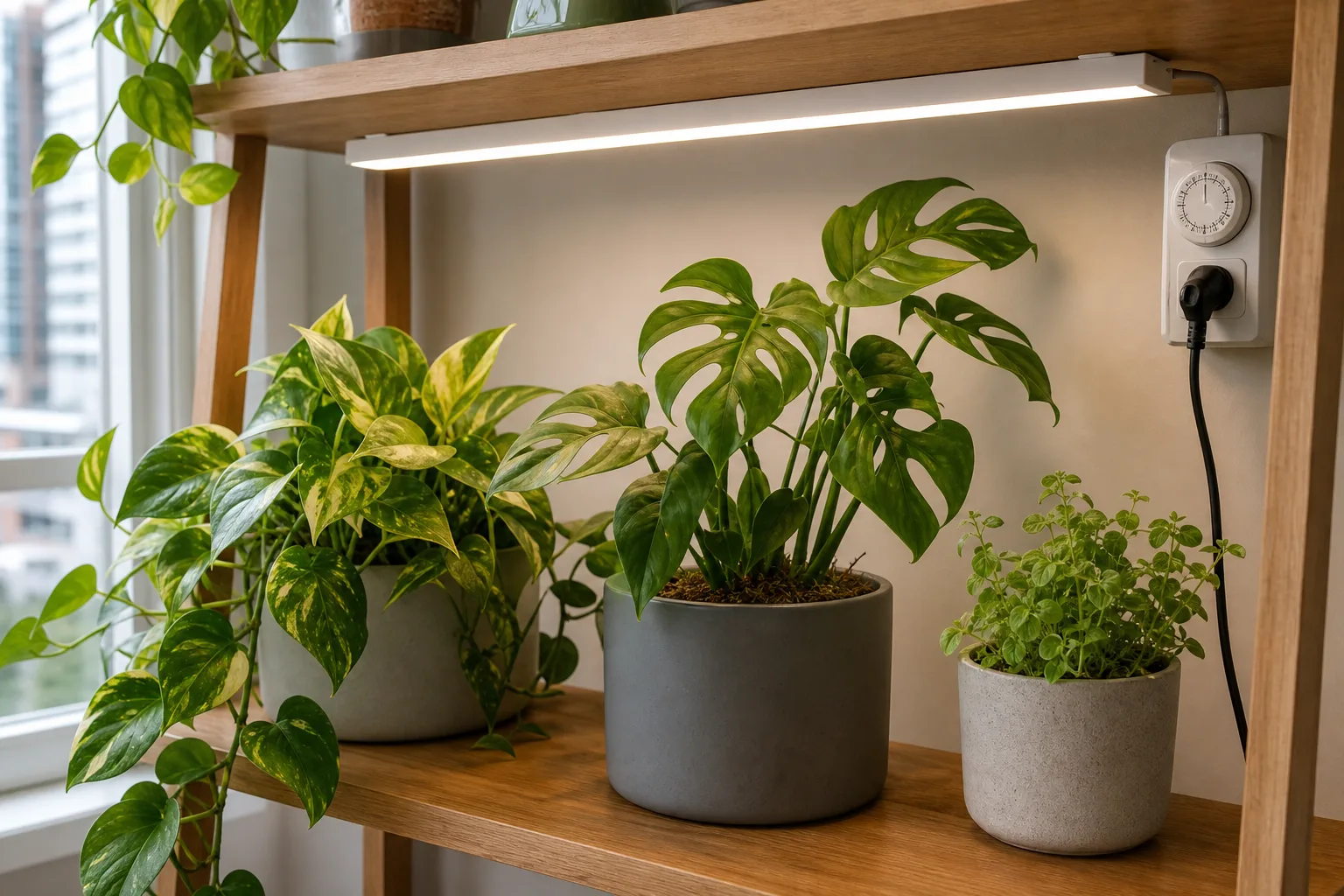
Yes, a regular LED light can grow plants if it delivers enough plant-usable light to the leaves for enough hours each day. The word “regular” does not make a bulb useless: plants respond to photons, not to whether a package says “grow light.” The practical difference is that an ordinary household bulb may not provide enough intensity, spread, or product information for the job you want it to do.
A bright white LED close to a pothos or other tolerant foliage plant may help it hold its shape and keep growing in a dim room. The same bulb can disappoint if it is several feet above a seed tray, expected to keep basil productive through winter, or asked to light a wide shelf from one small hotspot. Judge the light at the plant, not by the fixture’s name or how bright the room feels to you.
The short answer: yes, when enough light reaches the leaves
A regular LED is most likely to work as supplemental light for a low- or medium-light houseplant that already receives daylight. It can also work as the sole source for some foliage plants if the bulb is bright enough at canopy height, covers the whole plant, and runs on a consistent schedule. “Can grow” is not the same as “will grow well”: a plant may stay alive while producing smaller leaves, longer gaps between them, or very little new growth.
A bulb is less likely to replace a purpose-built fixture for seedlings, herbs harvested repeatedly, succulents, or plants grown for flowers or fruit. These jobs generally need a stronger, more even light field than a typical ceiling bulb or decorative lamp creates at leaf level. A high-output workshop or shop light can sometimes serve them, but only when its measured output, distance, and coverage support the intended crop.
Start with the goal. If you want a pothos to hold steady through a dark winter, an existing white LED might be a reasonable trial. If you want tomato seedlings to develop stout stems or want to harvest herbs from a shelf, compare horticultural fixtures that publish useful light-output data before committing the plants to a weak bulb.
Regular LED bulbs and grow lights solve different problems
Both household LEDs and LED grow lights turn electricity into light. A plant can photosynthesize under either one when enough appropriate light reaches it; the distinction is that a grow fixture is designed and described for plant production, while most household bulbs are designed to make rooms look bright and comfortable.
| What you are comparing | Regular household LED | LED grow light |
|---|---|---|
| Main design goal | Comfortable human-visible room light | Delivering plant-useful light to a growing area |
| Common product information | Lumens, color temperature, actual wattage | Often PPFD maps at distance, coverage, spectrum, and power draw |
| Typical beam and mounting | Built for a room fixture, lamp, or downlight | Built as a bulb, bar, or panel positioned near a canopy |
| Best starting job | Supplemental light for tolerant foliage plants | Seedlings, productive herbs, larger shelves, and more demanding plants |
Those are tendencies, not guarantees. Some regular bulbs are bright, broad-spectrum LEDs; some products sold as grow lights have poor coverage or vague specifications. A label is a useful clue only when it is paired with output and placement information.
What a household white LED can provide
A white LED is not a single wavelength. It combines colors, commonly using a blue-emitting diode with a phosphor coating that converts some of that light into a broader white appearance. A warm-white, neutral-white, or daylight-colored bulb can therefore emit wavelengths that plants use; the visible tint alone does not tell you whether enough light is reaching the plant.
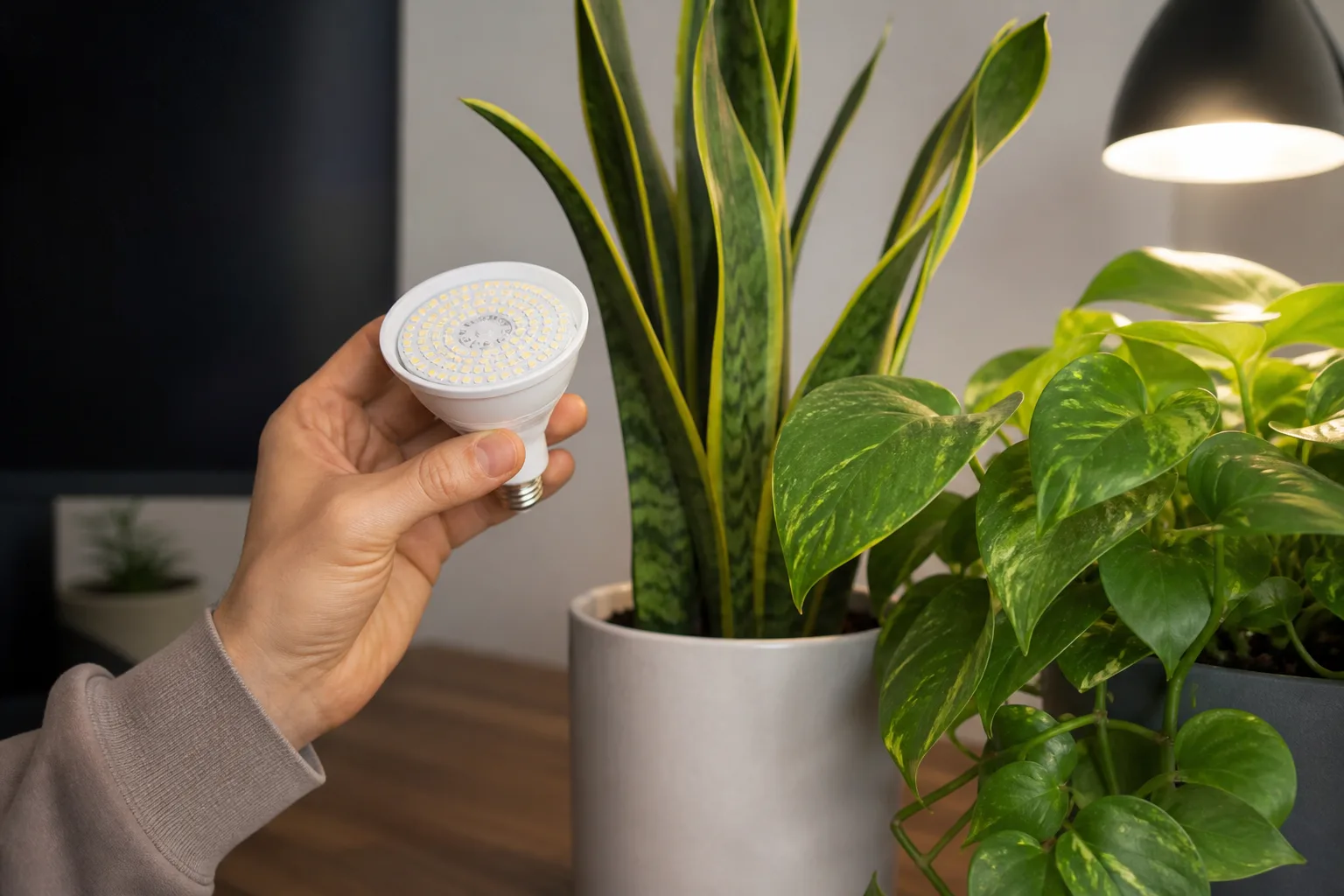
University of Florida IFAS Extension notes that broad-spectrum white light can support houseplant growth and that cool-white, warm-white, and daylight lamps can all be options. The important caveat is output at the plant: a bulb that looks bright to a person across a room may deliver little usable light to a leaf several feet away. (University of Florida IFAS Extension)
What a horticultural fixture adds
A dedicated grow light usually makes the growing setup easier to plan. The manufacturer may provide a PPFD chart at several distances, a coverage footprint, adjustable mounting, and a spectrum description. Those details let you compare the fixture at the height where the leaves will actually sit, rather than guessing from the bulb’s marketing name.
Purpose-built fixtures also come in shapes that fit the job: a screw-in bulb for one plant, a bar for a shelf, or a panel for a tray. Their advantage is not that a plant recognizes a special “grow” spectrum. It is that the user can more often find a fixture with adequate, documented output over a useful area. For choosing a complete setup, see this grow-light guide for indoor plants.
Why watts and lumens do not settle the question
Watts measure electricity used, not the amount of light a plant receives. Two bulbs that draw the same watts can produce different light outputs because their efficiency, optics, and spectrum differ. A package may also list “60-watt equivalent,” which describes a comparison with an older incandescent bulb; it does not mean that the LED draws 60 watts or supplies a known amount of plant light.
Lumens measure visible brightness weighted for human vision. Our eyes are especially sensitive to yellow-green wavelengths and adapt quickly as we move between a bright window and a dim corner, so a room can look comfortable while providing little light for growth. Maryland Grows at the University of Maryland Extension explains why lumens are useful for comparing human-visible light but do not directly quantify plant-usable output. (Maryland Grows)
Kelvin ratings are also easy to overread. Correlated color temperature describes whether a white light looks warmer or cooler; it does not say how many photosynthetic photons land on your plant. A higher Kelvin value is not automatically a stronger grow light, and “full spectrum” on a package is not a substitute for intensity or coverage data.
PAR, PPFD, and DLI in plain language
PAR, or Photosynthetically Active Radiation, is the portion of light usually counted for photosynthesis measurements, conventionally 400 to 700 nanometers. PPFD measures the photosynthetic photons landing on a square meter each second, in micromoles per square meter per second. It answers, “How much light is reaching this spot right now?”
DLI, or Daily Light Integral, totals those photons over a day. If you know the average PPFD at leaf height and the number of hours the light is on, estimate DLI with this formula:
DLI = PPFD × hours per day × 0.0036
For example, a measured average of 60 µmol/m²/s for 12 hours gives about 2.6 mol/m²/day from the lamp. At 120 µmol/m²/s for the same 12 hours, the estimate is 5.2 mol/m²/day. That calculation helps compare schedules, but it is not a universal “good plant” target; species, growth stage, daylight, and whether you expect maintenance or harvest all matter.
Oklahoma State University Extension describes PPFD as light reaching a surface and DLI as the total received each day, and emphasizes that the appropriate DLI depends on the crop and growing conditions. Its ranges come from plant-production settings, so do not apply them as rigid prescriptions for every living-room plant. (Oklahoma State University Extension)
Which plants are realistic candidates?
Think in terms of the growth you expect, not a simplistic “low-light plant” label. A plant that tolerates shade may persist in weaker light, but it will not necessarily maintain its largest leaves or grow at the same pace as one under brighter conditions. A household LED is most useful when the plant’s demand and the bulb’s actual delivery are a reasonable match.
The light from a nearby window counts too. A lamp supplementing an east-facing window does not need to supply all of a plant’s daily light by itself, whereas a bulb over a plant in an interior room must carry much more of the load. Treat natural and artificial light as one daily light environment.
Low- and medium-light foliage plants
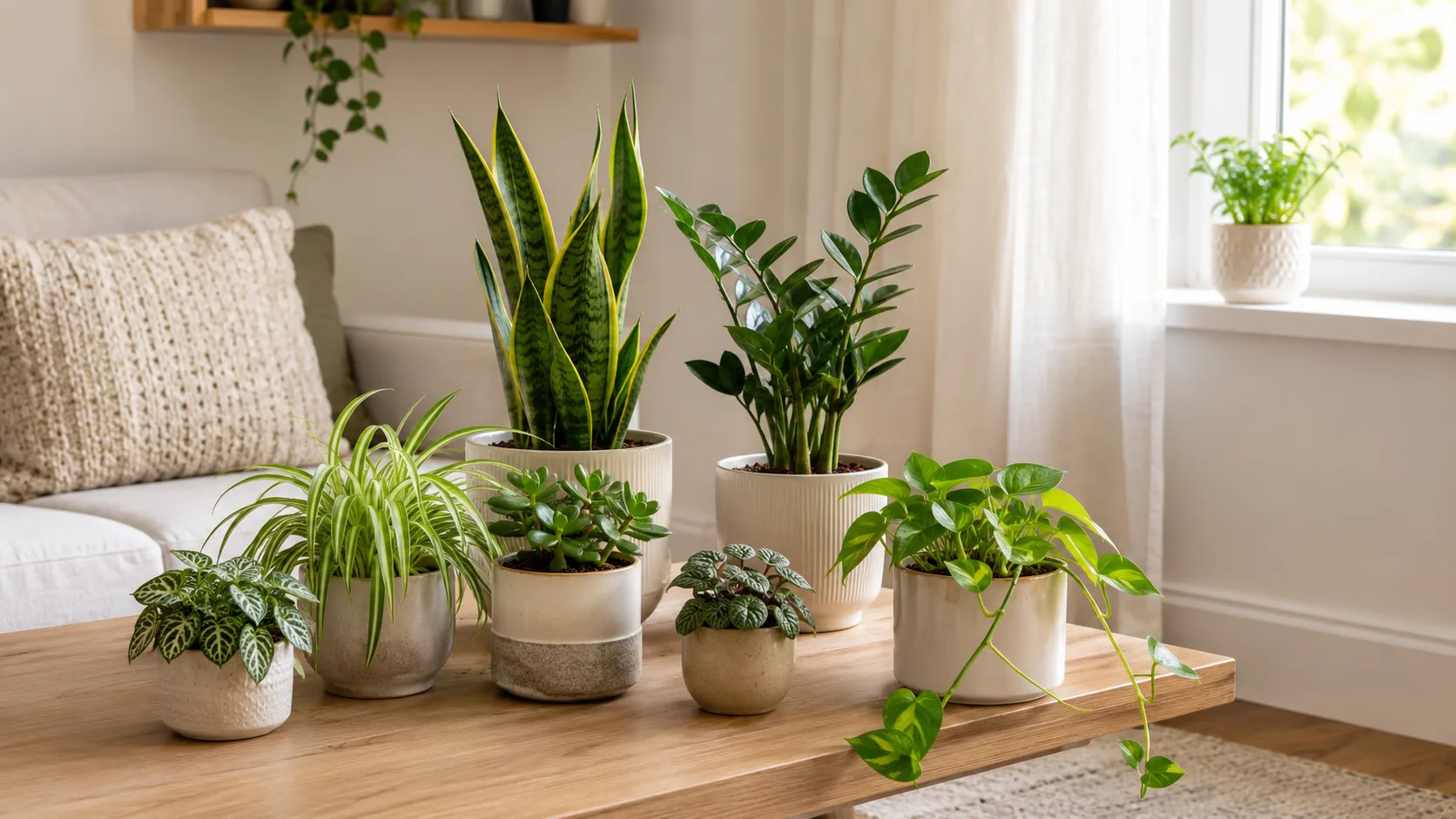
Pothos, heartleaf philodendron, many dracaenas, and snake plants are practical candidates for a regular LED when the goal is to support foliage growth or prevent decline in a dim location. Place the light over the leafy part of the plant, then look at new growth over the next several weeks. Tighter spacing between leaves and normal-sized new leaves suggest the setup is helping; persistent stretching suggests the plant still needs more light.
A single bulb can be adequate for a compact plant directly under it, especially if a window contributes additional light. It is a weaker choice for a broad or tall specimen whose lower leaves sit well outside the beam. In that case, add a second light, use a bar or panel for more even coverage, or move the plant closer to a suitable window rather than simply extending the hours indefinitely.
“Low light” does not mean “no light.” UF/IFAS Extension points out that people are poor at judging indoor light because our eyes adjust rapidly, and that plants differ in the intensity they can use. If a room feels bright but new leaves are small and stems reach toward the window, test or change the position before assuming the plant is naturally slow-growing. (UF/IFAS houseplant light guidance)
Seedlings, herbs, succulents, and flowering plants
Seedlings are a demanding test for ordinary bulbs because they need a close, even source soon after emergence. A window may provide enough light for a short, well-timed start, but a dim household bulb often produces tall, thin stems when the tray is far from the fixture. A shop light can work for a small tray if it gives adequate, uniform output at a practical height; the fixture should be adjustable as seedlings grow.
Culinary herbs need enough light to replace leaves after harvesting. Basil and similar sun-loving herbs placed far below a standard room lamp may stay alive but become sparse, lean toward the light, or produce smaller leaves. If you expect regular harvests, a grow bar or panel with output information is usually a more dependable choice than a decorative bulb.
Succulents and cacti also expose the limits of a weak bulb. Many need a brighter position to maintain compact growth, and prolonged dimness can cause stretching; yet a sudden move under a very bright fixture can stress leaves. Flowering and fruiting add another variable: intensity may support growth, but flowering can also depend on the plant’s day-length response and maturity. A regular LED is possible when its output fits the species, but an unspecified household bulb gives little basis for predicting results.
How to judge a regular LED before relying on it
Read the packaging and manufacturer’s page for the bulb’s actual input watts, lumen output, color temperature, and beam angle. Those specs do not prove plant suitability, but they help identify a very dim, narrow, or low-power bulb before you mount it. Ignore “equivalent watts” as a measure of fixture draw, and do not compare plant performance by wattage alone.
The strongest evidence is PPFD information measured at a stated distance and across the area you intend to light. A center reading without edge readings can hide a bright hotspot surrounded by a weak perimeter. If the maker does not publish a PPFD chart, a quantum sensor can measure photosynthetic light at the leaves; a basic lux meter or phone app can help compare positions under similar white bulbs, but should not be treated as a precise substitute for a plant-light meter.
Make the measurement where the leaves sit, with the fixture in its final position. Check the center and the plant’s outer edges, then repeat after a tall stem grows closer to the bulb. A white household light can be compared roughly with human-oriented measurements, but different white spectra can make a lux reading less reliable as a direct measure of plant photons. Maryland Grows and Oklahoma State both describe why plant-focused metrics give a fairer comparison across fixtures than wattage or lumens alone. (Maryland Grows; Oklahoma State University Extension)
If you do not own a meter, use an observation-based trial rather than pretending the label answers the question. Start with one representative plant, place the bulb close enough to light its canopy evenly without touching leaves, and run a timer. Take a photo of the newest leaves at the start, then compare fresh growth after two to four weeks; the older leaves may not change even when the new conditions are better.
Set the light up for useful growth
A workable setup balances intensity, coverage, and duration. Increasing one while ignoring the others can fail: a strong bulb too far away may be weak at the leaves, a close bulb may illuminate only the center, and a long photoperiod cannot fully compensate for a very low output. Make one adjustment at a time so you can tell which change helped.
First, decide whether the lamp is supplementing window light or acting as the sole source. Place the plant where it can get the best available daylight without sacrificing its temperature or watering needs, then add artificial light to fill the daily gap. This usually requires less electricity and makes an ordinary bulb more useful than using it as a substitute for all daylight.
Distance, coverage, and plant shape
Measure from the light-emitting surface to the top leaves, not from the pot rim. The farther a light moves from the canopy, the weaker its intensity tends to become, even as the beam covers a wider patch. The correct distance therefore depends on the bulb’s output, reflector, beam angle, plant, and maker’s instructions; a fixed number of inches is not meaningful across all lamps. Practical grow-light guides describe the same tradeoff: moving a fixture farther away widens its footprint but lowers the intensity at the leaves. (Epic Gardening)
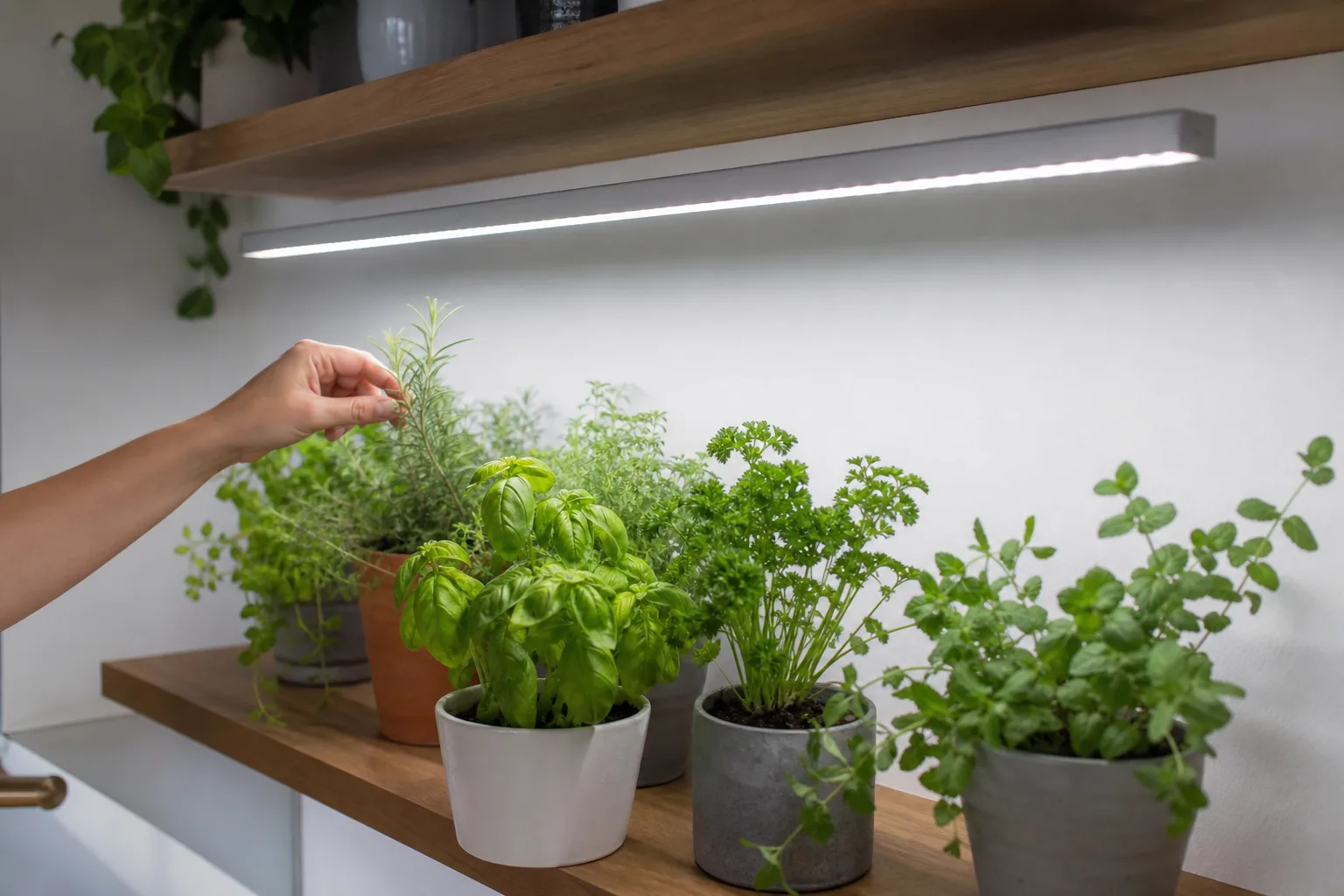
Aim the source over the canopy so the leaves receive light from above. Side light can help fill a shaded area, but a lamp aimed at the trunk may leave the upper leaves exposed and the lower canopy dark. On a shelf, a bar running along the plants often spreads light more evenly than a single narrow spotlight.
Use a simple coverage check: look at whether the outer leaves are as bright as the center leaves and whether neighboring plants shade one another. Rotate a round plant periodically if growth is leaning, or spread plants apart if their canopies overlap. Oklahoma State Extension likewise treats plant type, coverage area, natural light, fixture type, and manufacturer guidance as parts of LED placement rather than recommending distance in isolation. (Oklahoma State University Extension)
Keep a close light from pressing against foliage, and check leaf temperature if the lamp or housing feels warm. LEDs generally send less radiant heat toward plants than incandescent lamps, but fixtures and drivers can still warm up, and direct sun through glass can add heat that the LED is not responsible for. Move the lamp or plant if leaves become bleached or scorched, then reassess before concluding that spectrum is the cause.
Daily hours and a dark period
Use a timer to keep the schedule consistent. As a cautious starting point, a foliage plant receiving some daylight might get roughly 8 to 12 hours of added lamp time; a plant relying almost entirely on artificial light may need a longer day or a stronger fixture. Seedlings commonly use a longer schedule, but follow crop guidance and keep the light close and even rather than leaving a weak bulb on all day.
More hours are not always the right fix. A plant that receives very little light per second may still get too little total light after a long day, while an already strong fixture can overexpose leaves even at a shorter schedule. Add the window’s daylight to the lamp’s hours rather than treating each source as a separate full day.
Give plants a normal dark period instead of running the light around the clock. Darkness supports the plant’s daily rhythms, and day length can influence flowering in some species. The Royal Horticultural Society explains that plants vary in light needs, that seedlings can be grown under lights, and that foliage response can help indicate whether intensity needs adjusting. (Royal Horticultural Society)
If a plant is far from any window, begin with a practical schedule and judge the next leaves, not just the number of hours on the timer. Savvy Gardening’s indoor-lighting guidance also emphasizes that fixture height and exposure are part of keeping seedlings compact; a fixed schedule does not rescue a source that is too weak or too distant. (Savvy Gardening)
Diagnose weak growth and light stress
A plant that does not improve under a regular LED may need more intensity, more even coverage, or a different schedule. It may also have another problem, such as damaged roots, poor drainage, pests, low temperature, or a seasonal pause. Use light symptoms as clues, then change the light in a controlled way rather than immediately adding fertilizer or watering more often.
| What you notice on new growth | What it may mean | First adjustment |
|---|---|---|
| Long gaps between leaves or strong leaning | The canopy may be receiving too little light or uneven light | Move the plant nearer the source, improve coverage, and rotate it |
| New leaves are unusually small or growth has stalled | Light may be inadequate, though roots, temperature, and season also matter | Measure or compare leaf-level brightness; check roots and moisture before changing several conditions |
| Pale, bleached patches on leaves nearest the lamp | Light may be too intense or the plant may not be acclimated | Increase distance or shorten the schedule gradually |
| Leaf edges curl or feel unusually warm | Excess light or heat may be contributing | Check leaf temperature, airflow, and direct sun; move the fixture if needed |
| Older leaves remain unchanged while new growth improves | The setup may be working; old damage does not reverse | Keep conditions stable and evaluate the next set of leaves |
Make changes gradually, especially when moving a plant from a dim corner to a strong bar or panel. A plant adjusted to low light may react badly to a sudden increase even if the final level is appropriate. Increase exposure over several days, then hold the setup steady long enough for new growth to show the result.
Do not use leaf color alone as a light meter. Yellowing can reflect watering problems, nutrient issues, pests, or natural aging, and red or purple color can be a normal species trait as well as a stress response. The Royal Horticultural Society lists bleached or stunted growth near lights as a possible sign of excess intensity and poor growth as a possible sign of inadequate intensity, while also recommending adjustment of distance and hours. (RHS artificial-lighting guidance)
A lack of progress after two to four weeks is a reason to recheck the setup, not to run the bulb for 24 hours. Confirm that it is actually aimed at the leaves, that the beam covers the plant, and that other growth conditions are sound. If the output is unknown and the plant’s light demand is high, a fixture with a PPFD map is the clearer next step.
When to upgrade to a dedicated grow light
Upgrade when the regular bulb cannot deliver the light your plant needs at a safe, practical distance, or when you cannot tell whether the canopy is receiving enough. A dedicated fixture is a sensible choice for shelves of several plants, repeated seed starting, productive herbs, high-light succulents, flowering collections, and any sole-source growing setup where failure would waste a season. It is also worth considering when you find yourself compensating for a dim bulb with extremely long hours.
Choose the fixture around the growing area and plant job. Look for actual power draw, a PPFD map with measurements at usable mounting heights, coverage dimensions, a spectrum that suits the plant, and a way to position or dim the light. For most home rooms, white full-spectrum light is easier on people and lets you inspect foliage naturally; “full spectrum” still needs enough intensity behind it. If you are deciding between white and red-blue fixtures, this comparison of grow-light spectra for houseplants explains the comfort and plant-response tradeoffs.
Estimate electricity cost from the fixture’s actual wattage, hours of use, and your local electricity rate. For example, multiply watts by hours per day and divide by 1,000 to get kilowatt-hours per day, then multiply by the rate on your bill. A lower-wattage lamp is not automatically cheaper for the same result if it has to run much longer or fails to cover the plants; compare delivered light and energy use together.
You do not need to replace a regular bulb that is already producing compact, healthy new growth for the plant you are growing. Keep checking the tallest leaves, rotate or widen coverage as the plant changes shape, and reduce added hours when stronger seasonal window light returns. If the household fixture is working, the simplest useful setup may be the right one; when it is not, upgrade based on evidence rather than a “grow light” label alone.
Conclusion
Plants can grow under regular LED lights, but only when the bulb supplies enough usable light at the leaves, across the plant, for an appropriate part of the day. White household LEDs can support some foliage plants, especially as a supplement to daylight, while seedlings, herbs, succulents, and flowering plants are more likely to need a stronger and better-documented fixture.
Check actual output rather than equivalent watts, set the light above the canopy, use a timer, and judge fresh growth after a few weeks. If the plant stretches, coverage and intensity are the first things to reassess; if leaves bleach or heat up, reduce exposure and acclimate more gradually. A regular bulb is a reasonable tool when its measured or observed performance fits the plant’s job, and a dedicated grow light is the simpler choice when it does not.