Full-Spectrum vs Red-Blue Grow Lights for Houseplants
Compare full-spectrum and red-blue grow lights for houseplants: PPFD, distance, foliage vs bloom goals, and eye comfort in living rooms.
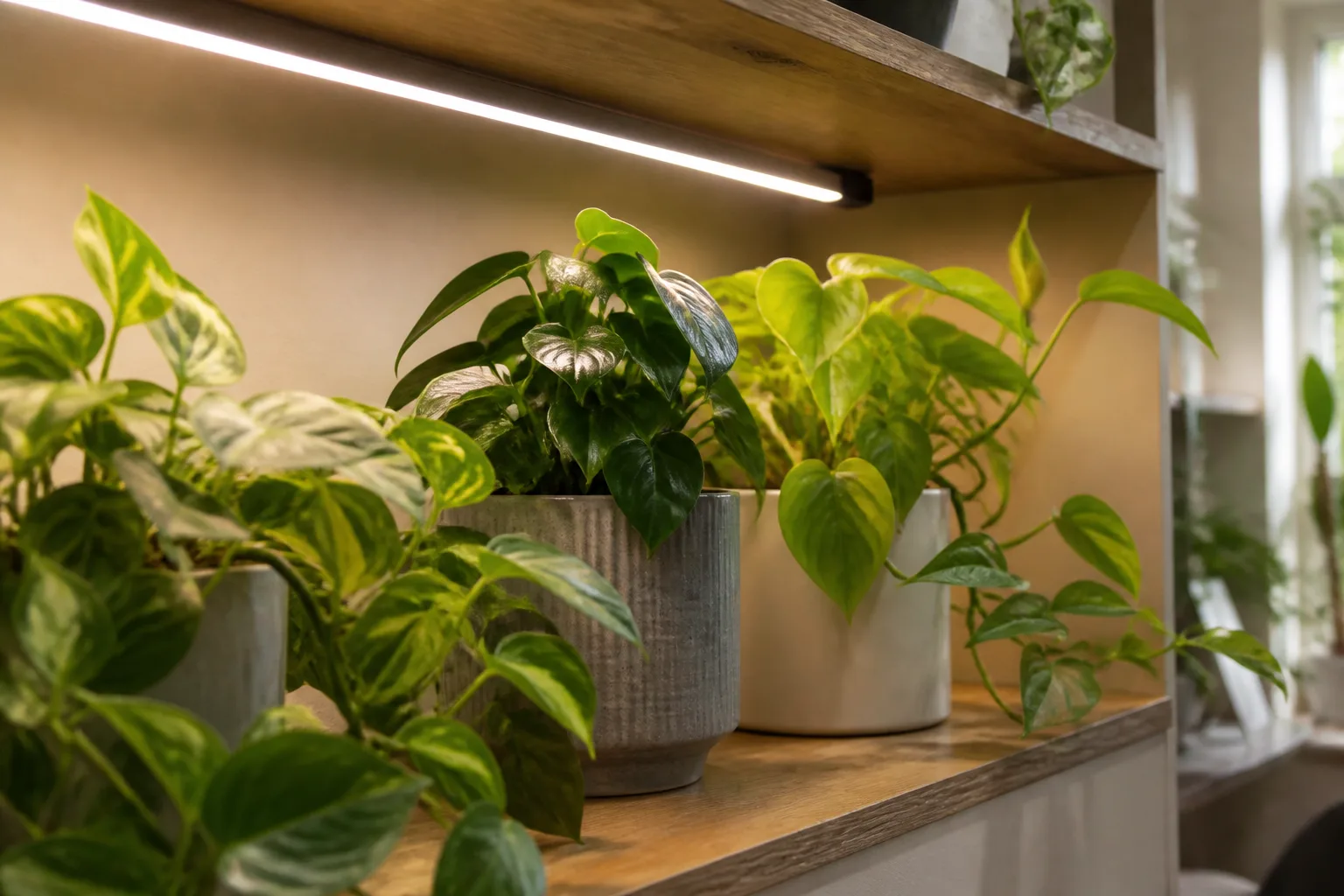
The spectrum question shows up the moment you open a grow-light listing: soft white “full spectrum” bars on one side, pink-purple “red-blue” panels on the other. Both can grow plants. They are not interchangeable for a living room, a bedroom shelf, or a flowering African violet collection. The useful decision is not which color looks more “scientific.” It is which spectrum matches your plants, your space, and how long you can tolerate looking at the light.
This guide compares full-spectrum white LEDs with red-blue (blurple) LEDs for houseplants. You get a clear default recommendation, the plant-science reason both colors matter, practical PPFD and distance rules, foliage-versus-bloom guidance, spectrum-graph shopping tips, and eye-comfort criteria most product pages skip. For fixture types, wattage myths, and general setup, use the grow lights complete guide after you settle spectrum.
Written by Sai Ananth; horticulture review by Dr. Priya Menon (botanist and indoor plant specialist).
Quick Verdict: Which Spectrum Should You Buy?
For most houseplant homes, buy a white full-spectrum LED with published PPFD at stated distances, then place it correctly. Red-blue lights can grow plants efficiently, especially in closets, tents, or short-term seed and greens racks where nobody sits under the glow. They are a weak default for shared rooms because they distort leaf color, make pest inspection harder, and strain eyes.
Choose full-spectrum white when plants live in a living room, office, bedroom, or open shelf; when you care how leaves and flowers look; and when you want one fixture that handles mixed foliage collections. Choose red-blue only when efficiency and photosynthetic targeting matter more than aesthetics, the space is not a seating area, and you accept purple light as a trade-off.
Spectrum alone does not win. A strong white LED at the wrong distance still fails. A weak purple panel still fails. Intensity at the leaf, coverage across the canopy, and daily hours decide growth. Spectrum decides whether you can live with the setup while those numbers do their job.
When Red-Blue Is Still the Right Tool
Keep or buy red-blue when the grow space is enclosed, you visit briefly, and photosynthetic efficiency matters more than room ambience. Seed racks, utility closets, temporary lettuce or herb production, and research-style shelves fit that pattern. If a purple fixture already delivers compact growth at a sane distance, there is no botanical obligation to replace it with white light until you move the plants into a shared room.
The reverse is also true. Do not force blurple into a bedroom because a product page claims higher “PAR efficiency.” A white fixture with honest PPFD data and a timer will outperform a harsh panel you avoid turning on.
What Full Spectrum and Red-Blue Actually Mean
Marketing language is messy. Two fixtures can both claim “full spectrum” and look different under a spectrometer. Two purple panels can use different red:blue ratios. Treat labels as starting points, then read spectrum graphs and intensity data when manufacturers provide them.
Full-Spectrum White LEDs
In home horticulture, full spectrum usually means a white-looking LED that spreads energy across many visible wavelengths in a pattern closer to daylight than a narrow red-blue mix. University of Maryland Extension horticulturist Miri Talabac explains that full-spectrum labeling means the color mix mimics natural sunlight and looks fairly white, and that manufacturers ideally publish a spectrum graph so you can see the relative amounts of each color. Full-spectrum light is not required for acceptable growth and flowering, but it makes plants easier to view and reduces eye strain compared with harsher red-blue lights (Maryland Grows).
White LEDs often use a blue diode plus phosphor conversion to fill green, yellow, and red bands. That fill is why leaves look natural and why a high CRI (color rendering index) matters for spotting yellowing, pests, or pale new growth. Kelvin ratings around daylight white (roughly 5000–6500K on many home fixtures) are a practical shopping shorthand for fluorescents and some LEDs, though LED spectrums are more customizable than a single Kelvin number implies.
Fixture form factor is coverage, not spectrum family. A white bar, white panel, and white bulb can share a similar spectrum graph while lighting very different footprints. Choose bars for long shelves, panels for trays, and bulbs for single pots after you decide white versus blurple.
Red-Blue Blurple LEDs
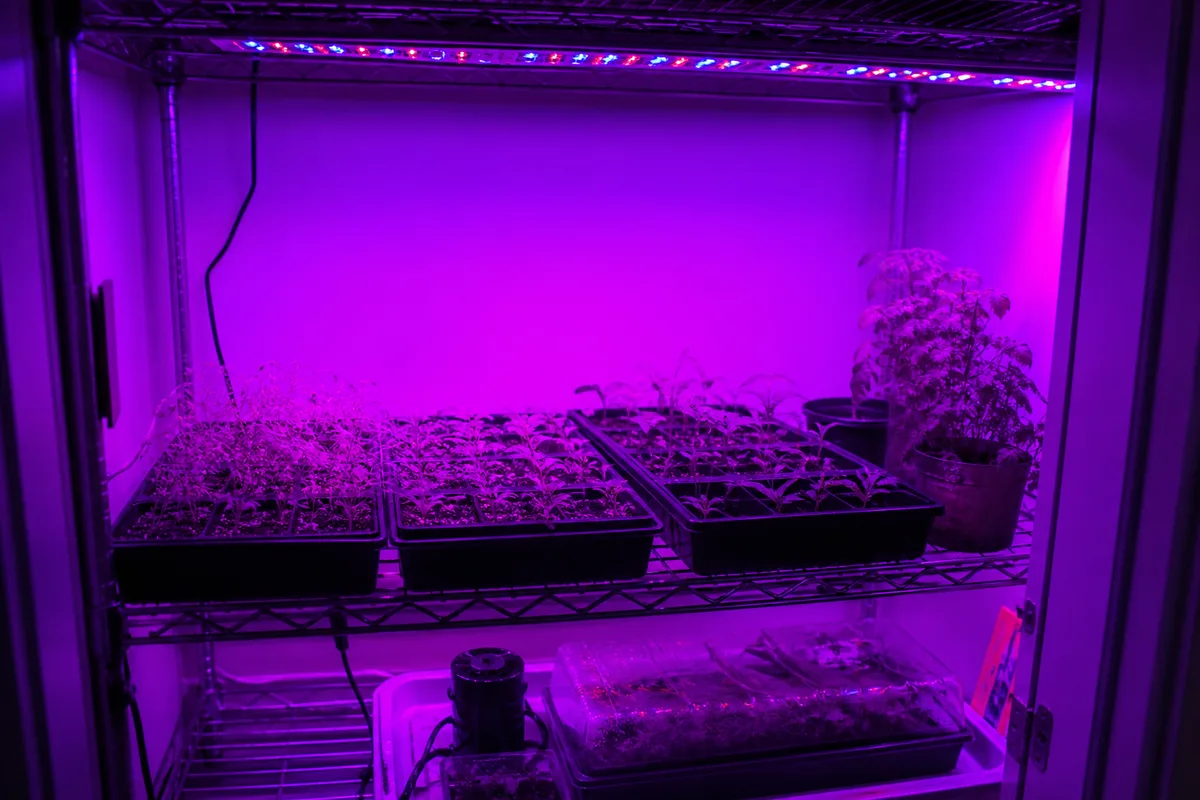
Red-blue grow lights concentrate output in the blue and red bands plants use heavily for photosynthesis. When those diodes mix in your eye, the room turns pink-purple—internet slang calls this blurple. The design logic is simple: put energy where chlorophyll absorption is strong and skip wavelengths that look bright to humans but contribute less to photosynthesis per watt.
Oklahoma State Extension notes that wavelengths between about 400 and 700 nm are considered optimum for plants, with blue around 440 nm, red around 660 nm, and far-red around 730 nm especially influential for plant responses. Blue light increases chlorophyll production and supports healthier foliage responses; red and far-red promote growth and flowering behaviors useful for long-day plants under short-day conditions (Oklahoma State Extension). That physiology is real. It does not automatically mean a purple panel is the best purchase for a pothos shelf next to your sofa.
Ignore marketing that treats a single red:blue ratio (for example “3:1”) as a universal houseplant law. Ratios matter in research and tunable bloom setups; for a mixed living-room collection, published PPFD, coverage, and a readable white spectrum beat chasing a purple ratio sticker. Treat UV claims on cheap consumer lights as marketing until the manufacturer publishes a real spectrum graph that shows UV output and safe use limits. Cannabis and tent wattage advice also does not transfer cleanly to a short houseplant shelf.
How Plants Use Blue, Red, and Other Wavelengths
Plants do not “see” light the way you do, but they detect color, intensity, and day length. The Royal Horticultural Society explains that plants absorb mostly blue and red light to grow and flower: blue generally stimulates growth, while red is important for growth and flower production (RHS). Chlorophyll is a major green pigment in that story, which is why leaves look green—they reflect more green than they absorb (RHS).
The trap is reading “mostly red and blue” as “only red and blue.” Plants also use other wavelengths through additional pigments and signaling pathways. Maryland Grows makes the practical point clearly: plants use mostly red and blue, but they use other wavelengths as well, so a more balanced white light is often better for people and plants unless aesthetics truly do not matter or the crop is short-term. UF/IFAS Gardening Solutions likewise notes that plants grow better under a broad spectrum of light even though they do not need every color of sunlight to survive (UF/IFAS Gardening Solutions).
Think of red and blue as the main engines and the broader spectrum as the dashboard and side mirrors. A car can move with only engines. Driving is easier when you can also see the road. For houseplants you inspect weekly, white light is that visibility.
PPFD, Distance, and Why Intensity Beats Marketing Color
If you remember one technical idea, make it this: spectrum without intensity is incomplete. Maryland Grows defines PAR as the wavelength range plants use for photosynthesis and PPFD as the density of those useful photons at a surface, in µmol·m⁻²·s⁻¹ (Maryland Grows). Foot-candles and lumens describe human brightness. They are imperfect for comparing artificial lamps because human eyes weight yellow-green heavily while plants lean on red and blue.
Oklahoma State Extension recommends thinking in PPF, PPFD, and DLI for LED work. PPFD is what reaches the leaf right now. DLI is the daily total. Their production-oriented DLI bands (roughly 5–10 mol·m⁻²·d⁻¹ for low-light plants, 10–20 medium, 20–30 high, 30–50 very high) are directional for home growers, not rigid houseplant laws (Oklahoma State Extension). They still beat shopping by wattage alone.
Reading a PPFD Chart and a Spectrum Graph
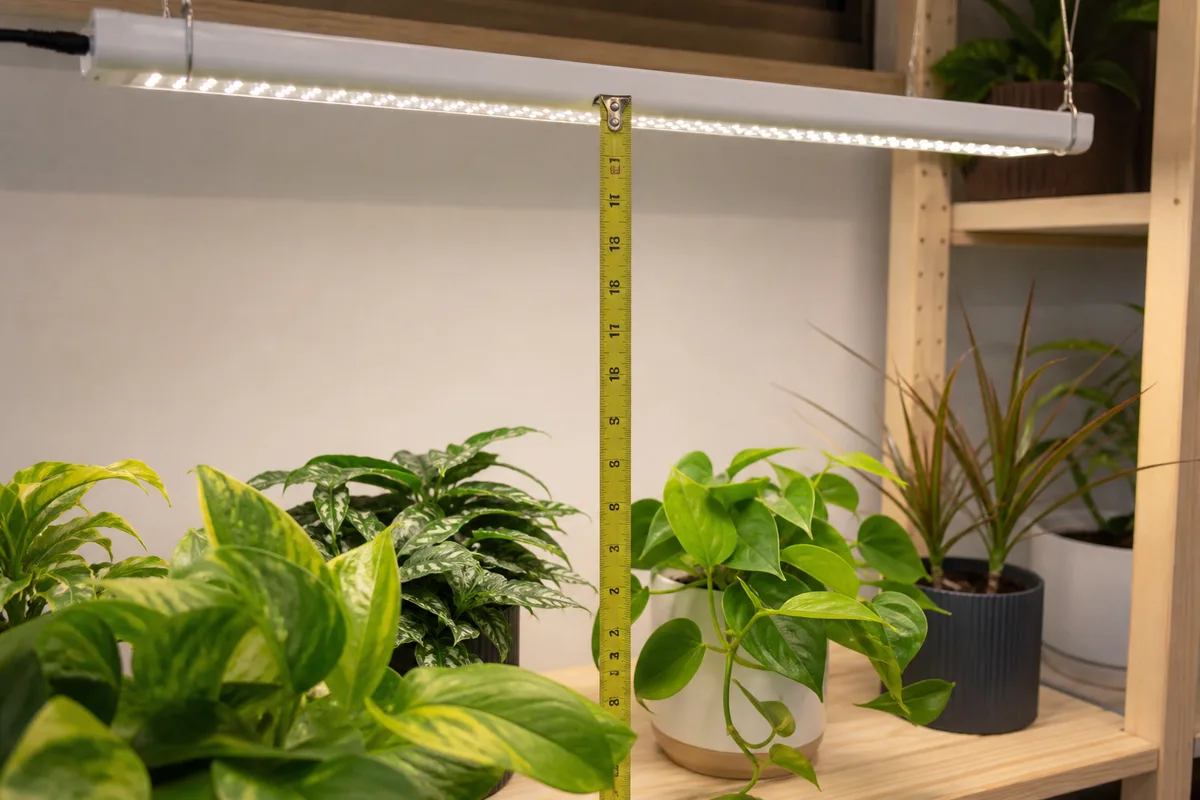
A useful manufacturer chart lists PPFD at several heights—often 6, 12, 18, and 24 inches—and shows center versus edge values. Read the row that matches your planned hang height. Then check edge numbers. Edges are often much weaker than the center. If you light a whole shelf from one narrow spotlight, the plant under the hotspot may look tight while neighbors stretch.
A spectrum graph is the other shopping document. Look for peaks in blue and red plus enough fill that the light looks white if you plan to live under it. For blurple panels, the graph should show dominant red and blue spikes with little green-yellow fill—that is expected. For white fixtures, distrust a “full spectrum” label with no graph and no PPFD map.
Worked example from a typical chart row: 200 µmol·m⁻²·s⁻¹ at 12 inches, run 12 hours. Approximate DLI with the home formula PPFD × hours × 0.0036 (Iowa State Extension). That is 200 × 12 × 0.0036 ≈ 8.6 mol·m⁻²·day⁻¹, a low-to-medium daily total for many foliage fixtures when window light also contributes. Treat chart math as illustrative until you confirm your hang height; real shelves often sit closer to the weaker 18-inch row than the optimistic 12-inch marketing photo. If new growth still stretches, change one variable: move closer, improve coverage, or add modest hours. Do not change all three at once.
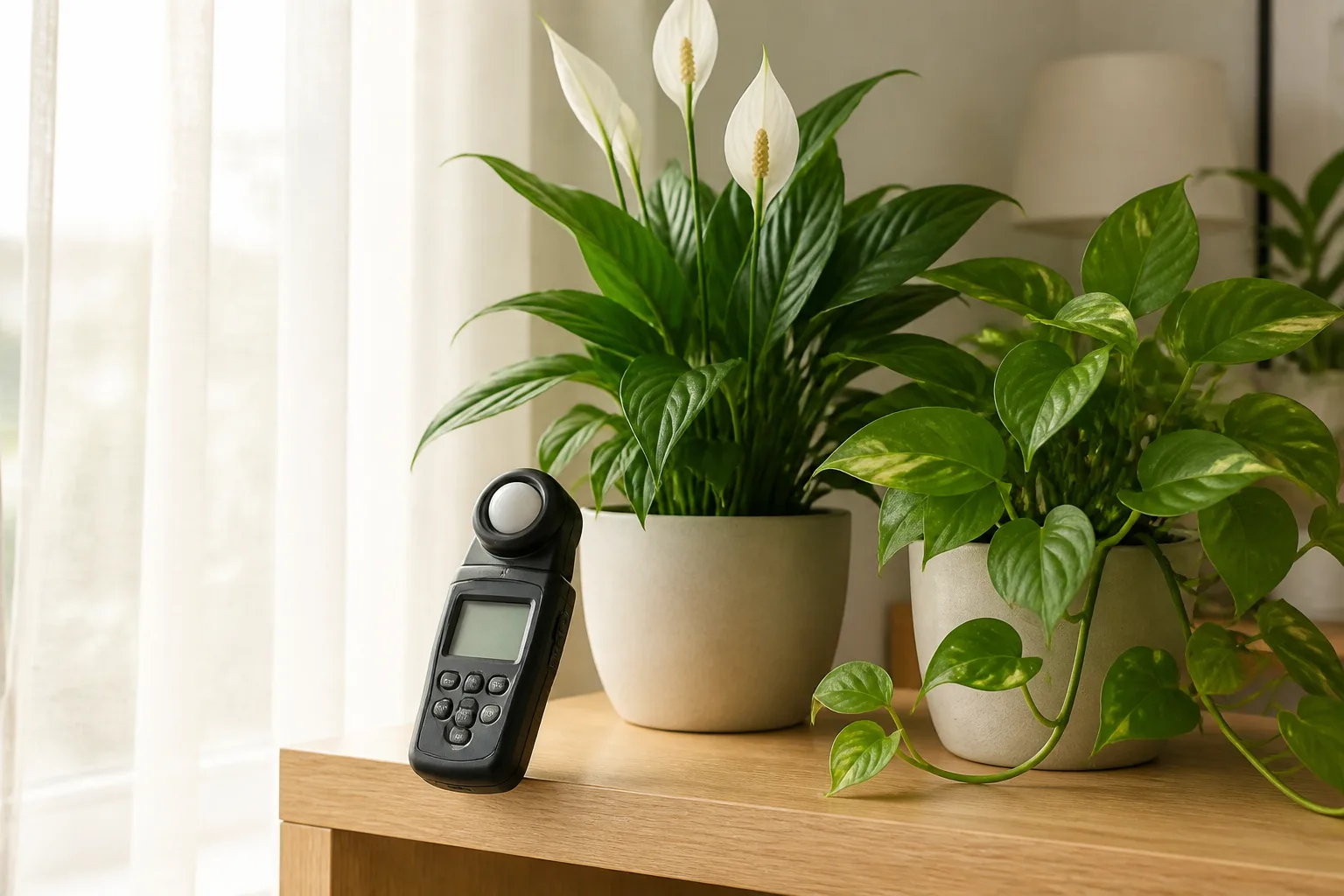
You do not need a research-grade quantum sensor for every houseplant shelf. Oklahoma State notes research meters can cost around $1,000 or more, with cheaper light meters in a much lower range (Oklahoma State Extension). For most homes, a manufacturer PPFD map plus plant response is enough; buy a meter when you run many fixtures, distrust every chart, or diagnose chronic stretch after placement looks correct.
Starting Distances and Daily Hours
Intensity falls quickly with distance. Maryland Grows notes that even a few inches closer or farther can change brightness a lot, and that tube ends are often dimmer than the center. Use manufacturer guidance first. As a practical starting range, many home setups use distance bands similar to University of Minnesota Extension guidance for indoor lighting (University of Minnesota Extension):
| Plant goal | Starting distance | Daily hours (typical) |
|---|---|---|
| Seedlings / compact starts | 4–6 inches (10–15 cm); raise as plants grow | 14–18 hours |
| Herbs and many flowering houseplants | 6–12 inches (15–30 cm) | 12–16 hours |
| Foliage houseplants | 12–24 inches (30–60 cm) | 12–14 hours |
Maryland Grows commonly cites 12–16 hours when artificial light is the main source, and warns against treating light as a 24-hour free-for-all. Most plants need a dark period. Short-day bloomers such as poinsettia, Christmas cactus, and chrysanthemum may even need shorter days—about 10 hours or less of light—to flower, so extra evening room light can interfere (Maryland Grows).
Hand test still helps: after the fixture warms for ten minutes, hold your hand at canopy height. Uncomfortable radiant heat means raise the light or reduce intensity. Stretching means the plant is still photon-hungry. Bleaching or crisp patches mean too close or too long.
Foliage Houseplants vs Flowering Plants
Spectrum choice should follow the job. A monstera shelf and a moth orchid rack do not need identical red:blue strategies, even if both prefer white light in a living room.
When Foliage Plants Prefer Balanced White Light
Most popular foliage plants—pothos, philodendron, snake plant, ZZ, calathea, many ferns—are grown for leaves, not blooms. They need enough daily photons to keep internodes short, leaf size on target, and variegation stable. UF/IFAS notes interiorscape pothos can tolerate very low light but maintain better leaf size and color around 150 foot-candles or more (UF/IFAS). That is a human-eye unit for natural-spectrum contexts, but the lesson transfers: foliage quality tracks usable intensity.
For these plants, white full-spectrum LEDs win on practicality. You can judge mid-green healthy color, catch spider mites early, and keep the fixture on a shelf people walk past. Oklahoma State’s summary that blue emission supports vegetative growth is useful design background; you do not need a purple room to deliver blue wavelengths. Quality white LEDs already include strong blue peaks.
If your foliage plants look stretched under a white light, the fix is usually distance, hours, or coverage—not switching to blurple. If they bleach, raise the fixture or shorten the schedule before blaming spectrum.
When Extra Red Helps Blooms
Flowering houseplants and ornamental crops respond strongly to red and far-red signaling as well as total light. The RHS pairs blue with growth and red with growth plus flower production. Oklahoma State notes LEDs emitting red or far-red are especially useful for flowering ornamentals, while blue suits vegetative growth, and many seedlings and cuttings respond well to red, blue, or red+blue combinations.
That does not mean every blooming houseplant needs a purple panel. Many African violets, orchids, and holiday bloomers do well under white full-spectrum fixtures with enough intensity and the right photoperiod. Use red-heavy or bloom-boost channels when you have a fixture with tunable spectrum, when you are deliberately controlling day length for a short-day or long-day crop, or when you are running a dedicated flower rack where purple light is acceptable. Keep far-red and “bloom” channels subordinate to photoperiod and PPFD—fix day length and intensity before buying a second purple fixture.
If blooms fail under a white light that already delivers solid PPFD, check day length, plant maturity, temperature, and fertilizer before assuming spectrum is the missing piece. Light color is one lever, not the whole flowering machine.
Eye Comfort, Color Rendering, and Living-Room Reality
Houseplant lights fail socially before they fail botanically. A fixture that grows great basil but makes guests squint will get unplugged. Maryland Grows treats CRI and Kelvin as satisfaction factors: higher CRI (ideally 80s, better in the 90s) makes colors look truer, which helps you spot nutrient stress and pests. Daylight-like white makes plants look natural; warm white looks yellower; cool white looks bluer.
Blurple fails this test on purpose. Leaves turn muddy. Pink variegation disappears into noise. Photographing progress becomes useless. Eye fatigue shows up faster in open rooms because the purple cast fights the rest of your home lighting. If the grow area is a closed cabinet, tent, or basement rack you visit briefly, that cost may be acceptable. If the grow area is your dining-room shelf, it usually is not.
Use CRI as a shopping filter for white fixtures you will stare past every day. Ratings in the 80s are acceptable; the 90s help when you care about true flower and variegation color. For fluorescent tubes and many white LEDs, a daylight-leaning Kelvin band around 5000–6500K is a practical target when you want plants to look natural under the lamp (Maryland Grows).
Control glare the same way you control intensity: raise the fixture, aim diodes at leaves instead of eye level, and use a timer so supplemental light is not competing with evening lamps unless the plants need those hours. If a white bar still feels harsh at desk distance, you likely bought too much intensity for that mount height—not the wrong spectrum family.
Practical comfort rules: prefer white full-spectrum for any space you sit in; use a timer so lights are not blasting during movie night unless that is intentional; angle or shield bright diodes away from eye level; raise intense panels rather than staring into them at desk distance; and keep CRI in mind if you bought a bargain white light that still makes plants look grayish.
Side-by-Side Comparison: Full Spectrum vs Red-Blue
| Factor | Full-spectrum white LED | Red-blue (blurple) LED |
|---|---|---|
| Plant growth potential | Strong when PPFD and hours are adequate | Strong when PPFD and hours are adequate |
| Best home use | Living rooms, offices, bedrooms, open shelves | Closets, tents, utility racks, short-term crops |
| Foliage appearance | Natural color; easier pest checks | Distorted color; harder diagnostics |
| Flowering support | Good with enough intensity and photoperiod | Can emphasize red/far-red strategies |
| Eye comfort | Generally comfortable | Often harsh and fatiguing |
| Shopping signal | Spectrum graph, CRI, PPFD map | Red:blue ratio plus PPFD map |
| Common failure mode | Weak bulb labeled “full spectrum” | Buying purple for aesthetics-sensitive rooms |
Neither column excuses bad placement. Coverage overlap, stable timers, and acclimation still matter more than the Instagram color of the diodes.
First-Hand Notes From Shelf Setups
These are single-home LeafyPixels shelf notes from winter–spring 2026 lighting checks, not lab trials or brand rankings. Use them as lived context next to the extension rules above.
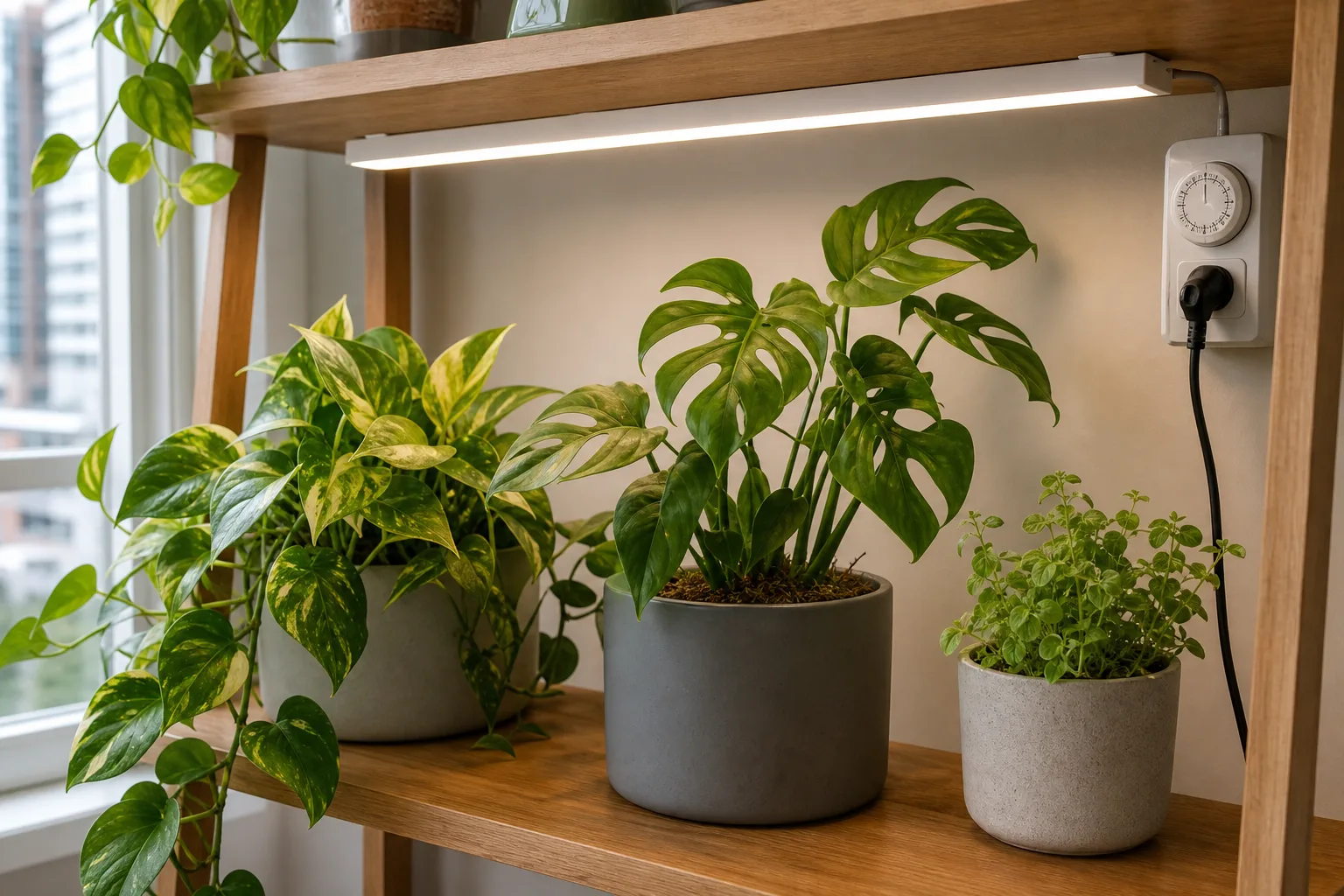
White bar on an open living-room shelf (18 March 2026). A 24-inch white full-spectrum bar hung about 18 inches above a mixed pothos and philodendron canopy looked like ordinary room light once evening lamps were on. Leaf greens stayed readable; a light dusting of spider-mite webbing on one petiole was obvious during a weekly check. New internodes tightened after two weeks of 13-hour days compared with the same plants under a dim decorative bulb at the same height.
Blurple panel in a utility closet (22 March 2026). The same week, a small red-blue panel over seedling trays at roughly 6 inches grew compact starts, but leaf color looked muddy pink-brown in photos and in person. Checking for damping-off or pale true leaves required leaning in with a phone flashlight because the purple cast hid mid-green differences. Fine for a closed closet; unacceptable for a shelf next to a sofa.
PPFD chart vs hang-height reality (5 April 2026). One white bar’s chart listed about 210 µmol·m⁻²·s⁻¹ at 12 inches and roughly 120 at 18 inches in the center. Our living-room mount sat nearer 18 inches to clear tall pots. Using the Iowa State approximation, 120 × 13 × 0.0036 ≈ 5.6 mol·m⁻²·day⁻¹ from the lamp alone—low for sole-source herbs, acceptable for foliage that also saw a bright east window. Raising intensity by dropping the bar three inches helped more than any spectrum swap would have.
Those three notes reinforce the purchase order: room comfort first, then real hang height and PPFD, then coverage and hours.
Decision Framework: Pick Spectrum by Room and Goal
Use this sequence instead of scrolling product roundup rankings.
- Name the job. Maintenance for low-light foliage, recovery for a stretched plant, herb productivity, seedlings, or reliable blooms.
- Name the room. Shared living space defaults to white full-spectrum. Closed grow space can consider red-blue.
- Demand intensity data. Prefer fixtures that publish PPFD at distance or clear hang-height guidance. Ignore wattage bragging.
- Match footprint to plants. Bars for shelves, panels for trays, bulbs for single pots. Spectrum cannot fix a narrow hotspot.
- Set hours on a timer. Most mixed houseplant shelves do well around 12–14 hours; seedlings often need longer; avoid 24-hour schedules for normal plants.
- Read new growth for two to four weeks. Compact, correctly colored new leaves beat any packaging claim.
If you already own a purple light and the plants are thriving in a non-living space, keep it. Replace it when you move those plants into a room where people spend evenings, or when you cannot diagnose leaf problems under the cast. If you already own a weak white decorative bulb, do not defend it because the spectrum label sounds right—upgrade intensity.
For plants already showing stretch, pale new leaves, or faded variegation from dim corners, pair the fixture decision with the symptom guide on not enough light for houseplants and species pages such as monstera light requirements. Spectrum choice is step one; placement and plant-specific needs finish the job.
Common Mistakes When Choosing Grow Light Spectrum
Buying purple because it looks “more plant science.” Efficiency marketing is not the same as home usability. Maryland Grows explicitly questions whether blurple is the most cost-effective choice once aesthetics and broader wavelength use are considered.
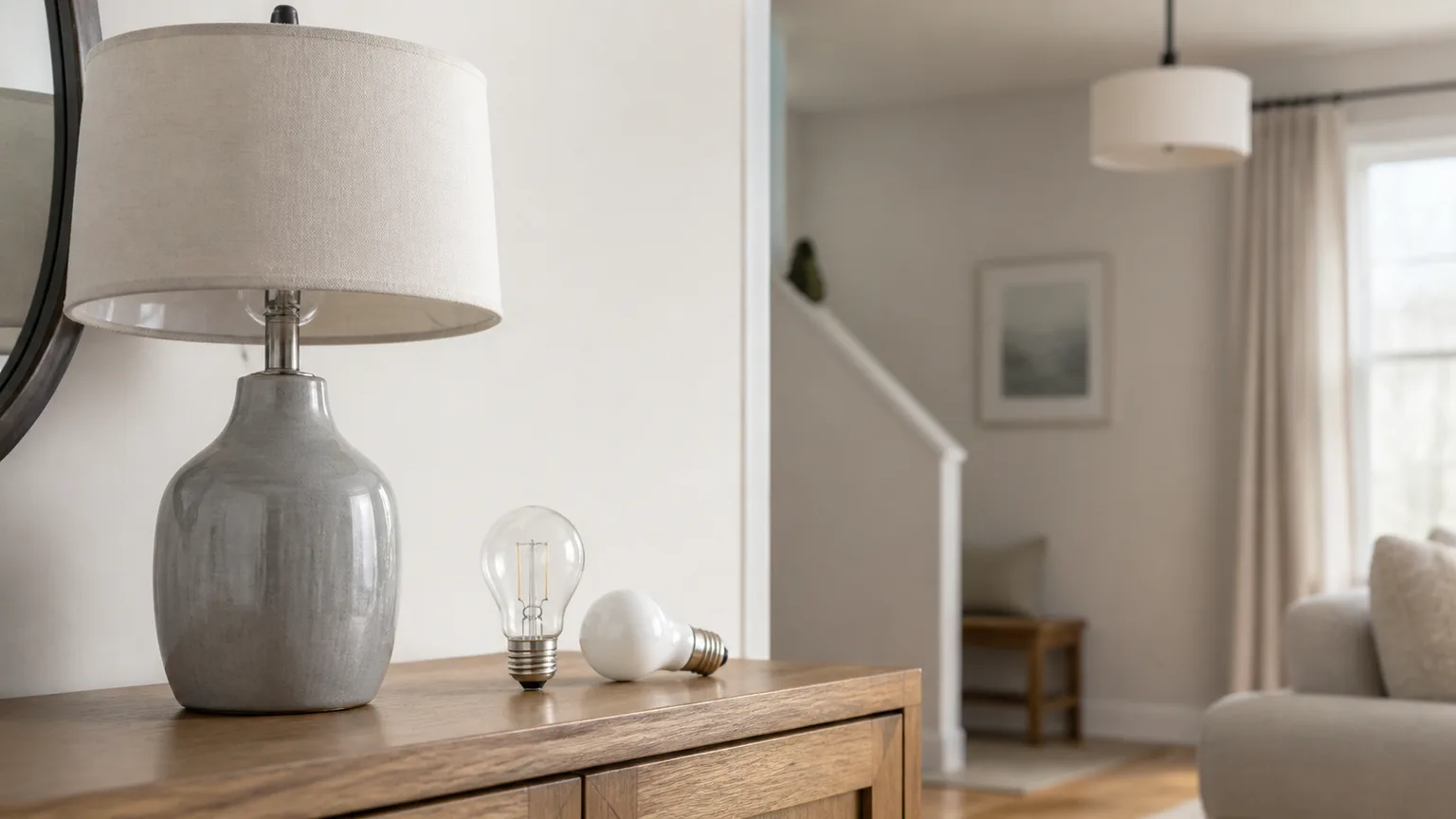
Trusting “full spectrum” with no PPFD. A dim white bulb can be full spectrum and still useless at two feet.
Chasing a red:blue ratio sticker without a PPFD map. Ratios without intensity data are incomplete shopping.
Using lumens as the plant score. Lumens are for humans. PAR/PPFD language is for plants. UF/IFAS reminds growers that human eyes adapt poorly as light meters; the same trap applies when shopping by “brightness” photos.
Mounting any spectrum too far away. Distance kills intensity faster than people expect. A few inches matters.
Running lights 24 hours. More hours are not linear improvement forever. Plants need dark periods, and short-day bloomers can be pushed out of flowering by stray night light.
Changing spectrum to fix a coverage problem. If only the top leaf is happy, widen the footprint or add a second bar. Do not assume red diodes will rescue a shaded lower canopy.
Skipping acclimation. Moving a shade-grown plant under a strong panel—white or purple—can bleach leaves. Start farther away or shorter hours, then tighten the setup.
Copying tent wattage into a bookshelf. High-watt cannabis guidance is for dense canopies and sealed rooms, not a short houseplant shelf where heat and glare hit people first.
Setup Checklist After You Choose
Once spectrum is decided, install like a grower, not like a decorator.
Hang or stand the fixture so the beam covers the whole canopy, not one trophy leaf. Set the starting distance from the table above, then adjust from plant response. Put the schedule on a mechanical or digital timer. Dust the diodes monthly so output does not silently drop. Keep cords out of saucers, use drip loops near water, and avoid daisy-chaining more fixtures than the manufacturer allows—Maryland Grows safety notes are worth following even for small shelves.
After lighting improves, revisit watering. Stronger light and slightly warmer canopies dry mix faster. A plant that needed water every ten days in a dim corner may need a check every five to seven under lights. If winter window light collapses, extend supplemental hours before you fertilize harder—see winter houseplant care and why houseplants struggle in winter. If summer sun returns, raise the fixture or shorten the timer so you do not stack stress.
For the wider fixture buying checklist, start with the grow lights complete guide for indoor plants. If stretch or pale growth is already underway, diagnose with not enough light for houseplants and species pages such as monstera light requirements, indoor plants without direct sunlight, best low-light indoor plants, and the pothos light guide.
Related guides
- Grow lights complete guide for indoor plants — fixture types, PPFD setup, timers, and buying checklist once spectrum is decided.
- Not enough light for houseplants — diagnose stretch, pale growth, and faded variegation before you blame the spectrum label.
- Monstera light requirements — species-specific window and supplemental-light targets for a common foliage plant.
- Indoor plants without direct sunlight — plant choices for rooms that still need thoughtful supplemental lighting.
- Best low-light indoor plants — match tolerant species to dim architecture when a grow light is only a partial fix.
- Pothos light guide — practical intensity targets for a classic shelf vine under white LEDs.
Conclusion: Room, PPFD, Coverage, Then Hours
Full-spectrum white LEDs are the right default for houseplants in real homes because they deliver the blue and red plants need inside a spectrum people can live under, inspect, and photograph. Red-blue lights remain valid tools for enclosed, efficiency-first setups and some flowering or production tasks, but they are a poor first buy for open living spaces.
Make the purchase decision in this order: room comfort, then PPFD at a real distance, then coverage, then hours, then optional spectral tuning for blooms. When those pieces line up, the purple-versus-white argument gets quiet—and the plants get louder in the only way that matters: compact new growth.