How to Determine Sunlight Levels for Houseplants
Find the right sunlight levels for houseplants: map your windows, measure lux or foot-candles at leaf height, and adjust the position without scorching leaves.
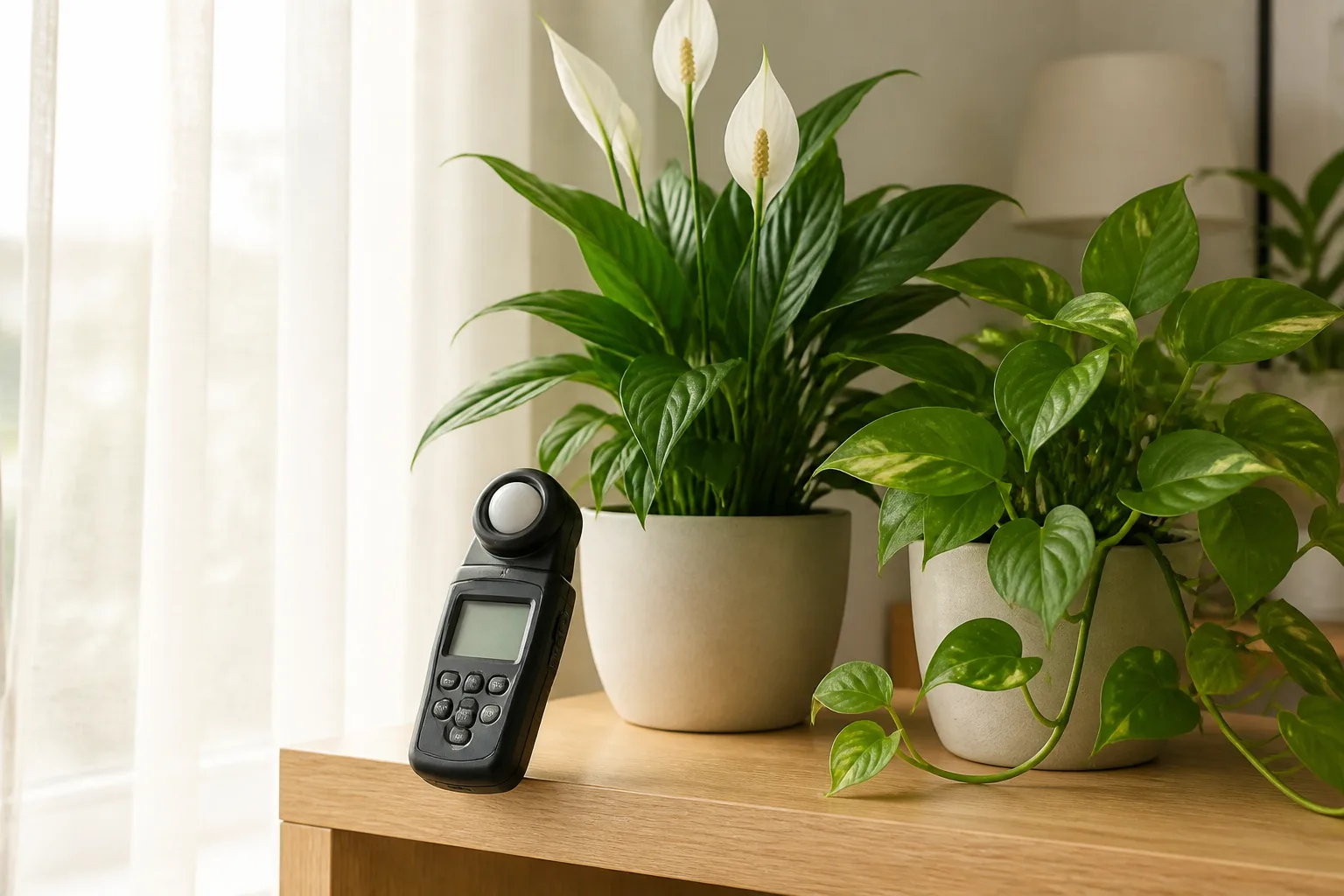
A room can feel bright to you and still be dim to a plant. Human eyes adjust quickly as you move away from a window, but a leaf cannot compensate for the falling light. The most useful way to assess a houseplant’s spot is to combine what the canopy can see with repeat readings taken where the leaves actually sit.
You do not need laboratory equipment to make a better placement decision. Map the windows, notice direct and filtered sun over the day, and use a lux app or light meter to compare likely spots. Then check the plant’s new growth over time; a single noon reading or yellow leaf cannot tell the whole story.
What indoor light terms actually describe
“Bright,” “low,” and “indirect” are useful descriptions, but they are not universal measurements. “Direct light” means sunlight reaches the leaves without being blocked; “filtered” or “diffused light” passes through a curtain, foliage, or another translucent barrier; and reflected light bounces from a bright surface. Bright indirect light usually means a plant receives strong daylight without a long, unfiltered view of the sun. A spot can be bright without a visible sunbeam.
Outdoor labels such as “full sun” often refer to hours of direct exposure across a day, while houseplant labels tend to describe the intensity and character of light at a particular indoor location. A plant tagged “low light” is often a plant that tolerates less light than others, not one that grows well in darkness. Shade-tolerant plants still need usable daylight to maintain growth, and flowering or fruiting plants usually need more energy than foliage plants.
These terms work best as a first filter, not a final diagnosis. A north-facing window in a high-rise with an unobstructed view of bright sky may give more usable light than a south-facing window shaded by a deep porch and neighboring building. Your actual room, the plant’s position, and the season matter more than the label over the window.
Start with the plant’s point of view
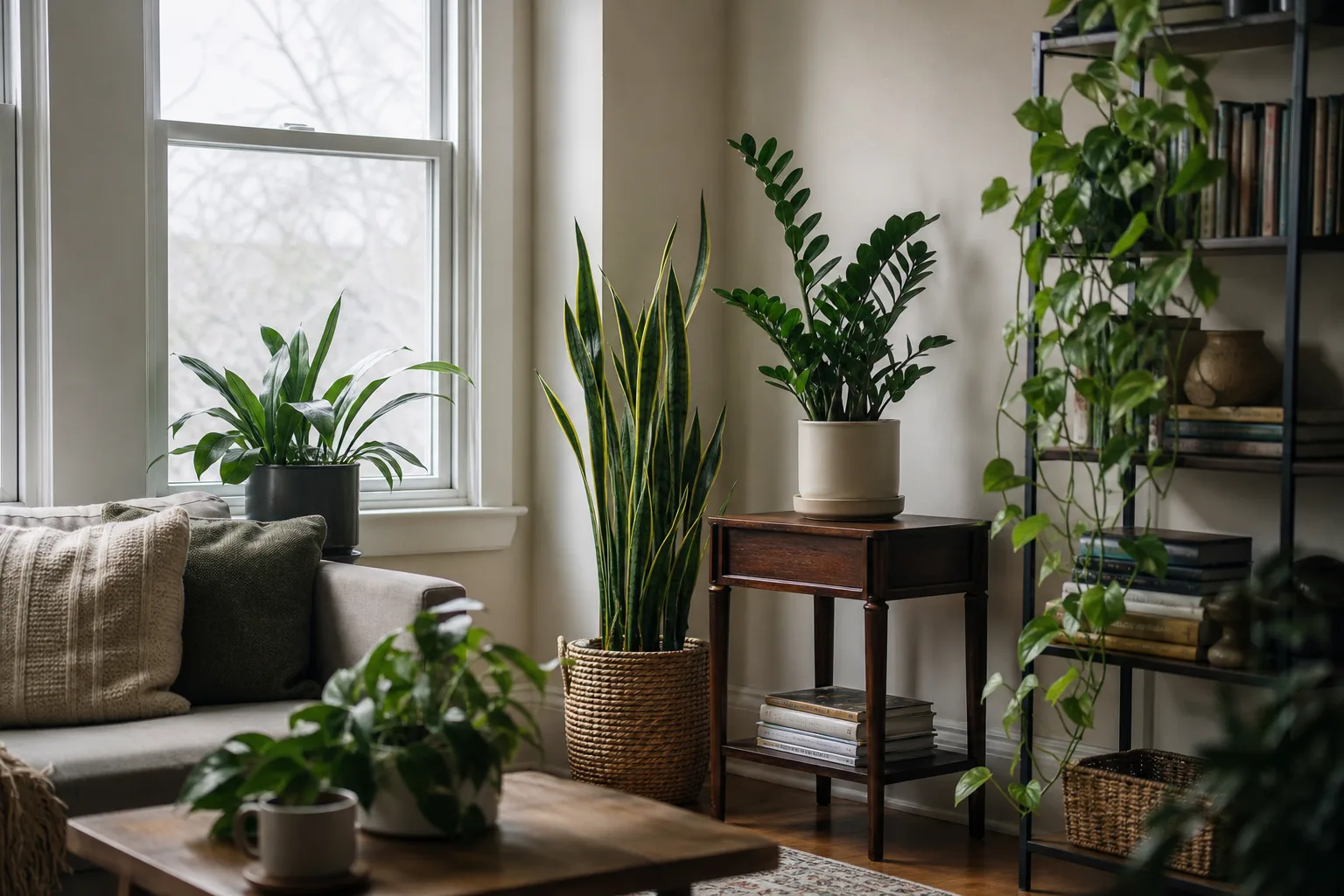
Get down to the level of the leaves and look outward from the plant, rather than judging the room from the doorway. Ask what reaches the canopy: a direct sunbeam, a bright curtain, light reflected from a pale wall, or only a small patch of sky through a distant window. This simple “what can the plant see?” check helps explain why two shelves in the same room can have very different light.
The amount of visible sky matters because daylight arrives from the whole window, not only from the strip of floor where a sunbeam lands. A plant several feet back may receive no direct sun but still have a broad, bright view of the outdoors; another plant in a dark corner may see only a narrow sliver of glass. A practical houseplant-light guide uses this plant-level viewpoint alongside meter readings to make ambiguous labels easier to interpret.
Look for direct, filtered, reflected, and sky light
For one day, observe the spot in the morning, around midday, and later in the afternoon. Note when direct sun touches the leaves, when it passes through a sheer curtain, and whether nearby pale walls or surfaces bounce daylight toward the plant. Repeat the check on a cloudy day if the room is often overcast; the goal is not to label one moment “bright,” but to understand the pattern the leaves experience.
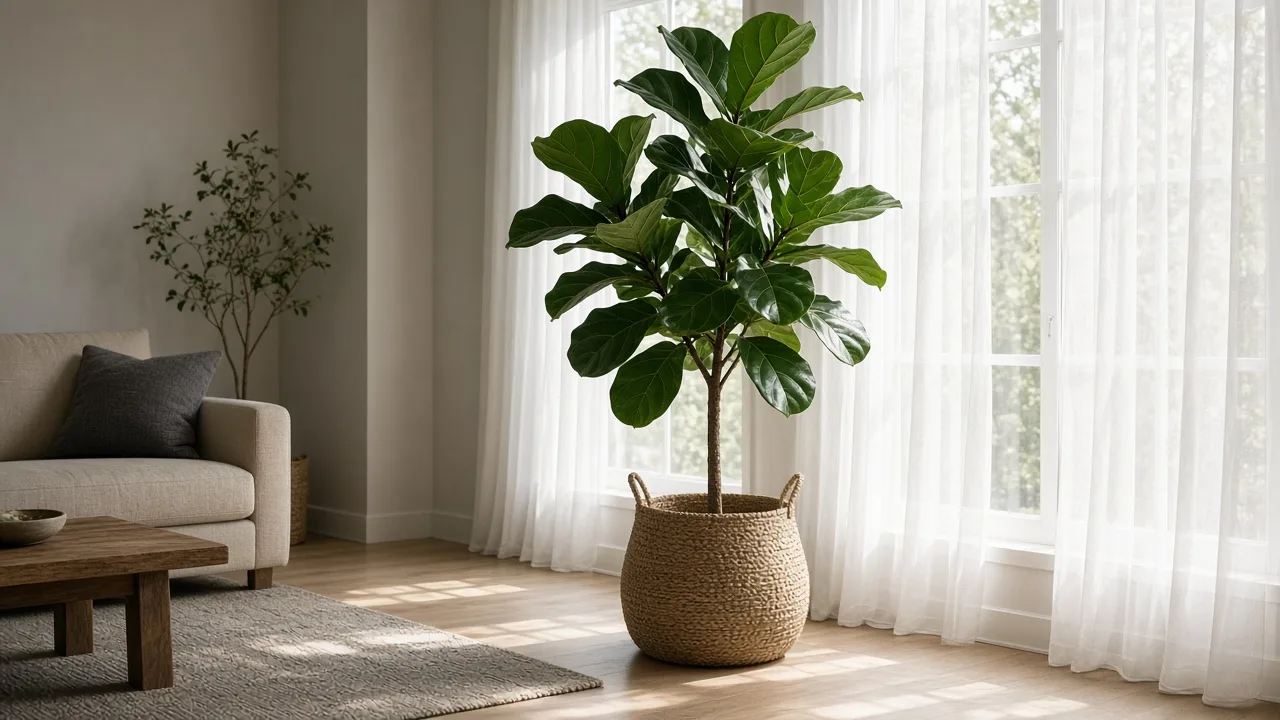
Direct sun is not automatically harmful, and indirect light is not automatically weak. A sun-loving cactus may need the bright window exposure that would scorch a shade-adapted fern if the fern has not acclimated. A sheer curtain can soften intense rays while preserving a broad view of the sky, which is often a useful compromise for tropical foliage plants.
Map the room before you measure
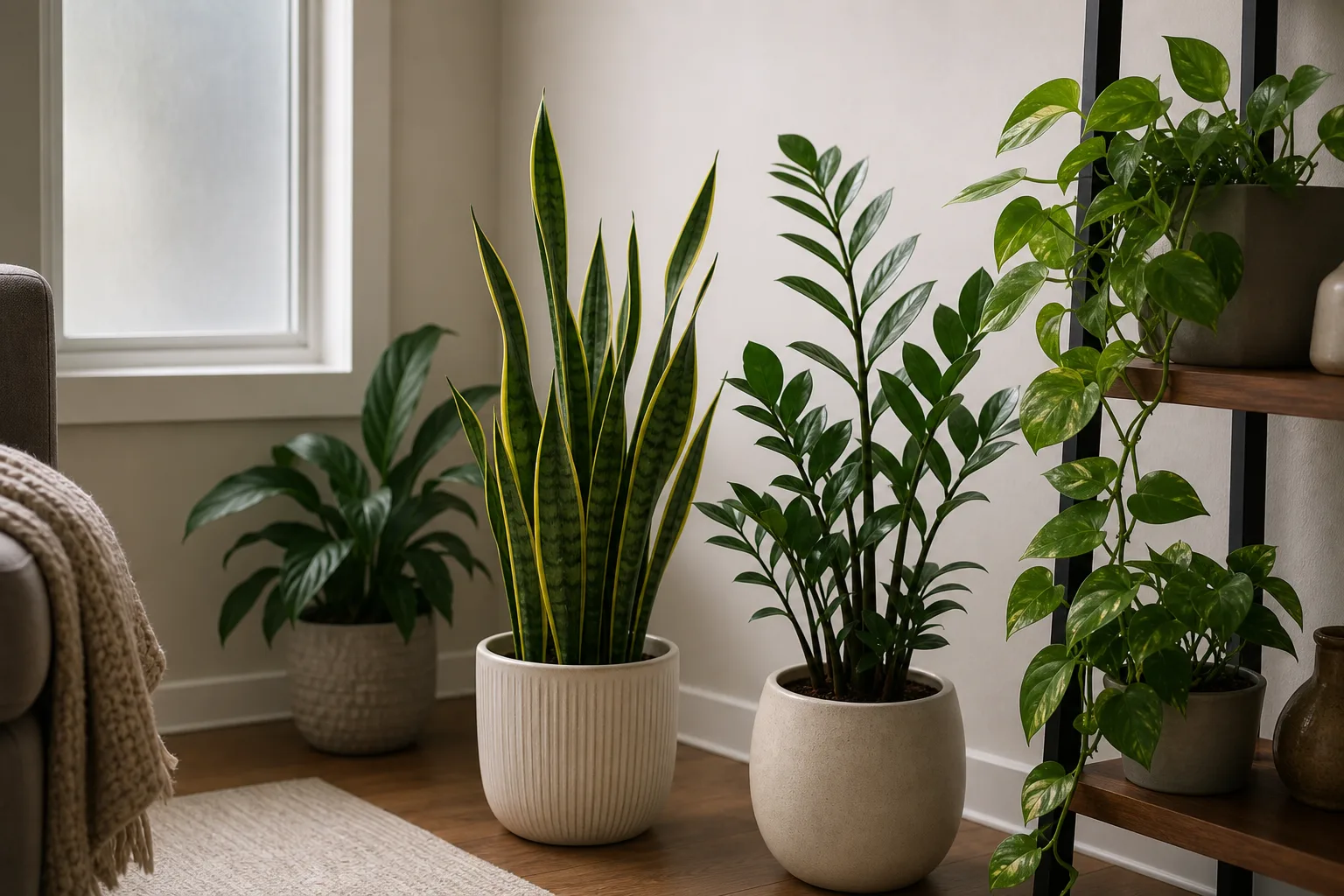
Start with each window that could realistically hold or illuminate a plant. Record its compass direction, approximate size, nearby trees or buildings, exterior overhangs, and any screens, blinds, curtains, or tinted glass. If you are deciding where a plant should go, include the spot’s distance from the window and whether another wall, shelf, or taller plant blocks the canopy’s view.
A compass app can identify the direction a window faces, but that information only describes one part of the light environment. A large window with open sky may outperform a smaller window in the same direction; a balcony above can cut off midday sun; and a bright interior wall can reflect some light into a spot that does not face the glass. Washington State University Extension’s houseplant-light guidance lists window exposure, distance, weather, season, curtains, trees, nearby buildings, and interior surface color among factors that change indoor plant light.
Window direction is a clue, not a verdict
In much of the Northern Hemisphere, south-facing windows tend to receive the strongest direct sun over the day; east-facing windows usually get gentler morning sun, west-facing windows often get warmer afternoon sun, and north-facing windows tend to receive the least direct exposure. The pattern reverses in much of the Southern Hemisphere, and latitude, building orientation, and local shade can alter it. Near the equator, the sun’s seasonal path can make the simple north/south rule less dependable.
Use direction to decide where to look first, then verify the actual light at the plant. A west-facing room may be excellent for a sun-loving succulent in winter but too hot behind glass during a summer afternoon. Conversely, a north-facing window can still support foliage plants if the canopy sees a wide, bright area of sky and stays close enough to the glass. The RHS light guide notes that intensity and aspect shift with season, so one window can move from generous to marginal over the year. In one Alabama windowsill account, growers found west-facing afternoon sun too hot for some of their plants—a useful reminder that a window can add heat as well as light, though their experience is not a rule for every home.
Distance, glass, shade, and seasons change the result
Light drops quickly as a plant moves away from a window, but there is no reliable universal rule such as “three feet is bright indirect.” Window size and the room’s geometry change the result. Measure at the plant’s actual shelf or floor position; taking a reading on the sill and applying it to a plant several feet back will overstate what reaches its leaves.
Glass transmits daylight but can reduce or alter it, and a screen, privacy film, curtain, or shade tree can reduce it further. Dusty glass usually matters less than a deep overhang or a large obstruction, so check the whole path between the sky and the leaves instead of treating glass cleaning as a cure for a dark room. Recheck after moving furniture, changing window coverings, or reaching a new season: winter sun sits lower and days are shorter in many regions, while summer sun may reach farther indoors or be blocked by leaves on outdoor trees.
Measure light at leaf level
A light reading is most useful when you take it where the plant’s foliage receives light. Hold the sensor beside the upper leaves, with the sensor oriented toward the brightest source that illuminates that part of the canopy. If the plant has a dense or layered shape, check a representative outer leaf and a lower leaf separately; the top may be bright while the interior stays shaded.
For a practical room audit, compare several candidate locations rather than chasing a supposedly perfect number. At each spot, use the same device and orientation, record the time and weather, and note whether the plant sees direct sun. The number is one piece of evidence: the duration and pattern of light matter too.
Use a phone app as a comparison tool
A phone light-meter app is a convenient way to compare locations, especially if you do not own a dedicated meter. Most phones use a small ambient-light sensor near the front camera or screen, and different phone models, cases, app settings, and sensor positions can produce different readings. Keep the sensor uncovered, use the same app and phone throughout the comparison, and treat its values as approximate rather than as a certified plant-light measurement.
A phone is most helpful for relative questions: is the shelf near the glass brighter than the console across the room, and does moving a plant by a foot make a meaningful difference? It is less reliable for comparing your reading with a number published by someone using a different phone or setup. If the app offers both lux and foot-candles, choose one unit and use it consistently; do not confuse lux, which describes light arriving on an area, with lumens, which describe the total visible light emitted by a source.
Use a dedicated meter for cleaner readings
A handheld lux or foot-candle meter is usually easier to position consistently than a phone, so it is useful if you have many plants or want to repeat measurements over months. One foot-candle is about 10.76 lux. The units describe illuminance, not the amount of plant-usable light at every wavelength, so lux and foot-candles are practical room-comparison tools rather than a complete measure of photosynthesis.
For grow lights, a PPFD meter measures photosynthetic photon flux density at the canopy and is more directly tied to the amount of photosynthetically active light arriving each second. That extra precision is useful for seedlings, herbs, or a deliberate indoor growing setup, but most foliage-plant owners do not need to buy one before moving a plant closer to a window. Start with a simple meter or observation and spend more only if the decision still feels uncertain.
Keep a light log instead of trusting one number
Light changes through the day and across the year, so a single reading can be misleading. For each candidate spot, record readings in the morning, near midday, and in the afternoon on at least two or three representative days. Include a clear day and a cloudy day if both are common where you live, and write down when direct sun reaches the leaves. A short note such as “east window, 9 a.m. sunbeam for 45 minutes, bright curtain light after” often tells you more than one isolated value.
The plant responds to both intensity and duration. Ten minutes of a high reading is not equivalent to several hours of moderate daylight, and the same reading at noon cannot tell you how dim the room is at 8 a.m. or 5 p.m. Washington State University Extension describes intensity, duration, and light quality as separate parts of indoor plant lighting; the RHS also emphasizes seasonal changes in light strength.
Commercial growers sometimes summarize a day’s total plant-usable light as daily light integral (DLI), calculated from photosynthetic photon flux over time. A consumer lux app does not reliably produce DLI because lux is weighted for human vision and a phone samples only a few moments. You do not need to calculate DLI for ordinary houseplants; the practical takeaway is to log several times and compare the room’s overall light pattern, not to treat one midday value as the plant’s full daily allowance.
Translate readings into a placement decision
Use the plant’s care guidance to set a direction, then compare the window and meter observations with its likely tolerance. If a plant is described as needing bright indirect light, look for a broad, bright view of the sky or a softly lit window without long stretches of intense direct sun. If the plant is described as low-light tolerant, it may cope with a farther-back position, but it still needs daylight and may grow more slowly there.
This is where a light log beats a window label. A plant near a west-facing window behind a sheer curtain may receive a strong but softened afternoon; one in the middle of a north-facing room may receive low, steady sky light. The right choice also depends on what you want: a slower-growing foliage plant can be easier to water in a modestly lit spot, while a variegated plant or flowering species may lose color or fail to bloom if the location is too dim.
Rough meter bands for common foliage houseplants
The following readings are rough reference bands, not universal species requirements. They are adapted from practical houseplant light-meter guidance, which recommends checking around the brighter part of the day and holding a meter beside a leaf facing the light source. Use the same meter, sensor angle, and location when comparing your own plants; do not reject a healthy plant because one reading misses a boundary by a few units.
| Approximate midday reading | What it often suggests indoors | How to use it |
|---|---|---|
| 50–150 foot-candles (about 540–1,600 lux) | Very dim for sustained growth; a few tolerant foliage plants may persist | Check for a wider view of the sky or add a suitable grow light if growth is weak |
| 200–800 foot-candles (about 2,150–8,600 lux) | A broad workable range for many tropical foliage plants, depending on duration and species | Compare the plant’s growth and the hours of light rather than aiming for one exact value |
| 800–1,000 foot-candles (about 8,600–10,800 lux) | Strong bright-indirect light, especially if a sheer curtain softens direct sun | Watch shade-adapted foliage for bleaching or scorching and acclimate gradually |
| Several thousand foot-candles in direct sun | Intense sun at the sensor; exposure time and plant adaptation become critical | Reserve prolonged exposure for species adapted to it; filter or relocate tender leaves |
These bands should not be read as “all plants need 200–800 foot-candles.” A shade-tolerant aglaonema and a sun-loving cactus do not share the same target, and a healthy plant’s growth rate may be slower than a grower expects. That practical guide distinguishes very dim readings from a broad zone that supports many tropical foliage plants, while also pointing out that more light can mean faster water use and more active growth. Match the plant first, then use the meter to compare realistic locations.
Read plant growth without blaming every symptom on light
Light mismatch often shows up in new growth, because leaves that formed under one condition cannot fully remodel after you move the pot. If new stems stretch toward a window, spaces between leaves lengthen, or new leaves are smaller than older leaves, insufficient light is one plausible cause. Variegated foliage may produce greener growth when the plant has too little energy to maintain areas with less chlorophyll, but genetics, pruning, and seasonal growth can also affect the pattern.
Too much direct sun can bleach or scorch leaves, particularly after a plant moves abruptly from shade into a hot window. Look for pale or tan patches on the side facing the glass, crispy areas that appeared after a sunny spell, and a temperature spike near the foliage. The same damage can also follow dry roots, a heater, or low humidity, so check the position and recent care history before concluding that light alone is responsible.
Yellow leaves are especially easy to misread. One old lower leaf yellowing is normal on many plants; widespread yellowing can result from overwatering, root stress, nutrient problems, pests, or low light. Compare the plant’s light log with how quickly its potting mix dries, inspect the roots only if other evidence points to a root problem, and watch the next growth cycle before making several changes at once. The RHS guide to how plants use light lists weak, pale, spindly growth and reduced flowering among possible low-light signs, not as proof of a single cause.
Use a grow light when daylight falls short
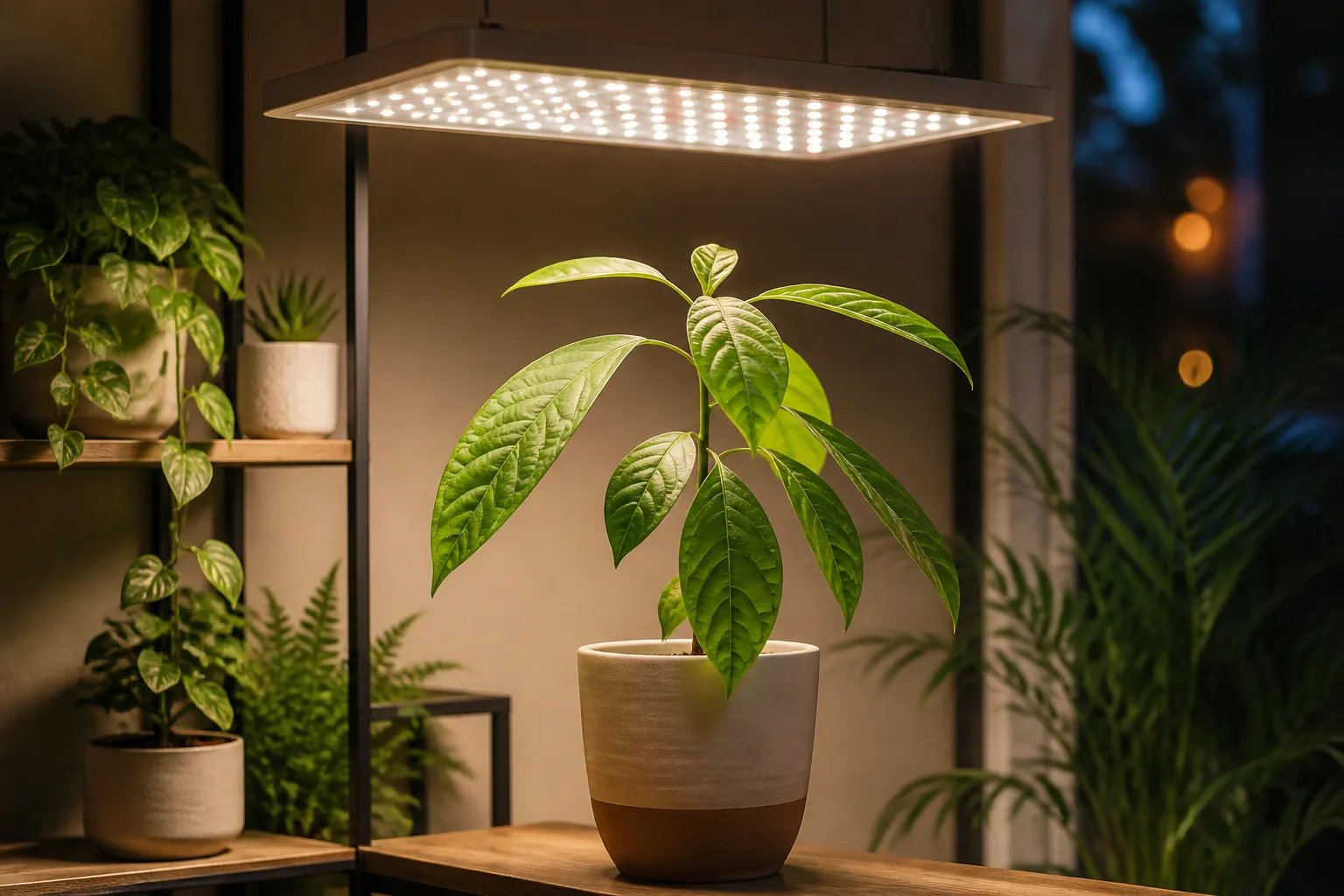
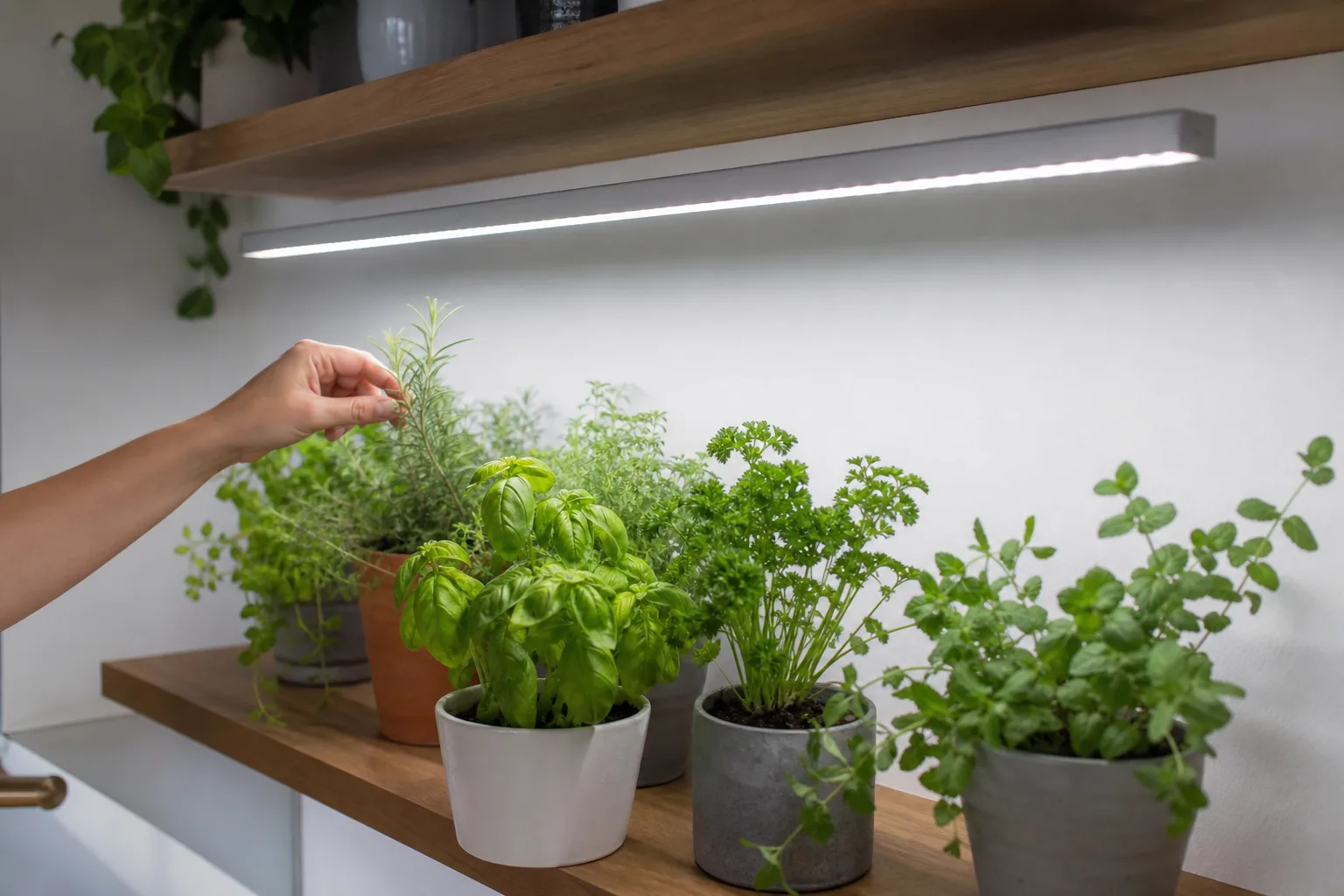
A grow light is not inherently “indirect light.” That phrase describes how natural sunlight reaches a plant; an LED fixture can deliver gentle or very intense light depending on its output, distance, beam spread, and operating time. If natural daylight is consistently low, a grow light can add usable light without moving the plant to a hotter window. Washington State University Extension discusses supplemental fixtures as an option when natural light is insufficient.
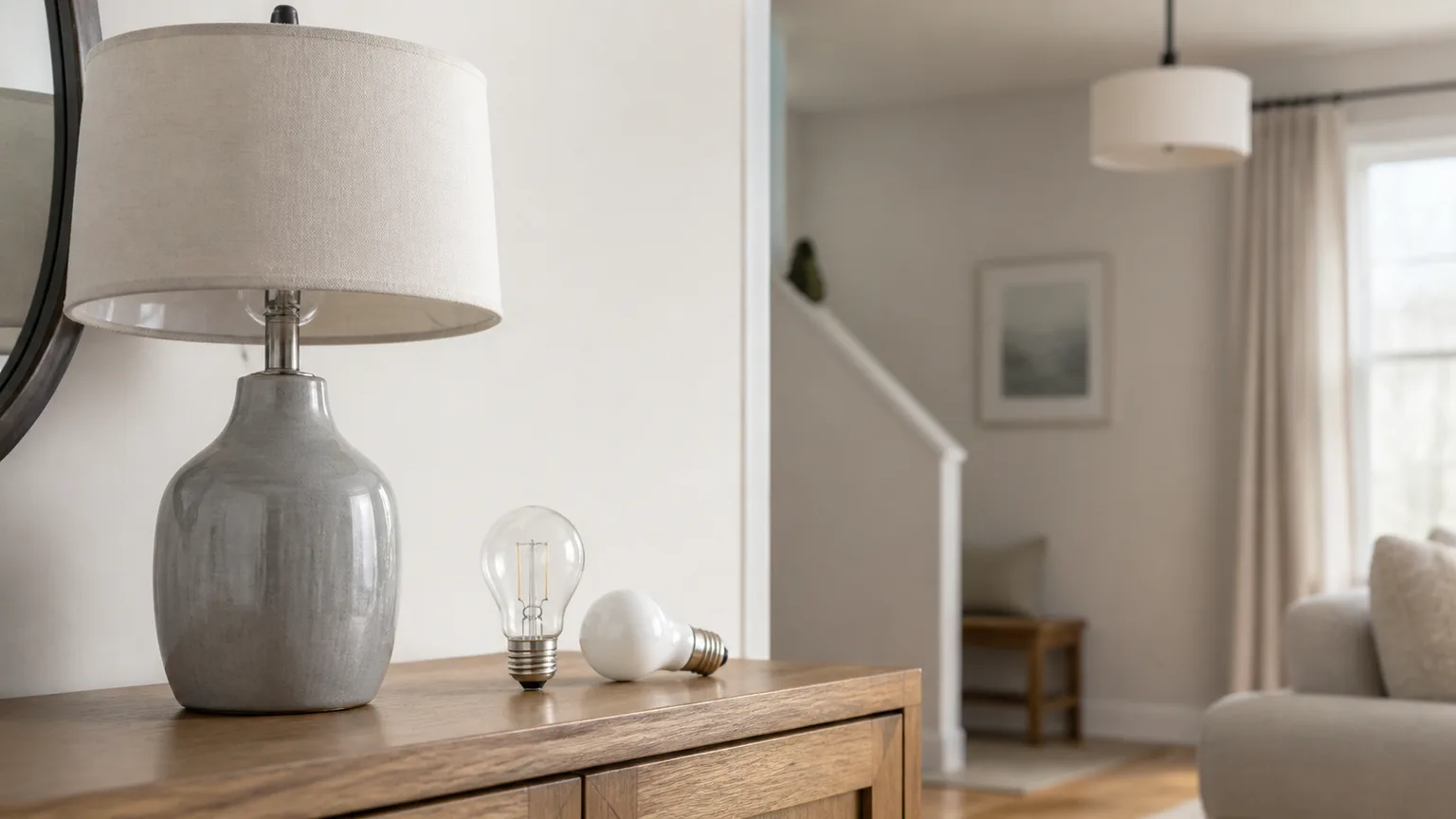
Place the fixture so the canopy receives the manufacturer’s recommended intensity and coverage, not simply because the lamp looks bright to you. A standard room bulb may illuminate a room for people without delivering enough plant-usable light at leaf level. For fixture specs, PPFD at the stated distance is more useful than watts alone; if you have only a lux meter, use it to compare readings under the fixture and follow the product guidance rather than converting an arbitrary lux number into a guaranteed growth result.
Put the light on a timer and leave a dark period; running a fixture around the clock is not a sound default. The needed schedule varies with plant, fixture intensity, and available window light, and a longer photoperiod cannot always compensate for weak intensity. Start with the fixture instructions, observe the plant for heat stress or bleaching, and adjust either distance or duration one step at a time.
Change light gradually, then reassess
Do not move a plant that has lived in a dim corner straight into hours of strong, unfiltered sun. A sudden jump can damage leaves before the plant has produced growth suited to the brighter position. Washington State University Extension recommends gradual acclimation when indoor plants move into stronger outdoor sun; the same cautious principle is useful when you increase exposure through a window.
Make one manageable change: move the pot closer to the window, rotate it slightly, open a curtain for a limited part of the day, or add a grow light. Keep watering and fertilizer routines stable while you test the change, since brighter light can increase water use and changing multiple conditions at once makes cause and effect harder to read. Recheck your measurements after the move and judge the result from healthy new growth over the next few weeks, not from an old leaf that was already damaged.
Common mistakes that distort a light check
The most common error is judging light from how comfortable the room feels. Eyes adapt, while a plant’s light supply falls sharply with distance and obstruction. A second mistake is measuring at the window instead of the leaf canopy, or taking one reading at noon and treating it as a daily average. Record the position, time, weather, sensor angle, and direct-sun duration so you can reproduce the comparison later.
It is also easy to treat phone lux, dedicated lux, foot-candles, lumens, and PPFD as interchangeable. They describe different quantities or are measured differently, so compare like with like and avoid applying a single threshold across devices or plant species. Finally, do not diagnose light from yellow leaves alone, assume every south-facing window is safe, or make a sudden move into direct sun. Check the window path, compare more than one time of day, and change only one variable before deciding that the spot is wrong.
Conclusion
To determine sunlight levels for houseplants, observe what the leaves can see, map the window and its obstructions, and take repeated readings at canopy height. A phone app is enough to compare nearby spots; a dedicated lux meter makes repeated checks easier, while PPFD equipment is useful for precise grow-light setups. No meter value replaces the plant’s species needs, exposure duration, and seasonal context.
Choose a likely spot, log the light pattern for a few days, and make one gradual change if the evidence points to too little or too much light. Then give the plant time to show you through new growth. That simple cycle—observe, measure, adjust, and reassess—is more dependable than relying on a window direction or a vague “bright” label alone.