7 Holiday Decor Ideas When You Can’t Fit a Tree
Try seven holiday decor ideas when you can’t fit a tree, from a ribbon wall tree and narrow-vessel greenery to renter-safe garland and pet-aware lighting.
You do not need a tree-shaped hole in the floor to make a room feel like the holidays. In a small apartment, rental, dorm-style room, or home with a crowded living area, the better move is to choose one focal zone—wall, window, media console, table, or doorway—and give it the height, texture, and glow a tree would normally provide.
The seven ideas below are deliberately mix-and-match, but they are not all equally practical for every room. Start with the footprint audit, then choose one main display and one supporting detail. A slim wall arrangement plus a vase of branches usually feels more finished than seven unrelated decorations competing for attention.
Start with the footprint you actually have
Before buying a wreath or string of lights, measure the space people need to walk through. Record the available width, depth, height, and reach around a wall, tabletop, console, or window; a display that looks compact in a product photo can still snag sleeves, block a cabinet, or crowd a narrow passage.
Use this quick decision rule:
- If you have almost no floor depth, choose a wall tree, wreath, wall gallery, or flat garland line.
- If you have a narrow surface, choose a tall vessel or a low centerpiece rather than a wide arrangement.
- If your walls cannot be altered, use a console, bookcase, window ledge, or tension-mounted rod.
- If children or pets can reach the display, avoid small breakable ornaments, loose cords, sharp foliage, and loose berries.
The missing tree is not a problem to conceal. It is a cue to make the room’s existing architecture do the work. A vertical line can make a low-ceilinged room feel taller, while a concentrated tabletop display creates warmth without visually filling every corner.
1. Build a ribbon-and-ornament wall tree
A wall tree gives you the familiar triangular silhouette without a stand, skirt, or pile of needles. Use one long length of wide ribbon, twine, or narrow garland as the center line, then attach progressively shorter diagonal ribbons or cords to create a loose triangle. Hang lightweight ornaments at the joins and finish with a small bow, star, or cluster at the top.
The key is to design the shape to the wall, not to recreate a full-size tree. A 24- to 36-inch-tall version works above a desk, beside a media console, or on the narrow wall at the end of a hallway. Keep the widest point above furniture or within the wall’s visual center so it reads as intentional instead of looking like decorations that ran out of room.
For a rental, test your hanging method with an empty ribbon first. Use the lightest attachment that can safely support the finished weight, let the adhesive sit according to its label, and avoid placing hooks on dusty, freshly painted, damp, or textured surfaces. If the wall is uncertain, hang the design from a removable over-door hook or a tension rod instead of gambling with the paint.
Choose one color story: evergreen and brass, red and natural wood, silver and white, or a restrained mix of two colors plus the wall color. Too many ornament shapes make a flat display look busy. Vary size slightly, but keep heavier pieces low and secure every hanging point so an accidental tug does not bring the whole arrangement down.
2. Put evergreen branches in a narrow vessel
A tall vase, crock, pitcher, or weighted bottle can supply the scent and vertical rhythm of a tree while taking up only a few inches of floor or table depth. Place it on a console, kitchen island corner, entry bench, or a slim stand; the arrangement should rise above the surface but stay narrow enough that it does not become another obstacle.
Use three to seven branches rather than stuffing the vessel. Start with the tallest stem in the center or slightly to one side, add shorter branches to create an uneven outline, and reserve one distinctive branch—berry stem, bare twig, eucalyptus, or cedar—for the silhouette. A few pinecones, dried citrus slices, or small ornaments tied to twine provide contrast without turning the vase into a miniature overloaded tree.
A low, wide vase of winterberry or bare branches works when headroom is limited. A tall narrow vessel with fir, pine, cedar, or juniper works when the room needs height. Fine Gardening’s guide to festive greenery notes that evergreens, berry branches, woody stems, and cones can all contribute to indoor winter arrangements; that mix is useful because texture, not just green volume, makes a small display feel complete.
Choose greenery by room conditions
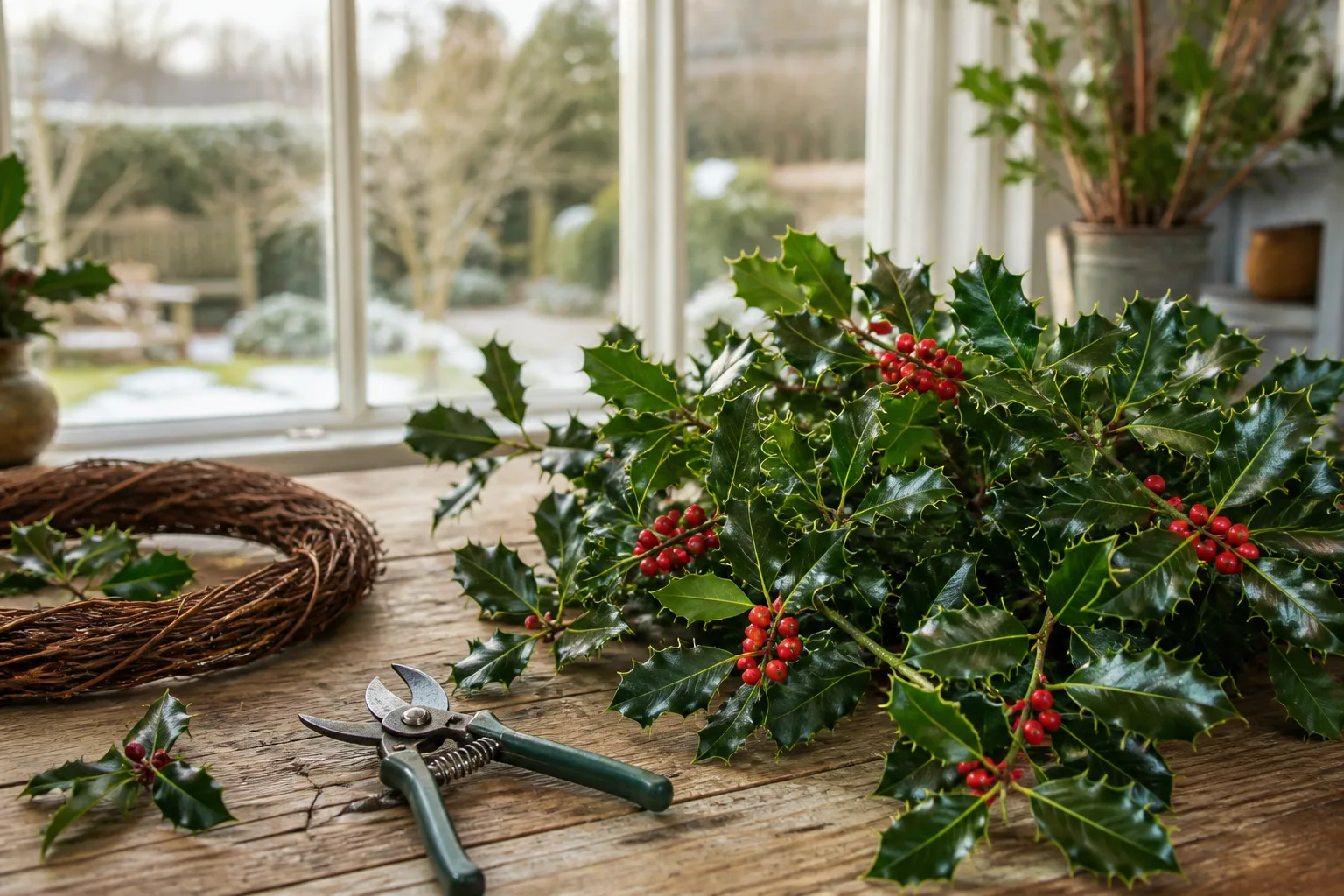
Fresh greenery lasts longest when it starts fresh and stays cool. Gardening Know How’s greenery guidance lists pine, fir, cedar, juniper, boxwood, holly, ivy, yew, and spruce as options, while noting that many can stay fresh for up to about a month in cool conditions. Treat that as a best-case range, not a promise: a sunny, heated room can dry foliage much faster.
For the longest display, buy cut stems close to the day you will use them, keep them outdoors or in an unheated garage while you prepare, and recut the woody ends before putting them in water. Change the water when it becomes cloudy, keep the vessel stable, and remove any branch that turns brown, drops needles heavily, or smells sour. Do not collect from a public place or a neighbor’s property without permission, and do not prune a landscape plant simply to fill a vase.
If your room is warm, choose preserved or artificial stems for the high, hard-to-reach part of the display and keep a small fresh arrangement on a table where you can monitor it. This hybrid approach often looks more natural than a large artificial bundle and avoids the daily maintenance of a full fresh garland.

3. Hang a wreath or asymmetrical swag
A wreath is the simplest tree alternative when you want a strong focal point with almost no floor footprint. Hang one on an interior door, above a console, over a mirror, or in the center of a blank wall. For a softer, less formal look, use a one-sided swag: bundle evergreen stems at one end, let the tips taper toward the other, and add one oversized ribbon bow near the top third.
Scale matters more than ornament count. A wreath that is too small disappears on a large wall; one that is too large can make a narrow room feel blocked. As a starting point, let the wreath occupy roughly half to two-thirds of the usable wall width, leaving breathing room around door trim, switches, artwork, and the opening path.
For a rental, hang the wreath from the top of a door with an over-door hook, or suspend it from a removable hook after checking the surface and the weight. Protect painted doors from rubbing by adding felt to the back of the frame. A swag is often easier than a wreath on a fragile wall because its weight can sit partly on a shelf, picture ledge, or console rather than pulling from one point.
The practical advantage of this idea is that it can change jobs after the holidays. Remove the ribbon and ornaments, and the same branch ring can become winter decor. If you use fresh foliage, keep it away from heating vents and direct sun, and check the lowest tips first; they often dry before the rest because they hang closest to warm air.
4. Frame the TV, mirror, or window with garland
If the TV is already the room’s visual anchor, give it a holiday frame instead of trying to compete with it. A slim garland along the top edge and down one side creates an asymmetrical border, while a strand of warm battery-operated lights adds glow without sending a cord across the floor. The same treatment works around a mirror or window, where the reflection and outdoor light amplify a small amount of greenery.
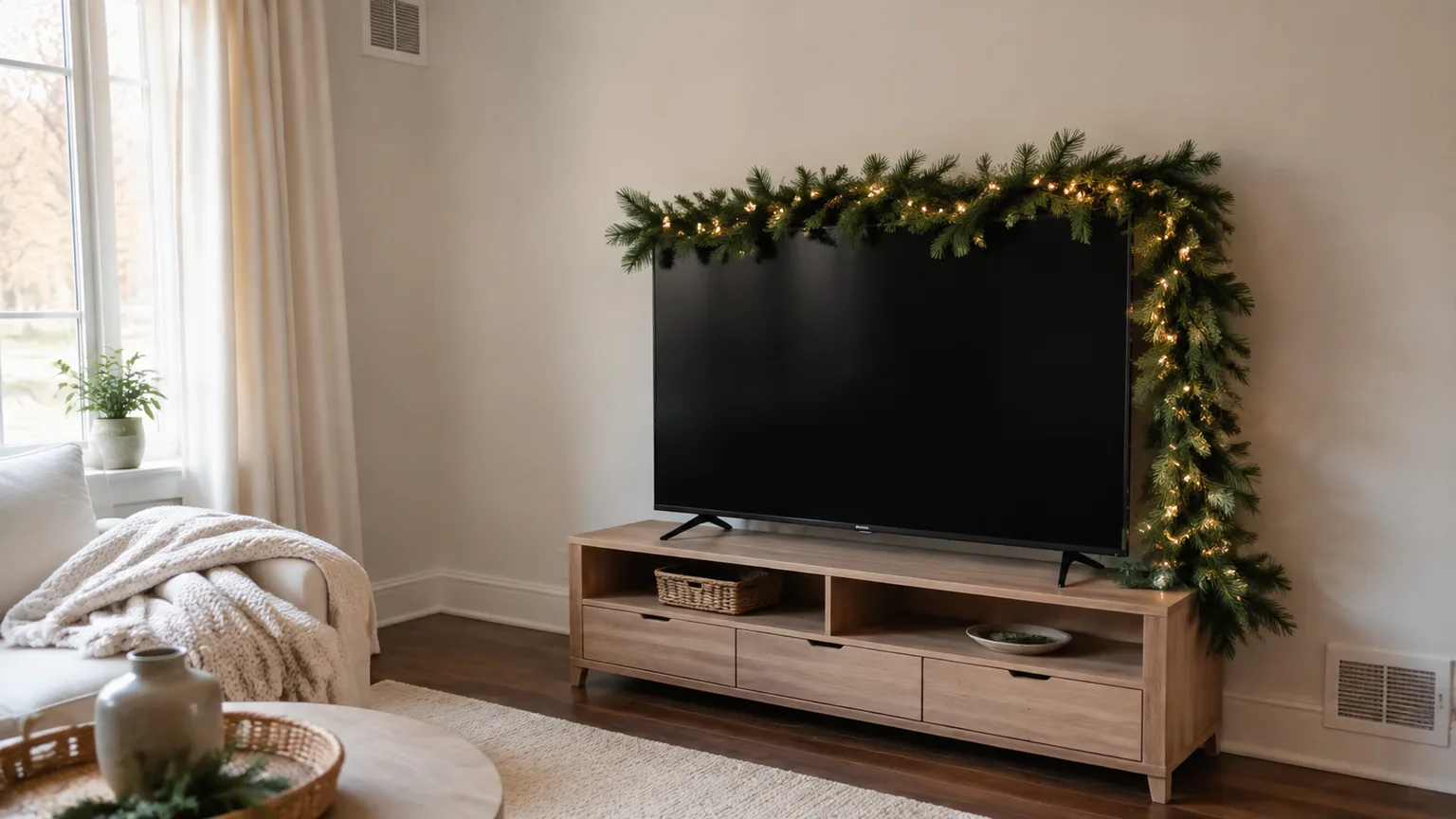
Do not lay heavy greenery on top of a television’s ventilation openings, press branches against a hot device, or let the garland droop over a screen. Use lightweight artificial or preserved garland for electronics, secure it to the furniture or wall rather than the device, and keep the arrangement removable so you can clean dust and access cables.
For a narrow room, decorate only the upper or outer edge. A full rectangle can make a small screen look smaller and can crowd the wall. A single diagonal sweep looks more deliberate, uses less material, and leaves the screen readable. Add two or three repeated accents—small bows, wood beads, or unbreakable ornaments—rather than attaching a different object at every foot.
5. Make the table the holiday focal point
When there is no tree, a dining table, coffee table, or kitchen island can carry the season. The safest small-space centerpiece is low enough to see over, narrow enough to preserve serving space, and easy to lift away when the table’s main job returns.
Try a shallow bowl of pinecones and dried citrus, a row of three small vessels with cut branches, or a tray holding a vase, battery candles, and a few ornaments. Repeat one element elsewhere in the room—a ribbon color, a wood tone, or the same greenery—to connect the table to the rest of the decor without adding another large object.
Keep a centerpiece beautiful and functional
Begin by marking the portion of the table that must stay clear for plates, work, or a laptop. Build the decoration inside the remaining zone and keep fragile pieces toward the center, not at the edge where elbows, paws, or sleeves can catch them. If the table doubles as a desk, use a lidded box or handled tray so the entire centerpiece can move in one lift.
Use water only in a vessel that cannot tip easily, and place it on a waterproof saucer. Fresh greenery in a vase can look beautiful, but standing water, dropped needles, sap, and loose berries create maintenance work. A dry arrangement with preserved stems and a battery candle is often the better choice for a busy kitchen or a home where children investigate everything.

6. Turn one wall into a seasonal gallery
A seasonal gallery uses the wall’s height instead of the floor’s depth. Hang a small wreath, two framed prints, a strand of wooden beads, a few paper stars, or a line of cards in a deliberate vertical group. The display can be festive without showing a single tree shape, which suits minimalist rooms and homes where a traditional holiday silhouette feels out of place.
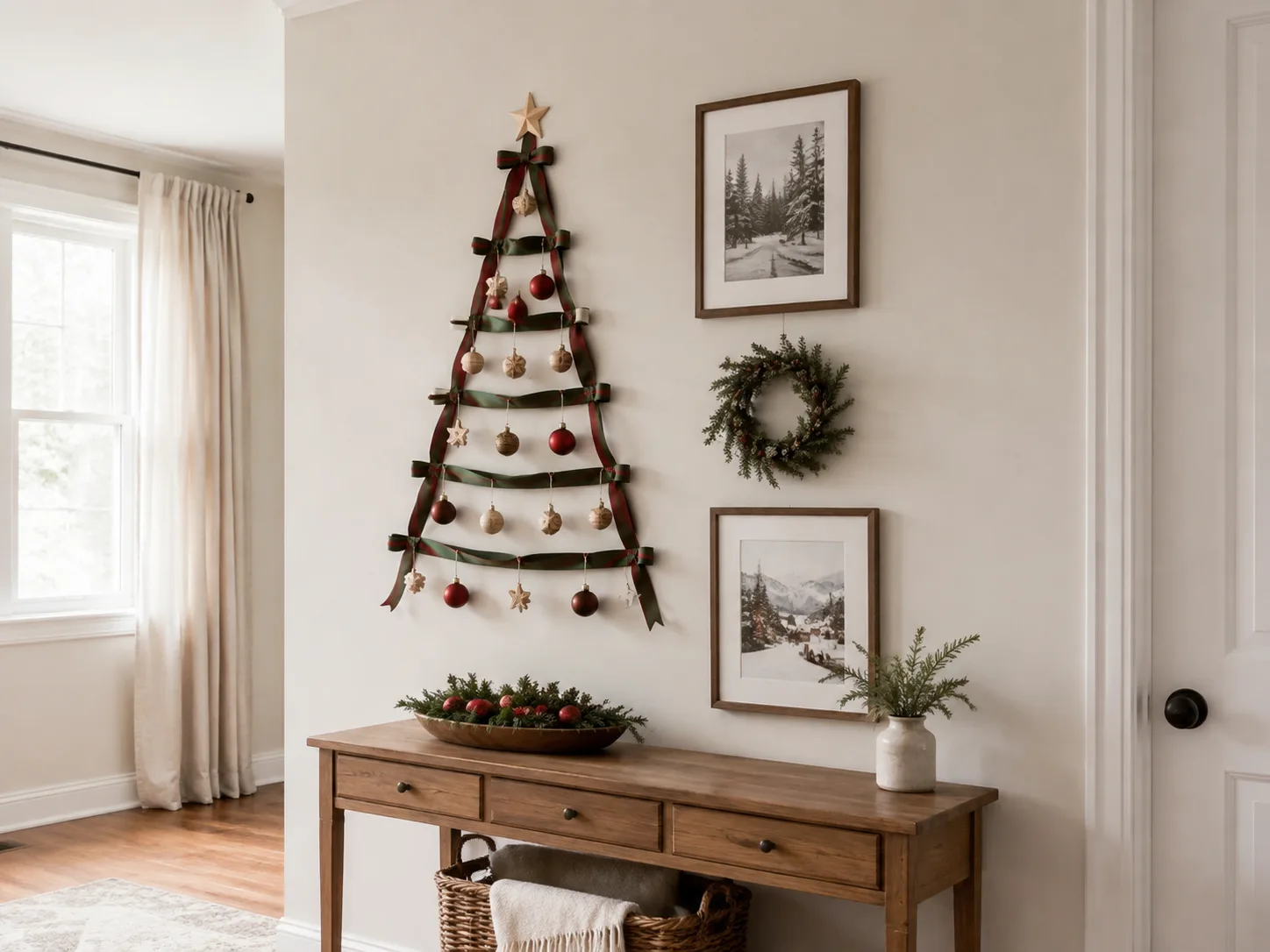
Use the “one tall, two small” rule: one vertical anchor, such as a narrow wreath or ribbon, balanced by two smaller pieces nearby. Align the group to furniture below it, and leave enough clearance for doors, lamps, and coat hooks. In a studio, placing the gallery above a console or behind the sofa helps define a holiday zone without visually dividing the entire room.
A picture ledge or existing hooks make this idea especially renter-friendly. If you need new support, use removable hooks only within their stated load rating, and keep the heaviest piece closest to the support point. Avoid hanging ornaments at face height in a passage, and skip glass where a chair, door, or pet tail could strike it.
7. Create a faux fireplace moment with light
You can borrow the emotional job of a fireplace—warmth, glow, and a place for stockings—without building one. Put a narrow bench, low bookcase, or console against a wall, arrange flameless candles at different heights, and add one garland or a few branches above it. If you have a screen, a quiet fire video can fill the background, but the physical arrangement should still look finished when the screen is off.
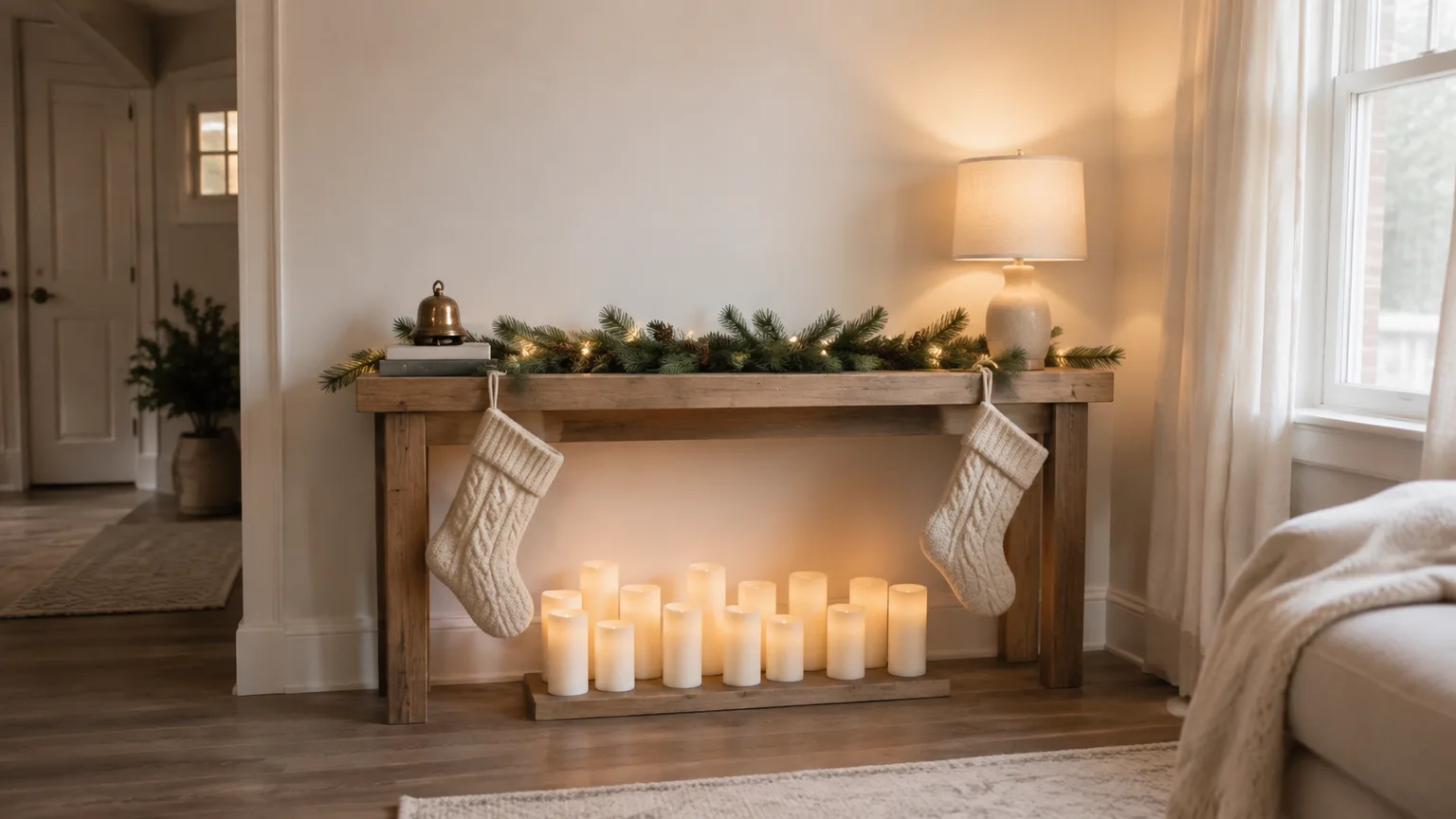
Keep the composition low and contained. A stack of stable boxes can suggest a mantel only if it is secured and not carrying anything that could topple; in a rental or small apartment, a shelf with stockings and a warm lamp is usually safer and easier. Choose battery-operated candles when real flame would sit near greenery, paper, fabric, or a busy walkway.
The U.S. Fire Administration’s holiday fire-safety guidance recommends keeping candles at least 12 inches from anything that burns, inspecting light strands for frayed or pinched wires, following the manufacturer’s connection limits, and using flameless candles as an option. Those rules still apply to a tiny faux fireplace; scale does not make a dry branch or loose cord nonflammable.
Combine two ideas without making the room feel crowded
The strongest no-tree rooms usually have one main focal point and one echo. Pair a wall tree with a small vase, a wreath with a few table candles, or a garland-framed mirror with a bowl of pinecones. Do not give every surface equal visual weight; repeat a material or color instead of adding another category of ornament.
Think in layers: vertical shape, natural texture, and light. The wall or wreath supplies the shape, greenery or wood supplies texture, and a short string of warm LEDs or flameless candles supplies glow. If an arrangement needs more than one sentence to explain where it belongs, it may be trying to solve too many room problems at once.
Match the setup to renters, roommates, kids, and pets
Renters should prefer door hooks, picture ledges, consoles, and tension rods over drilling or adhesive on uncertain paint. Roommates should keep the display out of shared pathways and agree on one place for cords, batteries, and ornaments. Families with toddlers should use soft, unbreakable ornaments below reach level and secure every tall vessel against tipping.
Pet households need a species and access check, not a blanket assumption that “natural” means safe. Pet Poison Helpline’s holiday toxin guidance warns about holly berries and leaves, mistletoe, and yew in wreaths, as well as tinsel, ribbon, dangling lights, and breakable ornaments. Keep those materials out of reach, inspect greenery brought home by guests, and contact your veterinarian or a poison-control service promptly if a pet chews an unknown plant or decoration.
Keep live greenery fresh long enough to enjoy it
Fresh stems need a cooler, cleaner placement than most holiday photos suggest. Keep them out of direct sun, away from radiators, fireplaces, heat vents, and appliances that warm the surrounding air. Gardening Know How also advises keeping greenery cool before bringing it inside, using cool LED bulbs if lights are woven through it, checking it every day or two, and discarding sections that brown or drop needles.
For a vase arrangement, recut the stem ends and give the branches clean water. For a wreath, swag, or garland, a light mist may temporarily improve the look, but it will not reverse drying and can damage walls, electronics, paper, or finished wood. Never mist a lighted arrangement or a display attached to a television, and never use a water trick to justify keeping brittle greenery in place.
Watch the room, not just the calendar. A branch can remain green while becoming dry enough to shed heavily, and a preserved arrangement can collect dust or loosen its wire. When the foliage becomes brittle, remove it; the decoration has reached its useful endpoint even if a few needles still look green.
Place holiday decor with fire and pet safety in mind
Do a safety pass after styling, when the room looks finished and cords are easier to overlook. Keep fresh or artificial greenery away from flames and heat sources, do not block exits or vents, and route cords along the wall rather than across a walking path. Inspect every light strand before use and discard one with frayed insulation, crushed wire, or a loose connection.
LED lights are a sensible choice for greenery because they produce less heat than older incandescent strands, but “cool” does not mean “leave it unattended.” Use the strand and power source as directed, avoid overloading connections, and switch lights off when you leave or go to sleep. The U.S. Fire Administration specifically notes that nearly one-third of home Christmas tree fires are caused by electrical problems; a smaller display still deserves an electrical check.
Keep candles stable and at least 12 inches from greenery, paper, fabric, and ribbon. For households with cats, be cautious with hanging strings, tinsel, and long ribbon tails: Pet Poison Helpline explains that swallowed string-like decorations can cause a dangerous linear foreign body, so decorative tails should be short, secured, or omitted.
Use this 30-minute no-tree decorating plan
Start with five minutes of measuring and clearing: choose one focal zone, note the traffic line, and remove anything that will compete with the display. Spend the next five minutes gathering one shape-maker, one texture, one light source, and the attachment or vessel you need.
Use ten minutes to install the main idea without ornaments. Step back from the doorway and the sofa; if the shape is too low, too wide, or crooked before embellishment, fix it now. Add greenery or the table arrangement next, keeping the screen, switches, handles, and working surfaces usable.
Use the final ten minutes for restraint and safety. Add a repeated ribbon or ornament accent, hide or secure the cord, stabilize the vessel, test the lights, and move any candle or berry branch that is too close to a heat source or within a pet’s reach. Take one photo from the room entrance; it will show clutter and scale problems your close-up view hides.
Conclusion
The best holiday decor ideas when you can’t fit a tree do not imitate a full tree at a smaller scale. They move the season into a wall, a narrow vessel, a wreath, a garland line, a table, a gallery, or a contained pool of warm light. Choose the idea that fits the room’s actual traffic, surfaces, residents, and maintenance tolerance.
If you want scent and texture, use a small, fresh branch arrangement and monitor it. If you want the longest display with the least risk, choose preserved or artificial greenery with flameless light. A single intentional focal point, supported by one repeated detail, can make a small room feel generous, calm, and unmistakably festive without sacrificing the floor space you live in every day.