Homemade Weed Killers: What Actually Works
Learn which homemade weed killers actually work, why vinegar and alcohol rarely kill roots, and when boiling water is the right low-chemical choice.
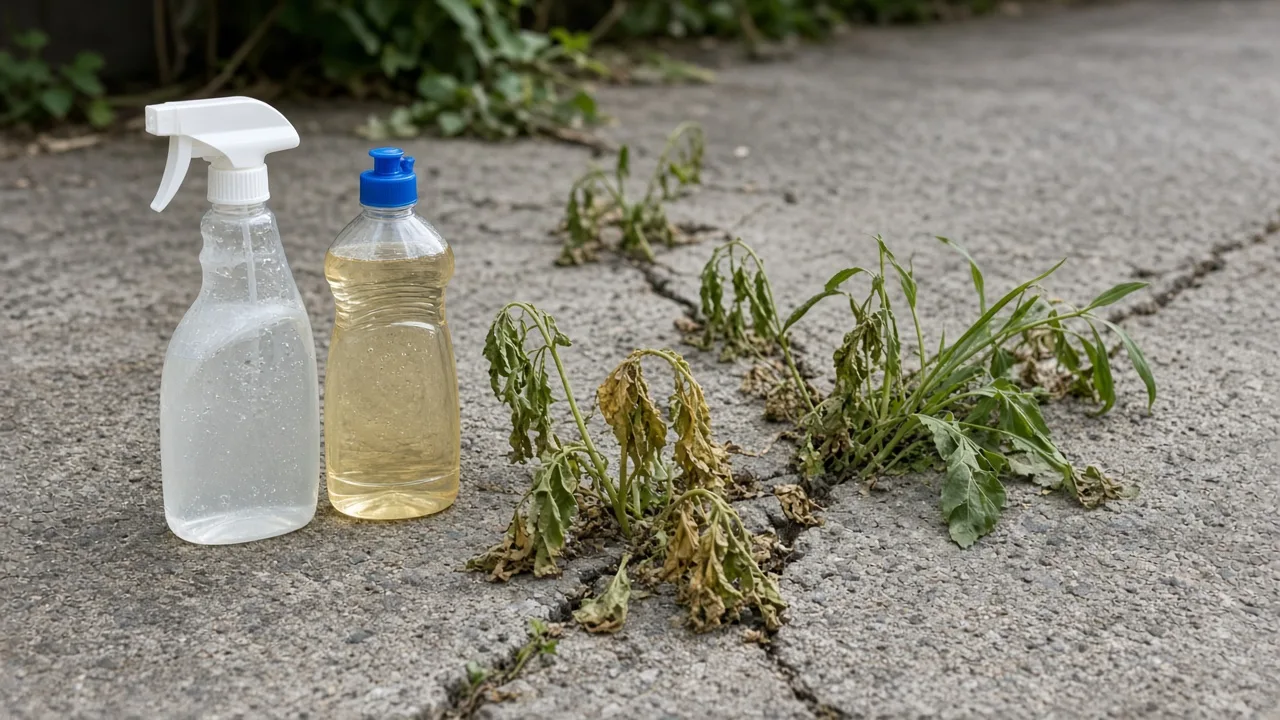
Homemade weed killers can make a plant look dead in a few hours, but that is not the same as controlling the weed. Vinegar, rubbing alcohol, and boiling water are all capable of damaging exposed foliage. None can tell a dandelion from a flower, a lawn grass blade, or a shallow feeder root.
The most useful way to think about these methods is as limited contact treatments. They can be reasonable for a few young weeds in a place where no desirable plant is nearby, especially a pavement crack. They are poor substitutes for identification, root removal, mulch, and repeat follow-up in a planted bed.
The short version is simple: use vinegar cautiously on tiny weeds, treat rubbing alcohol as an optional last resort rather than a garden staple, and reserve boiling water for isolated hardscape cracks. Skip salt and bleach, do not improvise a lawn spray, and do not mistake quick browning for a permanent cure.
The honest answer: “natural” does not mean selective
“Natural” describes where an ingredient comes from, not how it behaves after you apply it. Acetic acid in vinegar, alcohol, heat, sodium chloride, and detergents can all injure living plant tissue. A kitchen ingredient can still burn skin, damage eyes, harm a wanted plant, or move with rainwater into a place where it does not belong.
The important distinction is contact action versus systemic action. A contact treatment damages the plant tissue it reaches. A systemic treatment moves within the plant and may reach growing points or roots. Vinegar and heat are mainly contact tools; rubbing alcohol is also a surface-desiccating treatment. That is why each can be impressive on a small seedling and disappointing on bindweed, nutsedge, Canada thistle, or a mature dandelion.
The University of Illinois explains that acetic acid has no residual activity and that complete coverage of growing points matters. It also notes that higher-acid products can be hazardous even though they are commonly described as natural. The same logic applies to every homemade recipe: what touches the leaf is not automatically what kills the underground plant.
Match the method to the weed and the site
Before mixing or pouring anything, look at two things: the weed’s life cycle and the surface beneath it. Those two observations usually tell you more than the ingredient list does.
Annual seedlings and established perennials behave differently
Annual weeds depend heavily on seed production. Chickweed, carpetweed, and young crabgrass are much easier to stop when they are small and have not flowered. Pulling, shallow hoeing, or a carefully directed contact treatment can remove that season’s plant before it adds to the seed bank.
Perennial weeds have a reserve system below the soil. Dandelions store energy in a taproot; bindweed spreads through roots and rhizomes; nutsedge produces underground tubers; perennial grasses can regrow from crowns and runners. Scorching the top in July may only force the plant to spend stored energy before it sends up another shoot.
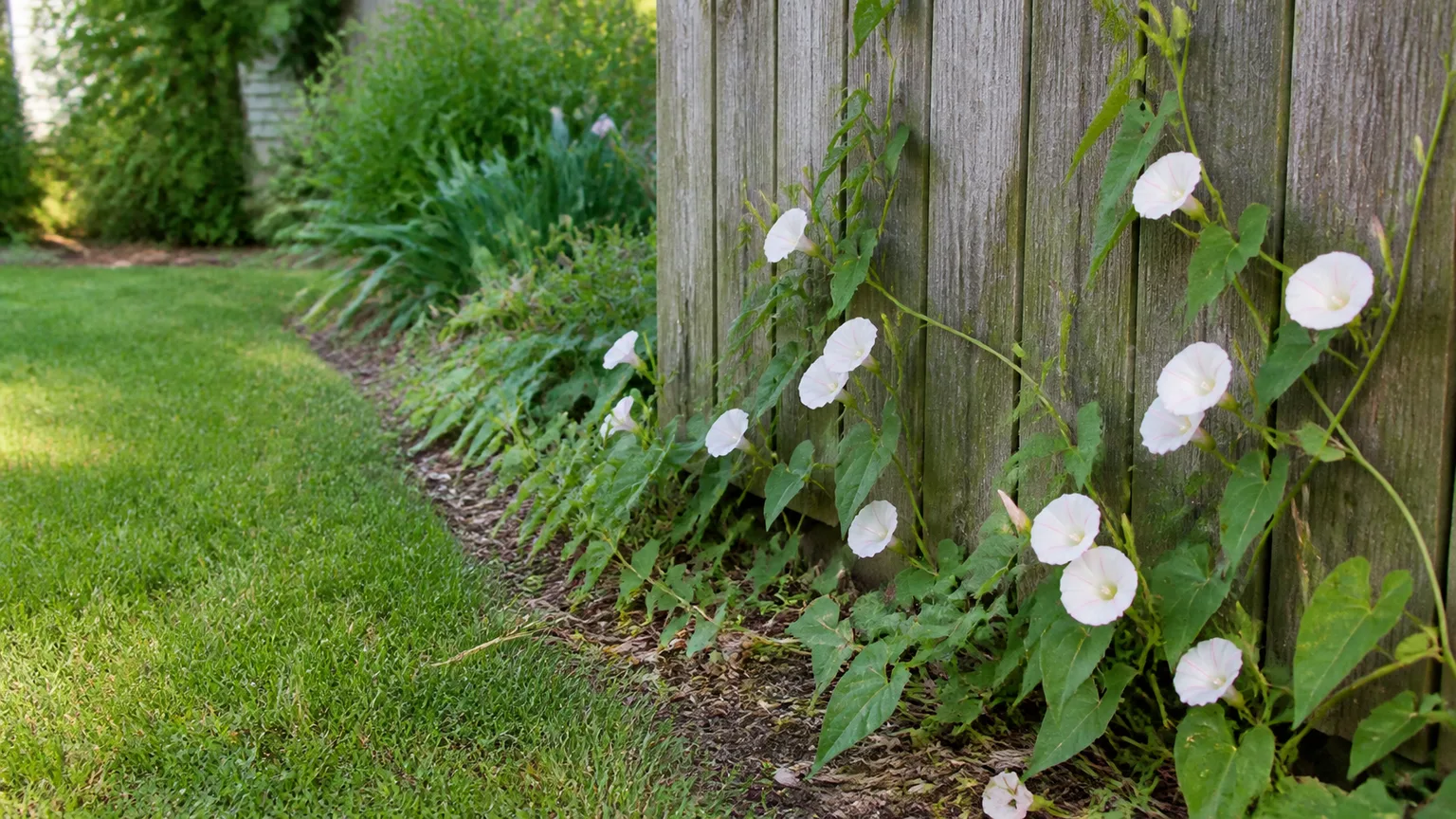
That does not mean contact methods are useless on perennials. Repeatedly removing new leaves can gradually weaken a plant, but the schedule matters. Check the area every few days, remove fresh growth before it rebuilds a full leaf canopy, and keep going long enough to exhaust the root reserve. If you only treat once, expect regrowth.
The University of Nevada, Reno Extension puts the timing principle plainly: low-toxicity methods work best when used early, consistently, and strategically in small landscapes. That is a more realistic promise than “one spray kills everything.”
Garden beds, lawns, and hardscape need different tactics
In a garden bed, selectivity matters most. A weed may be growing beside a perennial, under a shrub, or among edible crops with roots extending farther than their stems. Use a hand tool or mulch there before reaching for a nonselective liquid.
A lawn is an even worse target for homemade sprays. Vinegar, alcohol, boiling water, salt, and detergent do not distinguish a broadleaf weed from turf. Treating a whole lawn with a homemade mixture can leave dead patches, expose soil to more weed seeds, and still fail to remove the weed’s crown or roots. Improve mowing, irrigation, turf density, and spot removal instead.
Hardscape is the place where a contact treatment makes the most sense because the goal is often bare joints between pavers or isolated cracks. Even there, check where runoff flows. A crack beside a planting bed, storm drain, pond, or tree root is not truly isolated.
1. Vinegar for young weeds in isolated spots
Vinegar is the most studied of the three familiar pantry methods. Household white vinegar is commonly about 5% acetic acid. It can damage cell membranes and desiccate exposed foliage, especially on small, young weeds with little protective leaf surface.
That makes vinegar a plausible short-term tool for a few annual seedlings in a gravel path or a clean, empty strip of pavement. It is not a blanket weed killer for a lawn, a planted bed, or a mature perennial border.
What vinegar can do—and where it fails
A vinegar spray can produce visible browning within hours because the leaf tissue it contacts is injured quickly. The result is easiest to see on tender broadleaf seedlings. Grass seedlings and waxy-leaved plants may be harder to wet thoroughly, while mature plants have more tissue and more stored energy to draw on.
The University of Illinois Extension reports that acetic acid is nonselective, works best when it reaches the growing points, and has no residual activity. It also notes that annuals and seedlings are generally more susceptible than mature perennials. The practical translation is: wet the target completely, but judge success weeks later by whether it regrows.
Research from the USDA Agricultural Research Service shows why concentration and selectivity must be discussed together. In an onion field study, a 20% acetic-acid treatment gave strong broadleaf control for up to five weeks, but the over-the-top spray also caused severe injury to the crop. A stronger burn is not a safer or more selective treatment.
How to use a vinegar product with less collateral damage
If you choose vinegar, treat it as a targeted foliar application, not as a soil drench. Use it only where a little spray drift or runoff will not reach a wanted plant, and avoid windy weather. A shield such as a piece of cardboard can help protect a nearby stem or leaf, but it does not make the treatment selective.
Household vinegar may be too weak for an established weed. Do not solve that problem by concentrating it, adding random ingredients, or assuming a “horticultural” label means harmless. The NC State Extension discussion of acetic acid describes household vinegar as unimpressive in past testing and points readers toward research on stronger products.
If you buy an acetic-acid herbicide, use a product labeled for the site and follow its label for protective equipment, application rate, storage, and re-entry. The University of Illinois guidance warns that concentrations above 11% can cause serious skin burns and severe eye injury. Keep children and pets away during application and until the label allows access.
Do not spray near edible crops simply because the ingredient began as food. Washable does not mean crop-safe, and a nonselective contact herbicide can injure a vegetable plant faster than it injures the weed you meant to target.
2. Rubbing alcohol as a narrow contact treatment
Rubbing alcohol can desiccate the foliage it contacts, so it belongs in the “may damage a few exposed leaves” category. It does not offer a reliable route to the roots, and its performance varies with the weed, weather, coverage, and the amount that evaporates before the leaf is fully wetted.
I would not choose it for a garden bed, lawn, compost area, or broad patch of weeds. It is too easy to hit a wanted plant, too easy to create a flammable situation, and too poorly suited to solving the underground part of a perennial problem. A hand weeder is usually more precise.
Why the method is limited and easy to misuse
The common mistake is to treat rubbing alcohol as a gentle version of vinegar. It is not. Isopropyl alcohol is flammable, can irritate skin and eyes, and evaporates quickly. Never use it near a flame, grill, smoking material, electrical spark, or a hot surface. Do not store a mixed solution in an unmarked food or drink container.
I am deliberately not giving a stronger kitchen recipe for alcohol weed spray. Diluting a household product does not make it a labeled herbicide, remove its flammability, or make it safe around crops and pets. If a few weeds are growing in a clean, isolated crack, mechanical removal is the better first option; if you still test a contact treatment, use only a very small, controlled spot and follow the product’s safety information.
Alcohol is most defensible as a last-resort surface treatment where there is no desirable vegetation and no soil you intend to plant. Even then, pull or dig the dead material afterward and inspect for regrowth. A brown leaf is a signal to check the root, not permission to stop.
3. Boiling water for pavement cracks
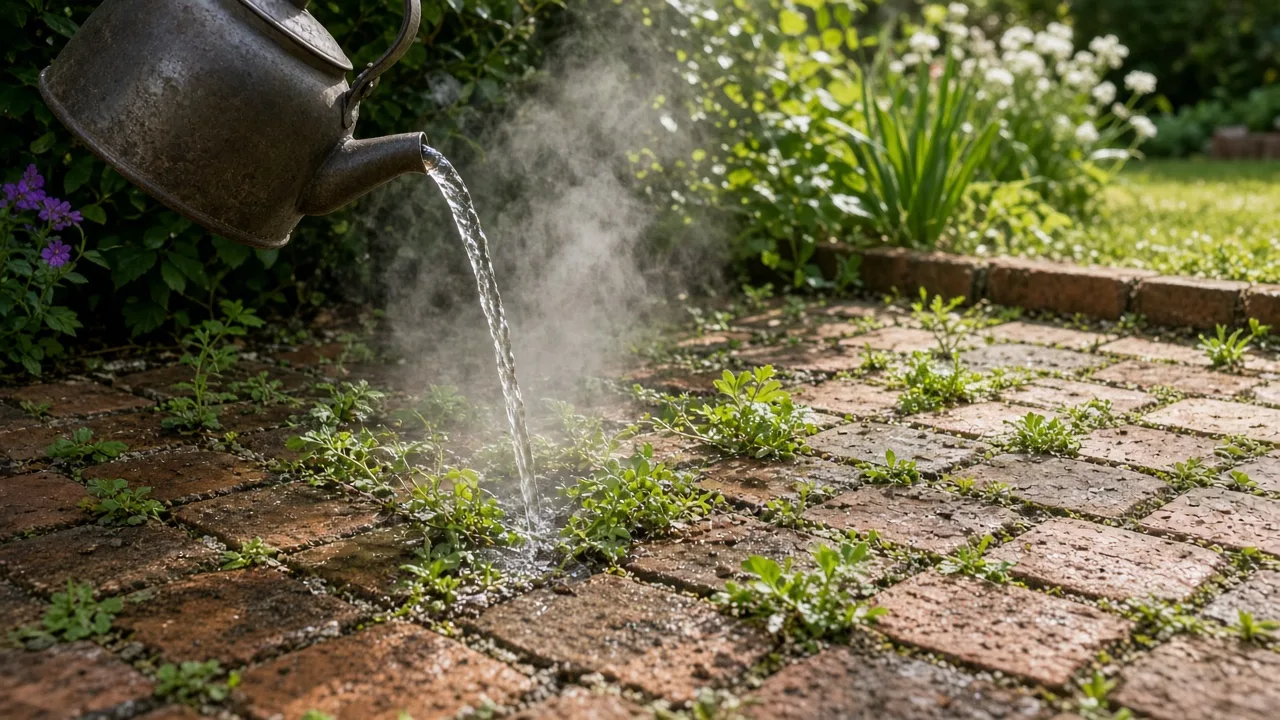
Boiling water is simple, inexpensive, and genuinely effective against exposed plant tissue. It is also the method with the clearest boundary: use it on weeds growing through isolated cracks in concrete, brick, or stone where nearby plants and vulnerable materials are out of the splash zone.
The heat collapses living cells at the surface. Young annual weeds may die after one treatment, while a plant with a thick crown or deep root often sends up new growth. Pouring more water is not automatically the answer; repeated flooding can damage the site around the weed and creates a scalding hazard.
Where heat works best and where it can hurt
The best target is an accessible pavement joint with no garden soil connected to it. Pour slowly and close to the crack rather than swinging a full kettle across the yard. Wear closed shoes, keep the path clear, and let the surface cool before brushing away dead material.
Gardening Know How highlights three practical no-go zones: near shallow-rooted shrubs, on landscape fabric, and along raised-bed edges. A bed edge may look like bare soil, but it can contain feeder roots, earthworms, beneficial microbes, irrigation lines, and a crop you want to keep. Hot water can also warp synthetic fabric and injure turf that grows beside a path.
Do not use boiling water where it can run toward a pond, drain, vegetable row, or tree base. Do not pour it on a slope above someone’s feet, and never carry an uncovered stockpot through a busy yard. If you cannot control the landing zone, pull the weed or use a hand tool instead.
For a persistent pavement weed, remove the top growth, loosen and extract as much of the crown and root as possible, then sweep soil and seed-rich debris from the joint. Refill or repair the gap with a suitable joint material. Killing today’s leaves without closing the crack simply leaves an invitation for the next seed.
Homemade recipes to skip
The most popular homemade weed-killer recipes often combine vinegar, salt, and dish soap. They look persuasive because each ingredient seems to add a job: acid burns foliage, salt increases stress, and soap helps liquid spread. The problem is that the mixture is still nonselective, the salt can remain in the soil, and the detergent is not automatically safe for plants or waterways.
Salt, bleach, and dish detergent create avoidable problems
Salt is the ingredient I would avoid most strongly in a home landscape. Sodium chloride dissolves and moves with water, so it can reach the root zone of trees, shrubs, turf, or future plantings. It can also degrade soil conditions that took years to build. A weed-free patch is not a success if the site becomes difficult to replant.
Epsom salt is not a safer weed killer. It supplies magnesium sulfate rather than sodium chloride, but it is still a soluble salt and is not selective for weeds. Add magnesium only when a soil test and a crop need justify it, not because a recipe promises a stronger burn.
Bleach belongs under the sink, not in the soil. It is a cleaner and disinfectant, not a landscape herbicide. Never mix bleach with vinegar, ammonia, or another cleaner; acidifying hypochlorite products can release dangerous chlorine gas.
Dishwashing liquid is a detergent formulated to remove grease from dishes. It may contain fragrances, dyes, solvents, enzymes, or preservatives, and its effect on leaves varies by plant. A labeled horticultural adjuvant is not interchangeable with a squirt of kitchen detergent. More soap can mean more leaf burn without better weed control.
The University of Illinois Extension notes that an herbicidal use must follow the product label and that using an unregistered product as an herbicide can violate U.S. pesticide law. Rules differ by location, but the safe principle travels: use a product only for the site and purpose on its label, and do not assume an ingredient’s presence in a pantry authorizes outdoor pesticide use.
Build lasting control with removal, mulch, and suppression
For most beds, the “homemade weed killer” that works best over a season is a sequence, not a bottle. Remove existing weeds, deny light to new seedlings, and revisit the site before survivors can flower. This approach is slower than a dramatic scorch but much kinder to the planting and more dependable against repeat germination.
A repeatable sequence for the next four weeks
Start after rain or irrigation has softened the top layer. Pull annuals by the base, loosen taproots with a narrow tool, and lift as much of a perennial crown as the soil allows. Bag seed heads rather than adding them to a cool home compost pile, and do not rototill a patch of rhizomatous weeds unless you know how you will contain the fragments.
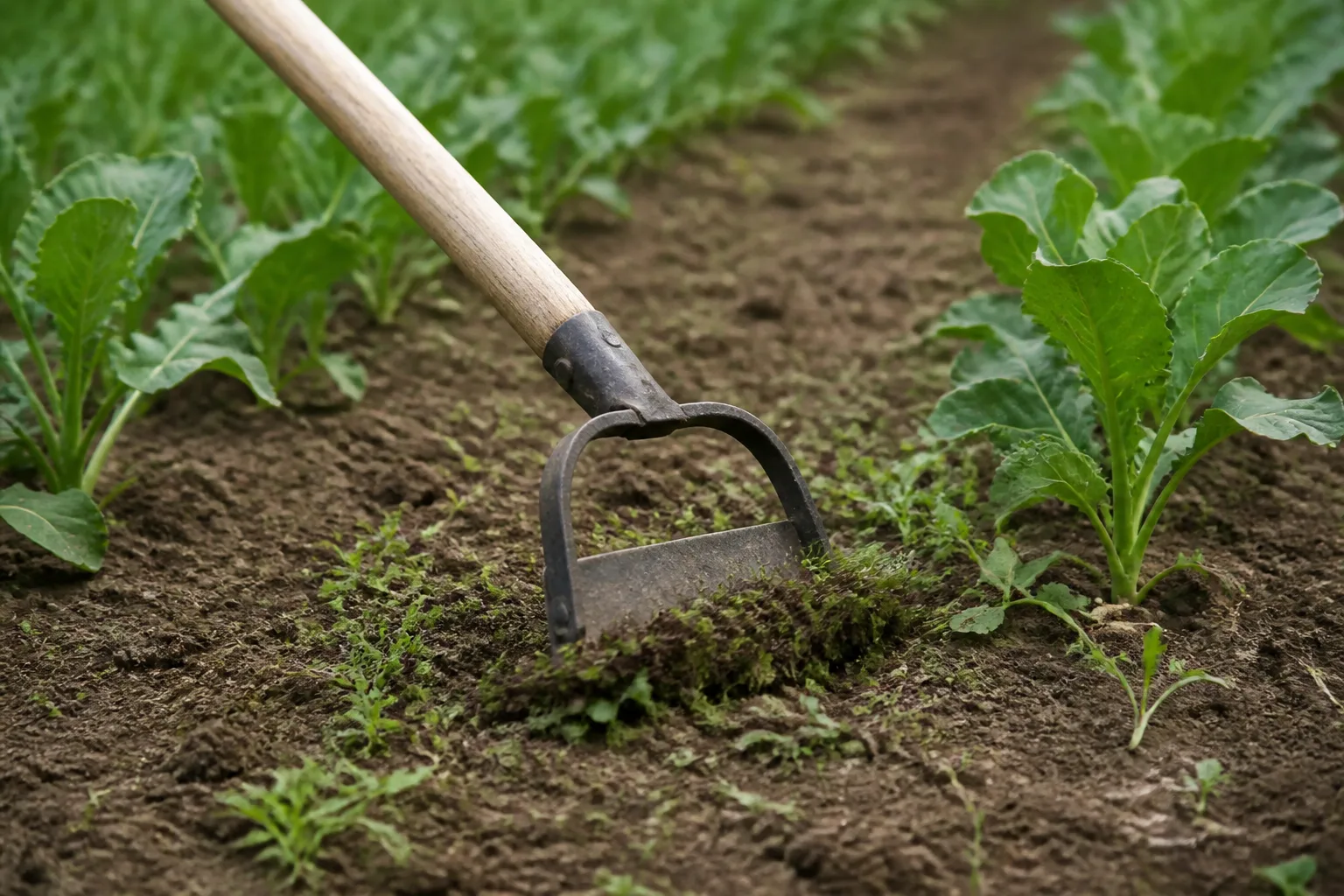
Next, shallowly hoe or scrape the exposed soil on a dry day. A stirrup hoe is useful between rows because it severs tiny seedlings at the surface without turning over a deep layer of soil. Work around crop roots and keep the blade shallow; deep cultivation can bring buried seeds to the light.
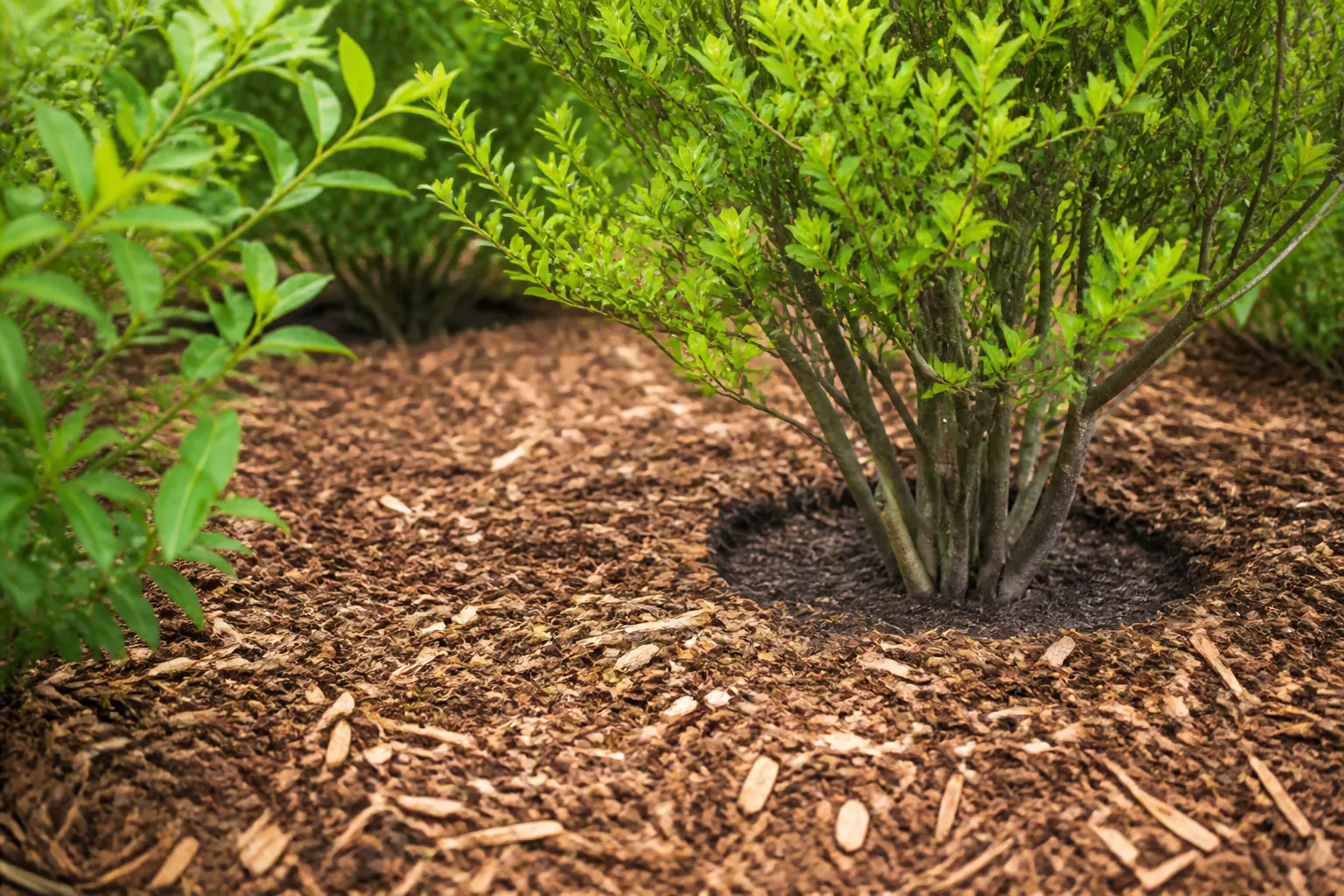
Then cover bare soil with an appropriate organic mulch. A layer around 2 to 4 inches is a practical range for many ornamental beds, but keep it away from trunks, stems, and crowns. Wood chips, shredded bark, leaf mold, and clean straw each behave differently as they settle, so top up when the layer thins rather than piling it against plants.
For an area that can remain out of production, consider sheet mulching. Fine Gardening’s step-by-step guidance describes a shallow approach using untreated cardboard or paper overlapped beneath 2 to 4 inches of mulch. Soak the site, cut vegetation down, overlap seams, cover the paper, and keep the area moist while the material decomposes.
Recheck weekly for a month. Pull anything that reaches the surface, repair gaps in the mulch, and cut perennial regrowth before it rebuilds a full canopy. The University of Nevada, Reno Extension also emphasizes early action, mulch, hand weeding, and solarization as parts of a low-toxicity weed program.
Prevent the next flush of weeds
Weeds become easier when the garden stops offering empty, sunlit soil. Plant ground covers at a spacing that lets them knit together, use mulch in the spaces between ornamentals, and water the crop’s root zone rather than wetting every exposed surface. Dense, healthy planting does not prevent every weed, but it reduces the number of places where seedlings can establish.
Timing matters more than most recipes. Walk the bed once a week during the growing season, especially after rain. Removing a weed at the two-leaf stage is a short job; removing a flowering plant with a mature root and a fresh crop of seed takes longer and may create next year’s problem.
In a lawn, focus on turf health instead of homemade sprays. Mow at the appropriate height for the grass, avoid scalping, correct irrigation problems, and reseed thin areas when the season suits the turf. Dig isolated perennial weeds with a narrow tool, and get local extension advice when the weed is spreading through runners, tubers, or a large area.
For a neglected bed or an empty patch, solarization can be more appropriate than repeated pantry sprays. Clear the area, water the soil, and cover it with clear plastic during the hottest part of the season, following regional guidance for duration and setup. It is a site-preparation method, not something to place over living crops or a mature ornamental border.
Corn gluten meal is sometimes described as a natural pre-emergent. Treat it as a limited prevention tool, not a killer for existing weeds. Its usefulness depends on timing and application instructions, and adding a high-nitrogen material to a lawn or bed without considering the plants and soil can create a new management problem.
If you have repeated failures, identify the weed before escalating. A local extension office can help distinguish bindweed from an ornamental vine, sedge from grass, and a native volunteer from a nuisance plant. The right identification often changes the recommendation more than a stronger homemade formula would.
Conclusion
Three familiar homemade methods can work, but only in narrow situations. Vinegar can burn young weeds, rubbing alcohol can desiccate a few exposed leaves, and boiling water can collapse weeds in isolated pavement cracks. All three are nonselective, none reliably solves a deep perennial root problem, and the first two are easy to misuse around plants and soil.
Choose the method by location: remove and mulch weeds in beds, improve turf rather than spraying a lawn, and reserve heat or a carefully targeted contact treatment for hardscape where runoff and collateral damage are controlled. Skip salt, bleach, and improvised detergent recipes. The lasting win is not the fastest brown leaf; it is fewer seeds, weaker roots, covered soil, and a garden you can safely plant again.