How Long Does a Christmas Tree Last? 8 Tips to Keep It Looking Good
Learn how long a real Christmas tree lasts, when to buy one, and how fresh cuts, plain water, stand size, lights, and placement prevent needle drop.
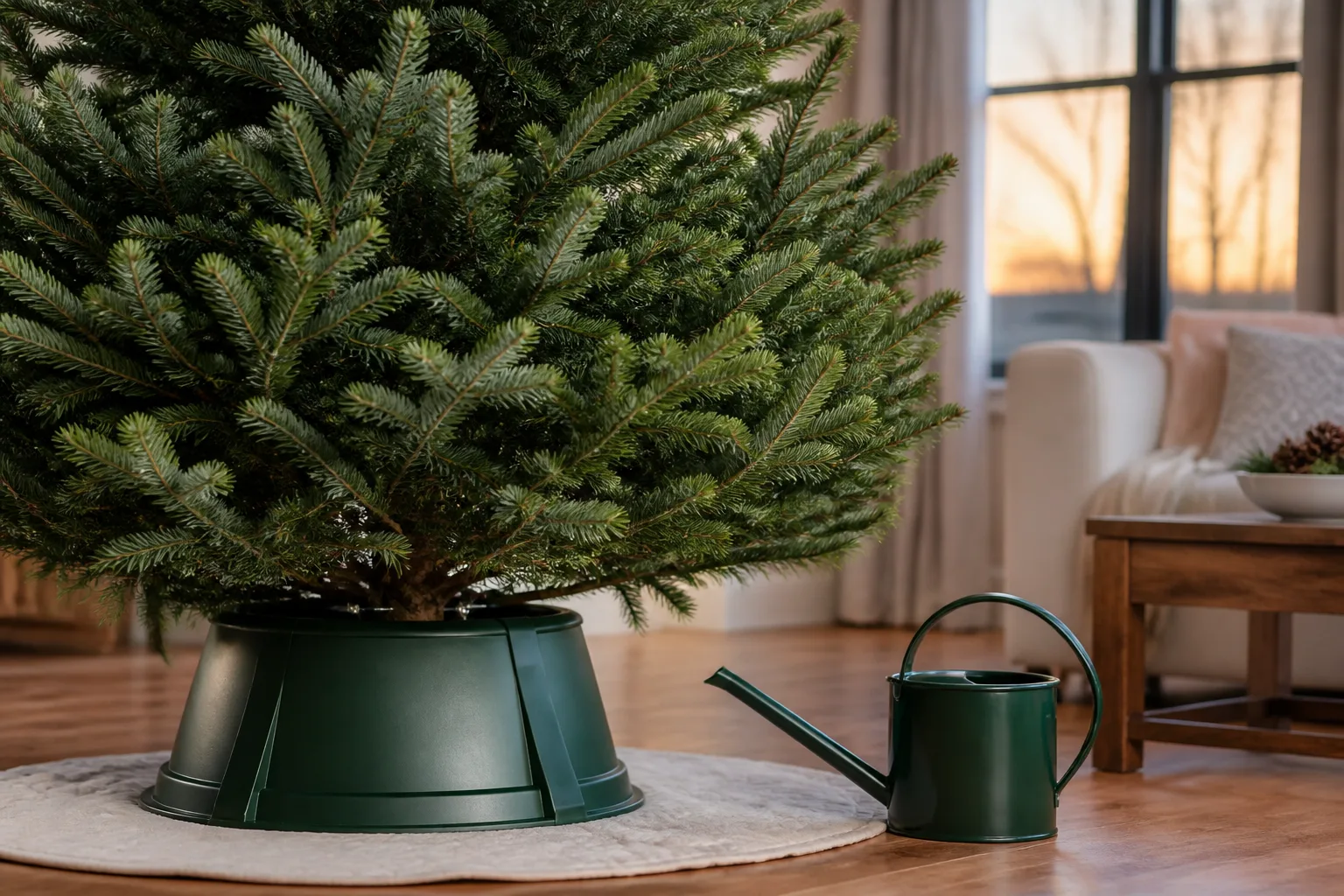
The short answer: plan on three to four weeks indoors
A cut Christmas tree usually looks good indoors for three to four weeks after harvest when it starts fresh, receives steady water, and stays away from heat. A particularly fresh, well-hydrated Fraser fir can sometimes hold its color and needles for four to six weeks, while a tree that was already dry when purchased or allowed to sit without water may decline much sooner.
That range is more useful than a promise because “tree age” is not the same as the number of days since you brought it home. A tree may have been cut at the farm, transported, displayed dry at a lot, stored in a garage, and then placed in your stand. The clock begins before you see it. NC State Extension’s keepability guidance explains that cooling, hydration, and protection from drying conditions all preserve quality after harvest.
The practical goal is not to keep a dead tree green indefinitely. It is to start with enough freshness for your intended display window, then prevent the few avoidable mistakes—especially an empty stand, a poor trunk cut, and a position beside a heater—from consuming that margin.
When to buy your tree for the date you want it to look best
Work backward from the day the tree needs to look its best. If you want it at peak condition on Christmas Day, buying around the first week of December is usually reasonable for a fresh local tree. If your household decorates in late November and keeps the tree through New Year’s, choose a very fresh tree, arrange reliable watering, and favor a species with strong needle retention rather than buying the earliest tree available.
Buying earlier is not automatically wrong. It can work when the tree is freshly cut, the seller keeps it shaded and watered, or you can store it in a cool, protected garage with the trunk in water before bringing it into a heated room. Buying early from a hot, dry lot and then waiting two weeks to set it up is a different risk because the tree may spend much of its useful freshness before display.
Use this simple rule: buy as early as your display date requires, not as early as the decorations appear in stores. Ask when a pre-cut tree was harvested, and prefer a choose-and-cut farm or a seller who can explain how the trees were handled. A tree’s freshness at purchase is often more important than an exact species name.
What controls a tree’s lifespan after cutting
Four factors set the ceiling for how long a real Christmas tree can look good: starting freshness, species, water uptake, and indoor stress. You can improve the last two, but you cannot fully reverse a tree that has already lost substantial moisture before sale.
Species changes the likely window, but it should not be treated as a guarantee. NC State Extension reports that Fraser firs can have excellent keepability, with a potential display life of four to six weeks under typical household conditions. True firs are often chosen for needle retention, while pines and spruces can behave differently depending on freshness and handling. A fresh, well-watered tree of a less fashionable species will usually outperform a stale tree with a “long-lasting” label.
Water uptake also changes over time. A six-foot Fraser fir may use several quarts a day during its first week indoors and then settle into lower use, according to NC State consumer guidance. Michigan State University Extension’s explanation of fresh-tree care gives a useful planning benchmark—up to one quart per day for each inch of trunk diameter—but the actual amount varies with tree size, species, room conditions, and how recently the tree was cut.
Finally, warm air, direct sun, dry drafts, and hot lights increase moisture loss. A living tree outdoors is adapted to a cool, humid winter environment; a cut tree beside a fireplace or forced-air vent is being asked to survive a much harsher microclimate. The care steps below are designed to protect the tree’s water supply and reduce that stress.
8 tips to keep a Christmas tree fresh
1. Choose the freshest tree you can find
Start with a tree whose needles are flexible for its species, whose branches feel resilient, and whose foliage has a healthy color rather than a gray, faded, or brittle appearance. Run a closed hand gently along a branch or give the tree a light tap; a few old needles may fall, but a handful of green needles is a warning that the tree has already dried.
Use the pull test as a comparison tool, not a laboratory test. Michigan State Extension recommends gently pulling a shoot and checking whether needles come away in your hand. If several trees are available, compare them under the same conditions and choose the one that feels heavier, smells fresh, and has supple outer shoots.
Inspect the cut end too. A dark, dirty, heavily resin-coated base suggests the tree has been handled or sitting for a while; it does not prove the tree is unusable, but it makes a fresh recut more important. Avoid trees with extensive bare patches, widespread brown foliage, cracked branches, or needles that snap when bent.
2. Store it cool and hydrated before bringing it inside
If you cannot set up the tree immediately, keep it outdoors in a shaded, sheltered spot or in a cool garage. Place the trunk in a bucket of water if the tree will wait more than a short time, and keep strong wind and direct winter sun off the foliage. Do not leave a wrapped tree leaning against a hot wall, on blacktop in sun, or in a dry heated room.
Storage is especially helpful when you buy early or need to delay decorating. Keep the tree’s trunk end submerged, but protect the bucket from tipping and keep pets from drinking the water. If temperatures are low enough for water to freeze solid, focus on shelter and avoid creating a heavy ice problem around the trunk; the point is to prevent drying, not to keep an outdoor reservoir full at any cost.
Before moving the tree indoors, let it transition in a cool, protected space when possible. A gradual change is easier on the foliage than moving it directly from a freezing yard to a room beside a radiator, although you do not need to turn the process into a complicated acclimation ritual.
3. Make a straight fresh cut before setup
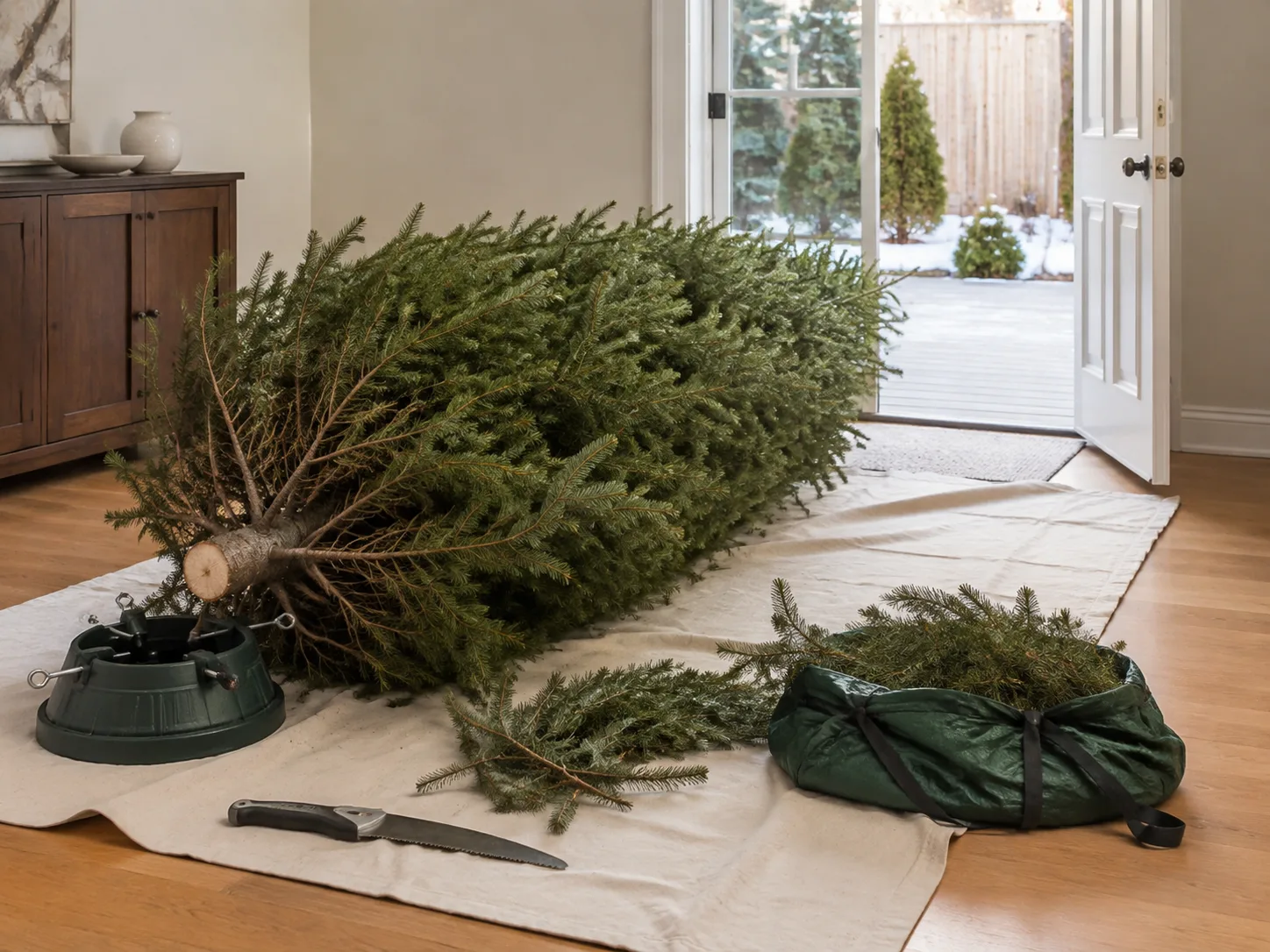
Saw off about one-half to one inch from the bottom of the trunk immediately before placing the tree in its stand. Make the cut straight across, not at an angle, and get the tree into water promptly. The fresh surface removes dried resin and debris that can limit water movement through the trunk.
Do not drill holes in the trunk, shave away the outer wood to make a large trunk fit a small stand, or carve the base into a cone. The outer layers are important for water uptake, and a stand that does not fit the trunk is the wrong stand. Country Living’s practical guidance also cautions against whittling the trunk and recommends a straight cut.
If the tree has been dry for several days after a cut, the initial recut may not be enough to restore strong uptake. In that situation, another clean cut is more useful than adding a homemade preservative. Because a decorated tree is difficult and unsafe to remove for sawing, get the trunk preparation right before the ornaments go on.
4. Match the stand to the trunk and water demand
Choose a sturdy stand that fits the trunk without forcing you to remove side wood. Give priority to a reservoir large enough that the water level will not fall below the cut end between checks. A tall tree with a thick trunk can use several quarts during the first days, so a tiny cup-sized stand creates a daily failure point even when you are trying to care for the tree correctly.
The stand must also be stable on the floor. A full tree can become a serious tipping hazard when a child, pet, or ornament pulls a branch. Tighten the stand according to its design, keep the tree vertical before filling the reservoir, and anchor the tree discreetly if it is tall, top-heavy, or in a high-traffic room.
The best stand is not the one that hides completely beneath a skirt; it is the one you can safely refill and inspect. Leave enough access to see the waterline. A pretty stand that prevents you from noticing an empty reservoir is a false economy.
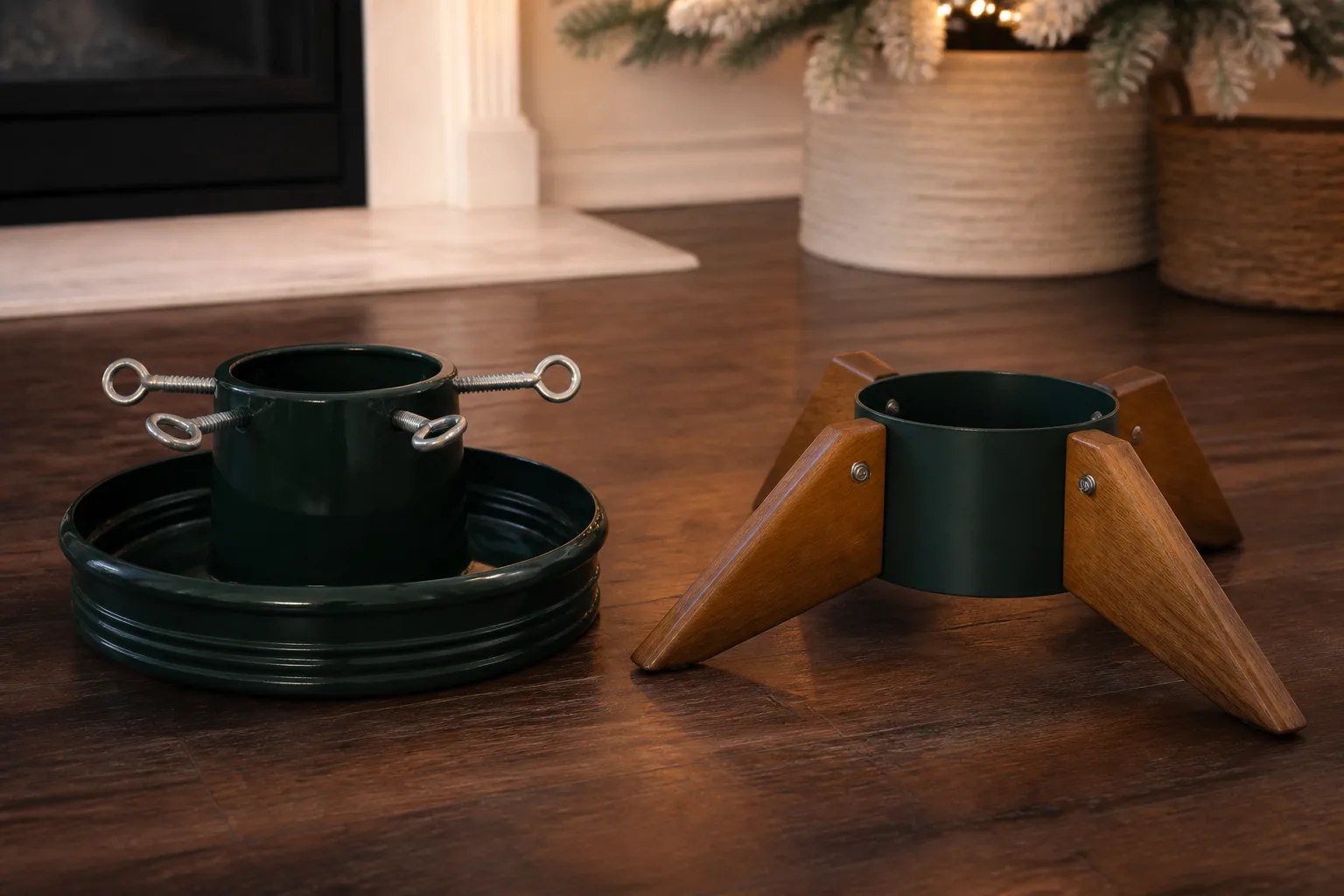
5. Keep plain water above the cut end
Use clean, plain tap water unless your local water authority tells you not to drink it. Keep the water level above the base of the trunk at all times, not merely somewhere in the bowl. The stand may look wet while the cut surface is exposed to air, especially as the reservoir drops or the trunk shifts.
Skip sugar, aspirin, bleach, soda, vodka, fertilizer, floral preservative, and homemade recipes. Michigan State Extension says research supports plain tap water and advises against sugar, aspirin, bleach, and floral preservatives. NC State Extension likewise describes plain water as the best preservative. Additives do not compensate for a dry stand and can create extra risk if they encourage faster water use or make the tree water unsafe around children and pets.
If the reservoir smells stale, empty it carefully and refill it with fresh water. Do not pour a cleaning chemical into the stand while the tree is still installed. Keep pets away from the reservoir; even plain water can become dirty, and chewing branches or drinking stand water is not a behavior to encourage.
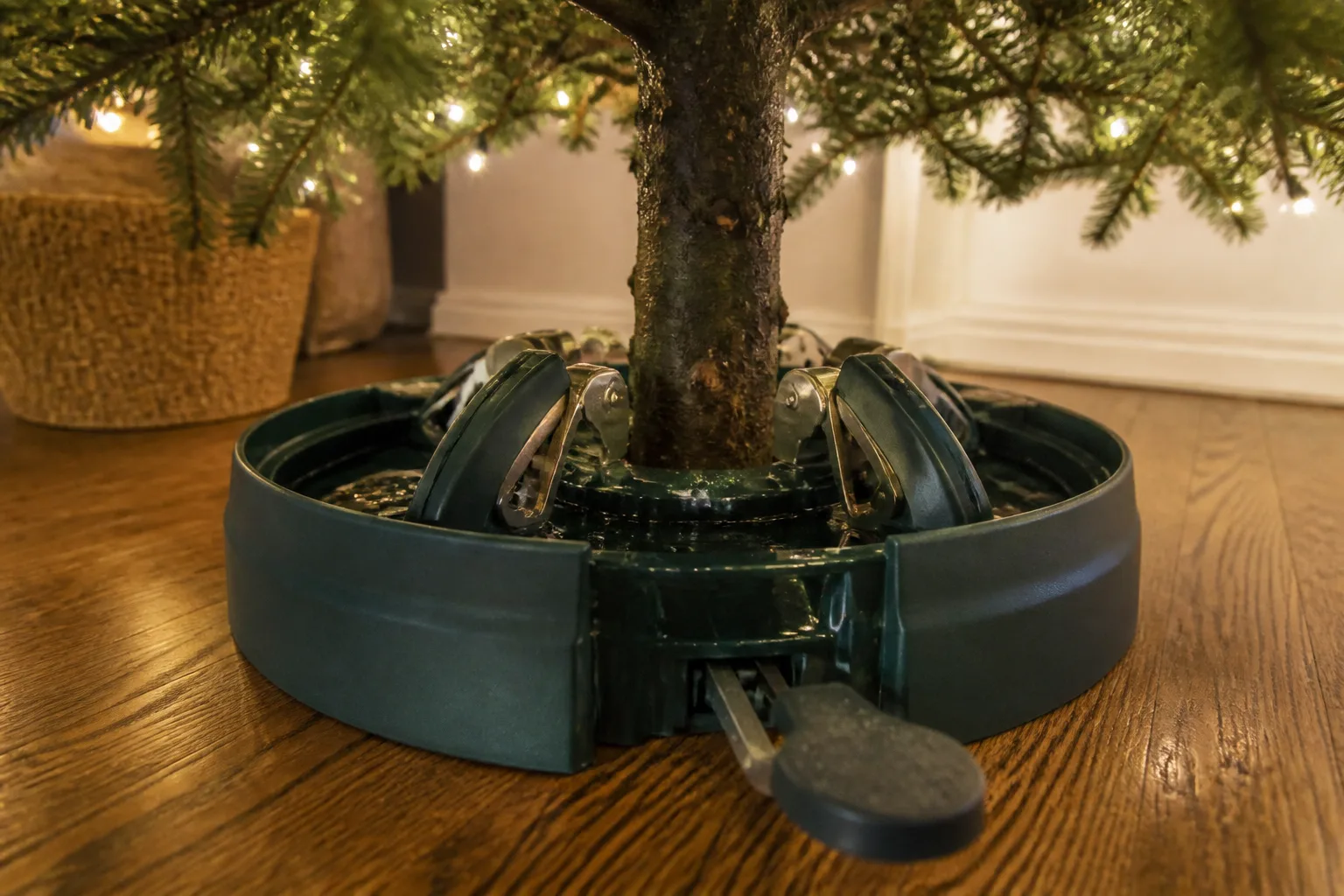
6. Check the reservoir twice a day at first
Check the water in the morning and evening for the first week, then continue at least daily while the tree is up. The first several days are when a fresh tree can take up the most water, and a busy household can miss a surprisingly fast drop. Top it up before it reaches the level of the trunk base.
The diameter benchmark from extension guidance is useful for choosing capacity, not for forcing a precise schedule. A tree with a three-inch trunk might use up to about three quarts in a day under thirsty conditions, but room temperature, humidity, species, tree age, and airflow all change the result. Measure what your tree actually uses by marking the stand or checking it at consistent times.
If you are away overnight, ask someone to check the tree rather than assuming a full stand will last. Gardening Know How’s practical review of automatic tree-watering systems illustrates the convenience of keeping a hidden reservoir topped up, but a system still needs a working tube, sensor, and reservoir. A system that quietly fails is no safer than a stand you forgot to fill.
7. Put the tree away from drying conditions
Choose the coolest practical location that still works for your room. Keep the tree away from fireplaces, wood stoves, radiators, heat vents, space heaters, sunny windows, and strong drafts from frequently opened doors. Homes & Gardens’ household care guide makes the same practical point about heat sources and low-heat lights. A nearby humidifier may make the room more comfortable, but it is not a substitute for water in the stand and should not be aimed at the foliage or electrical connections.
Distance matters more than chasing a perfect thermostat number. Move the tree a few feet from a heat source, close a vent if the room allows, and avoid positioning the top branches directly in rising warm air. If you can feel a steady stream of hot air on the needles, the tree is paying for that placement with faster moisture loss.
Do not spray the tree as a routine preservation trick. Wet foliage around lights, outlets, floors, or ornaments creates more problems than it solves. Hydrate through the trunk, reduce heat exposure, and keep the room’s normal safe comfort range rather than trying to create greenhouse humidity.
8. Use low-heat lights and turn them off
LED lights are a sensible choice because they produce less heat than older incandescent strings. Use lights rated for the intended application, inspect cords before installation, and avoid overloading outlets or running damaged wires through the branches. Turn the lights off before bed, before leaving home, and any time you are watering or moving the tree.
Keep candles and open flames away from a real tree. Even a well-watered tree is not fireproof, and a dry tree can ignite rapidly. A timer is useful because it removes the memory task of switching the lights off, but it does not replace checking the tree’s water level or inspecting the wiring.
What to do if the tree stops drinking
First confirm that the water level has not fallen below the trunk. A stand can contain water while the base is sitting above it, especially if the tree was bumped or the reservoir has an uneven interior. Top it up and watch whether the level changes over the next several hours.
If the tree has a fresh cut, the base is submerged, and the level does not move after a reasonable observation period, the trunk may have sealed with resin or the tree may already be too dry. Do not add sugar, hot water, bleach, or a commercial preservative as a rescue attempt. The useful intervention is a clean recut, but that means taking the decorated tree down and safely handling a saw; it is often not worth the risk once the tree is fully decorated.
Decide whether it can recover or should come down
Remove the tree when the needles are brittle across multiple branches, the foliage is turning brown, branches droop and do not rebound, or needles fall heavily with a light touch. A few dry lower needles are not the same as whole-branch shedding, but widespread brittleness means the tree has crossed from “needs water” into “fire and mess risk.”
If the tree ran dry only briefly and the needles are still soft and green, refill the stand, move it away from heat, and monitor it closely. Recovery is not guaranteed; once water-conducting tissue is badly blocked or the tree has lost too much moisture, rewatering may not restore it. Treat any improvement as a reason to keep monitoring, not as permission to leave a dry tree up longer.
Needle drop: normal shedding or a dry tree?
Evergreens do not hold every needle forever. Interior needles that were already old can shed after the tree is brought indoors, especially when the tree is shaken, moved, or decorated. This is usually limited and does not make the tree unsafe by itself.
Rapid, widespread needle drop is different. Test a few branches in different parts of the tree: if needles are brittle, snap instead of flexing, or come away in handfuls, the tree is drying out. Look at the stand at the same time, because needle drop plus an empty reservoir points to a care failure rather than simple species behavior.
Do not judge freshness only by the floor. A tree can hold green needles while its branches are becoming dangerously dry, and a tree can release a modest number of old interior needles while remaining hydrated. Use the touch of the needles, the flexibility of small twigs, the water history, and the location near heat together.
Fire-safe placement and a clean takedown
Place the tree at least several feet from heat sources and keep exits, stairs, and walkways clear. Secure it if it could fall, keep breakable or tempting ornaments higher when children or pets are present, and never leave lights on while everyone is asleep or away. If the tree becomes dry before the holiday is over, take it down; sentimental timing is not a good reason to keep a brittle fuel source in the living room.
When the display period ends, unplug the lights, remove decorations, and drain the stand before moving the tree. Lay down a sheet or tree bag if you can, carry it out with a second person when necessary, and check your community’s collection rules. Many municipalities chip trees for mulch, and clean branches can sometimes be used as garden mulch or wildlife shelter after all wire, hooks, tinsel, and ornaments are removed.
Conclusion
A real Christmas tree generally lasts three to four weeks indoors, with a longer window possible when you start with a fresh tree and protect its water supply. The most effective routine is simple: buy close enough to your display date, make a straight fresh cut, use a stable stand with a generous reservoir, keep plain water above the trunk, check it twice daily at first, reduce heat and direct sun, and use low-heat lights that are switched off when unattended.
Species can influence needle retention, but no label beats freshness and consistent hydration. If the stand runs dry, the needles become brittle, or the tree sits beside a heater, its useful season may end early. Start with the right tree and the right setup, and you can enjoy the smell and texture of a real evergreen without turning the final week of the holidays into a daily battle with dry needles.