How Long Does It Take to Grow a Christmas Tree? A Gardener Explains
Learn how long a Christmas tree takes to grow, from seedling to harvest, with species timelines, site checks, pruning rules, and realistic home-growing advice.
The Short Answer: Plan on 7 to 10 Years for a Typical Tree
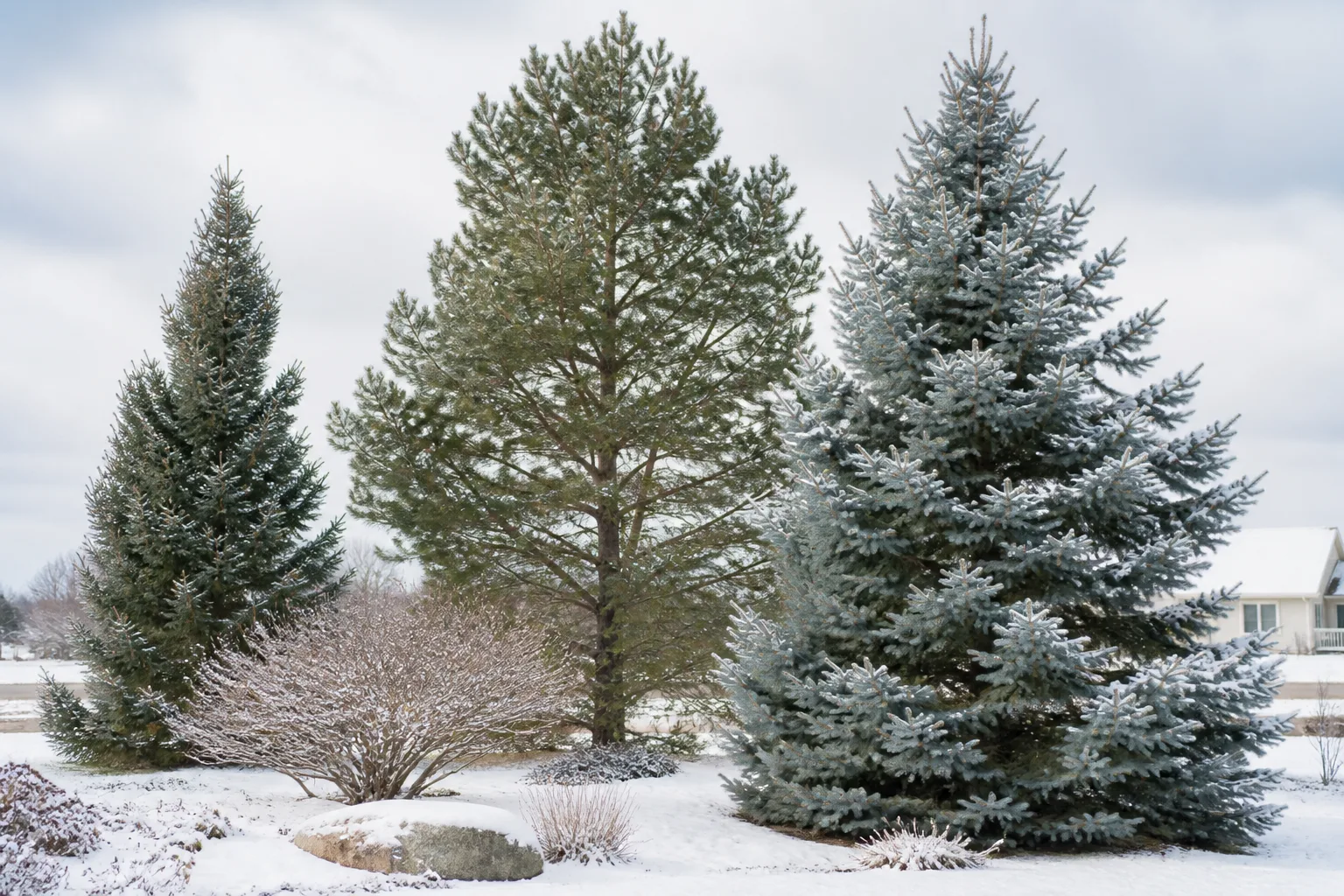
Most Christmas trees take about 7 to 10 years to reach 6 or 7 feet, the height many families want for a living room. That is an average, not a promise: a fast species on a good site may be ready in four to six years, while a slow fir or a poorly matched planting site can take 10 to 15 years or fail before harvest. The National Christmas Tree Association’s consumer FAQ uses the 7-to-10-year range for an average full, 6-to-7-foot tree.
The clock also starts in different places. A one-year nursery seedling planted outdoors has a longer road ahead than a three- or four-year transplant, and a tree grown from seed spends additional time germinating and building a sturdy root system before it looks like a miniature Christmas tree. Before you count calendar years, decide what you mean by “grown”: a small landscape evergreen, a 5-foot decorating tree, or a full, well-shaped tree ready to cut.
What “Christmas-Tree Size” Actually Means
Height alone is a poor harvest test. A tree can be tall enough for a room and still have a crooked leader, thin lower branches, open gaps, poor color, or a shape that will not hold ornaments. Commercial growers are selecting for height, symmetry, branch spacing, density, needle retention, and health at the same time.
The target also changes the estimate. A family that wants a loose, natural-looking 4-foot tree may harvest earlier than a grower producing a dense 7-foot tree for a choose-and-cut lot. The National Christmas Tree Association notes that shearing practices influence how dense a tree becomes, so “ready” is partly a design decision rather than a measurement on a tape.
For a backyard project, use this definition: the tree is ready when it has reached your planned height, carries a healthy crown from the base upward, has one strong central leader, and has enough branch structure for the decorations you expect to use. If you are planting a tree for permanent landscape value, it may never be “ready to cut” because the goal is to keep it growing.
Species That Reach Harvest Size Fastest
If the shortest possible wait matters most, start with a species known to grow quickly in your region rather than choosing by needle color alone. Virginia pine can have a four- to six-year rotation in suitable parts of North Carolina, and Leyland cypress is commonly harvested at about three to six years there. Those ranges come from NC State Extension’s Christmas tree species guide, which also makes clear that fast growth brings management trade-offs.
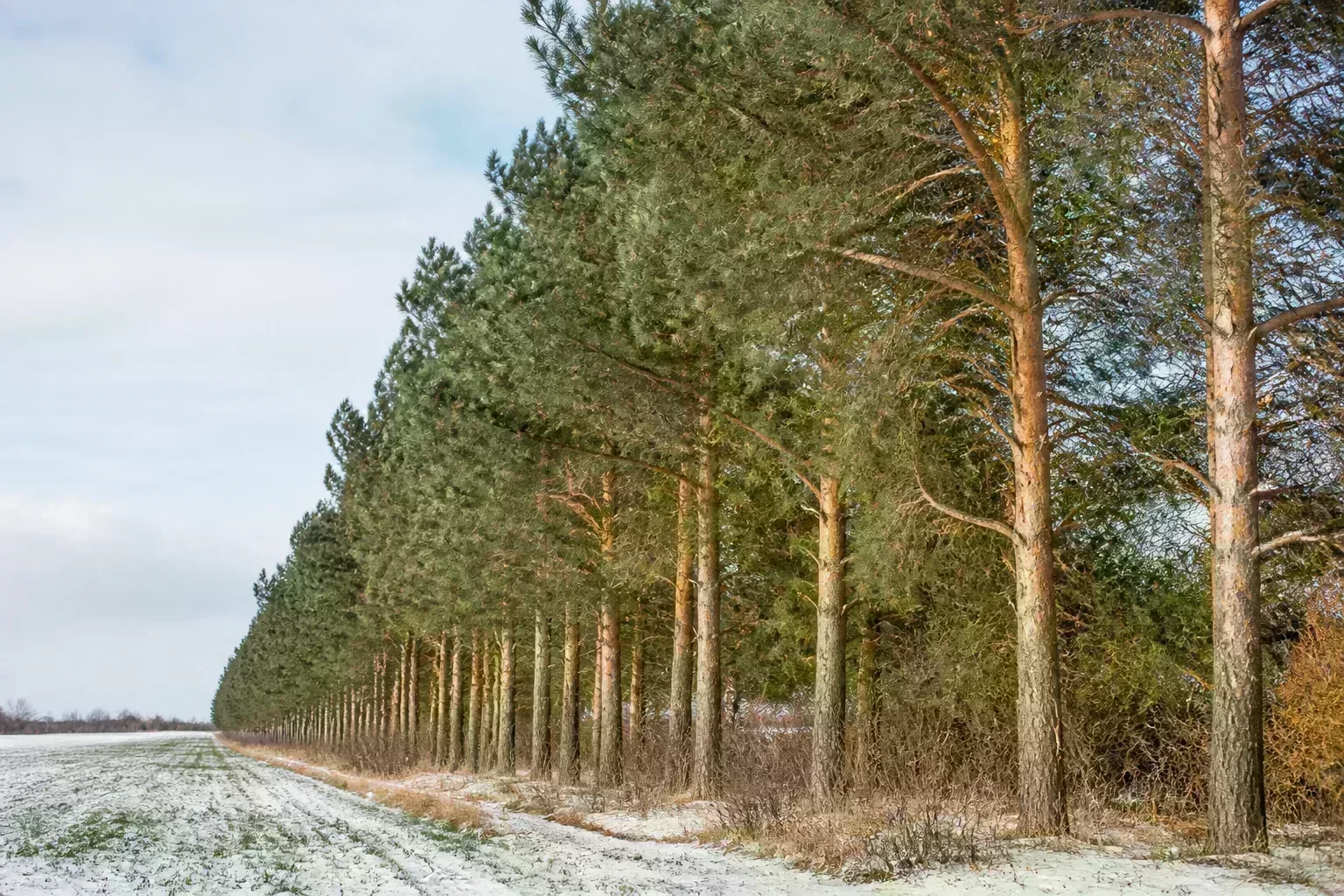
Virginia pine can put on multiple flushes of growth, which helps explain its quick schedule but also means it may need shearing two or three times a year to hold a marketable form. Leyland cypress grows well on many southern sites and reaches size quickly, but it dries rapidly after cutting, making it better suited to local choose-and-cut sales than long-distance shipping.
Fast does not mean best. A rapid grower planted in a wet hollow, compacted clay, or a climate it cannot tolerate will not beat a slower species growing in the right place. Treat the range as a starting point for choosing a species, not as a guarantee that the tree in your yard will add the same number of inches every year.
Species That Take Longer but May Be Worth It
Eastern white pine is a useful middle-ground option on a good site. NC State Extension estimates six to eight years to produce a 6-foot tree, and the species offers soft blue-green needles and a form that works well for some living-tree plantings. Its long, flexible branches may be less suitable for heavy ornaments than a fir or spruce, so the desired decorating style matters.
Fraser fir is a classic holiday tree because of its fragrance, strong branches, and needle retention, but it is not a quick project. On well-drained sites, a five-year-old transplant may need another five to eight years to reach 7 to 8 feet, according to NC State Extension. That means roughly 10 to 13 years from the age of the transplant in that specific production example, before counting any earlier nursery time.
White fir is slower still in the NC State guide, taking about 10 to 15 years to reach merchantable size. Blue spruce and Norway spruce may be attractive choices for living landscape trees, but their actual holiday harvest schedule depends heavily on climate, cultivar, starting size, and whether you want a cut tree or a tree that stays rooted.
Match the Species to Your Climate and Site
USDA hardiness zone is a useful first filter, not a complete planting plan. A tree can survive your average winter and still struggle with summer heat, poor air movement, drought, salt, late frost, or a soil profile that stays saturated. Choose a species that fits your winter cold, summer temperature, rainfall pattern, soil texture, available sunlight, and long-term space.
Drainage Is the Non-Negotiable
Christmas-tree roots need oxygen as well as water. Penn State Extension warns that excess moisture at the roots can cause serious root-rot problems, while sandy or shale-heavy soils may hold too little water during dry years. NC State’s Fraser fir site-selection guidance likewise emphasizes landscape position, soil depth, clay layers, and internal drainage because a tree can be watered correctly and still fail in a wet root zone.
Walk the site after a substantial rain. If the proposed planting spot sits in a hollow, at the foot of a slope, beside a downspout, or in a place where water remains visible long after the surrounding ground drains, do not assume a bag of compost will solve it. Move the planting location, raise the bed where practical, or choose a different project; improving the surface around a persistently wet root zone rarely changes the deeper soil problem.
Sun, Hardiness, and Summer Heat
Most field-grown Christmas trees need strong light to build a dense, balanced crown. A tree shaded by a house, hedge, or tall woodland edge may stretch toward light, lose lower branches, and need extra years to fill out. Good air movement also matters because crowded, damp foliage is more vulnerable to disease.
Heat can be as limiting as cold. Fraser fir is adapted to cool mountain conditions and is sensitive to drought, poor soil aeration, and low-elevation heat in places where it is not adapted. A warm-climate gardener may get a better result from a cypress, pine, or other locally proven species, even if the foliage looks different from the fir seen at a northern tree farm.
Start With a Transplant If You Want a Shorter Wait
For a home grower who wants a harvestable tree within a decade, a healthy transplant is usually a more practical starting point than seed. Penn State Extension specifically recommends three- to four-year-old transplants over younger seedlings for new growers because survival, establishment, and early growth are better and the trees should reach marketable size sooner.
That does not mean buying the largest tree you can find. Oversized trees can suffer more transplant shock, cost more, and be harder to plant without bending or drying the roots. Choose a nursery-grown tree with a sound root system, a straight leader, no mechanical trunk damage, and a size you can plant promptly and water consistently.
Seed is worthwhile when the project is educational, you want many trees, or you enjoy waiting for the result. It is a poor choice when the real goal is one 6-foot tree for a near-term holiday. Seed-grown trees also vary genetically, so the eventual form, color, and growth rate may not match the parent tree that supplied the cones.
Plant and Protect the Root System in Year One
Plant as soon as the local season allows, while the soil is workable and the tree has time to make new roots before its strongest top growth. Penn State Extension advises spring planting for its production context; in other climates, a well-timed early-fall planting may also work, but the deciding factor is local weather, soil temperature, and the time available before heat or deep freezing.
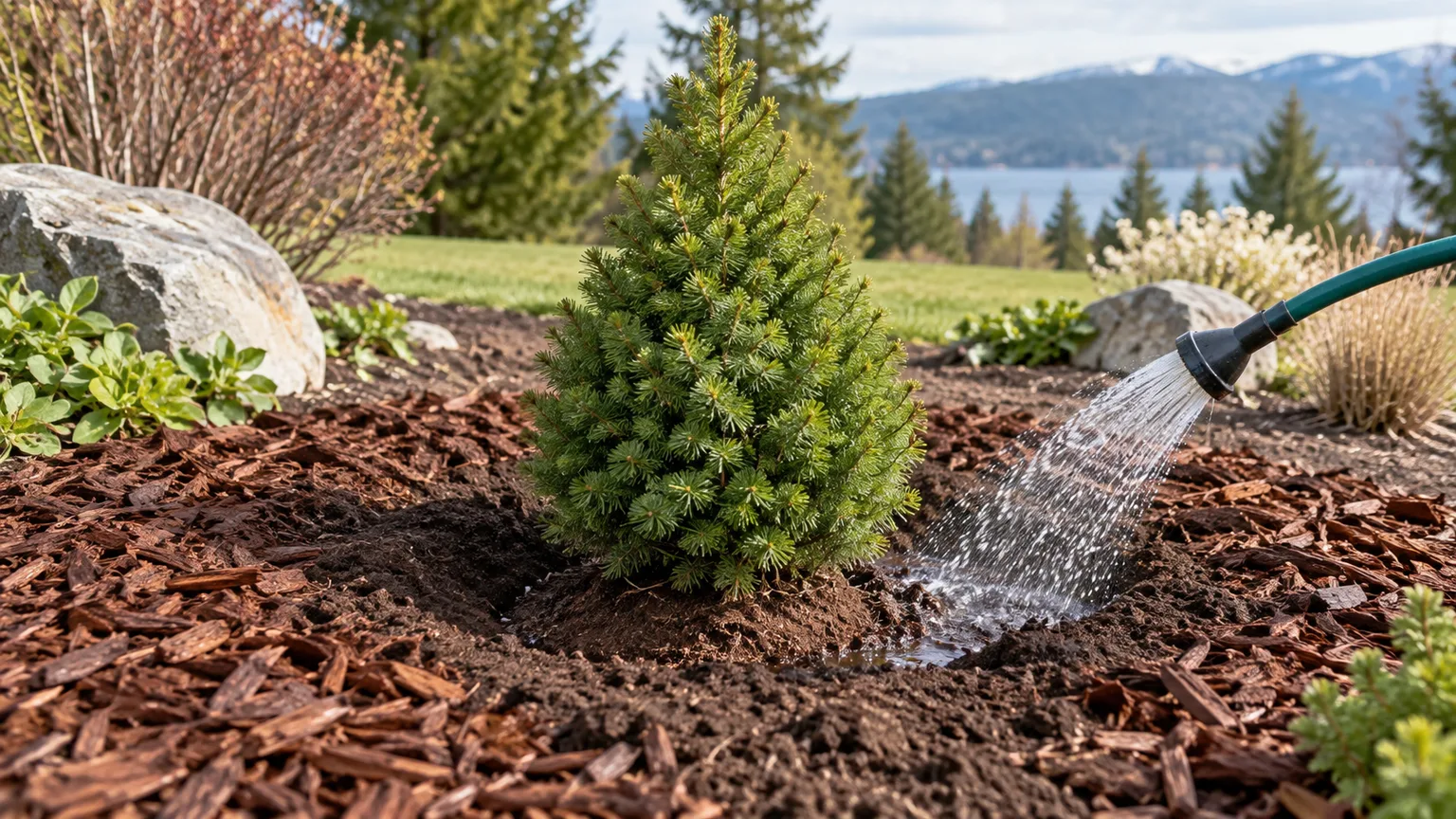
Set the tree at the same depth it grew in the nursery. Do not twist, fold, or cram roots into a narrow hole, and do not bury the trunk flare under mulch. Water the entire root zone after planting, then monitor moisture through the first growing season; shallow sprinkling encourages a shallow root system and does not protect a new tree during a hot, dry stretch.
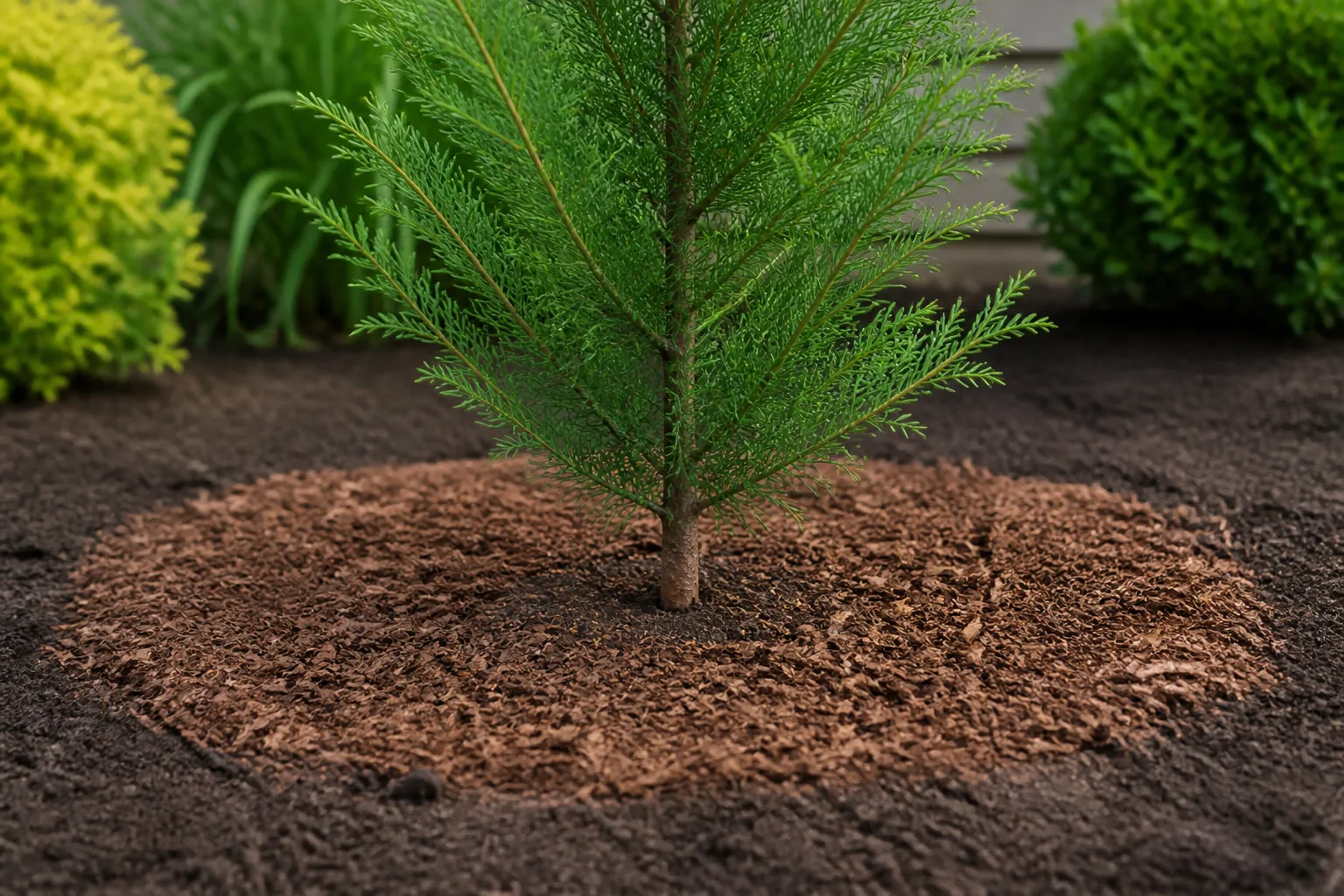
Keep competing grass and weeds away from the root zone, but do not pile mulch against the trunk. A broad, shallow mulch ring can reduce competition and moderate soil moisture while the tree establishes. If the site dries rapidly, a slow soak is more useful than a little water applied to the surface every day; if the site stays wet, more water is the wrong response.
Follow a Realistic Year-by-Year Timeline
Think in stages rather than expecting a uniform yearly height gain.
- Before planting: Confirm the species, mature size, hardiness, sun, drainage, water access, and your desired harvest height. Correct soil problems before a tree is in the ground, because fixing a bad site around established roots is harder.
- Year one in the field: Root establishment is the priority. The tree may appear to grow slowly while it rebuilds roots, especially after transplanting. Protect it from drought, grass competition, browsing, and planting damage.
- Years two and three: The crown begins to build structure. Watch the central leader, remove competing leaders only when you know what you are doing, and keep the root zone evenly supplied with moisture without keeping it saturated.
- Years four through six: Fast species or larger transplants may approach a useful holiday size. Form and density now matter as much as height, so light shaping, weed control, and pest scouting protect the time already invested.
- Years seven through ten: Many average trees reach the 6- to 7-foot range in this window. Slow species, difficult climates, small seedlings, and poor sites may need several more seasons.
This timeline is a planning framework, not a measurement formula. A real grower interviewed by RNZ Country Life described receiving one-year-old seedlings and keeping them on the property for about two to four years for ordinary trees, with six or seven years for larger deluxe trees. That example shows why “the tree is one year old” and “the tree will be ready in one year” are completely different statements.
Shear Lightly Until the Tree Has Enough Height
Shearing creates the dense, symmetrical silhouette many people associate with a Christmas tree, but aggressive early trimming can slow the schedule. Penn State Extension advises light trimming while trees are young and cautions that tight shearing too early can lengthen the time to harvest; its guidance places heavier shaping after the trees reach roughly 4 to 5 feet.
The goal is not to shave every branch to the same length. Protect one central leader, preserve balanced lower branches, and remove growth that is dead, badly damaged, or clearly competing with the intended main stem. Timing and technique vary by species, so ask a local extension office or experienced grower when the tree is actively extending and how much of the season’s new growth can be removed safely.
Keep Water, Weeds, and Fertility From Slowing Growth
Water deeply enough to wet the root zone, then allow the soil to drain before watering again. New transplants need closer observation than established trees, and sandy soil may require more frequent irrigation than a loam that holds moisture. Do not use a fixed calendar in place of checking the soil and weather.
Weeds compete directly for water and nutrients and can hide trunk damage from mowers or rodents. Keep a clean strip around each tree, mow between rows without striking the bark, and avoid herbicides unless the product is labeled for the site and species and you can follow its directions. Penn State Extension notes that production also depends on periodic soil testing and fertility management; more fertilizer is not a substitute for suitable drainage or sunlight.
For a backyard tree, a soil test before planting is more useful than a routine fertilizer schedule copied from a different region. Correct a confirmed deficiency, add organic matter only when it improves the actual soil problem, and avoid high-nitrogen feeding that produces soft, excessive shoots which are harder to shape and more vulnerable to weather.
What Can Add a Year or More to the Schedule
Some delays are visible early; others appear only after several seasons. A missed first-year watering, root damage during planting, a frost pocket, or repeated weed competition can reduce growth long enough to move harvest into another year. Tight clay, a shallow hardpan, or a high water table can cause chronic root stress that no fertilizer can fully correct.
Other delays come from the tree itself. Poor planting stock may have weak roots or an unsuitable seed source. Deer can browse or rub young trees, rodents can girdle trunks under snow, and insects or disease can damage the leader. A tree that loses its central leader may recover, but restoring a straight, balanced crown can take a season or more.
Do not try to recover lost time by shearing harder or feeding heavily. First diagnose the limiting factor: dry soil, standing water, competition, shade, pest damage, winter injury, or a species-site mismatch. The right correction can be slower than a quick product, but it is more likely to protect the next decade of growth.
How to Tell When the Tree Is Ready to Cut
Measure height, but inspect the whole tree. A harvest-ready Christmas tree should have a healthy color for its species, a straight or intentionally shaped leader, a reasonably full crown, sound branches, and no active disease or severe insect damage. The lower third is especially important because a bare trunk or a large gap cannot be repaired by making the tree taller.
Decide whether you want a dense, traditionally sheared tree or a more open natural form before the final season. If you prefer a spacious look for larger ornaments, you may harvest a tree that a commercial grower would classify differently. If the tree will be shipped or displayed for weeks, needle retention and branch strength matter in addition to appearance at the stump.
Use the tree’s condition, not a birthday, as the final signal. A five-year-old transplant can be ready in one location and undersized in another, while a ten-year-old tree may still be a poor choice if drought, disease, or a damaged leader has left it weak.
Living Potted Trees Follow a Different Clock
A potted or balled-and-burlapped tree is not simply a cut Christmas tree with a future attached. Its root system must survive handling, indoor warmth, holiday decoration, and replanting, and the tree still needs a permanent outdoor location with room for mature height and spread. The National Christmas Tree Association describes rooted trees as a reasonable option when a homeowner already has a landscape use for one, not as a guaranteed way to plant a full-size holiday tree every year.
If you choose a living tree, select a species that fits the outdoor climate and keep the indoor display brief enough to limit stress. Plan the planting site before buying, protect the root ball from drying, and expect the tree’s long-term landscape size to matter more than its current holiday proportions. A dwarf cultivar can be a better container or small-yard choice than a standard fir that will eventually need far more space.
For a small seasonal display, an existing ornamental evergreen may be the honest answer. The BBC Gardeners’ World Magazine Christmas garden guidance treats seasonal containers and outdoor holiday planting as their own garden projects; that is a useful reminder that a decorative Christmas plant does not have to be managed like a commercial cut-tree crop.
A Practical Home-Grower Plan
If you want to grow one tree for your household, use this order:
- Set the deadline and height. If you need a 6-foot tree in five years, do not start with seed and hope for a fast result.
- Ask what succeeds locally. A county extension office or reputable nursery can tell you which conifers tolerate your summer heat, winter lows, rainfall, and soil.
- Buy the right stock. A healthy three- to four-year transplant is a more realistic shortcut than a tiny seedling, but only if its roots are sound and you can plant it promptly.
- Test the site after rain. Reject a location that stays saturated, collects runoff, or sits in a frost pocket. Full sun and workable access make long-term maintenance easier.
- Protect the first season. Water by soil conditions, control grass, mulch without covering the trunk flare, and guard against browsing.
- Shape with restraint. Keep one leader, shear according to the species, and do not chase a dense silhouette before the tree has enough height to spare.
- Reassess each autumn. Measure height, inspect the leader and lower branches, and decide whether the tree is on schedule or whether the site needs correction.
That plan turns the project from a vague holiday dream into a manageable long-term garden experiment. It also leaves room for the possibility that your tree will become a permanent landscape evergreen rather than the one you cut for a single December.
Conclusion
Plan on 7 to 10 years for a typical 6- to 7-foot Christmas tree, but use the range as a starting point, not a guarantee. Fast species such as Virginia pine and Leyland cypress may reach harvest size in about four to six years on suitable sites, eastern white pine often lands in the middle, and Fraser fir, white fir, and other slow or site-sensitive choices can take roughly 10 years or more.
The biggest time-saving decision is usually made before planting: choose a species that fits your climate and soil, then start with healthy planting stock and protect the root system in year one. With good drainage, full light, restrained shearing, weed control, and realistic expectations, growing a Christmas tree is a long project—but the timeline becomes predictable enough to plan.



