How Often to Mow Your Lawn in Fall
Learn how often to mow your lawn in fall, when to stop, and the right final height for cool- and warm-season grass without scalping.
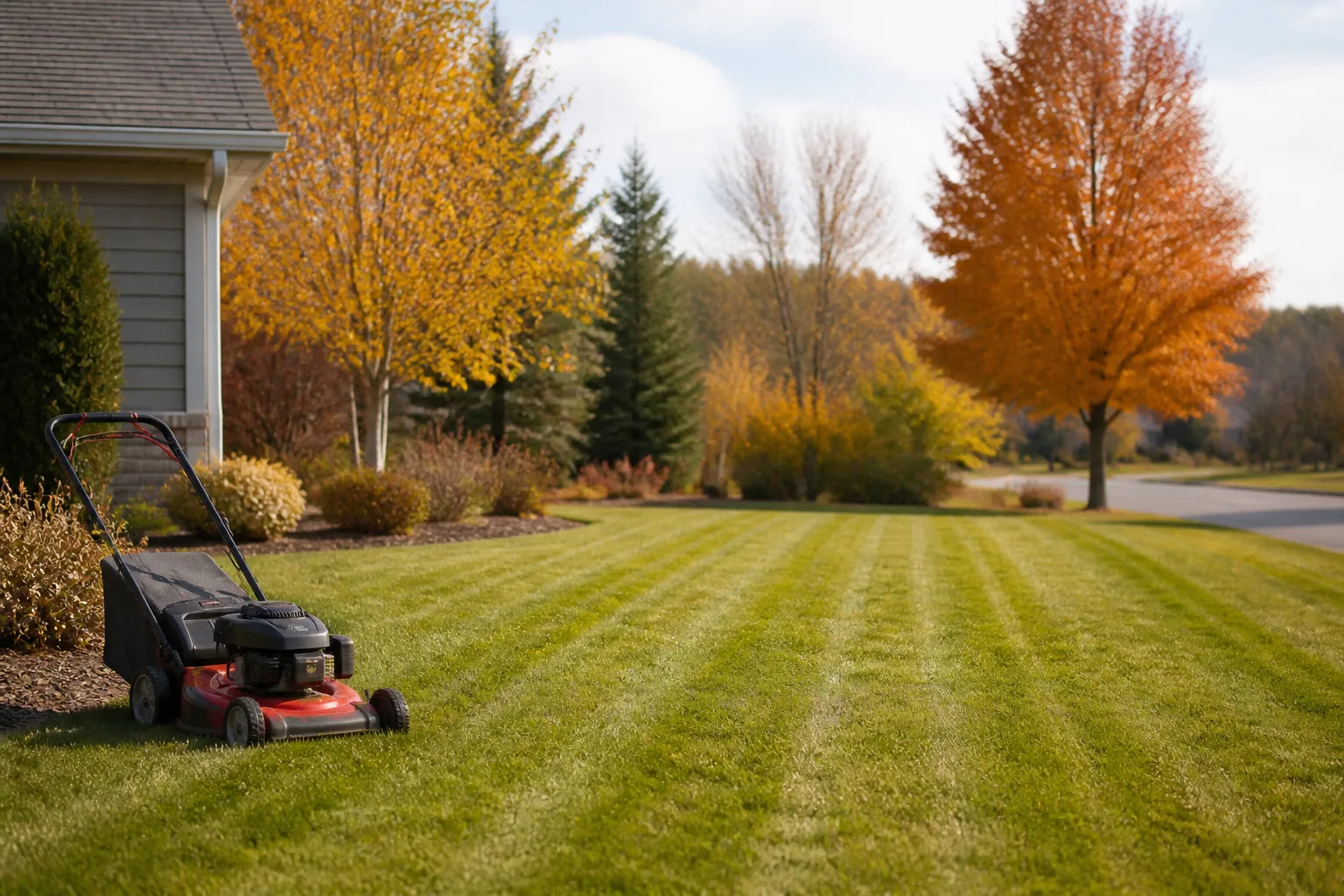
Fall mowing is not a date on the calendar. It is a response to growth.
If your grass is still adding height, keep mowing. If it has held the same height for a week or two, growth has nearly stopped and the season is ending. The right schedule can be weekly during a cool, rainy September, then every 10 to 14 days later in autumn. A warm spell may even make one more cut necessary after you thought you were finished.
The most important rule is simple: never remove more than one-third of the blade in one pass. That rule protects the plant when recovery is easy in spring and summer, and it matters even more late in the year when cool weather slows regrowth. Your final cut should leave a tidy, resilient lawn—not a shaved lawn that has lost its crown protection.
The quick answer: mow by growth, not the calendar
For most home lawns, start fall at your normal mowing height and frequency. Cool-season grasses such as Kentucky bluegrass, tall fescue, fine fescue, and perennial ryegrass often grow vigorously when summer heat breaks, so early fall may require weekly mowing or more. Warm-season grasses such as bermudagrass, zoysiagrass, St. Augustinegrass, and centipedegrass usually slow as soil cools and may need cutting every 10 to 14 days before dormancy.
Stop only when the lawn is no longer gaining meaningful height. A useful home test is to mow a small, representative section, measure the blades at the same spot seven days later, and repeat once more if the weather is mild. If the grass has barely changed and the next cut would remove little, the mower can go away.
Do not use the first frost, a particular holiday, or the final fallen leaf as an automatic stop date. Those events can happen before or after active growth ends, depending on your region, grass mix, shade, rainfall, and the length of the autumn. The University of Maine Cooperative Extension puts the decision on growth rate rather than the calendar and ties mowing height to grass type and conditions.
Why fall mowing still matters
Mowing is not only cosmetic. A properly timed cut keeps the turf canopy dense, reduces the chance that grass will fold into a damp mat, and prevents a late flush of weeds from setting seed. It also gives you a chance to remove or finely mulch leaves before they block light from the living blades.
The overgrown-lawn trap
The common fall mistake is to stop after the last summer mow and assume the lawn is done. In a cool-season lawn, that can leave several weeks of growth lying over the crown. Long blades bend under rain, leaf litter, or snow; the flattened layer dries slowly and has less air movement than upright turf. That does not guarantee disease, but it creates a more favorable setting for wet-weather problems such as snow mold and for rodents that use dense cover beneath snow.
Long grass also makes the next cut harsher. A mower set for a normal height may remove half the blade in one pass, leaving large clumps that shade the turf. The Royal Horticultural Society’s autumn lawn guidance treats mowing, leaf removal, drainage, and disease prevention as connected autumn tasks rather than separate chores.
Why scalping is the wrong correction
Scalping means dropping the deck low enough to remove a large portion of the blade at once. It may make an overgrown lawn look “finished,” but it sacrifices leaf area and exposes the crown and soil to temperature swings, drying wind, and weed competition. University of Minnesota Extension and the Northern Virginia Soil and Water Conservation District both emphasize removing only the top third of the blade.
If you missed two or three cuts, lower the height gradually. Mow high enough to remove no more than one-third, wait for the lawn to recover and dry, then repeat. If persistent cold arrives before you reach your preferred final height, protect the turf from a damaging one-time cut; a slightly taller lawn is easier to correct in spring than a scalped lawn with thin, exposed crowns.
Identify your grass before changing the schedule
Your grass type changes both the growth curve and the safest final height. If you do not know the mix, check a seed or sod receipt, ask a local extension office, or look at growth habit: cool-season lawns commonly stay green through cool autumn weather, while warm-season lawns slow, lose color, and enter dormancy as temperatures fall.
Cool-season lawns
Kentucky bluegrass, tall fescue, fine fescue, and perennial ryegrass generally welcome cool weather. A lawn that looked slow during a hot, dry July can start growing again in September, especially after rain. Do not be surprised if the fall schedule resembles spring more than summer.
Keep mowing while the grass is actively growing. For many home lawns, a final height in the roughly 2.5- to 3-inch range is a practical target, but the correct number depends on species, cultivar, shade, mowing history, and local extension guidance. Tall fescue and mixed lawns are often better kept toward the taller end because bunch-type grasses have growing points above ground. The Maine Extension table, for example, gives different height ranges for Kentucky bluegrass, fescue, and perennial ryegrass rather than treating “grass” as one plant.
Shade is another reason not to chase a short final cut. Grass growing under trees has less energy available and benefits from enough leaf area to capture light. If your lawn is thin in shade, improve light and drainage where possible instead of trying to solve the problem by mowing lower.
Warm-season lawns
Bermudagrass, zoysiagrass, St. Augustinegrass, and centipedegrass usually grow fastest in warm weather. Their fall schedule often stretches out as soil cools, and some will turn tan or brown before a nearby cool-season lawn stops growing.
Do not copy a cool-season “short winter cut” onto a warm-season lawn without checking local recommendations. In many home settings, warm-season turf should finish at its normal height or slightly higher rather than being scalped just before dormancy. A warm-season lawn in a mild, frost-free region may continue growing intermittently through winter, while one in a colder transition zone may stop weeks earlier.
Regional timing matters. A LawnStarter fall guide for Dallas notes that warm-season grasses there slow as soil temperatures move through the mid-60s to low 70s °F and may reach full dormancy below about 50°F for sustained periods. Those figures are useful context for North Texas, not a universal trigger for every lawn. Use your grass’s appearance and your local extension service for the final call.
How often to mow in early, middle, and late fall
Think in phases rather than “once a week all fall.” In early fall, continue the summer height and check the lawn every five to seven days. A cool-season lawn may need a weekly cut after rain; a warm-season lawn may already be slowing.
In middle fall, measure before you mow. Many lawns can move to seven- to 14-day intervals, but a shaded or recently fertilized cool-season lawn may still need a weekly pass. This is the time to begin a gradual height transition if your final target is lower than your summer setting.
In late fall, the interval is determined by whether the lawn has grown enough to justify a cut. A long gap does not mean you should remove a large amount. If the grass is only slightly taller than target, mow once on a dry day. If it is unchanged from the previous measurement, stop and focus on leaf removal, drainage, and equipment storage.
Weather can move you between phases quickly. Warm nights and rain extend growth; drought, frost, shade, and cold soil slow it. The Lawn Chick seasonal mowing guide makes the same practical point: its frequency table is general guidance, while local climate, cultivar, fertility, rainfall, and desired height determine the actual schedule.
Use the one-third rule to set frequency
The one-third rule is more useful than a weekly reminder. Mow whenever the grass is tall enough that your chosen deck setting will remove no more than one-third of the blade. If you want to keep a lawn at 3 inches, mow near 4 to 4.5 inches rather than waiting until it is 6 inches tall.
Here is the calculation in real life:
- Measure the blade height from the soil surface, not from the thatch or a bent leaf tip.
- Choose your target height, such as 3 inches.
- Schedule the cut when the lawn is about one-third taller than that target—roughly 4 inches for a conservative approach.
- If the lawn has grown far beyond that point, raise the deck and take a partial cut first.
Removing more than one-third at once can stress the plant, deplete stored carbohydrates, and encourage thinning. That is not just a summer concern. Late fall recovery is slower, so the “catch-up mow” is exactly when you should be most conservative.
Choose a safe fall mowing height
There is no single winter height that fits every grass species and climate. Start with the height your lawn has tolerated well, then make only a gradual adjustment. The goal is to leave enough leaf area for crown protection and enough upright structure to reduce matting.
As a general starting point, many cool-season home lawns finish around 2.5 to 3 inches. Kentucky bluegrass can tolerate a lower range in some managed settings, while tall fescue, mixed turf, and shady grass often need the upper end. Avoid lowering a neglected lawn to a short number in one pass.
Warm-season lawns often finish at their regular height or slightly above the summer setting, depending on species and local winter conditions. In a mild climate where the grass remains green and growing, continue normal mowing by the one-third rule. In a frost-prone area, stop once dormant rather than making a cosmetic cut through brown turf.
If your lawn is newly seeded, follow the seed supplier or extension instructions instead of applying a standard final-cut rule. Young seedlings need enough leaf tissue to establish roots, and a mower that drops too low can pull or bury them. If your lawn is a mix, use the height that safely accommodates the tallest or most vulnerable component.
Signs your grass still needs a cut
Mow if several of these conditions are true:
- The blades are visibly taller than your target height.
- A ruler shows measurable growth since the last cut.
- Recent rain and mild temperatures have produced a fresh flush of green.
- The canopy is folding over or shading itself.
- Leaves are beginning to settle into the grass, but the soil is firm and the blades are dry.
- A one-third cut is possible without lowering the deck aggressively.
Do not mow simply because your neighbors are mowing. A sunny lawn in an exposed yard may dry and grow differently from a shaded lawn under trees. Walk the area, inspect the height, and check soft spots before starting the engine.
Signs it is time to stop mowing
The season is probably over when the lawn stays essentially the same height for seven to 14 days, daytime growth is minimal, and the next pass would remove only a small amount. A soil thermometer can add context, but it should support observation rather than replace it. The RHS notes that grass can continue growing in mild weather above about 7°C, which is why a calendar-only rule fails in some autumns.
Stop for the day—not necessarily for the season—if the grass is coated with frost, the soil is saturated, or the mower would leave ruts. A one-day warm spell does not automatically restart dormant turf. Look for sustained growth, not one green-looking afternoon.
If leaves continue falling after growth stops, use a rake or blower, or mulch only a light, dry layer with a mower if the mower can do so without tearing the turf. Leaf cleanup is still lawn care, even when mowing is finished.
The final-mow checklist
Plan the last cut as a small sequence:
- Inspect the lawn. Remove branches, stones, toys, and other objects. Check for wet areas and compacted paths.
- Confirm the height. Measure several spots, including shade and slope. Do not set the deck from one unusually tall tuft.
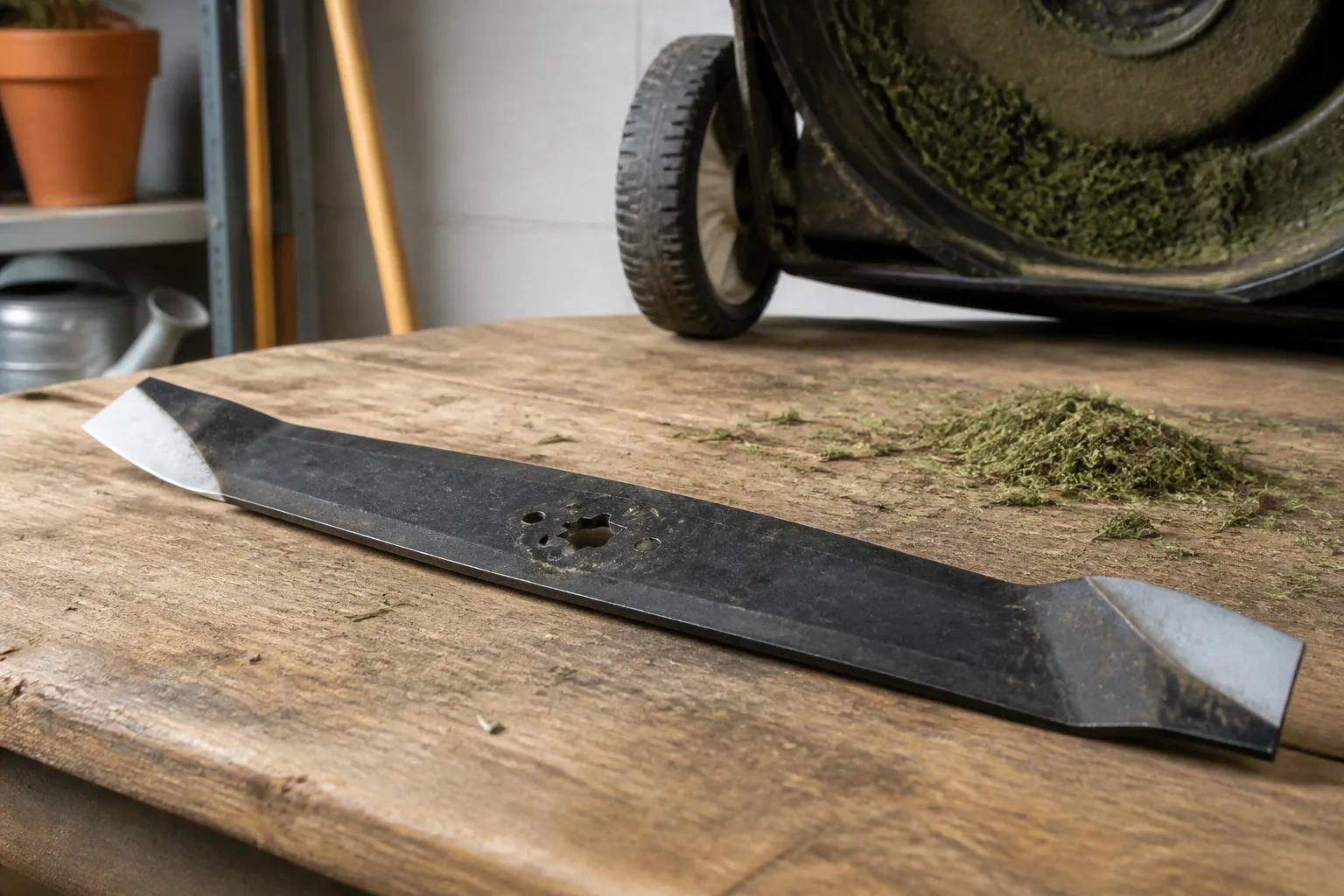
- Sharpen and secure the blade. A dull blade tears the leaf and leaves a ragged, brown cast. The Fairfax conservation district specifically recommends sharp blades and a one-third cut.
- Mow dry turf on firm soil. Aim for a dry afternoon after dew has lifted, but before a freeze if possible.
- Change direction. Alternating the mowing pattern helps prevent persistent wheel wear and leaning stripes.
- Inspect the clippings. Fine, evenly distributed clippings can stay. Thick rows or weed-filled clippings should be removed.
- Finish the leaf cleanup. Do not leave a thick layer of whole leaves on top of the turf after the last pass.
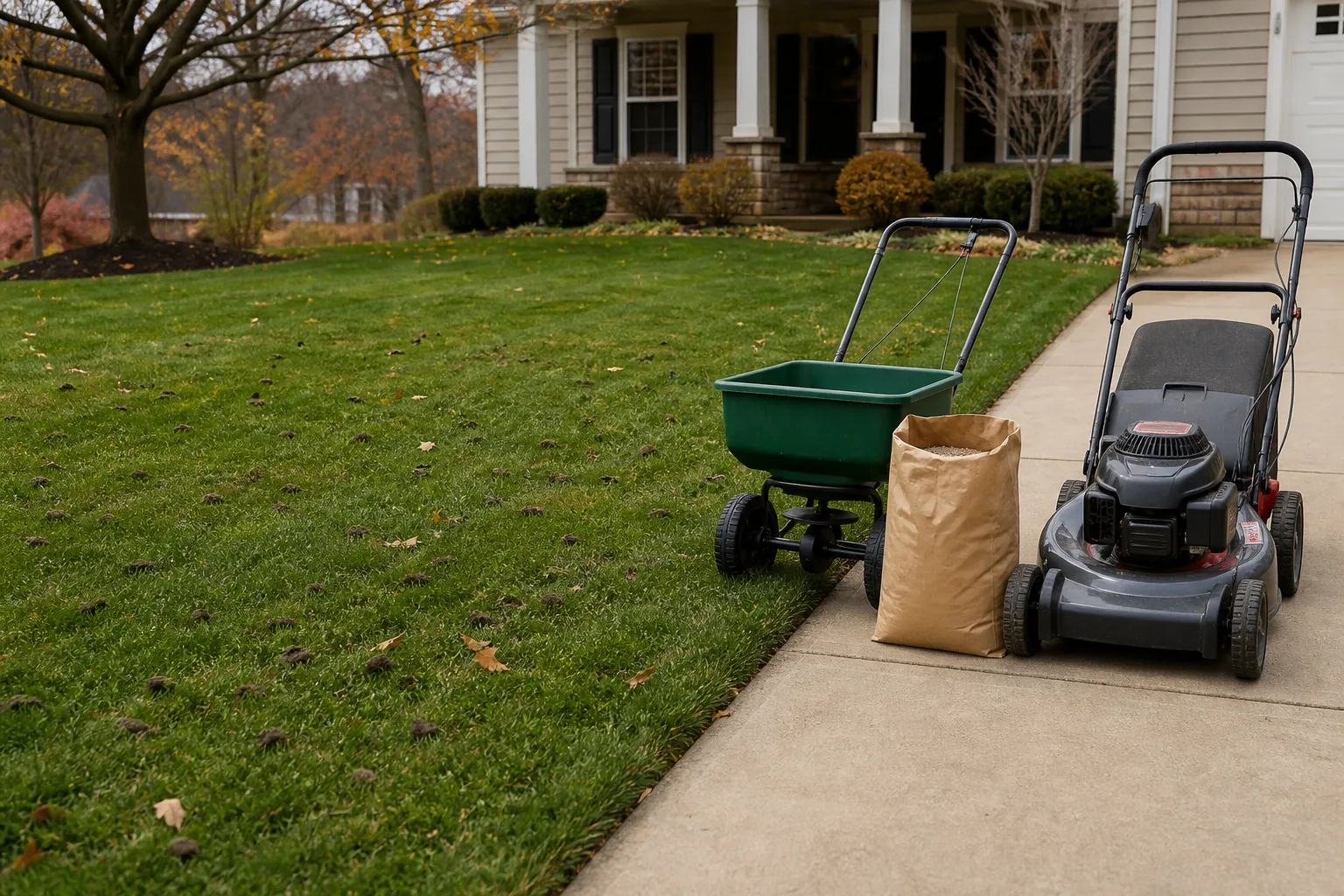
For a more detailed end-of-season sequence, see the LeafyPixels guide to cutting your lawn before winter. The useful distinction is that the final cut is one step in preparing the lawn, not permission to keep lowering the deck until the turf looks golf-course short.
Wet leaves, frost, and soft soil: when to wait
Fall is full of tempting but bad mowing windows. Wet blades bend under the deck, clippings clump, and the mower can leave an uneven cut. More importantly, driving heavy equipment across saturated soil can compact the root zone and create ruts that hold water.
There is a difference between slightly damp blades and a lawn that is too wet to carry traffic. If the grass is tall and a long rain delay would let it become overgrown, choose the driest safe window, raise the deck, clean clumps from the lawn, and avoid the softest areas. Never turn a small timing problem into soil compaction across the whole yard.
Frost deserves its own caution. Do not mow while blades are frozen or crunchy; frozen tissue tears under the wheels and blade. Wait for the frost to thaw and the soil surface to firm. A first light frost does not always end active growth, but it ends mowing for that morning.
What to do with leaves and grass clippings
Leaves are useful until they become a blanket. A thin layer of dry leaves can often be shredded with a mulching mower so small pieces filter between the blades. A thick, wet layer should be raked or blown off first. If leaves are already matting in a shaded area, bag them rather than forcing the mower to chew through a damp pad.
The Fine Gardening guide to fall leaves recommends shredding and spreading leaves where they can decompose, composting them, or making leaf mold. On a lawn, the practical test is coverage: if you can still see the grass canopy through the shredded pieces, the layer is more likely to break down without smothering turf.
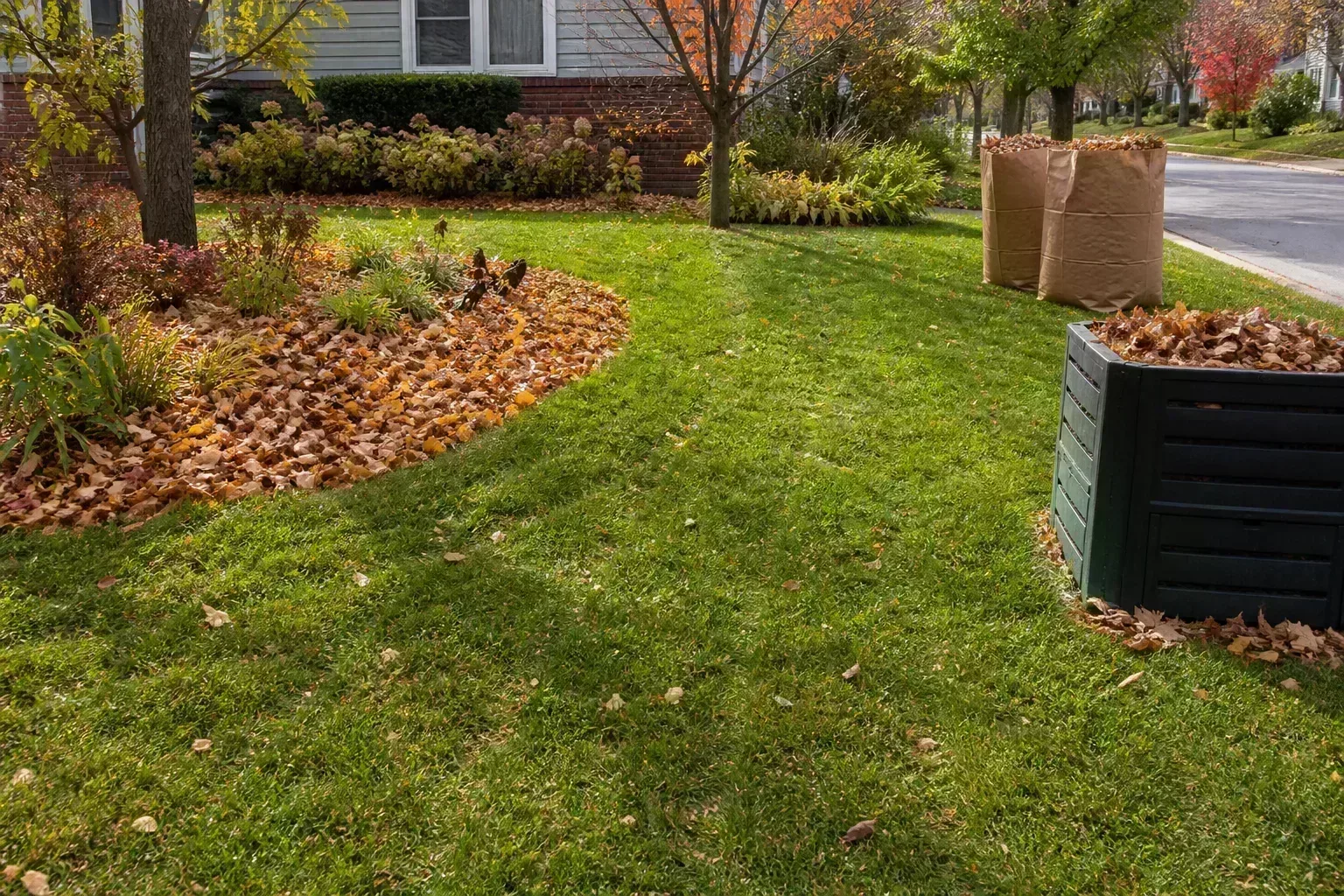
Grass clippings are different from whole leaves. Fine clippings usually break down quickly and return nutrients to the soil. The Maine Extension guide says clippings generally do not cause thatch buildup and that mulching can reduce fertilizer needs, but it also advises removing clippings from a weedy lawn or from a very tall cut where they would shade the turf and hold moisture.
Do not leave windrows of clippings over winter. Spread them with a second pass, rake them up, or compost them if they are free from recent herbicide residues. If you have applied a weed-control product, follow that product’s label before composting or returning clippings to beds.
Fall mowing mistakes that backfire
Stopping after the last summer cut. Cool-season grass often grows strongly in early fall. Use measurements, not the end of hot weather, to decide when mowing is over.
Cutting a month of growth in one pass. Raise the deck and stage the correction. The one-third rule is a ceiling, not a suggestion to remove one-third every time regardless of height.
Scalping for a “clean” winter look. A short lawn is not automatically a safer lawn. Match the final height to the grass, shade, climate, and mowing history.
Treating every grass type alike. A dormant warm-season lawn and a still-growing cool-season lawn need different decisions. Mixed lawns should be managed for the more vulnerable component.
Mowing through wet leaves. The mower may shred some leaves, but deep wet mats clog the deck, leave clumps, and hide ruts. Remove heavy coverage first.
Mowing frozen or saturated ground. Frozen blades tear; saturated soil compacts. Waiting for a firm, dry window protects both turf and soil structure.
Assuming brown means dead. Warm-season grass can be dormant rather than dead. Avoid trying to “wake it up” with extra mowing or fertilizer when the plant is no longer actively growing.
Adding fertilizer to solve a mowing problem. Fertilizer cannot correct scalping, compaction, poor drainage, or a disease. Test soil and diagnose the cause before adding nutrients. The RHS advises feeding only when a lawn actually needs it and using a formulation intended for autumn rather than leftover high-nitrogen summer feed.
What to do after the last mow
Keep checking for leaf buildup even after the mower is stored. Clear leaves from areas where they form a thick, wet layer, especially beneath trees, along fences, and in low spots. If your lawn has drainage issues, late fall is a good time to mark the worst areas and plan aeration or grading work for a suitable season; do not repeatedly drive over mud to “finish cleanup.”
Clean the mower deck, remove packed clippings, sharpen or replace the blade as needed, and follow the equipment maker’s storage instructions. A clean machine is easier to start when the lawn resumes growth, and a sharp blade makes the first spring cut less traumatic.
Use the quiet period to note what the lawn told you: where it grew fastest, where leaves matted, where wheels left tracks, and where grass thinned. Those observations are more useful than copying a neighbor’s mowing calendar. They can guide next year’s height, leaf strategy, shade correction, and soil testing.
If the lawn still grows after your supposed final cut, make one more measured pass on a dry day. A late warm spell is not a failure of the plan; it is new information. Continue until the growth signal disappears, then leave the lawn at a moderate height with leaves managed and soil undisturbed.
Conclusion: leave a clean, not scalped, lawn
The best answer to “how often should I mow my lawn in fall?” is: as often as the grass grows enough to need a one-third cut, and no more often than the weather and soil safely allow. Cool-season turf may need regular mowing well into late fall, while warm-season turf usually slows earlier. Neither should be forced into a universal calendar or shaved short for appearance.
Measure the lawn, identify its grass type, mow dry and firm ground, and lower the deck only in gradual steps. Stop when growth has truly stopped, then turn your attention to leaves, clippings, drainage, and mower storage. That balanced finish gives the crowns enough protection for winter without leaving a damp, matted canopy waiting for spring.