How to Fertilize Orchids Safely and Simply at Home
Choose an orchid fertilizer, measure it accurately, and feed only when growth and roots can use it. Learn when to flush salts, reduce feeding, and pause.
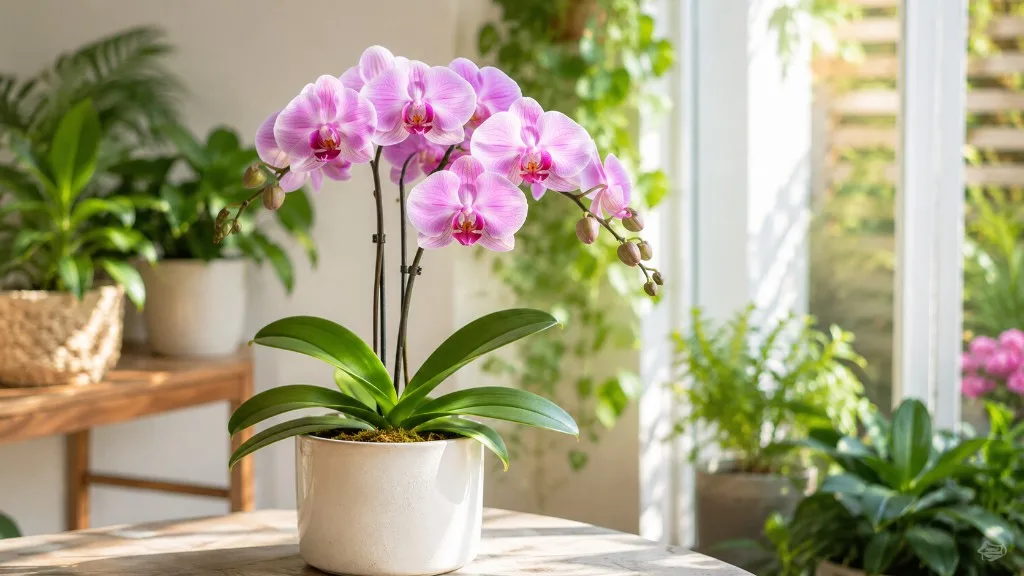
The short answer: feed lightly when an orchid is growing
For most indoor orchids, use a complete, water-soluble fertilizer at a weaker concentration than the package gives for ordinary houseplants, and apply it only when the plant is actively growing. A conservative start is one-quarter to one-half of the label rate, then adjust only after watching new roots, leaves, and the condition of the potting mix; the label and the orchid’s needs take precedence over any universal schedule.
If you grow a common moth orchid, or Phalaenopsis, that usually means feeding gently during periods when it is making new roots or leaves and reducing or pausing when growth slows in dim, cool conditions. The familiar “weakly, weekly” phrase can be a useful reminder to keep the solution dilute, but it is not a prescription to add fertilizer every week regardless of species, water, medium, or root health. The American Orchid Society emphasizes that epiphytic orchids evolved with low nutrient availability and that water quality and accumulated mineral salts are part of the fertilizing decision, not afterthoughts (American Orchid Society fertilizer guidance).
Think of fertilizer as a small supplement to good culture, not a bloom switch. It cannot compensate for insufficient light, rotting roots, stale potting medium, poor drainage, or a plant that has not matured enough to flower.
Choose fertilizer for the roots, medium, and water
An orchid’s roots interact directly with the air, water, and fertilizer moving through its pot. A feed that works well in coarse bark may be too frequent for a pot of moisture-retentive sphagnum, while the same fertilizer mixed with mineral-heavy water can leave more residue than it would with rainwater or low-mineral water. Before you buy a special product, identify how the orchid is planted and how quickly that medium dries.
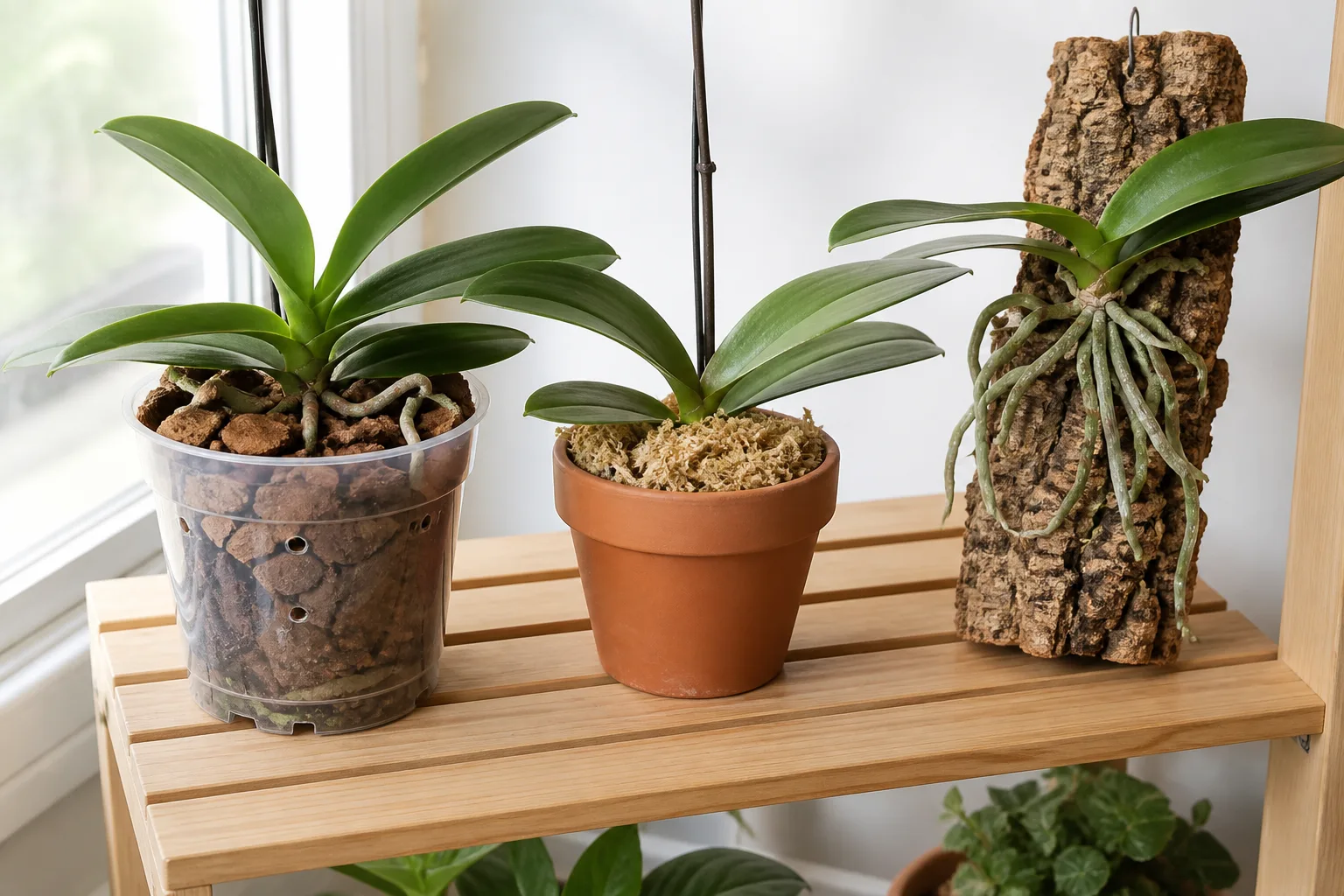
A complete soluble formula is usually enough
Choose a water-soluble fertilizer that supplies nitrogen, phosphorus, potassium, and trace elements, unless you have a specific reason to use a different formula. A fertilizer labeled for orchids is convenient because its directions are intended for orchid growers, but the word “orchid” on the package does not make an incomplete or highly concentrated product automatically safer. A complete, balanced product diluted according to its label is more useful than buying several bottles with overlapping ingredients.
If you use rainwater, distilled water, or reverse-osmosis water for most irrigations, check whether the fertilizer also supplies calcium and magnesium. Those elements may be present in tap water or some mixes, but low-mineral water contributes little; using a complete formula reduces the temptation to add supplements without knowing what is missing. Conversely, if your tap water is hard, extra calcium or other minerals may be unnecessary, and repeated feeding can compound the solids already entering the pot. The American Orchid Society explains that fertilizer nutrients are mineral salts and that water hardness influences how quickly residues accumulate (American Orchid Society).
Avoid using garden granules or concentrated slow-release pellets as a casual substitute for a measured liquid feed. A plant growing in an outdoor bed has a larger soil volume and a different pattern of water movement than an orchid’s small, airy pot; a pile of granules against orchid roots can release a concentrated dose in one spot. Fertilizer spikes can also deliver nutrients unevenly, so they make it harder to control what the roots receive.
Read the label instead of chasing an NPK ratio
The three numbers on a fertilizer label describe the guaranteed percentages of nitrogen, available phosphate, and soluble potash by weight. A 20-20-20 product is not automatically twice as appropriate as a 10-10-10 product, and a high-middle-number “bloom booster” does not make flowers appear on demand. What matters for a home grower is the actual concentration in the water, the product’s nutrient completeness, the orchid’s growth stage, and how the roots respond.
A complete fertilizer with a moderate ratio is a sensible default when the label includes trace nutrients and clearly states how to dilute it. Many orchid growers choose formulas that avoid relying heavily on urea as the nitrogen source, particularly for plants growing in bark, but the nitrogen-form question is more nuanced than a simple “urea is unusable” rule. A peer-reviewed review of nitrogen forms and Phalaenopsis culture shows why recommendations can depend on the orchid and growing conditions rather than a single rule for all genera (Wang and Chang’s review in HortTechnology). If the label is vague, the product is meant to be sprayed on leaves, or its directions assume a different growing system, choose a more clearly labeled soluble fertilizer instead of guessing.
Do not compare products by the fertilizer name alone. One capful of a concentrated liquid can deliver far more nutrients than one capful of a dilute ready-to-use feed, so use the marked dose and a clean measuring tool. Do not add Epsom salt, extra phosphorus, or a calcium supplement just because an orchid is not flowering; those additions can make nutrient balance harder to diagnose.
Set timing by active growth, not a calendar
Indoor orchids do not all follow the same season. A home that stays warm and bright may support growth through winter, while a cool window or short days can slow an orchid even when the calendar says spring; the plant’s visible growth and the pace at which its medium dries are better cues than month names alone.
Gardenia’s practical guide recommends reduced-strength feeding during active growth and a plain-water rinse to limit residue, while its blanket advice about dormancy and bud development should not be treated as a rule for every orchid (Gardenia’s orchid fertilizing guide). For reliable home care, keep the routine modest and follow species-specific culture guidance when the orchid’s name is known.
Moth orchids need a flexible indoor rhythm
Phalaenopsis, the common grocery-store moth orchid, usually has no dramatic dry-season dormancy in a heated home. If it is producing fresh green root tips or a new leaf and its pot dries at a reasonable pace, a dilute feeding during some waterings can support that growth. If the plant is not growing, light is low, or the medium is staying wet for a long time, cut back rather than maintaining a weekly dose by habit.
Gardenia and other horticulture writers often suggest feeding once a week during active growth, while the American Orchid Society stresses low nutrient availability and managing salts. Treat weekly feeding as one possible cadence for a quickly draining bark setup, not as the default for a plant in slow-drying moss or a dim room. Everyday Orchids also describes weak regular feeding and watering before applying fertilizer, a practical approach when roots are dry, but its product and seasonal suggestions should be filtered through the exact fertilizer label and your orchid’s response (Everyday Orchids fertilizing advice).
A straightforward household rhythm is to use plain water at one irrigation, then a mild fertilizer solution at a later irrigation while the orchid is actively growing. If the plant is in a coarse bark mix that dries quickly and grows steadily, you may use a weaker solution more often; with dense moss, low light, or hard water, stretch the interval and rinse periodically. The goal is a repeatable amount the plant can use, not maximum frequency.
Some orchid genera have a real seasonal rest
A Phalaenopsis schedule should not be copied onto every plant sold as an orchid. Some Dendrobium types and Catasetinae have recognizable seasonal growth and rest cycles; a dormant plant with shed leaves and firm pseudobulbs may require much less water and no fertilizer until new growth begins. Feeding heavily into a rest period can leave nutrients unused in a pot that is receiving little water.
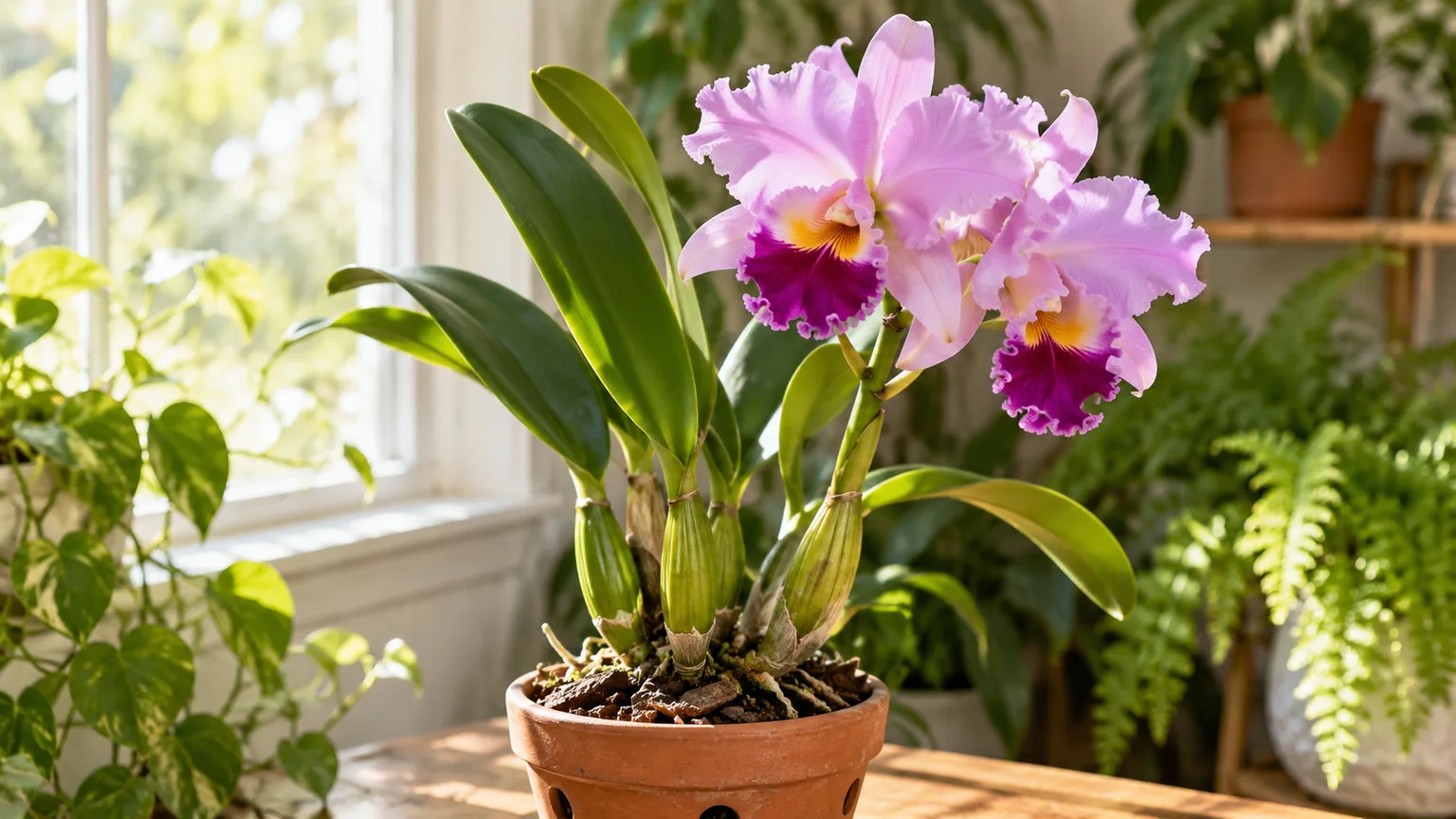
Cattleyas and many other orchids also have growth patterns that vary by species, hybrid, temperature, and light. If the plant label gives a seasonal rest or genus-specific care sheet, use that information to set feeding and watering together. During active root or leaf production, a light complete feed may fit; during a prescribed dry rest, do not pour fertilizer into dry media simply because another orchid in the collection is growing.
For an unidentified orchid, use conservative signals: feed weakly when fresh growth is developing, reduce when growth stalls, and avoid trying to force a cycle with high-phosphorus products. Catasetinae offer a clear example of why species guidance matters: the American Orchid Society’s seasonal culture sheet ties fertilizing to resumed spring watering, then stops feeding as the pseudobulbs mature and dormancy begins (American Orchid Society Catasetinae seasonal culture sheet). A photo of the flower or a nursery tag may help identify the genus before you make a major seasonal change.
Apply fertilizer without burning roots
The safe method is simple: mix accurately, put nutrients through a drained pot, and avoid leaving the orchid in a saucer of fertilizer. A dilute solution is still a fertilizer solution, so do not treat it as harmless water or pour the leftover mixture into every plant without checking their labels and needs.
Measure a mild solution accurately
Start with the fertilizer’s stated rate for the type of application you are doing. If the package says one teaspoon per gallon for ordinary houseplants, one-quarter strength would be one-quarter teaspoon in that same gallon volume; half strength would be one-half teaspoon. Use a measuring spoon or scale rather than estimating a splash, and make only the amount you can use during that watering session.
That example is arithmetic, not a universal orchid dose: products vary in concentration, and some labels already give orchid-specific directions. If your product’s label specifies a lower rate for orchids, follow it. When no orchid rate exists, beginning at one-quarter to one-half of the labeled houseplant concentration is a cautious starting point for common epiphytic orchids, especially when you are still learning the plant’s watering pattern; then observe new root tips and leaves over several weeks before changing anything.
Do not increase concentration to make up for missed feedings, and do not combine multiple products in one can unless their labels expressly allow it. Mixing a stronger dose because the orchid is flowering, newly repotted, or “looks hungry” can damage root tips without addressing the actual problem. Store fertilizer in its original labeled container, keep it away from children and pets, and rinse measuring tools before using them for food.
Feed moist roots and let the pot drain
Do not apply concentrated solution to bone-dry roots. On a normal watering day, first wet the medium or briefly hydrate very dry roots with plain water; once it has drained, run the diluted fertilizer through the pot so it reaches the roots throughout the medium. This is a practical approach also described by Everyday Orchids, and it prevents a dry root surface from being hit first by the fertilizer salts (Everyday Orchids).
Use a container with open drainage and apply enough solution to move through the whole root zone, rather than adding a small splash to the top. Lift the clear nursery pot from its decorative cover so you can see whether water is draining; pour out anything left in the cachepot or saucer. Roots should not sit in standing fertilizer water after feeding.
Keep solution out of the crown and leaf axils, particularly on Phalaenopsis. If liquid collects between leaves, blot it away and improve airflow; fertilizer sitting in the crown is not a useful substitute for root feeding. Foliar sprays are unnecessary for most home growers and can leave residue on leaves or flowers, while a measured root-zone application is easier to control.
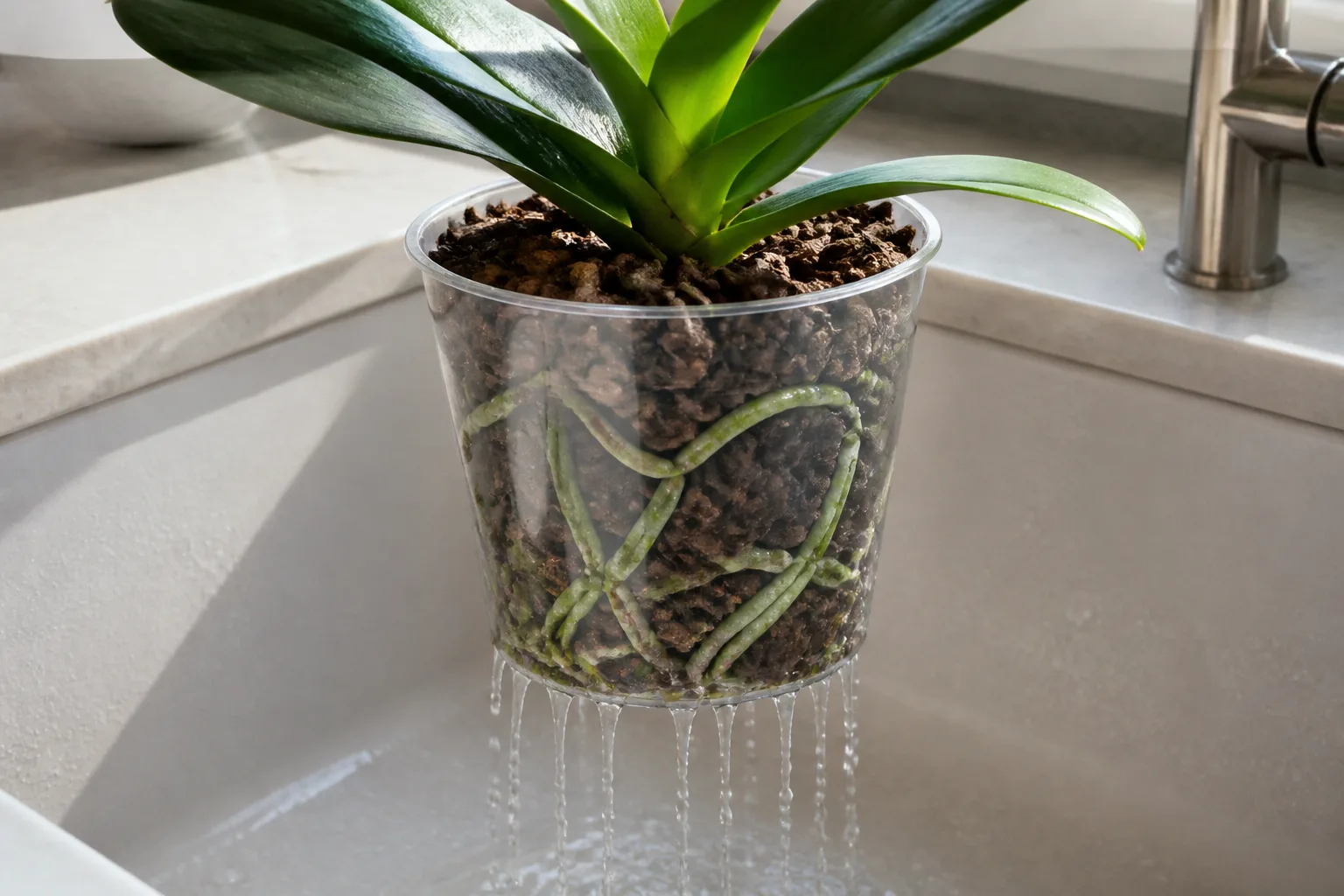
Flush salts before they accumulate
Fertilizer nutrients are salts, and irrigation water brings its own dissolved minerals. As water evaporates, residues can concentrate in the medium or along a clay pot; a periodic plain-water rinse helps move those soluble deposits through the drainage holes instead of letting each feeding add another layer. The American Orchid Society notes that water hardness and overfertilizing both affect salt accumulation, so there is no single flush interval that suits every home (American Orchid Society fertilizer guidance).
For an orchid in a pot with drainage, take it to a sink and slowly pour plain water through the medium until it runs freely from the bottom. Let the pot finish draining before returning it to its decorative cover. Use water at room temperature if possible, and never leave the inner pot standing in the rinse water; dumping water on top while the plant remains in a cachepot does not flush salts out if the runoff cannot escape.
Some growers skip every fourth feeding and use plain water instead, but think of that as a reminder to rinse, not a mandatory calendar. A pot in hard water or frequent feeding may need more regular leaching; a mount or a plant watered with low-mineral water may need a different approach. If you see crusting, flush with plain water and reassess both fertilizer strength and water quality rather than increasing the dose to correct suspected deficiencies.
Know when to pause and when to restart
Pause fertilizer when the roots are rotting, the plant is badly dehydrated, the medium is sour or breaking down, or the orchid is undergoing a species-specific dry rest. In those situations, solve the underlying culture problem first. Fertilizer does not repair damaged roots, restore air to decomposed bark, or make a waterlogged pot safe.
After repotting, decide based on the condition of the roots and the new medium rather than following a fixed number of days. If you had to remove many damaged roots, let the plant stabilize and resume with a weak solution after it begins producing healthy new roots; feeding damaged tissue cannot make it absorb nutrients. If you simply moved a healthy plant into fresh medium and it is actively growing, a cautious feed can resume as the roots settle, provided the product label does not advise otherwise.
Restart gently when you see signs the plant can use nutrients: fresh root tips, a new leaf, or growth resuming after a rest. Begin at the low end of the labeled range, maintain ordinary watering and light, and wait long enough to observe growth before changing dose. Do not compensate for pale leaves or a stalled spike by immediately doubling fertilizer; many conditions can look like nutrient shortage.
Diagnose fertilizer trouble without guessing
A fertilizer problem is more likely when symptoms follow a change in dose or water source, but orchid leaves and roots respond to several kinds of stress in similar ways. Start with the recent care history: what was mixed, how much, how often, which water was used, how long the pot stays wet, and whether roots were already healthy when feeding changed.
Crust, brown tips, and damaged roots have more than one cause
White or tan deposits on the pot, bark, or clay often point to minerals left as water evaporates. Reduce fertilizer strength, flush the pot thoroughly, and consider whether hard water or a sodium-based water softener is adding more dissolved material; softened water that contains sodium is a poor choice for orchids. If your tap water is naturally mineral-heavy, rainwater, reverse-osmosis water, or distilled water can reduce the load, though low-mineral water makes a complete fertilizer with trace nutrients and, where needed, calcium and magnesium more important.
Brown or black root tips can follow excess salts, but color alone does not prove fertilizer burn. Dead roots are often hollow or mushy, whereas healthy Phalaenopsis roots are firm; blackening can also accompany rot or other root injury. If the mix stays wet and smells sour, repotting into fresh, airy orchid medium and correcting the watering setup matters more than another fertilizer rinse.
Brown leaf tips also have several possible causes, including mineral accumulation, uneven watering, root loss, low humidity, or physical damage. Look for a pattern across new and old growth and inspect the roots before making a nutrient diagnosis. If the newest roots look healthy and a single old leaf has a dry tip, changing fertilizer may do more harm than leaving it alone.
More fertilizer will not solve every bloom problem
When an orchid makes leaves but no flowers, check light and temperature before changing the fertilizer. A plant may grow foliage because it receives enough light for maintenance but still lack the stronger or seasonally appropriate light cue needed for a spike; some Phalaenopsis also respond to a cooler nighttime period. A mature plant may need time to build energy, while a stressed plant with compromised roots may not have resources for flowering.
A bloom booster with extra phosphorus is not a reliable shortcut around those conditions. Nitrogen, phosphorus, and potassium all have roles in plant growth, but switching to a high-middle-number formula does not create adequate light, healthy roots, or a species-specific seasonal trigger. The peer-reviewed review of nitrogen management in Phalaenopsis is a reminder that nutrient responses depend on the plant and its culture, not just on the ratio printed on a bottle (Wang and Chang, HortTechnology).
Change one factor at a time. If light is low, improve it gradually; if roots are damaged, stabilize the root zone; if the plant has a known seasonal rest, respect it. Keep a simple note of feeding concentration and date so you can tell whether a later improvement followed a genuine correction rather than several simultaneous changes.
Conclusion
Fertilize orchids with a complete water-soluble product, dilute it conservatively, and time applications to active growth and healthy roots. Match the frequency to the orchid, medium, and water instead of following a weekly slogan as if every plant has the same needs.
Apply the solution through a moist, well-drained pot, let it drain completely, and rinse accumulated salts with plain water when your setup calls for it. If leaves brown or flowers fail to appear, inspect roots, light, water, and the plant’s growth cycle before adding more fertilizer; steady culture is a better bloom strategy than a stronger dose.