How to Get Rid of Jimsonweed Safely
Learn how to get rid of jimsonweed before it sets seed, protect pets, bag toxic plant parts, and choose the safest control method for your yard.
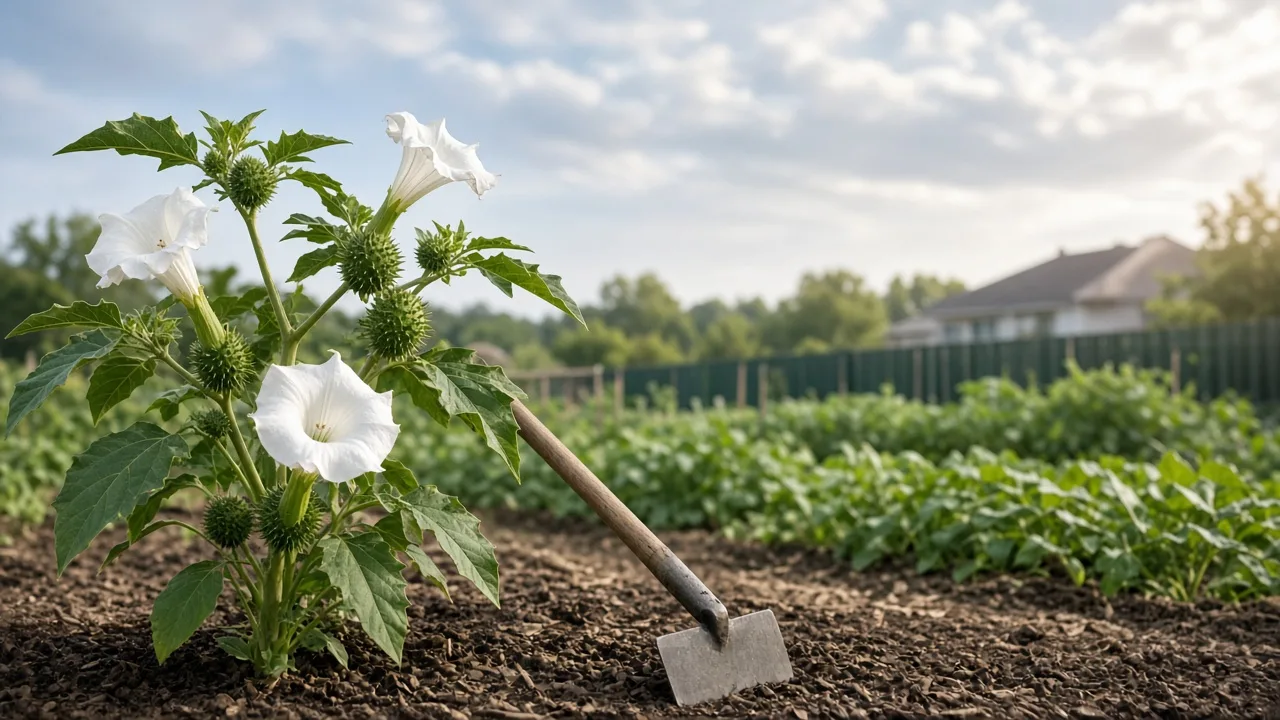
If you have identified jimsonweed in a place where children, dogs, cats, horses, or other animals can reach it, make today the day you contain it. Keep everyone away from the patch, prevent the plant from making or dropping seed, and choose a removal method that fits its size and location.
Jimsonweed (Datura stramonium) is a summer annual, so it does not need a permanent root system to become a long-term problem. Its advantage is speed: it can flower within weeks of emergence, keep producing flowers as it grows, and turn a single overlooked plant into a persistent seed-bank problem. All parts are poisonous if eaten, with the seeds and leaves posing particular risks to animals and people. The West Virginia University Extension profile and Cornell University’s toxic-plant reference both treat jimsonweed as a serious plant around livestock and humans.
The fastest safe decision: contain first, remove before seed
Do not rush into the yard and yank an unfamiliar trumpet-flowered plant while pets circle your feet. First close the gate, move animals indoors or to another part of the property, and look from a distance for flowers, green capsules, brown capsules, or loose black seed on the soil. If you cannot confidently identify the plant, photograph it without touching it and ask your county extension service or a qualified local professional.
For a small, accessible plant with no seed capsule, careful digging and bagging is usually the most controlled first choice. For a mature plant with pods, contain the pod-bearing material before cutting or moving the rest; for a large patch, a windy slope, or growth mixed through desirable plants, stop and choose a professional or label-based plan rather than creating a bigger exposure and dispersal problem.
How to identify jimsonweed before you touch it
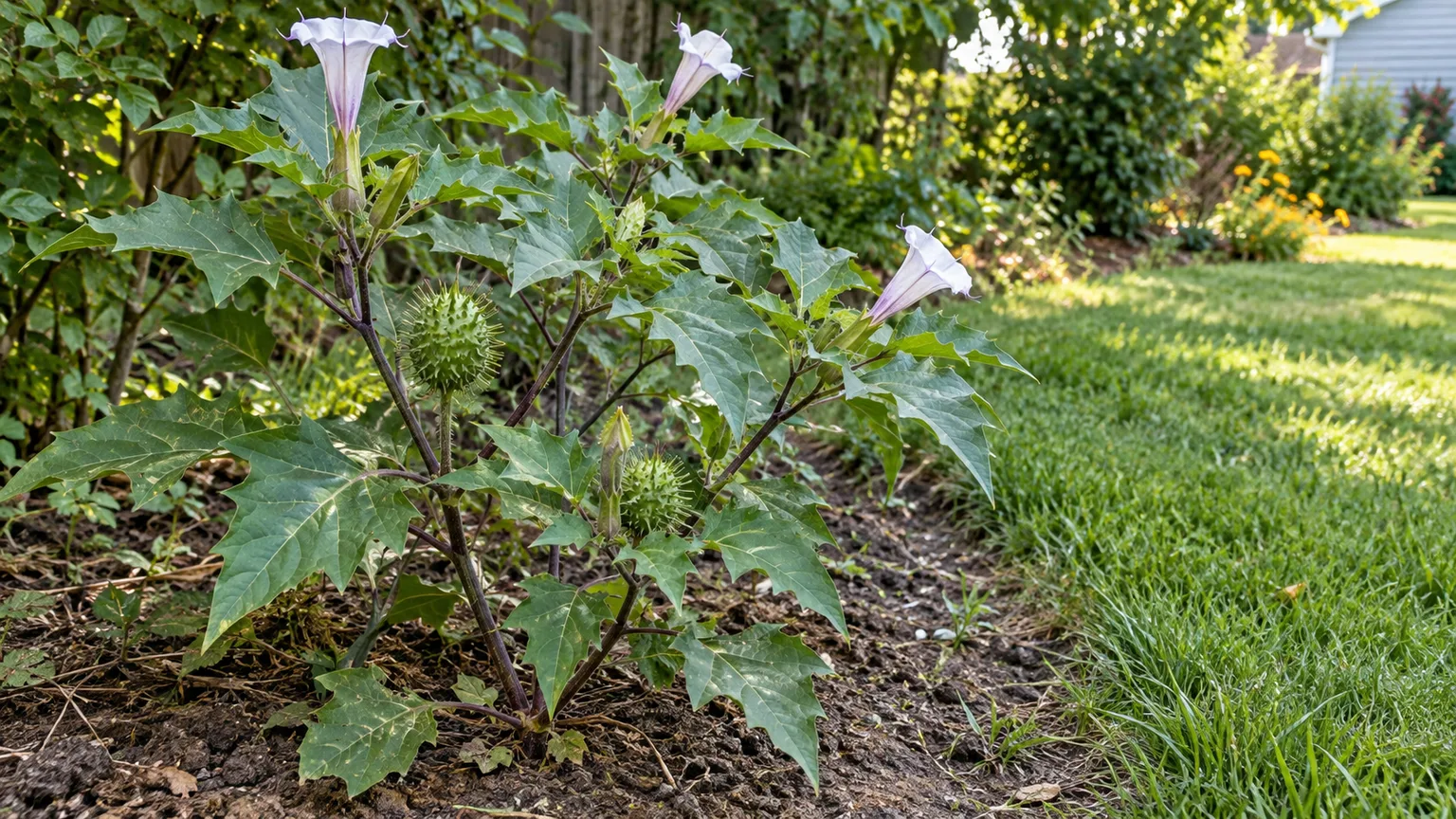
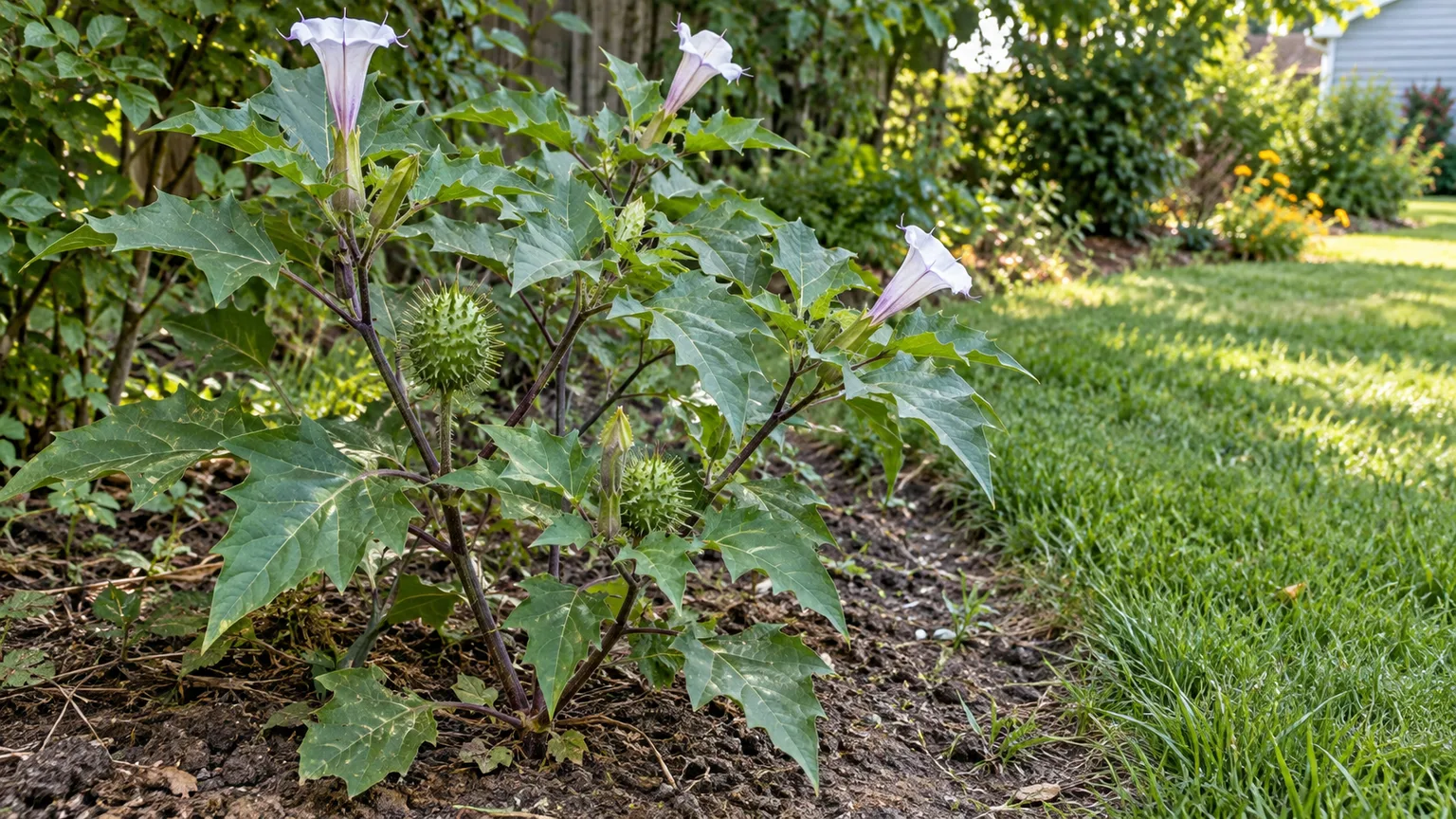
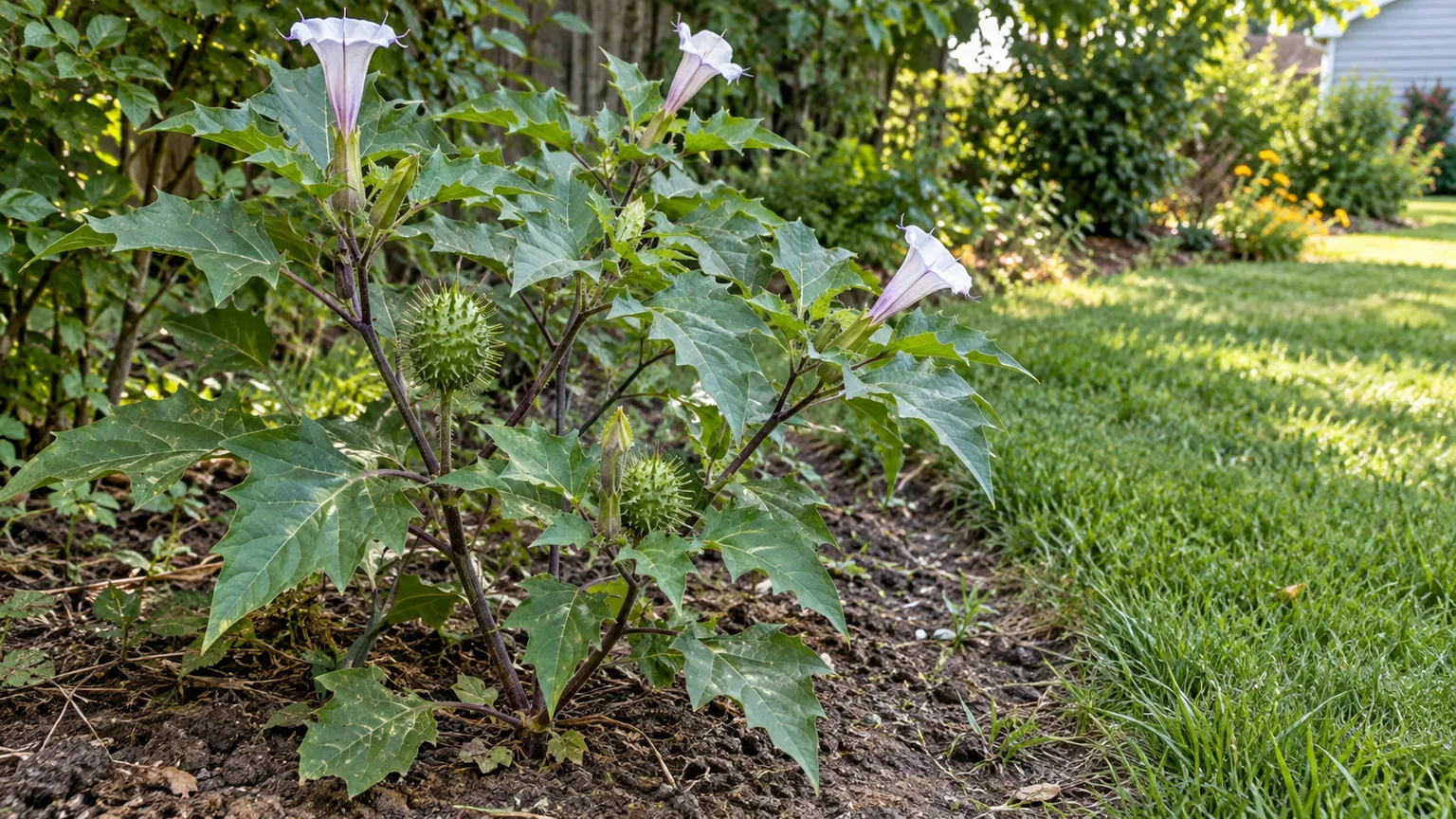
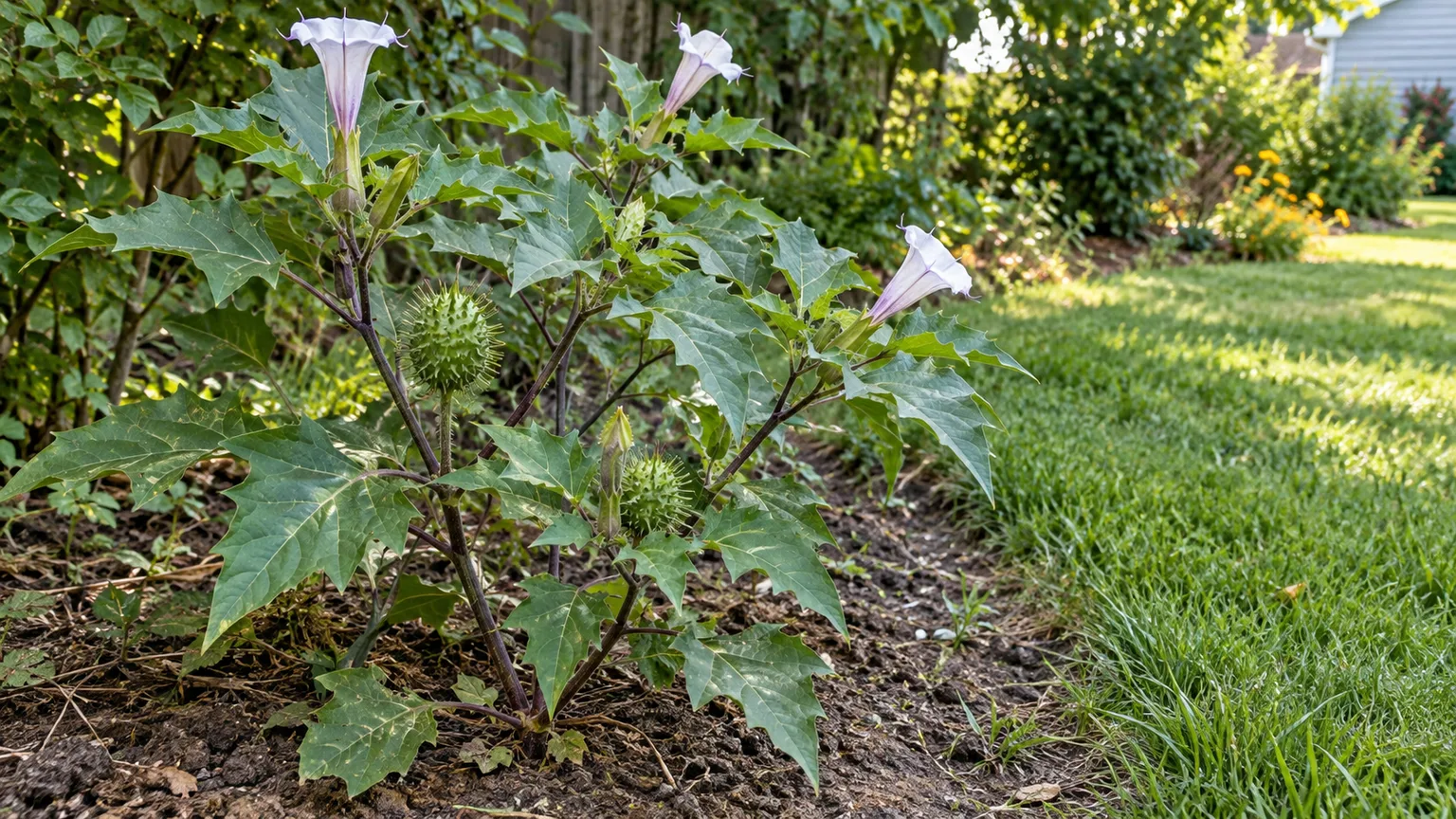
Jimsonweed is an upright, freely branched annual in the nightshade family. Mature plants commonly reach about 1 to 6 feet, with stout hollow stems that may be green, purple, or red-purple. The leaves are alternate on mature growth, broad to triangular in outline, and irregularly or coarsely toothed, giving them an oak-leaf look. A strong unpleasant odor is another clue, but do not crush a leaf just to test it.
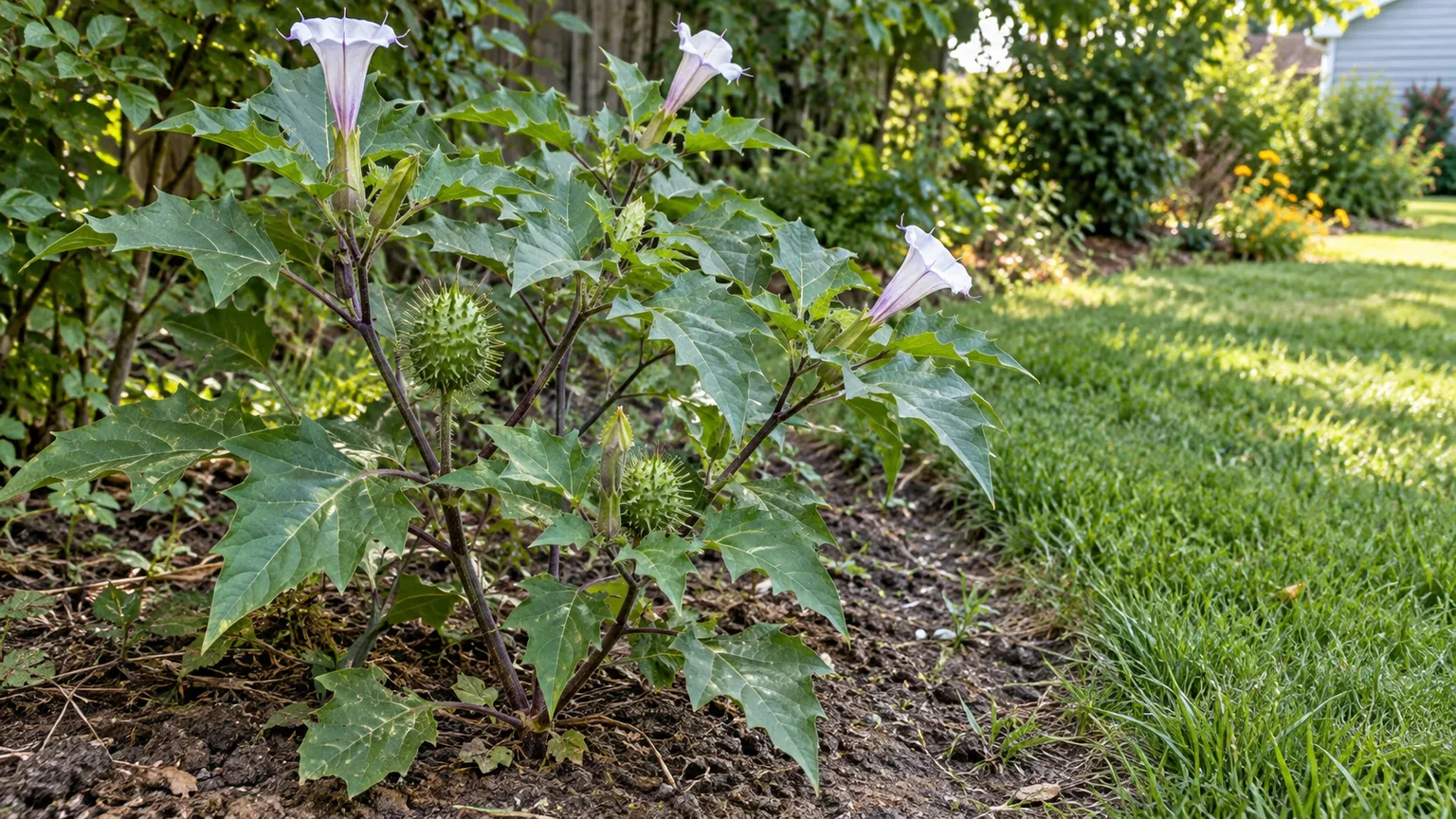
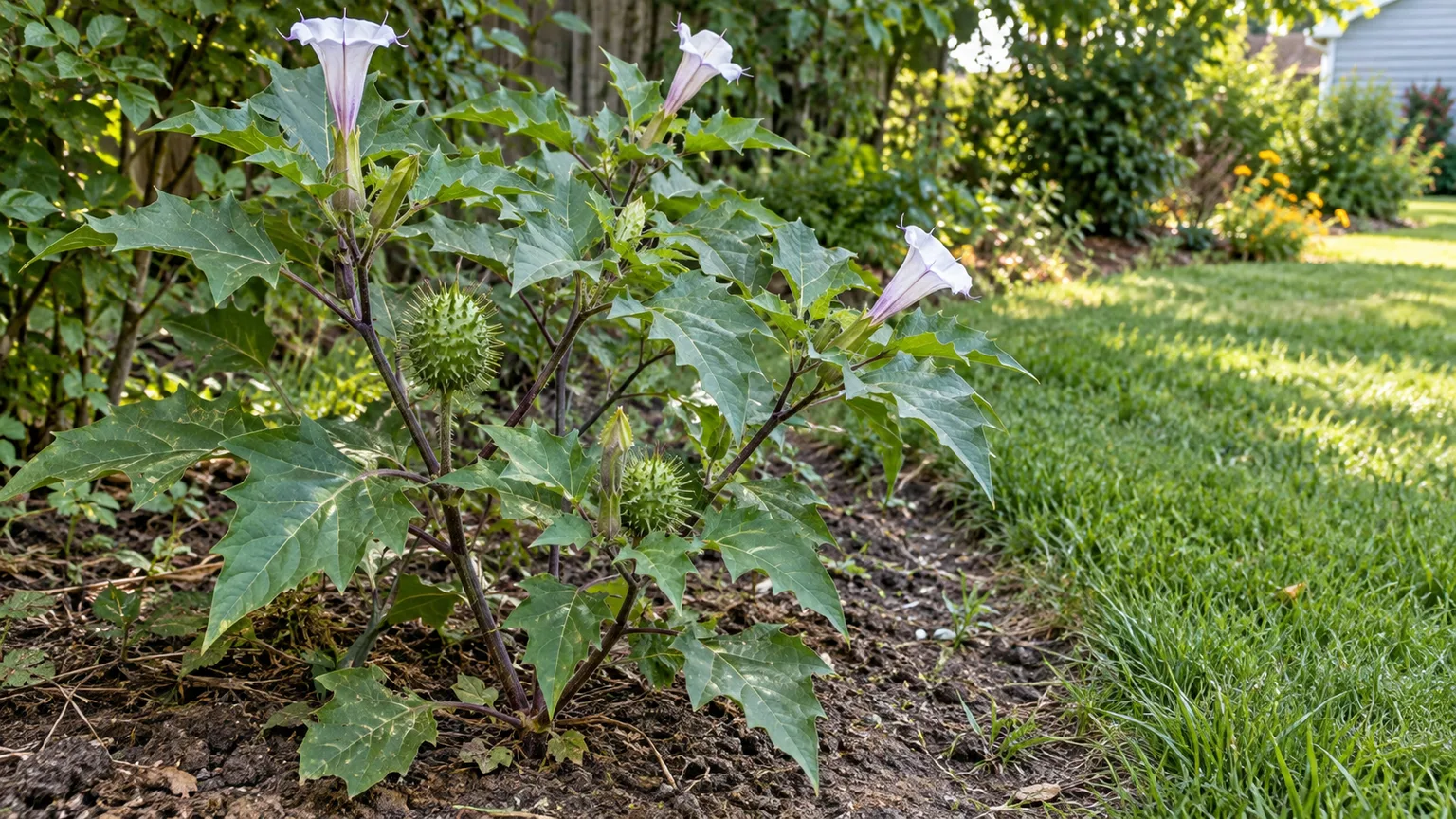
The flowers are solitary, trumpet-shaped, and generally white, lavender, or purple. A flower may last only a day, but a healthy plant can keep replacing flowers from late spring into early fall. The feature that should make you stop and switch from casual weeding to seed containment is the fruit: an egg-shaped capsule covered in stiff spines that turns brown and opens into four sections.
These features are consistent with the identification details in the Sustainable Agriculture Research and Education jimsonweed profile. Do not identify it from flower color alone; several unrelated plants have pale trumpet flowers, and some other Datura species are also toxic.
Seedlings and mature plants look different
Small jimsonweed can be easier to pull but harder to recognize. The seedling is relatively large, with thick, narrow cotyledons; its first true leaves may be opposite, gray-green, and less dramatically toothed than the later leaves. The stem can begin turning purple near the base as the plant develops.
As the plant matures, the leaf arrangement becomes alternate and the leaves become larger, darker, and more irregularly toothed. The combination of a thick branching stem, broad toothed leaves, a rank smell, and a trumpet flower is more useful than any one clue. If the plant is already carrying a spiny capsule, treat it as jimsonweed for safety purposes until an expert says otherwise.
Tell jimsonweed from similar weeds
Common cocklebur can look similar at the seedling stage, but SARE notes that it lacks jimsonweed’s strong odor and develops older leaves with a different hairier texture. Mature jimsonweed’s four-part spiny capsule is a stronger clue than a vague resemblance in the leaves.
Do not confuse the ornamental name “angel’s trumpet” with a guarantee of safety. Common names are inconsistent, Datura species overlap in appearance, and both the identification and the toxicity question matter before a plant is handled or left in a pet area. When the plant is growing in hay, pasture, or a feed-storage area, use a livestock or weed-science specialist rather than guessing.
Why waiting raises the cost of control
Jimsonweed is not dangerous because it is an especially deep-rooted perennial. It is dangerous because the plant can reproduce quickly, the seeds can remain dormant, and the attractive flowers and capsules invite investigation. Waiting until the plant is tall and full of pods turns a simple dig into a containment job.
One plant can create a long-lived seed-bank problem
SARE summarizes reports of roughly 600 to 700 seeds in a vigorous capsule and up to 50 capsules, or about 30,000 seeds, on a vigorous low-density plant under favorable conditions. Those are potential outputs, not a promise that every backyard plant will reach that number, but they explain why removing a plant before seed set is so valuable.
The seed bank is also unusually persistent. SARE reports that seeds buried deeply in one study remained viable for more than 39 years, while other experiments showed much faster losses under different depths and conditions. The practical conclusion is not that every seed lasts 40 years; it is that you should avoid adding new seed and avoid disturbing buried seed unnecessarily.
Most seedlings emerge from roughly 0.4 to 2 inches of soil, with some emergence deeper than that, and emergence is concentrated from mid-spring into early summer. Rain can trigger another flush later in summer. That makes shallow monitoring and repeated removal more effective than assuming one cleared patch is finished.
The pet and livestock risk is about ingestion
Every part of jimsonweed contains toxic tropane alkaloids, including atropine, hyoscyamine, and scopolamine. Ingestion can produce an anticholinergic poisoning pattern: dilated pupils, unusual agitation or confusion, rapid pulse, rapid breathing, thirst, twitching, diarrhea, weakness, seizures, coma, or worse. The CDC report on jimsonweed poisoning and Cornell’s animal-safety reference document the seriousness of ingestion rather than treating the plant as a mild stomach irritant.
Dogs and cats may investigate a new plant, while grazing animals are at risk when desirable forage, water, or feed is limited. Cornell also notes that jimsonweed can contaminate hay, silage, and grain; that matters on properties with horses, poultry, goats, sheep, cattle, or stored feed even when the animals usually avoid the plant’s unpleasant taste. The ASPCA jimsonweed listing and the ASPCA Poison Control service are useful references for pet owners.
If a pet may have chewed any part, remove access and call your veterinarian or an emergency veterinary clinic immediately. In the United States, the ASPCA Poison Control number listed in its plant database is (888) 426-4435; do not wait for symptoms and do not induce vomiting or give home remedies unless a veterinary professional specifically instructs you.
A no-regret safety setup for removal day
Treat the job as contaminated-plant cleanup, not a race to pull a weed. Wear intact gloves, long sleeves, long pants, closed shoes, and eye protection; use clothing and shoes that can be washed or cleaned immediately. The goal is to keep plant material, seed dust, and dirty hands away from your face, food, children, pets, door handles, and vehicle interiors.
Have a shovel or hand weeder, a sturdy bag, ties, and a clean place for tools ready before you begin. A second bag is useful if the first tears. Work in calm, dry weather so wind does not move loose seed or cut stems, and keep the bag beside you instead of carrying loose plants across the yard.
Jimsonweed is not the same exposure problem as poison ivy. WVU Extension reports that contact does not cause an allergic rash in the poison-ivy sense, but gloves and eye protection are still sensible because they reduce accidental transfer to your mouth and eyes, protect against rough or spiny material, and make cleanup more controlled. Never eat, taste, smoke, or make a home remedy from any part of the plant.
Hand-pull a small plant without spreading it
Hand removal is a good fit for one or a few young plants in open soil where you can see the base. Garden Gate’s practical guidance notes that jimsonweed has a thick, dense but relatively shallow root system, which is why a small plant can often be lifted with a hand weeder or shovel. Digging at the crown is more dependable than snapping off the stem at soil level.
Use this sequence:
- Clear the work zone. Keep pets and children away, and place the bag within reach before you touch the plant.
- Find the crown. Move only enough mulch or loose soil to see where the stems meet the roots; do not rake broadly through the patch.
- Loosen the soil. Push a hand weeder or shovel a few inches away from the stem and work around the crown. Slightly moist, crumbly soil is easier to work than powder-dry soil or saturated mud.
- Lift slowly. Pull upward with steady pressure while supporting the root mass. If the stem breaks, bag the top and dig for the remaining crown rather than leaving it exposed.
- Bag immediately. Put the roots, stems, leaves, flowers, and loose soil clumps containing seed directly into the bag, then tie it before walking to the next plant.
- Close and mark the spot. Replace the disturbed soil and mark the area for follow-up inspections instead of assuming the first pull ended the problem.
Do not leave an uprooted plant on the ground while you pull the next one. Gardening Know How’s jimsonweed control guidance also warns that capsules and seeds can make control much harder once they scatter. A plant can look dead and still have a capsule that continues to mature after it has been cut or uprooted, and a loose pod is much harder to track than one that goes straight into a bag.
What to do with plants that already have flowers or pods
Flowering is a warning to work more deliberately, not a reason to panic. If there are open flowers but no visible capsules, you can still use the small-patch sequence, but keep stems together and inspect the soil afterward for dropped material.
If green or brown spiny capsules are present, do not mow or shake the plant. Keep the bag at the base, gently gather or cut pod-bearing stems into the opening, and tie the bag before moving the remaining root mass. If the plant is too large to contain without brushing your clothing or scattering pods, pause and hire a professional rather than turning a single plant into a trail of seed.
Do not strip pods off and toss them into a separate compost bucket. Every pod is part of the disposal problem, and mature capsules can split into four sections and release black seeds. Bag the pods with the rest of the plant and follow your local waste authority’s direction for noxious or poisonous yard waste.
Choose control by location and plant size
The best control method is determined by two questions: Can you remove the crown without spreading seed, and can you protect the plants or surfaces you want to keep? A method that works in bare soil can be reckless in a vegetable bed, beside a pond, or under a tree.
| Situation | Best starting point | Main limitation |
|---|---|---|
| One to a few young plants in open soil | Dig at the crown and bag everything | You must inspect for seedlings again |
| Small plants in a lawn before flowering | Hand-pull, or mow repeatedly before seed set | Cutting may not remove the crown, and pod-bearing plants should not be mowed |
| Flower bed or vegetable garden | Carefully dig isolated plants; protect wanted roots | Herbicide drift or overspray can damage desirable plants |
| Fence edge, compost area, or manure pile | Remove early and correct the seed source | Disturbed, fertile soil encourages new emergence |
| Dense patch, steep bank, or inaccessible growth | Use a licensed applicator or vegetation professional | Cost and local rules affect the plan |
Lawn or open soil
A few young jimsonweed plants in a lawn are usually easier to hand-pull than to spray, especially when the turf is surrounded by flowers, edible plants, or a play area. If the plants are numerous but still vegetative, repeated mowing can reduce their height and seed production; the method only works as prevention when the mower visits before flowers and capsules develop.
Once capsules are visible, do not run over the patch. Mower blades can scatter pieces and seed, and the operator may track contaminated debris to other parts of the property. Stop mowing that area, contain what you can, and change to hand removal or a professional plan.
For an isolated bare-soil patch, a securely anchored opaque cover can reduce light and suppress emergence, but it is not an instant kill switch. The edges must stay closed, the cover cannot smother a wanted tree or create a trip hazard, and the site still needs inspection when the cover is removed.
Flower bed, vegetable garden, or fence edge
Digging is the most controlled option beside plants you want to keep. Work from the clean side of the bed toward the weed, use a narrow tool, and stop if the jimsonweed crown is intertwined with a valuable root system. It is better to remove several shoots over time than to excavate half a perennial border in one attempt.
In vegetable beds, avoid improvising with salt, vinegar, bleach, or boiling water. These methods can injure crops, alter soil, burn skin, or kill only the contacted foliage while leaving the control problem unresolved. Pull early, mulch after the plant is removed, and manage the bare or disturbed spot so it is not left as a bright, open germination site.
Fertile disturbed areas deserve extra attention. SARE notes that jimsonweed responds strongly to nutrients and is common around manure and compost storage areas; avoid over-fertilizing, keep finished compost contained, and do not move soil or manure from a contaminated patch into a clean bed.
Dense patch or inaccessible ground
Do not crawl into a dense stand, climb a bank, or reach behind a fence with a hand tool just because the plants look removable. A dense patch can contain unseen capsules, and a difficult stance makes slips, torn gloves, and accidental contact more likely. Mark the area, keep animals out, and get a local extension recommendation or licensed applicator assessment.
If a label-approved herbicide is appropriate for an isolated patch, the label—not a social-media recipe or a remembered product name—controls the target, site, rate, protective equipment, weather limits, re-entry interval, and water restrictions. A product suitable for turf may be unsuitable for a flower bed or vegetable garden, and a non-selective spray can injure every broadleaf plant it contacts.
Do not spray a mature pod-bearing plant simply because it is too large to pull. Drift and runoff create new risks, and dead foliage does not prove that seeds were contained. For a large patch, ask the applicator how seed-bearing debris will be handled and what follow-up will happen if seedlings emerge.
Why mowing, tilling, and homemade sprays can backfire
Jimsonweed control is a timing problem. Mowing or hoeing a young plant before seed set can be useful, while the same action after pods form can spread the material you meant to remove. The plant can also regenerate from buds near the base after cutting or trampling, so a short stump is not proof that the job is done.
Deep or repeated tillage is another poor default for a home garden. SARE reports that jimsonweed seeds are particularly responsive to light and temperature cues near the soil surface, and that burial depth changes dormancy and survival. Turning soil can expose buried seed, move it around the bed, and create more emergence sites even if the original plant is gone.
Homemade weed killers are not automatically safer because the ingredients are familiar. Salt can accumulate and damage soil, vinegar is non-selective and mostly a foliage treatment, and boiling water is a burn hazard with limited reach around wanted roots. Use hand removal, mulch, repeat scouting, or a label-approved treatment according to the site rather than choosing a recipe by how natural it sounds.
Pre-emergent herbicides can be part of a larger plan where the label permits the target and site, but they do not remove a plant that is already growing. They also do not make identification, pet exclusion, or follow-up unnecessary. If food crops, water, children, or pets are nearby, get local advice before applying any pesticide.
Dispose of jimsonweed and clean up
Bag the entire plant, including roots, leaves, flowers, capsules, and visible seeds. Do not put jimsonweed into a home compost pile, a brush pile, or a burn barrel; composting is not a reliable way to destroy every seed, and burning converts a contained plant into smoke and airborne debris. Use the disposal route your municipality allows, and check first if local regulations treat poisonous or noxious weeds differently from ordinary yard waste.
Carry the tied bag without dragging it over the lawn. If it tears, place it inside a second bag while wearing clean protective gloves, and do not shake soil or pods loose beside a path. Keep the bag separate from leaves, mulch, vegetable trimmings, and any material you plan to spread elsewhere.
After the job, clean tools and shoes before touching door handles or entering the house. Wash gloves according to their material, launder work clothing separately, and wash exposed skin with soap and water. Keep pets away until loose debris is removed, and if an animal brushed through the patch or may have chewed a piece, call a veterinarian for advice about safe cleaning and exposure monitoring.
Stop the next flush of seedlings
Expect follow-up; a clean-looking patch is not a cleared seed bank. Walk the area at least weekly during the active growing season and after substantial rain, looking for the first pair of true leaves, purple stem color, or a familiar rank odor. Pull or hoe seedlings while they are small and before flower buds form, then bag them rather than leaving them in place.
Keep a simple map or phone photo of the original patch. Recheck fence bottoms, compost and manure storage areas, garden edges, poultry runs, bare spots in turf, and places where soil or equipment has moved. Shoes, tires, tools, livestock, flowing water, and contaminated grain or cover-crop seed can all move seed beyond the original plant, so inspect the route as well as the hole.
Reduce the conditions that give seedlings an easy start. Maintain dense turf, cover bare garden soil with an appropriate mulch, use cover crops where they fit the rotation, and avoid unnecessary deep cultivation. Do not over-fertilize a nutrient-rich corner in an attempt to make the problem disappear; stronger competition from desired plants helps, but it is not a substitute for removing jimsonweed before it reproduces.
Do not promise yourself a one-season victory. You can prevent new seed production this season and still see seedlings from older seed in future years. Success is a declining number of seedlings, no new capsules, and a routine that catches each flush while it is still small.
When to call for help
Get professional help when the stand is large, pod-bearing, tangled through shrubs, on a steep or unstable slope, beside water, near a play area, or close to hay, grain, or livestock feed. Professional help is also sensible if you have limited mobility, cannot keep pets away, cannot interpret a pesticide label, or cannot guarantee that removed material will be contained.
Ask what the plan covers: plant identification, seed-stage containment, treatment method, protection of wanted plants, debris disposal, pesticide label compliance, and follow-up visits. A useful plan should explain what happens if seedlings reappear rather than promising that one spray or one mowing will permanently erase the patch.
Pause the work if the weather is windy or wet, your gloves are torn, you have no bag ready, or your only disposal idea is burning. One day spent arranging safe containment is a small cost compared with spreading thousands of seeds or carrying a toxic plant into a child’s play area or a pet’s mouth.
Conclusion
Pull jimsonweed now when it is small, identifiable, and still before seed production. Keep pets and children away, dig at the crown, bag every plant part immediately, and switch to a more controlled or professional method when the plant is large, pod-bearing, tangled, or inaccessible.
The long-term job is prevention: do not mow plants with capsules, do not till a contaminated patch deeply, do not compost or burn the debris, and inspect the area after rain and through the growing season. If a person or pet may have eaten jimsonweed, treat that as an urgent poisoning concern and contact a medical or veterinary professional rather than waiting for symptoms.