How to Get Rid of Oxalis Weeds in Your Lawn Like a Pro
Learn how to get rid of oxalis weeds in your lawn: identify the species, remove small patches carefully, choose a label-safe treatment, and prevent regrowth.
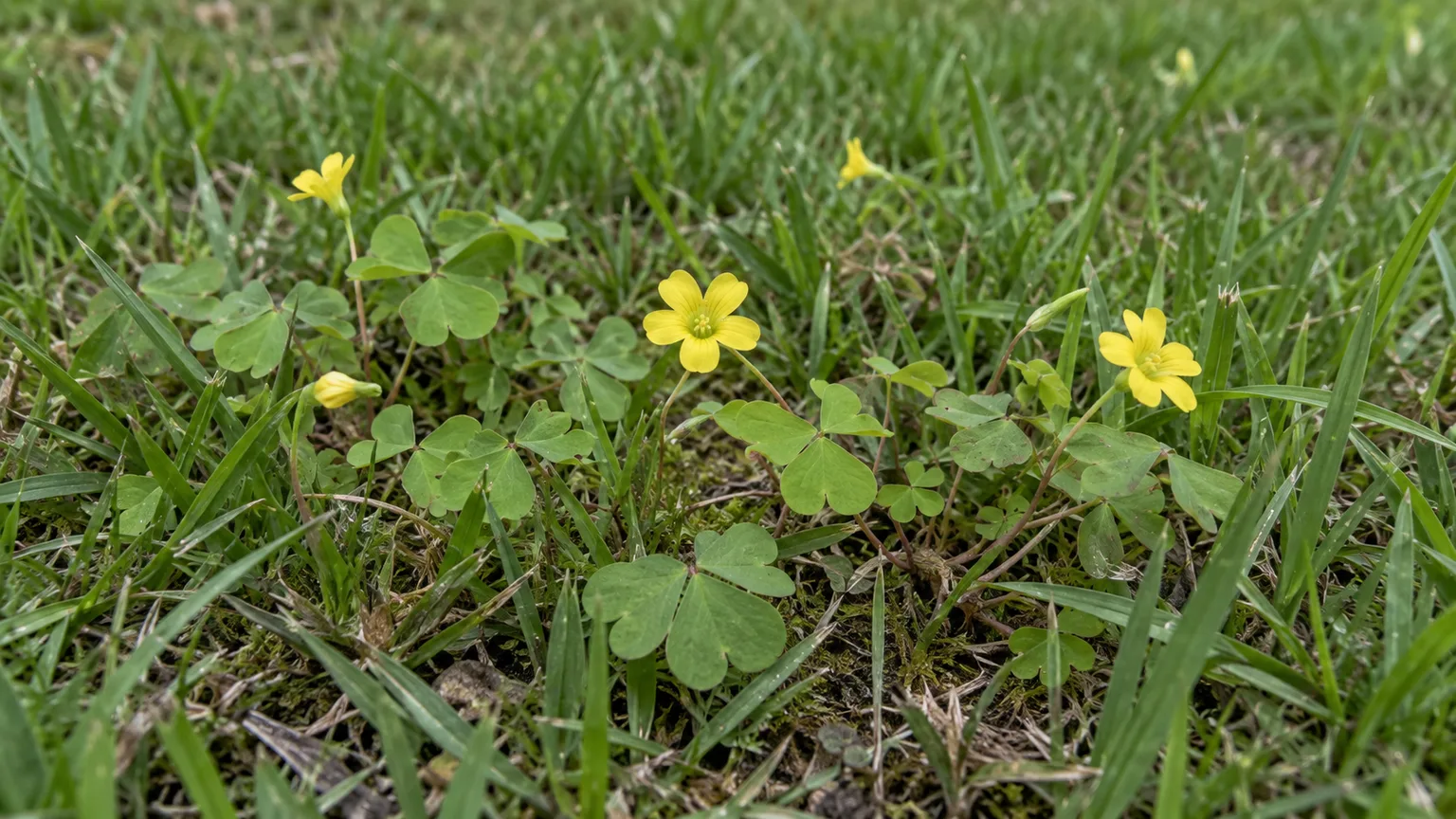
The reliable way to control oxalis is to identify how it spreads, choose a method that fits both the weed and your grass, and return to the patch before it sets another crop of seed or regrows from what was missed. Pulling the leaves alone often fails; blanket spraying can injure the lawn you are trying to save.
For a few young plants, careful lifting may be enough. For established or widespread growth, identify your turfgrass and use only a treatment whose label lists both the weed and your grass. Then strengthen thin turf and inspect the treated area through the next active growth period. There is no single “one and done” treatment for every plant sold or described as oxalis.
Make a quick assessment before treating the lawn
Before reaching for a tool or spray, look closely at one representative plant. Note whether the stems creep along the ground and root at joints, rise upright from a crown, or emerge in a clump from underground bulbs. That growth habit matters: surface runners, rhizomes, seed capsules, and bulbils do not respond to the same control step.
Next, estimate the size and pattern of the infestation. A handful of separated plants in otherwise dense turf is a different job from a connected mat, repeated patches near flower beds, or oxalis scattered through a lawn that is already thin. Mark the areas on a simple sketch or take photos from the same spots; this makes it easier to tell whether the patch is shrinking after treatment or merely disappearing for a few weeks.
Identify your grass if you plan to use an herbicide. A product that is tolerated by one turf species may damage another, and some labels restrict use by grass type, season, temperature, reseeding plans, or site. If you do not know whether you have, for example, tall fescue, Kentucky bluegrass, St. Augustinegrass, centipedegrass, zoysia, or bermudagrass, ask your local extension service or a qualified lawn professional before treating.
Finally, check whether flowers have turned into upright seed capsules. If capsules are mature, avoid dragging or crushing the plant through the lawn. Containing the seed-bearing material is the immediate priority; you can decide on longer-term control after the seed source is removed.
Identify the oxalis before choosing a method
Oxalis leaves usually have three leaflets, each with a noticeable notch that gives it a heart-like outline. Clover also has three leaflets, but they are generally more rounded and often show a pale V; clover flowers form rounded heads, while common oxalis flowers are small and five-petaled. Yellow flowers are common in lawn species, but pink-flowered and purple-leaved oxalis also occur, so flower color alone is not enough to identify a plant.
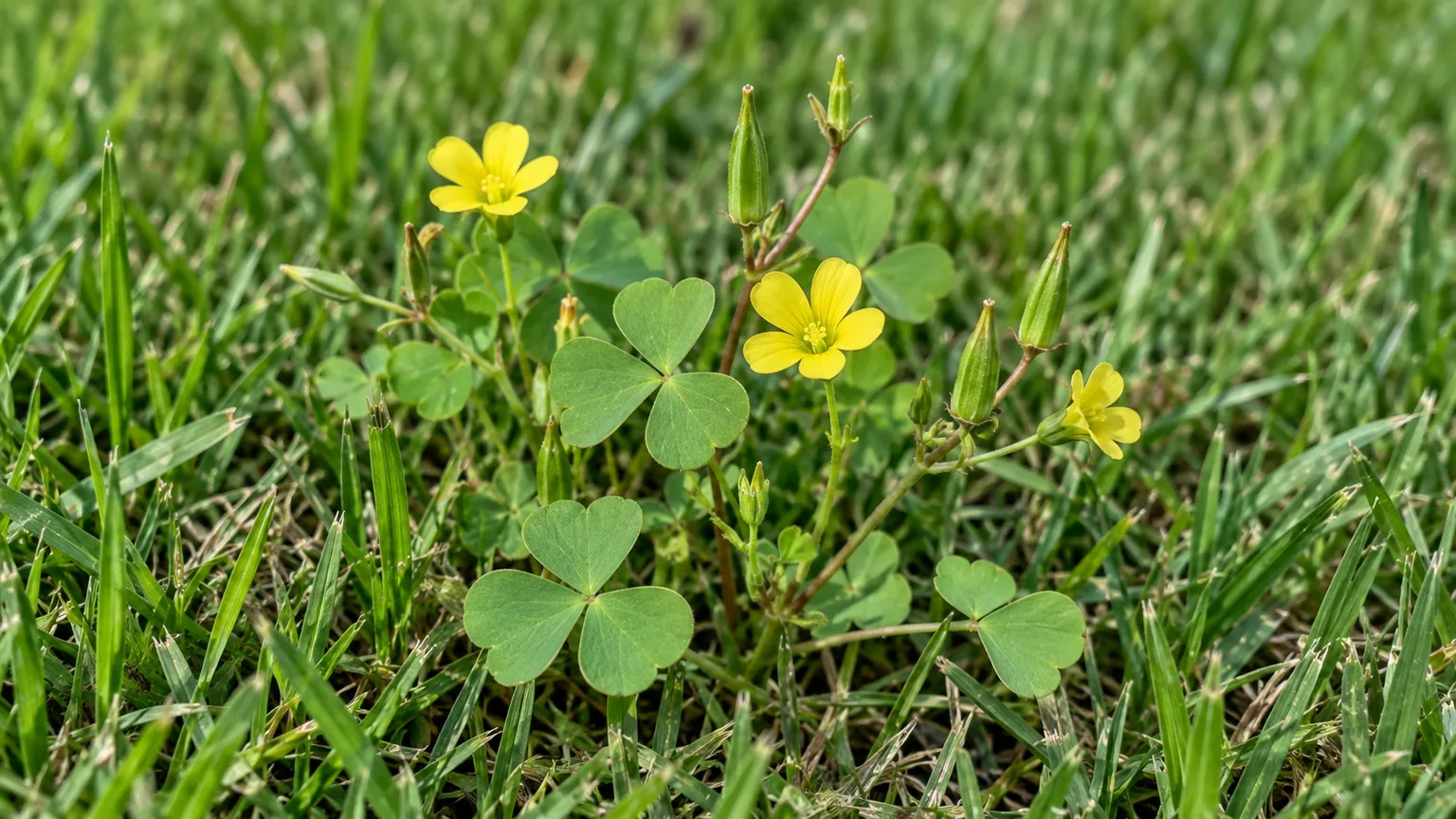
Yellow woodsorrel may start low and then branch upright. Its leaves alternate along the stem, and the small yellow flowers can be followed by narrow seed capsules that split when mature. Penn State Extension notes that yellow woodsorrel produces seeds from late spring into early fall and can also spread through rhizomes; its updated turf profile includes close identification details and photographs. Penn State Extension’s yellow woodsorrel profile
Creeping wood sorrel (Oxalis corniculata)
This species tends to hug the soil surface. Green, bronze, or purple-tinged leaves sit on creeping stems that can root where they touch damp soil; small yellow flowers and upright seed capsules may appear among the grass. A patch can therefore expand sideways even when the central plant looks small. The RHS describes its low, creeping habit and recommends lifting low stems before mowing when the goal is to collect and remove them. RHS guidance on identifying and controlling oxalis
Yellow woodsorrel (Oxalis stricta)
Yellow woodsorrel is often more upright and branched than creeping wood sorrel, especially once established. Its three heart-notched leaflets, yellow flowers, and slender capsules help separate it from clover, but young plants can still be difficult to distinguish in a dense lawn. Penn State’s turf profile describes it as a weed of home lawns, parks, golf courses, and athletic fields, and notes that it occurs in both sunny and shaded sites.
Bulb-forming oxalis
Some oxalis form small bulbs or bulbils below the soil surface. Pink wood sorrel (O. debilis) and broadleaf wood sorrel (O. latifolia) are examples; Bermuda buttercup or soursob (O. pes-caprae) is another bulb-forming species in regions where it occurs. A clump with pink flowers or a larger rosette may be a clue, but species and local distribution vary. RHS and Yates both emphasize that bulb-forming oxalis can spread when tiny bulbils are dislodged, so aggressive digging or rototilling may distribute the problem rather than solve it. RHS oxalis guide and Yates’ species descriptions
Not every oxalis is an unwanted lawn weed. Some species are grown ornamentally, and a low patch in a rough area may not justify disturbing healthy turf or applying herbicide. If identification affects the treatment choice, take a clear photo of the leaves, flowers, seed capsules, and whole-plant habit to your county extension service before acting.
Decide whether control belongs in the lawn
The right target is not always a completely oxalis-free yard. A few plants in a low-traffic edge or informal meadow may be tolerable; the same plants in fine turf, a play area, or a patch that is producing seed may deserve control. If you are comfortable with a mixed lawn, removing seed heads and keeping the surrounding grass vigorous can be a reasonable middle ground.
Control is more urgent when the patch is expanding into thin turf, when runners are entering beds or pavement joints, or when seed capsules are forming. It also makes sense to act when the weed is interfering with the way you use the lawn. That simple decision prevents unnecessary chemical use and helps you set a realistic goal, such as stopping spread and reducing visible patches rather than promising eradication in one season.
Match the method to the patch and the plant
Use the plant’s growth form and the turf’s condition together. The table is a starting point, not a substitute for local identification or a product label.
| What you see | Sensible first move | Main limitation |
|---|---|---|
| A few young, separated plants | Lift each plant with a narrow hand fork and remove attached runners or roots | Missed nodes or root pieces can regrow; check again |
| Low creeping stems across grass | Rake gently to lift runners before mowing, then collect clippings and remove seed-bearing material | Mowing weakens and contains; it does not remove underground growth |
| Repeated patches in established turf | Identify the grass and compare a selective postemergence product label with the weed and conditions | One application may not control all stages or species |
| A clump that appears to have bulbs or bulbils | Avoid rototilling; identify it and lift carefully only if you can contain the small propagules | Breaking and scattering bulbils can create more plants |
| Oxalis throughout thin or failing turf | Treat the turf problem as well as the weed; consider a staged lawn renovation | Herbicide alone leaves the openings that allowed reinvasion |
For a decision that is not obvious, choose the least disruptive first step that can realistically work. Gardening Know How writer Bonnie L. Grant also cautions that pulling can leave fragments behind; the practical lesson is to lift a small plant rather than tugging its foliage and to return for regrowth. Gardening Know How’s oxalis control guide
Remove small, isolated patches by lifting the plant
Hand removal is most useful when plants are young, patches are small, and you can see what you are extracting. Water the lawn lightly the day before if the soil is dry; slightly moist soil releases roots more readily, while saturated soil tears and compacts. Work when the ground is workable, not when it is muddy or hard as concrete.
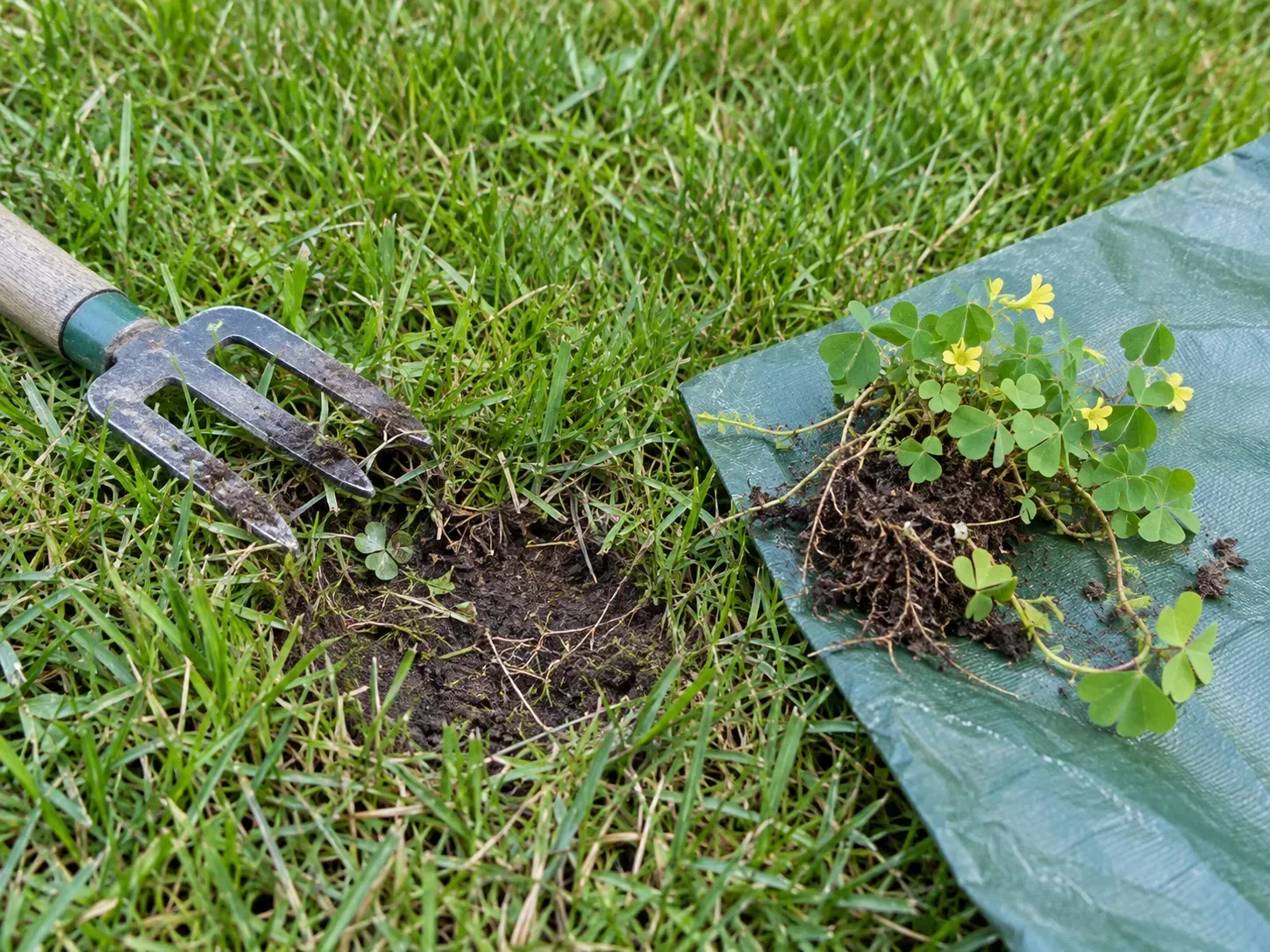
Use a narrow hand fork or dandelion weeder to loosen the soil around the crown. For creeping wood sorrel, follow the visible runner far enough to lift the rooted joints rather than plucking only the upright leaves. For yellow woodsorrel, loosen the soil around the crown and taproot, then inspect the hole for attached plant material. Avoid slicing through a connected mat before you know how it spreads.
Lift gently and keep the plant intact as far as practical. Shake off only loose soil, not attached roots or bulbs; if you see tiny bulbils, avoid scattering them. Put the plant directly into a bag or container instead of carrying it across the lawn. Refill the small hole with soil and press the surrounding turf back into place so it does not become a bare spot for another weed.
Do not expect to find every underground part in one pass. Return to the same patch after new growth is visible and remove the survivors while they are still small. A repeated, careful pass is usually less damaging to the lawn than digging a broad crater around every leaf.
Keep low runners and seed capsules from spreading
Low oxalis stems can sit beneath the mower deck and escape a routine cut. On a small patch of creeping wood sorrel, use a light rake to lift the stems so the mower can cut and collect them, as the RHS recommends. Keep the mower at the correct height for your turf; scalping the lawn to reach a weed stresses grass and can leave more bare soil.
If you see seed capsules, collect the clippings from that area rather than leaving them in the lawn or using them as mulch. Do not put seed-bearing plants, roots, bulbs, or bulbils in a cool home compost pile. The RHS advises sending oxalis waste through a local green-waste service or disposal route that accepts it, rather than relying on a home heap to kill viable plant parts. Check your municipality’s rules before bagging or transporting invasive weeds.
Lawn Phix author Mark Marino, a licensed lawn-care applicator, similarly recommends removing clippings where oxalis may be present. The exact risk depends on the plant and whether it carries mature capsules, but collecting clippings during active seed production is a sensible containment step. Lawn Phix’s practical oxalis guide
Use a lawn herbicide only when its label fits
For established oxalis in turf, a selective postemergence herbicide may be an option, but “broadleaf weed killer” is not enough information to choose one. Read the current label for the exact turf species, oxalis or woodsorrel target, site, application timing, temperature range, reseeding restrictions, protective equipment, and required waiting periods. If the label does not clearly allow your grass and use site, do not apply the product there.
Penn State Extension lists several combinations of active ingredients for yellow woodsorrel and stresses that the label governs tolerant grass species, rates, and timing. That list is regional and product availability changes; it is not a recommendation to buy a particular brand or to apply a product at a rate from an article. LSU AgCenter guidance also shows why turf type matters: herbicide options for warm-season grasses differ from options in other lawns. Penn State turf guidance and LSU AgCenter guidance
Do not spray by calendar alone. Treat only when the weed is at a stage and the weather fits the product directions; avoid drift onto ornamentals, vegetable gardens, water, or neighboring property. Do not assume that extra product, repeated applications closer together, or tank-mixing will improve control. Follow the label exactly, including rain-free intervals, re-entry directions, and any limits around pets, children, or reseeding.
Selective products: less collateral risk, not zero risk
A selective product is intended to control listed weeds while being tolerated by listed turf species under stated conditions. That does not make it harmless to every lawn. The same active ingredient can have different restrictions across formulations, and heat, drought stress, mowing timing, application rate, or an incompatible grass type can raise the risk of turf injury.
Preemergence and postemergence products also do different jobs. A preemergence product can reduce germination from seed when correctly timed, but Penn State notes that it does not affect yellow woodsorrel plants emerging from rhizomes. It will not remove leaves or mature plants already in the lawn. A postemergence product targets emerged foliage; it may reduce existing growth but cannot guarantee that every seed, runner, or bulbil is gone.
Nonselective and “natural” weed killers
Nonselective herbicides can injure or kill desirable grass as well as oxalis. Reserve them for a situation where killing the turf in the treated area is acceptable, such as a planned renovation, and only if the current label permits that use. A shield or careful spot treatment can reduce drift, but it does not make contact with nearby grass impossible.
Household vinegar, salt, boiling water, and dish-soap mixes are poor lawn fixes. They can scorch exposed leaves or damage grass, but they do not reliably remove underground runners, rhizomes, or bulbils. Salt can also persist in soil and harm future plants. “Natural” describes an origin or marketing category, not selective behavior or guaranteed safety; choose a method by its effect on both the weed and the lawn.
Time treatment to growth, then check again
There is no single national date to treat oxalis. Yellow woodsorrel flowering and seed production, bulb-forming species, local winter temperatures, turf type, and the product label all affect timing. Use growth stage and local extension advice rather than copying a month from a different climate. For herbicide treatment, the label’s temperature and seasonal restrictions take priority over a general calendar tip.
Make the first visit a control pass, then schedule a follow-up while the lawn is still in an active growth period. Check the treated area about a week later for missed plants or visible seed capsules, and revisit it every week or two while new growth is appearing. That interval is a practical inspection routine, not a claim that all oxalis responds on the same timeline. Remove or spot-treat new growth only when the selected method and label allow it.
Keep a simple record of the date, weather, product if used, lawn species, and what changed. If foliage disappears but the same patch returns, the likely issue may be surviving plant parts, new seedlings, or a treatment mismatch—not proof that a stronger dose is needed. Change the diagnosis or method before repeating an application.
Help the lawn close the gaps
Oxalis takes advantage of openings. Penn State Extension recommends reducing yellow woodsorrel infestations by improving turf density through regular mowing, fertilization, and grasses suited to the site. That does not mean feeding more than the lawn needs: follow a soil test or local turf calendar, and avoid pushing tender growth with excess fertilizer.
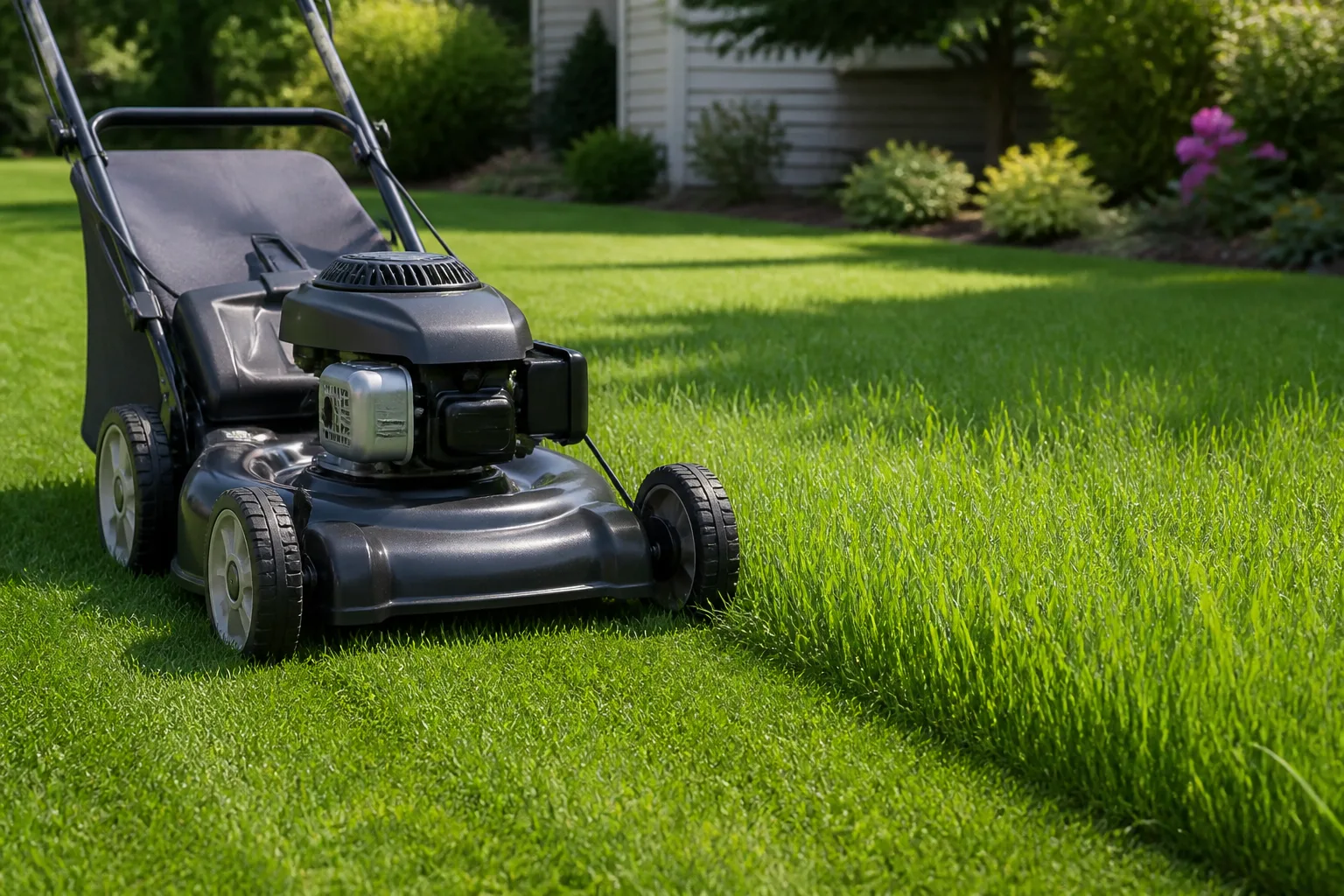
Mow at the height recommended for your grass species and keep the blade sharp. Cutting too short weakens turf and exposes soil; letting it become excessively tall and then removing a large amount at once can stress it too. Water deeply enough for the turf’s needs, then allow the surface to dry between irrigations when appropriate for your climate and soil. Fix compacted or chronically wet areas that are preventing grass from filling in.
After manual removal or herbicide treatment, repair bare spots with a turfgrass suited to the site and season. Before seeding, check the herbicide label for the waiting period; some products can prevent desirable grass seed from germinating as well as weed seed. If shade, traffic, drainage, or soil conditions make the chosen grass struggle, reseeding the same failing species may simply recreate the opening.
Keep the lawn strategy species-specific. A cool-season fescue lawn in shade needs a different mowing and renovation calendar from a warm-season lawn in a hot, sunny region. Good turf care will not kill an established oxalis colony by itself, but it makes reinvasion less likely after removal or treatment.
Avoid control methods that create a second problem
Do not yank a large mat and assume the job is done. Fragile stems can break, rooted nodes may stay behind, and a bulb-forming species can leave small propagules in the soil. Digging is reasonable for a small, identifiable patch; repeated deep cultivation or rototilling through unknown oxalis can spread pieces and destroy the turf you want to retain. RHS guidance specifically warns against unnecessary soil disturbance around oxalis that spreads by bulbils.
Do not use a preemergence product as a rescue treatment for green plants already growing. Do not use a nonselective spray over grass because the bottle says “weed killer,” and do not assume that a product suitable for a garden bed is safe for turf. A lawn herbicide label must match both the weed and the grass.
Avoid vinegar or salt “recipes,” cutting the grass unusually short, and applying fertilizer as a weed-killing tactic. Those moves can injure turf or soil without addressing the plant’s actual route of spread. Also avoid composting seed heads or bulbils in a pile that does not reliably heat throughout; contain the material and follow local disposal guidance.
How long oxalis control really takes
Expect control to take more than one inspection, especially if plants are mature or widespread. A successful first treatment may brown or remove visible foliage, but dormant seeds can germinate later and surviving rhizomes or bulbils can produce new shoots. Gardeners Know How and Lawn Phix both describe oxalis as persistent and emphasize repeated monitoring; Penn State’s life-cycle account explains why seed and rhizome sources need different control.
Measure progress by the patch getting smaller and producing fewer seed heads over successive growth periods, not by whether every leaf vanishes immediately. If the same plants return, note where they emerge: along runners, at the original crown, or as scattered seedlings. That pattern helps you decide whether you missed roots, disturbed bulbils, left seed-bearing clippings, or need to improve thin turf.
When a lawn professional makes sense
Call a qualified lawn-care professional when oxalis is widespread, the grass species is uncertain, several treatments have failed, or the lawn is valuable enough that a wrong herbicide could be costly. Ask what species they believe is present, whether the proposed product is labeled for your exact turf, how they will protect nearby ornamentals, and what follow-up or reseeding interval applies.
If the oxalis forms bulbils or appears across beds and turf, ask the professional to explain how their plan avoids spreading small plant parts. A competent plan should include identification, treatment limits, and a follow-up visit or monitoring schedule—not a promise that one application will make the weed disappear permanently.
Conclusion
Start by confirming the oxalis and how it spreads. Lift a few small plants intact, collect low runners and seed-bearing clippings where appropriate, and use herbicide only when the label fits both the weed and your grass. Then repair thin turf and revisit the same areas while growth continues.
The lawn that stays clearer is not necessarily the one treated most aggressively. It is the one where the weed was identified correctly, the treatment matched the species and turf, and regrowth was caught before it became another mature patch.