How to Get Rid of Ants Fast—and Keep Them Away
Get rid of ants with a practical sequence: erase trails, use slow-acting bait, seal entry points, protect plants, and know when to call a pro.
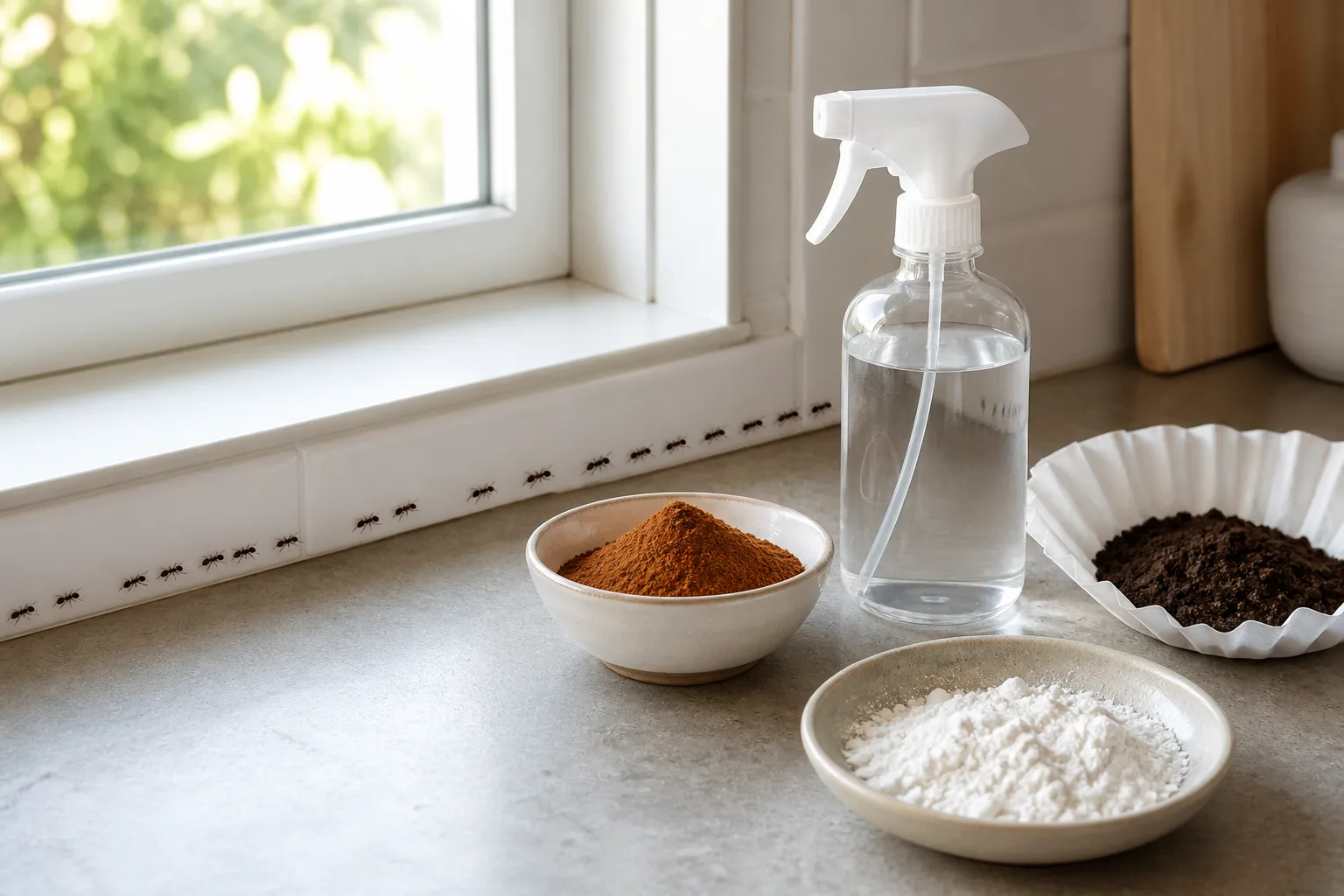
If you need ants gone today, use a sequence instead of reaching for the strongest spray: remove food and water, wipe away the trail, place a slow-acting bait where ants are actively foraging, and seal the route once activity drops. That combination deals with both the ants you can see and the colony you cannot.
There is one frustrating catch: the fastest visible result is not always the fastest lasting result. A contact spray can make a countertop look clear in minutes while leaving the nest and its queen untouched. Bait may attract more workers at first and take several days—or longer—to finish its work, but it gives the colony a chance to carry the active ingredient home.
The first 30 minutes: stop the trail without making the problem worse
Remove the reward and erase the scent trail
Put away sugar, fruit, bread, pet food, and anything sticky. Wipe counters and the floor around the trail with soapy water, vacuum up visible ants, and empty the vacuum afterward. Ants follow chemical trails left by earlier foragers, so cleaning is not just about making the room look tidy: it removes a route that tells the next worker where to walk.
Check for water at the same time. Dry the sink, wipe up condensation, repair an obvious drip, and do not leave a wet dishcloth bunched beside the trail. The UC IPM quick guide to ants in the home recommends combining sanitation, exclusion, and baiting rather than expecting one treatment to solve every invasion.
Do not seal the first crack you see while ants are still pouring through it if sealing would trap them inside a wall void or force them into another room. Clean and observe first; close the route after you understand where it leads and have decided whether bait belongs there.
Follow the trail to its entry point
Watch the ants for five to ten minutes without disturbing them. Trails commonly run along baseboards, cabinet edges, plumbing, electrical wires, window frames, door thresholds, and the seam where a wall meets a floor. Follow the line in both directions: one end may lead to a crumb, while the other reveals the gap, plant, pipe, or exterior wall that is supplying the workers.
If the trail disappears under trim, behind a backsplash, or into a wall, note the exact spot and the time of day. A few scouts wandering alone suggest a food search; a steady, organized line suggests a known resource or a nest route. That distinction helps you decide whether cleaning and caulk are enough or whether bait and an inspection are warranted.
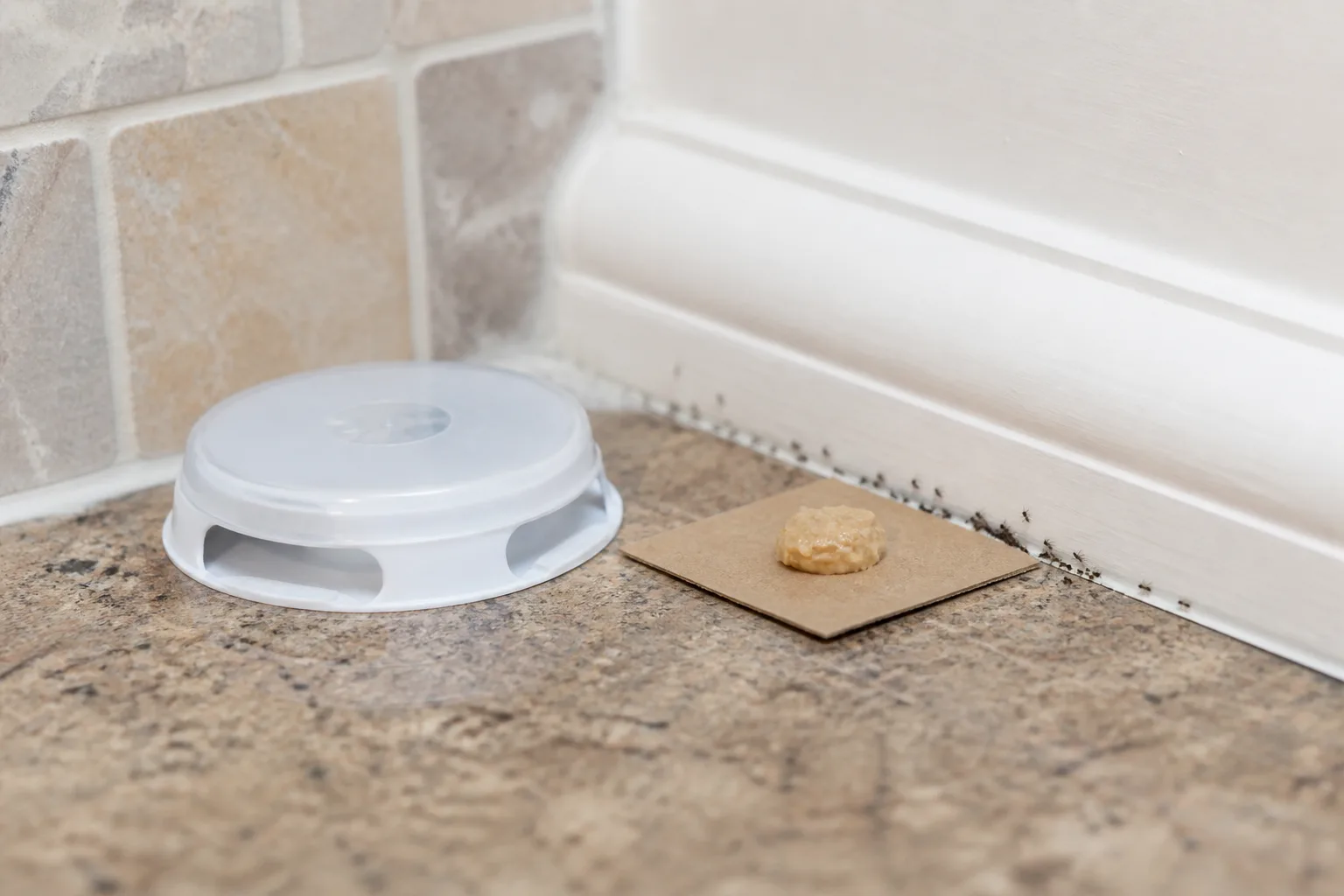
Keep any bait in its labeled station or container, beside active traffic, and inaccessible to children and pets.
Identify the ant before choosing treatment
You do not need a microscope to choose a sensible first step, but you should not identify an ant by color alone. Size, body shape, wings, location, nesting material, and the time of year all matter. If possible, trap one specimen on clear tape or photograph it beside a ruler rather than crushing the entire trail before you have looked at it.
Small indoor ants are usually a food-and-entry problem
Tiny brown, black, or yellowish ants in a kitchen, bathroom, or windowsill are often searching for sugar, grease, water, or a warm protected route. Several common household species look alike to an untrained eye and may respond differently to sweet, protein-based, or grease-based baits. The University of Minnesota Extension ant guide makes the key point: correct identification affects nesting, food preference, and control.
For this group, begin with sanitation, trail removal, a check for indoor plants, and exclusion. If ants keep returning from a hidden gap, a ready-to-use bait station labeled for indoor use is usually a more useful next step than spraying the baseboard repeatedly.
Carpenter ants and termites need a different response
Carpenter ants are usually much larger than the tiny ants found around sugar, and they may leave coarse wood debris or sawdust-like frass near a nest opening. They excavate existing weak or damp wood rather than eating wood like termites, but a nest inside a wall, sill, ceiling, or roof edge still deserves attention. University of Minnesota Extension’s carpenter-ant guidance notes that indoor nests can be hidden and that spraying foraging workers does not eliminate the nest.
Winged insects make identification more urgent. Ants have a pinched waist, elbowed antennae, and—when winged—front wings longer than hind wings. Termites have a broad, straight-sided waist, straight antennae, and four wings of similar length. If you see many winged insects indoors, discarded wings, or wood damage, save a specimen and arrange a professional inspection instead of assuming it is an ordinary ant trail.
| What you notice | More likely explanation | Best next move |
|---|---|---|
| Tiny ants near sugar, grease, or water | Common household foragers | Clean, follow, bait if persistent, then seal. |
| Large dark ants plus wood dust or damp wood | Possible carpenter-ant nest | Inspect moisture and wood; use bait or a qualified professional rather than random spraying. |
| Winged insects with a broad waist and equal-length wings | Possible termite swarmers | Treat it as an inspection issue; do not rely on ant bait. |
| Ants climbing a plant with sticky leaves or curled new growth | Aphids, scale, or another honeydew source | Inspect the plant and control the sap-sucking pest. |
Use bait when you want to kill the colony
An ant bait is food combined with a slow-acting insecticide. Workers feed, carry small portions back, and share it with nestmates. The goal is not to kill the first worker at the kitchen edge; it is to give the colony enough time to distribute the bait before the active ingredient takes effect. UC IPM’s ant-management guide explains why slow action, correct placement, and patience are central to colony control.
Choose and place bait so workers can carry it home
Start with a commercial bait station or gel whose label names the ant and the location you need to treat. A bait labeled for outdoor use is not automatically appropriate for a kitchen, and a product safe for a crack or crevice may not be approved for a countertop or food-preparation surface. In the United States, pesticide labels are legally enforceable; the U.S. Environmental Protection Agency’s label guidance is the reason “follow the label” is a use rule, not a vague disclaimer.
Place the bait next to active traffic, not in the middle of a room and not on top of food. Use several small placements if the trail splits. Keep stations away from children, pets, toys, food bowls, and areas that get washed, and check the package for indoor/outdoor limits. If ants ignore the bait, do not keep adding more of the same product: move it closer to the trail or try a different labeled formulation, because food preferences can change by species and season.
Expect an initial increase in activity. That is often evidence that workers found the food attractant, not proof that the bait failed. Leave the trail undisturbed, replenish only as the label directs, and watch the trend over the next several days. UC IPM’s quick tips note that visible reduction can take roughly five to ten days, while larger or hidden colonies may take longer.
Never mix your own borax or boric-acid recipe around a home simply because it sounds natural. A homemade concentration may kill workers before they return, spill easily, contaminate a food surface, or create an exposure risk that an enclosed product is designed to reduce. The National Pesticide Information Center’s boric-acid fact sheet advises following the label and limiting contact, inhalation, and access by children and pets.
Why spraying alone usually fails
Contact sprays kill exposed foragers, which can be useful for a one-off ant that wandered inside, but they usually do not reach the queen, brood, or hidden nest. A colony can replace the workers you killed, and a repellent spray can make ants change routes or remain trapped indoors. Spraying around a bait can be especially counterproductive because the workers need to stay alive long enough to carry food back.
The EPA’s pest-control guidance places baits among the first chemical defenses after prevention and advises targeted applications instead of coating a whole room. If you choose an insecticide, use the least extensive labeled treatment that fits the pest and location, and do not combine a repellent spray with a baiting program unless the product label and a pest professional specifically support that plan.
Seal the route and change the outdoor conditions
Close entry points and remove moisture
Once bait has had time to work and the trail has thinned, caulk the crack, replace worn weatherstripping, repair a window-screen gap, and close openings around pipes, cables, and utility lines. Inspect under sinks, around dishwashers, behind toilets, at door thresholds, and where a foundation meets siding. A sealed gap is much more effective when the leak, condensation, or damp wood that made the route attractive has also been corrected.
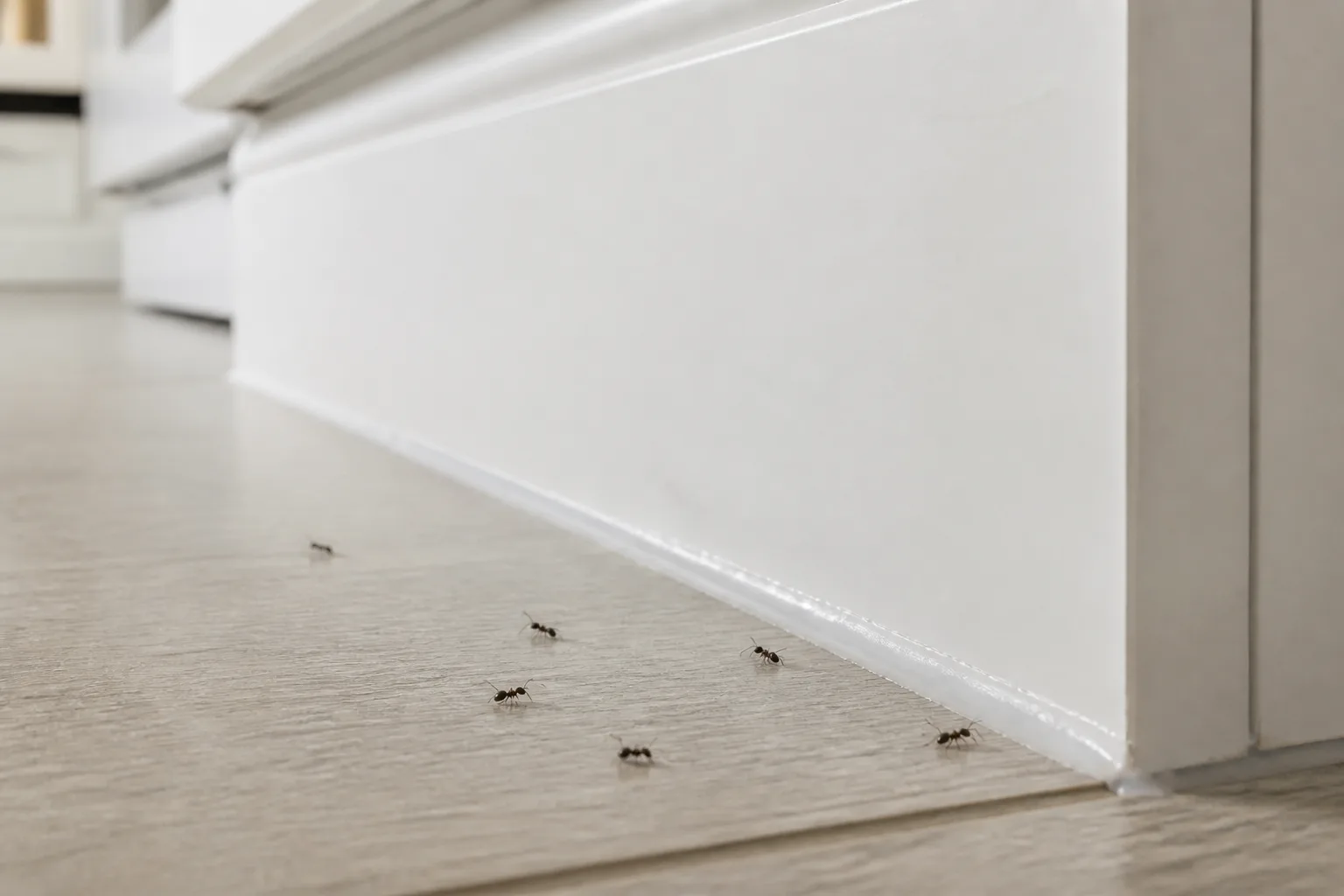
Trace the route before you seal it; the useful target is the gap the ants use, not every visible ant.
If the route is in a wall and you suspect a carpenter-ant nest, do not inject dust or liquid pesticide into an electrical void or drill into trim on a guess. Hidden nests are a job for someone who can locate the colony and choose an application that will not create a new indoor hazard.
Break bridges and address honeydew-producing plant pests
Outside, prune branches and stems that touch the siding or roof, pull mulch and leaf litter back from the foundation, and keep firewood, lumber, and damp debris away from the house. Look at the exact plant route the ants are using rather than removing every plant near the building. Ants often travel on a branch because it is a convenient bridge, not because the plant itself is the nest.
Ants on a garden plant can also signal aphids, scale, mealybugs, or another sap-sucking insect. These pests excrete honeydew, and ants may protect them from predators to keep the sugary food supply. The Royal Horticultural Society’s ant guidance recommends tolerating garden ants where they are not causing harm, while its aphid guidance explains the ant–aphid relationship. Inspect leaf undersides, shoot tips, and stems before reaching for an outdoor insecticide.
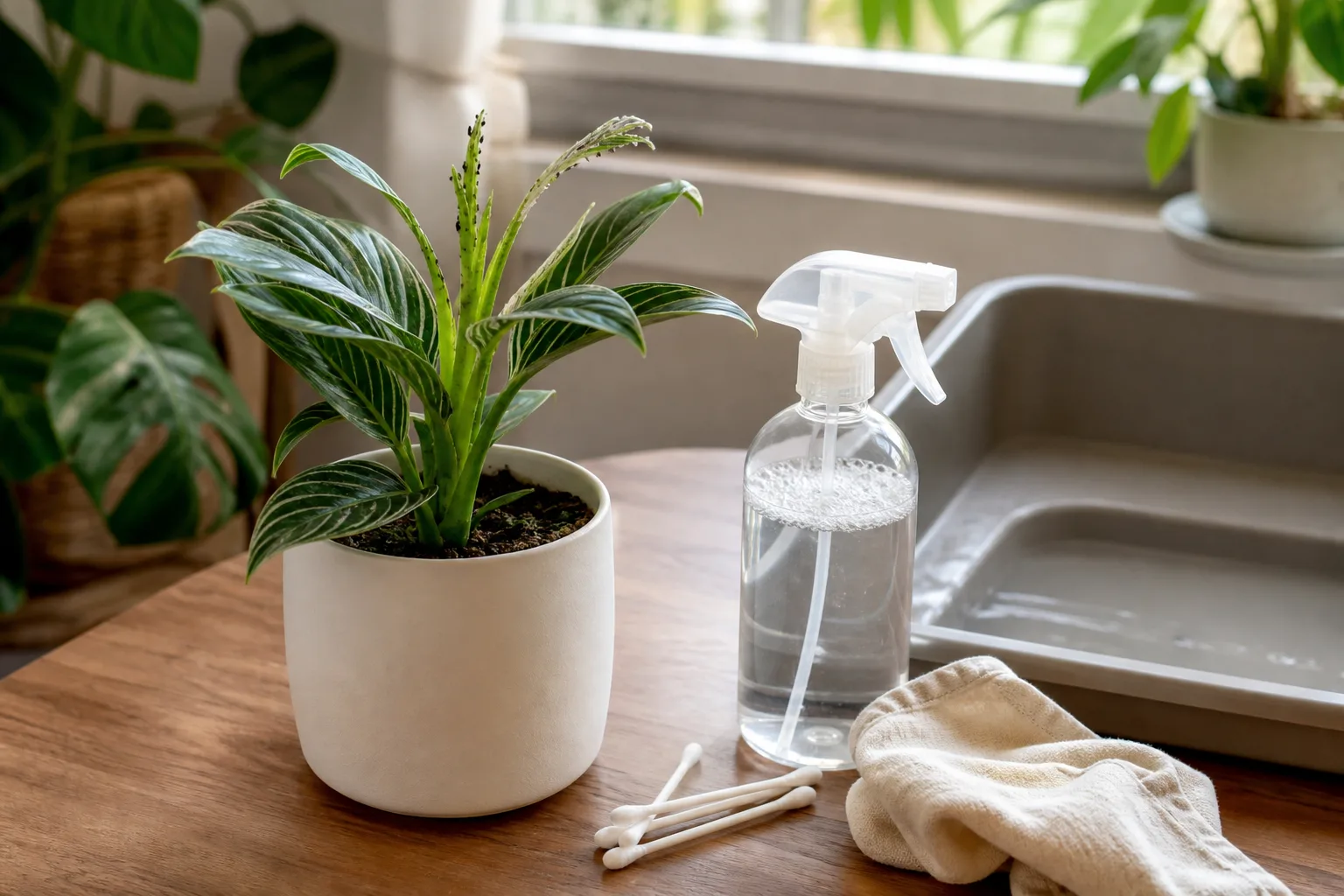
Ant activity on a plant is a reason to inspect for honeydew-producing pests, not automatic proof that ants are eating the plant.
If the issue is fire ants in a lawn or play area, use a product labeled for fire ants and your application site, keep people and pets away as directed, and consider local extension advice. Fire-ant baiting is a distinct job from treating a few kitchen ants; Fine Gardening’s fire-ant overview describes why colony-directed bait is preferred to indiscriminate spraying.
If ants are in a potted plant
Move the plant away from the rest of the collection and inspect the pot rim, drainage holes, saucer, soil surface, and undersides of leaves. Ants may be nesting in dry potting mix, using the pot as a sheltered route, or harvesting honeydew from aphids or scale above the soil. The UC IPM ant guide specifically lists potted plants among places to inspect for indoor nesting.
First remove the plant’s saucer water, dead leaves, and visible pests; wipe the trail from the shelf with soapy water. If the colony is clearly in the pot, take the plant outdoors or to a washable area, remove the plant from its container, discard badly infested old mix, rinse the pot, and repot into fresh mix if the roots are sound. Do not pour household ant spray, bleach, vinegar, essential oil, or a concentrated borax mixture into the soil. Those substances can injure roots without solving a colony that has already moved into a wall or nearby planter.
After repotting, keep the plant isolated until you no longer see ants and treat any aphids, scale, or mealybugs with a product labeled for that plant and pest. If the plant is valuable or the ants return from the room rather than the pot, focus on the building trail instead of repeatedly disturbing the roots.
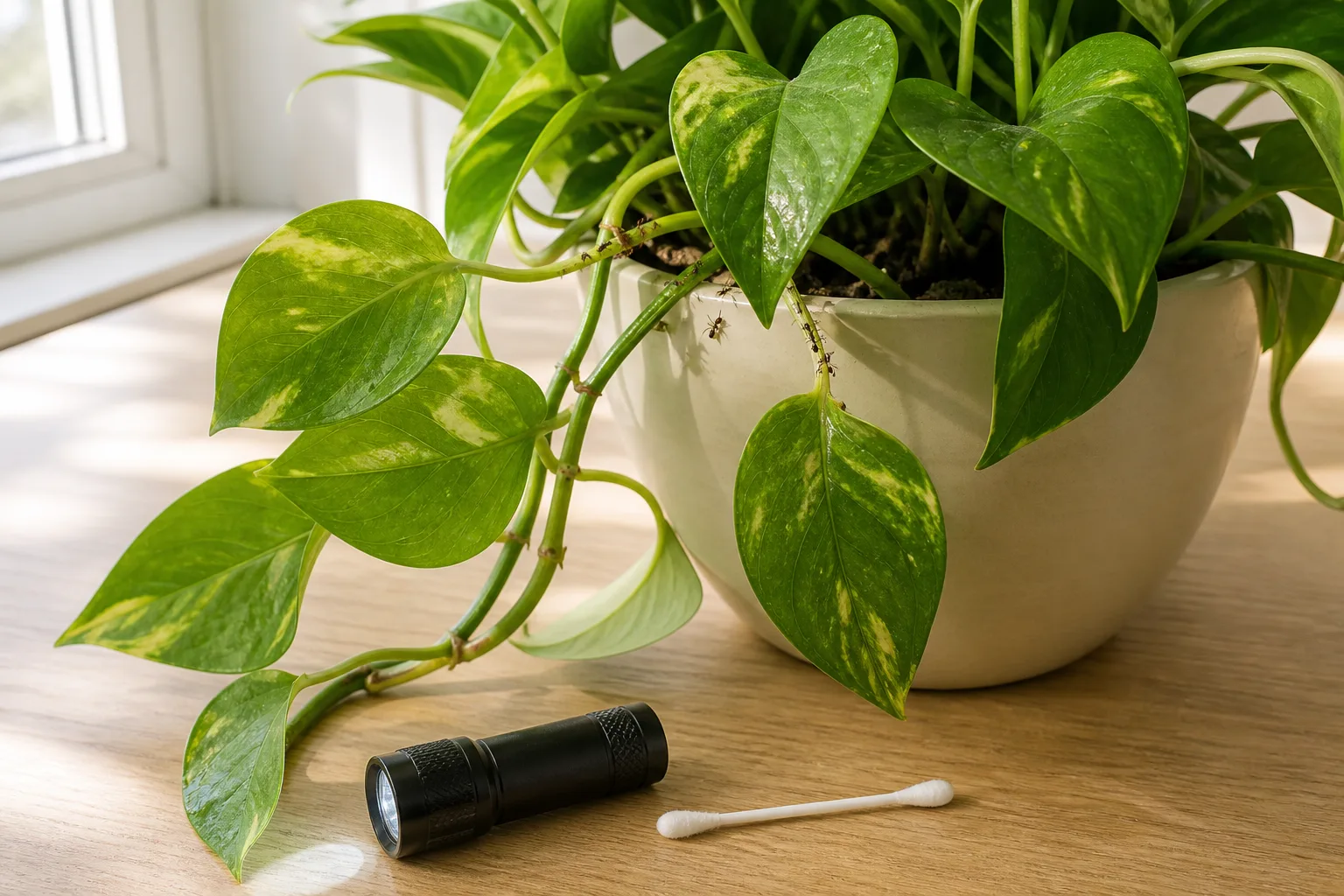
Isolate an ant-filled pot and inspect both the soil and the foliage before treating either one.
What about vinegar, cinnamon, coffee grounds, and diatomaceous earth?
Strong smells and household powders can make an existing trail less attractive for a while, but they are not a reliable replacement for colony control. Vinegar or soapy water can remove the trail on a hard surface; cinnamon, coffee grounds, citrus, and essential oils may disrupt traffic temporarily; none should be treated as proof that the nest is gone. If the food, water, and entry route remain, workers can simply choose another path.
Diatomaceous earth has a different limitation. It can damage an insect’s waxy outer layer when it stays dry and the insect crosses it, so it may kill exposed ants. It does not travel through the colony like bait, and damp conditions make it less useful. More importantly, “food grade” does not mean “tested and labeled for pest control.” The National Pesticide Information Center’s guidance on diatomaceous earth warns that unlabeled food-grade products do not provide pest-control directions or exposure precautions; if you use a dust at all, choose a labeled product, avoid creating airborne dust, and keep it away from children, pets, food, and high-traffic areas.
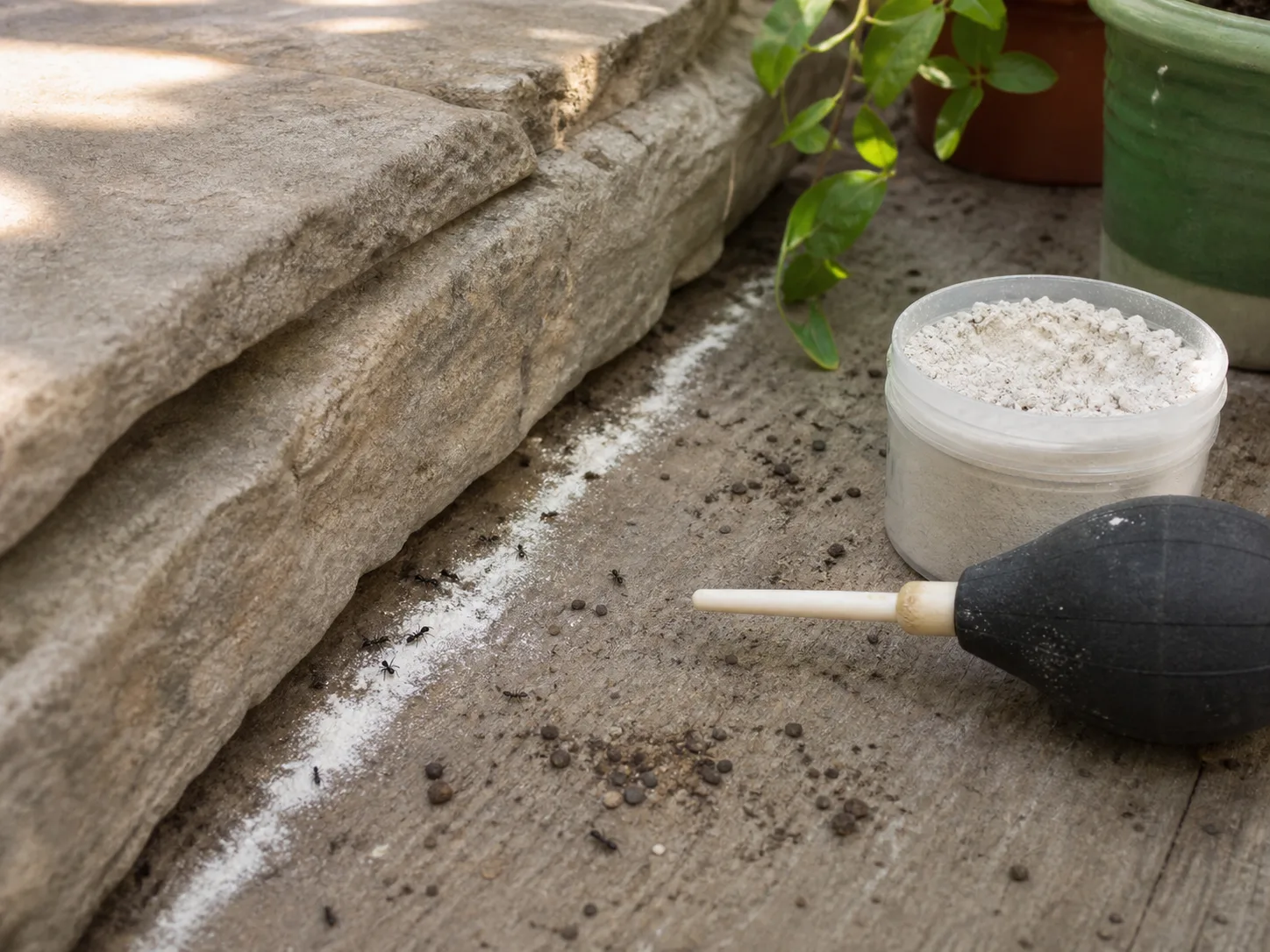
A dry dust can affect exposed insects, but it is a contact tool—not a substitute for locating a colony or using bait safely.
Know when to call a professional
Red flags that deserve an inspection
Call a licensed pest-management professional or your local extension office when:
- large ants repeatedly appear from a wall, ceiling, window frame, sill, or roof edge;
- you find wood dust, hollow-sounding damp wood, or visible galleries;
- winged insects emerge indoors or you find piles of shed wings;
- ants return after a careful baiting and exclusion cycle;
- the nest is inside an inaccessible wall, beneath a slab, or near electrical wiring;
- the infestation involves stinging fire ants near children, pets, or a frequently used path; or
- someone in the household cannot safely be kept away from bait or pesticide treatment areas.
Ask what species the technician suspects, where the nest is, what moisture or food source is sustaining it, and whether the plan uses targeted bait and crack-and-crevice treatment rather than automatic monthly perimeter spraying. The EPA recommends asking hired help to find and correct the source before applying pesticides and to use baits or targeted treatments when feasible.
If a child or pet gets into bait, do not guess from the product name. Move the product away, keep the package, rinse the mouth or skin as appropriate, and contact your local poison center or veterinarian. In the United States, Poison Control’s ant-bait guidance provides immediate advice at 1-800-222-1222; other countries have their own poison-information services.
Keep ants away with a small weekly routine
Ant prevention is less about making a home chemically hostile than removing the conditions that make a trail worth maintaining. Once a week, sweep crumbs from edges, wipe sticky spills, rinse recycling, empty food waste, and check pet-food areas. Store sugar, flour, cereal, and ripe fruit in clean, sealed containers rather than open bags or cardboard boxes.
Run a quick moisture check under sinks, around the dishwasher, at bathroom fixtures, near refrigerator water lines, and around exterior hose bibs. Replace failed caulk and weatherstripping before the next warm spell. If ants used a plant as a bridge, prune the contact point and inspect that plant for aphids; if they used mulch or firewood against the foundation, create a dry inspection gap.
Do not try to eliminate every ant outdoors. Ants can prey on other insects, move through soil, and contribute to garden biodiversity. The RHS notes that most garden ants do little direct damage to plants and are best tolerated unless the nest is troublesome. Reserve stronger control for ants entering buildings, protecting plant pests, stinging people, damaging structures, or creating a genuine nuisance.
Conclusion
The dependable way to get rid of ants is to think in layers: clean the reward, erase the trail, identify the route, bait the colony when needed, seal the entry, and correct the moisture or plant-pest problem that keeps attracting workers. Sprays and strong smells may clear a few ants quickly, but they rarely solve the hidden nest and can interfere with bait.
Give a properly placed bait time to work, keep every pesticide within its label, and escalate when the evidence points to carpenter ants, termites, fire ants, or a hidden structural nest. That approach is faster in the only sense that matters: it reduces the chance you will be back at the same baseboard next week.



