How to Grow a Pineapple Indoors or Outdoors at Home
Learn how to grow a pineapple indoors or outdoors, with clear steps for rooting, light, water, feeding, flowering, harvest, and pups for the next generation.
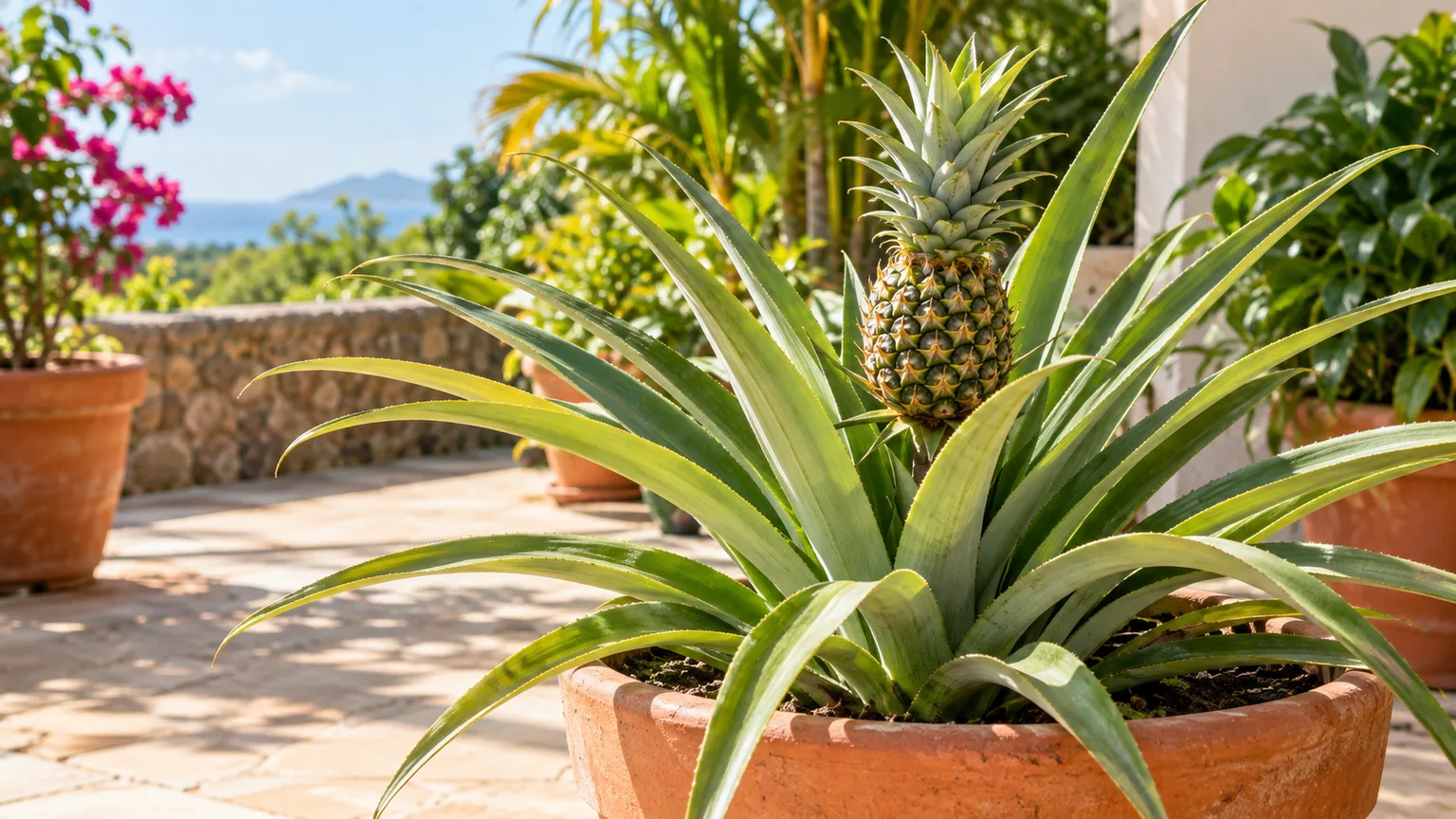
You can grow a pineapple from the leafy crown of a grocery-store fruit, but treat it as a long-term container or warm-climate garden project, not a quick kitchen experiment. The crown has to root, build a broad rosette of leaves, and reach flowering size before a fruit can develop; a healthy plant can still take a couple of years to complete that cycle.
Pineapple (Ananas comosus) is a bromeliad, a tropical herb with stiff leaves arranged around a short stem. It can look handsome as a houseplant long before it fruits, but ornamental growth and fruit production have different light and space requirements. UF/IFAS Extension describes mature plants as about 3 to 6 feet tall and wide, so a fruiting plant needs a genuinely sunny position and room for spiny foliage.
Can a grocery-store pineapple grow into fruit?
Yes. A fresh, healthy top from an edible pineapple can root and become a fruiting plant. The leafy crown is not a seedling; it is vegetative planting material taken from the growing point above the fruit. Once it has roots, it grows as a rosette and may eventually produce a flower stalk from its center.
The realistic question is not whether a crown can grow, but whether your conditions can support a mature plant. In warm, bright, well-drained conditions, UF/IFAS reports a planting-to-harvest window of roughly 18 to 24 months in favorable Florida locations and 18 to 36 months in subtropical settings. An indoor plant often takes longer, or remains a foliage plant, when window light is weak or winter temperatures slow growth. A small top may start leaves quickly and still be far from ready to fruit.
That difference helps set expectations: rooting is an early milestone, not evidence that a harvest is close. A plant grown for fruit needs a large, vigorous leaf rosette; the leaves collect the energy that pays for flowering and fruit development. The University of Hawaiʻi botany and National Park Service plant inventory lists pineapple among the bromeliads, which helps explain its rosette form and why it is grown from crowns and offsets rather than ordinary tree cuttings.
Pick a starting point: crown, offset, or nursery plant
A crown is easiest to obtain, while a sucker or slip from a mature plant is often a better shortcut to a larger plant. A potted nursery specimen may be the quickest route if it is a fruiting variety and already has substantial size. The best choice depends on whether you value the experiment, the shorter wait, or the chance to get a plant with known fruit characteristics.
Start with a crown
Choose a pineapple with a fresh, firm top and leaves that are mostly green. The center should feel solid, not mushy or black, and the leaves should not pull free with a light touch. A crown from a fruit that has been chilled or stored for a long time may still grow, but a dry, damaged center gives you less viable tissue to work with.
The advantage of a grocery-store crown is availability: you can use the top of a fruit you were already going to eat. The downside is that the base must heal and form roots before the plant can begin its long growth phase. Epic Gardening and Harvest to Table both describe crowns as a practical home propagation method, while noting that offsets are also used.
Choose a sucker or slip for a head start
A sucker grows from the leaf axils or lower stem; a slip forms on the stalk just below the fruit. You may also see them called pups. These are young plants already attached to a mature mother plant. A larger, healthy offset generally establishes and reaches flowering size sooner than a fresh crown because it begins with more leaf area and stored energy.
If you know someone with a fruiting plant, ask for a substantial offset after the mother has produced its fruit. Let the cut surface dry briefly in a shaded, airy place, then plant it in the same type of mix used for a crown. Avoid taking a tiny pup just because it is easy to remove: small offsets are slow to size up, and pulling them off too early can damage both pieces. UF/IFAS notes that larger crowns, slips, and suckers grow more quickly and shorten the time to fruiting.
Skip seeds unless experimentation is the goal
Seeds are a poor choice when your goal is a predictable home fruit. Grocery-store pineapples are propagated commercially from crowns and offsets, and the fruit may contain no visible seed. Seed-grown plants also add an uncertain germination and juvenile period, and they may not match the parent fruit. For a first attempt, a crown or a well-developed offset is simpler and more dependable.
Root the crown without inviting rot
Use a clean knife and gloves, because pineapple leaves can have sharp tips and sometimes spiny edges. Cut or twist the crown off with a small piece of fruit attached, then remove every bit of soft fruit tissue from the base; leftover pulp can stay wet and decay. Trim away a few of the lowest leaves to expose about an inch of firm stem, but keep the healthy central leaves intact.
Let the prepared crown dry in shade for a day or two. The goal is for the cut surface to become dry to the touch, not for the leaves to shrivel. UF/IFAS recommends air-drying crowns and other planting material briefly before planting. This pause gives the wound a chance to seal; it is particularly useful if you have cut away juicy fruit tissue.
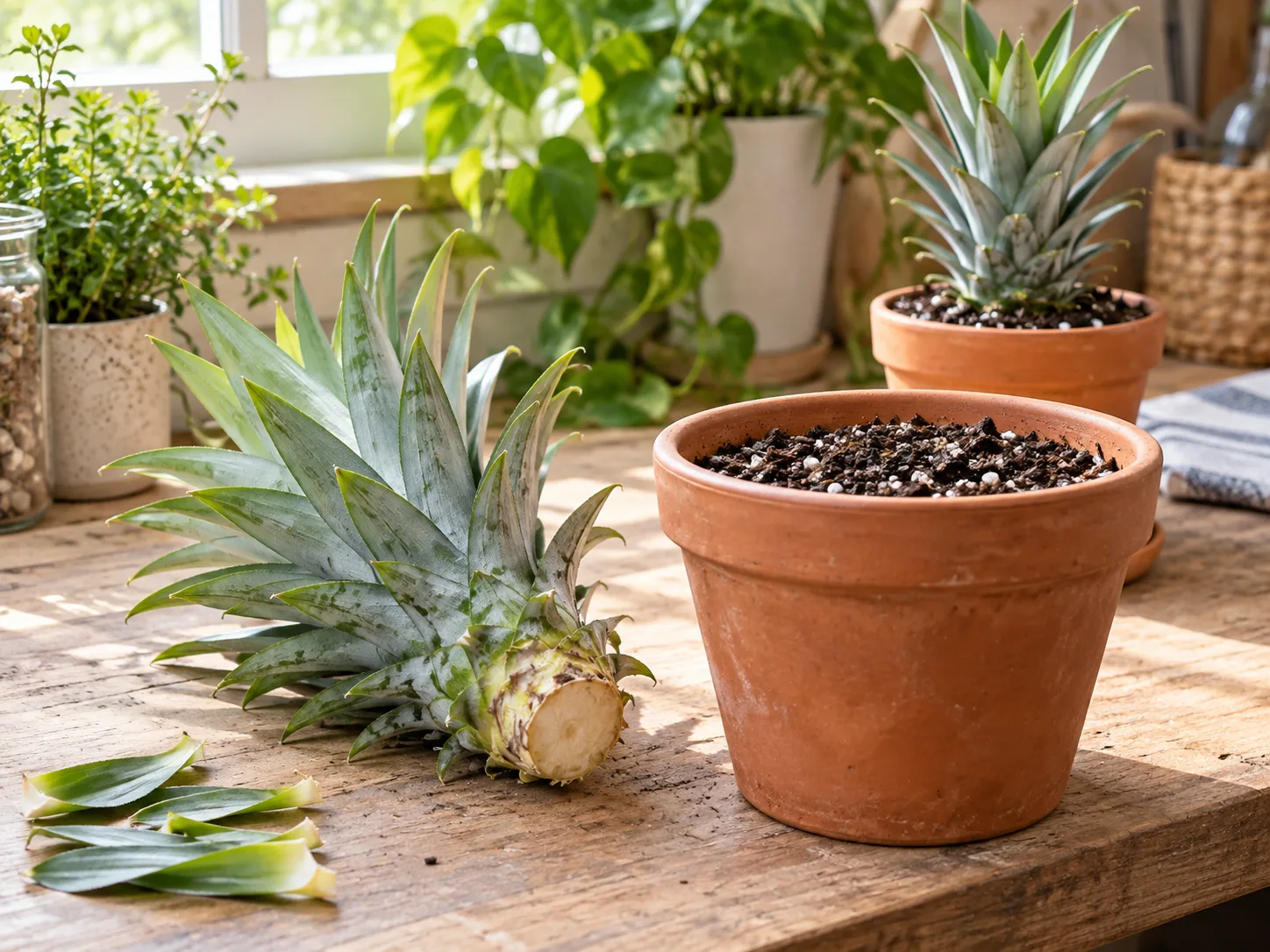
Set the stem upright in a small pot of lightly moist, airy mix, burying only the bare stem and keeping the lowest leaves above the surface. Firm the mix around the base so the crown does not wobble. Water once to settle the medium, let the pot drain, and place it in a warm, bright spot away from cold drafts. Keep the mix barely and evenly moist while roots form; saturated soil around an unrooted stem is the quickest way to lose it.
Roots commonly develop over several weeks, but do not tug on the crown every few days to check. After about six weeks, give it one gentle nudge. Resistance, a new leaf emerging from the center, or both are useful signs that it has anchored. If the crown stays loose but firm, give it more time and check that the mix is not staying wet. If its base softens or smells sour, remove it, cut back to firm tissue with a clean blade, let the fresh cut dry, and restart in clean mix.
Rooting in water is possible, but it adds a transfer step. If you try it, suspend only the bare stem in a clean glass so leaves stay dry, refresh the water every few days, and pot the crown once roots are visible rather than waiting for a tangled mass. Direct rooting in potting mix is usually the more straightforward route because the plant can continue growing in the medium where it will live.
Choose the right pot and growing mix
A pineapple needs a container with drainage holes and enough weight to support a spreading rosette. For a crown, begin with a modest, stable pot rather than a huge tub. A pot that is far larger than the root system holds excess wet mix for longer, increasing the risk of rot before the plant can use that water.
For a mature container plant, UF/IFAS recommends a 3- to 7-gallon pot with drainage. A wide, sturdy container is useful because the plant can become top-heavy once it flowers and fruits. Repot only when the roots have filled the current container or the plant dries out unusually fast; move up one size and keep the base of the rosette at the same depth. Burying the crown or packing soil into the leaf bases can trap moisture around the stem.
Use a loose, fast-draining potting medium. A quality indoor potting mix amended with coarse perlite, pumice, or fine orchid bark can work; a cactus or citrus mix is another starting point if it does not dry into a hydrophobic brick. Avoid dense garden soil in a pot, and do not add a gravel layer to the bottom as a substitute for drainage holes. The mix should absorb water, then drain freely.
Pineapple tolerates a range of soils, but a slightly acidic to near-neutral mix is a sensible target. Harvest to Table gives a pH range of about 4.5 to 6.5, while UF/IFAS emphasizes moderately fertile soil that drains well. If your plant is growing steadily in a commercial potting mix, there is no need to acidify it with vinegar or add a special amendment based on a guessed pH.
Decide between outdoor and indoor growing
Pineapple is tropical and frost-sensitive. Grow it outdoors year-round only where winter temperatures are reliably mild and the planting spot drains after rain. If cold weather is part of your normal winter, a container is more forgiving: it lets you give the plant bright summer light and move it under cover before a cold night.
Plant outdoors only where frost is rare
Choose the warmest open part of the garden, away from tree shade, roof runoff, and low places where water collects. Full sun supports stronger growth and a better chance of fruit. Give the plant room from paths because its leaves can be stiff and sharp, and keep grass tools from striking the base. If heavy rain leaves the bed soggy, mound the planting area or choose a better-drained site.
UF/IFAS places the best growth around 68 to 86°F (20 to 30°C). Growth can slow below about 60°F (15.5°C) or above 90°F (32°C), and freezing temperatures can damage or kill the plant. Short cold snaps may also interrupt growth even when they do not kill it. In a marginal climate, a warm wall can provide shelter, but it does not turn a frost-prone site into a reliable fruiting location.
Use a movable container in cool climates
A pot is the practical choice if you need to bring the plant inside each winter. Start with a crown where it gets several hours of bright direct light, then move it outdoors gradually once nights are warm. Give it a few days in bright shade before full sun so leaves developed indoors do not scorch abruptly.
Before moving it inside for winter, check the leaf bases and soil surface for insects. Set it near the brightest available window, with space for the mature leaves to spread. A room can be warm enough for foliage growth but still too dim for a fruiting-size plant to build energy. A grow light can supplement a weak window, but it cannot compensate for a cold, waterlogged pot.
Give pineapple strong light and warmth
Outdoors, use full sun for the strongest growth and best chance of fruit. Indoors, choose a bright south-, southeast-, or west-facing window where the plant receives direct sun for part of the day. A bright-looking room may still be low light to a pineapple; if the leaves lengthen, lean toward the window, or become narrow and weak, move it closer to the glass or add a grow light.
Keep the plant warm and away from cold window glass or drafty doors. UF/IFAS reports that both cool temperatures and heat above roughly 90°F can slow growth. Do not put the pot directly against freezing glass in winter, and do not leave it outdoors through a cold snap simply because the daytime forecast is mild. Since this is a slow crop, even a seasonal pause can extend the wait for fruit.
Humidity is usually less important than light, warmth, and root health in a home. You do not need to mist the leaves on a schedule. Misting does not make a dim window brighter, and repeated wetness in the center of a tightly packed rosette can linger in cool rooms. Focus first on giving the plant enough light and letting the growing mix drain between waterings.
Water only after the mix begins to dry
Pineapple is more tolerant of a brief dry spell than of roots sitting in wet soil. Water the pot thoroughly when the top inch or two of mix begins to dry, then allow excess water to leave through the drainage holes. Empty the saucer after watering. The right interval changes with pot size, sunlight, temperature, and season, so a fixed weekly schedule is less reliable than checking the mix.
A newly planted crown needs a little more attention because it has few roots to draw on. Keep its mix lightly moist, not continuously wet, and use a small pot that can dry at a reasonable pace. Once it is established, water deeply enough to moisten the root zone, then let the surface begin to dry before watering again. Indoors in winter, the pot may need water much less often than during warm, sunny growth.
Outdoors, water during extended dry periods, especially when the plant is actively growing or carrying fruit. UF/IFAS notes that drought can reduce growth and fruit production, even though pineapple tolerates dry conditions. At the other extreme, continuously wet soil raises the risk of root rot. A rainy season usually means less supplemental water, not more.
Do not try to compensate for poor drainage by using tiny daily sips. That can keep the lower mix damp while leaving some roots dry. If the pot takes many days to dry, check for blocked holes, compacted mix, or a container that is too large. If leaves become limp while the soil is wet, investigate roots rather than adding more water.
Feed for steady leaf growth, not rapid forcing
Wait until the crown has rooted and begun active growth before fertilizing. Then use a balanced fertilizer suitable for edible container plants, following the label and erring on the lighter side in a pot. UF/IFAS describes small, repeated applications during the growing phase; a modest feed every six to eight weeks during warm, active growth is safer than a large dose intended to make the plant grow faster overnight.
Pause or reduce feeding when growth slows in a cool, dim winter. Fertilizer cannot replace light, and unused salts can accumulate in a container. If the leaf tips brown after feeding, flush the pot with clean water if drainage is good and hold fertilizer until the plant resumes healthy growth.
A high-nitrogen push may make foliage without solving a flowering delay. The plant needs a mature, healthy rosette, not simply more fertilizer. Once a flower stalk appears, keep care steady and avoid heavy doses that might injure roots or disrupt the plant while it supports the developing fruit.
Expect leaves first, flowers later
The longest phase is the quiet one: the plant builds its leaf rosette. New leaves emerge from the center while older leaves spread outward. UF/IFAS uses roughly 70 to 80 leaves as an indicator that a plant is ready to flower, but treat that as a maturity clue rather than a strict countdown. Leaf size, strength, plant age, light, and temperature all matter; a stretched plant with many weak leaves may not be ready to carry a good fruit.
When flowering begins, a central stalk rises from the rosette and develops a compact head of flowers. It is not a second leafy crown or a pup. Many individual flowers contribute to one pineapple, with the small fruitlets fusing into a single compound fruit. As UF/IFAS explains, pineapple varieties are self-incompatible and the usual fruit is seedless, so pollination is not a home-grower’s missing step.
A mature plant may flower naturally after seasonal conditions change. UF/IFAS notes that short days, cool conditions, and drought can contribute to flower induction, but stressing a young plant can trigger a small, disappointing crop. Keep a young plant growing steadily instead of deliberately chilling or drying it out.
If a robust, mature plant has not flowered and you want to experiment, UF/IFAS describes ripe apple slices placed in the center of the plant as a source of ethylene that can encourage flowering. This is optional, and the response is not guaranteed in a home setting. Use it only after the plant has reached flowering size and is actively healthy; remove the slices before they rot. Do not use calcium carbide or improvised chemical treatments. Once flower induction occurs, UF/IFAS reports roughly 50 days until the first flowers open and about five to seven months from induction to harvest, with weather and plant condition affecting the finish.
Troubleshoot slow growth, rotting crowns, and pests
When a pineapple seems stuck, check the basics in this order: plant age and size, light, temperature, drainage, watering, then pests. It is easy to blame fertilizer because the plant grows slowly, but a young crown normally spends a long time making roots and leaves. Adding more feed or trying to force flowers before fixing the environment can create new problems.
The crown is loose or not growing. If it has been less than six to eight weeks and remains firm, leave it in place and keep the mix lightly moist. A tug test repeated every few days can break new roots. If the base is black, soft, or sour-smelling, cut away decayed tissue and replant only if firm, healthy stem remains. Discard a crown whose center has collapsed.
The leaves are pale, stretched, or leaning. Move the plant toward stronger light, then acclimate it gradually if you are taking it outdoors. Weak light slows the plant’s ability to build a fruiting rosette. Do not correct stretched growth with extra fertilizer; new leaves will improve only after the light level changes.
The plant is declining in wet mix. Check that water can escape freely and that the pot is not standing in a filled saucer. A sour smell, mushy base, or general decline despite damp soil suggests root or stem rot. Let the medium dry appropriately, trim only tissue that is clearly decayed, and repot into clean, airy mix if the root system still has firm sections. Repeated overwatering is more likely to be the cause than a need for misting.
The leaf tips are brown or reddish. A few old tips can dry naturally and do not always mean disease. Review cold exposure, dry spells, fertilizer strength, salt spray outdoors, and physical damage before cutting leaves. Keep healthy green leaves because they provide the energy needed for flowering and fruit. Remove only fully dead leaves with clean shears.
You see white cottony clusters, small scales, or ants. Mealybugs and scale can hide where leaves meet the stem, while ants may protect honeydew-producing insects. Isolate an indoor plant, inspect leaf bases, and remove visible pests with a damp cloth or a firm rinse. If you use insecticidal soap, choose a product labeled for the plant and pest, follow its directions, and test a small area first; blanket spraying is not a substitute for identifying the insect. UF/IFAS lists mealybugs and scales among pineapple pests and emphasizes starting with clean planting material.
If an established plant is still not fruiting, compare it with a mature rosette rather than the calendar alone. A plant that is small, shaded, cold, drought-stressed, or root-bound needs better growing conditions and more time. Flower induction is a final option for a strong mature plant, not a cure for weak growth.
Harvest by maturity cues, then manage the pups
After the flower head forms, the fruit gradually fills and the individual fruitlets flatten into the familiar patterned shell. Look for full fruit size, a change from green toward yellow or golden color beginning at the base, and a sweet aroma. UF/IFAS recommends harvesting once roughly one-third to two-thirds of the peel has changed color for good sweetness. The exact appearance varies with cultivar, so use size, shell color, and smell together.
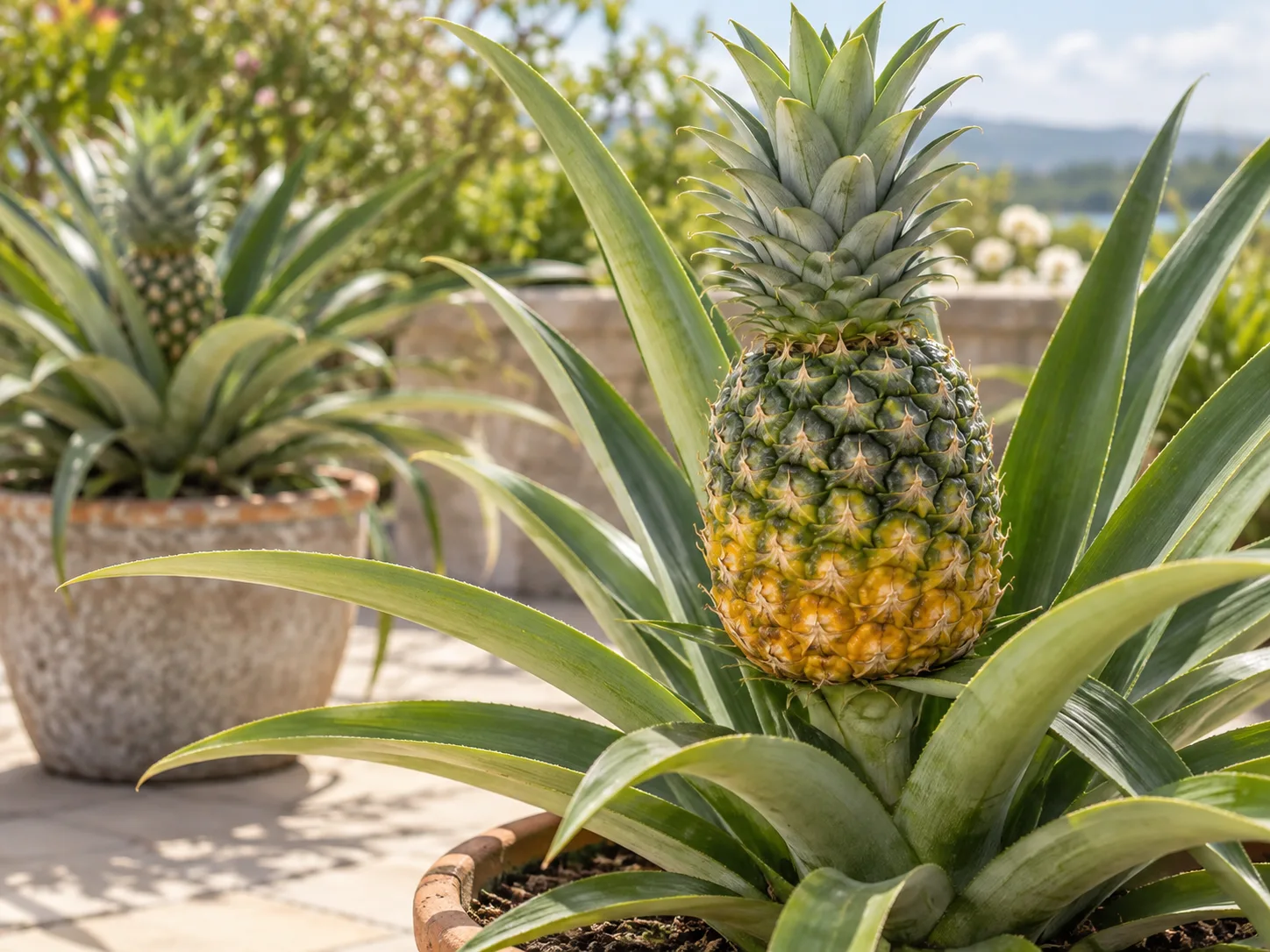
If wildlife threatens the fruit, a mature-green pineapple can be cut before the shell is fully colored, but early cutting does not guarantee that it will become sweeter indoors. Harvesting maturity matters; a fruit that is simply undersized or immature will not gain the flavor it would have developed on the plant. Cut the stalk with a clean, sharp knife and support the fruit so its weight does not bend or break the stem. UF/IFAS recommends staking a fruiting stalk when needed.
The central rosette that produced the fruit gradually declines, but the plant may produce new suckers or slips. You have two choices after harvest: leave one strong sucker attached for a possible second, or ratoon, crop, or separate a healthy offset and grow it as the next plant. UF/IFAS describes plants producing up to two fruits when a sucker is retained; for a home grower, raising a sizable pup is often the more dependable way to continue the cycle.
Do not remove every offset while the plant is young unless you need to keep it compact. Once you have your first fruit, decide whether you prefer a second crop from the same plant or a new container plant with its own root system. A substantial offset is a faster starting point than another grocery-store crown, so it can be a useful next step if you have room for the broad, spiky leaves.
Conclusion
To grow a pineapple, start with a firm grocery-store crown or a larger healthy offset, let cut tissue dry briefly, and root it in a warm pot with excellent drainage. Give the plant bright light, water after the mix begins to dry, and feed modestly while it builds leaves. Outdoors year-round is realistic only in warm, frost-free conditions; elsewhere, a container lets you protect the plant, though indoor fruiting still depends on strong light and patience.
Expect a long vegetative phase before flowering and several more months before harvest. Watch for plant size, a central flower stalk, full fruit size, peel color, and aroma rather than treating a calendar date as a guarantee. A first fruit is only one part of the project: a well-grown sucker or slip can start the next plant with a head start.



