How to Grow and Care for String of Turtles
Master String of Turtles care: choose the right window, avoid wet roots, propagate stem cuttings, and fix wrinkled, yellow, or dropping leaves.
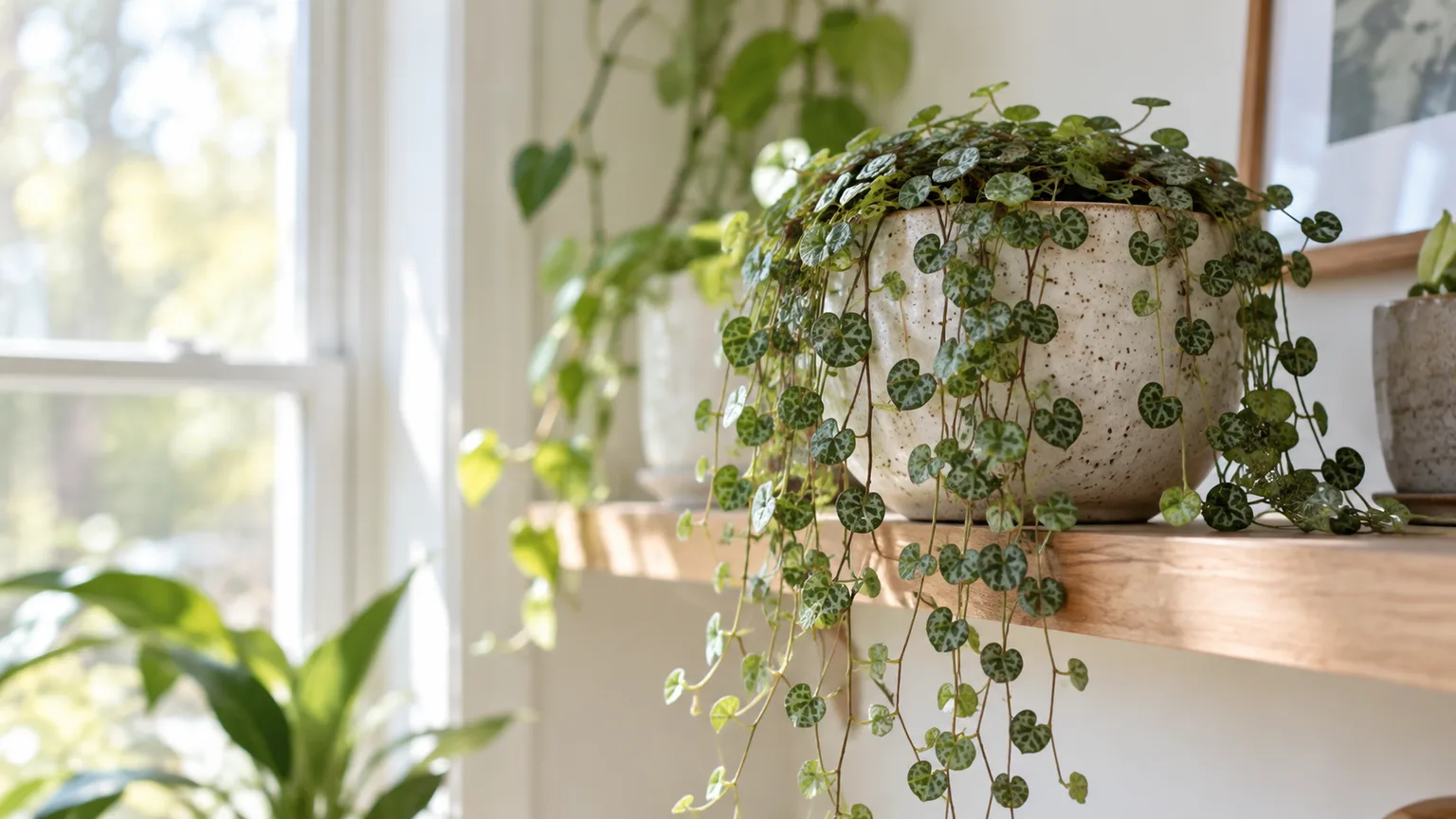
String of Turtles (Peperomia prostrata) is a compact trailing houseplant with small, round leaves marked like miniature shells. It is often sold beside desert succulents, but its care is closer to a moisture-holding tropical peperomia: give it bright filtered light, an airy root zone, and a thorough drink only after the mix has dried partway.
The plant grows slowly, so patience is part of good care. A healthy specimen may spend months building roots and short new runners before it looks dramatically fuller. The goal is not to force growth with extra water or fertilizer; it is to create stable conditions in which the thin stems can keep producing leaves without rotting at the base.
Start with the plant’s identity and care model
The Royal Horticultural Society’s species profile describes String of Turtles as a compact, trailing evergreen perennial with red stems, circular leaves, pale markings along the veins, and slender flower spikes. Those details matter because the plant’s small leaves and delicate vines can look fragile even when it is healthy. It is a trailing Peperomia in the Piperaceae family, not a true string succulent such as String of Pearls.
You can grow it in a hanging pot, on a shelf where the vines can spill over, or in a small terrarium with good ventilation. In a hanging container, place the pot high enough to show the trailing stems but low enough that the top of the plant still receives light. A shelf that leaves the foliage in a dark corner can produce long bare sections even when the room itself feels bright.
The species is also capable of producing thin, upright flower spikes. They are usually less showy than the foliage, so flowering is not a useful measure of whether every part of the care routine is perfect. Watch for firm leaves, steady new growth, and a root zone that dries at a predictable pace instead.
Why a semi-succulent still needs moisture and air
String of Turtles stores some water in its fleshy leaves and stems, which gives it a buffer when the pot dries. That storage does not make it a desert plant. Its roots still need oxygen, and the fastest way to lose a small plant is to keep a dense mix wet around a fine root system.
The useful mental model is moisture with a dry-down, not “keep it wet” and not “treat it like a cactus.” The RHS peperomia growing guide recommends moist but well-drained conditions, while its general guidance warns that overwatering and standing water can lead to root rot. This balance is why light, pot size, mix, and watering cannot be adjusted independently.
Give String of Turtles bright filtered light
Choose the brightest position that does not turn the leaves hot or bleach them. An east-facing window is a forgiving starting point because it supplies gentle morning sun; a west- or south-facing window can work farther back from the glass or behind a sheer curtain. A grow light can also work when the plant is in a dim apartment, but keep it far enough away that the foliage does not heat up.
The RHS recommends bright, indirect or filtered light for peperomias and notes that strong summer sun can scorch foliage. Epic Gardening’s String of Turtles guide adds an important placement detail: when the plant is displayed high on a shelf, the cascading part may be visible while the crown receives too little light. Aim the light at the top of the pot, not just at the ends of the vines.
Read the plant’s light signals before moving it
Long gaps between leaves, small new leaves, and slow or stalled growth usually mean the plant needs more usable light. Move it closer to a bright window in small steps, or add a grow light for a consistent daily period. Do not solve low light by watering more; dim conditions slow drying and make wet roots more likely.
Pale, faded, reddish, or scorched patches suggest the opposite problem: too much intense direct sun. Shift the plant behind a curtain or a little farther from the glass, then give damaged leaves time to recover. A leaf that has already bleached will not regain its original markings, so judge the adjustment by new growth rather than by trying to reverse old damage.
Build an airy root zone with the right pot
Use a small container with a drainage hole and a mix that holds a little moisture while leaving plenty of air spaces. Garden soil is too dense for a plant this small. A decorative cover pot is fine, but the inner pot must be removable so you can water fully and empty the collected runoff.
For a practical home mix, combine two parts quality peat-free houseplant or ericaceous compost with one part perlite and one part medium orchid bark. The RHS mix guidance gives a similar loose recipe and distinguishes this kind of mix from the sharper cactus compost suited to peperomias from drier habitats. If your commercial mix is already very airy, use less amendment; the final test is how quickly water passes through and how long the center remains damp.
Do not add a thick layer of gravel to the bottom of a pot as a substitute for drainage. It reduces the depth available to roots without fixing a waterlogged mix. Drainage comes from the hole, the texture of the whole mix, and the size of the container.
Choose a pot only a little wider than the root ball. An oversized container stays wet longer because the plant cannot use the extra mix quickly, and wetness around the roots is a bigger risk than being slightly snug. A shallow pot can work well for a trailing specimen if it is stable and does not dry out completely within a day.
Water by root-zone dryness, not a calendar
There is no reliable “every seven days” rule for String of Turtles. The interval changes with pot diameter, mix, window, season, humidity, and whether the plant is actively growing. In a bright warm room a small pot may need water sooner; in a cool, dim room the same plant may stay damp for much longer.
Use a finger check at the surface and just below it. When the top inch or two feels dry and the pot has become noticeably lighter, water thoroughly. If the mix is still cool and damp below the surface, wait and check again in a few days. A moisture meter can be a useful second opinion, but it should not replace learning how your pot feels when it is dry and when it is properly watered.
Use a reliable watering sequence
- Move the inner pot to a sink, tub, or saucer where runoff can escape.
- Pour room-temperature water slowly over the mix until water exits the drainage hole.
- Pause briefly, then water once more if the mix was very dry or hydrophobic.
- Let the pot drain completely, and empty the saucer or cachepot.
- Return the plant to its bright position only after the bottom is no longer sitting in water.
Bottom watering is optional, not automatically better. It can wet a compact root ball evenly, but leaving the container in a basin for a long time keeps the lower mix saturated. If you bottom-water, remove the pot when the surface becomes slightly moist, let it drain, and do not keep a reservoir under this plant.
The RHS also notes in its watering guidance that peperomias can be sensitive to fluoride in tap water, which may contribute to brown tips. If brown tips persist despite sensible moisture, try rainwater or filtered water at room temperature and occasionally flush the mix with plenty of plain water to move accumulated salts out of the drainage hole.
Keep temperature and humidity steady
Normal indoor temperatures suit String of Turtles, especially a stable range around 65 to 80°F (18 to 27°C). Protect it from cold drafts, a hot radiator, air-conditioning discharge, and a window that becomes cold at night. Sudden changes can damage tender leaves even when the average room temperature seems acceptable.
Moderate humidity is helpful, but you do not need to turn the room into a greenhouse. The RHS says most peperomias adapt to ordinary home air while preferring more humid conditions when available. Group plants, use a clean humidifier nearby, or use a shallow pebble tray only when the pot sits above the waterline. The tray should raise local humidity slightly; it should never turn the pot into a standing-water container.
Routine misting is not a dependable humidity plan. It wets the leaves briefly, does little for the room’s average humidity, and can encourage spotting when airflow is poor. If you mist occasionally, do it early in the day and let the foliage dry, but prioritize light, root-zone drainage, and stable air movement.
Feed and prune during active growth
Feed in spring and summer when the plant is making new leaves. Use a balanced liquid houseplant fertilizer diluted to half the label strength about once a month as a conservative default. If the plant has strong light and active growth, a label-directed schedule every two weeks can work, but more fertilizer is not a shortcut to fuller vines.
Never fertilize a bone-dry root ball. Water first, then feed after the mix is already evenly moist. Every few months, water generously with plain water so salts can drain through. A crust on the mix, brown tips appearing after feeding, or sudden leaf drop is a reason to pause fertilizer and flush rather than increase the dose.
Pruning is optional, but it can make a sparse plant look fuller. Use clean, sharp snips to remove dead or damaged sections, then shorten a long healthy runner just above a node where you want branching. Remove no more than about one-third of the plant at a time, and save healthy pieces for propagation. Avoid heavy pruning immediately after a move, repot, or pest treatment; let the plant stabilize before asking it to regrow.
Repot only when the roots or mix need it
String of Turtles is slow enough that an annual repot is usually unnecessary. The RHS notes that most peperomias can remain in their original container for two or three years, or until roots become densely packed or emerge from the drainage holes. Repot in spring or early summer when the plant is actively growing.
Check the plant if water begins to sit on the surface, the mix has collapsed into a dense mass, the pot dries dramatically faster than before, or roots circle the container. A sour smell, dark mushy roots, and repeated leaf drop despite careful watering point to a more urgent root-zone problem.
Slide the plant out without pulling the vines. Keep firm, pale roots, remove only rotting material with a clean tool, and move the plant into fresh airy mix in the same pot or one size larger. Water lightly enough to settle the mix, let it drain, and keep the plant in bright filtered light while it recovers. Do not repot a healthy plant just to use a much larger decorative container.
Propagate with healthy stem cuttings
Spring and summer are the easiest seasons to propagate because the parent plant and cutting can grow actively. Choose a firm, healthy runner with several leaves and no pests, rot, or discolored tissue. Epic Gardening’s peperomia propagation instructions recommend taking mature, healthy cuttings and not removing more than one-third of the parent plant at once.
Cut a short section just below a leaf node, remove the lowest leaves, and keep at least one or two nodes available for rooting. Because the vines are easy to flip while handling, set the cutting on the table for a moment and mark the original lower end mentally before planting. A cutting placed upside down can stay green for a while without making useful roots.
Root cuttings in lightly moist mix
Soil rooting is the best default when you want a cutting that can stay in its first medium. Fill a small pot with airy propagation mix, such as houseplant mix loosened with perlite, and moisten it before planting. Insert the lower node just beneath the surface and firm the mix gently so the stem stands upright.
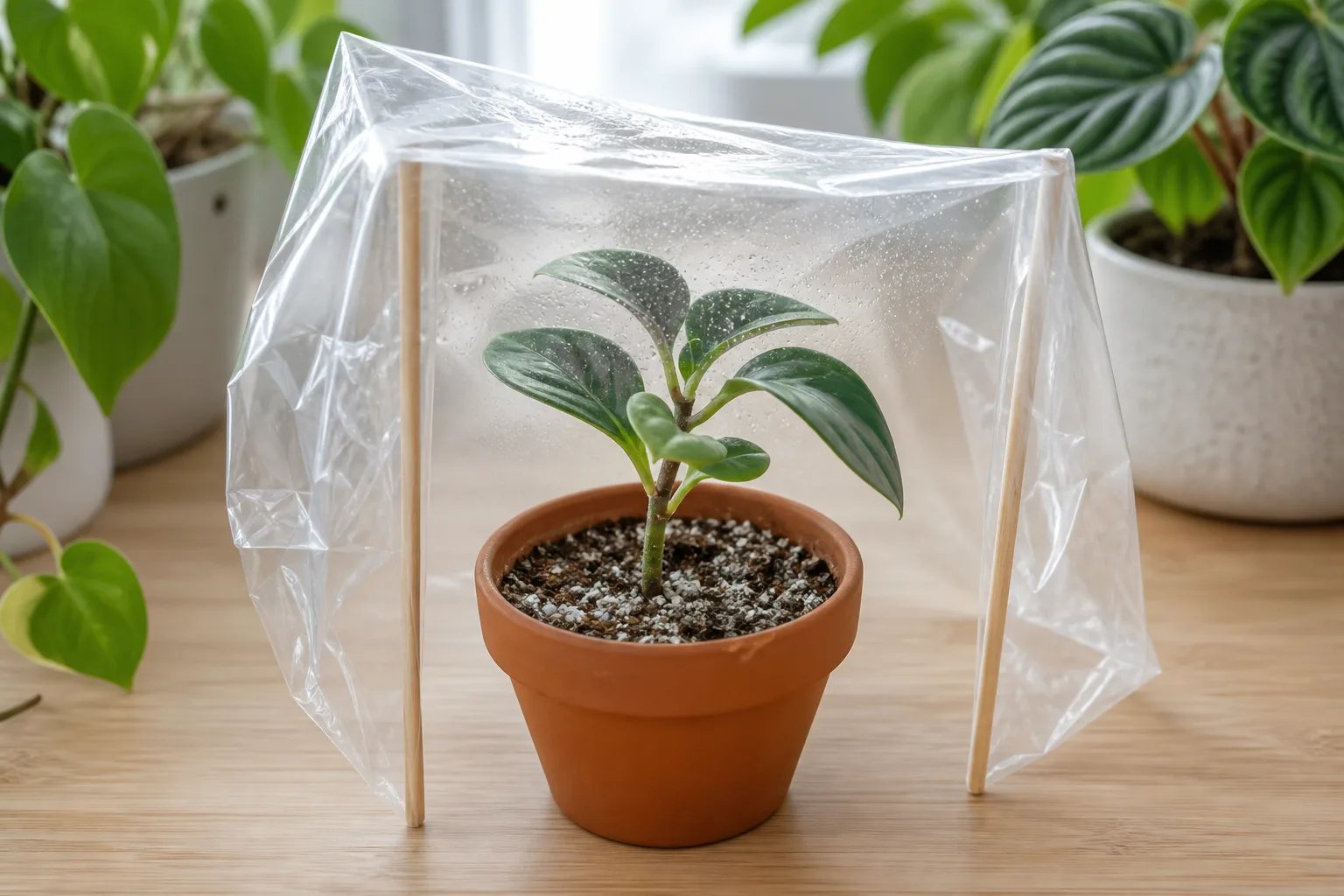
Keep the pot in bright indirect light and a warm, stable room. A loose clear bag or vented humidity dome can slow moisture loss during the first weeks, but leave space around the foliage and open it every few days for fresh air. The mix should feel lightly moist, never saturated. New growth at the base is a better sign than tugging on the cutting to test for roots.
Epic Gardening’s propagation guidance recommends waiting until the cutting is well rooted and producing new growth before moving it to a larger pot. Keep the first container small; a tiny root system in a large volume of wet mix is more likely to rot.
Root cuttings in water when visibility helps
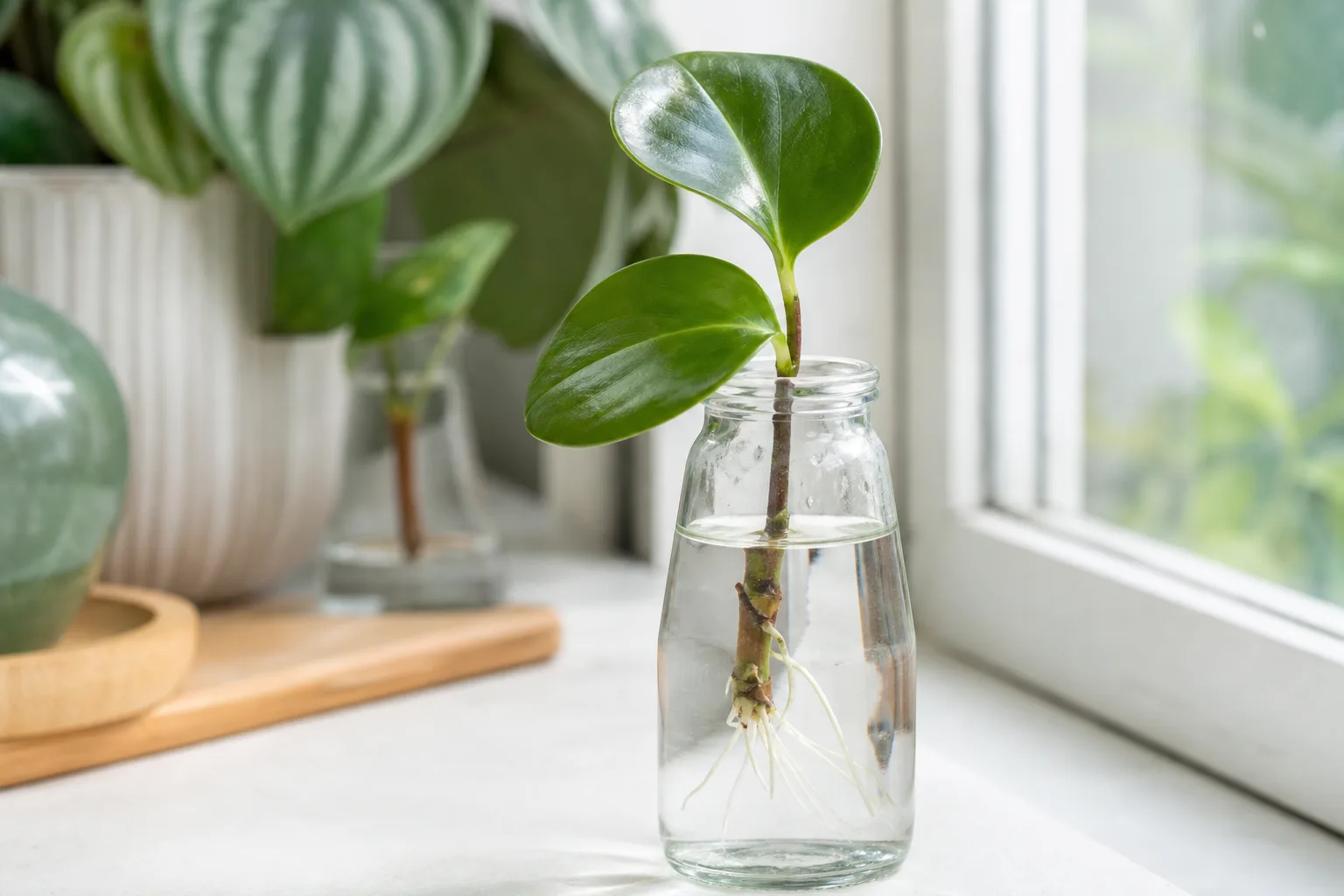
Water propagation lets you see roots form, but it is not automatically faster. Put only the lowest node or two into a clean glass of water and keep the leaves above the waterline. Change the water when it clouds and keep the glass in bright indirect light rather than direct sun.
Once the cutting has several firm roots, move it into lightly moist airy mix. Roots formed in water are adapted to constant access to water, so the new pot should not be allowed to swing from saturated to bone-dry during the transition. Water enough to settle the mix, then return to the normal dry-down routine.
Leaf cuttings are possible for some fleshy peperomias, but a String of Turtles stem section is the more practical choice because it carries multiple nodes and several chances to root. Do not take a leaf from a weak or pest-damaged parent simply because it is available; propagation multiplies the plant you have, including its problems.
Solve common symptoms from the soil upward
When several leaves look wrong, do not change light, water, fertilizer, and humidity all at once. Record the last watering, feel the mix, inspect the base of the stems, and look at the roots if the pot has stayed wet. The pattern below is more useful than any single symptom label.
Separate dry, wrinkled leaves from wet-root stress
Wrinkled or curling leaves with a genuinely dry mix usually mean the plant has used its stored water. Water thoroughly, let excess drain, and watch the newest leaves over the next week. A leaf that has collapsed completely may not recover its shape, but the stems can still produce new growth if the roots are sound.
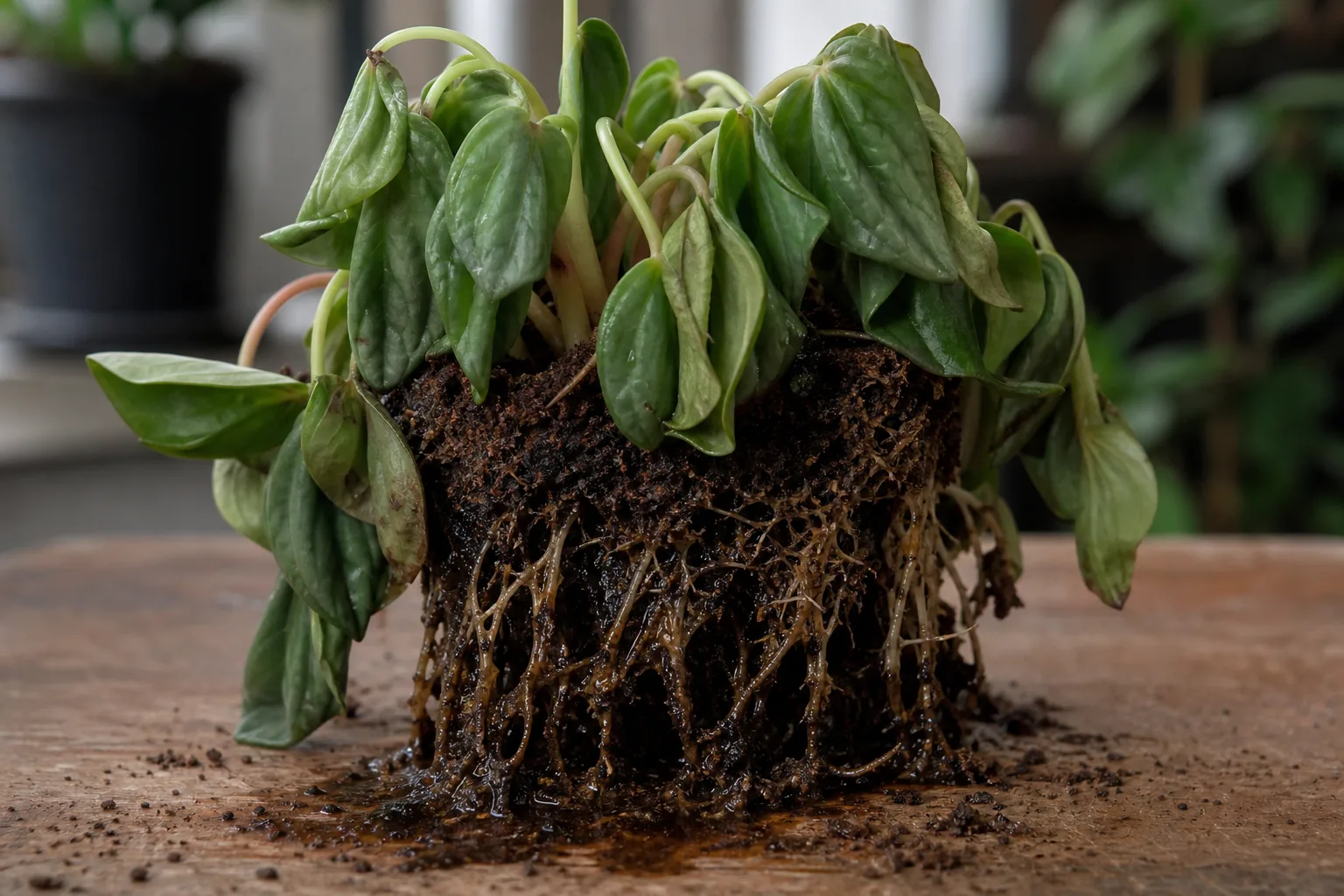
Wrinkled leaves with a wet, cool, or sour-smelling mix suggest root stress instead. Roots damaged by excess water cannot supply the foliage, so the plant can look thirsty while sitting in wet soil. Unpot it, inspect the roots, cut away only soft dark tissue, and repot in fresh airy mix. Do not respond to this version of “thirst” with another watering.
Read yellowing, dropping, and brown tips together
Yellow leaves that drop from a plant in persistently wet mix point toward overwatering, poor drainage, or low-light slow drying. The RHS connects wet roots with yellowing and leaf drop, and Gardening Know How’s peperomia problem guide similarly describes black, soft roots as a root-rot warning. Improve the root zone first; fertilizer will not repair roots that lack air.
Brown tips have a wider differential. Dry air, fluoride-sensitive foliage, salt buildup, direct sun, or inconsistent watering can all contribute. Check the light and water quality, flush accumulated salts, and trim only the dead tissue with clean scissors. If brown spots are spreading across the leaf rather than staying at the tip, isolate the plant and inspect airflow, pests, and wet foliage.
Bare, stretched runners usually mean insufficient light or a plant that has been allowed to trail from a poorly lit shelf. Move the crown into brighter filtered light, then prune gradually once new growth begins. A brighter position plus regular pinching is more reliable than heavy feeding.
Raised, corky, or rust-colored bumps on the undersides of leaves can be oedema rather than a pest. The Connecticut Agricultural Experiment Station’s peperomia note describes peperomia oedema as water-soaked blisters that can become rust-colored, especially after overwatering during cool, cloudy conditions. Let the mix dry more between waterings, increase usable light and airflow, and avoid wetting the foliage while the room is cool.
Control pests and prevent recurring problems
Inspect the undersides of leaves, leaf joints, and the soil surface whenever you bring home a new plant or take cuttings. Mealybugs look cottony, spider mites may leave pale stippling or fine webbing, and fungus gnats are more likely when the mix stays continuously moist. Gardening Know How lists these pests alongside root rot and leaf-spot problems for peperomia.
Isolate a suspect plant before treating it. Remove visible insects with a gentle rinse or cotton swab when the plant can tolerate it, then use only an indoor-plant product whose label names the pest and crop situation. Follow the label exactly; a homemade stronger concentration can burn small leaves and does not make treatment safer. Repeat monitoring matters because one cleaning rarely removes every life stage.
Airflow, spacing, clean tools, and careful watering prevent more trouble than a shelf full of treatments. Do not propagate from a plant with unexplained spots or pests. If a stem is soft, dark, and moving upward from the soil line, cut healthy runners above the damaged area and discard the compromised base rather than trying to root wet tissue.
Keep the plant in a pet-safe position
The ASPCA listing for trailing peperomia identifies Peperomia prostrata as non-toxic to dogs and cats. That corrects the blanket toxicity warning sometimes repeated for String of Turtles. Keep the source’s species distinction in mind because common names can be applied loosely in plant shops.
Non-toxic does not mean a plant should be a chew toy. Soil, fertilizer, and pest treatments can be harmful even when the foliage itself is not classified as toxic, and chewing any plant may cause stomach upset. Place the pot where pets cannot knock it down, and contact a veterinarian or animal poison service if a pet eats a treated plant or develops symptoms.
Conclusion: make small adjustments, not constant changes
Good String of Turtles care is a controlled balance: bright filtered light for compact growth, a small pot with an airy mix, and a thorough watering only after the root zone has dried partway. Moderate humidity helps, but it cannot compensate for wet roots, poor light, or a container with no drainage.
Feed and prune lightly during active growth, repot only when the roots or mix call for it, and propagate from firm healthy stems. When leaves wrinkle, yellow, or drop, inspect the soil and roots before adding water or fertilizer. A stable routine with one thoughtful adjustment at a time gives this slow-growing peperomia the best chance to become a full, patterned cascade.