5 Practical Ways to Keep Bugs Away From Your Patio
Keep bugs away from your patio with five practical layers: remove standing water, clean food spills, use fans, adjust lights, and repel safely.

The most effective patio pest plan starts with the things bugs need, not the product you can light or spray. Remove places where mosquitoes can reproduce, close down food odors that pull in flies, ants, and wasps, then make the seating area harder to reach with moving air, smarter light, and a real barrier.
That order prevents a common summer mistake: trying to repel adult insects while the patio is still supplying water, sugar, shelter, or bright night lighting. A patio can be comfortable without being insect-free, because most outdoor spaces share air with a living garden. The goal is to reduce the insects you are inviting and protect the zone where people actually sit.
The fastest way to make your patio less inviting to bugs
If you want relief today, take five actions in this order: empty every water-holding container, seal food and trash, run a fan across the seating area, switch off unnecessary white or blue-tinted lights, and use a labeled skin repellent if anyone is still being bitten. This sequence covers both sides of the problem: fewer insects developing nearby and fewer adults reaching your body or dinner.
The CDC’s mosquito-control guidance recommends emptying and scrubbing, turning over, covering, or throwing out water-holding items once a week. That routine matters more than a scented candle because mosquito eggs and larvae are not waiting on the patio for a fragrance to bother them; they are developing in a container that stays wet.
| If you are dealing with | Fix first | Add for tonight |
|---|---|---|
| Mosquito bites | Flowerpot saucers, gutters, toys, buckets, and other water sources | Fan, long sleeves, or an EPA-registered repellent |
| Flies around food | Crumbs, sticky drinks, pet food, trash, and recycling | Fan and covered serving dishes |
| Ant trails | The food source and the crack or edge they follow | Wipe the trail and move food off the route |
| Wasps around drinks | Open sweet drinks, fallen fruit, and exposed scraps | Cover beverages and keep a calm distance from nests |
| Tiny biting midges | Damp, shaded edges and local peak activity | Tighter mesh, clothing, and skin repellent |
Do not expect one method to solve every row. A clean patio can still have mosquitoes if a neighbor’s neglected container or a nearby drain produces them, while a dry patio can still attract wasps when a sugary drink is open on the table.
Know which bugs are actually bothering you
“Bugs” is a useful everyday word but a poor diagnosis. Look at what the insect is doing before you choose a control. Mosquitoes usually leave itchy bites and hover near people; flies land on food and surfaces; ants travel in organized trails; and wasps patrol sweet drinks, meat, fruit, or a nest entrance.
Mosquitoes and no-see-ums point to moisture and bite protection
Mosquito larvae live in standing or nearly still water. The UC Integrated Pest Management Pest Notes on mosquitoes notes that some species can complete the egg-to-adult cycle in a week or less under summer conditions, which is why a container that looks harmless on Monday can matter by the following weekend. Mosquito activity also varies by species and location: some are most active around dawn and dusk, while others bite during the day.
No-see-ums, also called biting midges, are smaller and can pass through loose garden netting. If the bites continue after you drain obvious containers, use tighter mesh or personal protection rather than assuming every tiny flier is a mosquito. The first practical distinction is simple: water control reduces future mosquito pressure; clothing, screens, airflow, and repellent protect the person being bitten now.
Flies, ants, and wasps point to food, trash, and shelter
Flies follow moist organic material, pet waste, trash, and food residue. Ants follow a repeatable route to sugar, grease, crumbs, or water, so spraying a visible line without cleaning the source often creates a short pause rather than a lasting fix. Wasps can be beneficial predators in the garden, but adults may visit exposed protein, ripe fruit, and sweet drinks while they forage.
This is why the same “natural repellent” performs differently against different pests. A fragrant pot may add a pleasant local scent, but it will not remove a sticky soda ring, a full garbage bag, or a nest tucked under the deck. Identify the attractant first, then use a barrier for the people and food area.
1. Run a weekly standing-water patrol
Make a loop around the patio, porch, grill area, downspouts, garden edge, and storage zone. Empty anything that holds water: flowerpot saucers, buckets, watering cans, toys, tarps, wheelbarrows, lids, clogged gutters, recycling containers, and the shallow folds in outdoor furniture covers. Turn containers upside down or store them under cover so rain cannot refill them.
The scrub is important. Some mosquitoes attach eggs to the inside walls of containers, above the waterline, so dumping the water alone may leave behind the next hatch. Scrub the basin or saucer, rinse it, and tip it so it dries completely. Clear leaves and organic debris from gutters and downspouts, because a slow-draining gutter can function like a long, narrow nursery.
Do the inspection once a week during warm weather and repeat it after heavy rain. If a water feature is intentional, give it a maintenance schedule instead of abandoning it. An uncovered rain barrel needs a tight lid or fine mesh over access points; a birdbath needs frequent emptying and scrubbing; and a pond needs circulation and local, label-approved management if larvae are present.
Drain, scrub, cover, or refresh every water feature
Use this four-way decision rule:
- Drain anything you do not need, including unused kiddie pools and saucers.
- Scrub containers that held water, then let them dry.
- Cover rain barrels, storage tanks, and other necessary reservoirs with a secure lid or appropriately fine screen.
- Refresh birdbaths and pet-water bowls on a dependable schedule, cleaning the film rather than merely topping them off.
For a larger body of water that cannot be dumped or covered, a mosquito larvicide may be appropriate, but only if the product label allows that exact water use. Bti is a larvicide for mosquito larvae, not a general-purpose outdoor spray, and it does not make an otherwise neglected container safe to ignore. Follow the label, keep treated water away from drinking uses unless the label specifically permits it, and contact a local mosquito-control district when a water problem is broad or persistent.
2. Close the food-and-trash loop after every meal
Outdoor eating creates a scent trail that lasts longer than the meal. Wipe drink rings, rinse sticky utensils, brush crumbs from chair cushions, cover serving dishes, and move leftovers indoors or into sealed containers as soon as people finish eating. Keep a small lidded scrap bowl on the table while grilling so bones, fruit peels, and food-soaked napkins do not sit exposed.

Treat the trash and recycling area as part of the patio, even when it is several steps away. Use a tight-fitting lid and a fresh liner, rinse cans when residue builds up, and rinse bottles or cans before placing them in an open recycling bin. Keep pet food and water bowls away from the dining zone when possible, and clean spilled kibble rather than leaving it for wildlife and insects.
Ants deserve one extra step: wipe the trail with soapy water after removing the food source. Ants leave chemical cues that help nestmates follow a route, so killing a few visible workers does not remove the invitation. Follow the line toward a crack, planter edge, wall joint, or tree, then seal or clean that route if it leads into the house.
Wasps around a drink are a reason to cover the drink, not to swat wildly. Use cups with lids or straws, keep ripe fruit and meat scraps in closed containers, and move fallen fruit from beneath patio trees. If wasps are repeatedly entering a wall, roofline, or deck void, treat that as a nest-location problem rather than a table-repellent problem.
Sanitation also improves every other tactic. A fan is more useful when it is not blowing food aroma across an open trash bag, and a citronella candle is less frustrating when it is not being asked to overcome a puddle, a sticky table, and a full compost bucket at the same time.
3. Put moving air across the seating zone
Use a box fan, oscillating pedestal fan, or outdoor-rated ceiling fan to create a moving-air zone where people eat and talk. Mosquitoes and many small flies are weak fliers, so steady airflow can make it harder for them to approach, hover, and land. The Gardening Know How coverage of patio bug fans also emphasizes that these devices protect the immediate table area, not an entire yard.
Think of a fan as a comfort tool and a landing-disruption tool. It does not kill mosquitoes, remove larvae, or stop flies from breeding in a bin. It also loses value when the air is already gusty, when the fan is aimed behind the diners, or when a small tabletop unit cannot move air across the full group.
Position the fan for people, not the whole yard
Place the fan at the edge of the seating area and aim it across shoulders, legs, and the table rather than directly into one person’s face. For a rectangular table, one fan at the short end can create a useful cross-breeze; a large table or open-sided pergola may need two fans at opposing corners. Keep cords dry and protected, use an outdoor-rated unit where exposure is possible, and keep blades and outlets away from children’s reach and puddles.
Test the setup before guests arrive. Sit in the chair farthest from the fan and check whether a napkin, plant leaf, or light tablecloth moves. If only the fan-side chair feels breezy, rotate or elevate the unit until the airflow crosses the group. Ceiling fans can be excellent under a covered patio, but they are not a substitute for a ground-level cross-breeze in a wide, open seating area.
Fans are especially useful for dinner because they address the landing moment without adding residue to food or leaves. If bites continue in the still corners around the table, add a physical screen or personal repellent rather than simply buying a larger fan and assuming more wind will solve a breeding source.
4. Change the light, then change its location
Bright lights can turn a patio or doorway into an insect gathering point. Start by switching off lights that are not needed, then replace harsh blue-white bulbs with dimmable warm-white or amber LEDs where safety allows. Aim the fixture downward and shield the bulb so less light spills into surrounding foliage, windows, and the open sky.

The UF/IFAS Extension guide to exterior lighting explains that insects respond differently to light color and intensity, and recommends warm or ultra-warm LEDs over cool or bluish-white light. A UCLA research summary likewise reports that yellow or amber-filtered LED light attracted fewer flying insects than blue or ultraviolet light in the study it describes, while dimmer light and turning lights off reduced impact further.
Do not read “bug light” as “bug-proof patio.” A warm bulb can reduce the number of insects clustering at that fixture, but it cannot control mosquitoes coming from a shaded hedge or flies following dinner. It is also smart to light the route people need to walk and leave decorative bulbs off when the patio is not in use.
Use less blue and UV light, not more bug zappers
Bug zappers often work by using ultraviolet light to attract insects, which can pull more flying insects toward the patio before killing some of them. The UCLA summary notes that zappers are inefficient for mosquitoes and may kill beneficial insects, while UF/IFAS warns against their indiscriminate effect on pollinators and other helpful insects. They are a poor first choice for a garden-adjacent eating area.
Use a motion sensor or timer for safety lighting, choose warm or amber light for the fixture nearest the seating area, and keep high-intensity security floodlights pointed where they are needed rather than across the whole yard. This makes the patio less visually attractive to night-flying insects without asking you to sit in the dark.
Lighting has a second trade-off: not every insect near a lamp is a pest. Moths, beetles, lacewings, and other insects are part of the garden food web, and some are pollinators or predators. The RHS guide to beneficial insects explains how many garden insects help pollination or eat plant pests, so reducing unnecessary light is a more selective choice than trying to kill everything that arrives.
5. Use plants, screens, and labeled repellents as the last layer
Once water, food, airflow, and lighting are in order, add a barrier that matches the way you use the patio. This could be a few healthy aromatic plants near the table, a tight mosquito curtain around a pergola, long sleeves at dusk, or an EPA-registered repellent on exposed skin. These tools protect people in a defined zone; they do not change the larger insect population overnight.
Treat aromatic plants as close-range comfort, not a force field
Lavender, rosemary, basil, mint, lemongrass, scented geranium, and marigold can all be worthwhile patio plants. They add fragrance, flowers, culinary leaves, or texture, and a healthy container placed beside a chair is more useful than a stressed plant hidden at the back of the yard. Brush or harvest foliage lightly if you want to release more scent, but do not rub an unknown plant or essential oil on skin.
The limitation is the important part. Outdoor air dilutes plant volatiles, wind carries them away, and a passive pot does not create a measured protection zone. Practical horticulture coverage, including Gardening Know How’s patio-feature guidance, is most useful here for placement inspiration; treat plant-based deterrence as a small comfort layer, not as a replacement for source reduction or personal protection.
Choose plants for the site even if the insect effect turns out to be modest. Lavender and rosemary need sun and well-drained soil; basil wants warmth and regular harvest; mint should stay in its own container; and lemongrass needs room and a long warm season. A plant that thrives will give you more fragrance and fewer maintenance problems than a “mosquito plant” that is mislabeled, shaded, or drowning in a saucer.
Match physical barriers and skin repellents to the people outside
For a covered patio, fine-mesh curtains or screens can be the most dependable nonchemical protection because they stop insects from entering the seating zone. Close gaps at corners and below panels; a curtain that hangs open at the bottom is a doorway, not a barrier. Tight mesh is particularly useful for tiny biting midges that pass through coarse garden netting.
When skin is exposed, use a repellent registered for that use and follow its label. The CDC and UC IPM guidance identifies products containing ingredients such as DEET, picaridin, IR3535, and properly formulated oil of lemon eucalyptus or PMD as options, with product effectiveness and protection time varying by formula and conditions. Pure essential oil is not the same thing as a tested repellent formulation.
Apply only as directed to exposed skin or clothing, never under clothing, and do not let children handle the product. Do not spray directly onto the face; put the labeled product on your hands first if the instructions allow face application. Wash treated skin after coming indoors, and stop using a product if it irritates the skin. For children under 3, check the label carefully because PMD and oil-of-lemon-eucalyptus products have age restrictions.
What not to rely on for patio pest control
Skip the idea that one scented candle, one pot of lavender, or one “mosquito-repelling” gadget can defend an entire yard. Citronella candles and coils can add a short-range scent and smoke effect, but UC IPM notes that they work best with little air movement—the opposite of a breezy patio where a fan may be useful. Use candles as atmosphere and a minor layer, not as proof that the patio is protected.
Do not spray the lawn or patio indiscriminately because you saw a few insects. Broad outdoor treatments can affect pollinators, drift into water, and provide only temporary adult relief. If a pesticide or larvicide is appropriate, use a product labeled for the target pest and site, follow the application rate and re-entry directions, protect food and water, and keep people and pets away as directed. The label is not optional guidance; it is the boundary for legal use.
Also be skeptical of ultrasonic repellers, wristbands, crushed leaves rubbed on skin, and electric zappers marketed as complete solutions. Some products may change the experience in a tiny area, but a claim that sounds universal usually hides the variables that matter: species, wind, temperature, placement, product age, and how many breeding sites remain nearby.
A practical 24-hour reset plan
If the patio feels unusable, do this before buying another product:
- Morning: empty and scrub saucers, buckets, toys, and other containers; clear gutter debris you can safely reach; cover or screen rain barrels.
- Midday: remove food scraps, rinse sticky recycling, scoop pet waste, close the compost, and wash the table and chair arms.
- Late afternoon: inspect the shaded perimeter for wet mulch, leaking hoses, clogged drains, and damp hiding places under furniture. Move the seating a few feet from dense vegetation if mosquitoes cluster there.
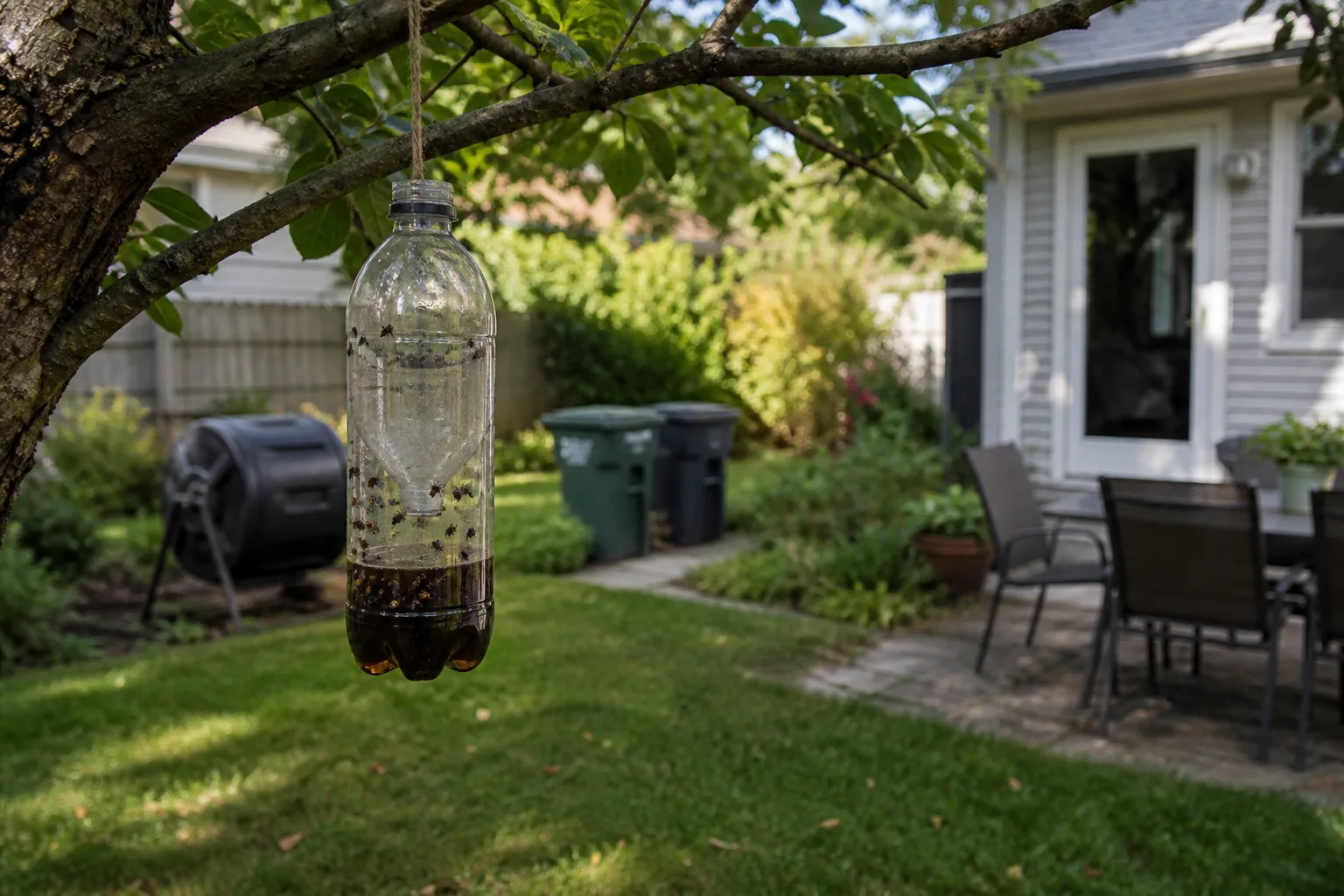
- Before dinner: install or position the fan so airflow crosses the group, cover drinks and food, and put attractive traps—if you use them—well away from the table rather than beside the plates.
- At dusk: use the least light that makes the space safe, favor warm or amber bulbs, and add screens, long sleeves, or a labeled repellent if biting continues.
The next morning, note what improved. Fewer mosquitoes but the same ant trail means you solved a water problem and still have a food route. Fewer flies but continuing bites means you need personal protection or a second water audit. Treat the response as evidence instead of changing five products at once.
Troubleshoot by pattern, not by product
Bites continue after you removed standing water: check shaded vegetation, roof gutters, drains, toys behind sheds, and containers beyond the patio. Mosquitoes can disperse from neighboring properties, and adults may already be present after you remove the nursery. Add a fan or screen for the seating zone, avoid your area’s peak mosquito hours when practical, and use labeled repellent or protective clothing for exposed skin.
Flies return within a day: inspect trash-can rims, recycling residue, pet waste, compost, fallen fruit, and damp organic material under decks or shrubs. A trap can catch adults, but it cannot empty a breeding site. If the swarm seems to come from one wall, attic, crawlspace, or roof void, move from patio tactics to exclusion and professional inspection.
Ants reappear after you wipe the table: follow the trail in both directions. Find the food, water, or plant honeydew source and the entry crack; clean the route and seal the gap where appropriate. Do not spray a repellent across food-preparation surfaces or soak flowering plants where pollinators forage.
Wasps keep circling drinks: cover every sweet beverage, remove fallen fruit, and place food scraps in closed containers. Watch from a distance for a nest under eaves, deck boards, or a wall opening. Do not block or disturb an active nest beside a door or seating area if someone in the household is allergic; arrange a professional assessment.
When to call a pest professional
Call for help when heavy activity persists after a careful water and sanitation audit, when insects are entering from a wall or roof void, when a nest is close to a doorway or children’s play area, or when anyone has a serious sting allergy. A professional can identify the pest, locate hidden breeding or nesting sites, and select a targeted treatment that fits the structure and local rules.
Persistent mosquito pressure may also deserve a call to your county or municipal mosquito and vector-control agency, especially after flooding or when a large pond, drainage feature, or shared water source is involved. A patio plan can reduce exposure, but it cannot correct a neighborhood-scale source by itself. Escalation is the sensible choice when the insects are numerous, the source is inaccessible, or the risk is higher than ordinary summer annoyance.
Conclusion
To keep bugs away from your patio all summer, start with the boring work that changes the habitat: empty and scrub standing-water containers, close food and trash, and check the shaded edges. Then make the place where you sit less reachable with cross-flow from a fan, dim warm or amber lighting, screens, clothing, and a labeled repellent when needed.
Plants, citronella, and other natural options can make a patio feel nicer, but they work best as supporting layers with honest limits. If the problem survives a weekly water patrol and a complete cleanup, stop cycling through gadgets and look for the hidden nest or breeding source—or call a pest professional who can find it safely.