How to Kill Tree Roots Safely and Efficiently
Learn how to remove unwanted tree roots safely, choose between digging, cutting, grinding, and redesign, and avoid salt, utility, and tree-stability mistakes.
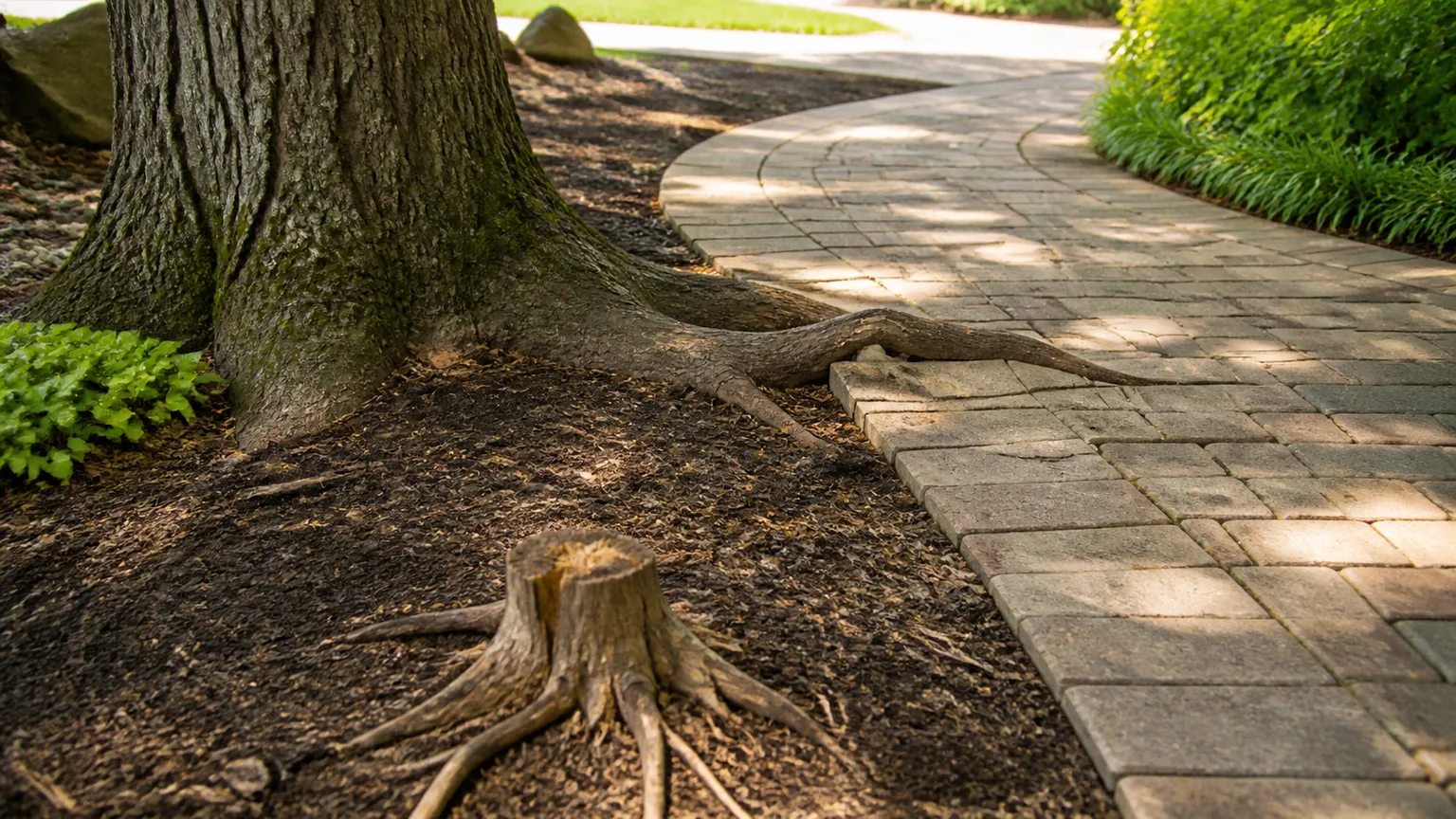
If a tree root is lifting a path, tangling with a planting bed, or emerging from an old stump, the safest answer is usually physical removal of a dead root or a redesign around a living tree. Those are different jobs. A healthy tree can be weakened or destabilized by the same cut that would be harmless on a long-dead stump.
Before you pick up a shovel, identify what is actually causing the trouble: a living tree, a dead stump, a leaking drain, or an underground utility conflict. Then check local rules and request a utility locate. A root-removal project becomes much simpler once you stop trying to solve the wrong problem.
Quick answer: choose the method by the situation
Use this short decision rule:
| Situation | Best first move | Avoid |
|---|---|---|
| A living tree has a surface root near a path | Redesign, bridge, mulch, or ask an arborist about a distant root-pruning plan | Cutting large roots near the trunk or poisoning the soil |
| A small dead stump or exposed dead root is in open soil | Excavate, cut cleanly, and remove the wood | A chainsaw in dirt or blind digging |
| A large stump remains after felling | Hire a stump-grinding or tree-removal professional | Renting powerful equipment without training |
| Roots are blocking a drain | Have the pipe inspected and repair the leak or broken joint | Pouring herbicide, salt, or acid into the drain or soil |
| Roots are near a gas, electric, water, sewer, or communications line | Stop and request 811 plus a private locate where needed | Assuming a shallow hand-dig is automatically safe |
The fastest result is not always the best result. Digging can remove an accessible dead root today; grinding can reduce a large stump below grade; natural decay can be inexpensive but slow; and a landscape change may be the only sensible way to keep a valuable living tree.
First identify what you are dealing with
Living tree or dead stump?
Look for a trunk, live shoots, fresh leaves, or new sprouts connected to the root system. If any part of the tree is alive, treat the roots as part of an active support and water-uptake system, not as inert debris. The International Society of Arboriculture’s research on root pruning and stability found that root cuts closer to the trunk can reduce anchorage, and Trees Are Good guidance lists severed roots, compaction, grade changes, and construction as forms of damage that can threaten tree health and risk.
Do not try to “kill just the roots” of a tree you want to keep. Roots do not function as isolated underground cords; removing enough of them can reduce water uptake, invite decay, or leave the tree less stable in wind. A qualified arborist may be able to plan a clean cut well away from the trunk, install a barrier, or recommend changing the hardscape, but the acceptable amount depends on species, tree condition, soil, root size, and the pattern of cuts.
If the trunk has already been removed, the problem is different. A stump and its large roots can be excavated, ground, or left to decay. Some stumps resprout, particularly when the tree was vigorous or naturally suckering, so monitor the site for new shoots rather than assuming the underground system is finished.
Roots in a pipe are a plumbing problem
Roots usually exploit a drain that already has a crack, loose joint, or other source of moisture. The RHS guide to trees near buildings notes that roots are unlikely to penetrate sound footings and that roots tend to proliferate where water is available; leaking or poorly sealed drains are much more plausible entry points than an intact pipe being crushed by a root.
If a drain is slow, repeatedly backing up, or showing roots on a camera inspection, fix the pipe as well as clearing the growth. A plumber can use a camera to identify the location and condition of the line, then choose cleaning, lining, or replacement. Killing roots above the pipe will not repair a leak, and a chemical poured into soil can damage nearby plants without reaching the real source of the problem.
Safety checks before you dig
Utility locating and property rules
In the United States, contact 811 or your state’s one-call center before any excavation, including a small stump or a shallow trench. The U.S. Department of Transportation’s PHMSA guidance describes 811 as a nationwide toll-free prevention measure for excavation damage. Wait for the response and understand the markings; do not treat an unmarked area as proof that nothing is buried there.
Public locates may not cover private electric lines, irrigation, landscape lighting, septic components, or lines installed beyond a meter. Ask the one-call center what it covers, then hire a private utility locator when necessary. If a line is exposed, damaged, or suspected to be gas or electric, stop work, move away, and contact the utility or emergency services as appropriate.
Also check whether the tree is protected by a local ordinance, preservation order, HOA rule, lease, or neighbor-rights agreement. A tree may be on your property while its roots, canopy, or protected status create responsibilities you cannot settle with a shovel. Large trees near a building, retaining wall, public path, or property boundary deserve an on-site assessment before you cut.
Wear boots, eye protection, gloves, and long trousers. Keep people and pets out of the work zone. A root under tension can move when cut, and a mattock, axe, chainsaw, winch, stump grinder, or mini-excavator can cause serious injury when used without training. Never use a chainsaw in soil: dirt rapidly dulls the chain and increases the chance of kickback.
Method 1: hand excavation and physical removal
Hand excavation is the most direct DIY method for a small dead stump or an exposed, non-structural root in open ground. It is also the best way to learn what is actually in the soil before making a cut. It is not a license to trench through the root zone of a mature living tree.
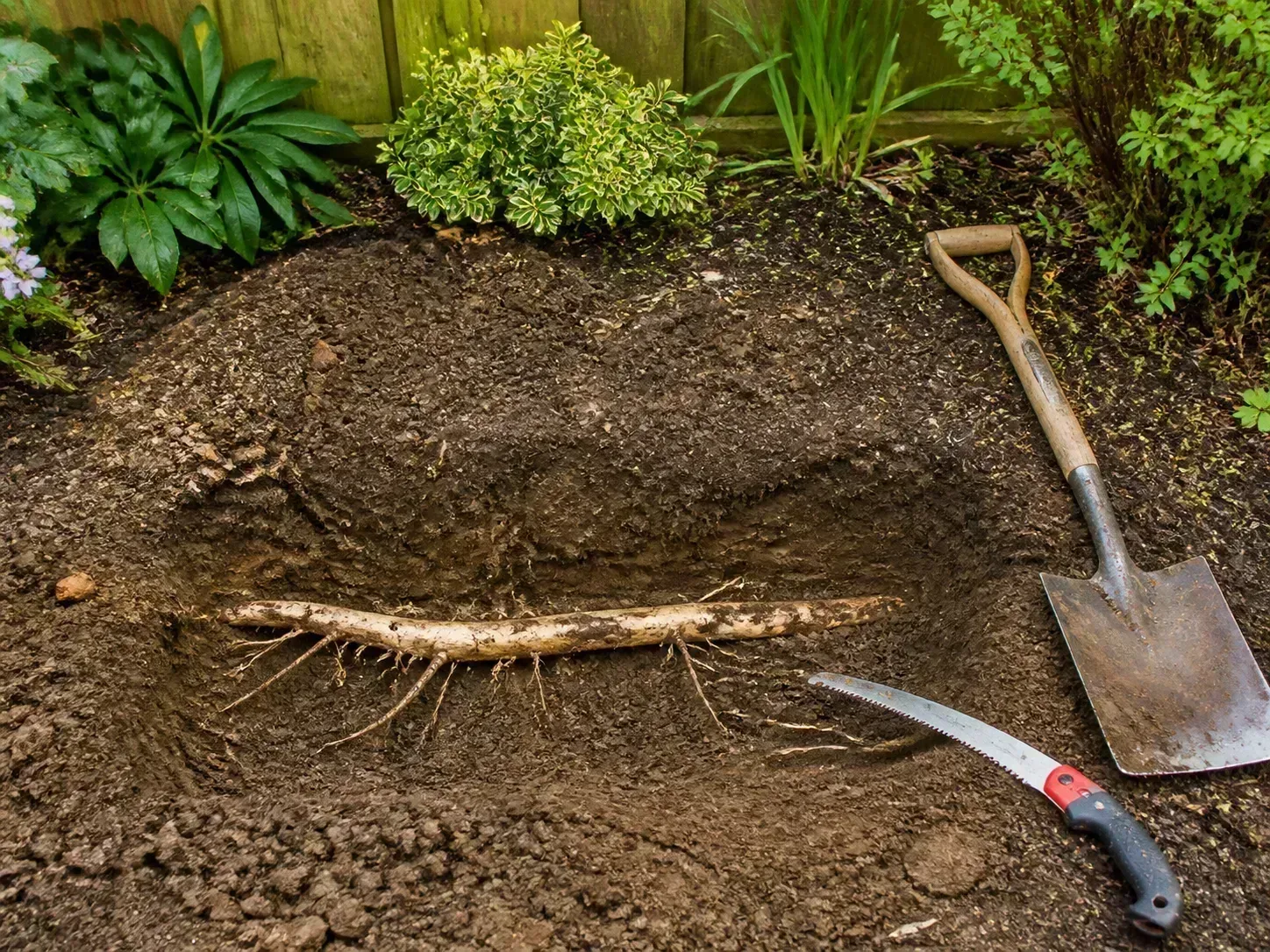
Expose a dead root fully before making a controlled cut; never cut into soil or unseen utilities.
A safe sequence for small stumps and exposed roots
- Mark the work area, complete the utility locate, and photograph the site before digging. Note nearby trunks, irrigation heads, drains, walls, fences, and paving.
- Remove grass and loose mulch by hand. Use a spade to open a shallow trench alongside the dead root rather than chopping downward into unseen material.
- Expose the root’s top and sides with a shovel or hand tool. Stop if you find a utility, a large root leading directly to a living trunk, masonry, a pipe, or a void under a path.
- Follow the root outward and loosen the soil beneath it. Pry gently only after enough soil is removed; levering against a living trunk or hardscape can shift both.
- Once the wood is fully visible, make a clean cut with a hand pruning saw or loppers sized for the root. A saw cut through clean wood is more controlled than swinging an axe in a crowded trench.
- Lift the pieces, remove loose chips, and inspect the remaining root ends. Do not keep digging simply to chase every fine root. Small fragments can decay in place when they are not sprouting and are not in the way of construction.
- Backfill in layers with soil that matches the site. Firm it lightly to remove large air pockets, but do not bury a nearby trunk flare or pack wet clay into a hard lump.
You can usually handle a thin dead root, a short surface root in a non-structural bed, or a small stump that rocks freely after its main roots are exposed. Stop when the root becomes large, runs under a foundation or slab, supports a living tree, passes near a marked line, or requires a deep trench. The time saved by stopping is worth more than the time lost repairing a damaged tree or utility.
Method 2: cut and let dead roots decay
If a dead root is below a lawn or future planting bed but is not blocking a footing, drain, or new structural work, you may not need to remove every piece. Cut the accessible wood, remove the largest sections, and let the rest decompose naturally. This is the lowest-input option, but it is measured in months or years rather than days and can leave a soft spot as the wood shrinks.
Natural decay works best when the remaining wood is dead, the area is not needed for a load-bearing foundation or retaining wall, and you can tolerate occasional settling. Mark the location if children, pets, or mowing equipment could encounter a depression. Do not pile heavy soil or paving over a fresh void without compacting and checking it over time.
Do not fill drilled holes with fertilizer in the hope of forcing a root to disappear. High-nitrogen material can move into surrounding soil and does not replace physical removal. The University of Iowa’s stump-removal guidance explains that herbicide can prevent resprouting but does not promote decay; it also warns that old chemical poured into a stump or holes can leach toward nearby plants.
Method 3: stump grinding or professional extraction
For a broad stump, a root flare close to paving, or a stump that must come out before construction, professional grinding is usually the efficient option. The machine removes the stump and some major roots below grade, leaving chips and a cavity to manage. It does not necessarily remove every root or solve roots that have traveled far from the stump.
Hand extraction can make sense for a small tree when you have open access and the root ball is manageable. A winch, excavator, or stump grinder changes the risk quickly: underground lines, unstable equipment, flying chips, hidden stones, and the weight of the stump are reasons to hire an insured operator. The RHS stump-removal guidance likewise treats winches, mini-excavators, and stump grinders as potentially hazardous and recommends trained help when you are not confident using them.
Ask for a written scope that says how deep the stump will be ground, whether chips will be removed, how the cavity will be filled, and whether surface roots are included. If you plan to build, pave, plant a tree, or install a fence in the same spot, tell the contractor before work begins; the required depth and backfill are different for a lawn than for a footing.
Chemical treatments have a limited role
Chemical treatment is not a general-purpose shortcut for living tree roots. It can be used in some cut-stump situations to prevent a dead tree from resprouting, but only when the specific product label permits that use. The Penn State Extension cut-stump treatment guidance explains that the target is the living cambium on a freshly cut stump and that timing, formulation, and application method matter.
That is a narrow use, not a recipe for drilling holes through roots and pouring in a concentrated weed killer. Some products are labeled for stump treatment; some are not. Labels differ by active ingredient, concentration, site, species, water restrictions, protective equipment, and replanting interval. Follow the label exactly, keep spray off desirable plants and soil, prevent runoff, and do not use a product near water or a root-grafted desirable tree unless the label and a qualified professional support it.
Why salt, vinegar, and boiling water disappoint
Salt can kill vegetation by making the root zone hostile, but that is precisely why it is a poor choice in a yard. It does not know which plant you want to preserve, can persist in soil, and can move with water into beds or lawns. Epsom salt is still a salt; its reputation as a garden remedy does not make it a selective root killer.
Vinegar is a contact burn, not a reliable way to kill a mature woody root system. It may injure foliage or shallow tissue it touches, but it is unlikely to travel through a large root network and solve the problem. Boiling water can scald small surface roots or weeds, but repeated applications are awkward, dangerous, and still indiscriminate near desirable plants, mulch, irrigation, and skin.
The practical ranking is simple: remove dead wood mechanically when you need a quick result; leave harmless dead fragments to decay when time and settling allow; and use a labeled cut-stump treatment only for a specific resprouting problem where the risks are understood. Never use salt, vinegar, boiling water, or an unlabeled chemical treatment near a living tree you want to keep.
Preserve a living tree with redesign
Many “problem roots” are really a hardscape-design conflict. Tree roots can lift a sidewalk, but cutting them may create a larger hazard by weakening the tree. The UF/IFAS guidance on roots lifting sidewalks recommends considering alternatives such as a ramp, a cushioning layer, or a surface that can accommodate movement rather than cutting roots close to the trunk.
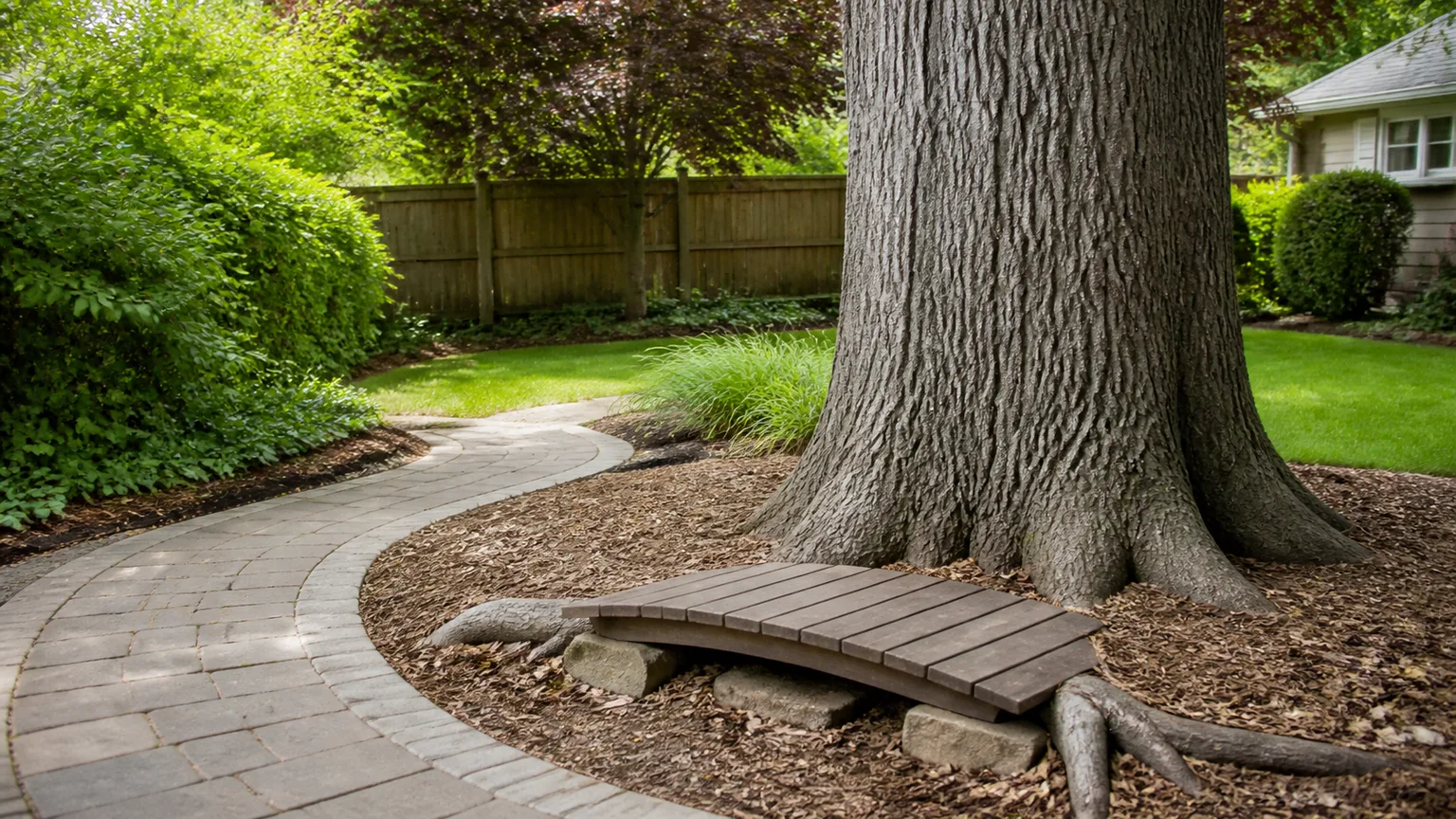
Rerouting or bridging a path can solve a root conflict without sacrificing a healthy tree.
If the raised section is local, reroute the path around the root, narrow a bed edge, use permeable or flexible paving, or create a low bridge that spans the root without pressing on it. In a lawn, a broad layer of clean mulch can reduce mower and foot traffic over exposed roots, but do not pile mulch against the trunk or bury the root flare. A landscape professional can also adjust grades and drainage without scraping away the shallow root zone.
Barriers and flexible hardscape
A root barrier can help when the conflict is localized and there is room to install it between a tree and paving. It must be continuous and deep enough for the site, with the top installed according to the product and design; a shallow scrap of plastic that roots can grow under is not a durable fix. Iowa State’s sidewalk-management guidance describes barriers as one part of a larger solution, alongside species choice, rooting space, and flexible materials.
Do not install a barrier by trenching through the major roots of a mature tree without professional planning. A barrier can move the conflict elsewhere, cut roots during installation, or restrict water movement if it is placed poorly. Its job is to guide future roots away from a hardscape, not to erase an established root system overnight.
Repair soil and hardscape after removal
After physical removal or grinding, remove loose chips from areas where you will plant. Fresh wood chips mixed heavily into the planting zone can temporarily tie up nitrogen as they decompose and can leave an uneven, spongy surface. Use screened soil or suitable fill to bring the area close to grade, then water it lightly and allow it to settle before making the final lawn or paving repair.
For lawn, level in stages and reseed after the surface is stable. For a bed, match the existing soil texture and keep the new grade away from the trunk flare of nearby trees. For a walkway, driveway, footing, or retaining wall, have the contractor evaluate compaction and bearing capacity rather than treating stump chips as structural fill.
The Fine Gardening guidance on soil care around trees is a useful reminder that compaction and excess mulch can harm roots even when no root is cut. Protect the remaining root zone from repeated vehicle traffic, keep mulch shallow and off the trunk, and water the surviving tree during dry weather if an arborist recommends it.
When to call a professional
Call an ISA Certified Arborist or other qualified tree professional before cutting if the tree is alive, mature, leaning, valuable, close to a house, near a retaining wall, or surrounded by paving. Also call if the root is more than a couple of inches thick, enters the trunk flare, crosses a large portion of one side of the root zone, or has already been damaged. A professional can assess tree stability and suggest a root-pruning distance, barrier, canopy management, or redesign.
Call a plumber when roots recur in a drain, when a camera shows a broken or separated pipe, or when backups occur after root cutting. Call the utility locator or utility owner for anything near marked or suspected lines, including private lines that 811 may not locate. Call a licensed contractor or engineer before removing roots beneath a foundation, footing, retaining wall, or load-bearing slab.
The most useful professional request is specific: “I have a living tree with a root lifting a path,” “I have a dead stump that must be removed before a patio,” or “A camera shows roots in a leaking drain.” Photos, the tree’s approximate size, the distance to structures, the location of utility markings, and the outcome you want will produce a better assessment than simply asking someone to kill all the roots.
Conclusion
The safest way to kill tree roots depends on whether the wood is alive, whether the tree must be preserved, and what the roots are interfering with. For a dead stump or accessible dead root, careful excavation, clean cutting, grinding, and patient decay are the practical options. For a living tree, redesign or a professionally planned root-management treatment is usually safer than poisoning or cutting blindly.
Start with the utility locate, confirm the source of the damage, and choose the least destructive method that actually solves it. Salt, vinegar, boiling water, and unlabeled herbicide recipes promise simplicity but create more uncertainty than efficiency. A short assessment from the right professional is often the quickest route to a yard that is safe, usable, and still supports the trees you want to keep.



