How to Prune a Dogwood Tree: Timing and Cutting Tips
How to prune a dogwood tree: when to cut flowering and shrub dogwoods, which branches to remove, how to avoid flush cuts, and when to call an arborist.
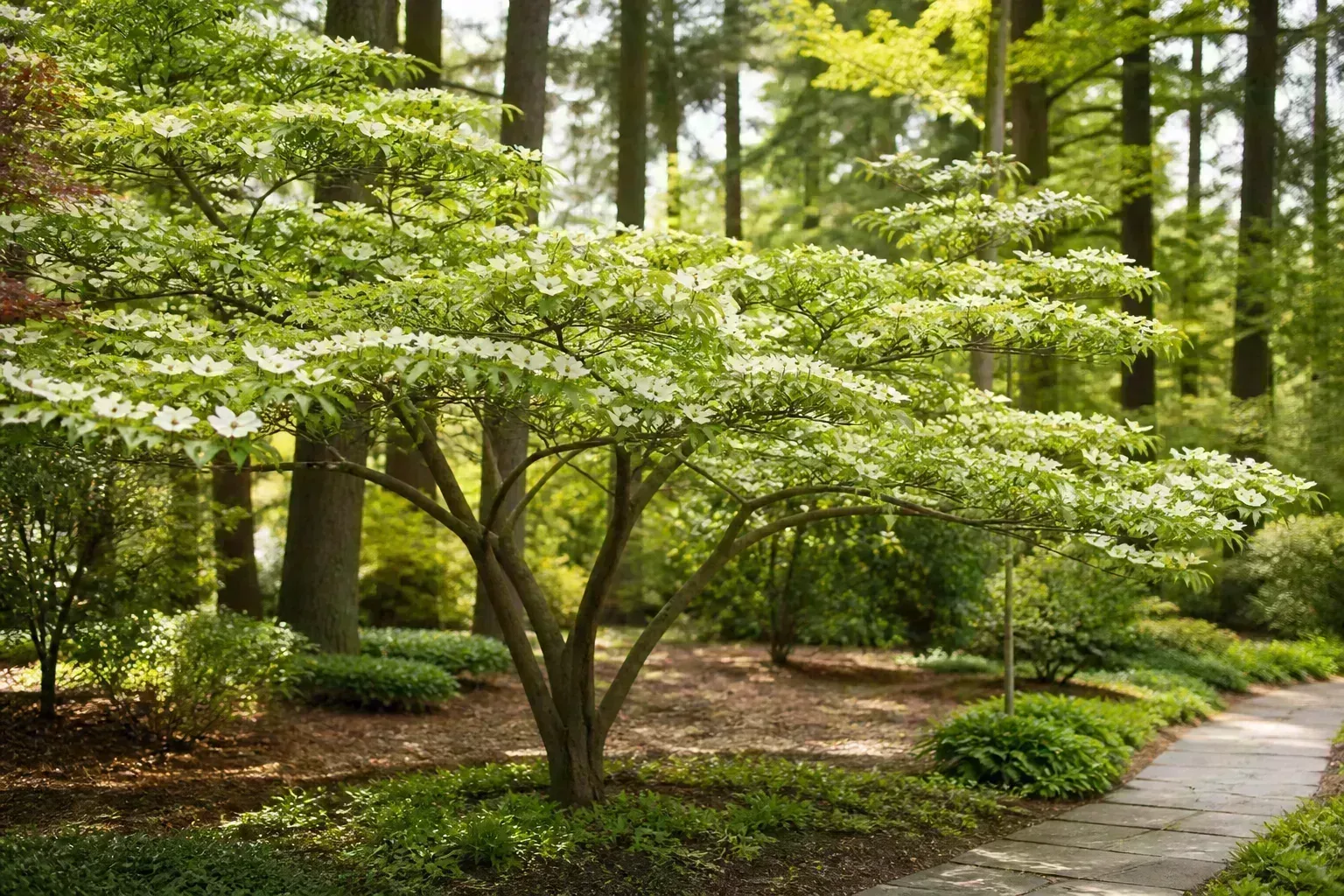
The safest default is simple: do not make routine live-wood cuts to a flowering dogwood just because spring has arrived. If it is Cornus florida, wait until the flowers have finished for ordinary shaping, because pruning while buds are swelling or opening can remove the display you are trying to protect. Dead, diseased, broken, or dangerous branches are exceptions; those should not be left in place for the sake of a calendar.
Timing is only half the job. The right cut removes a problem branch at its origin or shortens it to a well-placed lateral branch without leaving a stub or cutting into the trunk. The guide below separates flowering trees from shrub-form dogwoods, then walks through tools, cut placement, disease precautions, and the point where a ladder and chainsaw should give way to an arborist.
The spring mistake to avoid
The common spring mistake is routine pruning before a flowering dogwood blooms. That is when the tree is carrying flower buds formed on older growth, so a tidy-looking cut can quietly remove the season’s flowers. A tree may survive the mistake, but survival is not the same as preserving its natural form, bloom, and energy balance.
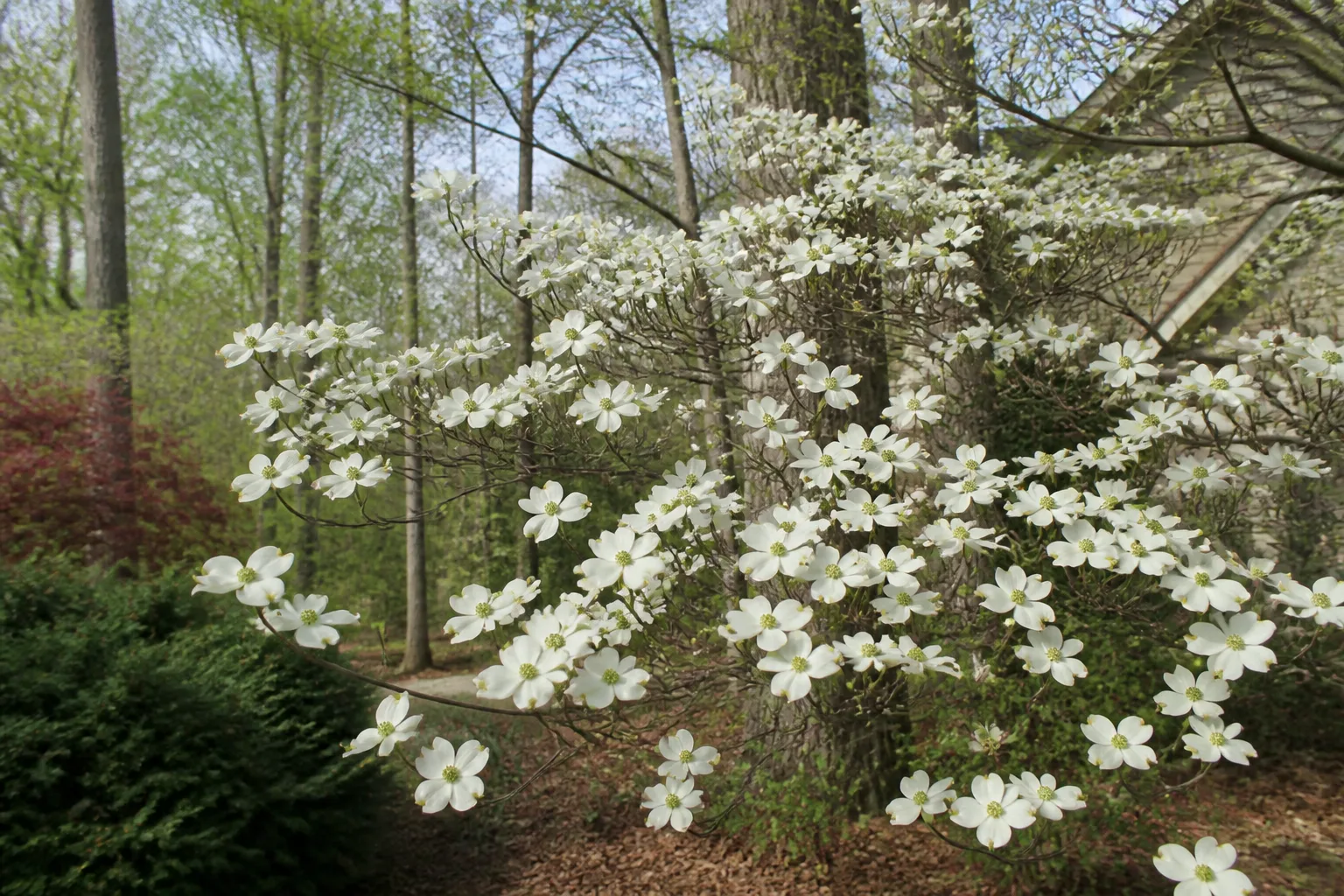
There is a reason pruning advice can sound contradictory. Dormant trees are easier to inspect, and some disease-management situations call for removing dead wood during dormancy. But general pruning guidance from Clemson Cooperative Extension notes that spring-flowering trees such as dogwood set flower buds in fall, while the New York Botanical Garden’s dogwood guide recommends pruning flowering dogwood immediately after bloom so flowers are not sacrificed.
If the tree is healthy and the goal is shape, crowding, or size, let the flowers finish and the leaves begin to expand before cutting. If a limb is split, dead, rubbing badly, infected, or threatening a person, roof, vehicle, or utility line, the priority changes from flower preservation to safety and plant health.
First identify which dogwood you have
“Dogwood” describes a large group of Cornus trees, shrubs, and groundcovers rather than one pruning schedule. A flowering dogwood with a single trunk is managed for a natural canopy and spring bracts; a red-twig dogwood grown as a many-stemmed shrub is often pruned to replace old stems with younger, more colorful ones. Treating both plants as interchangeable is how a useful renewal cut becomes a bad tree cut.
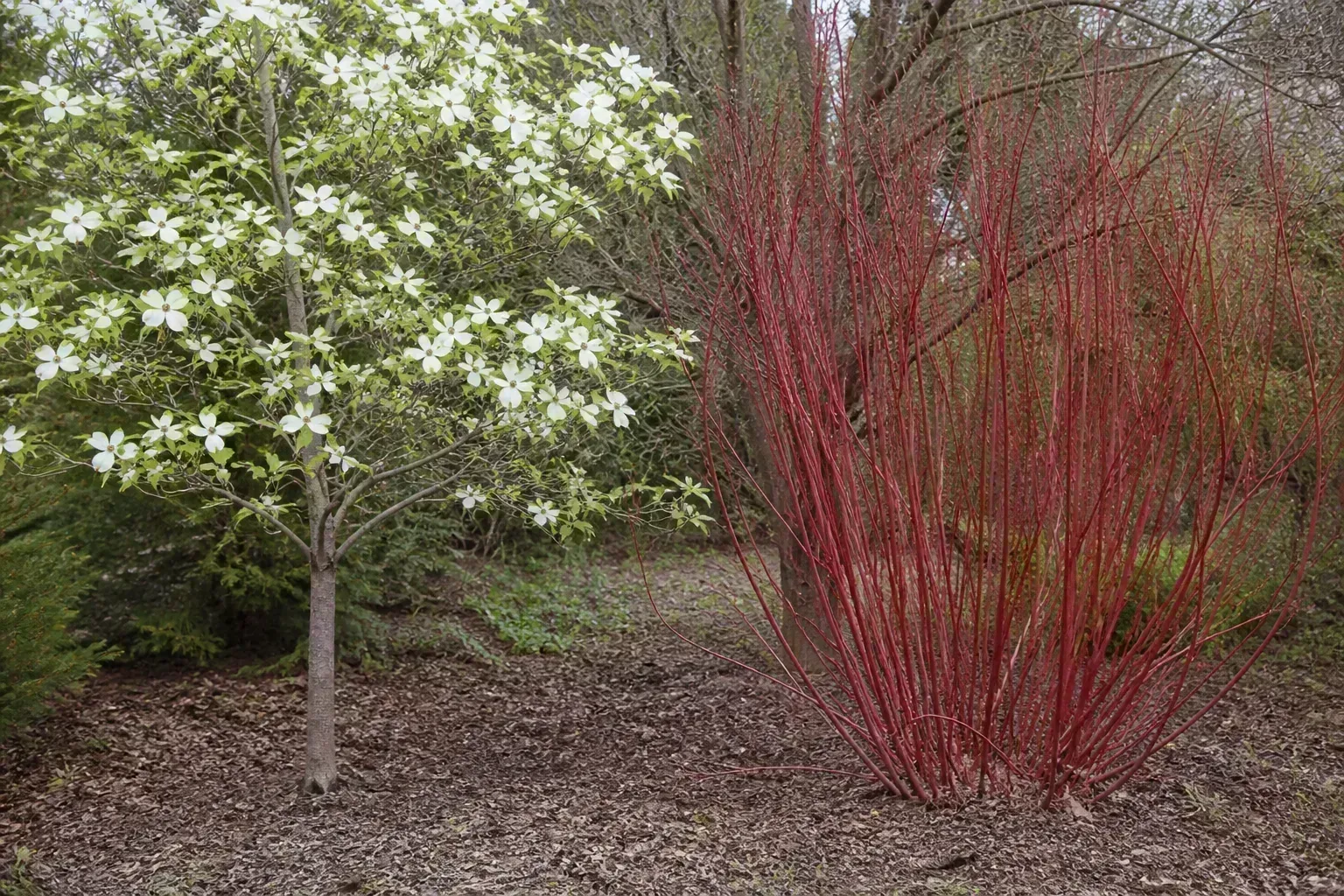
Look at the plant’s structure and seasonal show before picking up a saw. NC State Extension’s profile of flowering dogwood describes Cornus florida as a small, low-branching understory tree with opposite leaves and bracts that appear before the leaves. By contrast, pagoda dogwood has distinctive horizontal tiers, and shrub dogwoods often have multiple stems emerging from the base.
| What you see | Likely pruning job | Timing starting point |
|---|---|---|
| Low-branching tree; large white, pink, or red bracts before leaves | Preserve canopy and flowering structure | Routine work just after bloom |
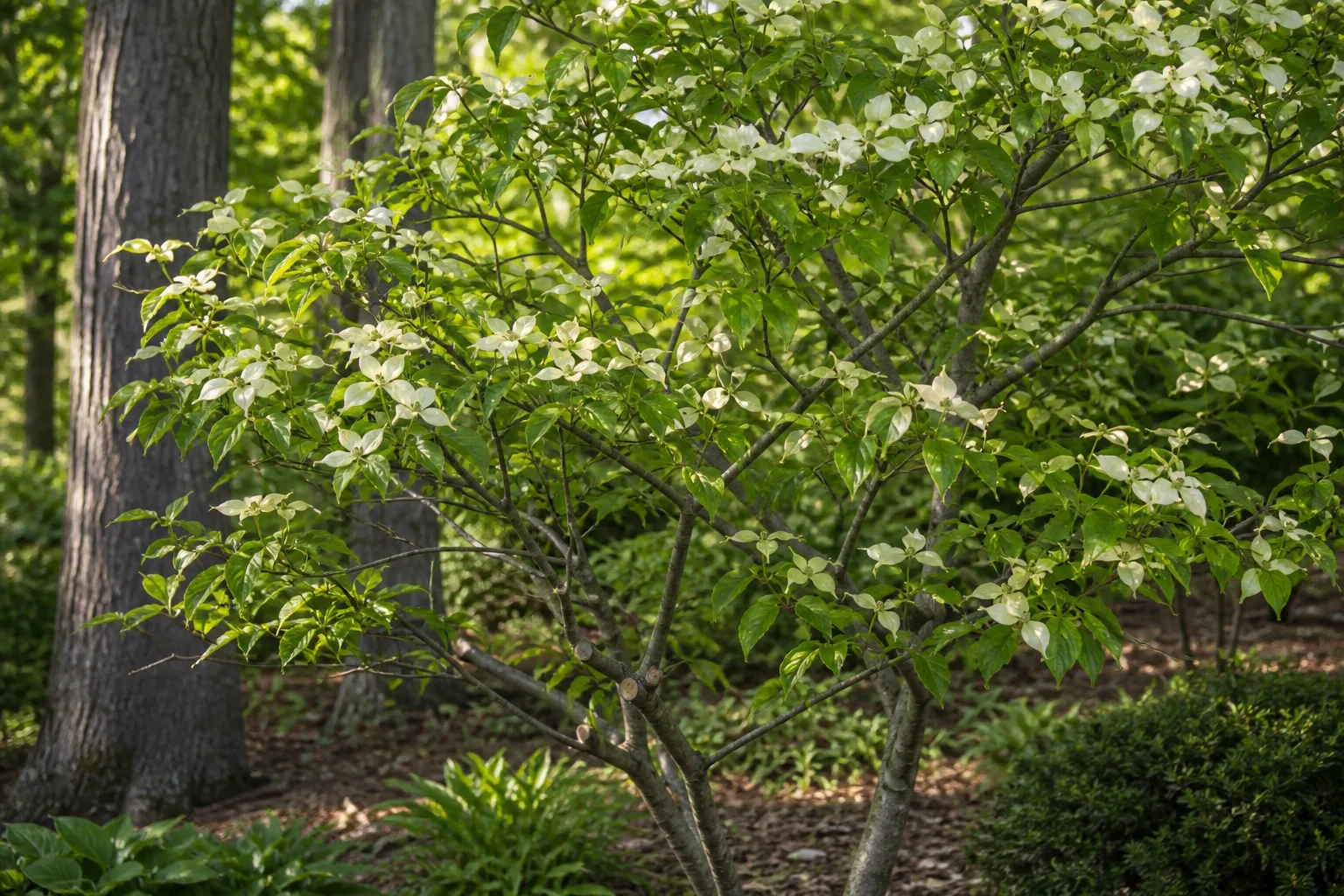
| Similar flowering tree with blooms among fresh leaves and mottled bark | Lightly shape a kousa dogwood | Immediately after its later bloom |
| Many stems and bright red young twigs in winter | Renew a red-twig or red-osier shrub | Late winter or early spring, following shrub-renewal practice |
| Flat, tiered branches and alternate leaves | Preserve the pagoda form | Light, selective cuts after flowering or when necessary |
Flowering dogwood and kousa dogwood
Flowering dogwood (Cornus florida) is the classic eastern North American flowering tree. Its showy bracts surround the small true flowers, and the tree’s broad, horizontal silhouette is part of its appeal. Kousa dogwood (Cornus kousa) is a different species with later flowers, a different fruit, and a reputation for greater resistance to dogwood anthracnose.
The timing rule is still not “prune all dogwoods in winter.” The New York Botanical Garden specifically places C. florida pruning immediately after bloom and says kousa should also be pruned immediately after flowering, although its bloom occurs later. RHS guidance on light pruning likewise lists flowering dogwood among trees that need light, selective pruning rather than hard cutting.
Red-twig and shrub dogwoods
Red-twig dogwood (Cornus sericea) is primarily a multi-stemmed shrub valued for young red stems and its tolerance of moist sites. It is not a smaller version of a flowering dogwood tree. If you cut a red-twig shrub back selectively at the base, you are renewing stems; if you cut a flowering dogwood to the ground, you may destroy the tree’s framework.
For shrub-form dogwoods, the practical objective is to remove a portion of the oldest, dullest stems at ground level and keep strong young stems to carry the display. Nature & Garden’s dogwood overview separates the end-of-winter renewal approach for red-barked Cornus alba from the light shaping recommended for tree-form dogwoods. Confirm the species and mature form before applying that advice.
Choose the pruning window by your goal
Start with the result you want, not the month on the calendar. The best pruning window changes if you are removing a hazard, protecting flowers, reducing a healthy tree’s size, or renewing a shrub for colored stems.
| Goal | Best starting window | Main trade-off |
|---|---|---|
| Remove dead, broken, or clearly diseased wood | As soon as it is safe and the cut can be made correctly | You may work outside the ideal bloom window |
| Shape a healthy flowering dogwood | Immediately after flowering | Waiting means accepting the existing shape through bloom |
| Shape a healthy kousa dogwood | Immediately after its later flowering period | Delaying too long can affect next year’s buds and tender regrowth |
| Reduce a tree that is slightly too large | After bloom, in stages | One aggressive session can weaken the tree and spoil its form |
| Renew red-twig or other shrub dogwood stems | Late winter or early spring, according to the shrub’s growth cycle | A hard renewal cut changes the season’s appearance |
The tree may “bleed” sap when cuts are made as spring growth begins. Clemson Extension explains that sap flow from dogwood wounds is not usually harmful, but it can be unsightly and may attract stinging insects. That is another reason not to choose the bud-swelling period for casual cleanup.
Routine shaping and deadwood
For a healthy flowering dogwood, routine shaping belongs after the bracts have faded. At that point you can see which branches are truly weak, crowded, or badly placed, while the tree has a long growing season ahead to replace leaves and develop the next cycle of growth.
Dead, broken, and diseased branches are a different category from live shaping. Remove them when discovered, provided you can reach the branch safely and identify a proper cut. A hazardous dead limb high in the canopy is not a do-it-yourself pruning task just because it is technically dead.
Size reduction
Pruning is a poor substitute for planting a tree in a space large enough for its mature spread. If a flowering dogwood is repeatedly outgrowing a wall, walkway, or roof, small annual thinning cuts may buy time, but they will not make the wrong site permanently right.
Reduce size by removing whole branches back to a suitable lateral or parent limb, not by cutting every branch at the same height. The Town of Cary’s tree-care guidance warns that topping and tipping produce weak, unnatural regrowth and make trees more vulnerable to weather and disease. If the tree needs a large reduction, get an arborist’s plan before making the first cut.
Inspect the tree before you cut
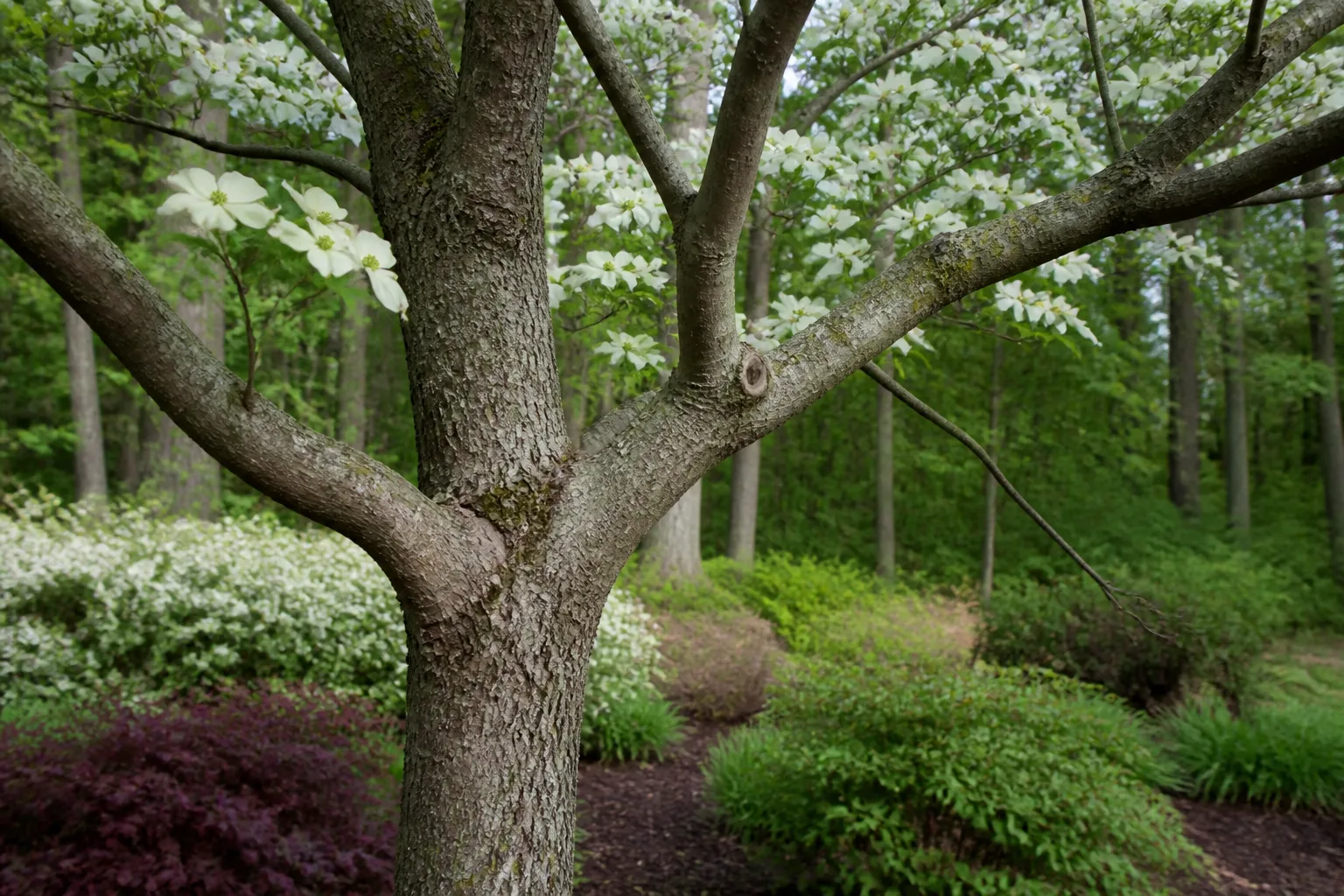
Walk around the entire tree and identify the trunk, major limbs, branch unions, root flare, and canopy before removing anything. Mark the three Ds first: dying or dead, damaged, and diseased. Then mark branches that cross, rub, grow inward, or interfere with a path or sightline. This pause is where most bad cuts are prevented.
Check the tree’s condition, not just its appearance. A dogwood that is wilted, thin-leaved, declining, or drought-stressed has less margin for heavy live-wood pruning. Penn State Extension’s dogwood disease table describes anthracnose and decline as problems that can include leaf and bract lesions, twig dieback, and progressive decline, and it pairs pruning with protection from drought stress rather than treating pruning as a cure by itself.
Stop and arrange professional help if the branch is large, high, under tension, close to a power line, attached to a visibly cracked union, or positioned above a target. A pole saw does not make overhead work safe. For a mature tree, the value of a correct assessment is greater than the cost of replacing a damaged canopy or repairing a roof.
Use the right tools and clean them
Use a sharp bypass hand pruner for small twigs, loppers for branches that fit their capacity, and a pruning saw for larger limbs. Clemson’s tree-pruning factsheet gives useful working ranges: hand pruners for branches up to about one-half inch, loppers for roughly one-half to one and one-half inches, and a pruning saw above one and one-half inches. The tool should cut in one smooth motion instead of crushing or tearing the bark.
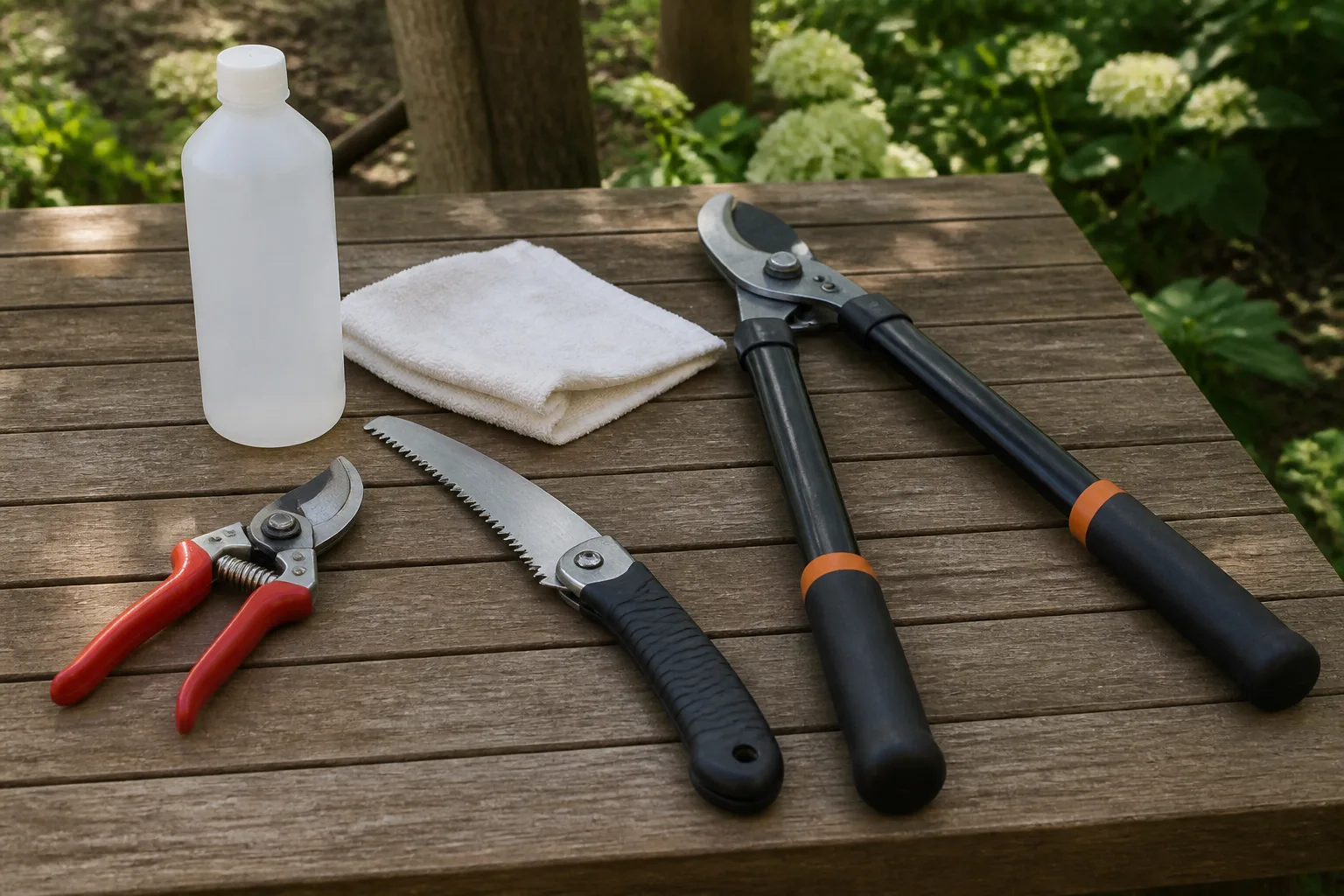
- Bypass pruners: small twigs and precise cuts near a bud or lateral branch.
- Loppers: medium branches that can be held steady while you cut.
- Pruning saw: heavy limbs and any branch too large for a clean lopper cut.
- Pole pruner: only for reachable work from the ground and never near power lines.
Clean the blades before you start and whenever you move from a suspect tree or branch to another plant. UF/IFAS guidance on disinfecting garden tools separates cleaning from disinfecting: first remove sap, soil, and debris, because organic residue reduces the effectiveness of a disinfectant. A 70% isopropyl alcohol wipe or dip is a practical option; follow the product’s safety instructions and keep flammable alcohol away from heat.
If you use a bleach solution, the same UF/IFAS guidance specifies one part bleach to nine parts water, a 30-minute soak, and a fresh solution because its effectiveness falls with time. Rinse and dry the tool afterward to reduce corrosion. For ordinary cuts on one healthy tree, frequent wiping is sensible; after diseased wood, sanitation deserves much more attention.
Remove dead, damaged, or diseased wood
Start with branches that no longer contribute to the canopy. Dead twigs are brittle and dry, while living wood has flexible tissue and visible buds or side shoots. Remove a dead branch back to its point of origin or to healthy tissue, taking care not to enlarge the wound by cutting into the trunk or a sound parent limb.
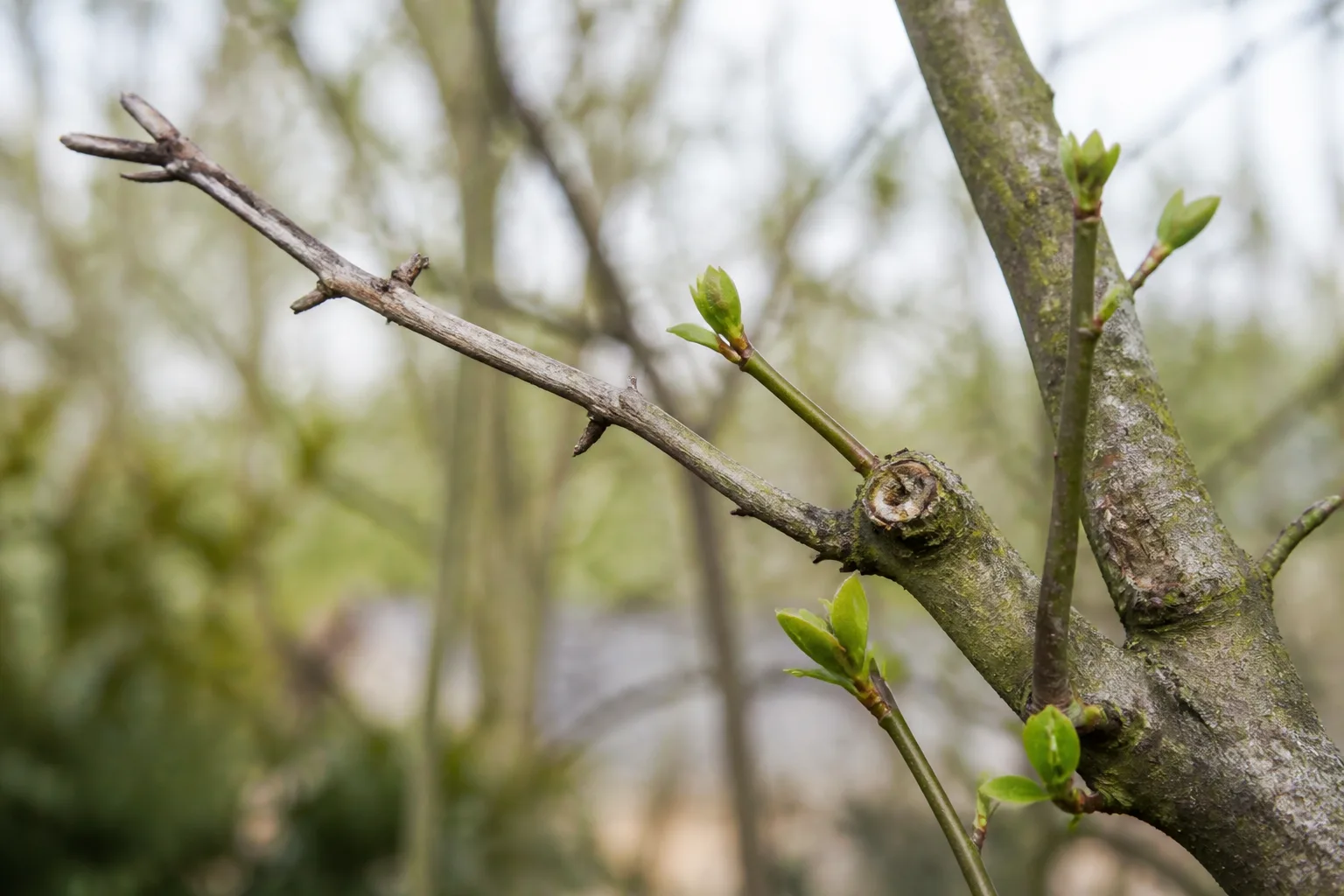
For a broken branch, find the cleanest safe point below the split. A torn limb can hang on while its damaged edge continues to dry and decay. If the break is high, heavy, or pulling bark from the trunk, leave it for an arborist rather than trying to finish the job from a ladder.
Diseased wood needs more than a cosmetic haircut. Remove clearly dead or blighted twigs, collect the cut material, and do not leave suspicious debris beneath the canopy. Penn State Extension reports that dogwood anthracnose can cause leaf and bract spots, twig dieback, and attached blighted leaves; a tree with recurring symptoms should be diagnosed rather than repeatedly stripped of foliage.
Do not use pruning to “open the tree” by removing large amounts of green canopy when the real problem is drought, poor site conditions, or a disease already advancing through the tree. Improve moisture management and obtain a local diagnosis. NC State Extension notes that flowering dogwood can be challenging in some landscape settings and is susceptible to several diseases, so prevention of stress matters as much as the cut itself.
Thin crossing and crowded branches
When two branches rub, choose the better-placed one and remove the other at its origin or back to a suitable lateral. Repeated rubbing removes bark and creates an open wound. A branch that points toward the center of the crown can also crowd the structure, especially when several shoots emerge from the same area.
Use thinning cuts rather than shortening every branch into a tuft. Thinning removes a whole branch or returns it to a well-positioned side branch, preserving a natural silhouette. Heading cuts made across many branch tips encourage dense, weak regrowth near the cut and make the tree look clipped rather than naturally branched.
Work from the inside out, but remove only enough to solve the identified problem. A little more light and air through a congested crown can be useful; an overly opened canopy exposes limbs and bark to stress and leaves the tree with less leaf area. Pause after each major cut and reassess the balance from several angles.
Make cuts that the tree can close
The branch collar is the slightly swollen area where a branch joins its parent limb or trunk. Keep that collar intact. Make the final cut just outside the collar, following the natural angle of the branch union, rather than cutting flush against the trunk. A flush cut removes protective tissue and creates a larger wound.
When shortening a young twig, cut just above a healthy bud or side branch, preferably one pointing toward open space. Leave a small margin so the bud is not damaged, but do not leave a long bare stub. A stub dries back and can become a slow-closing entry point for insects and decay.
For larger branches, locate the branch bark ridge on the upper side of the union and the collar below it. The final cut begins outside the ridge and ends just beyond the collar. Clemson Extension explains that this preserves the tree’s natural barrier to decay and that routine wound paint or tar does not prevent decay.
The three-cut method for heavy limbs
A heavy branch can tear a long strip of bark when its weight drops. The three-cut method removes the weight in stages:
- Make a shallow undercut on the underside of the limb, several inches away from the final collar cut. Stop before the saw binds.
- Make the top cut a little farther out than the undercut. The outer section should break or fall away without pulling bark down the trunk.
- Support the remaining stub if it is safe to do so, then make the final cut just outside the branch collar and bark ridge.
The exact distance depends on the branch, your saw, and the space available; the point is to remove the heavy outer section before attempting the finish cut. Clemson Extension describes three cuts for branches larger than about one and one-half inches and shows why cutting straight through from the top can strip bark from the trunk.
Never make this procedure while standing beneath a suspended limb or while balancing on a ladder. If you cannot control where the branch will fall, the job has exceeded safe home pruning.
Train a young dogwood gradually
Young trees are the easiest place to build a strong, natural structure. Remove a competing upright leader, a branch that will eventually rub, or a low branch that blocks access while it is still small. Keep the cuts limited so the young tree retains enough foliage to grow a sturdy trunk and root system.
Dogwoods often have a spreading, low-branching habit, so training does not mean forcing every specimen into a tall single-trunk shape. Choose well-spaced permanent limbs that fit the tree’s natural form and remove obvious conflicts over several seasons. Clemson’s pruning guidance gives smaller trees such as dogwoods a closer branch-spacing range than large-maturing oaks, but the mature habit and cultivar still matter.
The best young-tree cut is often the one you do not need to make later. Keep lawn equipment, string trimmers, and mulch away from the trunk, water during dry establishment periods, and correct a structural conflict while it is a finger-thick branch rather than waiting until it requires a saw.
When renovation or removal is the better answer
Do not cut a mature flowering dogwood to the ground to make it “start over.” Ground-level rejuvenation is a technique for selected multi-stemmed shrubs, not a universal rescue for an established ornamental tree. It can erase the tree’s branching architecture, expose the plant to major stress, and leave weak regrowth without solving a bad planting site or serious disease.
If a shrub dogwood has become old and stemmy, gradual renewal or a planned end-of-winter cutback may be appropriate. Remove selected old stems at the base and keep younger replacements; do not shear only the top, because that preserves old wood while creating a dense cap of new shoots. Use the species’ growth habit as the guide.
Removal may be the responsible option when a tree has a dangerous union, extensive trunk decay, a girdling canker, or a site that keeps it in chronic drought stress. Penn State Extension’s disease information notes that some serious dogwood diseases can kill the tree over time. A certified arborist or local extension office can help distinguish a treatable branch problem from decline that pruning cannot reverse.
Aftercare and next-season check
After pruning, water the root zone during dry weather rather than spraying the canopy. Dogwoods benefit from consistent moisture, but saturated soil is not a substitute for drainage. A 2- to 4-inch mulch layer can moderate root-zone temperature and moisture; keep mulch away from the trunk so the bark stays dry and visible.
Do not fertilize heavily just because you made a cut. Recovery depends on remaining leaves, healthy roots, water, and suitable light. Excessive soft growth can create a new crowding problem and does not repair a flush cut or cure a disease.
Inspect the tree again after several weeks and at the next dormant season. Look for dead stubs, new rubbing, water sprouts near old heading cuts, fresh cankers, and branches that are becoming dominant. If the tree produced a thicket of shoots after a bad cut, do not keep topping them; have the structure evaluated and remove selected sprouts over time.
Keep the tools clean, dry, sharp, and lightly oiled after use. The goal of aftercare is not to force a dramatic flush of growth. It is to help the dogwood keep enough healthy foliage and sound structure to close the wound and return to its natural rhythm.
Conclusion
Pruning a dogwood well is mostly a timing and restraint exercise. Identify the species, decide whether the branch is hazardous or merely untidy, and remember that a flowering tree is usually shaped after it blooms—not cut back in early spring simply because the canopy is easy to see.
Make selective cuts just outside the branch collar, remove crossing and diseased wood, sanitize tools between suspect plants, and stage any meaningful size reduction. When the limb is large, the tree is declining, or the cut requires climbing, stop at the ground and call an arborist.