How to Keep Skunks Out of Your Yard Humanely
Stop skunks from digging up your lawn without harming them. Identify the cause, use deterrents wisely, and know when to call wildlife control.

The most reliable way to keep skunks out of your yard is to remove the reasons they keep returning, then block access to the places where they can den. Start with pet food, garbage, poultry feed, brush, and easy shelter. Use lights, sprinklers, or a labeled repellent only as temporary backup, not as the whole plan.
The important exception is an occupied den. Do not fill a hole under a porch, deck, shed, or foundation until you know whether a skunk is inside and whether young are present. A one-way door installed at the right time can let an adult leave without allowing reentry; a rushed barrier can trap an animal, separate a mother from kits, or push the skunk into a more dangerous part of the property.
Start by Identifying the Problem
Skunks are usually nighttime visitors that forage for insects, grubs, worms, fallen fruit, eggs, garbage, and pet food. They are valuable predators of many invertebrates, so the goal is not to make every square foot of a property hostile. The goal is to make the high-conflict areas—your lawn, pet run, coop, crawl space, and garbage area—less rewarding and less accessible.
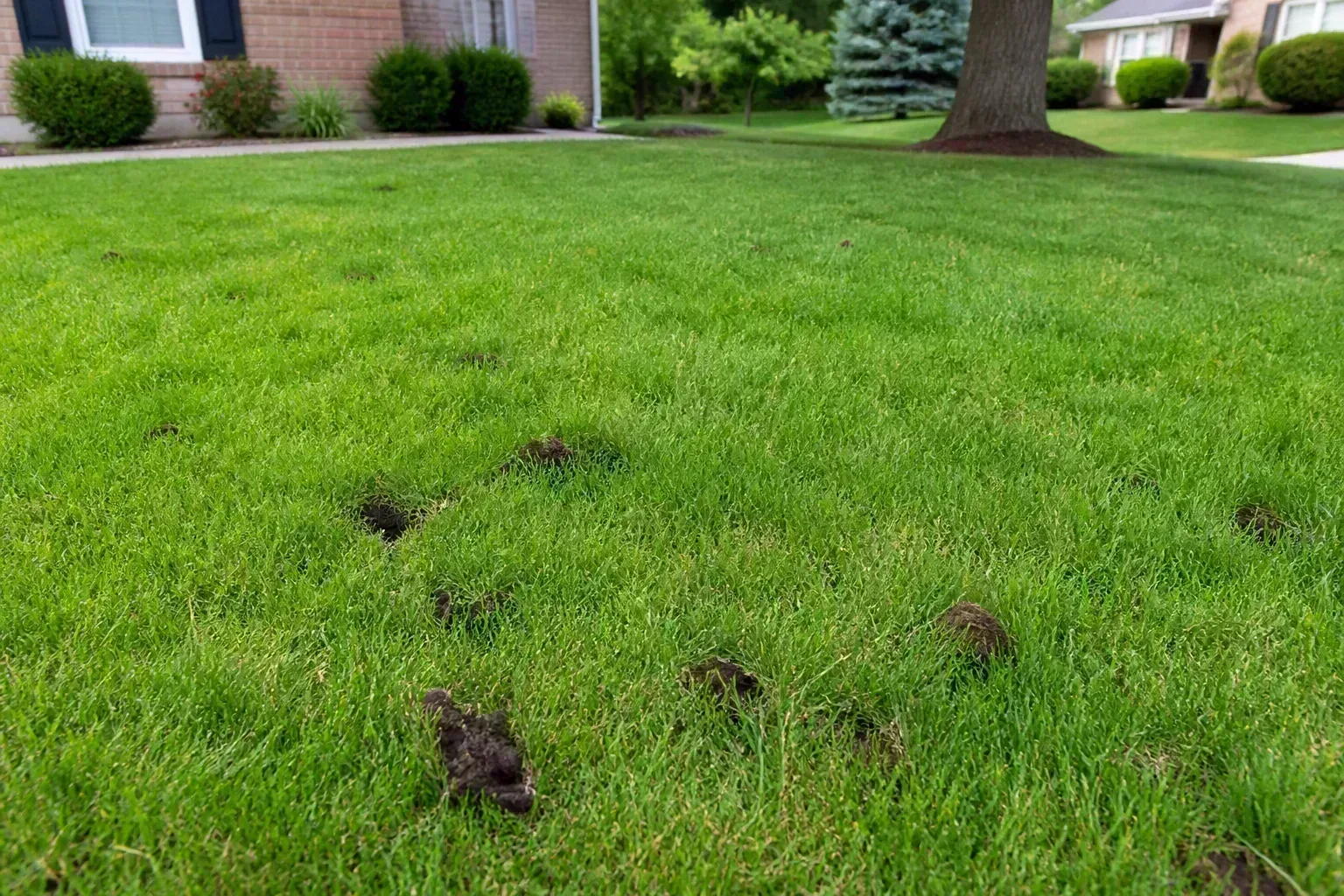
The University of Georgia’s wildlife and turf specialists describe two useful clues: small cone-shaped holes can indicate skunks foraging for grubs and worms, while odor or droppings under a building can indicate a den. Those clues are not a complete identification, though. Raccoons, armadillos, birds, squirrels, and even irrigation or mower damage can produce confusing marks.
If the animal is not visible, place a game camera where the damage begins and check it from a distance. A camera is often more useful than guessing from one hole because it tells you whether the visitor is a skunk, what time it arrives, and whether it is entering a structure. Keep pets away from the camera site and do not use food as bait; bait can create the problem you are trying to solve.
Foraging Holes vs. a Den
Foraging damage usually looks like several shallow, roughly 1- to 3-inch cone-shaped holes scattered across turf or a bed. You may also see a patch of sod lifted or rolled back, especially where the soil is moist and insects are close to the surface. That pattern suggests a skunk is searching for food, not building a permanent home in the lawn.
A den is more likely when there is a larger opening near a foundation, under a porch or deck, beside a shed, in a woodpile, or under dense debris. A persistent musky smell, tracks at the same entrance, disturbed soil, and repeated traffic to one sheltered spot are stronger evidence than a single hole. The MSPCA’s skunk guidance notes that skunks commonly use spaces beneath porches, patios, sheds, and decks as well as brush, wood, or rock piles.
Treat those two problems differently. Foraging visits call for food-source cleanup and targeted lawn diagnosis. A den calls for a careful exclusion plan, and the timing of that plan matters more than any scent spray.
When a Skunk Needs Professional Help
Call a licensed nuisance-wildlife operator, animal control agency, or wildlife rehabilitator when a skunk is trapped in a window well, garage, basement, drain, or fencing; when it is living under a building; when you suspect kits; or when the animal is injured or behaving abnormally. Ask what license the operator holds, how they handle dependent young, what the law allows in your area, and whether they use exclusion rather than indiscriminate trapping.
Do not approach a skunk to decide whether it is healthy. A skunk that is staggering, circling, unusually tame, persistently aggressive, unable to walk normally, or active in daylight while behaving strangely should be treated as a public-safety concern. Daytime activity alone is not proof of rabies—skunks can be disturbed or displaced—but it is a good reason to keep people and pets inside and call for advice.
The CDC’s current rabies guidance identifies skunks as a wildlife rabies reservoir in much of the United States and advises local risk assessment after potential exposure. Never handle a wild skunk, even if it appears calm.
Make Your Yard Less Rewarding
Habitat modification is the foundation of humane skunk control because it reduces the animal’s reason to keep testing your property. Do the easy changes first and give them several nights to work. If food is still available, a bright light or strong odor may only teach a skunk to work around the nuisance.
Remove Food and Water at Night
Bring pet food and water bowls indoors before dusk. Feed pets on a schedule, clean crumbs from patios and decks, and store birdseed, chicken feed, compost, and livestock feed in tight, animal-resistant containers. If neighbors feed outdoor cats, coordinate rather than moving the bowls or confronting the animals; unattended food can attract skunks, raccoons, opossums, rodents, and free-roaming pets at the same time.
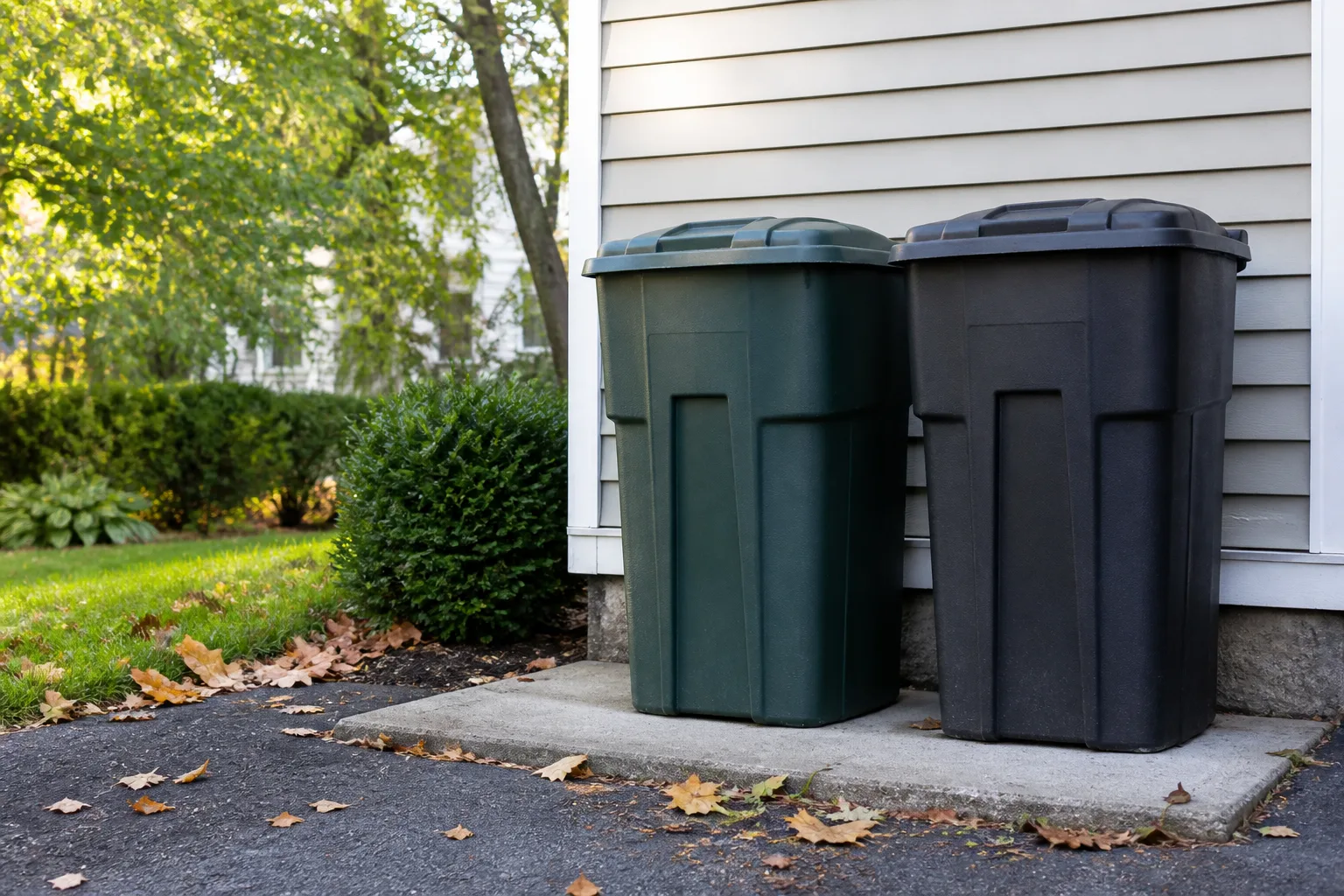
Use garbage cans with tight-fitting lids and keep them behind a closed gate or inside a shed until collection day. Rinse food residue from recycling, tie off smelly scraps, and do not leave meat, grease, eggshells, or fallen fruit in an open compost pile. Secure a chicken coop at night and repair gaps along its base. Skunks are capable diggers, so a door that latches but a floor-level opening remains is not a secure coop.
Water matters too. Fix dripping outdoor faucets, avoid leaving shallow pet dishes outside overnight, and correct irrigation that keeps the lawn saturated. Moist soil can bring worms and other prey closer to the surface, making a lawn easier to forage. You do not need to dry out a healthy landscape; you do need to stop creating a reliably wet, food-rich corner beside a deck or foundation.
Fix the Lawn Without Chasing Wildlife
Do not treat the entire lawn with an insecticide simply because skunks have made holes. First confirm that the holes are from skunks and that grubs are present at a level that warrants treatment for the turf in your region. Dig a small test section at the edge of the damage or ask your county extension office how to sample and interpret the result for your grass type and season.
The University of Georgia guidance connects cone-shaped holes with skunk foraging and says grub control may be appropriate once the cause is confirmed. That is different from treating grubs as a guaranteed skunk repellent. Insecticides can affect beneficial organisms and non-target wildlife, and a label may not permit the timing, site, or use you had in mind.
If the lawn is wet, improve irrigation timing and drainage where practical, repair thin turf, and remove the easiest cover around the problem area. If you do use a lawn product, follow the label exactly, keep children and pets off the treated area for the required period, and never increase the dose to make the lawn less attractive to wildlife. A healthier lawn may reduce repeat digging, but it will not replace securing food or a den entrance.
Clear Cover and Secure Poultry
Remove brush piles, fallen limbs, loose lumber, unused building materials, and rock piles from the edges of the yard. Trim dense vegetation where it touches a foundation, and keep the space beneath a shed or deck visible enough to inspect. The Internet Center for Wildlife Damage Management lists garbage, debris, and lumber piles as habitat features that make a property more attractive to skunks.
Inspect crawl-space vents, basement windows, shed doors, and gaps below porches. A temporary cover over an opening is not enough if an animal can push it aside or dig below it. For poultry, use mesh fencing that is secured at ground level and extend protection below grade or outward along the soil where digging is likely. Keep feed in a closed container rather than relying on the coop to be the only barrier.
Use Low-Risk Deterrents as a Backup
Deterrents work best when they protect a specific area while you correct the underlying attractant. They are not a permanent perimeter force field. If a skunk keeps finding food or shelter, it can learn to tolerate a light, sprinkler, or smell—especially when the reward is worth the inconvenience.
Motion Lights and Sprinklers
Aim a motion-activated sprinkler at the lawn edge, garden gate, garbage area, or approach to a bed rather than spraying a sidewalk where people will trigger it. A short burst of water can startle a nocturnal animal without injuring it, but check the device so it does not flood a foundation, erode soil, or soak a plant that dislikes wet foliage. Replace the batteries and reposition it as the animal’s route changes.
A motion light can be worth trying near a shed, coop, or garbage enclosure. It may make the spot less comfortable for a while, but it can also disturb neighbors, attract attention to a window, or stop working once the animal has learned the pattern. Use it as a temporary layer while you remove food and prepare exclusion. Practical garden guidance from Homes & Gardens and Martha Stewart treats motion lighting as a deterrent to try, while wildlife-damage guidance gives frightening devices limited value. The useful conclusion is not “lights never work” or “lights solve skunks”; it is “do not mistake a short-term startle for a control plan.”
Commercial Repellents, Scents, and Capsaicin
Some commercial products are sold for skunk deterrence and may use capsaicin or other odor and taste irritants. If you try one, read the entire label before application: confirm that skunks and your intended site are covered, check reapplication instructions, and keep pets, children, ponds, edible crops, and beneficial wildlife within the stated safety limits. Reapply only as directed after rain or irrigation.
Be skeptical of any product or home recipe that promises a permanent result from a smell alone. The ICWDM’s control summary says no repellents are registered for skunk control and no frightening devices are effective as a complete control method. That does not mean every marketed product is identical; it means scent is a weak foundation for a humane plan and should not delay food removal or exclusion.
Do not spread hot pepper powder where a dog, cat, child, or bird can walk through it and rub its eyes. Do not put irritating substances inside a den. Anything that harms a kit, prevents a mother from returning, or drives an animal into a wall, crawl space, or roadway is not a humane success.
Exclude Skunks From Buildings Safely
Exclusion is the durable solution for skunks under a porch, deck, shed, or foundation, but only after you establish that the space is empty or that the animals can leave safely. Closing an entrance while a skunk is inside turns a wildlife conflict into a trapped-animal emergency.
Check for Kits Before Closing a Den
Look for repeated adult traffic, soft squeaks or whining, rustling, and a den entrance under a protected structure. Do not put your hand, phone, or face into the opening. The MSPCA recommends tolerating a den with young when possible so the kits are not orphaned; its guidance also notes that young commonly remain with the mother for a period before traveling out to forage.
If you must address the den sooner, ask a wildlife professional to inspect and plan the timing. Do not assume that silence means there are no kits. The mother may be away feeding, and a frightened adult may remain quiet while you are nearby. Keep dogs, children, and outdoor work away from the entrance until you have a plan.
If no young are present and the skunk is still using the space, mild, intermittent human activity near—but not blocking—the entrance may encourage it to choose another den. A radio or light is not a substitute for observation, and constant harassment can create an unpredictable animal. Professional advice is the safer choice when the den is close to a doorway, pet area, or foundation.
Install a Mesh Apron or One-Way Door
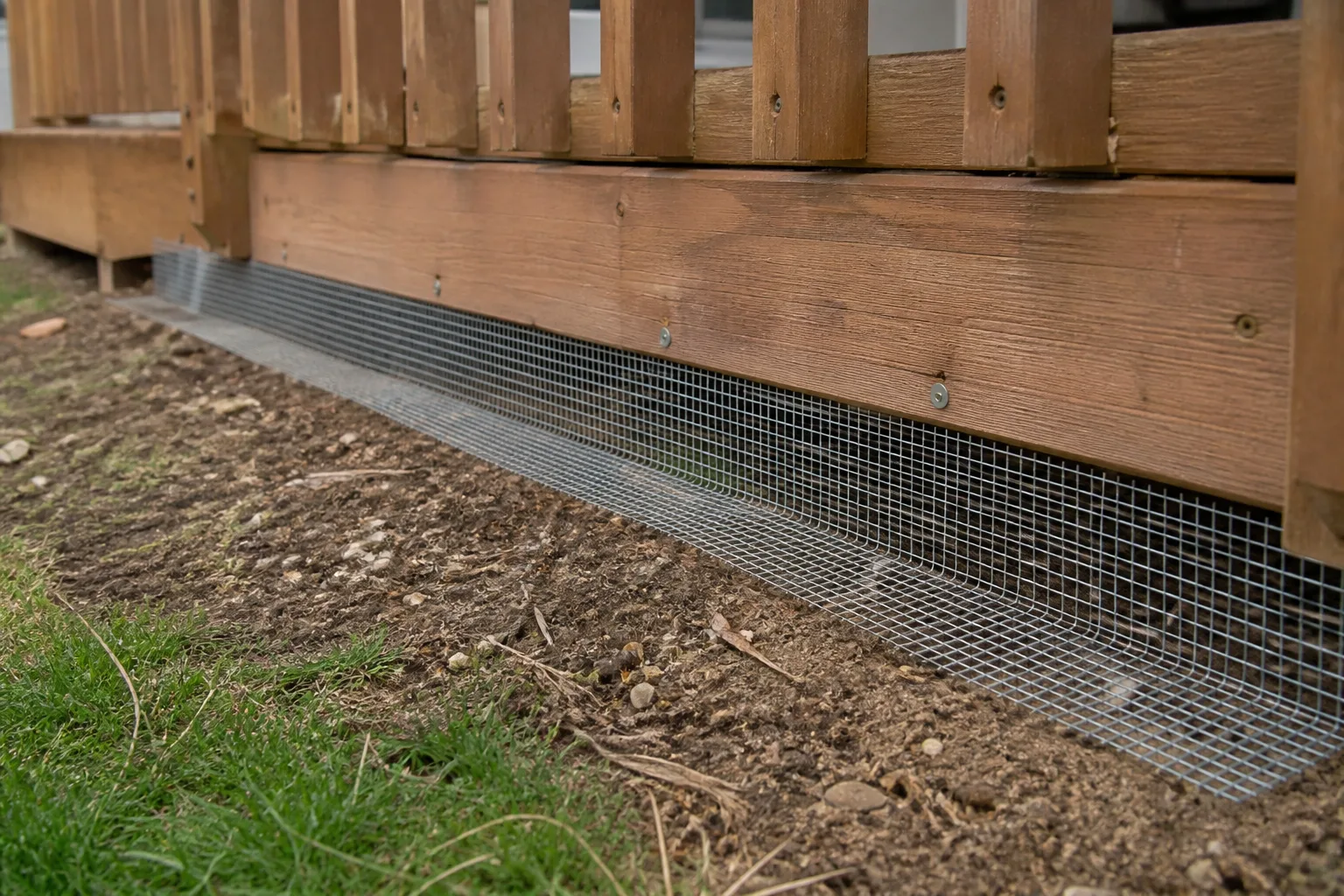
For a vacant entry or an active den that a professional has assessed, use sturdy welded wire or hardware cloth rather than flimsy chicken wire. A practical exclusion detail from the ICWDM’s mesh guidance is 1/2-inch mesh buried about 2 inches below ground and extended at least 12 inches outward in an L-shaped apron. Deeper or wider protection may be needed in sandy soil or where the animal is highly motivated to dig.
Fasten the mesh to sound framing, cover sharp cut edges, and inspect the entire perimeter for a second opening. Skunks can exploit a small gap beside a post, vent, step, or foundation. For a poultry yard, a taller mesh fence and a buried or outward apron can protect the enclosure; for a deck or shed, the barrier must meet the structure continuously rather than stopping at the obvious hole.
When a skunk is still inside, a one-way door can allow it to leave but not return. It must be installed over a confirmed entrance, with every secondary opening closed so the animal cannot bypass the door or become trapped inside. Watch the site through several nights of favorable weather. Once you have evidence that the den is empty, remove the door and seal the opening permanently.
Do not use a one-way door as a guess. If kits are inside, the mother needs reliable access. If an injured or sick animal is inside, exclusion without help can worsen the situation. This is the point where a wildlife operator earns their fee: they can assess occupancy, choose a legal method, and complete the final seal after the animal has moved on.
What Not to Use
Avoid mothballs, poison, fumigants, glue traps, improvised snares, and any chemical used off-label. Mothballs are pesticides, not outdoor wildlife air fresheners; they can expose pets and children and do not make an acceptable den treatment. Ammonia-soaked rags or other strong irritants can injure animals, contaminate a confined space, and prevent a mother from retrieving young.
Do not set a trap unless you know the local rules, the species, the legal disposition of the animal, and what you will do if a cat, dog, or other non-target animal is caught. Trapping a skunk near a home can also create the spray emergency you were trying to prevent. The ICWDM’s handling guidance says translocation is not advised and may be restricted because skunks are a rabies-vector species.
Predator urine, citrus peels, soap, pine-scented cleaners, and similar household hacks are not dependable barriers. Some smells may seem to change an animal’s route for a short time, but their effect fades with rain, evaporation, habituation, or a more valuable food reward. Never spray a household cleaner on a lawn, plant, animal, or den unless the product label specifically allows that use.
If You Find a Skunk in a Dangerous Spot
If a skunk is in an open garage or shed, move people and pets indoors, leave an obvious exit open, turn off indoor lights if it is safe, and give the animal time to leave. Do not corner it, chase it with a broom, or send a dog to drive it out. Close off access to the rest of the house without blocking the outside route.
For a window well, the safest general goal is a quiet escape route, not a capture. A rough board set at a gentle angle may give an animal enough grip to climb out of a deep, empty well, but do not lean over it or attempt this when the skunk is injured, frantic, or near a child. Ask animal control or a rehabilitator for instructions, then install a secure window-well cover once the animal is gone.
If the skunk is tangled, trapped in fencing, has its head caught in a container, or is lying in an exposed place, keep your distance and call for help. A blanket, net, or improvised grab can cause a bite or spray at close range. The objective is a controlled release or professional removal, not proving that you can handle wildlife yourself.
Protect Pets and Handle Spray
Keep dogs on a leash after dark until the skunk activity is resolved, and bring cats indoors at night. Check that rabies vaccinations are current. A dog that corners a skunk can be sprayed even when the skunk is not rabid, and a bite or scratch creates a separate veterinary and public-health question.
If a person is bitten or scratched, wash the wound immediately with soap and running water and contact a healthcare provider or local health department. If a pet is bitten, scratched, or mouthed a skunk, call a veterinarian promptly and report the encounter as local rules require. Do not try to capture the skunk for testing unless public-health or animal-control officials direct you.
For spray in the eyes, flush with clean water and seek medical or veterinary advice, especially if pain or vision changes persist. For odor on washable clothing, wash promptly and keep it away from heat until the smell is gone. For skin or fur, a fresh mixture of one quart of 3% hydrogen peroxide, 1/4 cup baking soda, and 1 to 2 teaspoons of liquid dish soap is commonly recommended by UGA experts, but keep it away from eyes and mouths, do not store it in a closed container, and ask a veterinarian before using it on a cat or an animal with skin disease. A commercial de-skunking product and professional veterinary guidance are safer choices when exposure is extensive.

Conclusion
To keep skunks out of your yard without harming them, remove the rewards first: outdoor pet food, unsecured garbage, feed, fallen fruit, wet foraging areas, and sheltered debris. Confirm whether the damage is a skunk’s shallow feeding holes or an occupied den, then use a camera, a temporary sprinkler or light, and a properly labeled product only as supporting measures.
For a den beneath a structure, pause before you seal. Check for young, use a professional one-way exclusion when appropriate, and finish with buried hardware cloth that reaches beyond the foundation. Keep pets away, never handle a skunk, and involve animal control or public-health officials after abnormal behavior or any bite, scratch, or direct contact.



