How to Plant Grass Seed in Winter Successfully
Plant grass seed in winter with practical rules for soil temperature, seed rates, site prep, snow, moisture, spring watering, mowing, and weeds.
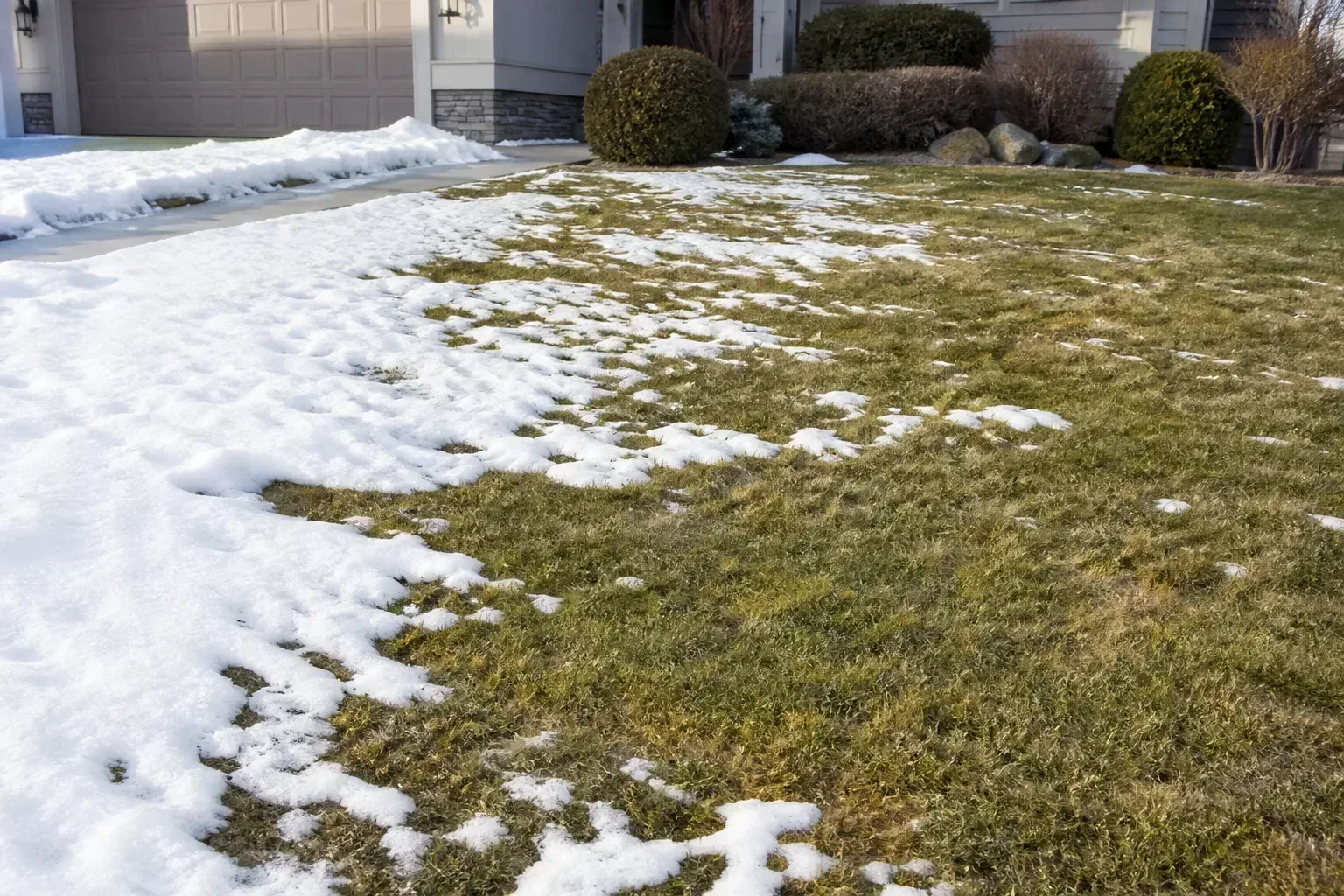
Winter is not automatically too late for grass seed. If you have a cool-season lawn and a stretch of genuinely cold weather ahead, you can use dormant seeding to put seed in place now so it is ready to germinate when spring soil warms.
The important distinction is that you are not trying to grow a green lawn in frozen soil. You are placing viable seed where it can stay put, remain dormant, and take advantage of spring moisture and the natural movement of the soil. That makes the method useful for thin lawns and missed fall repairs, but it is less forgiving than the normal late-summer or early-fall seeding window.
What dormant seeding actually means
Dormant seeding means broadcasting grass seed after conditions have become too cold for meaningful germination, but before winter weather makes the site inaccessible. The seed rests on or near the soil surface until moisture and temperature return to a range where the embryo can resume growth.
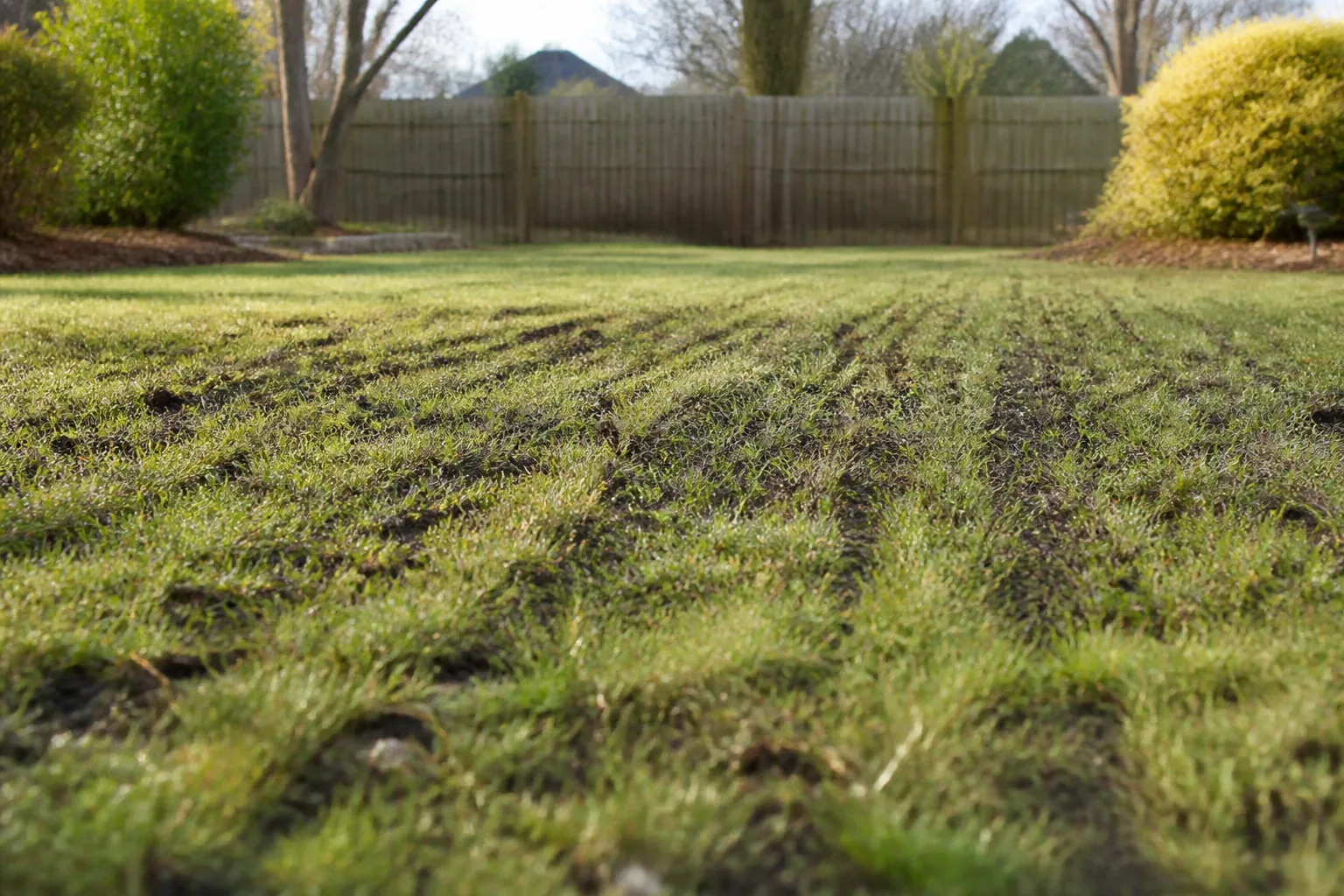
Winter freeze-thaw cycles may help move some seed into tiny cracks and pockets in the surface. Snow cover can also reduce wind movement and provide a slow release of water as it melts. Neither benefit is guaranteed, however: a sloped, compacted, leaf-covered, or frequently trafficked site can lose much of its seed before spring.
Think of dormant seeding as pre-positioning a spring repair, not as a shortcut that removes the need for spring care. Purdue Extension’s turf establishment guide describes dormant seeding as an option when spring seeding is necessary, while also identifying late summer as the more reliable establishment window for cool-season turf. That distinction matters because a winter project can be worthwhile without being the best time to seed every lawn.
Is winter seeding right for your lawn?
Dormant seeding is most sensible when the lawn needs repair and your weather reliably stays cold enough to delay germination. It can work well in northern and colder transition climates, especially where the ground freezes or persistent snow protects the seed, but success becomes less predictable where winter alternates between warm rain and short freezes.
Use this quick decision rule:
- Choose dormant seeding for bare or thin areas when you have cool-season grass, a prepared seedbed, and a cold window ahead.
- Wait for the normal fall window if the soil is still warm enough for immediate germination and you can keep the seedbed moist.
- Wait for spring or early summer if your lawn is warm-season grass, the site is saturated, or your winter is too mild to keep seed dormant.
- Repair the cause first if the bare patch is created by standing water, heavy shade, salt, severe compaction, or repeated traffic.
Compare fall, dormant, and spring seeding
Fall seeding is generally the easiest of the three because warm soil speeds root and shoot development while cooler air reduces heat stress. The young turf has time to establish before summer, and it is easier to prepare the soil and keep the surface evenly moist.
Dormant seeding trades that favorable growing weather for scheduling flexibility. You do less watering while the seed is asleep, but you accept a greater chance of washout, bird feeding, uneven contact, and premature sprouting. Spring seeding gives you more visible feedback, yet the seedlings may face drying winds, cool wet soil, weed competition, and a short runway before summer heat.
If you can choose freely, use the best local fall window. If winter is your only practical chance to get seed onto a damaged area, dormant seeding can be a reasonable second choice—as long as you treat the result as a repair with a spring backup plan.
Check the grass type before buying seed
The phrase “grass seed” hides a major difference: cool-season grasses and warm-season grasses respond to opposite parts of the temperature calendar. Read the label on the seed bag or identify the existing turf before you decide that winter is an appropriate planting season.
Cool-season grasses that can wait for spring
Cool-season lawn grasses include Kentucky bluegrass, tall fescue, fine fescues, and perennial ryegrass. They are the usual candidates for dormant seeding because they can germinate and grow during the cool conditions of early spring.
Each species still has a different personality. Kentucky bluegrass is slower to establish but can spread through rhizomes after it is established. Tall fescue is valued for a deeper-rooted, coarser-textured lawn and is common in transition areas. Fine fescues can fit lower-input or partially shaded mixes, while perennial ryegrass is often chosen when quick early cover is a priority.
The best choice is the one that matches your existing lawn, sun exposure, drainage, and regional recommendations—not simply the fastest germinator. NC State Extension’s TurfFiles description of Kentucky bluegrass notes its cool-season habit, rhizomes, and preference for fertile, well-limed soil with full sun to moderate shade. Those traits are useful context when deciding whether a bluegrass-heavy mix suits a particular patch.
Temperature helps explain the trade-off. Purdue’s turfgrass germination table shows that the optimum temperature ranges for common cool-season species are not identical; tall fescue and perennial ryegrass, for example, favor a warmer optimum range than red fescue. Dormant seed is intentionally sown below the active germination range, then waits for spring conditions to improve.
Why warm-season grass should wait
Bermudagrass, zoysiagrass, and buffalograss are warm-season choices. They need warmer soil and a longer warm growing period, so putting their seed down in cold, wet winter ground usually creates a long wait during which seed can be eaten, moved, or lost to decay.
The UC IPM guide to healthy lawns lists cool-season grasses as best started in fall, with spring as the next-best window, while warm-season seeded grasses are most successful from mid-spring into early summer. That is a useful general rule even if your local dates differ.
If your lawn is mostly bermudagrass or zoysia, do not substitute a cool-season winter mix simply because it is available. You may create a temporary color change, a mismatched texture, or a turf stand that struggles when the original warm-season lawn resumes growth. Wait for the soil to warm and follow the seed label and local extension calendar.
Choose timing by soil temperature, not the calendar
There is no universal “winter seeding day” that works from one region to the next. December may be true winter in one yard and a series of warm, wet fall days in another, so use the condition of the soil and the next forecast rather than the month name.
A practical dormant-seeding window begins when the soil has become consistently cold enough that the seed is unlikely to germinate immediately. Many homeowner guides use about 40°F at roughly two inches deep as a guardrail, while turf specialists emphasize that the actual minimum temperature for germination is difficult to define because growth becomes extremely slow. Rutgers Center for Turfgrass Science makes the more important spring point: cool-season seed generally resumes germination when soil temperatures are consistently above about 50°F, with air temperatures often needing to be around 60°F or higher for soil to stay there.
Use a soil thermometer if you have one, but do not let a single reading overrule the forecast. A cold morning followed by a week of warm rain is not the same as a stable winter pattern.
Avoid the thaw-and-freeze trap
The riskiest timing is often not the coldest part of winter; it is the in-between period when seed can imbibe water and begin to germinate, then face a hard freeze before roots are established. A short late-fall cold snap does not automatically create a dormant-seeding window.
If a warm spell is forecast soon after you sow, consider waiting for the next colder stretch. If seed has already been sown and you see tiny green shoots before winter has settled, do not rake or walk over the area. Note the location, keep traffic off it, and be ready to patch losses in spring if freezing weather kills the seedlings.
Prepare the seedbed before the ground freezes
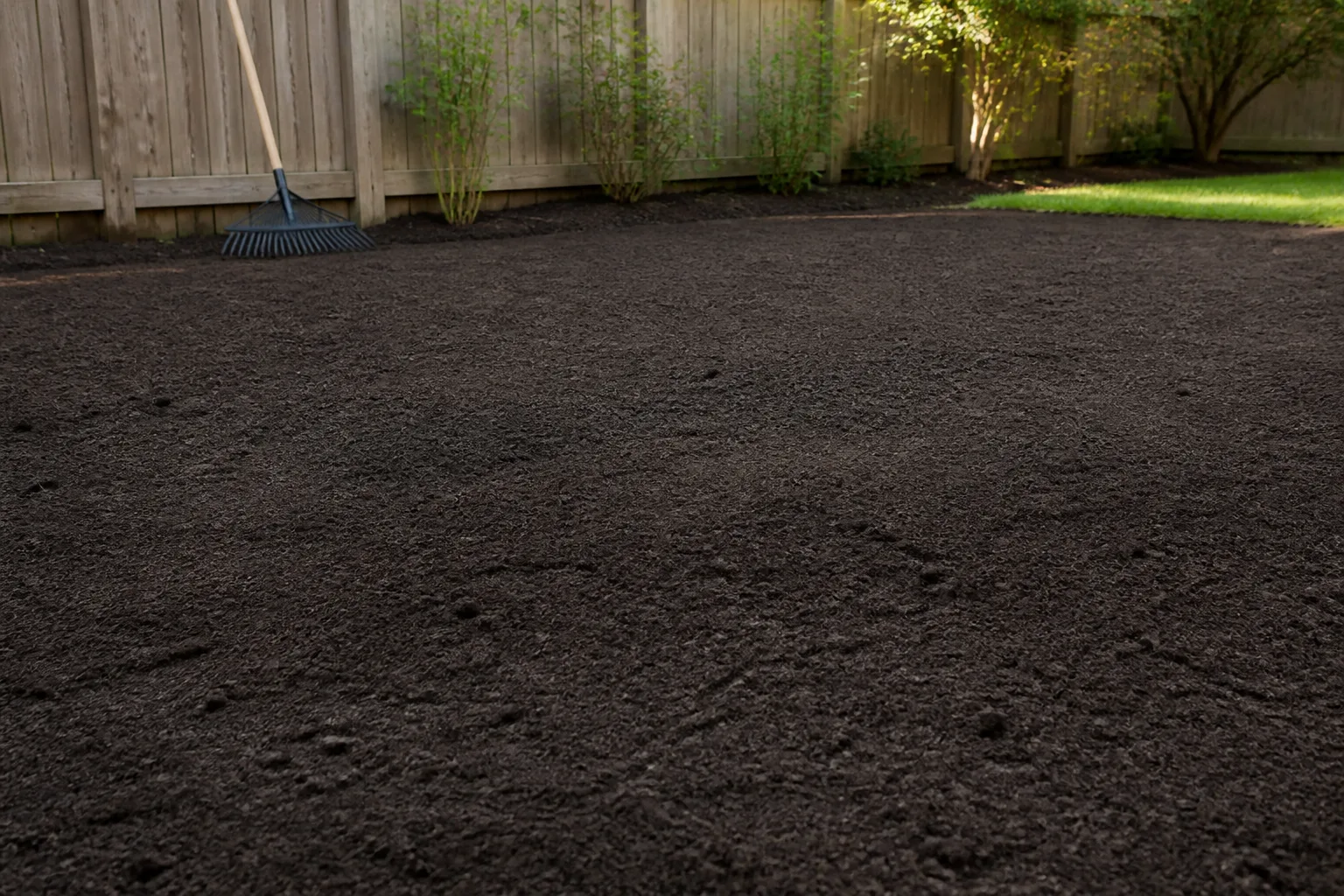
Seed cannot root through a thick leaf mat, hard crust, or air pocket. The most valuable winter preparation is done while the soil is workable, so do not wait until it is frozen to solve compaction, drainage, grade, or debris problems.
Start by inspecting the patch. If water ponds after rain, correct the drainage or grade before seeding. If a dog run, shortcut, vehicle, or playground caused the bare spot, change the traffic pattern or the new seed will fail for the same reason. If the patch is deep shade beneath a tree, more seed will not compensate for a lack of usable light.
Prepare existing turf
Mow the existing lawn at its normal late-season height while it is still growing, then remove clumps of clippings. Avoid scalping an entire lawn simply because a short competitor recipe recommends it; removing too much green tissue can stress the turf and expose crowns. The goal is to open the canopy enough for seed to reach soil, not to shave the lawn to dirt.
Where soil is firm and reasonably dry, core aeration can create pockets that catch seed and improve contact. Do not run heavy equipment over saturated or frost-softened ground: compaction and smeared soil can leave you with a worse seedbed than you started with. Purdue Extension similarly advises avoiding wet-soil preparation and using light raking and rolling to maximize seed-to-soil contact.
Rake out thick thatch and leaves from the target area. A thin layer of finely shredded leaves can be useful elsewhere, but whole leaves sitting on turf behave like a blanket: they keep seed from reaching soil and can move across the patch during wind and snowmelt.
For an entirely bare patch, remove stones and roots, correct low spots, and loosen the top layer without pulverizing it. Rake to a firm, level finish. The surface should be crumbly enough to accept seed but firm enough that a shoe does not sink deeply into it.
Measure the seed and spread it evenly
Uneven application is a quiet cause of “winter seeding failed.” A heavy stripe can produce crowded seedlings, while a light stripe can look like a dead zone even when the seed itself is viable.
Read the seed tag and set a realistic rate
Use the labeled rate for the specific species or blend. Check the percentage of each grass, germination percentage, test date, weed seed, and noxious-weed information. A cheap bag with a large filler percentage can be a poor bargain if it does not match the lawn you are trying to repair.
As a regional benchmark, Purdue’s establishment guide lists these rates for Indiana and Illinois lawn mixes:
| Seed type or blend | Example rate per 1,000 square feet |
|---|---|
| 100% Kentucky bluegrass | 1.5–2 pounds |
| Kentucky bluegrass with 10–15% perennial ryegrass | 3–4 pounds |
| Kentucky bluegrass with 30–50% fine fescue | 4–5 pounds |
| 100% tall fescue | 6–9 pounds |
These are not universal prescriptions. Seed size, cultivar, blend composition, regional recommendations, and whether you are establishing bare soil or overseeding existing turf all change the correct amount. UC IPM’s planting-time and rate table gives different ranges for several species, which is exactly why the bag label and local extension guidance should have the final word.
Winter does create extra loss risk. Rutgers notes that dormant-seeding rates are sometimes increased by 30–50% to offset washout, bird feeding, and seedling mortality, while other practical guidance recommends using the normal labeled rate and keeping a little extra for spring touch-ups. For a home lawn, the defensible approach is to avoid inventing a dramatic rate increase: use the label or local recommendation, buy a modest reserve of the same mix, and reserve it for spots that actually emerge thin.
Broadcast half the measured seed in one direction, then apply the other half at a right angle. Walk slowly, keep the spreader moving before opening the gate, and overlap passes slightly. Calibrate with a small test area if the spreader setting is unknown; a number printed for fertilizer does not automatically deliver grass seed at the right rate.
On bare soil, finish with a very light rake or an empty roller pass. Grass seed needs contact with soil, but most lawn seed should remain near the surface. Deeply burying it under a thick layer of soil is more likely to reduce emergence than protect it.
Protect the seed through winter
Once the seed is down, the job changes from “make it grow” to “keep it where you put it.” Avoid fertilizer on frozen or snow-covered ground. Rutgers warns that winter fertilizer applications have a high runoff risk, and dormant seed has no active root system ready to use that nutrient.

Snow, straw, and slopes
If persistent snow is normal in your region, sow before the snow arrives so the seed is on the soil surface underneath the cover. Scattering onto a loose, thick snow layer is less reliable because the seed can move with meltwater, collect in piles, or be exposed after an uneven melt. BHG’s dormant-seeding guidance similarly favors seed-to-soil contact before a thick snow cover.
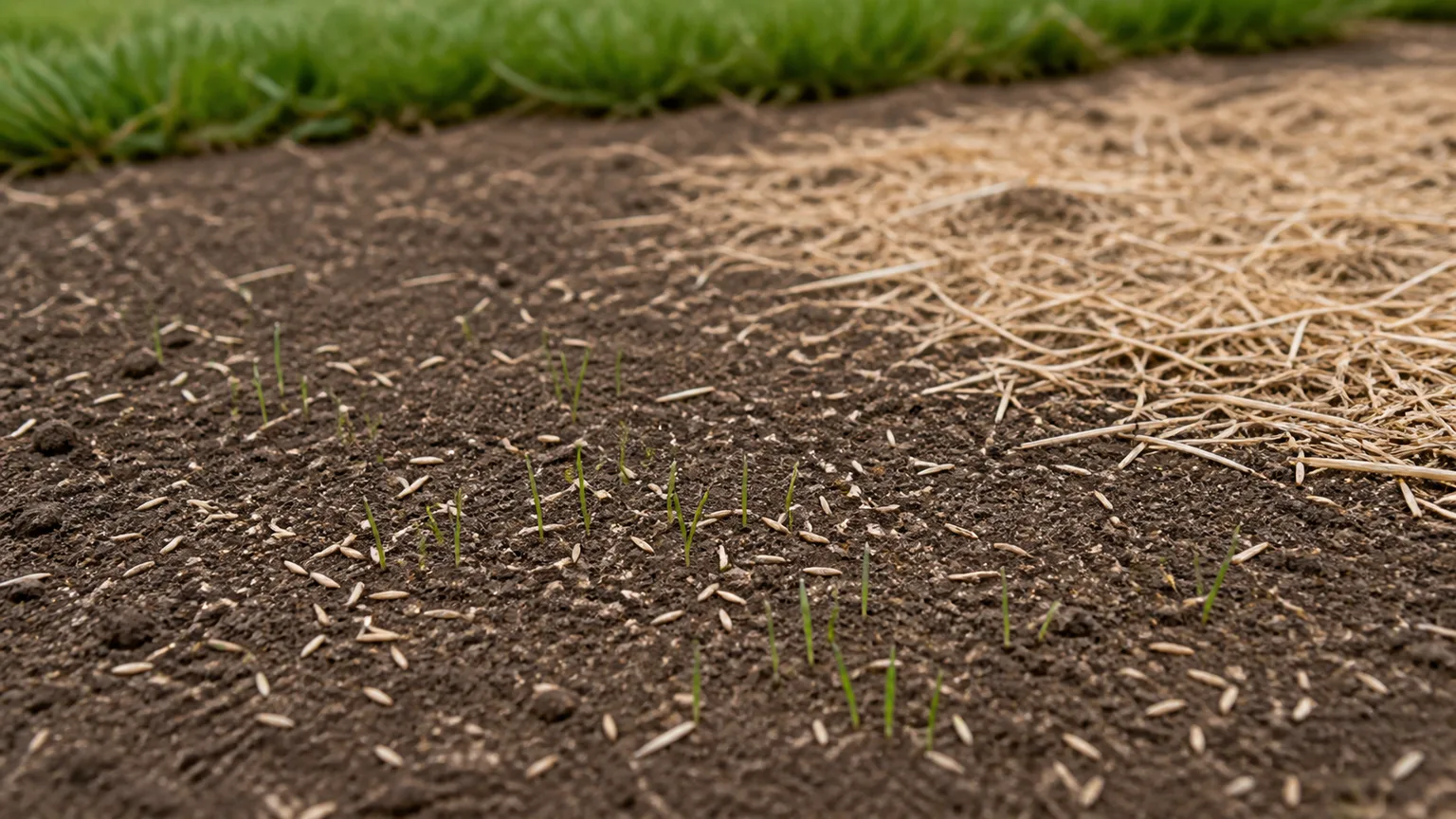
On open ground, a thin layer of clean, weed-free straw can reduce wind movement and help slow runoff. Purdue Extension’s general new-lawn guidance uses about one bale per 1,000 square feet as a light covering and says you should still see roughly half of the soil through the mulch. Too much straw blocks light and can smother emerging seedlings; hay is a poor substitute because it may contain viable weed seed.
Slopes need more than hope and a handful of straw. If water already cuts channels into the patch, dormant seeding may be the wrong repair because late-winter rain and snowmelt can carry seed downhill. Use a properly anchored erosion-control blanket or postpone the job until you can prepare and stabilize the soil; severe grades may need a professional seeding method designed for erosion control.
Protect the patch from repeated footsteps, pets, snow shoveling, and vehicle tires. A small temporary marker or low barrier can prevent the most common accidental disturbance. Birds may still take some seed, but a thin cover and good soil contact reduce the exposed-food effect without turning the lawn into a sealed mat.
Spring care determines whether the seed succeeds
The first green hairs are a beginning, not proof that the lawn is established. Dormant-seeded grass can emerge unevenly because sections of the yard warm, drain, and receive sunlight at different rates.
Water, mow, feed, and weed at the right time
While the seed is still dormant, do not water on a rigid schedule just to “wake it up.” Let rain and snow provide moisture unless the surface is unusually dry and your local conditions require a light irrigation. Watering frozen ground is wasteful and can create runoff or ice.
As spring warmth arrives, inspect the top half-inch to inch of soil. Once seedlings are emerging, keep that zone consistently moist but not saturated. Purdue Extension recommends frequent irrigation during early establishment, adjusting the frequency to weather, then gradually watering more deeply and less often once the turf is taller and has been mowed several times. If your spring is dry, this is the point when dormant seeding loses its low-maintenance advantage: you need a hose or functioning irrigation system ready.
Do not rush the first mow because the calendar says April. Let the new grass gain enough height to be cut cleanly, use a sharp blade, and remove no more than one-third of the leaf in a mowing whenever possible. A tall fescue patch and a bluegrass patch may reach mowing height at different times, so mow by the condition of the plants rather than forcing every area onto one date.
Delay routine spring fertilizer until the seed has germinated and the soil and turf are ready to use it. A soil test is more useful than guessing from color. Avoid applying a standard crabgrass pre-emergent over a dormant-seeded area unless the product label explicitly allows use with the grass species and new seeding; many pre-emergents are designed to stop germinating seeds, including the ones you want. Purdue Extension advises delaying such products on late or dormant seedings and checking the exact label instructions.
Spring weeds are frustrating, but do not respond by applying a broad herbicide to seedlings you cannot yet identify. First confirm that the desired grass is growing, keep mowing at the proper height, and use local extension advice for a product and timing that are legal and labeled for your turf. The safest weed-control decision may be to tolerate a few weeds while the grass establishes. A practical winter-seeding overview from Martha Stewart also highlights unusually dry spring weather as a meaningful risk, which is easy to overlook when the winter phase required little irrigation.
Fix patchy results without starting over
Patchiness does not automatically mean the entire project failed. Wait long enough for the slowest sections to receive suitable soil warmth, then diagnose the pattern before adding more seed.
Use the pattern as evidence:
- Thin everywhere: check whether the mix matched the lawn, the seed was old or poorly stored, or the rate was too low.
- Stripes or bands: suspect spreader calibration, walking speed, or missed crosshatch passes.
- Bare downhill zones: inspect for runoff, rills, and displaced straw before reseeding.
- Green only in low spots: suspect uneven moisture or a dry upper surface elsewhere.
- Green only where soil was exposed: leaves, thatch, or a dense canopy may have blocked contact.
- Early green followed by collapse: premature germination and a hard freeze are possible; wait for a stable spring pattern before judging survival.
For small thin areas, rake only the affected spots once soil is firm, apply the reserved seed at the label rate, and protect it from traffic. For a large failure, do not automatically throw down a second heavy application. Correct drainage, compaction, shade, or weed-control problems first, then choose the next reliable seeding window.
Set expectations around coverage. Dormant seeding is not a promise of a uniform carpet on the first warm day, and it cannot repair a lawn whose underlying conditions still oppose grass growth. Its real advantage is that it places a suitable cool-season seed source in the ground before spring gets busy; your spring moisture, mowing, and site management determine how much of that seed becomes turf.
Conclusion
Yes, you can plant grass seed in winter—but only when the grass type, weather pattern, and site make dormant seeding plausible. Choose cool-season seed, wait for a consistently cold window rather than a random chilly day, prepare the soil before it freezes, use the labeled rate, and spread in two directions for even coverage.
Keep seed on the soil, protect it lightly from wind and washout, and skip fertilizer on frozen ground. When spring arrives, shift quickly to moisture management, careful mowing, and cautious weed control. If emergence is thin, diagnose the pattern and patch the cause instead of blindly adding more seed. That honest, climate-aware approach gives winter seeding its best chance to become a useful spring lawn repair.



