How to Style a Round Coffee Table: 16 Rules
Style a round coffee table that looks collected but still works for real life. Get 16 rules for layout, height, color, texture, storage, and easy edits.
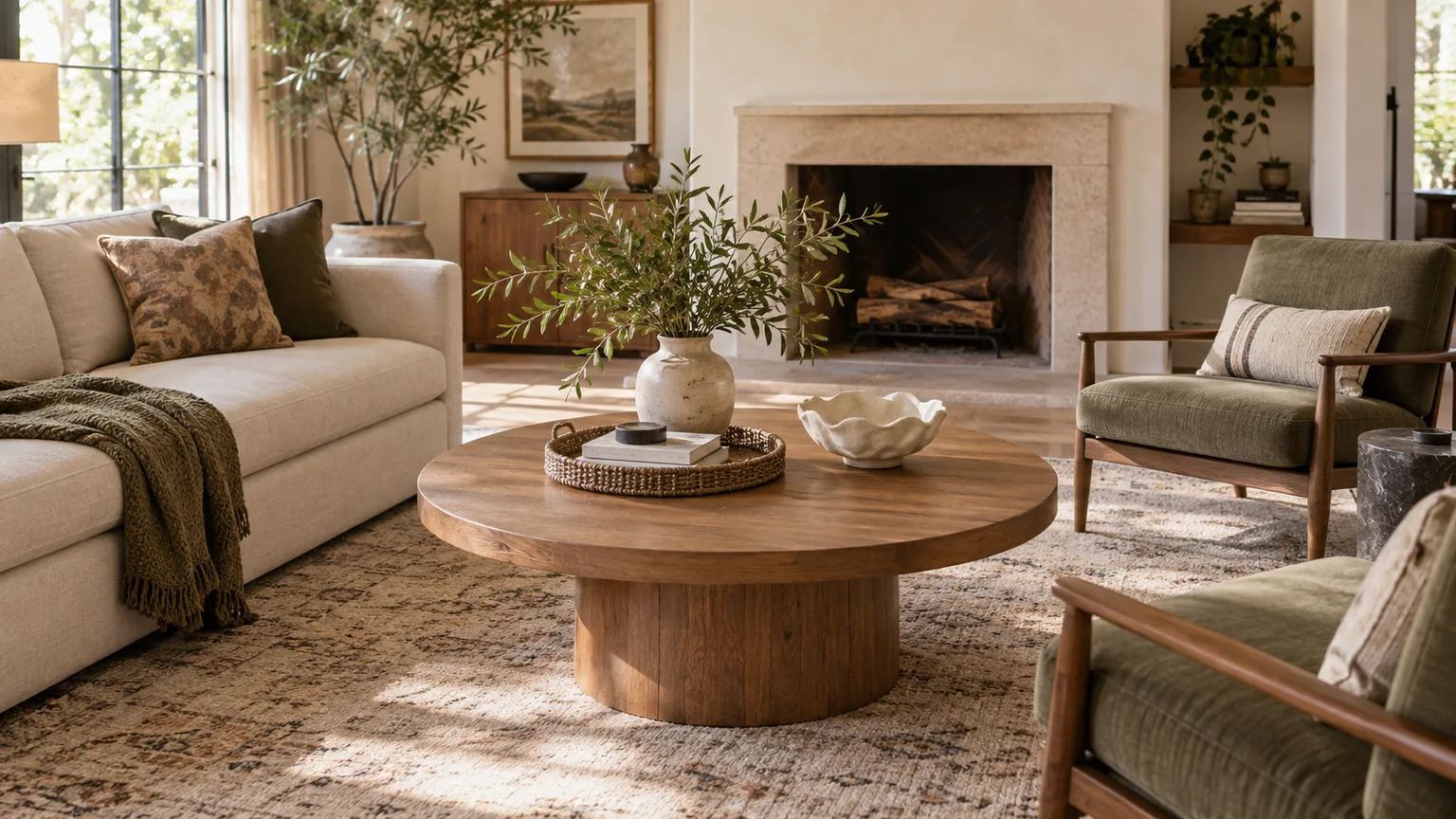
A round coffee table already gives a living room a softer center. The challenge is that there are no corners to organize against, so a display can look crowded in the middle, scattered around the edge, or too precious to use. The best arrangement treats the table as both a composition and a working surface: it has a focal point, a few supporting layers, and enough open space for the people who live there.
Use the rules below as a decision system rather than a shopping list. Start with the room and the table’s proportions, choose one of two simple formulas, then add only the objects that earn their place. A beautiful round coffee table should still have room for a mug, a book, a board game, or someone’s feet.
Start With the Room, Not the Accessories
Before you gather books and bowls, stand where the table is meant to be used. Look at it from the sofa, from each chair, and from the main walkway. That quick sightline check tells you more than arranging everything from above: a vase that looks elegant from the couch may block conversation between two chairs, while a low bowl may disappear against a dark tabletop.
The table should connect to something that is already in the room. Repeat a wood tone from the media console, a metal finish from the lamp, a color from the rug, or a shape from the upholstery. This keeps the display from looking like an isolated still life. House Beautiful’s designer interviews make the same broader point: a coffee table works best when its materials and colors echo the sofa, rug, shelving, or other room elements rather than performing by itself.
Ask one practical question before the decorative ones: What will this table need to do most days? If it is the landing place for drinks and remotes, keep the center lighter. If it sits in a formal room, you can give the display more visual weight. If children, pets, or frequent guests use the room, favor stable, rounded, washable, and non-breakable pieces.
Get Size, Height, and Spacing Right
Styling cannot rescue a table that is the wrong size for its furniture. Better Homes & Gardens gives common coffee-table starting points of roughly 17 to 19 inches high, about 24 inches deep, and 36 to 48 inches wide, while noting that dimensions vary. For a round table, translate “width” into diameter, then check the actual room instead of assuming a standard size will work.
Use the 18-inch clearance rule as a starting point
Aim for about 18 inches between the sofa and the table as a first measurement. That distance usually leaves room for knees and makes the tabletop reachable without creating an awkward obstacle; Better Homes & Gardens and House Beautiful both present it as a useful rule of thumb. In a compact room, you may need to tighten it slightly, but do not sacrifice a clear walking path simply to center the table perfectly.
Measure the gap from the sofa’s most projecting point—not always the front of the seat cushion—to the nearest table edge. Then walk through the room carrying a mug. If you have to turn sideways, bump the table with your leg, or squeeze between the table and a chair, the arrangement needs more space or a smaller diameter.
Match the table height to the sofa
The most dependable target is a tabletop that is level with the sofa seat or about 1 to 2 inches lower. That keeps a drink or book within easy reach and prevents the table from visually towering over the seating. A very low table can work with low-slung furniture, but pairing it with a high sofa often makes the whole seating group feel disconnected.
The same check matters for objects. A tall arrangement should add presence without blocking faces across the table. As a practical starting point, let the tallest object sit comfortably below the sightline between seated people, then adjust for the room’s purpose. Homes & Gardens cites a one-third-of-the-table-height styling guideline, but treat that as a proportion cue rather than a rigid limit—an airy branch arrangement and a dense ceramic sculpture occupy visual space differently.
Choose a Formula That Suits a Round Top
You do not need a dozen objects to style a circle. Two formulas cover most rooms, and you can combine them when the table is large.
The anchor-plus-support formula
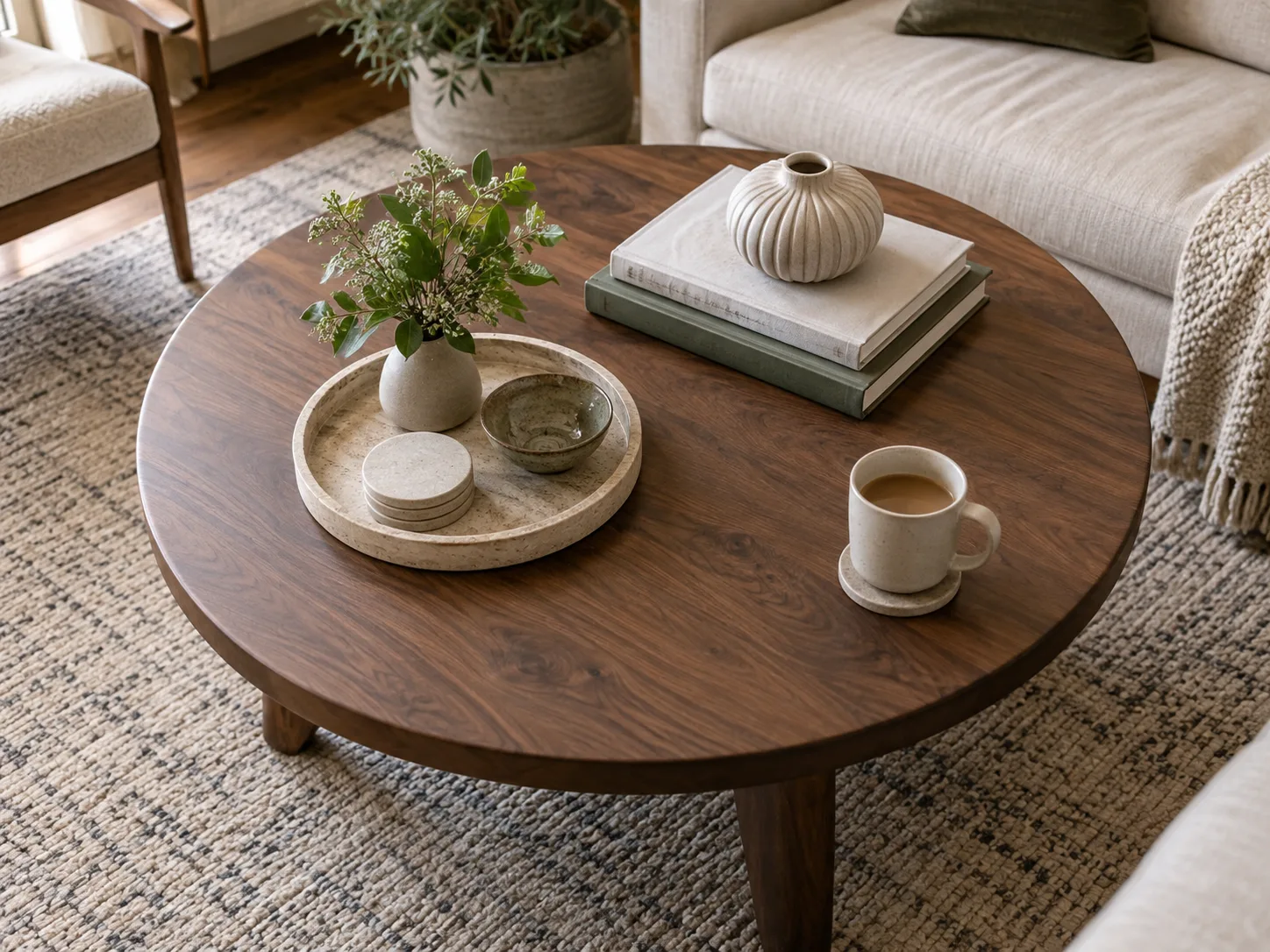
Place one anchor slightly off-center: a substantial vase, a wide bowl, a sculptural object, or a low plant in a stable pot. Add a smaller, lower group beside it, such as two books with a candle or a small box with coasters. The height difference creates movement, while the offset keeps the display from looking like a single object dropped in the exact middle.
This formula suits a small round coffee table because it creates a clear hierarchy. The anchor does the visual work; the supporting group supplies texture and function. If the display feels busy, remove the smallest item before changing the anchor.
The tray-centered formula
Use a tray as a movable island in the center or slightly toward the sofa. A round tray repeats the table’s curve and produces a calm, layered look. A square or rectangular tray adds shape contrast and can be especially useful on a large table or an upholstered ottoman, where straight edges give loose objects a clear boundary.
Fill the tray with a low group rather than every accessory you own. A stack of books, a bowl, and a candle can be enough. Homes & Gardens and House Beautiful both highlight the tray’s double job: it gives a vignette structure, and it lets you clear the entire display quickly when the table needs to become a work surface or footrest.
Build a Height Triangle Without Making It Fussy
Think of height as a gentle triangle: one tall or visually dominant piece, one middle-height layer, and one low spread. That does not require three literal objects. A vase can be tall, books can create a middle platform, and a tray or bowl can stay low. On a small table, the triangle may be only 4 inches tall; on a generous table, it can be more pronounced.
Keep the triangle uneven. If three objects are the same height, the eye reads them as a row, even on a round surface. Turn a book stack, overlap two tray edges, or move the tallest piece off the centerline. Then view the result from seated height. The goal is a readable silhouette, not a tabletop mountain.
16 Rules and Ideas for Styling a Round Coffee Table
Use these rules in order when you are starting from an empty table. The first five establish structure; the rest help you tailor the look to the material, room, and way you live.
Let the circle guide the composition
-
Arrange around a center, not along a front edge. A rectangular table can take a row; a round table usually looks better with a compact cluster, a triangle, or two opposing groups. Keep the arrangement visually inside the circle so it feels intentional from every seat.
-
Use the curve as a contrast opportunity. If the room already has many rounded forms, bring in a square book stack or a tray with corners. If the room is full of straight lines, repeat the circle with a round bowl, round tray, or low circular planter. Shape repetition makes the choice look considered.
Make the arrangement useful, not merely decorative
-
Start with the items you reach for. Put coasters, remotes, reading glasses, or a current book in the first layer. Then disguise or contain them with a tray, lidded box, or shallow bowl. A display that ignores daily habits will become a clutter pile within a week.
-
Leave one clear landing zone. Reserve a patch of tabletop for at least one drink, and more if several people sit around it. Negative space is not unfinished decoration; it is what lets the furniture work. House Beautiful designers repeatedly recommend leaving room for guests and for the table’s real activities.
-
Choose objects that are safe to move. If you regularly clear the table for dinner, puzzles, or work, avoid a fragile tower of tiny pieces. A lightweight tray, one lidded container, and a low bowl are easier to shift than a dozen individual objects.
Layer scale, height, and texture.
-
Mix three heights, not three random objects. Give the eye a tall, middle, and low point. If you use three books, vary their footprint or top them with a small object so the stack does not become a flat block.
-
Ground books with a heavier object. A stone bowl, ceramic vessel, or low sculpture stops books from looking like an accidental pile. The object should be stable and broad enough for the stack; a top-heavy piece on a narrow book is a tipping hazard.
-
Mix materials with a limited palette. Pair wood with ceramic, glass with woven fiber, or metal with stone. Two or three materials are usually enough. Repeating one material elsewhere in the room makes contrast feel connected instead of random.
-
Repeat one color from the room. Pull a single shade from a cushion, artwork, rug, or nearby bookcase. You do not need to match every object. One repeated color can tie together otherwise different shapes while a neutral base keeps the display calm.
-
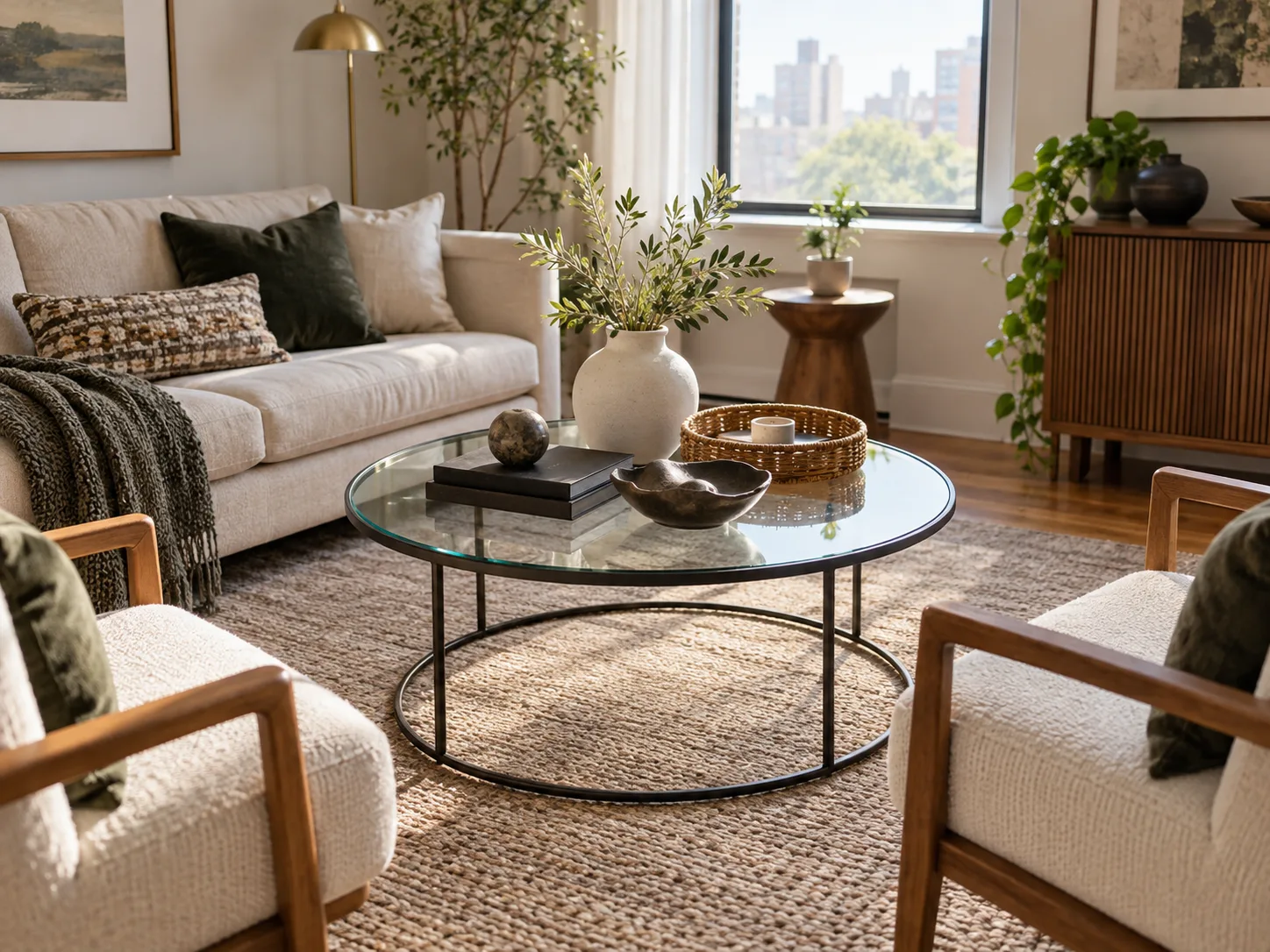
Use texture where color is quiet. A ribbed vase, matte ceramic bowl, woven tray, or rough stone adds depth to a beige or monochrome room. Texture is particularly helpful on a glass table, where a display made only from clear or glossy pieces can vanish.
Give the table a point of view.
-
Choose a focal piece that earns attention. A large vase, unusual bowl, vintage object, or sculptural piece should say something about the room. If the table itself has dramatic grain, marble veining, or a carved base, let the table be the focal point and style it lightly.
-
Bring in greenery with a maintenance plan. Fresh branches change with the season, a small plant brings life, and dried stems last longer, but each has a cost. Use a watertight vessel with a coaster or tray on wood, keep soil and water away from porous surfaces, and skip a tall plant if it interrupts conversation.
-
Use a candle for atmosphere, not as filler. One candle adds glow and scent, but it should have a stable base and enough clearance from books, branches, and upholstery. In homes with children or pets, choose a flameless option or place candles only where they cannot be knocked over.
-
Display something people can interact with. A beautiful chess set, small game, bowl of conversation-starting objects, or open book can make the room feel inhabited. Choose one interactive element rather than turning the tabletop into a store display.
Adapt the rules to the table itself
-
Treat a lower shelf as storage before decoration. Use baskets, a lidded box, magazines, or extra coasters below, then keep the top surface simpler. A decorated top and a crowded shelf compete for attention. Homes & Gardens recommends a clear separation: useful or visually heavy items below, a neat group above.
-
Change the formula for glass, ottoman, and nesting tables. On glass, use opaque pieces and dark books to create contrast; clear-on-clear objects often disappear. On an upholstered ottoman, use a broad, stable tray with a low arrangement. With nesting tables, let the larger table carry the anchor and leave the smaller one available to pull out when guests arrive. These tables are not failed versions of a wood circle—they have different jobs.
Fix the Common Round-Table Mistakes
The most common failure is filling the whole surface because the empty edge feels too exposed. Take a photo from the sofa, then remove one-quarter of the objects. If the result looks better, you were using accessories to solve a scale problem rather than styling the table.
Another mistake is putting the tallest object exactly in the center. That can work in a formal room, but it often blocks sightlines and makes the table feel like a pedestal. Shift it slightly, lower it, or replace it with a broad bowl if conversation is the room’s main purpose.
Avoid a display where everything matches in finish, height, and shape. A round table already has a strong repeated geometry; too many circles can become monotonous, while too many unrelated angles look scattered. Use one deliberate contrast—one square tray, one dark object, one rough texture—then repeat a color or material so the arrangement still belongs together.
Do not style by object category alone. Five candles, five books, or five small vases may be a collection, but they do not automatically make a composition. Style by visual weight and use: one strong anchor, one useful group, one low layer, and an open place for life to happen.
Style Recipes for Three Living-Room Moods
Minimal and calm
Use one substantial ceramic bowl or a short vase as the anchor. Add one thin book stack or a small round tray, then stop. Keep the palette to two neutrals plus one quiet accent, and let the tabletop’s wood, stone, or glass do part of the decorating. This is the easiest look to maintain because there are fewer objects to move or dust.
Collected and conversational
Start with a meaningful object—a vintage bowl, travel find, or handmade vessel—then build a triangle with books and a lower tray. Add one natural element such as branches, shells, or a small plant, but give it a boundary so it does not look like a loose collection of souvenirs. Leave enough room for someone to pick up the books or set down a drink; a conversation piece works better when people can actually engage with it.
Family- and hosting-ready
Use a wide tray or lidded box to contain remotes, coasters, and game pieces. Choose a low bowl or sturdy vase rather than a fragile tall arrangement, and keep one side of the circle clear for drinks. If the table doubles as a game surface, keep the display to one movable group that can be lifted off in a single trip.
Conclusion
Style a round coffee table from the outside in: get the clearance and height right, choose one visual anchor, build a small triangle of varied heights, and protect a clear space for everyday use. Then make the arrangement belong to the room with one repeated color, a few contrasting textures, and an object that reflects how you actually live.
When the table stops feeling balanced, reset it instead of buying more decor. Clear the surface, return the useful items, choose one anchor, add one supporting group, and remove whatever blocks a sightline or walking path. That five-minute edit is the pro move—and it works for a small wood table, a large glass circle, an upholstered ottoman, or a pair of nesting tables.