How to Water Air Plants Like Aeriums and Tillandsia Mounts
A practical air plant watering routine: choose soak or mist, dry Tillandsia fully, adjust for humidity, and fix brown tips, curl, or rot.
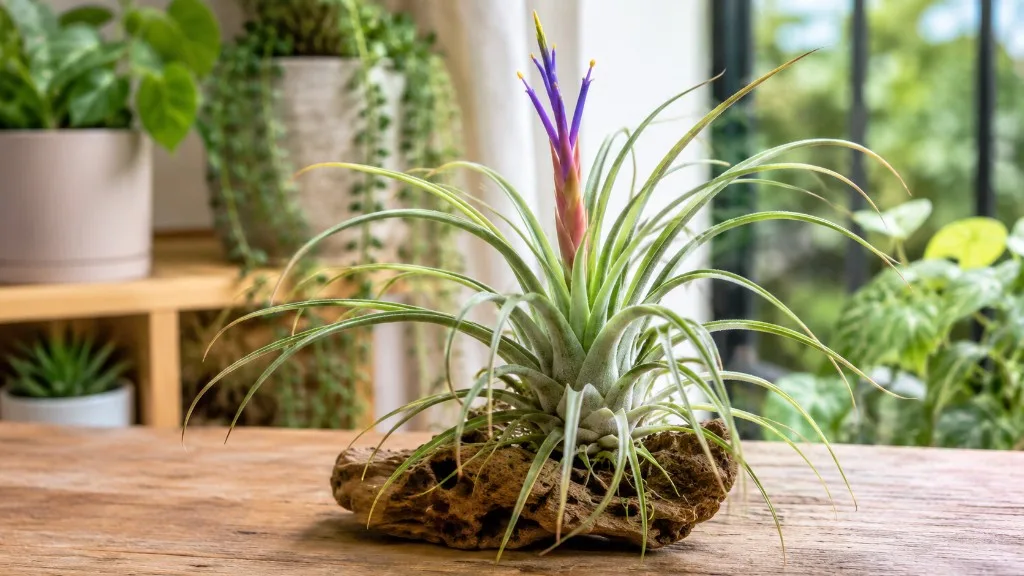
Air plants are not watered through soil, but they are not maintenance-free. Most Tillandsia do best when their leaves get a thorough drink, then dry quickly in moving air. The part that keeps them alive is not a misting ritual or a fixed calendar date; it is the combination of enough moisture, a clean water source, and a completely dry base before the next watering.
The dependable indoor default is to remove an unmounted plant from its display, soak it in room-temperature water for about 20 to 30 minutes, shake out the excess, and let it dry upside down or on its side. Mounted plants may need a careful dunk or thorough mist instead, especially when the wood or cork would stay wet. Use the routine below as a starting point, then adjust it to the plant’s leaf texture and the time it actually takes to dry.
Quick answer: soak most, mist selectively, and dry completely
For most indoor air plants, soak the whole plant weekly, or about every 10 to 14 days when the room is humid, the plant is silver and drought-adapted, or the display dries slowly. Let water reach the leaves, not pool in the crown, and never leave the plant submerged overnight. A light mist can supplement a soak in dry air, but repeated surface spritzing is a poor substitute if the leaves are already curling or losing firmness.
The safest sequence is simple: water in the morning, remove excess water, expose the base to air, and wait until the plant is fully dry before returning it to a globe, terrarium, or mount. North Carolina State Extension describes the leaves as the main water-absorbing surface and notes that the holdfast roots are for anchoring, while UF/IFAS recommends wetting an indoor air plant thoroughly and allowing it to dry between waterings. That combination is more useful than choosing between “never soak” and “always mist.”
Why air plants need water but hate staying wet
Tillandsia are epiphytic bromeliads. They can grow on bark, cork, stone, or another support because the roots mainly hold the plant in place; the leaf surface carries specialized scales called trichomes that capture moisture and dissolved nutrients. This is why a soil moisture test cannot tell you when an air plant needs a drink.
The same anatomy creates the main watering risk. A plant that is wet all the way through but cannot shed water from its base has little opportunity to dry between waterings. Water held between tight leaves, inside a bulbous base, against damp mounting material, or in a closed glass vessel can encourage rot even while the outer leaves look hydrated. The North Carolina State Extension Tillandsia profile and UF/IFAS air-plant guide both emphasize the leaf-based water uptake and the need for air around the plant.
Choose the routine that matches your plant and room
The right interval depends on how quickly the plant loses and replaces moisture. A bright, warm room with good airflow can require more frequent watering than a dim, cool room, but the bright room may also dry the plant more safely. Treat the calendar as a reminder to inspect, not permission to water a plant that is still damp at its base.
Mesic types and green, softer leaves
Many green, thin-leaved Tillandsia come from moister habitats and are a reasonable match for a weekly soak in an ordinary home. They often look greener and less heavily coated with silver scales. That appearance is not a perfect identification tool, so use the plant label or species name when you have it; a green plant can still be stressed by dry heat, and a silver plant can still rot in a wet display.
If a mesic plant is growing in strong light with a fan or open window nearby, start with a seven-day check. If the leaves are open and firm and the base dries within a few hours, keep the interval. If the plant stays wet into the evening or the room is cool and still, reduce the amount of water or improve the drying setup before adding more days to the calendar.
Xeric types and silver, fuzzy leaves
Silver, fuzzy, thick-leaved types such as many forms of Tillandsia xerographica are adapted to drier conditions and can often go longer between thorough waterings. They still need water; “xeric” means they are better at coping with scarcity, not that misting once a month is automatically enough. A plant with concave, tightly curled leaves needs attention even if its natural form is naturally twisted.
For an unidentified silver plant, begin with a careful soak every 10 to 14 days and watch the response. If the leaves remain firm and the base dries easily, that may be sufficient. If the plant is in air-conditioning, a heated room, or bright dry light, shorten the interval or add a real wetting rather than relying on a few decorative droplets.
Gather water and a drying setup first
Set up the drying part before you wet the plant. You need a clean bowl or basin, room-temperature water, a towel that can absorb runoff, and an open place where the plant’s base will not sit in a puddle. For a mounted plant, also have a way to keep the wood, cork, shell, or metal support from holding water against the plant.
Morning is the most forgiving time to water because the plant has the rest of the day to dry. Avoid watering immediately before a cold night, before placing the plant in a closed globe, or when the only available location is beside a cold draft. A low fan several feet away can improve circulation, but it should move air gently rather than blast the plant with cold, dry wind.
Soak an unmounted air plant step by step
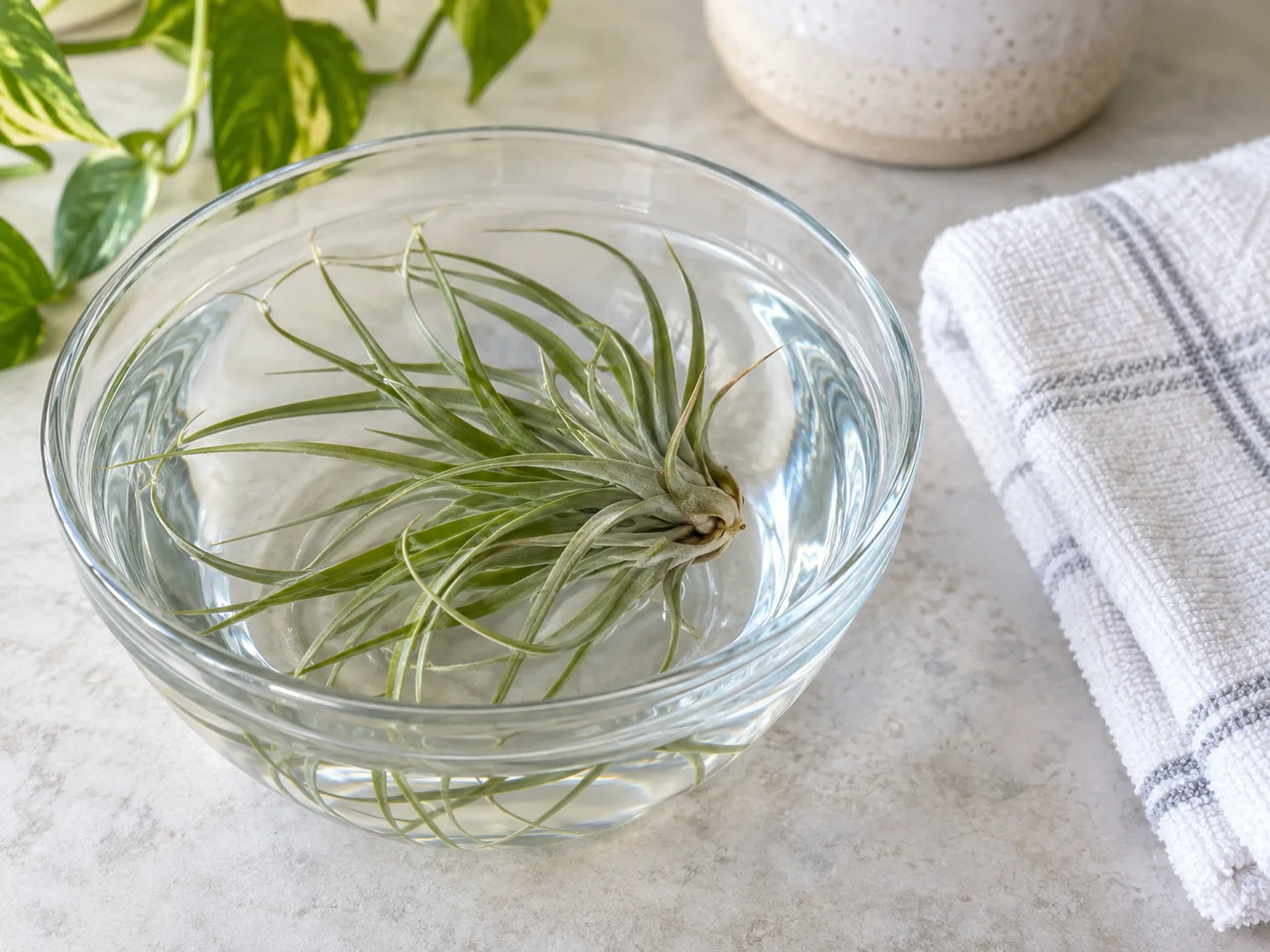
Soaking is usually the most reliable way to rehydrate a loose indoor Tillandsia because it wets the full leaf surface instead of only the parts a mister reaches. Epic Gardening’s Tillandsia care guide describes a roughly half-hour soak as a practical starting point, while specialist growers commonly recommend 20 to 30 minutes for routine watering.
- Remove the plant from its display. Lift it by the base or underside, not by pulling on individual leaves. If it is glued or wired in place, use the mounted-plant method below rather than forcing it free.
- Fill a clean bowl with room-temperature water. Rainwater or a low-mineral, non-softened water is a good choice when available. Do not use hot or ice-cold water, and do not add fertilizer to every watering.
- Submerge the plant for 20 to 30 minutes. Keep the entire leaf mass wet, but do not extend a routine soak overnight. A severely dehydrated plant may need a longer recovery soak, but it still needs a fast, open-air dry afterward.
- Lift and drain immediately. Turn the plant upside down or tilt it on its side, then give it a gentle shake. Do not squeeze, rub, or wipe the trichomes from the leaves.
- Dry it in an open position. Rest the plant on a towel with its base exposed, or suspend it so water can run away from the crown. Bulbous forms deserve extra attention because water can hide between their leaves.
- Return it only when it is dry. Check the base and the leaf axils, not just the outer leaf tips. If water is still visible or the plant feels cool and wet, leave it out longer.
The water should wet the plant thoroughly without turning the routine into permanent dampness. A plant that is still wet after four hours needs more airflow, a less crowded display, an earlier watering time, or a lighter method next time. Do not solve slow drying by placing the wet plant in direct hot sun; that can scorch tissue while the center remains wet.
Water a mounted air plant without trapping moisture
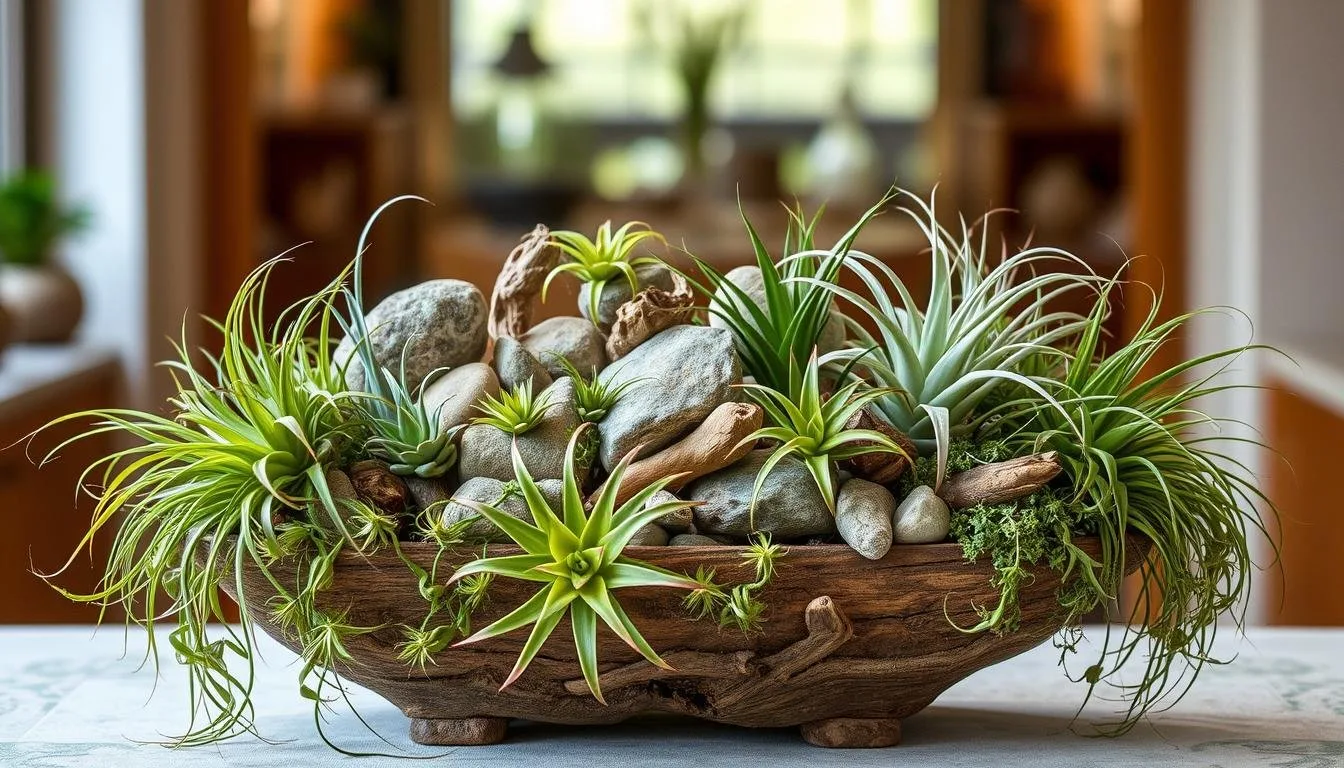
Mounted Tillandsia are easy to water badly because the display looks attractive but may be difficult to drain. The support should be dry, porous or well ventilated, free of leaking chemicals, and shaped so the plant’s base is not pressed into a wet pocket. UF/IFAS notes that a mount should not hold water, and Epic Gardening’s mounting guidance warns that some display materials and attachment methods can interfere with soaking, drying, or circulation.
If the mount can be removed safely, unhook it and soak the plant while holding the support above the water. Shake the plant gently, then let both the plant and mount dry separately before reassembling the display. This is the best option for a plant attached to a small, removable cork or open branch.
If the plant cannot be removed, use a thorough mist or a controlled dunk of the leaf mass while keeping the mount as dry as practical. Rotate the display so the underside receives water, then place it where air can reach the base from all sides. A fixed plant that repeatedly stays damp is not a watering-schedule problem; it is a display-design problem, and moving it to a removable mount may be the most useful repair.
Be cautious with copper wire, treated lumber, painted surfaces, and glues that seal the base. The plant should be attached without crushing the leaves or blocking the area that must dry. If a beautiful mount makes it impossible to inspect the base, remove the plant periodically for a health check rather than waiting for a black, collapsing center.
How to mist when soaking is impractical
Misting is useful for a plant that is fixed to a mount, for a quick moisture adjustment in dry air, or for a species and display that dry quickly. It works best as a deliberate wetting: use a fine spray, cover the leaves evenly, and stop before water begins collecting in the crown or running into a moisture-retaining support.
Do not turn misting into several tiny sprays every day without checking the plant. Daily droplets can keep the base damp without providing the fuller hydration of a soak, especially in a dry room where the outer surface evaporates quickly. If the leaves are curling or becoming limp, give the plant a proper soak when the display allows it, then improve airflow so the recovery does not create rot.
After misting, rotate or tilt a mounted plant so droplets leave the leaf axils. Air Plant Design Studio’s watering guidance treats misting as a supplement for dry conditions and emphasizes that plants should dry completely after wetting. That makes misting a tool, not a universal replacement for a thorough drink.
Dry Tillandsia completely before displaying it
Drying is the step that determines whether a good watering helps or harms. Place the plant upside down or on its side on an absorbent towel, with the base exposed to moving air. Keep it out of direct midday sun, away from a cold draft, and out of any closed container until the leaf axils and crown are dry.
Most healthy plants in a warm, ventilated room should dry within a few hours. The exact time varies with species, leaf density, temperature, humidity, and whether the plant was soaked or misted, so the clock is only a guide. Feel the base and look between the inner leaves; a dry outer surface does not prove that the center is dry.
Do not return a wet plant to a glass globe, narrow terrarium, decorative bowl, or dense arrangement. Enclosures slow evaporation, while a mount that touches a wet towel, moss, or standing water can keep the base damp long after the leaves appear normal. If the plant cannot dry before night, change the watering time or location rather than accepting overnight moisture as normal.
Adjust frequency for light, airflow, humidity, and season
There is no universal air plant watering schedule because the same Tillandsia can dry in one home and stay wet in another. Use a weekly inspection as a default, then make one change at a time. The Air Plant Expert watering guide similarly groups plants by mesic or xeric tendencies but stresses that humidity and temperature ultimately change the interval.
| Condition | What to change first |
|---|---|
| Warm, bright room with good airflow | Check sooner; the plant may need a weekly soak or supplemental misting. |
| Cool room or low light | Water less often and prioritize drying; wet tissue is slow to recover. |
| Dry heat or air-conditioning | Shorten the dry-air interval or add a thorough wetting, but do not leave the base wet. |
| Humid bathroom with airflow | Keep the normal inspection rhythm; do not water just because the room feels humid. |
| Closed globe or terrarium | Remove the plant to water and return it only when completely dry. |
| Dense, bulbous, or tightly folded plant | Use less trapped water and longer drying attention, not automatically more frequent misting. |
Light matters because a plant that is actively growing and receiving usable light can process water more reliably than one sitting dim and cool. Airflow matters just as much: good circulation lets the plant dry without requiring you to withhold water for so long that the leaves dehydrate. In winter, indoor heating may make the air drier even as shorter days and cooler windows slow the plant’s recovery, so inspect rather than applying a summer routine unchanged.
Use the leaves to decide when to water again
Healthy Tillandsia leaves vary by species, but they should not suddenly lose all firmness. A plant that is thirsty may look duller, feel less taut, develop more pronounced inward curves, or show dry brown tips. Compare the current texture with the plant’s normal appearance; silver scales, natural curls, and old leaf tips can otherwise be mistaken for an emergency.
The best check is a pattern, not one leaf. Note the last watering, whether the plant dried in a few hours, whether the room changed, and whether the newest leaves are still firm. If a plant perks up after a thorough soak and dries normally, the interval was probably too long. If it feels soft at the base or sheds leaves after staying wet, adding more water is likely to make the problem worse.
Water quality: tap, rain, filtered, and softened water
Rainwater is a convenient choice when it is collected cleanly, and a plain, low-mineral water can be useful if your tap water is very hard. Ordinary tap water may work in many homes, but “let it sit” is not a universal water-treatment plan: it does not remove hardness or dissolved salts, and it may not address every disinfectant used by a municipal system.
If tap water leaves a white crust on the display, causes persistent brown tips despite good drying, or comes through a household softener, switch to rainwater or filtered water and observe the new growth. Avoid artificially softened water because it can carry extra sodium. Routine distilled water is also not an ideal default for a plant that benefits from some dissolved minerals; if it is your only option, use it sparingly and follow a species-appropriate fertilizer plan rather than assuming it is automatically superior.
Do not use sugary, flavored, soapy, or chemically treated water. Aquarium water can be useful only when it is clean and free of medications or additives. Whatever source you choose, bring it to room temperature and keep the container clean so the watering bowl does not become a source of residue or microbes.
Blooming plants and delicate mounts need a modified routine
When a Tillandsia is flowering, avoid soaking open flowers or allowing water to sit in the inflorescence. Water the leaves and base carefully from the side, or use a fine mist that reaches the foliage without drenching the flowers. Keeping the display removable makes this adjustment much easier.
A bloom is not a reason to stop watering completely. The plant still needs hydration, but the wetting method should protect the flowers and allow the crown to dry. If the flower spike has finished and pups are forming, continue the same careful routine for the parent plant and its offsets; do not keep the base wet in an attempt to speed up growth.
Troubleshoot dehydration, rot, and look-alike symptoms
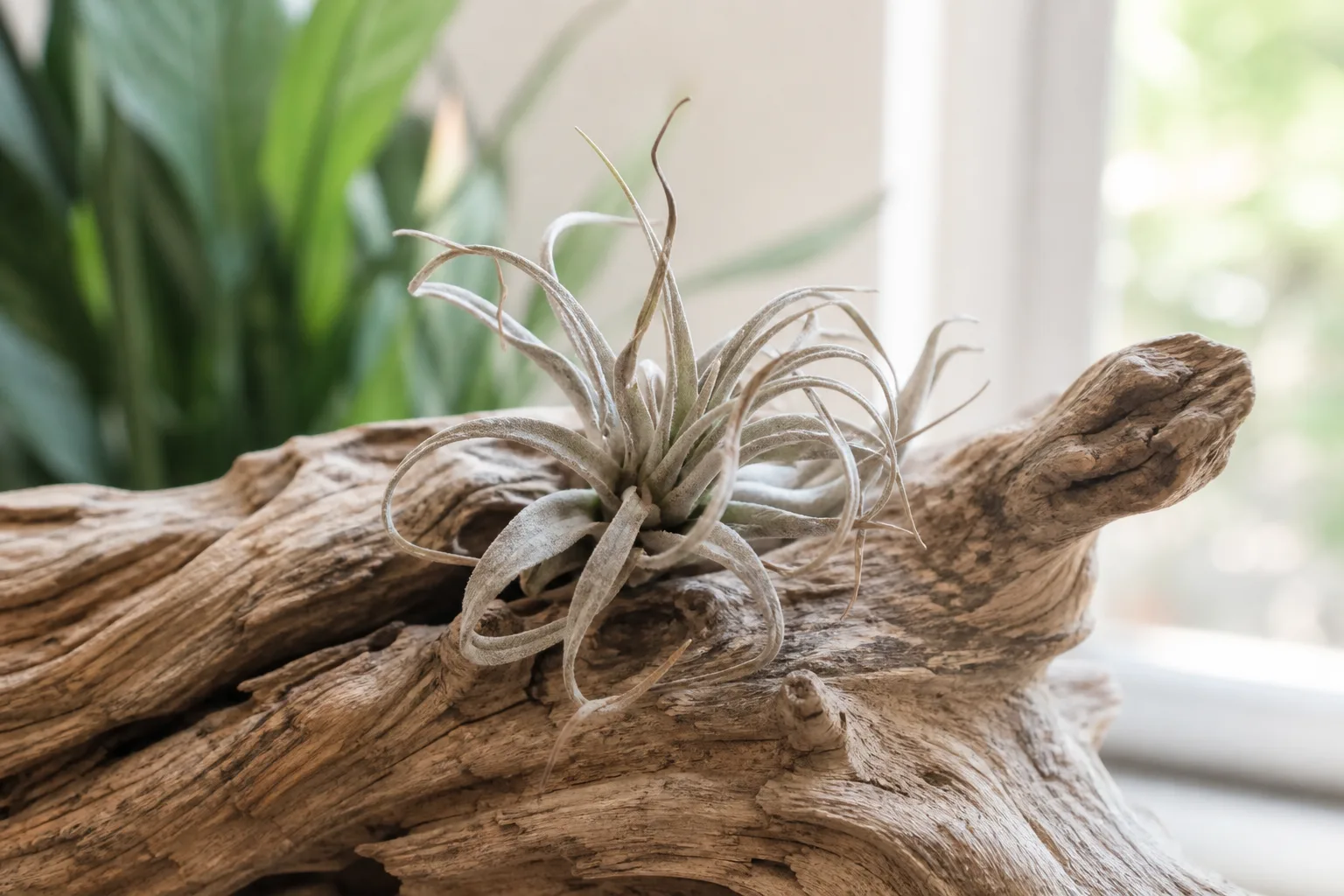
Watering symptoms overlap, so begin with the plant’s base and recent conditions. A dry, curled leaf can signal thirst, but a plant that is both wrinkled and sitting in a damp, stagnant display may be losing roots or crown tissue and unable to absorb water. Check the last watering, the time to dry, the light level, and the firmness of the center before changing the schedule.
What dry stress looks like
Underwatering usually develops with a dry, dull, less-taut appearance. Leaves may curl inward more than usual, flatten or droop, and develop crisp brown tips. Move a loose plant into a bowl and soak it for 20 to 30 minutes, then drain and dry it thoroughly; do not keep misting a severely dry plant several times a day if a safe soak is possible.
Brown tips alone are not proof of thirst. Strong sun through glass, low humidity, salt residue, cold stress, old leaves, and mechanical damage can produce similar edges. If the plant stays firm and the brown area does not spread after a sensible watering adjustment, look at the display and water quality before increasing frequency again.
What moisture damage looks like
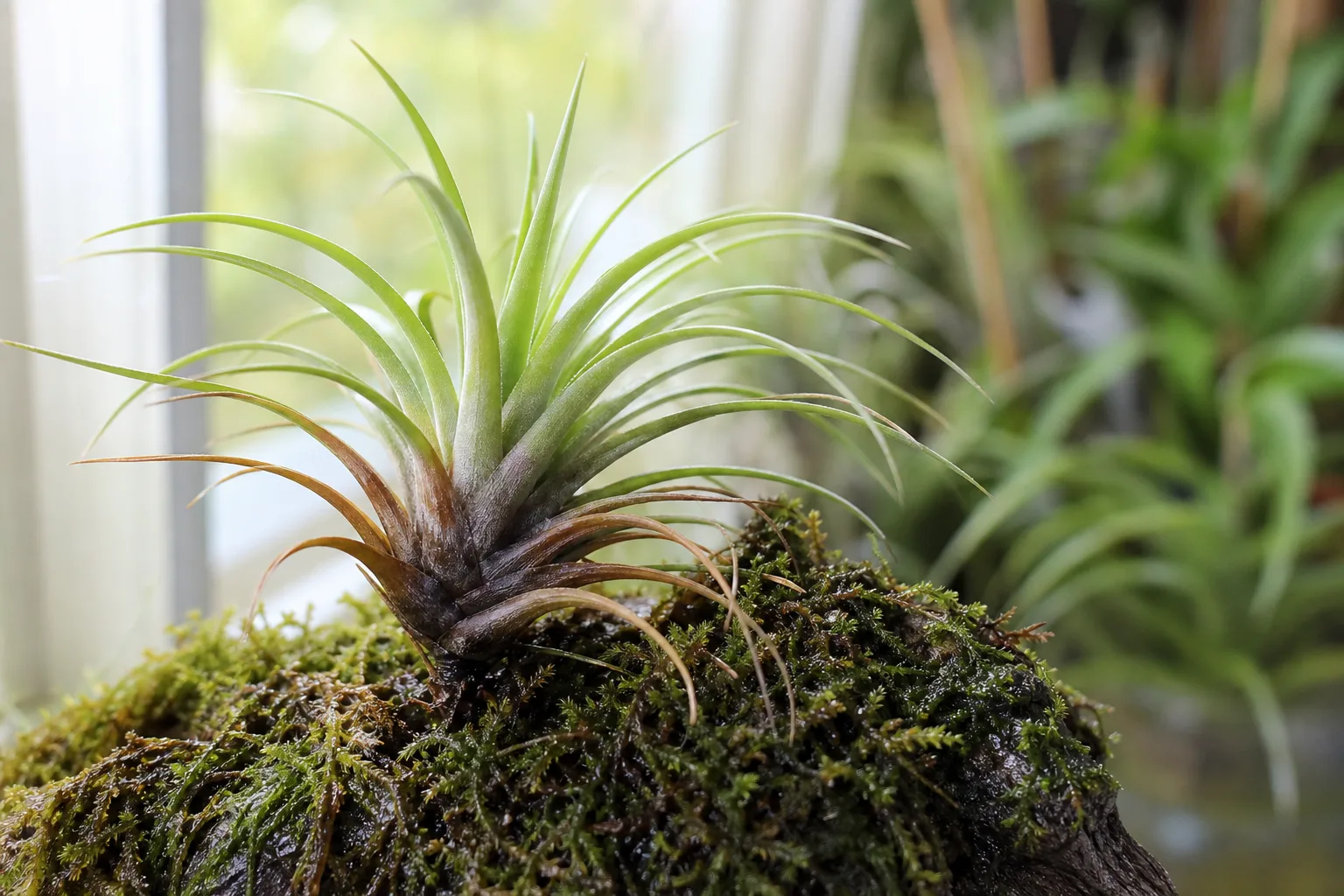
The urgent warning sign is a base that is soft, dark brown or black, foul-smelling, or collapsing. Leaves that pull away easily, fall from the center, or become mushy after repeated wetness point to rot rather than thirst. Yellowing by itself is not diagnostic, but yellow tissue combined with a wet base or poor airflow deserves an immediate inspection.
Stop watering and remove the plant from its mount or enclosure. Let it dry in open air and inspect the base; if firm healthy tissue remains, remove only unmistakably dead material with a sterile tool and keep the plant warm, bright, and dry enough to recover. Once the central base has become entirely black and soft, recovery is unlikely, so prevention through rapid drying is more effective than repeated rescue treatments.
Do not fertilize a collapsing plant, seal the base with glue, or place it in a humid terrarium “to help it recover.” Those actions add stress or trap the moisture that caused the damage. Correct the display and airflow first, then resume a conservative watering routine only after the plant is firm and dry.
Conclusion: make drying part of every watering
Water air plants by matching the method to the plant and its display: soak most loose indoor Tillandsia, mist when a mount or species calls for it, and always make complete drying the non-negotiable final step. Start with a weekly inspection, adjust for leaf texture and room conditions, and use the time-to-dry test to decide whether the routine is working.
When leaves curl, check for genuine dryness before adding water; when the base is soft or black, treat trapped moisture and rot as the emergency. A removable, well-ventilated mount, clean low-mineral water, and a morning watering habit will prevent more failures than a stricter calendar ever could.