Four-Leaf Clover Facts and Myths Explained
Learn how rare four-leaf clovers really are, what shamrocks actually are, how to spot lucky clovers in your lawn, and which St. Patrick's Day plants are not true clovers.
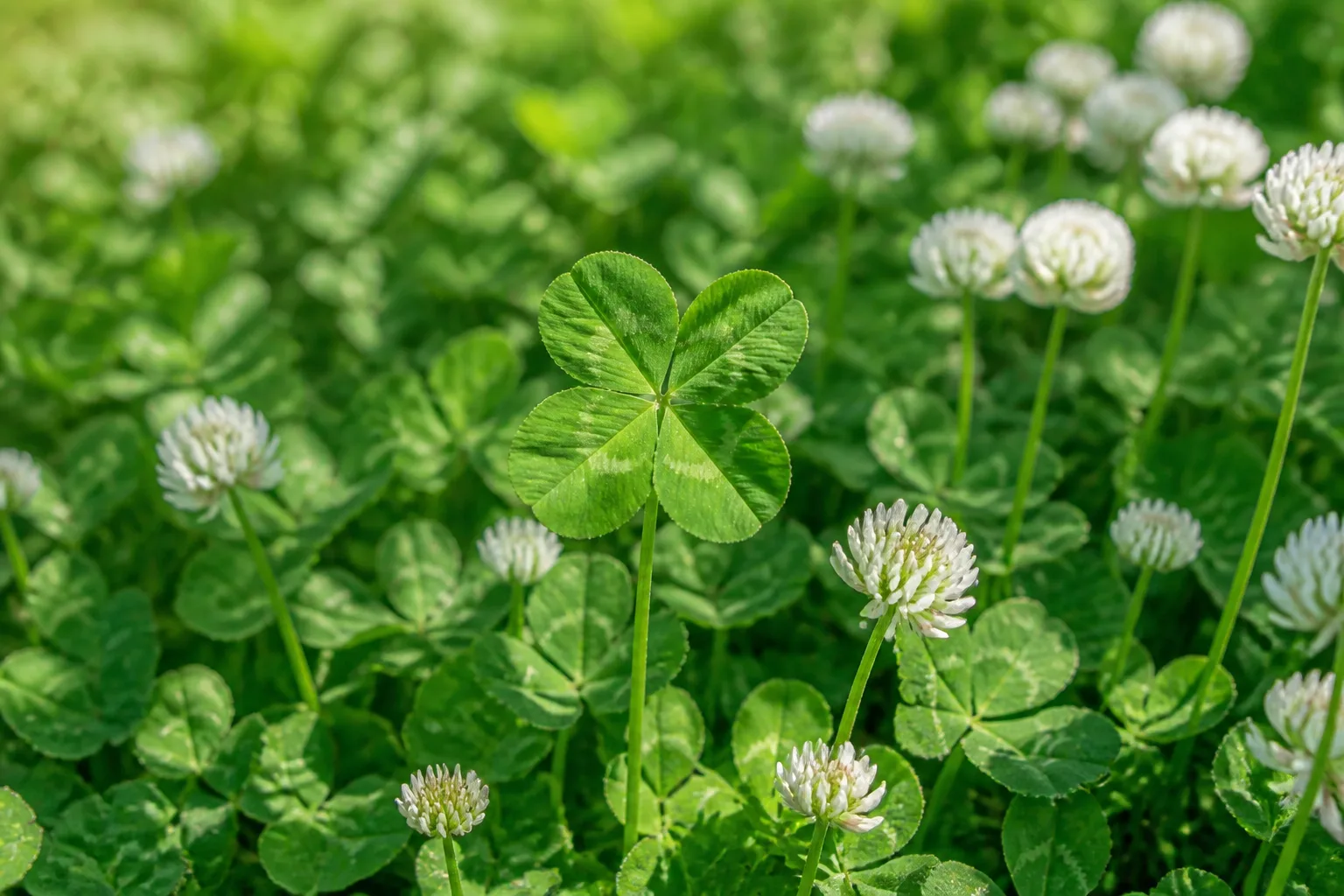
A four-leaf clover in the lawn stops most people mid-step—not because the plant is rare in the absolute sense, but because almost every clover leaf you see has three leaflets. The extra leaflet feels like a glitch in an otherwise uniform green carpet, and centuries of folklore turned that glitch into a luck charm. Before you press it in a book or tuck it in your wallet, it helps to know what you are actually holding: usually a genetic oddity on white clover (Trifolium repens), not a separate species and not necessarily the same plant Irish tradition calls a shamrock.
That distinction matters more than it sounds. Shamrocks are tied to St. Patrick’s Day, Irish identity, and religious symbolism around the number three. Four-leaf clovers are tied to superstition, lottery-ticket optimism, and backyard pattern games. Confusing the two is how grocery-store Oxalis pots get labeled “shamrocks” while your lawn holds the clover species where four-leaf forms actually appear. This guide separates verified botany from holiday marketing, gives you a practical method for finding lucky clovers, and explains why the same plant many homeowners spray as a weed once anchored healthy lawns.
Four-Leaf Clover vs Shamrock: What You Actually Found
Both words describe small green plants with divided leaves, but they answer different questions. A shamrock (seamróg in Irish, meaning “little clover”) traditionally refers to a three-leafed trefoil worn or displayed as an emblem—especially on St. Patrick’s feast day. A four-leaf clover is almost always the same white clover species as the three-leaf plants around it, except one stem carries four leaflets instead of three.
| What you see | Leaf count | Typical species | Common meaning |
|---|---|---|---|
| Shamrock emblem | 3 leaflets | Often Trifolium repens or T. dubium among others | Irish identity, St. Patrick, Holy Trinity symbol |
| Four-leaf clover | 4 leaflets (sometimes more) | Usually Trifolium repens | Luck folklore, rarity, collectibles |
| St. Patrick’s Day pot plant | 3–4 leaflets, often purple or folded | Oxalis species (not true clover) | Holiday decoration; houseplant care differs |
| Lawn “clover weed” | 3 leaflets + white flowers | Trifolium repens | Nitrogen-fixing legume; bee forage |
NC State Extension lists shamrock among the common names for Trifolium repens, which tells you how tightly linked the words are in American gardening—even though botanists still debate which species St. Patrick might have held. (NC State Plant Toolbox) If you find a four-leaf stem, you did not find a “better shamrock.” You found an unusual form of a clover that is already shamrock-adjacent in name.
The Five Plants Called Irish Shamrocks
Irish botanists and historians have never fully agreed on one authentic shamrock species. Surveys of living plants and historical presses point to five main candidates, all with three leaflets (or three leaf divisions in wood sorrel) and low-growing habits:
- Lesser trefoil / hop clover (Trifolium dubium) — small yellow-flowered annual common in Irish grassland
- White clover (Trifolium repens) — the lawn species where four-leaf forms appear; white flower heads
- Red clover (Trifolium pratense) — taller, pink-purple flower heads; pasture and meadow plant
- Black medic (Medicago lupulina) — yellow flowers; often treated as a lawn weed like clover
- Wood sorrel (Oxalis acetosella) — not a true clover (Trifolium); sour-tasting leaflets
None of these is defined by four leaflets. When a gift shop sells “lucky shamrock” seed or potted Oxalis deppei with four-part leaves, you are buying a look-alike houseplant or a marketing label—not a field clover guaranteed to produce four-leaf stems outdoors.
How Rare Is a Four-Leaf Clover?
Rare compared with three-leaf stems on the same patch—common compared with winning a random lottery. Most white clover plants produce only three leaflets per leaf. Multifoliate forms arise when genes and growing conditions align, but scientists still cannot predict exactly when the fourth leaflet will show.
Popular estimates place the odds between 1 in 5,000 and 1 in 10,000 for a random stem. University of Georgia coverage of clover breeding work cites an estimate of roughly 1 in 5,076 three-leaf clovers for each four-leaf one, based on citizen-science style counting—not a universal law of nature, but a useful mental anchor. (UGA News) Your backyard may beat or miss those odds depending on genetics in the local population and how thoroughly you search.
Genetics, Environment, and the Real Odds
UGA Distinguished Research Professor Wayne Parrott and colleagues identified genetic markers associated with the four-leaf trait in white clover, published in Crop Science. (Crop Science) That work proved multifoliate leaves are heritable—but not simple to control. Parrott noted that even when marker genes are present, day length and temperature can suppress the fourth leaflet, and the same genetics sometimes produce five, six, or eight leaflets instead.
Current UGA doctoral student Vincent Pennetti, who breeds ornamental clover lines in greenhouses, puts the hunt in plain terms: finding multifoliate clover is a pattern game, not a species hunt. The underlying biology is still partly mysterious, which is why commercial “four-leaf clover seed” packets oversell certainty. Environment filters whether genes express—and expression can jump beyond four.
The extreme end of that variability is documented. Guinness World Records lists the most leaves on a single clover stem (Trifolium repens L.) as 63, found by Yoshiharu Watanabe in Nasushiobara, Japan, on 2 August 2023—far above older references to 56 leaves from 2009. (Guinness World Records) Multifoliate clovers can stack leaflets like a tiny green fan when genetics and season cooperate.
Why Four-Leaf Clovers Became Lucky Charms
Luck stories predate lawn care forums. Celtic Druids reportedly treated four-leaf clovers as charms against evil spirits, elevating an already unusual plant into something spiritually potent. Medieval European folklore added layers—children carrying clovers to see fairies, soldiers pocketing them before battle, Napoleon legends bending to inspect a lucky stem. Most of these tales are oral tradition, not documented history, but they explain why the symbol persists on jewelry, lottery tickets, and sports logos.
Modern “luck” is mostly cultural performance: finding one feels special because you notice rarity against a sea of threes. Psychologists would call it a availability spike—one memorable success against thousands of unremarkable leaves. That does not make the emotion silly; it makes the symbol human.
Leaf Meanings and Myths Worth Checking
Victorian-era gift books popularized a four-part meaning for the four leaflets:
- Faith
- Hope
- Love
- Luck
That rhyme is poetic, not botanical. Clovers do not grow “faith” in leaflet one and “luck” in leaflet four. Other myths—Eve carrying a four-leaf clover out of Eden, or “luck of the Irish” meaning Ireland grows more lucky clovers—blend religion, nationalism, and garden statistics. Ireland’s clover-friendly pastures do host enormous amounts of Trifolium, which raises your chances of finding a multifoliate stem if you walk enough field margin. It does not change the genetics.
When sorting fact from story, hold onto three anchors: (1) four-leaf forms are the same species as three-leaf neighbors; (2) rarity is real but searchable; (3) symbolic meanings are cultural choices, not plant instructions.
How to Find a Four-Leaf Clover in Your Yard
You do not need a myth to find one—you need white clover, time, and a scanning method that beats random staring. Clovers spread in mat-forming patches with runners that root at nodes. NC State describes Trifolium repens as a prostrate perennial that spreads aggressively in moist, sunny to partly shaded sites—exactly the lawn edges, park strips, and unmowed spring corners where hunters should start. (NC State Plant Toolbox)
Look before the first spring mow if you hunt in turf. Cutting removes the visual mass that makes pattern breaks obvious and removes stems you might have collected. A fluffy, dense patch with consistent three-leaf triangles is your search field.
Pattern Spotting and Timing Tips

Pennetti’s UGA-published method is the clearest operational guide available:
Stand up, do not kneel. From standing height, three-leaf clovers create a repeating triangle of white leaf markings. A four-leaf stem interrupts that rhythm with a square silhouette. The fourth leaflet is often slightly smaller, and the center looks different once your eye calibrates.
Keep moving. Lingering in one square foot wastes time. Either the multifoliate gene is in that patch or it is not. Walk the edge of a clover mat, let your eyes travel quickly, and resist zooming on single plants.
Hunt on cloudy days if you can. Even light reduces harsh shadow that hides leaflet edges. After you find one, search the same patch again—multifoliate forms often cluster because related runners share genetics.
Press finds between paper if you want to keep them, or photograph them for bragging rights. Dried clovers fade; laminated ones last longer as bookmarks. Neither version changes your odds on the next stem.
Can You Grow Your Own Lucky Clovers?
Partially. Because multifoliate traits are heritable, breeders—including hobbyists like Pennetti—select parent plants that produced four or more leaflets and cross them over seasons. Parrott’s marker work helps science, but home gardeners cannot flip a switch. Even professionals see misses when temperature or day length is wrong.
What you can do:
- Transplant a lucky patch. If a corner of your lawn yields multiple four-leaf stems, dig a rooted runner and grow it in a container or isolated bed. You increase odds by concentrating favorable genetics—not by guaranteeing every leaf.
- Avoid “miracle seed” hype. Standard white clover seed may eventually produce a multifoliate stem at population odds; no packet honestly delivers 100% four-leaf plants without selective breeding behind it.
- Accept mystery. Pennetti told UGA reporters he would not use gene editing to mass-produce four-leaf clovers because it would ruin the search—a fair summary of why the charm works socially even when science catches up.
CRISPR could theoretically force the trait in a lab; culturally, the value is tied to finding, not manufacturing. For most readers, transplanting a productive patch beats buying unverified seed online.
Shamrocks, St. Patrick’s Day, and Irish History
St. Patrick’s Day (17 March) fused religious feast, spring timing, and emigrant identity abroad. Legend credits St. Patrick with using a three-part plant to explain the Holy Trinity—Father, Son, and Holy Spirit united like three leaflets on one stalk. Historians caution that the story was retrofitted to plants Irish people already used as green emblems; the exact species in Patrick’s hand is unknown.
By the early 1700s, wearing shamrocks on St. Patrick’s feast day was common enough to show up in written accounts. Architecture, textiles, and later political movements adopted the trefoil as Irish signifier—sometimes neutral pride, sometimes contested symbol during periods like the Troubles when green carried partisan weight. Four-leaf clovers stayed largely outside that religious-political core: luck charm rather than national creed.
The Irish word seamróg (seamair óg) translates as “young clover” or “little clover,” which is why the debate over species annoys purists. Language points to cloverness, not a single Latin name.
Indoor Shamrock Plants Sold for St. Patrick’s Day
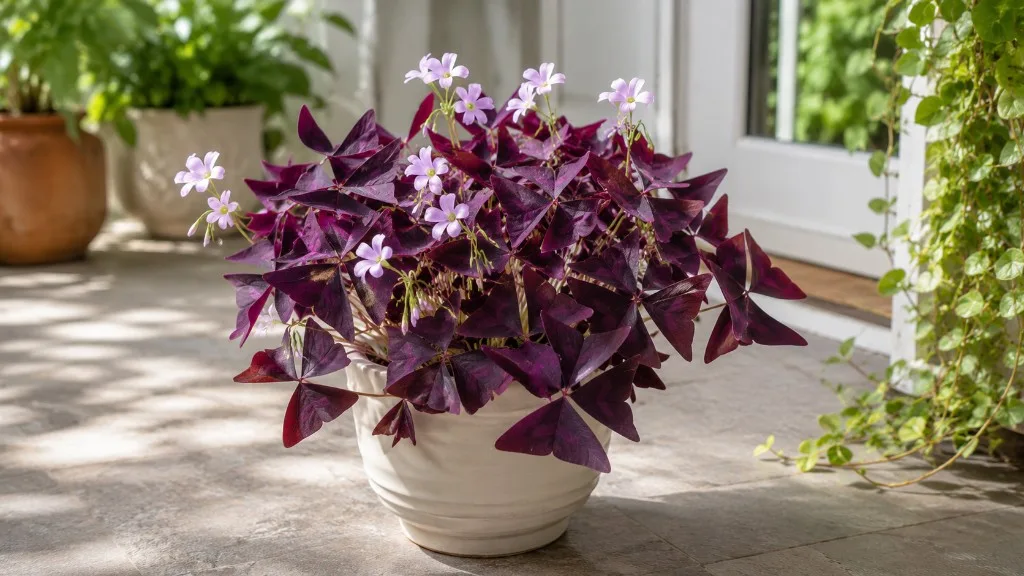
Grocery stores and nurseries stack Oxalis pots near the checkout every March. These are not Trifolium clovers. They belong to a different plant family (Oxalidaceae), grow from bulb-like rhizomes, and follow houseplant rules—bright light, even moisture, dormancy periods—rather than lawn mowing schedules.
Common holiday types:
- Good-luck plant (Oxalis deppei, syn. O. tetraphylla) — four leaflets per leaf, green with a dark blotch; marketed for its lucky look
- Purple shamrock (Oxalis triangularis) — deep purple triangular leaflets that fold at night; widely sold as “shamrock” though it is Brazilian in origin
The Oxalis triangularis plant hub covers watering, light, and dormancy for the purple shamrock specifically—worth reading before you assume it wants lawn sun and hose water. Overwatering dormant rhizomes is the fastest way to turn a St. Patrick’s impulse buy into compost.
If you want field clover symbolism, walk the yard. If you want a tabletop emblem, buy Oxalis—but label it correctly in your head so care mistakes do not follow.
Is White Clover Good or Bad for Lawns?
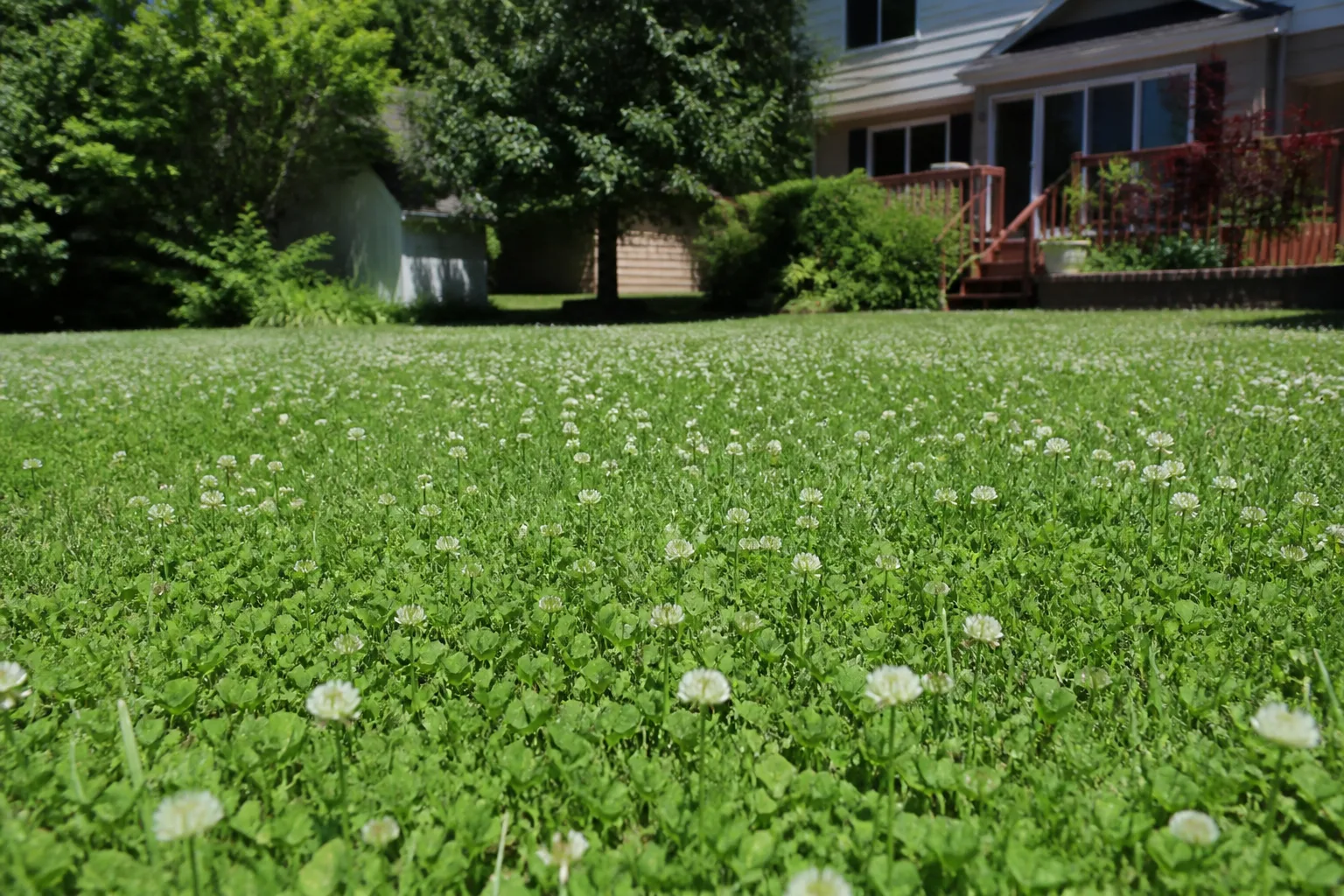
For decades, white clover was an intentional part of lawn seed mixes because it fixes nitrogen and stays green through modest drought. Mid-century broadleaf herbicides and perfect-grass marketing recast it as a weed. Today the pendulum is swinging back as homeowners weigh pollinator value, fertilizer reduction, and lower irrigation.
Purdue Turf describes white clover as a perennial legume that spreads by stolons, tolerates a range of soils, and produces white flowers attractive to bees. (Purdue Turf) Penn State Extension notes clover’s historical role in turf and its persistence in low-maintenance lawns. (Penn State Extension) Whether clover is “good” depends on your goals—not on luck.
Nitrogen Fixation and Pollinator Value
Clover roots host Rhizobium bacteria that convert atmospheric nitrogen into forms nearby grass can use. That natural fertilization reduces bagged nitrogen needs over time, which also lowers nitrogen runoff concerns tied to over-fertilized turf. NC State tags Trifolium repens as pollinator-friendly, bee-friendly, and larval host for the clouded sulphur butterfly. (NC State Plant Toolbox)
Trade-offs are real:
- Bee stings where barefoot kids play—flowering clover attracts pollinators you may not want in picnic lawns
- Patchy texture in formal monoculture turf aesthetics
- Staining on shoes from flowers and runners
- Herbicide conflict—many lawn weed killers damage clover by design
Clover also tolerates compacted soil and moderate foot traffic better than some turfgrasses in mixed stands. Mowing regularly keeps it lower and delays heavy flowering. If you are hunting four-leaf stems, a clover-friendly lawn is literally more search surface.
Environmental framing matters: reducing mower passes and synthetic fertilizer on low-input clover-grass mixes can lower equipment emissions and chemical load, themes EPA discusses in agriculture-related air-quality contexts. (EPA Agriculture and Air Quality) That does not make clover lawns virtuous for every site—it makes them a deliberate choice rather than a failure.
Test a small area with white clover or microclover blends if you are curious. Live with the look one season before converting the whole yard.
Eating Clover Safely
Clover is edible when you know the plant and the chemical history of the ground it grew in. Young leaves and flowers can go into salads; dried flowers steep into mild tea. Flavor is gently grassy; wood sorrel relatives taste sharper and sour because of oxalic acid—another reason to identify before nibbling.
Non-negotiable safety rules:
- No pesticides or herbicides on the lawn—if your neighborhood treats turf, do not forage there
- Positive ID — confirm true clover (Trifolium) vs look-alikes
- Moderation — oxalates in related plants can irritate sensitive stomachs; huge quantities are a bad idea
- Wash thoroughly and skip roadsides with exhaust residue
Four-leaf status does not change edibility. The fourth leaflet is not a superfood; it is the same tissue type as leaflet three.
Conclusion
A four-leaf clover is usually a white clover stem doing something genetically unusual—not a separate lucky species and not the same cultural object as a three-leaf shamrock worn for St. Patrick’s Day. The odds are long but searchable once you learn the triangle-vs-square pattern trick, hunt unmowed spring patches, and revisit clusters where you have already succeeded. Science from UGA and elsewhere confirms heritable multifoliate traits without offering a honest “always four” seed packet.
Shamrock history lives in three-leaf symbolism, Irish language, and several candidate species—while grocery-store Oxalis fills a different job as a holiday houseplant. In the lawn, white clover is neither pure villain nor magic charm: it fixes nitrogen, feeds pollinators, and gives lucky hunters more ground to scan. Treat folklore as fun, treat botany as the guide, and press the leaf if you want—but know exactly what story you are keeping.