Krinner Tree Genie Review: Is It Worth It?
See if the Krinner Tree Genie is worth it for your live tree, with sizing math, setup steps, water-capacity limits, safety notes, and honest drawbacks.
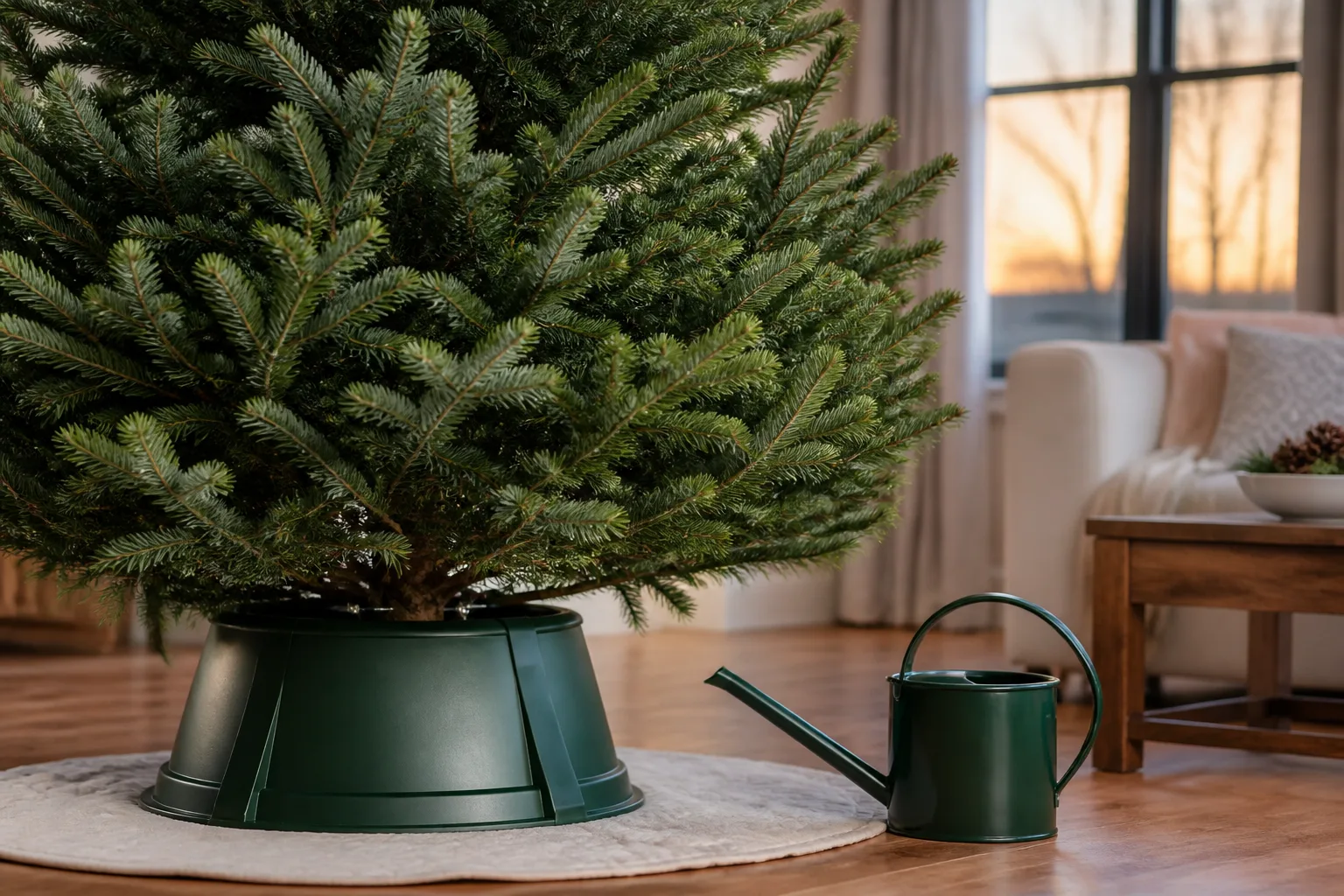
The Krinner Tree Genie solves the most annoying part of a real Christmas tree: keeping a tall, awkward trunk upright while you crawl around it tightening screws. Its foot-pumped clamp lets one person center the trunk, make a small adjustment, and lock the tree in place without needing someone else to hold the canopy straight.
That convenience is real, but it is not the whole buying decision. The XXL is a premium, heavy, 20-inch-wide stand for live trees, and its 2.5-gallon reservoir does not mean every 12-foot tree is a sensible match. The useful question is whether its setup mechanism, water gauge, and stability solve a problem you have often enough to justify the cost and storage space.
Quick Verdict: Who the Krinner Tree Genie Is For
The Krinner Tree Genie is a strong choice for someone who regularly buys a medium-to-large cut tree, sets it up alone, dislikes screw stands, and wants a reservoir that is easier to monitor. It is especially appealing if the person doing the decorating cannot comfortably kneel under low branches or would rather make the final straightening adjustment without coordinating with a helper.
It is not automatically the best stand for every tree. A small tabletop tree, an artificial tree with a narrow center pole, a very tight budget, or a home with almost no storage space all point toward a simpler option. A very tall or unusually heavy tree can also exceed what one person should safely lift, even if the stand itself is rated for it.
My short version is buy the Krinner for repeatable convenience, not because a clever stand makes tree handling risk-free. The stand removes the awkward clamping job; it does not replace a stable floor, a fresh trunk cut, daily water checks, or a second person when the tree is too heavy to move safely.
What the Krinner Tree Genie XXL Actually Does
The Tree Genie XXL is a water-holding stand for a cut Christmas tree. The trunk sits over a central spike, then a single cable draws five claws inward as you pump a foot pedal. A locking mechanism keeps the pedal from being released accidentally once the tree is secure. The design is different from the four-bolt stands that require someone to hold the tree plumb while another person works a wrench.
The current Krinner Tree Genie XXL product page identifies the model, while a current retailer specification page lists the XXL at up to 12 feet tall and up to a 7-inch trunk diameter. That same listing gives a 2.5-gallon reservoir, a 20-inch diameter, and an 18-pound empty weight. Treat those as product limits, not a promise that any tree at the maximum will be easy for one person to lift or stable in every room.
The reservoir includes a visible level indicator that shows when to stop filling and when the water has fallen. This is the second major convenience after the clamp: you can inspect a marked indicator instead of blindly reaching through branches to find a dark pool. It is still a level indicator, not an automatic watering system, so it cannot detect every leak or replace a daily glance.
The Setup Process, From Trunk to Locked Tree
The process is short because the stand arrives assembled, but the order still matters. Put the stand on a firm, level surface first, keep the pedal in its released position, and have the tree close enough that you do not need to drag a locked trunk across the floor.
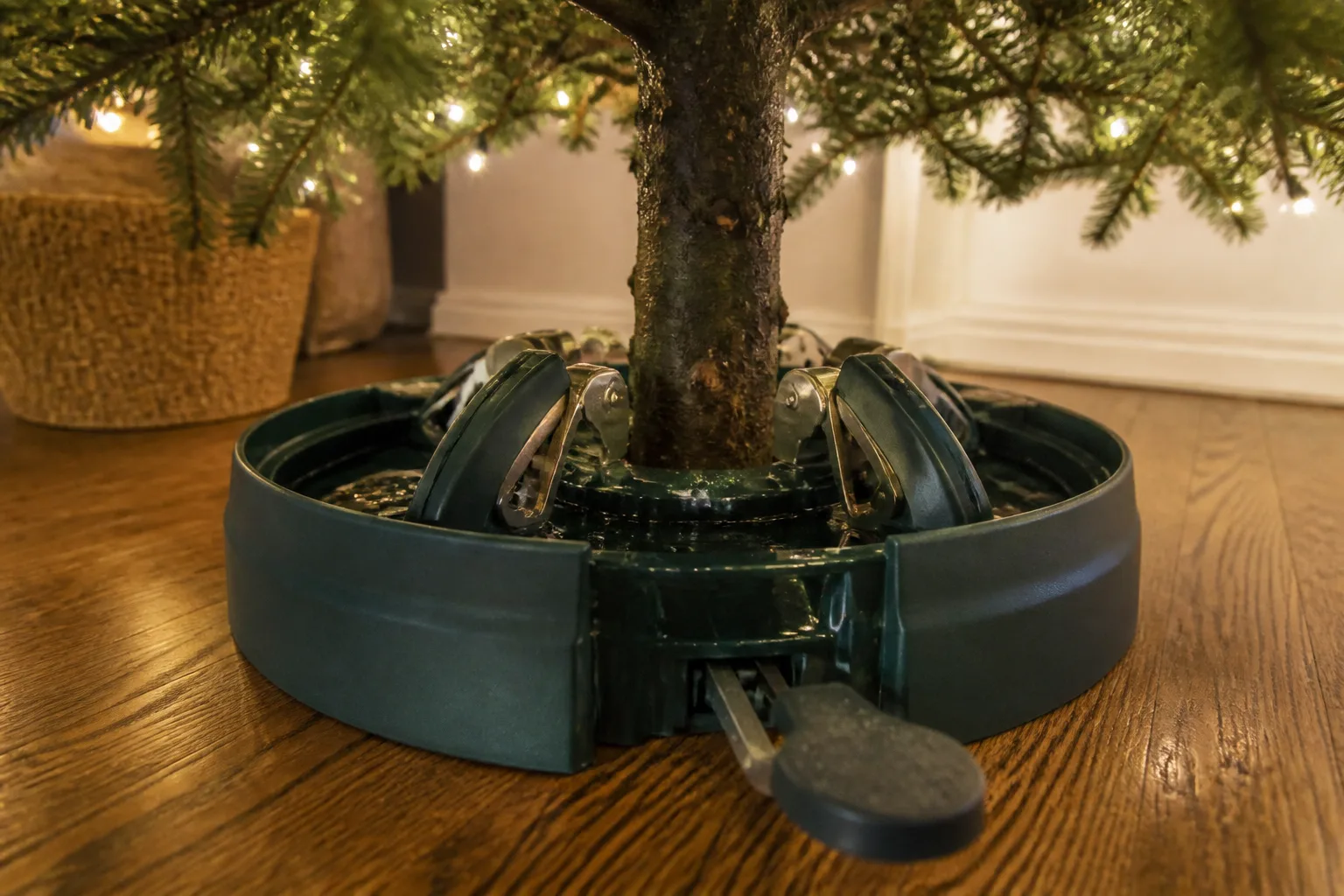
Center the trunk over the spike, lower it into the stand, and pump the pedal with your foot until the claws make firm, even contact. Step back before fully committing to the lock: if the canopy leans, release the mechanism, make a small rotation or position adjustment, and pump again. That ability to loosen, nudge, and re-clamp is what makes solo setup less frustrating than tightening four screws while the tree twists away from you.
The Tree Genie XXL manual emphasizes a solid, level surface, keeping hands away from the claws, checking the tree’s balance, and not using a damaged stand. Follow those instructions even if the stand feels intuitive. A foot pedal is convenient, but the claws are still a pinch point and the trunk is still a heavy moving object.
Prepare the trunk before you pump
A clever clamp cannot compensate for a poor trunk base. If the tree has been out of water long enough for the cut surface to dry, saw a thin disk from the base immediately before setup. Keep the cut perpendicular to the trunk rather than making an angled point or V-shaped notch.
Penn State Extension recommends fitting the stand to the untrimmed trunk instead of shaving away the outer wood. The National Christmas Tree Association’s care guidance gives the same practical warning and recommends getting the cut end into water promptly. The outer layers help with uptake, while a flat base gives the claws a more predictable surface to hold.
Why One-Person Setup Works
Traditional stands split the job into two tasks that fight each other: one person holds the tree vertical and the other tightens hardware. Each adjustment can change the lean, so the helper ends up pushing the trunk while the person with the wrench guesses whether it is straight. The Krinner transfers the clamping force to a foot-controlled mechanism, leaving both hands free to steady and inspect the tree.
That does not mean the tree floats into place. You still have to lift the trunk, guide the base onto the spike, and control the canopy while the first pumps engage. An average-height adult may manage a 6- to 8-foot tree alone if the path is clear and the trunk is manageable. A fresh tree that is broad, wet, awkwardly bundled, or taller than the decorator should be handled with a helper, regardless of the stand’s rating.
The two-minute setup story is best understood as a repeatable sequence after the tree is in the room, not a guarantee from curb to decorated branches. Unloading, trimming the base, carrying the tree, finding the straight side of a crooked trunk, and cleaning needles are still part of the job. The stand earns its keep by making the final positioning step calm and reversible.
Water-Level Gauge and Reservoir
The reservoir is a meaningful upgrade over a stand that hides a shallow basin under a skirt. The floating indicator gives you a visual target for the maximum fill level and an early warning that the water line is falling. You can leave the gauge visible through the tree skirt and add water with a long-spout can or funnel rather than kneeling in the branches.
Do not confuse reservoir capacity with daily water consumption. Penn State Extension says a stand should provide about 1 quart of water per inch of trunk diameter, with at least 1 gallon for most household trees, and the NCTA repeats that rule. A fresh tree can use far more water during its first week than it will later, so a large reservoir creates a buffer but does not grant permission to skip checks.
The gauge also cannot tell you whether water is reaching the cut end if the trunk is sitting high, whether a seal has started leaking, or whether the stand is on a slope. Check the indicator each morning, look for damp flooring, and confirm that the base remains submerged. If you cover the stand with a skirt, leave an opening around the gauge; hiding the feature defeats the reason to pay for it.
How to Size the Stand to Your Tree
Measure the trunk diameter near the base before buying the stand. The height limit matters for overall stability, but the trunk measurement determines whether the clamp can close around the tree and whether the reservoir has enough capacity for a reasonable interval between refills.
Use the quart-per-inch rule as a capacity check:
| Trunk diameter | Approximate minimum reservoir capacity |
|---|---|
| 3 inches | 3 quarts |
| 4 inches | 4 quarts, or 1 gallon |
| 5 inches | 5 quarts, or 1.25 gallons |
| 6 inches | 6 quarts, or 1.5 gallons |
| 7 inches | 7 quarts, or 1.75 gallons |
The XXL’s 2.5 gallons exceeds those minimum capacity examples, but the model’s stated maximum trunk diameter is 7 inches. That distinction matters: the tank can hold plenty of water while the clamp, trunk shape, height, and floor footprint still determine whether the tree is a sensible fit. Capacity is a planning buffer, not a way to make an oversized tree safe.
Stability on the Floor
The 18-pound empty stand and 20-inch footprint give the XXL more mass and base width than many inexpensive stands. The five-claw system also distributes pressure around the trunk instead of relying on four individual bolts that may not be tightened evenly. Those are real stability advantages when a tree has a slightly crooked trunk or a lot of ornaments on one side.
Stability is not the same as tip-proofing. Put the stand on a solid, level floor, not a thick uneven rug or a surface that can rock. Keep the tree balanced while you decorate, and consider a discreet upper anchor for a tall tree in a home with children, pets, or heavy ornaments. The manual’s warnings about level placement and damaged parts are more useful than a blanket claim that the stand cannot tip.
The central spike helps locate the trunk, but do not use it as an excuse to force a badly cut or sharply tapered base into place. If the tree remains unstable after the claws are locked, lower the risk by removing it, checking the cut, inspecting the stand, and starting again. Do not wedge random objects under the reservoir while the tree is decorated.
What It Feels Like to Water Without Crawling Under
The daily watering advantage is less dramatic than the setup advantage, but it may be the feature you appreciate after the novelty wears off. A long-spout watering can can reach the reservoir from standing height, and the visible indicator tells you where to stop. You do not have to push your shoulder through branches or feel for water with one finger while trying not to soak the carpet.
That convenience changes behavior. If checking the stand takes ten seconds, you are more likely to do it every morning during the first week, when fresh trees often drink most heavily. Gardening Know How’s practical coverage makes the same broader point about reducing the hassle of reaching a hidden stand, although a gauge still depends on the owner looking at it.
Put a waterproof mat under the stand while you test the fill line and inspect for leaks. Keep water away from extension cords and light connections, wipe spills immediately, and never fill past the marked maximum just because the tree looks thirsty. The goal is a submerged trunk, not a flooded floor.
The Real Trade-Off: Price, Weight, and Storage
The Krinner’s main trade-off is convenience versus cost. A basic screw stand can be dramatically cheaper and can do the essential horticultural job—hold the trunk upright in water—when it is correctly sized and used carefully. The Krinner asks you to pay for easier solo setup, a more substantial base, a clamp that is quicker to adjust, and a water indicator that is easier to see.
The empty 18-pound weight is helpful on the floor and inconvenient in the closet. Measure the storage shelf, under-bed clearance, or garage rack before buying, and remember that a 20-inch base takes more room than its streamlined shape suggests. A tree skirt can cover the stand, but the water gauge should remain visible.
Long-term ownership reports are useful for understanding the experience, not for proving a failure rate. In Umami Girl’s multi-season review, the writer praises the easy setup, heavy base, foot pedal, and 2.5-gallon capacity while also mentioning occasional user reports of cracks and leaks. That is enough reason to inspect a new stand immediately and keep the return or replacement information until the season is over.
Drawbacks and Failure Points to Know
The first drawback is model confusion. Tree Genie, Tree Genie XXL, and Deluxe versions can differ in height, trunk, bell, or included safety features, so compare the exact model number and current specifications before assuming a review of one version applies to another. Do not buy based only on a photo or on the word “XXL.”
The second is that the plastic reservoir is still a container that can be damaged. Inspect the basin, gauge, pedal, cable, claws, and seals as soon as the box arrives. Fill it with water before putting a valuable tree and an electrical display on top of it; a slow leak is much easier to spot before the tree is decorated.
The third is human limitation. A pedal can lock a trunk, but it cannot carry a 9-foot tree through a doorway, prevent a cat from climbing the branches, or correct a floor that slopes toward the wall. If a task involves lifting, sawing, or moving a heavy tree, ask for help instead of treating the one-person clamp as a one-person rule.
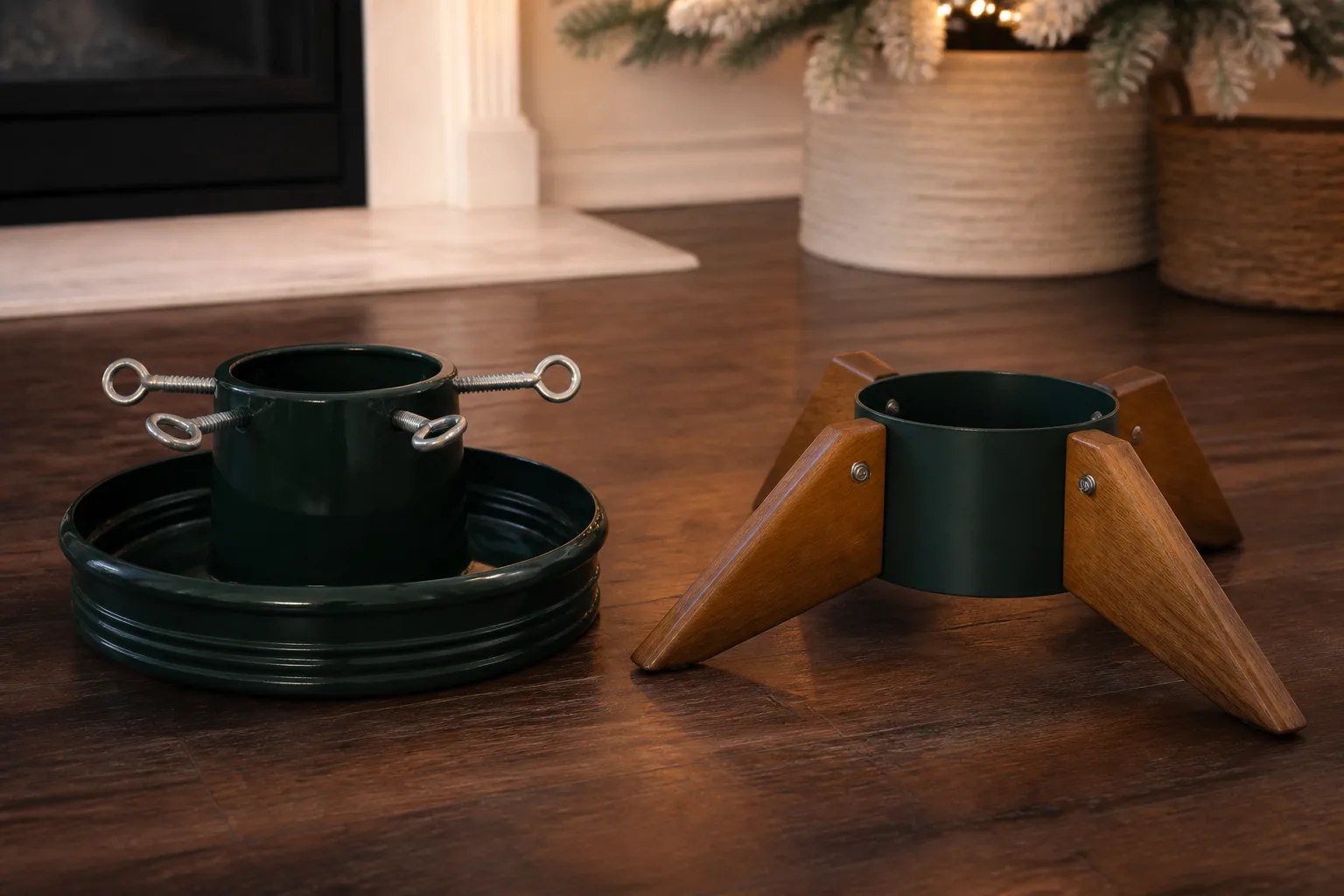
How It Compares With Screw Stands
The best comparison is not “modern versus old.” It is which part of tree care you find hardest.
| Decision point | Krinner Tree Genie XXL | Conventional screw stand |
|---|---|---|
| Solo setup | Easier once the trunk is lifted and centered | Often requires a helper to hold the tree while tightening |
| Straightening | Release, nudge, and re-clamp | Loosen and retighten several bolts |
| Water monitoring | Built-in visible indicator | Usually requires reaching into a hidden basin |
| Up-front cost | Premium | Usually lower |
| Storage | Heavy and about 20 inches wide | Often lighter, but legs can be awkward |
| Best fit | Frequent live-tree owners who value convenience | Occasional users with a manageable tree and tight budget |
Screw stands are not automatically unsafe, and pedal stands are not automatically superior. A properly fitted, sturdy screw stand on a level floor can hold a real tree perfectly well. The Krinner is worth the difference when the repeated labor of setup and watering is the part that makes you postpone or resent the tradition.
Who Should Buy the Krinner Tree Genie
Buy it if you put up a live tree most years and usually have one person doing the work. It is a good fit for decorators who want a 6- to 8-foot tree to be adjustable after placement, who dislike kneeling under branches, or who have learned that a cheap stand’s small reservoir and loose hardware create more work all month.
It also makes sense for a household that values a wide, heavy base and can store it without trouble. The premium is easier to justify when you will reuse the stand for several seasons, can inspect it before each setup, and have a tree whose trunk and height fall comfortably inside the published limits.
Who Should Skip It
Skip it if your tree is artificial, unless you are buying a compatible product designed for an artificial-tree pole. A live-tree reservoir stand is not a universal base for every faux tree. Also skip it for small decorative trees where a large, heavy stand adds expense and visual bulk without solving a real problem.
Choose a simpler stand if your budget is fixed, you have reliable help for setup, or you only display a small tree for a few days. If you buy pre-owned, be especially strict about inspecting the reservoir for hairline cracks and the clamp for smooth release; the convenience is not a bargain if the mechanism or seal is already compromised.
Safer Setup With Lights, Pets, and Heat
Tree freshness and electrical safety are separate decisions. Keep the tree away from fireplaces, radiators, space heaters, hot air vents, and strong direct sun. The NCTA and Penn State Extension’s Christmas-tree guidance recommend daily water checks, low-heat lighting, and removal when the tree becomes very dry.
Inspect light sets, avoid overloaded circuits, and turn lights off when you leave or go to bed. LED or miniature lights reduce heat around the branches, but they do not make damaged wires, wet plugs, or an overloaded outlet acceptable.
If pets or young children share the room, consider an upper anchor in addition to a strong stand. Keep cords and the water basin out of reach, avoid ornaments that can be swallowed or shattered, and do not assume the 18-pound base is a substitute for a whole-tree stability plan.
What to Do After the Season
Remove the tree when it is brittle, shedding heavily, or no longer staying fresh even with a submerged trunk. Watering can slow drying, but it cannot reverse a tree that has become a fire and needle-drop hazard. Follow local collection or recycling rules, and never burn the tree in a fireplace or wood stove.
Drain the stand before carrying it through the house. The NCTA care guidance recommends keeping dry trees out of the home and also warns against burning them. Wash the reservoir with mild soap, rinse it, dry every moving and recessed part, and store the stand where the pedal and cable cannot be crushed.
Conclusion
The Krinner Tree Genie earns its premium when the recurring problem is not “Can a stand hold my tree?” but “Can I set up and water this tree without a wrestling match?” The foot-pumped five-claw clamp makes centering and re-straightening much easier for one person, while the large reservoir and visible gauge make daily care less awkward.
It is still a heavy, sizable product with a higher price and a few important limits. Measure the trunk, compare the reservoir rule with the published fit, inspect the stand for leaks, use a level floor, and bring in help for a tree that is too heavy to lift safely. For a repeat live-tree owner who values that checklist and the saved effort, the Tree Genie is a genuinely useful upgrade; for everyone else, a correctly sized screw stand may be the smarter buy.