Little Gem Magnolia Care: Planting, Pruning, and Blooming
Learn how to plant and care for Little Gem magnolia, allow for its real mature size, water it while roots establish, and prune without losing blooms.
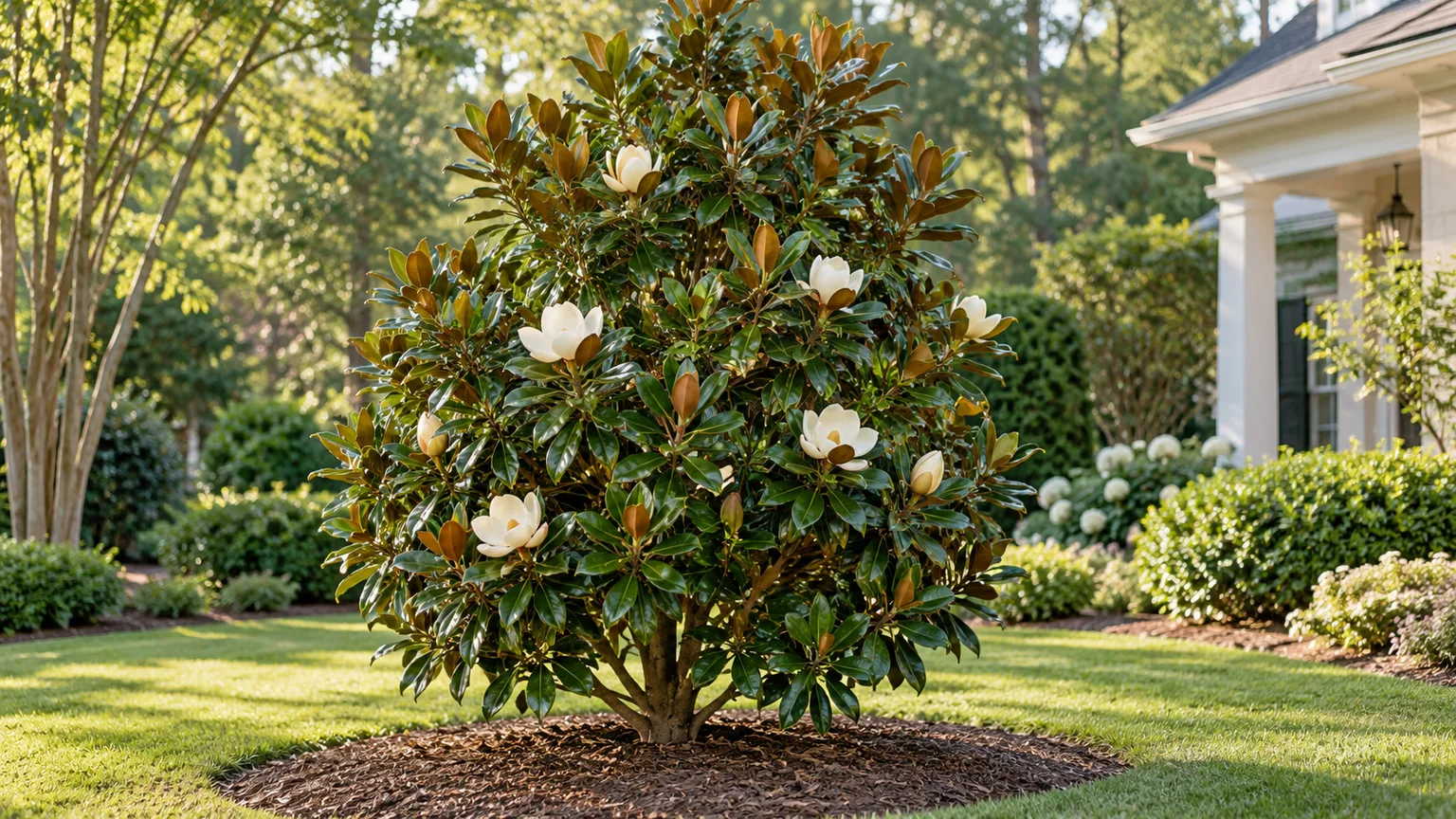
Little Gem magnolia (Magnolia grandiflora ‘Little Gem’) offers the glossy evergreen foliage and fragrant white flowers of a Southern magnolia in a narrower, slower-growing form. It is a better fit for a home landscape than the species tree, but “dwarf” is relative: a mature plant can still become a substantial tree. Choose its site for the eventual canopy and roots, then focus care on steady moisture while it establishes, good drainage, and minimal pruning.
There is no single dependable mature-size figure for every Little Gem. NC State Extension describes a compact tree that commonly reaches about 20 feet in its first 20 years; Clemson Cooperative Extension gives a broader range of 20 to 35 feet tall and about 10 feet wide. Cultivar, climate, and growing conditions all affect the result, so use 20 feet as a realistic planning baseline and leave room for more rather than squeezing it under eaves or beside paving.
Little Gem Magnolia at a Glance
| Feature | Practical expectation |
|---|---|
| Botanical name | Magnolia grandiflora ‘Little Gem’ |
| Form | Compact, upright, broadleaf evergreen tree or large shrub |
| Mature size | Often around 20 feet over its first decades; some references list 20–35 feet tall |
| Hardiness | NC State Extension lists USDA zones 7–9; colder sites are a gamble without a protected microclimate |
| Light | Full sun to partial shade; more sun generally supports stronger flowering |
| Soil | Moist, organically rich, acidic to near-neutral, and well drained |
| Flowers | Fragrant cream-white blooms, generally smaller than those of full-size Southern magnolia |
| Maintenance | Regular establishment watering, light structural pruning, and seasonal leaf cleanup |
‘Little Gem’ is a cultivar, not a separate miniature species. Its denser, upright habit and earlier flowering distinguish it from a seed-grown Southern magnolia, but labels such as “dwarf” do not mean it will remain shrub-sized. NC State Extension describes the selection as reaching roughly 20 feet during its first two decades, while Clemson lists 20–35 feet tall; Clemson notes that published magnolia-cultivar size estimates can vary. Treat the larger range as a safety margin when planning around a roofline, path, or overhead wire.
Decide Whether It Fits Your Space
This tree is most useful where you want a year-round green focal point, a narrow evergreen screen, or a small-scale Southern magnolia for a lawn or broad border. Its leaves stay through winter in suitable climates, flowers appear on an established tree over a long season, and its upright form can soften a blank wall without the very wide canopy of the species. It is less suitable for a tiny foundation bed, a narrow strip between a house and driveway, or a site where the tree must be held to a fixed small height.
Mature Size Is a Range, Not a Promise
Nursery listings often compress a plant’s likely eventual size into a neat height-and-width pair, but tree dimensions reflect climate, soil, irrigation, and age. NC State Extension describes Little Gem as a slow-growing, compact selection that typically grows to 20 feet over its first 20 years; Clemson’s broader 20–35-foot height range is a reminder that “typical” does not equal “maximum.” If space is tight, ask the grower for the source of its mature-size estimate and whether it refers to a 10-year height, a maintained size, or a mature landscape specimen.
Do not plan to keep it small by repeatedly topping it. Topping removes the natural leader and creates large wounds, weak regrowth, and an awkward silhouette. A better decision is to choose another cultivar or a naturally smaller plant if you cannot accommodate a tree at least 20 feet tall. For a screen, space plants according to the width of the specimens you buy and the mature spread on their local nursery label; tightly packing young pots together can create years of costly thinning later.
Roots, Evergreen Cover, and Seasonal Cleanup
Magnolias develop a broad root system that can extend well beyond the trunk. Clemson Extension describes magnolia roots as wide-spreading and notes that transplanting is difficult because much of that root system can be lost. Keep the main planting away from hardscape that cannot tolerate lifting, and avoid digging or cultivating under the future canopy once the tree is established. Surface roots are a reason to mulch and mow carefully, not a reason to raise the soil level over the trunk.
Evergreen does not mean leafless cleanup. Little Gem replaces older foliage periodically, often as new growth emerges, and its leathery leaves can accumulate beneath the tree. Give the tree enough space that you can rake or blow leaves without damaging low branches. The cultivar’s evergreen screen is useful in winter, but the canopy can still thin or shed leaves after cold, drought, or transplant stress.
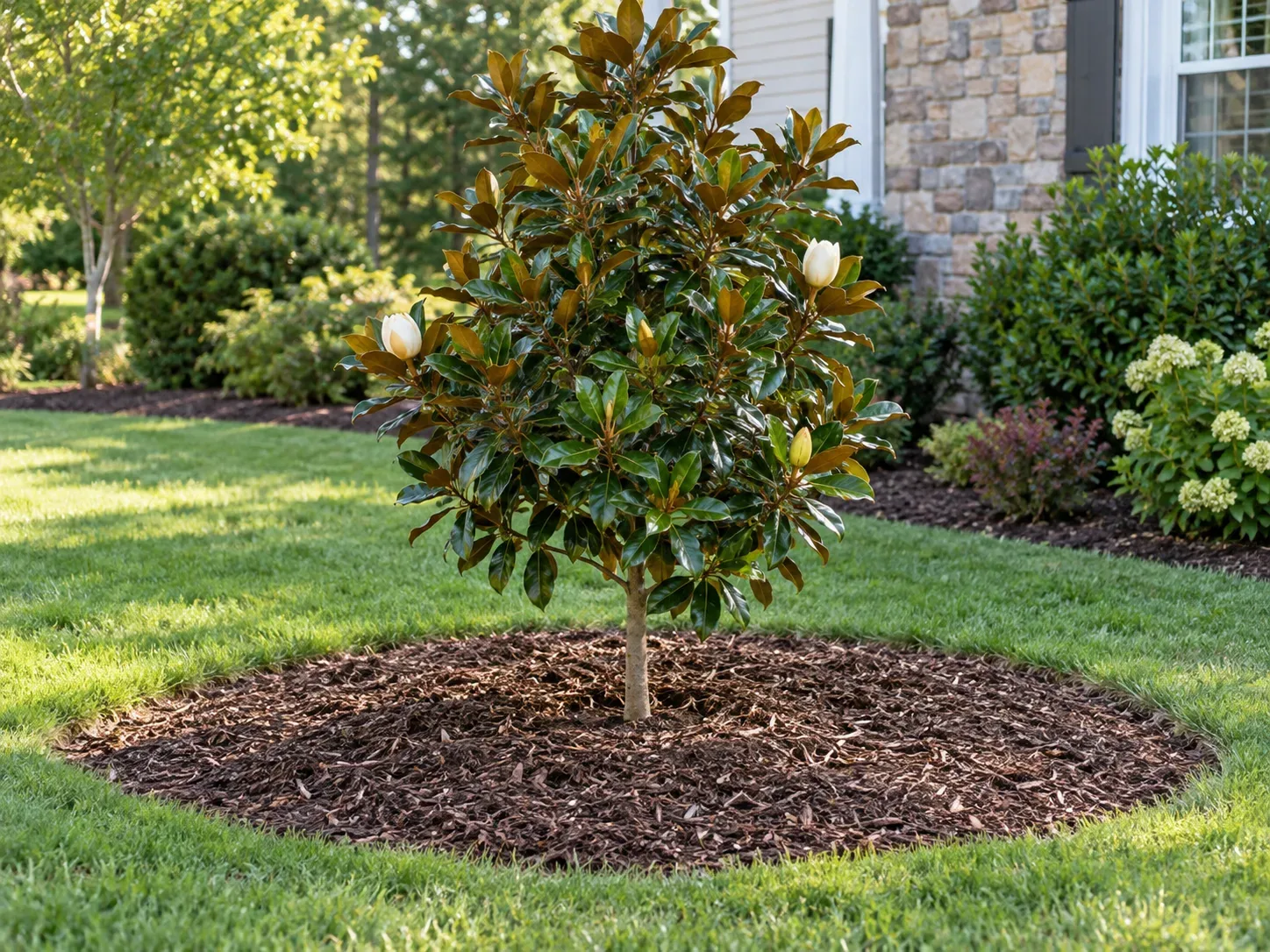
Choose a Site With Light and Drainage
A good site gives the canopy room, keeps the root zone from swinging between drought and saturation, and avoids exposure to severe winter winds in borderline climates. Little Gem tolerates partial shade, but it is not the right tree for a deeply shaded corner if reliable flowering is important. Before you buy, note the hours of direct sun, how quickly water drains after rain, and whether nearby roofs, pavement, or utilities will constrain the tree.
Sun and Heat
Aim for a place with at least six hours of direct sun if you want the densest growth and best flowering. NC State lists full sun to partial shade as suitable exposure, while Gardenia’s cultivar guide also favors full sun and notes that light shade may reduce flowering. In a hot, dry inland site, some afternoon shade can protect foliage from scorch, but it should not leave the tree shaded most of the day.
A sheltered position matters more in the colder parts of the cultivar’s range. Wind can dry evergreen leaves while frozen soil prevents roots from replacing lost moisture, leaving bronzed or brown foliage on the exposed side. A warm wall can soften wind and cold, but preserve room for the eventual branches and do not plant where reflected heat will bake an already dry root zone.
Soil, pH, and Drainage
Little Gem prefers moisture-retentive, well-drained soil with organic matter. Clemson Extension gives pH 5.5–6.5 as the general magnolia preference; that slightly acidic range helps avoid the nutrient-availability problems that can show up as yellow foliage in alkaline soil. If you do not know your soil pH, test it before applying sulfur, iron, or an acidifying fertilizer. These amendments are not interchangeable, and a product will not correct poor drainage.
The tree dislikes extremes: soil that dries out repeatedly while it is establishing, and a planting hole that stays waterlogged after rain. Check the site after a soaking storm. If water stands for a day or longer or the soil smells sour, choose a raised, better-drained area rather than digging a deep basin and filling it with rich compost. In heavy clay, improve the planting area broadly with organic matter at the surface and maintain a mulch layer; do not create a small pocket of loose soil that can collect water around the root ball.
Plant It Without Burying the Root Flare
Planting depth matters because magnolia roots and stems need air exchange near the soil line. Set the root flare—the place where the trunk widens into the first structural roots—at or slightly above the finished grade. If a nursery pot contains several inches of extra soil over the flare, scrape it away before measuring. A root ball set too deep can remain wet around the trunk, decline slowly, and be mistaken for a watering problem.
Dig a hole two to three times wider than the root ball but no deeper than its measured height. Roughen smooth sides, tease loose circling roots, and backfill with native soil so roots meet the surrounding ground without an abrupt soil-texture boundary. Water slowly to settle air pockets, then spread two to three inches of organic mulch across the root zone, leaving a bare gap of several inches around the trunk. The RHS magnolia guide likewise emphasizes a sheltered site and moist, well-drained soil; Gardenia’s cultivar directions recommend a wide hole with the flare at grade.
Choose a mild planting period when the soil is workable and the tree is not under heat or drought stress. In areas with hot summers, fall planting gives roots time to begin establishing before the next heat season; in colder climates, plant early enough for roots to settle before the ground freezes. Water the root ball before planting if it is dry, and remove any trunk ties or nursery stakes that are not needed after the tree is stable. Stake only if wind or an unstable root ball requires it, and check ties so they do not rub the bark.
Water by Root-Zone Moisture, Not the Calendar
A new Little Gem magnolia needs a regular water supply until roots grow out of the nursery root ball and into surrounding soil. The exact frequency depends on rainfall, soil texture, temperature, and the size of the tree. Instead of following a rigid “three times per week” schedule, probe the root ball and nearby soil a few inches down. If both are starting to dry, water slowly and deeply; if they are still cool and damp, wait and check again.
For the first growing season, inspect the plant every few days during hot or windy weather and less often after rain. A slow soak at the root zone wets a larger volume than a quick sprinkle against the trunk. Continue supplemental watering through dry periods in the second season, especially if the root ball is still noticeably drier than surrounding soil. A two- to three-inch mulch layer reduces evaporation, but it does not replace watering when the soil is dry.
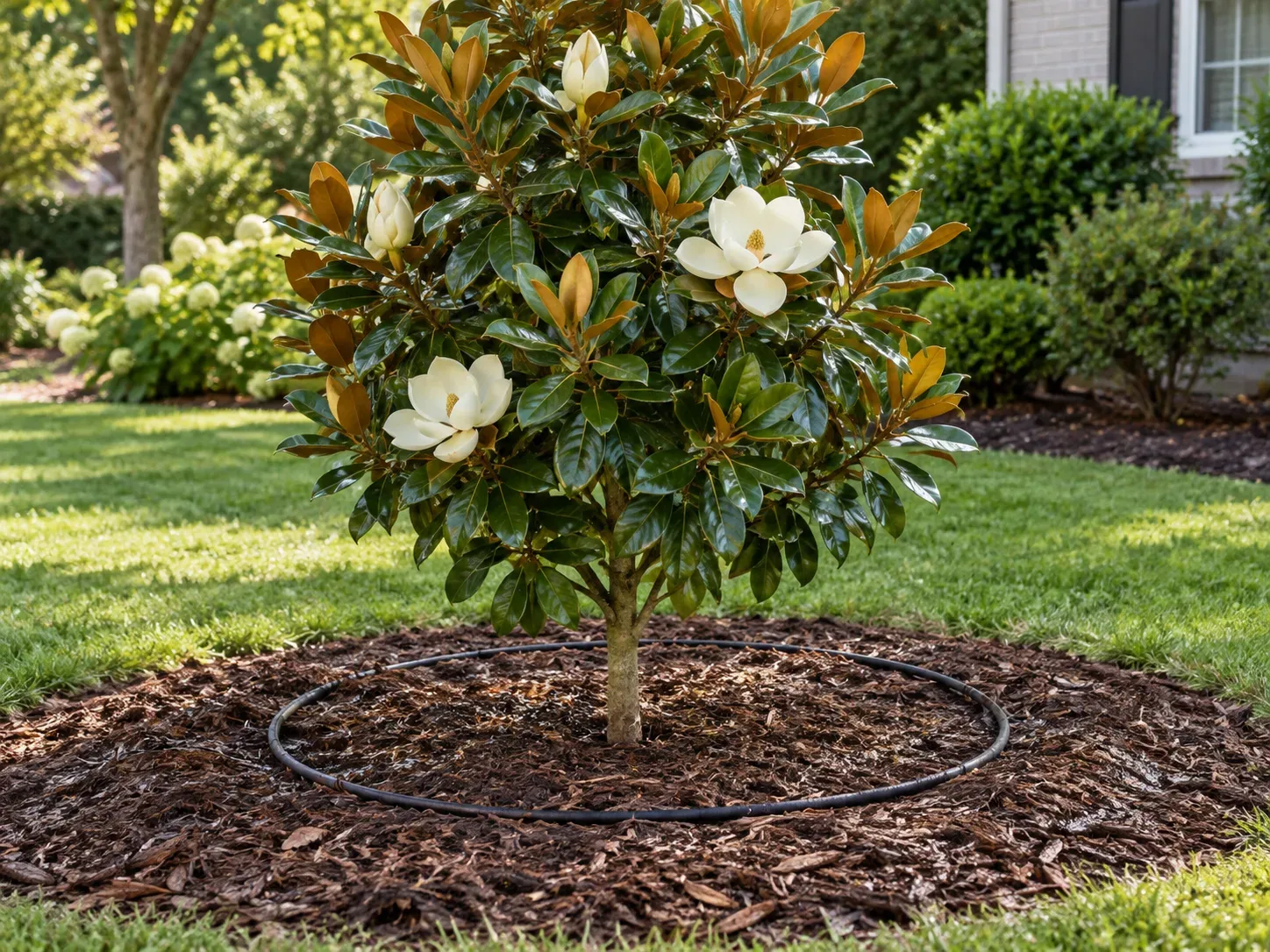
Established trees tolerate short dry spells better than newly planted ones, but they can still show stress in prolonged heat or drought. Water the soil across the root zone, not just the trunk base, and allow the surface to dry slightly between deep soakings in poorly draining soil. Yellowing, leaf scorch, or premature shedding can follow either drought or waterlogged roots, so check the soil before responding. More water is not a safe treatment for every wilted magnolia.
Feed Only When the Tree Needs It
Do not fertilize automatically to make Little Gem flower. Start with a healthy planting site and a soil test if growth is weak, leaves are pale, or the pH is outside the preferred range. A young tree spends energy establishing roots; heavy nitrogen can push tender leafy growth without correcting poor light, wet soil, or planting stress.
If a soil test or local extension recommendation indicates a nutrient need, apply a measured slow-release fertilizer in spring and follow its label for tree size and application area. Keep granules away from the trunk and water them in as directed. A light surface layer of compost or leaf mold can improve soil structure over time, but do not bury the root flare beneath annual top-dressing. Clemson Extension’s general magnolia guidance points to fertile, porous soil; it does not justify a strong phosphorus feed or monthly fertilizer for every landscape tree.
Grow It in a Container Only With a Plan
Little Gem can live in a large container while young, but pot culture is a compromise rather than a way to keep a mature tree permanently tiny. A container magnolia needs a stable, frost-resistant pot with generous drainage, a quality potting mix, regular moisture checks, and a protected winter position where cold is a concern. Choose a container wider and deeper than the nursery pot, then step up gradually as roots fill it; a small 10-gallon pot may be suitable temporarily for a young specimen but will not remain adequate indefinitely.
Container soil dries faster in hot sun and wind, so check the mix with a finger or moisture probe before watering. Water until it drains from the bottom, then empty any saucer so roots do not sit in standing water. Use a fertilizer intended for container trees only during active growth and at the label rate. Repot when roots circle densely or emerge from drainage holes, preferably before the root ball becomes a hard mass.
Avoid routine severe root pruning. Magnolias are difficult to transplant because their roots spread broadly, and cutting away too much root mass can set back a container tree. If the plant outgrows the pot, move it to a larger vessel or plant it in the ground; if neither option is possible, ask a qualified arborist or nursery professional about a cautious plan. The RHS guide notes that compact magnolias can be grown in containers but need regular water and feeding during active growth.
Prune Lightly After Flowering
Little Gem usually needs little pruning beyond removing dead, damaged, crossing, or poorly placed branches. If you need to shape it, prune after the main flush of flowers so you are less likely to remove buds that would open later in the season. Clemson Extension notes that magnolia pruning wounds may not heal well, making early structural decisions safer than large cuts on an older tree.
Use clean, sharp bypass pruners for small branches and a proper pruning saw for larger ones. Cut just outside the branch collar rather than flush to the trunk, and do not leave long stubs. Remove no more live wood than necessary in a single season. To raise the canopy gradually, remove or shorten a small number of low branches over multiple years instead of stripping the trunk all at once.
Do not shear the canopy into a tight ball or top the central leader to force a size the site cannot accommodate. These methods create dense outer growth, expose large wounds, and can destroy the plant’s naturally upright form. If branches are touching a roof, fence, or utility line, decide whether the clearance can be managed with light pruning while preserving the structure; if not, relocate or replace a young tree before that conflict becomes permanent.
Encourage Blooms and Diagnose a Flowerless Tree
Little Gem is known for flowering earlier than seed-grown Southern magnolias, and its flowers may appear in successive flushes through the warm part of the year. NC State Extension describes fragrant flowers around four inches across, smaller than the spectacular blooms of the full species. Flower size, timing, and quantity vary with the tree’s age, light, climate, moisture, and condition, so no single calendar date or bloom count is guaranteed.
If an established tree produces few flowers, check the growing conditions in this order: first, confirm it receives several hours of direct sun; next, consider whether drought, waterlogging, or a recent transplant has slowed growth; then review pruning timing and whether the plant is the named cultivar. A tree pruned before flowering can lose buds, and a stressed root system may prioritize survival over blooms. Fertilizer is not a reliable fix for shade or root stress.
Creamy flowers can brown as they age or after a sharp temperature change. A few spent flowers are normal on a tree that blooms repeatedly. If buds brown before opening across the whole tree, check for a late frost or drying wind, then look for broader foliage damage. Avoid heavy feeding or spraying in response to one short-lived flush of discolored flowers.
Recognize Leaf Drop, Scale, and Leaf Spot
A broadleaf evergreen still replaces old leaves. Some older leaves yellow and fall as new growth emerges, and a light seasonal leaf litter is not by itself proof of disease. Concern rises when leaf loss is sudden or widespread, new growth wilts, branches die back, or the soil stays saturated. Compare affected leaves across the canopy and inspect the root zone before deciding what to do.
Scale insects may appear as small, immobile bumps on twigs or leaf undersides; heavy infestations can cause yellowing, honeydew, or sooty growth. Clemson notes scale as an occasional magnolia pest. Confirm the insect before treating it: scrape a few bumps to see whether they are living scales, check for natural predators, and consult local extension if the canopy is large or the damage is increasing. Do not spray a large tree by default; coverage is difficult, and any horticultural oil or soap must be used according to its label and temperature limits.
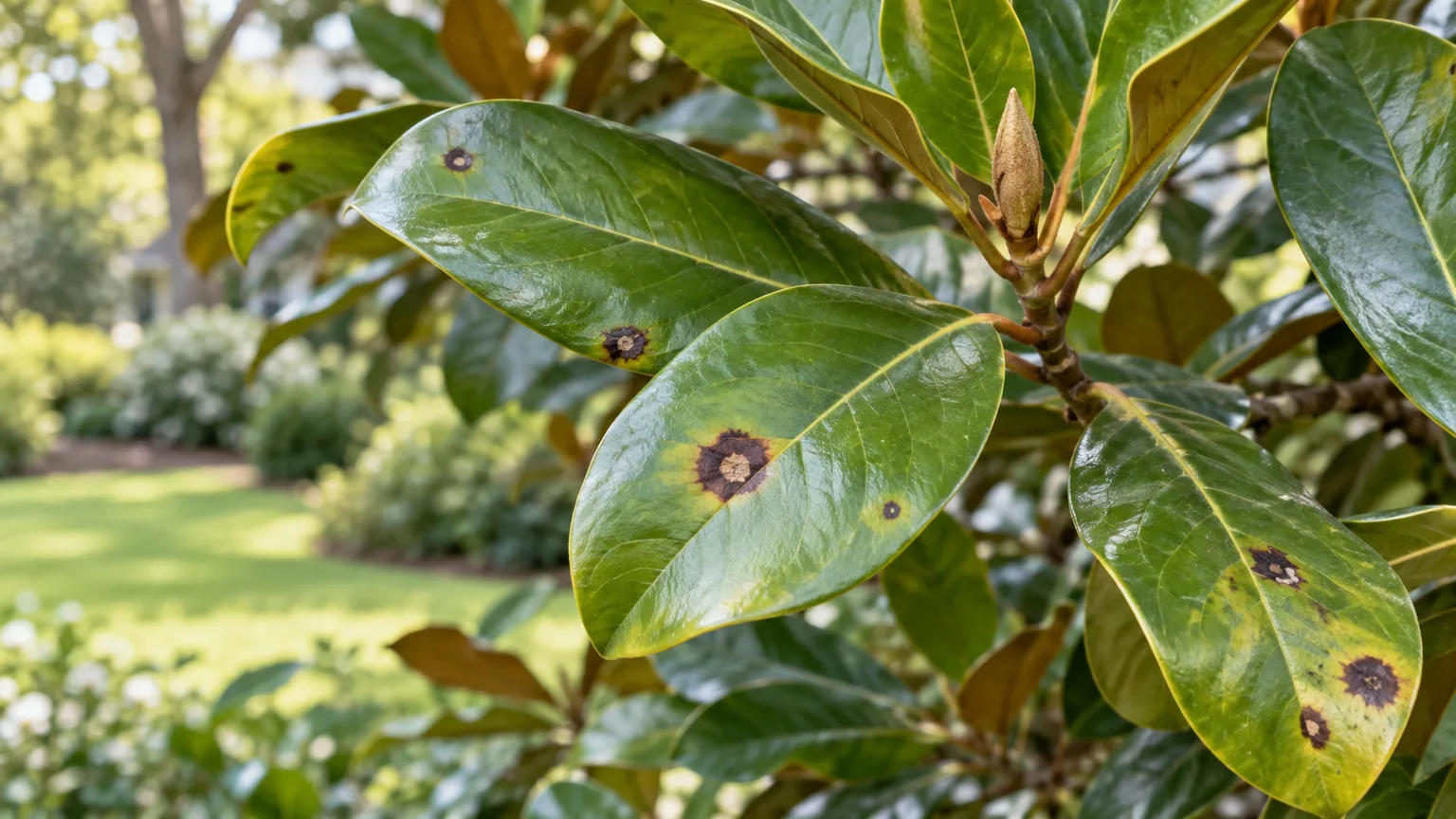
Leaf spots can result from fungi, bacteria, or algae and are often more cosmetic than dangerous on a mature tree. Remove heavily affected fallen leaves, avoid repeatedly wetting foliage late in the day, and preserve good airflow by avoiding dense planting around the canopy. If spotting is severe, spreading, or paired with dieback, take a fresh sample or clear photos to a local extension diagnostic service rather than applying a broad-spectrum pesticide without a diagnosis.
Protect a Young Magnolia From Winter Stress
Hardiness references differ: NC State lists Little Gem for USDA zones 7–9, while some nurseries list colder limits. For a long-lived landscape tree, use the extension range as the conservative guide and factor in the coldest nights, exposure, and drainage on your property. A sheltered courtyard in a marginal zone may perform differently from an exposed site with drying wind, but a warm microclimate is not a guarantee against severe freezes.
Young evergreen foliage can bronze or brown after cold, wind, or sudden temperature swings. Keep the root zone evenly moist going into a dry winter, maintain mulch without piling it against the trunk, and protect a newly planted specimen from harsh wind with a temporary breathable screen. Do not wrap branches tightly in plastic. After a freeze, wait until new growth shows the extent of injury before pruning; browned leaves alone do not always mean the branch is dead.
Propagate the Cultivar Without Relying on Seed
Seeds from a Little Gem magnolia may germinate, but seedlings are not guaranteed to retain the parent cultivar’s compact form or flowering traits. If you want another true-to-type Little Gem, buy a correctly labeled nursery plant or use a vegetative propagation method such as cuttings. Magnolia cuttings can be slow or inconsistent to root, so propagation is a patient project, not the quickest route to a landscape tree.
If you attempt cuttings, use clean tools and fresh, actively growing material, keep the medium airy and consistently moist, and provide bright indirect light rather than hot direct sun. Rooting hormone and a humidity cover can improve the setup, but they cannot guarantee success. Once roots are established, acclimate the young plant gradually before moving it outdoors, and protect it from drought and cold while it is small.
Conclusion
Little Gem magnolia is a compact Southern magnolia cultivar, not a guaranteed small shrub. Plan for a tree around 20 feet or potentially taller, give its roots room, and choose a sunny-to-partly-shaded site with acidic, moisture-retentive but well-drained soil. Plant with the root flare visible, water according to soil moisture while roots establish, and keep mulch from touching the trunk.
Once established, the tree is relatively low-maintenance: feed only when a soil test or visible growth problem gives you a reason, prune lightly after flowering, and expect some seasonal leaf turnover. A container can work for a young plant if you are prepared to monitor water and eventually repot or plant it out. If you have the space and a climate suited to it, Little Gem can provide glossy evergreen structure and fragrant flowers without the footprint of a full-size Southern magnolia.