How to Grow and Care for Saucer Magnolia Trees at Home
Learn saucer magnolia care: choose a sheltered site, plant at the right depth, water during establishment, prune lightly, and protect early spring blooms.
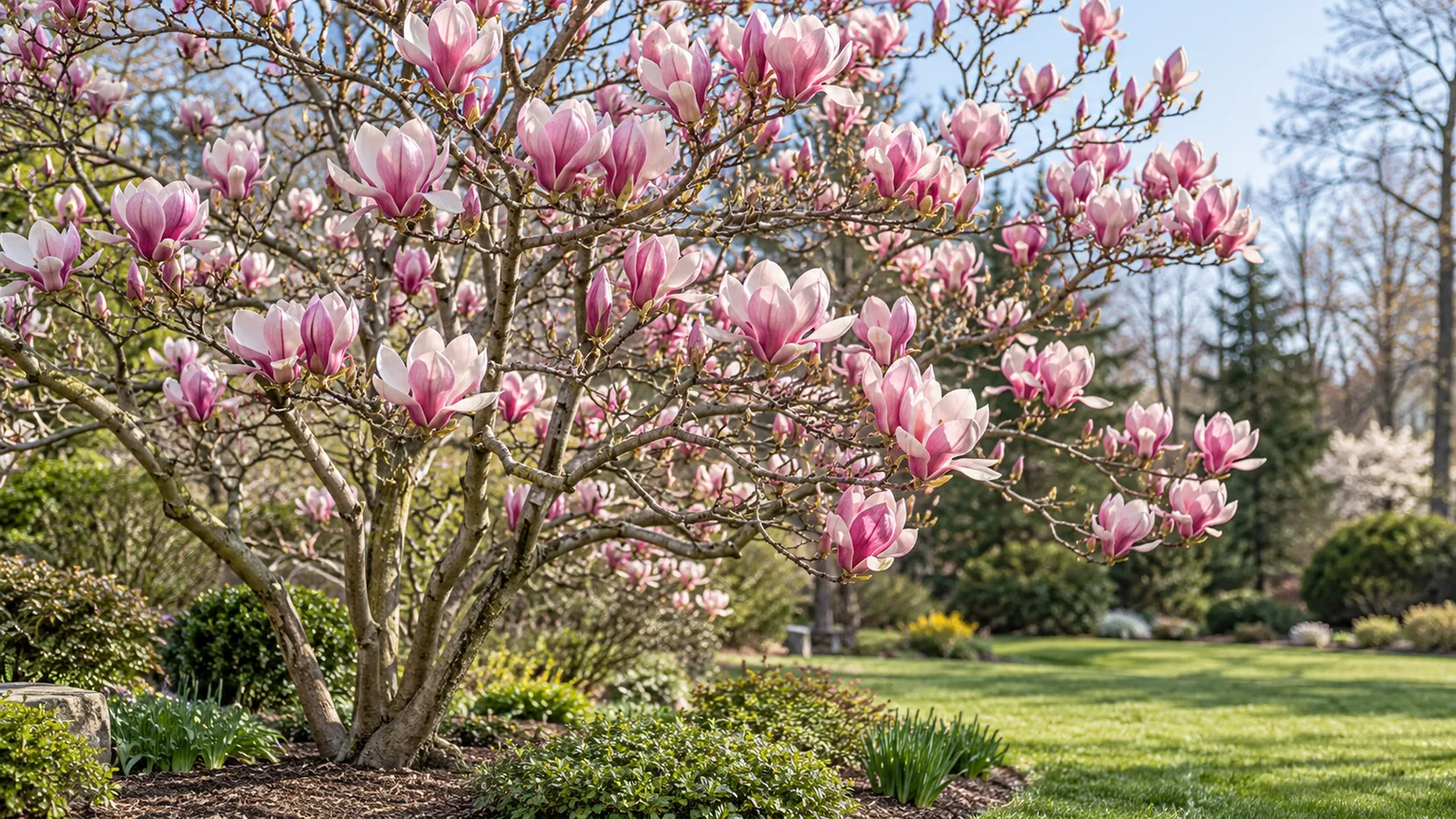
Saucer magnolia is a deciduous hybrid prized for oversized, cup-shaped flowers that open on bare branches in late winter or spring. Its spectacular bloom is also its main vulnerability: a warm spell can coax buds open, then one hard freeze can brown many of them overnight. The tree itself may be fine, but the display is gone for that year.
Good care starts before you plant. Choose a cultivar whose mature size fits the yard, give its broad root system room, and avoid a spot that warms too early or stays wet. Once established, saucer magnolia is usually a low-maintenance specimen tree; the most useful routine is consistent water for a young tree, light pruning, and a realistic understanding of what frost can do.
Saucer Magnolia Care at a Glance
| Need | Practical starting point |
|---|---|
| Light | Full sun to partial shade; more sun generally supports a denser flowering crown |
| Soil | Moist but well drained, rich in organic matter, and acidic to neutral |
| Mature size | Often about 15 to 30 feet tall and broad, but cultivar and climate matter |
| Water | Keep the root zone evenly moist while establishing; water during prolonged dry spells later |
| Pruning | Keep it light; remove dead or crossing growth and avoid topping |
| Main limitation | Early flowers and buds can be damaged by late freezes |
Those figures describe a range, not a promise for every tree. NC State Extension lists saucer magnolia at 15 to 33 feet tall and 15 to 25 feet wide, while the RHS gives a mature range of roughly 4 to 8 meters in both height and spread; nursery cultivars can be smaller or more upright. Check the cultivar name and local mature-size listing before buying, then allow for the canopy to broaden with age. (NC State Extension; RHS)
Understand the Tree’s Mature Size and Bloom Cycle
The botanical name is Magnolia × soulangeana, a cross between M. denudata and M. liliiflora. It can develop as a large shrub with several trunks or as a low-branched small tree. Its wide, spreading outline is part of its character, so it rarely behaves like a narrow ornamental that can be tucked beside a foundation and kept small with shears.
A young plant may look compact in a nursery pot, but the eventual crown needs clear space above and around it. Keep it away from rooflines, narrow paths, overhead wires, and places where regular canopy reduction would be required. The roots are fleshy and spread through the upper soil; they need room, and an established tree can be difficult to move. That does not make every saucer magnolia root an automatic threat to a foundation, but it does make cramped placement a poor long-term bet.
The flowers usually emerge before the leaves. Depending on cultivar and local weather, that can be late winter in a mild region, early spring in much of the temperate United States, or later in colder areas. Virginia Cooperative Extension notes that flowering time, size, color, and bud hardiness vary among the many cultivars, which is why a single calendar date or flower description cannot fit every tree. (Virginia Cooperative Extension)
After flowering, broad green leaves fill the crown through summer and often turn yellow before falling in autumn. Leaf drop is normal; a deciduous saucer magnolia is supposed to be bare in winter. Its sculptural branches and smooth gray bark remain visible while the next set of fuzzy flower buds develops.
Choose a Site for Sun, Shelter, and Root Room
Aim for a bright, open site with full sun or light afternoon shade, depending on how hot summers are in your area. A tree in too much shade may grow thin and flower less, while a very exposed site can put the early flowers in reach of cold wind. A sheltered position near other trees or a building can soften wind, but avoid placing the magnolia where a warm south-facing wall or paving repeatedly heats buds ahead of the surrounding garden.
Late frost risk is not the same as winter survival. A plant may tolerate the minimum temperatures associated with its listed hardiness zone and still lose its flowers to a brief freeze after the buds begin to open. If the yard has a frost pocket where cold air settles, choose a slightly higher position with free air movement rather than the lowest point in the landscape. Avoid an overly sheltered nook that heats dramatically on sunny winter afternoons.
Think about the tree’s crown and root zone together. Leave enough distance from patios and paths for the branches to spread, and do not design a lawn edge that requires constant mowing directly against the trunk. If you need access beneath the canopy, select a tree-form specimen or train a young one gradually; do not assume a mature multi-stem tree can be converted cleanly years later.
Soil and Drainage: Moist Does Not Mean Waterlogged
Saucer magnolia grows best in fertile soil that holds moisture without remaining saturated. RHS lists moist but well-drained soil with acidic or neutral pH, and NC State Extension recommends consistent moisture in well-drained, acidic, organically enriched soil. Heavy clay is not an automatic disqualifier if water drains away, but a low site that stays soggy after rain raises the risk of root stress. (RHS; NC State Extension)
Before planting, watch how the site handles a soaking rain. If water stands for hours or the soil smells sour, fix the drainage problem, choose another location, or plant on a broad raised mound rather than digging a deep, amended pocket. A small hole filled with loose compost inside dense clay can act like a bowl and trap water around the roots.
Do not add lime, sulfur, or fertilizer by guesswork. If leaves repeatedly yellow between green veins, or the tree has weak growth despite adequate moisture, test the soil and use the results to decide whether pH or nutrients need correction. Color alone is not enough to diagnose a deficiency; waterlogged roots and other stresses can also discolor leaves.
Plant With the Root Flare at Grade
Plant when the soil is workable and the tree is not under heat or drought stress. Timing differs by region and stock type: UF/IFAS recommends spring planting just before growth begins for its cultivar profile, while fall can be suitable where roots have time to settle before severe cold. Local extension advice and the nursery’s instructions should take precedence over a universal calendar rule. Avoid planting while a tree is in full bloom or during a heat wave. (UF/IFAS Extension; Epic Gardening)
Use a container-grown or properly balled-and-burlapped nursery tree with an intact, moist root ball. Choose by cultivar as well as flower color; if spring frost regularly spoils magnolias in your neighborhood, favor a later-flowering selection rather than buying the first early bloomer in stock.
- Set the pot or root ball on the ground and locate the root flare, where the trunk widens into the first major roots. Remove excess soil from the top of the root ball if that flare is buried.
- Dig a broad hole no deeper than the distance from the bottom of the root ball to the root flare. Make the hole at least twice as wide as the root ball so roots can enter loosened surrounding soil.
- Place the tree upright with the root flare level with, or slightly above, the finished grade. Never bury the trunk to compensate for a leaning tree or a hole that was dug too deep.
- Backfill with the soil you removed, breaking up large clods. Do not create a rich compost pocket that differs sharply from the native soil around it.
- Water slowly to settle soil around the roots, then check the grade again. Add more soil only if settling exposed roots below the flare; do not cover the trunk.
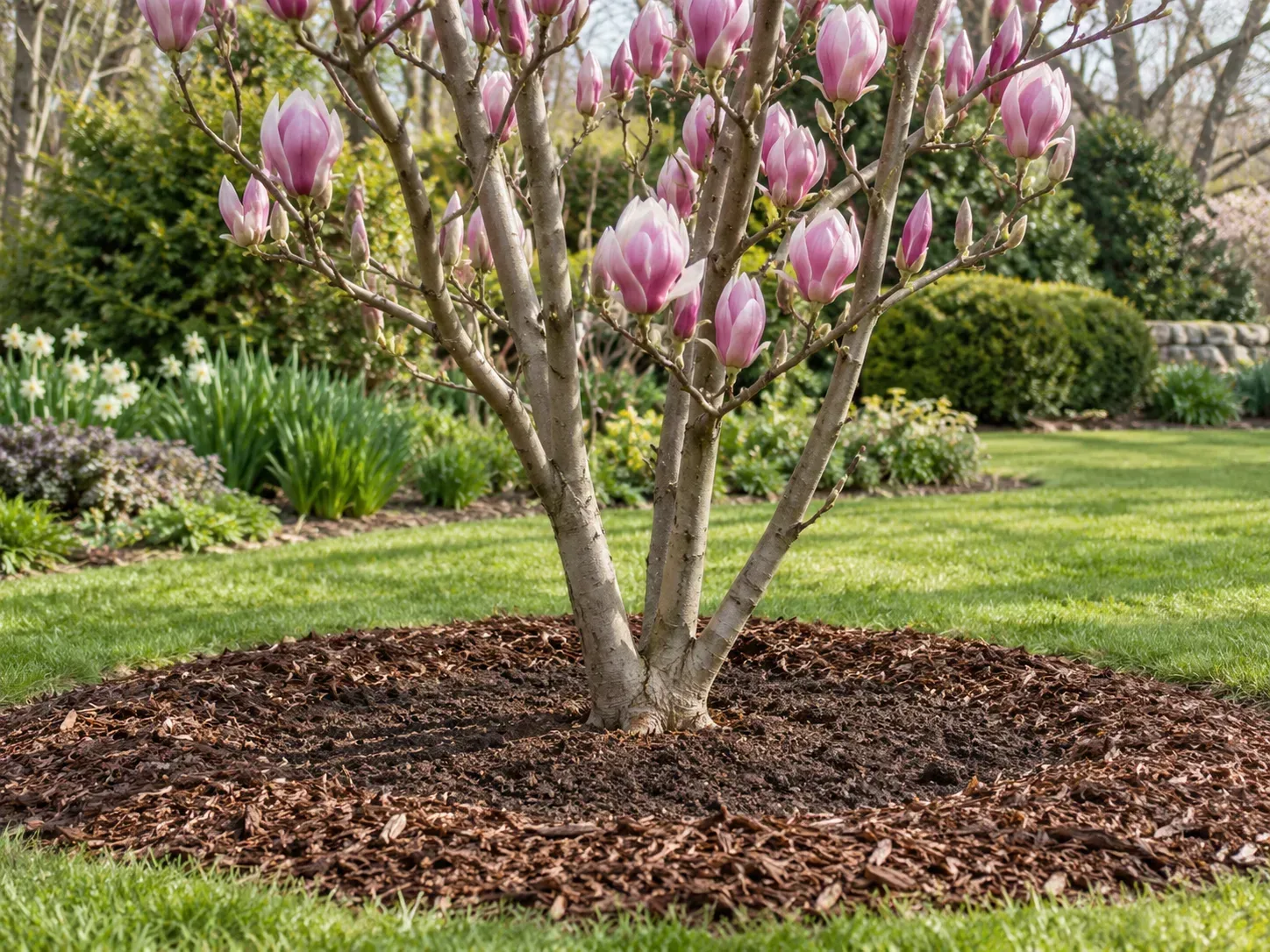
A root ball that rocks in wind may need temporary staking, but staking is not automatic. Use two stakes outside the root ball and flexible ties low enough to stabilize the trunk while allowing slight movement. Check ties regularly and remove them when the tree stands on its own, often within a year; leaving a tight tie in place can girdle the trunk.
Water Deeply While the Tree Establishes
The first growing season is when watering matters most. Check soil moisture near the edge of the root ball rather than judging by the dry surface: if soil a few inches down is dry, water slowly enough to soak the whole root zone. If it is still damp, wait and check again. A fixed daily schedule can keep clay soil saturated or leave sandy soil dry, so let the root zone and weather set the interval.
During hot, rainless periods, a young tree may need a deep soak more than once a week; after a cool rainy spell it may need none. As roots spread, widen the watered area beyond the original nursery ball instead of pouring every dose against the trunk. In the second year, continue to check the root zone during drought and taper supplemental irrigation as the tree establishes.
Established saucer magnolias tolerate short dry periods better than newly planted ones, but prolonged drought can reduce growth and stress flower-bud formation. Water deeply during an extended dry spell, especially when the ground has not received meaningful rain. If foliage wilts despite moist soil, do not keep adding water; investigate drainage, root damage, or disease instead.
Mulch Wide, but Keep It off the Bark
A loose organic mulch layer moderates soil temperature, slows water loss, and protects surface roots from mower and string-trimmer injury. Spread it broadly beneath the canopy as it grows, but keep a visible gap around every trunk. A mulch mound that touches bark traps moisture, hides the root flare, and makes small trunk injuries harder to notice.
Refresh only what has decomposed rather than building a new pile each year. Two or three inches is usually enough for a garden mulch layer; on poorly drained ground, use less and correct the drainage rather than adding more. Grass, weeds, or paving pressed against the trunk are not useful substitutes for an open, mulched root zone.
Take special care with lawn equipment while the bark is young and smooth. A shallow wound can become a pathway for pests or decay, and repeated mower strikes can remove bark around the trunk. Keep turf away from the base or protect it with a wide planting bed rather than circling the tree with a rigid guard that rubs or traps moisture.
Fertilize Only When Soil or Growth Calls for It
A healthy magnolia in reasonably fertile soil does not need automatic fertilizer every spring. First-year growth can be modest while roots establish, and that alone is not proof of nutrient deficiency. Excess fertilizer may push soft leafy growth without solving poor drainage, unsuitable pH, root disturbance, or the more common disappointment of a frost-damaged flower display.
If growth is weak or symptoms persist, test the soil through a local extension service or reputable lab. Follow the test result and product label, and spread any recommended material over the root zone rather than piling it at the trunk. Do not use high-nitrogen fertilizer to force flowers: flowering depends on the tree’s maturity, light, cultivar, bud health, and weather as well as nutrition. Epic Gardening also recommends diagnosing nutrient need with a soil test instead of treating every magnolia as if it needs the same feeding plan. (Epic Gardening)
Prune Lightly After Flowering
Saucer magnolia usually needs little routine pruning. Remove dead, broken, rubbing, or diseased branches, and make cuts just outside the branch collar rather than leaving long stubs or cutting flush to the trunk. Do not top the tree to control height; topping leaves large wounds and often triggers a thicket of weak shoots.
Timing recommendations can differ. The RHS advises pruning deciduous magnolias from midsummer to early autumn, while practical guides often suggest shaping after the flowers fade. A conservative approach is to limit pruning to a few corrective cuts and use the local RHS or extension timing guidance for your climate; heavy pruning can sacrifice the next display whichever calendar you choose. (RHS; Epic Gardening)
Use clean, sharp tools and avoid pruning in wet weather when fungal spores can spread more readily. If you remove a diseased branch, cut back to healthy tissue and disinfect the blade between cuts when the diagnosis warrants it. A large dead limb, trunk wound, or branch over a roof is an arborist job, not a reason to make a series of oversized cuts from a ladder.
Train a Young Tree Before Its Form Sets
Decide early whether you prefer the natural multi-stem shrub form or a small tree with one dominant trunk. Both are legitimate shapes; the multi-stem habit is common and often protects the tree’s graceful, low branching rather than being a defect that needs correction.
For a tree form, select a strong central leader while the plant is young and gradually remove competing low stems over several seasons. Do not strip away a large share of the canopy in one year. Each cut should solve a specific problem—crossing growth, a weak crotch, or a branch that conflicts with the intended structure—not simply make the plant look more like a lollipop.
Leave Major Reshaping to a Certified Arborist
An established magnolia may have a naturally leaning trunk or wide-spreading limbs. A stable lean with no recent change, soil heaving, or cracks can be part of the tree’s form; a new lean after wind, exposed roots, or a lifting root plate signals a possible failure risk. Have a qualified arborist inspect it rather than trying to straighten a mature specimen with a stake or cable.
Older magnolias do not respond well to drastic size reduction, and large pruning wounds may not close neatly. If branches are hitting a structure, ask an arborist what can be removed safely and whether the location is incompatible with the tree’s mature dimensions. Future pruning cannot reliably turn a large, broad cultivar into a narrow tree.
Protect the Spring Display From Late Frost
A late freeze can brown open flowers or kill buds without killing the tree. Petals may turn tan or limp, while the branch remains firm and the leaves emerge normally later. Fine Gardening describes this familiar magnolia gamble: a tree can lose its flowers to a sudden temperature drop and still recover for a future season. Do not cut back healthy branches just because one spring display failed. (Fine Gardening)
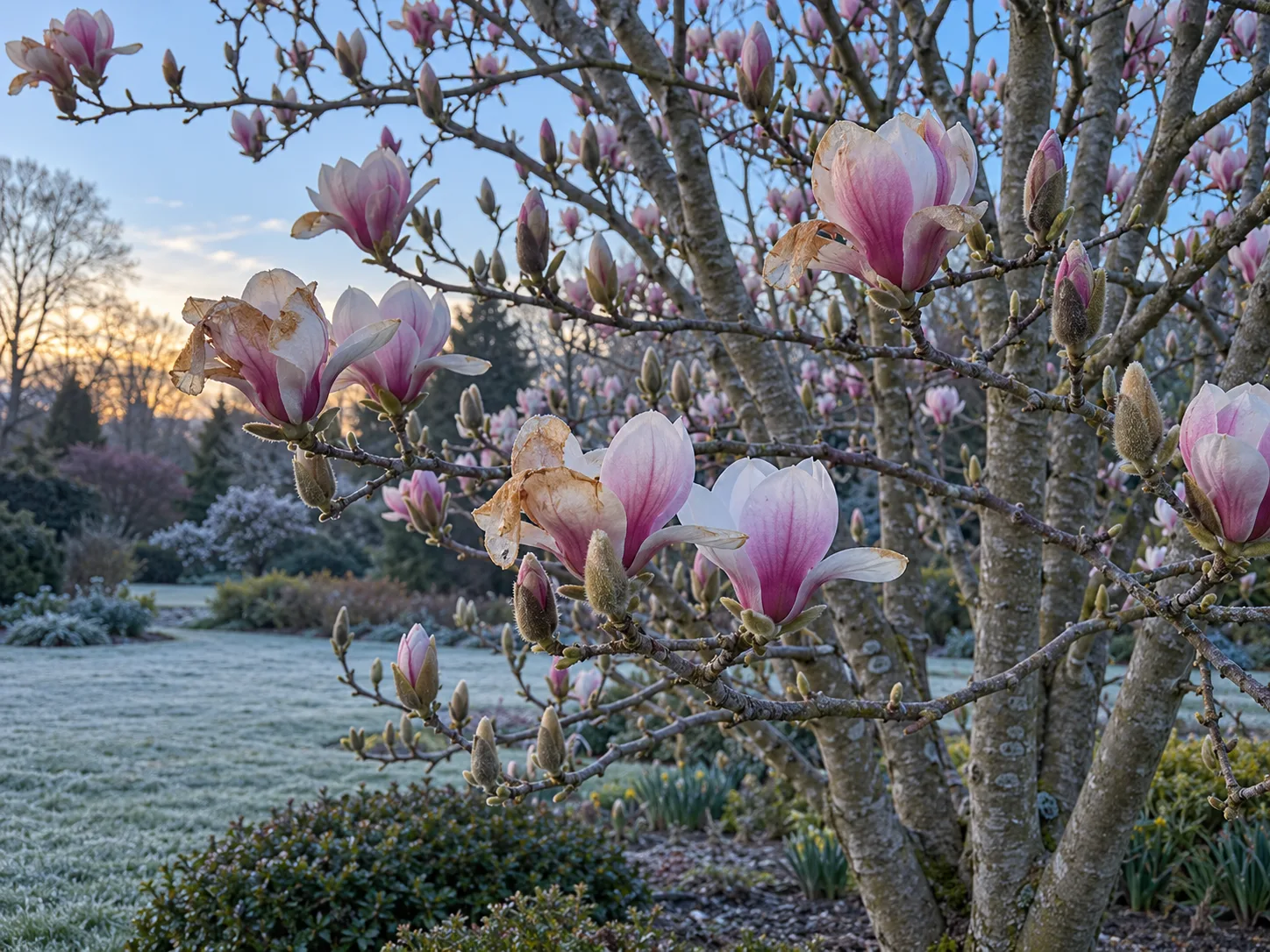
The best protection happens at planting time. Avoid warm pockets beside sun-heated walls, paved courtyards, or south-facing exposures that trigger early bud opening; choose a sheltered spot with good drainage and a cultivar that flowers later in your climate. Virginia Cooperative Extension notes that cultivars differ in bud hardiness and flowering time, while NC State Extension specifically warns that a warm southern exposure near a structure can bring buds on early and expose them to a later frost. (Virginia Cooperative Extension; NC State Extension)
For a newly planted tree small enough to cover, a breathable frost cloth that reaches near the ground can reduce overnight heat loss during a forecast freeze. Put it on before temperatures drop and remove it after the cold passes so sunlight and airflow return. Do not wrap a large tree in plastic or expect a cover to save a mature canopy; for those trees, microclimate and bloom timing are the practical controls.
It is useful to separate two questions: “Will the tree survive here?” and “Will the flowers escape frost every year?” Saucer magnolia is listed across a broad hardiness range, but flower buds can be damaged within that range. In colder sites, choose a late-flowering cultivar and accept that unusually cold spring weather can still affect the show.
Choose a Cultivar by Space and Bloom Time
Buy a named cultivar if flower color, mature size, or bloom timing matters. Seed-grown plants may not match their parent because saucer magnolia is a hybrid; even when seedlings flower, they can vary in form and color. Ask the nursery for local mature dimensions and typical bloom timing rather than relying on a generic species label.
| Cultivar | What to compare | Best fit |
|---|---|---|
| ‘Lennei’ | Large pink-purple flowers with pale interiors; often described as later flowering | A broad site where reducing early-frost exposure matters |
| ‘Speciosa’ | Pale flowers with a purple flush; flowers later than many forms | A gardener who values a later display and can provide canopy room |
| ‘Verbanica’ | Rose-pink flowers and a later flowering season in some references | A smaller garden, if the nursery’s local size listing fits |
| ‘Rustica Rubra’ | Rose-red flowers and a vigorous, tree-like habit | A larger lawn or specimen position |
| ‘Lilliputian’ | Compact form compared with many saucer magnolias; cultivar-specific size still varies | A smaller landscape where the measured mature spread is acceptable |
The list is a shortlist, not a universal ranking. Virginia Tech identifies cultivar variation in flower traits and bud hardiness and names late-flowering selections such as ‘Brozzonii’, ‘Lennei’, ‘Speciosa’, and ‘Verbanica’; Oregon State describes cultivar forms including ‘Lennei’, ‘Rustica Rubra’, and ‘Speciosa’. Those profiles are more useful than treating every saucer magnolia as a 20- to 25-foot clone. (Virginia Cooperative Extension; Oregon State University)
Check whether the plant is grafted and whether the cultivar name is documented. A grafted named selection can produce suckers below the graft that are different from the top; remove rootstock shoots at their point of origin rather than letting them dominate. If the nursery cannot tell you the cultivar’s mature width or local flowering time, ask a nearby botanical garden or extension office before committing to a tight site.
Diagnose Scale, Leaf Spots, and Canker
A saucer magnolia with a few leaf spots is not automatically dying. The useful first step is to note where the symptoms appear, whether they are spreading, and whether the tree is otherwise growing normally. Photograph affected leaves and branches, then compare new growth over a few weeks; this prevents a harmless seasonal mark from prompting an unnecessary spray.
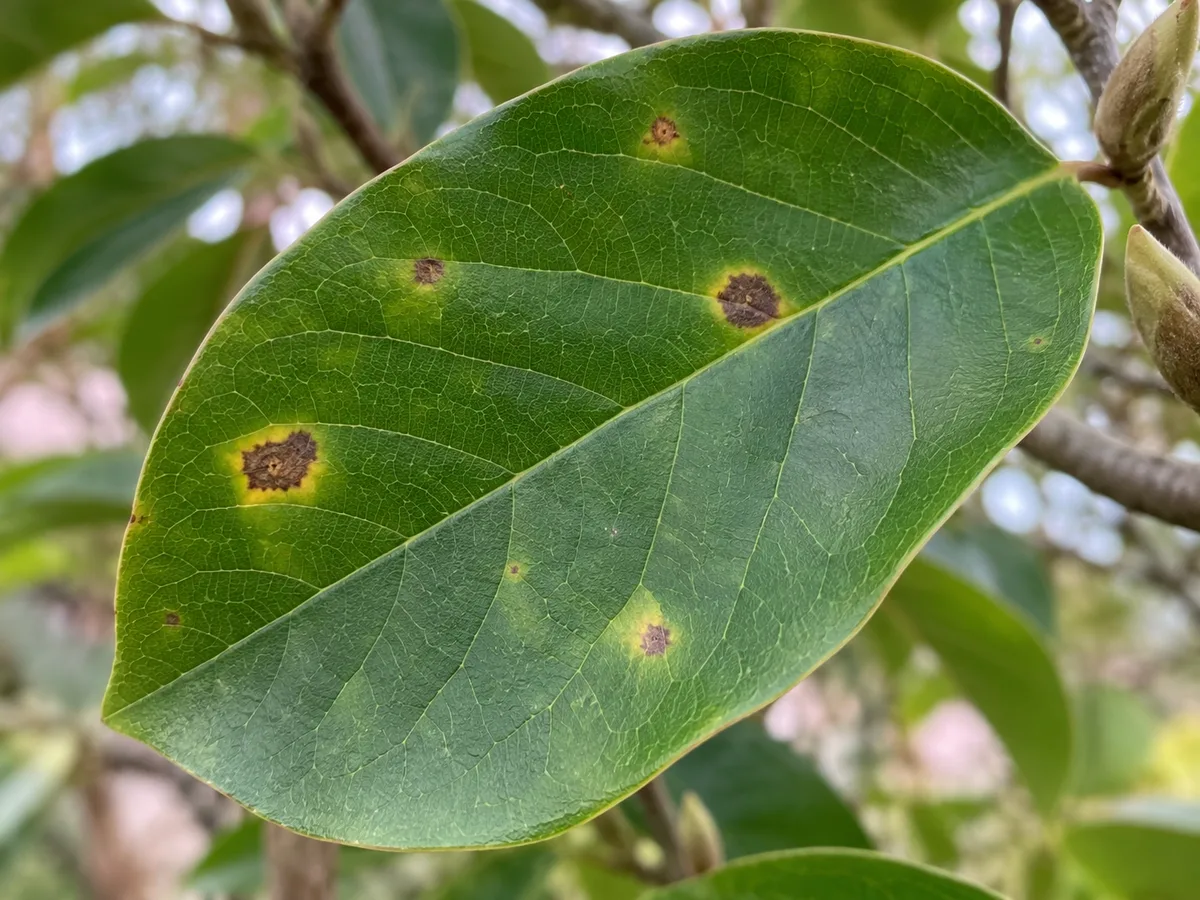
Small, discrete spots can occur on magnolia leaves; a few affected leaves do not by themselves identify the cause or call for fungicide.
Leaf spots can be caused by different fungi or bacteria, and many are more noticeable in wet weather. Remove fallen, heavily affected leaves, water at soil level when possible, and avoid crowding the canopy with dense understory plants. If spots are severe, recur every year, or come with branch dieback, send clear photos to a local extension diagnostic service rather than applying a fungicide by calendar.
Canker is a different concern because it affects woody tissue. A sunken, cracked, or dead section of branch with dieback beyond it deserves closer inspection; prune a small affected limb back to healthy wood in dry weather if the cut is safely reachable. Cankers on the trunk or main scaffold, extensive dieback, or uncertainty about where healthy wood begins should be assessed by an arborist or plant clinic.
Distinguish Black Sooty Mold From Leaf Spot
Sooty mold is usually a black surface coating associated with honeydew from sap-feeding insects such as magnolia scale. Look for sticky leaves, ants visiting branches, or stationary bumps along twigs and leaf veins. The dark coating itself is not the insect; identify and address the scale rather than treating the leaf surface as a fungal infection.
Leaf-spot lesions, by contrast, are part of the leaf tissue and are usually distinct round or irregular marks with darker centers or yellow edges. A strong rinse may wash away loose sooty residue, but it will not remove a lesion inside the leaf. If the insect identity or severity is unclear, contact extension before using horticultural oil or another pesticide; product labels, timing, weather, and pollinator exposure all matter.
If the tree suddenly wilts or yellows while its soil stays saturated, stop adding water and inspect the drainage pattern. Root problems are harder to reverse after major decline begins, so correct standing water and protect the root zone before symptoms become widespread. Yellow leaves in autumn, on the other hand, are expected on a deciduous tree.
Propagate With Patience and Realistic Expectations
Seed propagation is an experiment, not a dependable way to reproduce a favorite cultivar. Collect mature seed in autumn when the seed cones open and reveal colored seeds, clean off the fleshy covering, and provide the cool, moist stratification needed for germination. A seedling can take years to flower and may differ from the parent in bloom color, size, and habit.
Cuttings can preserve a cultivar’s traits because they are clones, but saucer magnolia cuttings are not guaranteed to root. RHS lists softwood cuttings from late spring to early summer and semi-ripe cuttings from late summer to autumn as possible methods; Epic Gardening describes taking flexible new growth, keeping cuttings humid, and allowing time for roots to form. Use clean material, a sterile, airy medium, bright indirect light, and steady humidity, then harden a rooted cutting gradually before planting outdoors. (RHS; Epic Gardening)
For a specific named flower form, buying a correctly labeled nursery plant is usually the practical choice. If you do raise seedlings, keep the plant in a pot until it is sturdy enough to handle outdoor conditions, and give it a permanent site only after you know its growth habit. Moving a large, established magnolia later is difficult and can set it back.
Conclusion
Saucer magnolia rewards thoughtful placement more than intensive maintenance. Give the cultivar room to mature, plant the root flare at grade in moist but well-drained soil, water the root zone while it establishes, and resist routine heavy pruning or fertilizer.
If spring frost is common where you garden, choose a later-flowering cultivar and a site that does not warm too early. Some flowers may still be lost in a cold snap; that usually means a disappointing season, not a dead tree. Once the site and expectations are right, the tree can grow with little intervention and make its brief spring display count.