How to Grow and Care for Mastic Trees in Your Garden
Learn how to grow a mastic tree with the right sun, drainage, establishment watering, pruning plan, and realistic advice on berries, gum, and propagation.
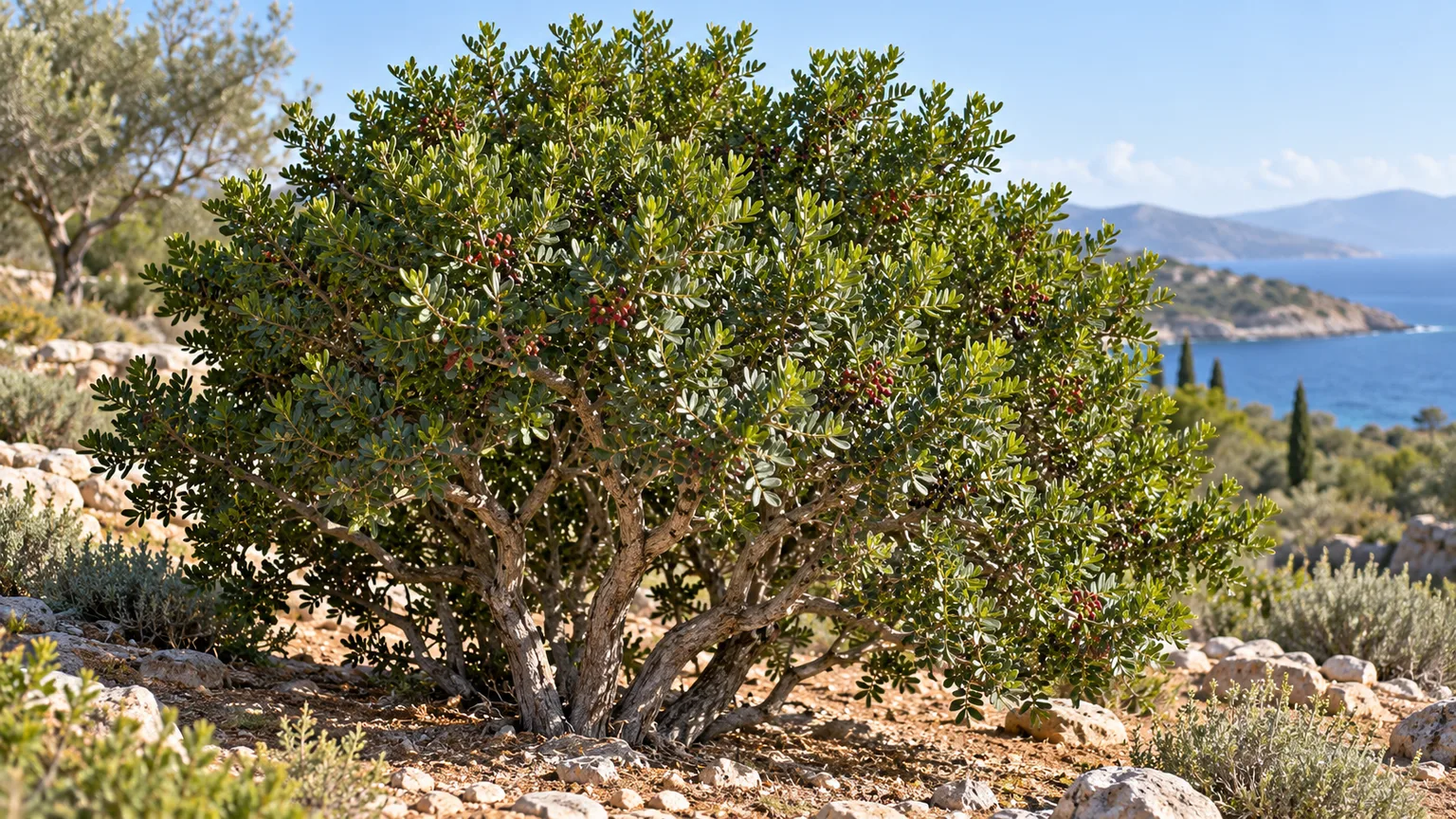
A mastic tree is a good choice for a hot, sunny garden where water drains away quickly and a broad evergreen shrub or small tree has room to spread. The plant is Pistacia lentiscus, a slow-growing Mediterranean native valued for leathery foliage, tolerance of dry conditions once established, and resinous stems. It is not a compact ornamental by default: in favorable sites, it can eventually reach roughly 15 to 25 feet tall and spread 20 to 30 feet, though many plants remain lower and wider.
The three decisions that matter most are whether your winter climate is warm enough, whether the planting spot stays dry around the roots, and whether you want a multi-stem shrub or a trained tree form. Set those expectations before buying. After establishment, mastic is generally easier to maintain than to force into a shape or climate that does not suit it.
| Growing factor | Practical starting point |
|---|---|
| Plant identity | Pistacia lentiscus, an evergreen shrub or small tree in the cashew family |
| Light | Full sun for compact growth and flowering |
| Soil | Well-drained soil; sandy, rocky, or ordinary garden loam can work |
| Water | Regular checks and deep watering while young; infrequent watering once established |
| Space | Plan for a broad shrub, often wider than tall; allow for a potentially 20-foot-plus spread |
| Cold | Commonly listed for USDA zones 9–11; local provenance and exposure affect winter performance |
| Form | Naturally multi-stemmed; can be trained gradually as a small tree |
What a mastic tree is—and what it is not
Kew’s Plants of the World Online accepts Pistacia lentiscus as a shrub or tree native across the Mediterranean and Canary Islands. Its foliage is evergreen and compound, made up of pairs of small, leathery leaflets on a central leaf stalk. The plant may look like a fine-textured shrub from a distance, but its woody stems can develop into a substantial, spreading structure over time. Royal Botanic Gardens, Kew’s Plants of the World Online is a useful reference for the accepted name and native range.
Mastic belongs to the Anacardiaceae, the same family as pistachio, cashew, and sumac, but it is not the edible pistachio tree. The female plant can produce small berries that turn from red to dark purple or black as they mature; those fruits are not pistachio nuts. The tree’s name also refers to aromatic resin called mastic, but an ornamental landscape plant is not automatically a productive gum crop. Specialized P. lentiscus var. chia material from Chios, Greece, is cultivated for commercial resin, and the yields and quality associated with that tradition should not be assumed of an unnamed nursery plant.
Check climate, mature size, and garden fit first
Think of mastic as a Mediterranean-climate plant: it is best suited to long, hot, relatively dry summers and mild winters. Horticultural listings commonly place it in USDA zones 9 through 11, while hardiness numbers are not a guarantee for every plant sold under the common name. A sheltered urban yard, a protected wall, a sharply drained raised site, or a plant with a locally adapted provenance can change how a specimen handles marginal conditions, but none removes the risk of a prolonged hard freeze. If your garden is routinely colder than zone 9, ask a local nursery or extension service whether mastic is reliably grown in your area before planting it in the ground.
Size is equally important. Garden references give mature dimensions as high as 15 to 25 feet tall and 20 to 30 feet wide in favorable conditions, while plants in harsher or drier sites may stay smaller and develop a broad, shrub-like outline. Gardenia’s plant profile describes this large shrub or small-tree habit, and Garden Oracle’s growing profile notes that it is often wider than tall. Use the larger dimensions when choosing a site; pruning a tree every year to keep it much smaller is a maintenance commitment, not a natural growth habit.
Mastic suits a sunny corner, informal screen, coastal garden, dry border, or large patio where an evergreen plant can anchor the space. It is a poor fit for a narrow walkway, compact foundation bed, low wet area, or a climate where winters regularly fall below its reliable range. It tolerates some salt and lean soil, but those strengths do not compensate for inadequate room or waterlogged roots.
Choose full sun and soil that drains quickly
Give a mastic tree the sunniest suitable spot you have. Full sun supports dense growth and flowering; light shade may be tolerated, but deep shade can leave the canopy looser and reduce bloom. In a very hot desert location, the tree can still take strong sun, but a newly planted root ball needs close moisture checks through its first summer. Do not confuse drought tolerance after establishment with an ability to ignore a young plant during extreme heat.
Drainage deserves more attention than soil richness. Mastic can grow in sandy, rocky, and ordinary loamy soils as long as water does not remain around the root zone. Heavy clay is not an automatic rejection if the site drains, but a low spot that stays soggy after rain is risky. Before planting, observe the area after a thorough rain or irrigation. If water sits for hours, or the ground remains saturated well into the next day, move to a better site or plant on a broad raised mound rather than making a small amended pocket in dense soil.
There is no need to make the soil exceptionally sandy or to raise the pH just because the tree is Mediterranean. The practical target is stable, aerated soil that sheds excess water while retaining enough moisture for new roots. Avoid filling a planting hole with a dramatically different potting mix or adding a layer of gravel at the bottom; an abrupt texture change can hold water at the edge of the root ball instead of improving drainage. Gardenia and Garden Oracle both emphasize drainage and dry-site tolerance in their cultivation guidance, while the Arizona-specific guidance from Happy Tree Guys illustrates why local alkaline soils and irrigation conditions still need local judgment.
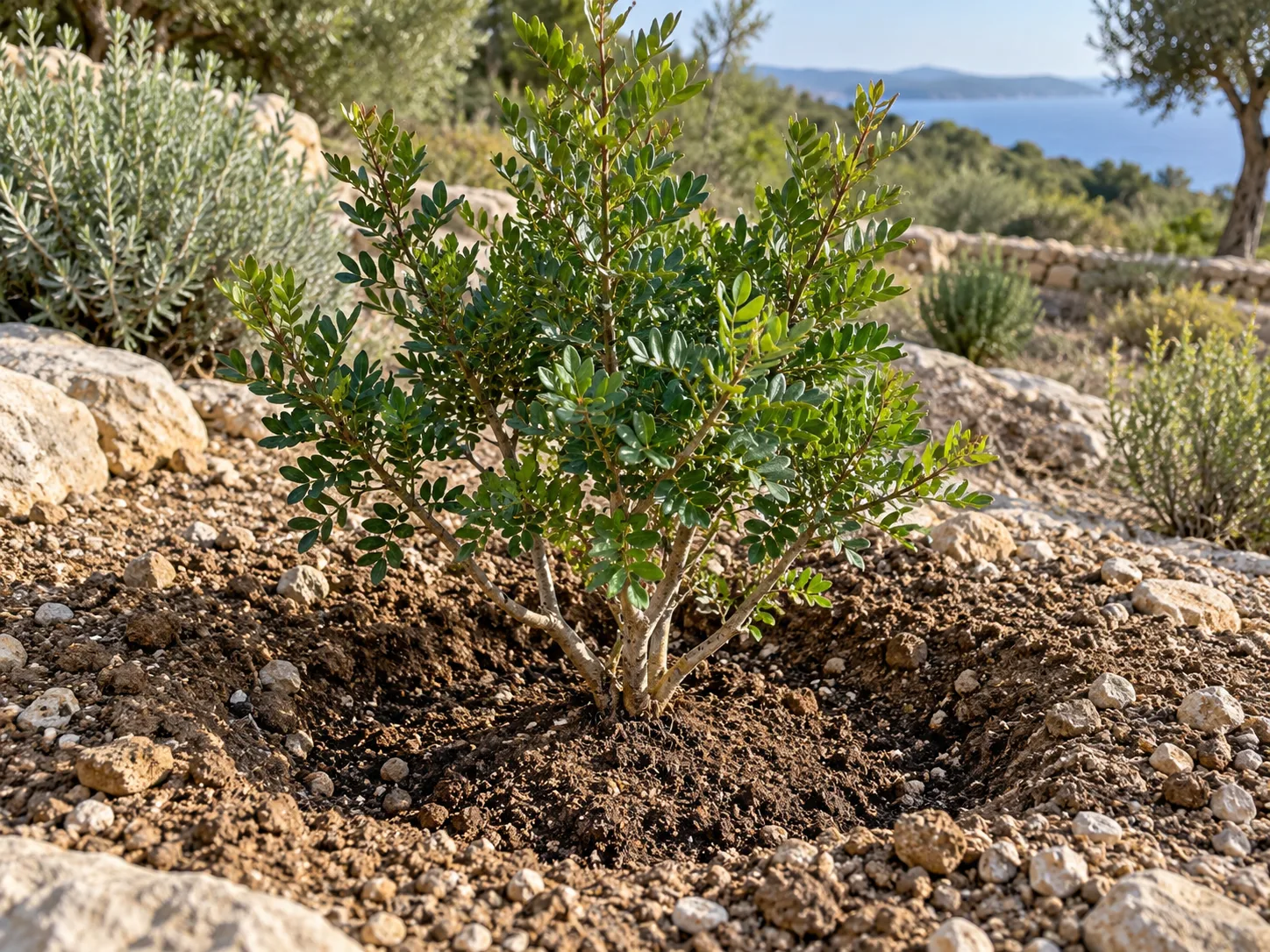
Plant it at the right depth and give it room
Plant in fall or spring when weather is mild and the soil is workable, avoiding the hottest stretch of summer and periods when the ground is saturated or frozen. Container-grown trees can be planted outside those windows in suitable climates, but heat increases the attention needed for watering. Water the nursery container before planting so the root ball is evenly moist, not waterlogged.
Dig a hole about as deep as the root ball and several times wider, then loosen circling roots at the outside if they are tightly bound. Set the plant so the point where the upper roots flare from the trunk sits at or just above the surrounding grade. Backfill with the soil removed from the hole, firm gently to eliminate large air pockets, and water slowly enough to settle soil around the roots. Do not bury the stem to make the tree look more stable; deep planting keeps the root crown too wet and can make later decline difficult to diagnose.
If the plant is exposed to strong wind, stake it only when the root ball cannot hold it steady. Use a flexible tie and check it as the trunk thickens. A mastic tree is slow to mature, so give it the room its eventual canopy needs now rather than planting it close to paving, utility lines, or a property edge and relying on severe pruning later.
Water for establishment, then read the soil
A newly planted mastic tree needs more reliable water than an established one. For the first growing season, check the soil in the root ball and just beyond it every few days in warm weather. Water deeply when the root zone begins to dry, then allow excess water to drain before watering again. The goal is not constantly moist soil; it is to keep the young roots from repeatedly drying out while avoiding conditions that exclude air from the soil.
During the second and sometimes third year, extend the interval between soakings as roots explore the surrounding ground. The exact schedule depends on temperature, rainfall, soil texture, plant size, and whether the tree is competing with turf. A weekly calendar that works in Phoenix may be excessive in a coastal Mediterranean garden or on clay soil. Use a trowel or a finger to check several inches below the surface rather than judging by the dusty top layer alone.
Once established, mastic is drought tolerant, and occasional deep watering during a prolonged dry spell is usually more useful than frequent shallow sprinkling. Direct water over the outer root zone rather than repeatedly wetting the trunk. If the leaves wilt or growth stalls during heat, check the soil before adding water: a dry root ball points toward drought stress, while cool, wet soil points toward a drainage or overwatering problem. A locally adapted arborist’s schedule can help in extreme desert conditions, but it should not be copied unchanged to a different climate or soil.
Fertilize only when a real need is confirmed
Routine annual fertilizer is usually unnecessary for a healthy mastic tree in suitable ground. Fertilizer does not correct poor drainage, compensate for deep shade, or make a cold-sensitive site warmer. Adding nitrogen to a tree that is already growing normally can encourage soft shoots and extra pruning without solving the limiting condition.
If growth is weak, first inspect light, root-zone moisture, planting depth, and signs of root or trunk injury. A soil test can help determine pH and nutrient levels before you add amendments. In alkaline regions, yellow new leaves with greener veins can suggest iron availability problems, but chlorosis can also accompany poor roots or excess water. Treat the cause rather than automatically applying iron or a balanced fertilizer. A thin layer of mulch can moderate soil moisture and temperature; keep it several inches away from the trunk so the bark stays dry.
Train the natural shrub or build a small tree
Mastic naturally develops as a dense, spreading shrub with several stems. That form is often the simplest and most resilient choice for an informal screen or Mediterranean planting. If you want a small tree, begin while the plant is young: select one or a few well-spaced trunks, remove only competing basal shoots gradually, and preserve enough foliage for steady root and branch growth. A multi-trunk standard is often easier to maintain than forcing a single perfectly straight leader from a plant already branching low.
Prune lightly to remove dead, broken, crossing, or badly placed branches. Make cuts just outside the branch collar, where the branch joins its parent, and avoid leaving long stubs or cutting flush against the trunk. Spread structural work across several seasons. Removing much of the live canopy at once can expose inner bark to sun and stimulate dense, awkward regrowth; it also undermines the plant’s natural rounded shape.
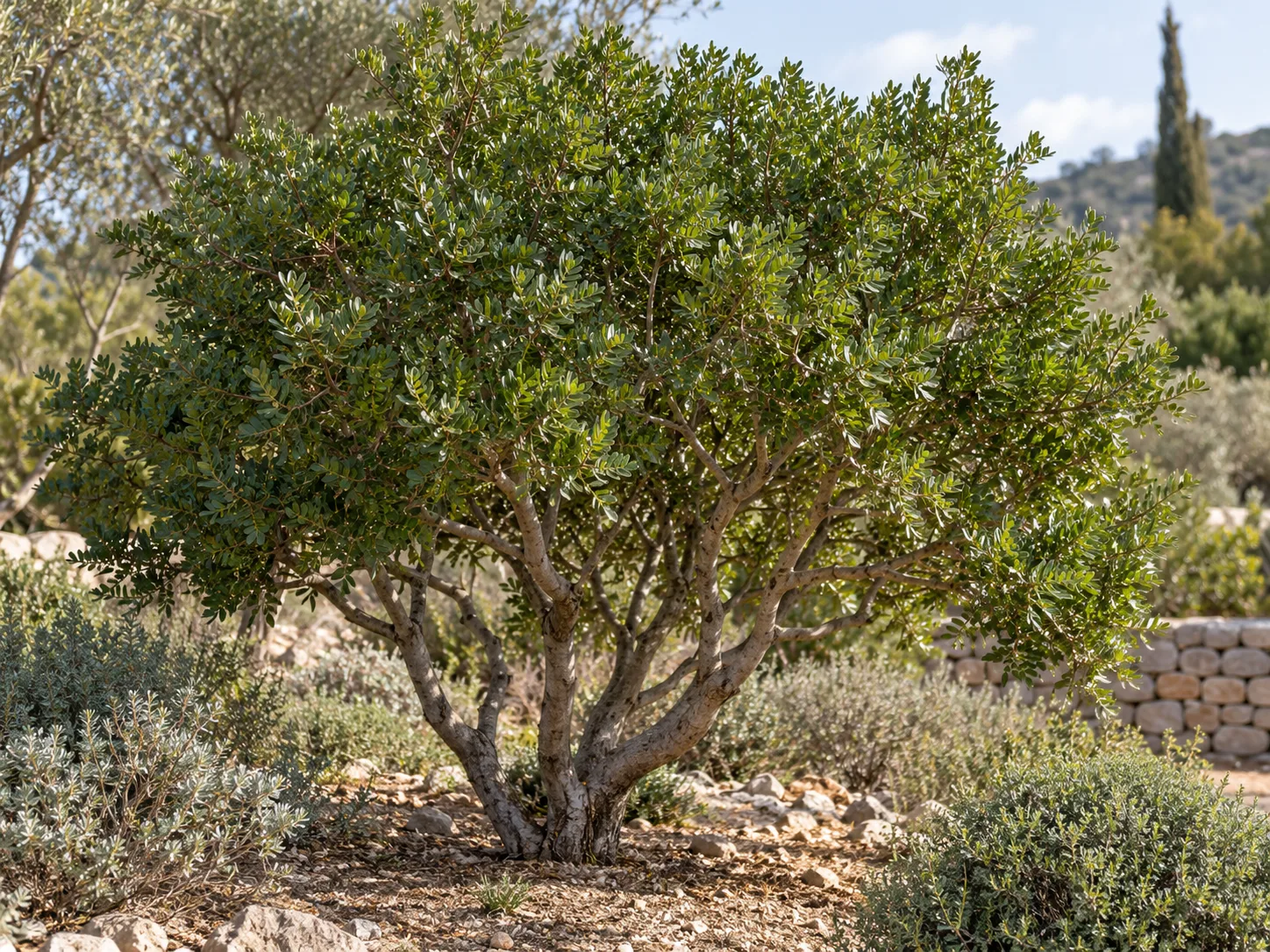
Do not shear it into a tight ball unless you are willing to repeat the work. A sheared outer shell can hide interior deadwood and leaves the plant dependent on frequent trimming. In a hot climate, avoid heavy cuts during the most intense summer heat; an Arizona arborist notes that fresh pruning cuts on this tree can be vulnerable to sunscald in that regional context. For most home gardens, use a dry, mild period in late winter or early spring for formative shaping, then make small corrective cuts as needed. If branches are large, overhead, or near structures, use a qualified tree-care professional instead of climbing or cutting from a ladder.
Grow a mastic tree in a container
A large, sturdy container can keep mastic manageable for a patio or for a gardener whose winters are too cold for permanent outdoor planting. Choose a pot with several open drainage holes and enough weight to resist tipping as the canopy grows. Use a free-draining container mix rather than garden soil alone, and do not let the pot sit in a saucer full of water. A container restricts the roots, but it does not turn a sun-loving outdoor tree into a good long-term indoor houseplant.
Container plants dry faster than in-ground trees, so check moisture more often in hot weather. Water thoroughly until excess runs through the drainage holes, then let the upper mix dry before watering again. In winter, move the pot to a bright sheltered area if hard frost threatens, while avoiding a warm, dark interior. Expect to root-prune or pot up when roots circle densely and water races straight through, but keep in mind that repeated repotting and tight root restriction can stress a long-lived tree. A container is best treated as a way to manage climate and size, not as a guarantee that the plant will remain small forever.
Propagate from seed or cuttings—with patience
Seed propagation is possible, but a seedling may not match the parent’s growth habit or ornamental traits. Mastic is dioecious, which means individual plants are usually male or female, and sex may not be obvious when a seedling is young. If you grow from seed, use fresh, fully ripe fruit, remove the fleshy outer layer, and sow in a clean, well-draining medium. Keep the medium lightly moist rather than saturated and be prepared for uneven or slow germination. A published study of P. lentiscus var. chia found that germination response differed among genotypes and that scarification improved results in some, not all, of the tested material; that is a reason to expect variation, not a home recipe for applying concentrated acid. The peer-reviewed Agronomy study on Chios mastic propagation also evaluated rooting efficiency in shoot cuttings.
Cuttings preserve the parent plant’s sex and many of its traits, but mastic cuttings can be slow or inconsistent to root. Semi-hardwood or hardwood shoots are commonly attempted, usually with a sterile, airy medium and steady humidity; the cutting must stay moist without being submerged in a constantly wet mix. Rooting hormone may help in controlled propagation, but following a product label matters, and success varies with cutting maturity, season, donor plant, and environment. If you need a particular form or want fruit from a known female, buying a correctly identified nursery plant is usually more dependable than raising several seedlings and waiting years to identify their eventual performance.
Understand flowers, berries, and mastic gum
Male and female flowers occur on separate mastic plants, and the small spring flowers are not the main ornamental display. A female plant can carry berries after pollination, but one female by itself may not fruit reliably if no compatible male is nearby. A plant tag that gives only the species name usually does not identify sex, so ask the nursery before purchase if fruit is important. Even then, local flowering overlap and conditions affect fruit set.
The fruit is a small drupe that changes color as it ripens; it is not an edible pistachio nut. Berries can add seasonal interest and may attract birds, but avoid assuming that a female plant will produce a heavy crop in a garden without a pollinizer. The main value for many home gardeners is evergreen form and tolerance of heat and dry soil, not fruit harvest.
Mastic gum is resin that exudes from wounded bark and hardens into aromatic tears. Traditional commercial production is associated with specialized cultivars grown in southern Chios, where selection, climate, and local harvesting knowledge are part of the crop. Randomly scoring a landscape tree is not a shortcut to a useful harvest: wounding creates entry points for decay, and the amount or quality of resin from an unselected ornamental is uncertain. Enjoy the tree as a landscape plant unless you have reliable, region-specific guidance on resin production and a plant grown for that purpose.
Troubleshoot yellow leaves and decline
Mastic is often resilient when its light, climate, and drainage are right, so visible decline should prompt a check of the growing conditions before a pesticide or fertilizer. Look at which leaves are affected, how quickly the change appeared, and whether the root zone is wet or dry. Then inspect the trunk base and major branches for buried bark, mechanical injury, or dieback.
Separate excess water from drought stress
Yellowing across older leaves, leaf drop, and a persistently wet root ball may point to overwatering or slow drainage. Pull back on irrigation, check that downspouts are not emptying near the tree, and correct the site if water remains around the roots. A tree with root damage may not recover simply because watering is reduced, so persistent decline or branch dieback merits a local arborist’s assessment.
A dry root ball during hot weather can cause drooping or dull foliage too. Check several inches down and water slowly if the soil is genuinely dry; a quick splash on the surface may run away without wetting the root zone. Wind, transplant stress, and a sudden heat wave can add to water demand even in a drought-tolerant species. Compare recent weather with the soil itself rather than diagnosing from leaf color alone.
Check alkaline-soil chlorosis before adding iron
If new leaves turn yellow while their veins remain green, iron chlorosis is one possibility, particularly where soil is strongly alkaline. The Phoenix-area mastic guidance from an ISA-certified arborist describes chlorosis in local alkaline soils, but that regional observation does not establish the cause in every garden. Confirm drainage and root health, then use a soil test or qualified local diagnosis before changing pH or applying iron. Overwatering, damaged roots, and nutrient availability can look similar from a distance, so targeted correction is safer than a guessed treatment.
Follow a seasonal care rhythm
In spring, watch for new growth and flowers, check mulch depth, and do any modest structural pruning while the weather is mild. If you are raising seedlings or rooting cuttings, protect the propagating medium from drying while maintaining air around the roots. Do not feed automatically just because spring has arrived; a healthy mastic in suitable soil may not need fertilizer.
During summer, water young trees according to root-zone moisture and rainfall. Established trees usually need less help, but a long dry spell in a very hot region can justify a deep soak. Keep irrigation aimed at the root zone, and avoid routine shallow watering that only wets the soil surface. In fall, newly planted trees still need to establish before winter, so water when the root zone dries if rains have not begun.
Before winter, check the local forecast if your plant is young or your site is near the edge of its hardiness range. A sheltered position can reduce exposure, and a container can be moved to a protected bright location, but neither makes a marginal climate fully safe. Avoid pushing late-season soft growth with fertilizer, and do not wrap the canopy so tightly that moisture is trapped against foliage. Most established plants in a suitable climate need no elaborate winter routine.
Conclusion
Mastic trees thrive when their Mediterranean preferences are treated as site requirements: give them full sun, room to spread, and soil that drains freely. Water regularly while they establish, then shift to occasional deep watering based on weather and soil rather than a calendar. Prune gradually only if you need to change the natural broad shrub form, and use a different plant if your garden is too cold, wet, shaded, or confined.
The practical payoff is an evergreen, heat- and drought-tolerant plant that asks for little once settled. Choose a known nursery plant if you want a particular shape or fruiting sex, and treat commercial Chios mastic production as a specialized crop rather than an automatic feature of every ornamental mastic tree.