5 Mistakes You’ve Been Making With Your Live Christmas Tree
Keep a live Christmas tree fresh with better selection, a straight recut, the right stand, daily water checks, and safer placement away from heat.
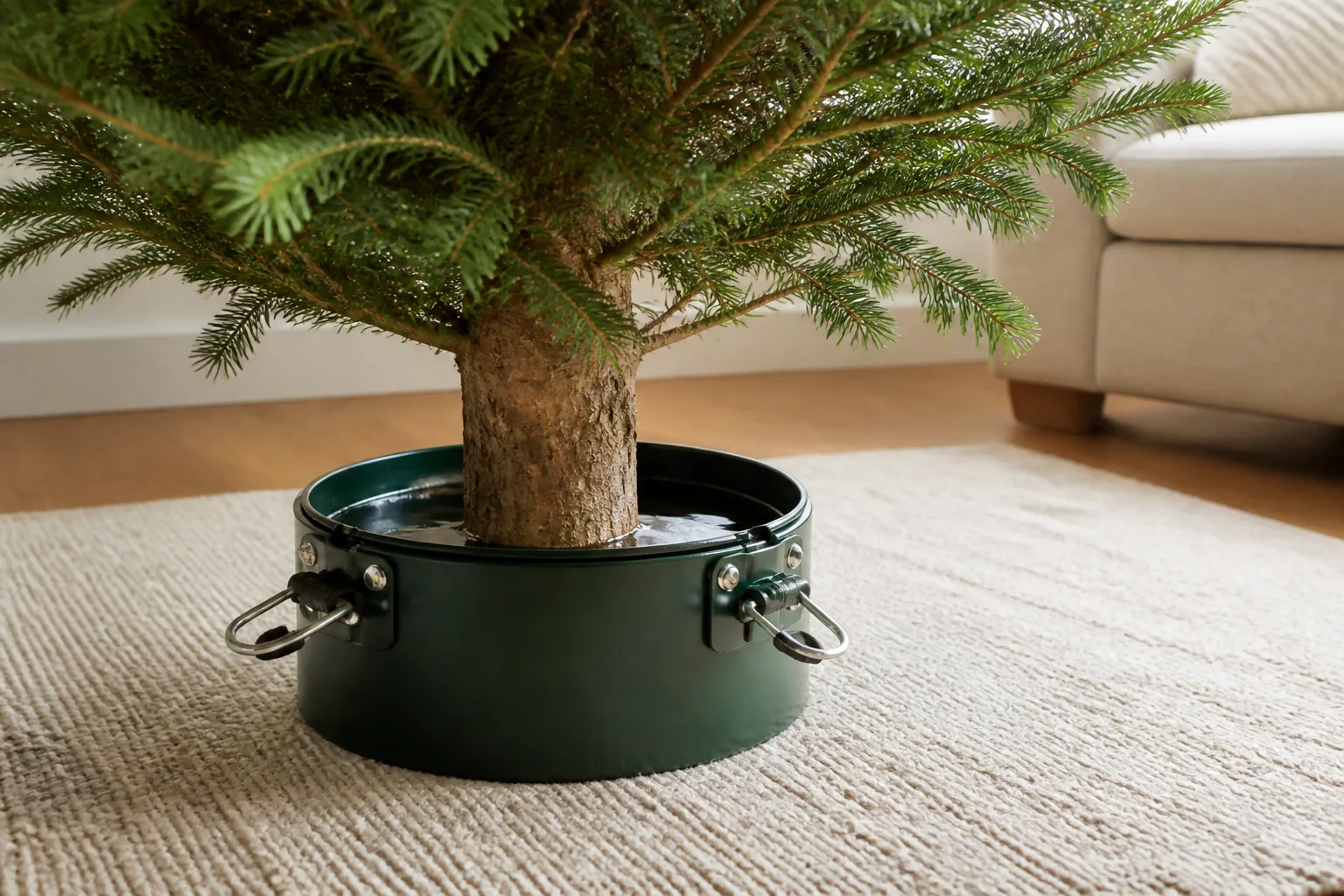
“Live Christmas tree” usually means a freshly cut tree displayed in a water-holding stand—not a potted tree with roots that you plan to plant outdoors. That distinction matters. A cut tree is managing a limited moisture reserve, so the goal is to slow water loss and keep the trunk continuously connected to clean water until you remove it.
The five mistakes below are connected. A tree that was old when you bought it has less margin for a warm room. A trunk that dries out cannot make good use of a large stand. A stand that fits badly can leave the tree unstable or remove the very wood that absorbs water. Fix the sequence, and most “mystery” needle loss becomes predictable.
A quick answer: what shortens a live Christmas tree’s display life
The biggest mistake is allowing the base of the trunk to sit above the water line, even when the stand itself still looks partly full. The next biggest are bringing home a dry or stale tree, delaying water after a cut, shaving the trunk to force it into a small stand, and placing the tree beside heat, direct sun, or unsafe lighting.
Penn State Extension identifies moisture retention as the central factor in reducing needle loss. The practical translation is simple: start with freshness, make a clean cut, use a correctly sized stand, keep the cut surface submerged, and reduce the room’s drying stress.
Mistake 1: Choosing by shape instead of freshness and fit
A tree can look full under a sales-lot net and still be past its best. Shape is a decorating preference; freshness is the factor that determines how much indoor heat and handling the tree can tolerate. A slightly uneven tree cut recently is usually a better purchase than a perfectly symmetrical tree whose needles are already loosening.
Freshness also has a size component. Measure the ceiling, the stand, the topper, and the path through the door before you buy. A tree that is too tall often gets forced into a cramped location, while a trunk that is too thick tempts someone to shave away the outer wood or use a stand that cannot support the canopy.
How to check a pre-cut tree in two minutes
Start with the branches, not the color. Lift a branch lightly and bend it; it should have some flexibility rather than snapping. Then run a small handful of needles between your fingers or give a branch a gentle tug. Needles should stay attached, and the foliage should feel resilient rather than dry and sharp in a brittle way.
Some interior brown needles are normal. Evergreen trees shed older needles from shaded inner growth, and those loose needles may fall when a tree is shaken. The concern is a broad pattern of dull color, crumpled branch tips, brittle twigs, or green needles that pull free easily. Penn State’s selection guidance makes the same useful distinction: firm, flexible needles are a better freshness signal than a perfectly green exterior.
Look at the cut end if it is visible. It should not be deeply cracked, excessively dirty, or so dry that the surface looks shrunken. Ask when the tree arrived and whether it was kept in water. If the seller can shake out old needles and give the base a fresh cut, that is a meaningful advantage over a tree that has spent weeks on hot pavement without hydration.
Why buying earlier can be safer when storage is right
Waiting until the day before Christmas does not automatically produce a fresher tree. It may leave you choosing from what has been sitting longest, while a tree bought earlier can stay in good condition if its trunk is kept in water in a cool, shaded, protected place.
The trade-off is timing. If you buy early but leave the tree lying dry in the sun or wind, you erase the benefit of the earlier purchase. If you buy early and can place the trunk in a full bucket of water in an unheated garage or sheltered outdoor area, you can preserve more freshness and avoid a rushed setup.
Species also changes the margin for error. Fir and pine branches differ in stiffness and ornament capacity, and Colorado blue spruce can lose many needles after a single serious dry-out. Choose the species that fits your decoration plan, room conditions, and local availability instead of assuming every evergreen responds identically.
Mistake 2: Leaving the trunk dry during transport or storage
The hours between the seller’s cut and your stand matter. A fresh cut is an open water pathway only for a limited window; resin, dirt, and drying can block the surface. The tree does not need a complicated preservative during that window—it needs shade, a cool environment, and water at the base.
Do not leave the tree on a sunny driveway while you rearrange the living room. Do not keep it strapped to a car roof for a long drive if you can transport it inside a vehicle or protected in the back of a truck. If the weather is warm or windy, covering a tree with plastic in direct sun can trap heat and bake the foliage rather than protect it.
The cool, shaded, hydrated holding sequence
If the tree will not go into the house immediately, ask for it to be bundled securely and keep it out of sun and wind. Stand the trunk in a bucket of clean water as soon as practical. The bucket does not need additives, and the foliage does not need misting; the objective is to keep the cut end wet and the whole tree cool.
NC State Extension describes freshness as a moisture-and-temperature problem: cooler, shaded, hydrated trees lose less water. That applies at home, not just on a retail lot. A shaded garage, porch, or protected north-facing location is usually better than a warm room while you wait.
Before moving the tree indoors, check whether the trunk has been dry for an extended period. If the tree has sat dry for more than a day or two, plan to make a new clean cut before it goes into the final stand. If it has been dry for several days, a recut becomes especially important; if the needles already break and fall freely, do not assume a recut will restore it.
Do not confuse a cut tree with a balled-and-burlapped or container-grown living tree. A living tree needs a root ball kept slightly damp, a short acclimation period, and a plan for planting suited to its species and climate. It should not be treated like a cut trunk in a deep stand of water, and it should not move directly from a heated room into freezing outdoor conditions.
Mistake 3: Cutting or fitting the trunk the wrong way
Two shortcuts cause recurring trouble: carving the trunk smaller to fit a stand and making a decorative angled or V-shaped cut. Both are attempts to solve a hardware problem with the tree itself. The better fix is to match the stand to the trunk and make one simple, flat cut.
The clean, straight recut that helps water uptake
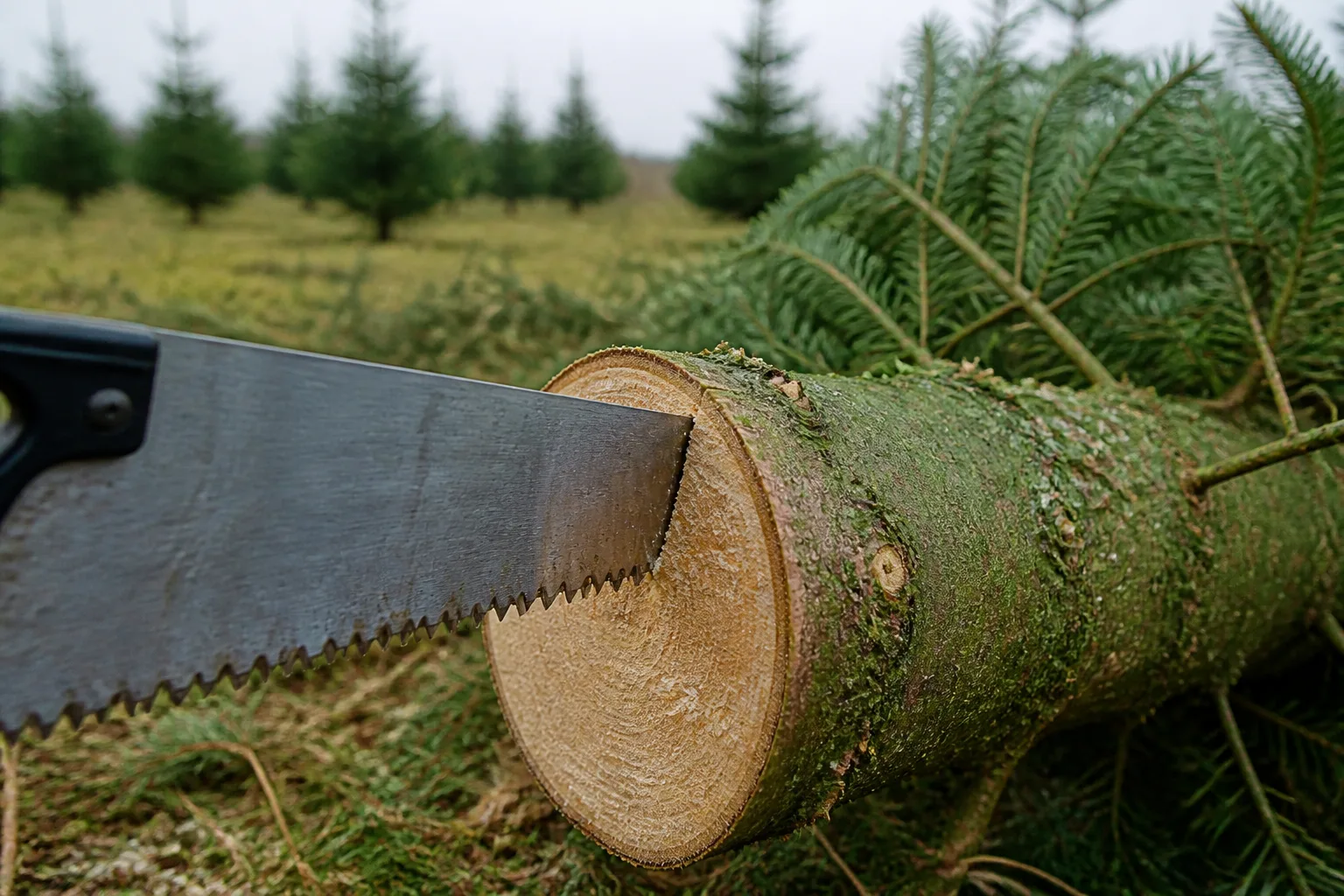
Use a saw to remove a thin disk—roughly ¼ to ½ inch—from the base immediately before the tree enters its water-holding stand. Make the cut perpendicular to the trunk, not at an angle. A flat base sits securely on the stand’s support and leaves the largest practical cross-section available for water uptake.
The purpose of the recut is not to make the trunk look fresh for photographs. It removes a surface that may be coated with resin, dirt, or air-blocked wood. NC State’s freshness research explains that a clean cut opens the ends of the wood’s water-conducting pathways.
Do not drill a hole in the base, drill channels up the trunk, split the trunk, or pour hot water over the cut in hopes of creating a faster pathway. These tricks add mess or weaken the support without replacing the simple benefit of a clean, perpendicular cut. The temperature of the water you add to the stand is not the deciding factor; continuous contact between the trunk and clean water is.
Choose the stand before you bring the tree home
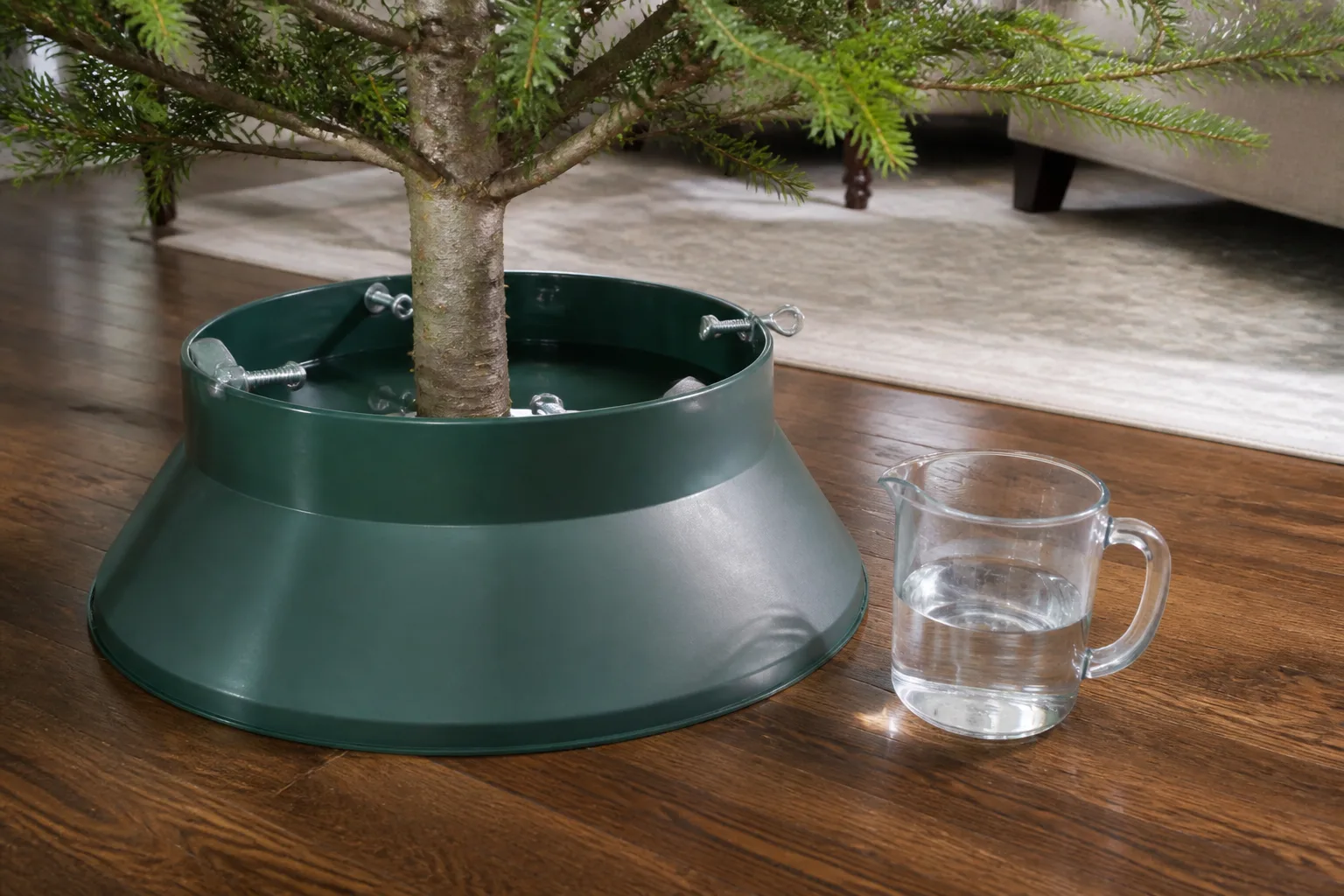
Measure the trunk diameter at the base and check the stand’s opening, screw reach, stability, and reservoir. A useful capacity rule from Penn State Extension and the National Christmas Tree Association is about 1 quart of water per inch of trunk diameter, with many household stands needing at least a gallon once the tree is inserted.
That number describes capacity, not a guaranteed daily drink. A seven-foot tree can use several quarts per day during the first week, while a cooler room or a different species may consume less. Buy enough reservoir that the trunk remains submerged between checks, especially if the stand is tucked behind a skirt where a low level is hard to see.
Never shave the bark and outer wood to make a large trunk fit a narrow collar. The outer layers are efficient at taking up water, and removing them can reduce hydration while leaving you with a stand that still cannot safely grip the tree. A larger stand is cheaper than recovering a fallen tree, damaged ornaments, wet flooring, or a dry tree that must be discarded early.
Mistake 4: Letting the water level drop below the trunk
The stand does not need to be topped off to a particular decorative mark; the cut surface simply must stay underwater. Some stands hold water around the trunk even after the water level has dropped below the base, so looking into the reservoir can give false reassurance. Reach around the trunk or use a narrow dipstick to verify the actual water line.
Water use is often highest during the first several days, and a thirsty tree can empty a modest reservoir faster than expected. UF/IFAS Extension recommends checking daily, with extra attention during the first 48 hours. That is a more reliable routine than assuming one large fill will carry the tree through the week.
A simple daily watering routine
Make the stand part of a routine rather than an emergency chore. Check the water level when you make coffee, refill it before the trunk is exposed, and check again after a hot day, a crowded gathering, or a room-temperature change. Put a flashlight near the stand if a skirt or low branches make the reservoir difficult to inspect.
Use clean tap water unless your local water is unsuitable for ordinary household use. There is no advantage to sugar, aspirin, bleach, soft drinks, honey, floral preservative, or a homemade recipe. Penn State’s research-based care guidance says clean water is enough, while gels can reduce the volume of water available to the trunk.
Do not let a pet drink from the stand, and do not add a chemical just to discourage it. Cover the reservoir with a well-fitting skirt or barrier that still lets you check and refill it, and keep cords secured so an animal cannot pull the tree over. The safest tree-water additive is no additive; the safest stand is one that stays full and cannot be tipped.
What to do if the stand ran dry
First, inspect the tree instead of panicking. If the stand was dry for a short period but the needles are still flexible and firmly attached, remove ornaments that make handling difficult, make a fresh thin cut if you can do so safely, and return the trunk to clean water immediately. Keep the tree in the coolest suitable part of the room while it rehydrates.
If the trunk has been exposed for a long time, it may have sealed again. A recut can reopen the water-conducting surface, but it does not guarantee recovery. If the foliage is brittle, needles fall with a light touch, branches snap, or the tree stops taking water for multiple days, treat the tree as dry rather than trying another additive or drilling trick.
The decision is not only cosmetic. A dry tree has less moisture available to buffer heat and electrical faults, and a room full of loose needles is a sign that your display period is ending. If the tree cannot rehydrate and regain flexible foliage, remove it from the home and use your community’s recycling or collection route.
Mistake 5: Putting the tree in a hot, overloaded, or unstable setup
The ideal location is rarely the one directly beside the fireplace or in front of the brightest window. A real tree is a cut plant material display, so the room’s heat, sunlight, airflow, and electrical setup all affect how quickly it dries and how safely it can remain indoors.
Place it away from heat and direct sun
Keep the tree away from fireplaces, radiators, space heaters, heat registers, and strong afternoon sun. Heat sources warm the branches and increase moisture loss; a sunny window can create a hot pocket even when the rest of the room feels comfortable. Purdue University Extension also warns that sun and wind can dry a tree quickly before it is even set up.
Give the tree enough clearance that curtains, blankets, and furniture do not press into the branches or block access to the stand. If you must choose between a dramatic fireplace position and a cooler location across the room, choose the cooler location and use the lighting and ornaments to make it feel intentional.
Lowering the room temperature a little can reduce drying, but do not turn the space into a cold-storage experiment. Comfort, water access, and stable conditions matter more than chasing one perfect thermostat number. A tree that is watered correctly in a moderate room will usually fare better than a tree in a cool room whose stand is allowed to run dry.
Decorate for branch strength and electrical safety
Match ornament weight to the tree’s branch structure. Pines and many spruces can support heavier decorations on sturdy branches, while firs may have softer or more flexible branch tips. Put heavier ornaments close to the trunk or on strong lower branches, use lightweight decorations at the ends, and skip any ornament that pulls a branch sharply downward.
Inspect every light set before it goes on the tree. Replace frayed wires, cracked sockets, loose plugs, or damaged insulation. Use lights rated for the intended indoor use, prefer low-heat LED sets, avoid overloading an outlet or power strip, and switch the lights off when you leave or go to sleep. A timer makes the safe habit automatic.
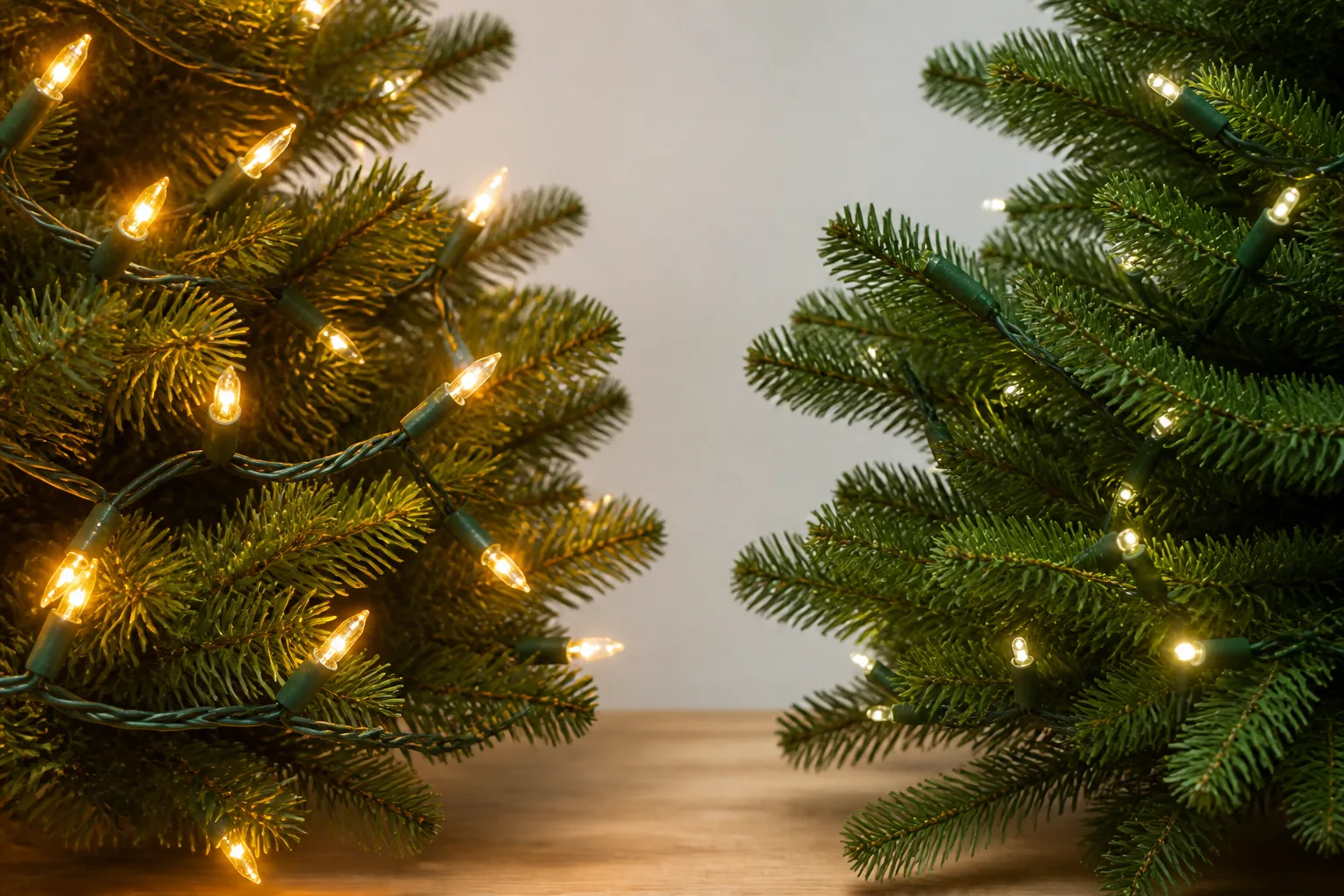
The National Christmas Tree Association recommends inspecting light sets, avoiding overloaded circuits, and turning lights off when the tree is unattended. Do not wrap lights tightly around brittle, dry branches and assume the water stand cancels other hazards. Moisture management, electrical condition, clearance, and supervision work together.
Stability is part of care, too. Tighten the stand screws evenly, keep the base on a level surface, and anchor a tall tree if children, pets, or a busy walkway could pull it. A tree that falls can expose the trunk, spill water, break lights, and turn a freshness problem into a safety problem in seconds.
How to tell when a tree is too dry to keep
No single fallen needle proves a tree is finished. Look for a pattern: needles feel dry and brittle instead of flexible, a light hand sweep removes many of them, small branches snap rather than bend, the foliage looks dull, and the tree no longer takes water after you confirm the trunk is submerged.
Run the test on a few branches at different heights, including the side facing the room’s heat source. A tree can have a clean-looking top and a dry lower interior, or it can shed older inner needles while the current-season foliage remains resilient. The combination of brittle texture and widespread easy shedding is more meaningful than a small pile under the stand.
If the tree is drying rapidly, turn off and remove the lights, keep people away from fragile branches, and plan to take it outside. Do not spray a flame-retardant product or pour a preservative into the stand as a last-minute rescue. The more useful intervention is earlier: continuous water, a cooler position, and a shorter indoor display period.
A low-stress setup checklist for the first 24 hours
Use this sequence whenever the tree comes home:
- Measure first. Confirm height, width, stand opening, reservoir capacity, and the route into the room.
- Keep it cool and shaded. If setup is delayed, place the trunk in a bucket of clean water and protect the tree from sun and wind.
- Make one flat recut. Remove a thin disk immediately before the final stand; do not angle, V-cut, drill, or shave the trunk.
- Stabilize before decorating. Tighten the stand on a level floor and anchor a tall or vulnerable tree.
- Fill with plain water. Verify that water reaches the cut surface, not merely the bottom of the reservoir.
- Choose the coolest practical room position. Avoid heat vents, radiators, fireplaces, and direct afternoon sun.
- Add decorations by strength. Heavy ornaments go on strong branches; lightweight ornaments go toward the tips.
- Check every light string. Use indoor-rated, intact, low-heat lights and a timer, and keep the electrical load reasonable.
- Check twice on day one. A morning-and-evening inspection catches a fast first-day water draw before the trunk is exposed.
That first day sets the pattern for the rest of the display. A stand that is easy to see and refill is more valuable than a hidden reservoir that looks tidy but goes unnoticed. A slightly cooler, less dramatic location is more valuable than a perfect photo beside a heater.
After the holidays: remove and recycle promptly
Do not wait for a tree to become completely brown before taking it out. Once the display period is over—or sooner if the tree is dry, brittle, or dropping needles heavily—remove the lights and ornaments, wrap the tree in an old sheet if you want to contain needles, and carry it outside carefully.
Never burn a Christmas tree in a fireplace or wood stove. The resinous material can contribute to a dangerous, fast-burning fire and the tree may not behave like seasoned firewood. Use a municipal pickup, drop-off site, chipping program, or a local recycling option instead. Some communities turn collected trees into mulch or habitat material.
If you want to reuse branches in the garden, keep them outdoors and use them as a loose winter cover or place them near a bird-feeding area where appropriate. Remove wire, hooks, tinsel, plastic, and ornaments first. The goal is to finish the season without moving a dry, indoor tree into another fire-risk situation.
Conclusion
A fresh live Christmas tree does not need a secret mixture or a complicated maintenance schedule. It needs a fresh start, a stand that fits, a flat cut, clean water that never drops below the trunk, a cool location, sensible decorations, and a prompt exit when the foliage turns brittle.
If you remember only one check, look at the actual water line where the trunk enters the stand—not the amount of water you can see around it. That small habit, repeated daily, prevents the most common failure. Pair it with a freshness check at purchase and a quick heat-and-light audit, and your tree has the best chance of staying attractive, hydrated, and safe throughout its intended holiday display.



