8 Natural Predators That Control Spiders Outdoors
Eight natural predators eat spiders, but their impact depends on habitat. See which ones matter in gardens and what to do when spiders appear indoors.
The quick answer: predators shape outdoor food webs
Birds, spider-hunting wasps, lizards, frogs, fish, shrews, centipedes, scorpions, and other spiders all eat spiders in at least some settings. Which ones matter depends on where you live and whether the spider is on a web, in leaf litter, near a pond, or tucked into a building.
That list describes natural predation, not a reliable way to clear a house. Predators can influence local outdoor populations over time, but they do not patrol rooms on demand; for indoor webs, egg sacs, or repeated sightings, exclusion and targeted removal work more predictably.
| Predator group | Where it may encounter spiders | Practical role |
|---|---|---|
| Spider-hunting wasps | Open ground, shrubs, eaves, and nest sites | Direct but species-specific hunting |
| Birds and lizards | Shrubs, walls, garden beds, and webs | Opportunistic outdoor predation |
| Frogs, fish, shrews, centipedes, and scorpions | Leaf litter, water edges, soil, and sheltered habitats | Local food-web pressure, not household control |
| Other spiders | Webs, corners, and hunting routes | Can remove individual spiders or compete for prey |
The University of California Statewide IPM Program names wasps, other spiders, birds, and reptiles among spiders’ natural enemies, while also noting that spiders eat many nuisance insects. That balance matters: the goal in a healthy garden is not to eliminate every spider, but to keep wildlife relationships in perspective and decide where you actually need intervention.
An animal eating one spider proves that the encounter happened; it does not show that the predator can lower spider numbers across an entire yard. Predators hunt only where they forage, prefer some prey over others, and respond to changing food and shelter, so a seasonal dip or a single dramatic observation is not the same as dependable control.
Eight animals and animal groups that eat spiders
1. Spider-hunting wasps
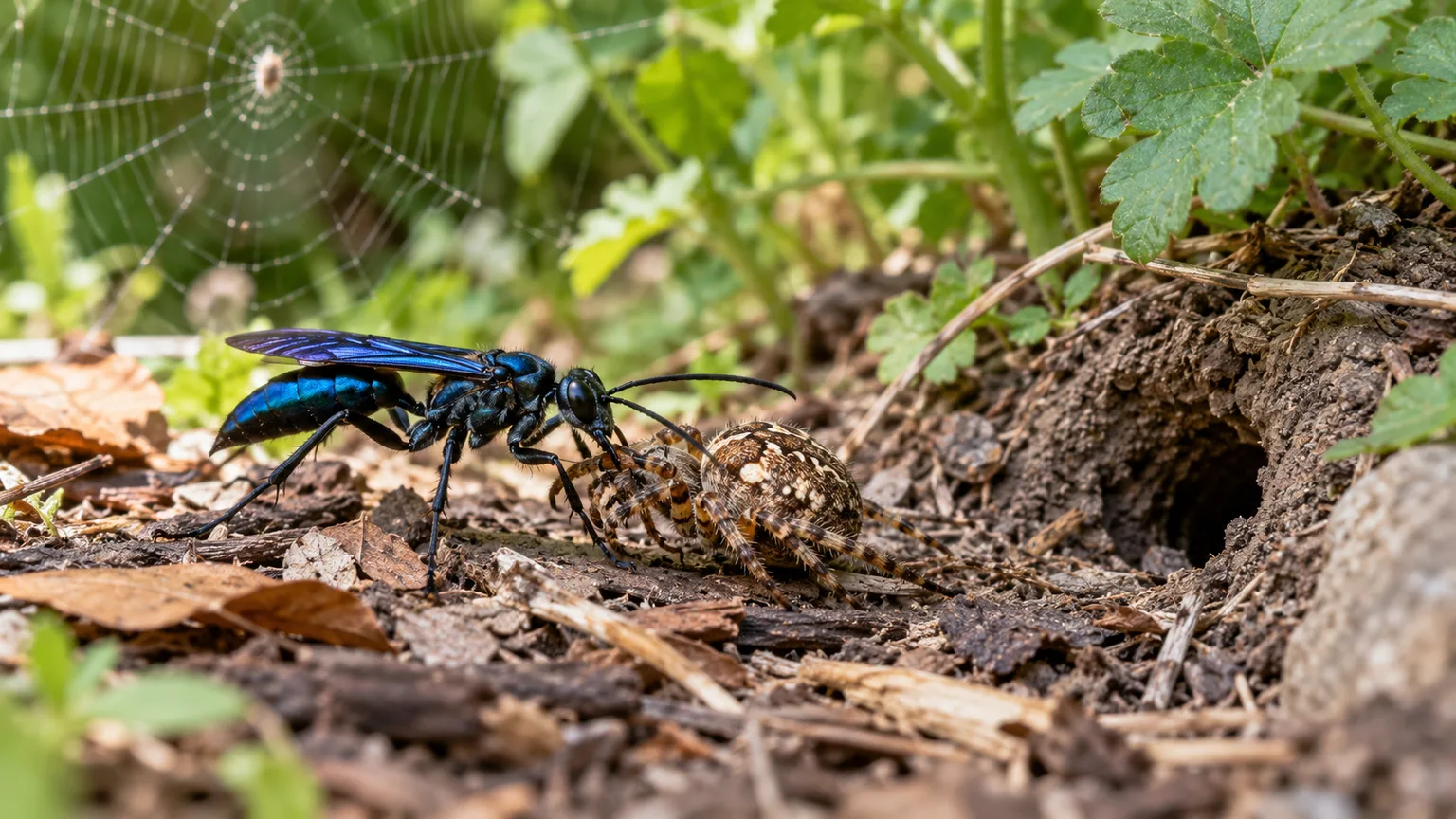
Spider wasps in the family Pompilidae are the most specialized hunters on this list. A female searches for a suitable spider, stings it to immobilize it, and carries or drags it to a protected nest; her larva then feeds on the spider. Different wasp species tend to target different kinds of spiders, so one wasp is not a universal spider-control agent.
The Missouri Department of Conservation notes that many spider wasps hunt free-living spiders such as wolf, crab, and jumping spiders, while other species take orb-weavers or funnel-web spiders. Because a larva may be provisioned with one spider, the impact is direct but limited to the wasp’s own reproductive needs.
Mud daubers are another spider-hunting wasp group, but they use a different nesting strategy: females pack paralyzed spiders into mud cells for their young. The University of Florida IFAS account of the black-and-yellow mud dauber describes females stocking a cell with multiple spiders, with prey choices varying among individuals. A mud nest under an eave is evidence of a wasp’s life cycle, not proof that the wasps will noticeably reduce every spider around the house.
Adults of many spider-wasp species visit flowers for nectar, and mud daubers also use nectar. If a wasp is hunting away from a doorway, leave it room to work; do not handle it or disturb a nest. A nest directly over a frequently used entrance is a placement problem to address carefully, not a reason to spray every flowering plant or kill every wasp in the yard.
“Wasp” covers many unrelated behaviors, so identify the insect before making a management decision. A solitary female dragging a spider is doing a specific job; it is not evidence that a colony is nesting in the wall. Watch from a distance, and if a nest sits where people must pass, ask a local extension service or qualified pest professional about safe options for that species and site.
2. Birds
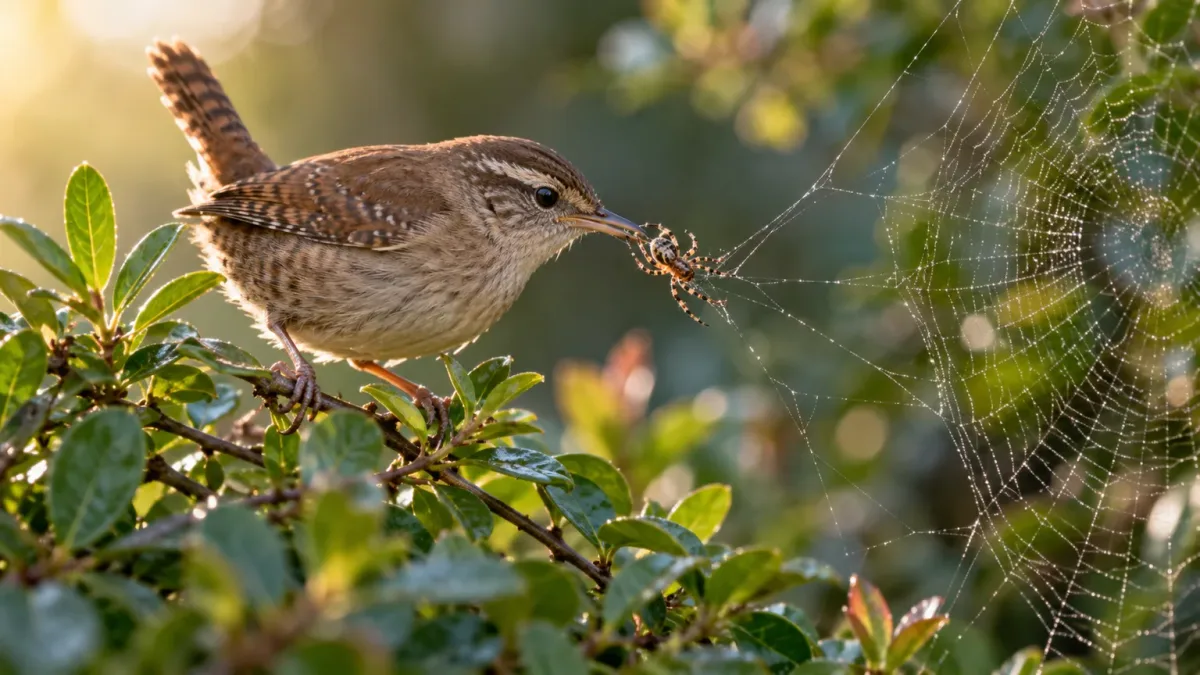
Many insect-eating birds take spiders, especially while foraging through foliage or gathering food for nestlings. A spider caught on a shrub, fence, or web is accessible; a spider hidden in a foundation crack is not. Birds therefore exert pressure in outdoor feeding areas, not inside the home.
A landscape-scale study in Guam found that spider abundance increased after an introduced brown tree snake caused major losses of insectivorous birds. This is strong evidence that bird predation can help shape spider populations in a particular ecosystem, but it is not a backyard trial and should not be translated into a promise that a bird feeder will clear a porch. The study of top-down bird control of spiders is best read as evidence that predators matter within food webs, not as a household control recipe.
Birds can also be vulnerable to pesticides and window strikes, so a sensible wildlife garden is more useful than trying to make birds hunt one target. Native shrubs with varied structure, safe nesting habitat, clean water, and fewer broad-spectrum sprays help birds use a yard naturally; the Royal Horticultural Society’s wildlife guidance explains how gardens provide food and shelter across wildlife life cycles.
Adding a seed feeder may bring more birds without changing how many spiders they take. Spiders are one item in a mixed diet, and access matters: small birds can glean webs from foliage, but they cannot reach a spider hidden in siding, a storage bin, or a sealed gap. Habitat is the lever a gardener can influence, not a way to direct a bird to a particular web.
3. Lizards and geckos
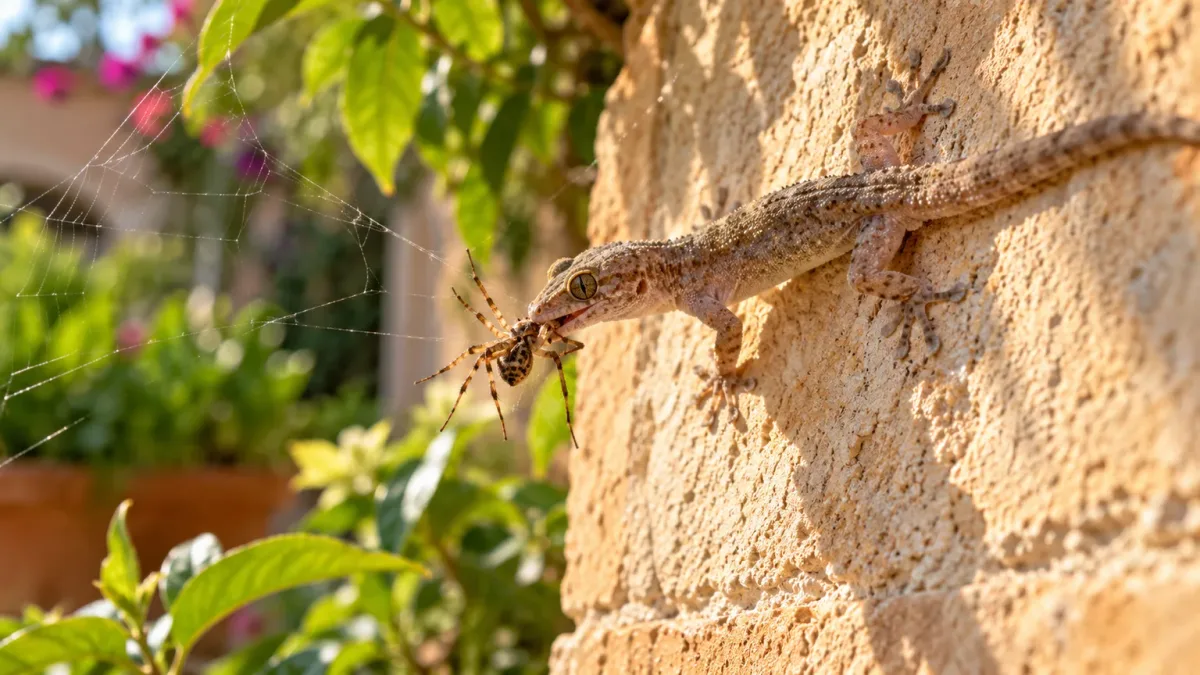
Small lizards such as anoles and geckos catch spiders and other arthropods when they can reach them on walls, leaves, or the ground. Their effect varies with species, climate, cover, and prey supply. A warm courtyard that naturally supports geckos is a different situation from a cold-climate yard, a sealed apartment, or a home that has no lizards at all.
One island experiment provides a useful example of both the potential and the limit. Researchers introduced brown anoles to 16 small islands and compared them with lizard-free islands; after four months, the lizards reduced average abundance of salticid spiders by 94%, while effects on web spiders varied with context. The peer-reviewed island study demonstrates that a predator can strongly affect certain prey under specific ecological conditions—not that importing lizards into a residential garden is safe or appropriate.
Do not buy, move, or release reptiles to manage spiders. A released animal may be nonnative, may not survive, and may disrupt local wildlife; in many places it is also restricted by wildlife rules. If geckos already live outside, you can simply let them hunt, but keep them outdoors and avoid using pesticides that would poison their prey or the lizards themselves.
The same caution applies to stories about an animal “eradicating” spiders. The island study measured abundance changes for particular spider groups over a defined period, and its authors found that effects varied by spider type and island conditions. That is useful ecological evidence, but a residential garden has different boundaries, habitat, and prey populations.
4. Frogs, toads, and fish near water
Frogs and toads are broad feeders that may eat spiders when the arachnids cross damp leaf litter or other accessible ground. They do not specialize in spiders, and their diet may be dominated by ants, beetles, or other invertebrates. A University of Florida IFAS guide to greenhouse frogs lists spiders among their leaf-litter prey, while noting that ants are often the most preferred food.
Fish can eat spiders that land on the water surface or live close to an aquatic habitat. The Missouri Department of Conservation’s account of aquatic spiders describes fish, amphibians, reptiles, birds, and spider-hunting wasps as predators of aquatic spiders. That relationship belongs at ponds, streams, marshes, and other water edges; a garden pond is not a tool for controlling spiders in a basement.
Do not introduce fish, frogs, or toads as pest-control equipment. Stocking decisions can harm native species, and adding a pond means ongoing water-quality and wildlife responsibilities. If an existing pond attracts native predators, treat that as part of a diverse habitat rather than expecting it to regulate spiders on the patio.
There is also a two-way food web at the waterline: fish are predators of aquatic spiders, while some semi-aquatic spiders capture insects and occasionally small fish or tadpoles. Those interactions depend on species and water-edge conditions, which is why a pond is not a targeted spider treatment. Never move wild frogs or fish between sites; local wildlife rules and disease risks matter.
5. Shrews and other small mammals
Shrews are small, active mammals that feed heavily on invertebrates, including spiders. In one study of western Oregon diets, spiders were among the important foods of Trowbridge shrews; other shrew species in the same study ate a wider mix of insects, slugs, snails, and other invertebrates. The Andrews Forest Research Program summary of shrew food habits supports the point that spiders can be prey, not that shrews seek them out as a dedicated control method.
Some bats and other mammals may take spiders opportunistically, but that behavior depends on species and setting. Do not install a bat box or try to attract mammals solely to reduce spiders; the practical benefit is uncertain, and habitat changes should be made for native wildlife as a whole. In a garden, a shrew’s presence is one sign of a functioning food web. In a home, finding a small mammal is a separate issue to manage, not a reason to tolerate a spider problem.
Predator presence is also hard to interpret: a shrew may be following insects or worms through leaf litter rather than searching specifically for spiders. Its diet can change with the season and what prey is available, so a shrew sighting should not be treated as a reliable indicator of spider abundance or a reason to leave debris against the house.
6. Centipedes
Centipedes are fast, nocturnal predators that use modified front legs to seize small prey. Some species hunt on soil or beneath cover; house centipedes may also consume spiders and other arthropods indoors. University of Wisconsin–Madison Extension describes centipedes as predators of insects, spiders, and other small arthropods, while noting that they are usually found in damp, dark places.
That makes them ecologically relevant, but not a good animal to recruit. A centipede’s presence can mean that prey or moisture is available, and the same damp hiding places may be what you want to correct near a foundation. Do not handle centipedes; reduce excess moisture and clutter if they are frequent indoors, and fix the conditions that support the small arthropods they hunt.
7. Scorpions
Scorpions eat spiders as well as insects and other small arthropods, mostly in regions where scorpions naturally occur. They hunt at night and hide beneath stones, bark, boards, or other cover. The University of Missouri Extension guide to scorpions confirms that spiders can be prey, but it also describes their stinging tail and gives home-exclusion advice.
Scorpions are not a sensible form of spider control. Do not attract or keep wild scorpions in a yard; their presence can create a more serious safety concern than the spiders you hoped to reduce. If you live in scorpion country, follow local extension guidance for identifying species, sealing entry gaps, and reducing harborage around the house rather than trying to build habitat for them.
8. Other spiders, plus a “daddy longlegs” correction
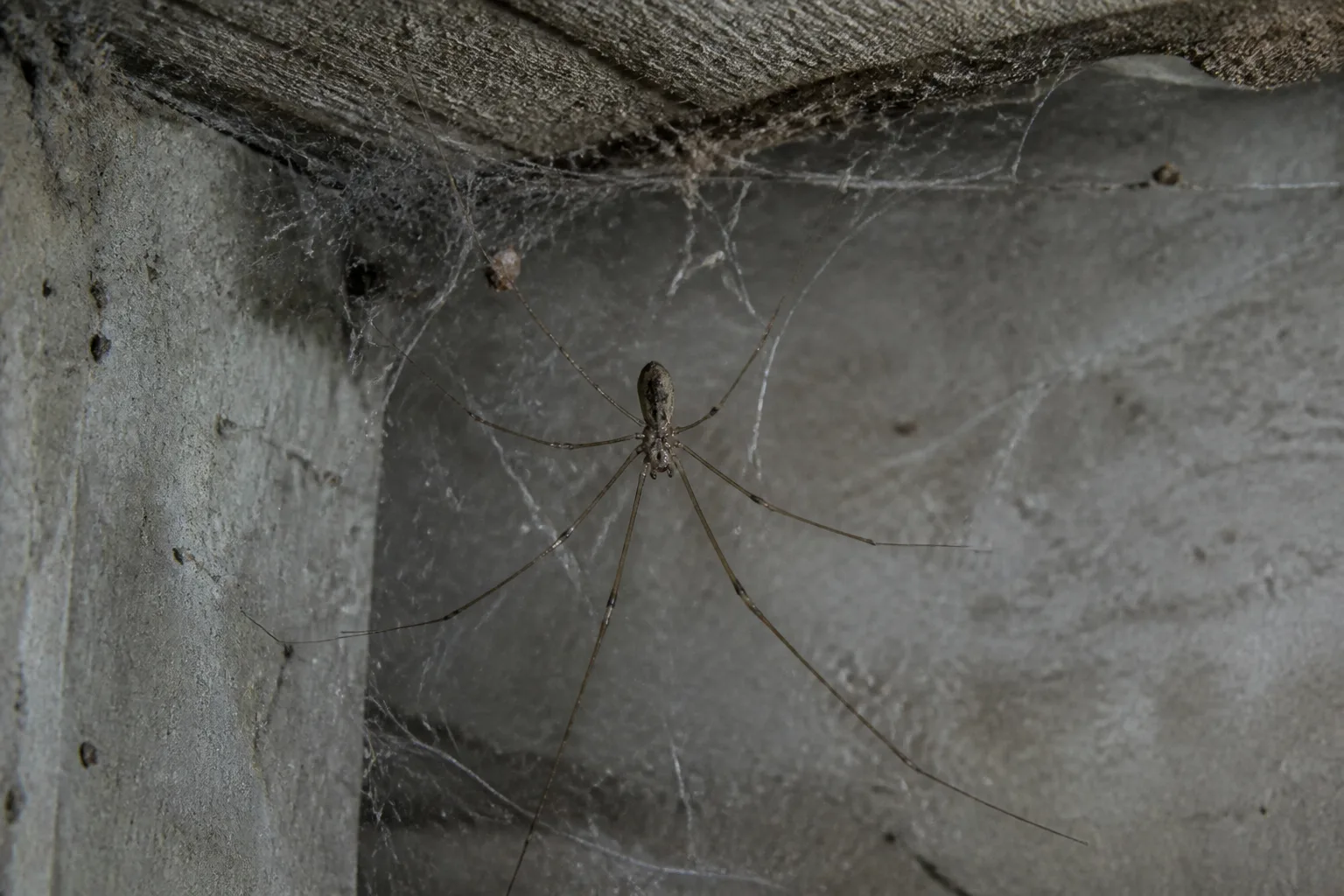
Spiders often eat other spiders. Some hunt across webs, some capture wandering spiders, and some cannibalize smaller members of their own species when the opportunity arises. Cellar spiders are a familiar indoor example: they can enter the webs of other spiders and capture them. A University of Florida IFAS overview of common Florida spiders describes this behavior and distinguishes cellar spiders from harvestmen.
“Daddy longlegs” is an ambiguous common name. It may refer to a cellar spider—a true spider with two main body regions and silk—or a harvestman, which belongs to a different arachnid order and does not spin a prey-catching web. The American Arachnological Society’s FAQ explains the distinction; the claim that any animal called a daddy longlegs is a dependable killer of black widows or other household spiders is too broad to use as pest advice.
Even when one spider eats another, it does not follow that the first will control all spiders in a room. Cellar spiders can leave messy webs of their own, and many spiders are harmless predators of insects. If you want fewer webs in a particular corner, remove them directly rather than preserving a second spider as an improvised exterminator.
Can natural predators control spiders in a house?
Usually, no. Outdoor predators cannot reliably reach spiders in wall voids, storage boxes, basements, or ceiling corners, and deliberately bringing birds, lizards, frogs, centipedes, or scorpions indoors creates welfare and safety problems. A predator may catch an individual spider, but it cannot be scheduled or aimed at the exact place that bothers you.
Spiders may enter a home accidentally, or they may stay where prey and undisturbed hiding places are available. If you see repeated spiders in a room, inspect for small flies or other insect prey, check door sweeps and window screens, and look for cluttered, quiet areas where webs can persist. The North Carolina State Extension guidance on spiders in and around homes recommends sanitation and exclusion because reducing entry points and food sources addresses the conditions that support indoor spiders.
A more reliable indoor plan
Start with the precise location and pattern. A single spider in a bathtub or on a wall may be a wanderer; recurring webs in the same garage corner or window frame point to a sheltered site that can be cleaned and monitored. Avoid assuming that every spider is dangerous based on size alone—accurate identification depends on geography and visible features.
For ordinary sightings, remove the spider and its web with a vacuum or container, then empty the vacuum outdoors. Wipe or vacuum the same corner again if a web returns, and remove egg sacs when you find them. For a non-urgent spider you would rather not kill, UC IPM describes placing a jar over it and sliding stiff paper underneath; do not attempt this with a spider you suspect may be medically significant.
If you are looking at fine webbing on a plant rather than a web in a room corner, check whether the problem is spider mites. They are tiny plant-feeding arachnids, usually found in colonies on leaf undersides, and the stippled or bronzed leaves and dense leaf webbing are different from a hunting spider’s web. The UC IPM spider-mite guide recommends inspecting leaves closely; bird or lizard predators of true spiders are not the control plan for a mite infestation.
Next, seal gaps around pipes, windows, doors, and foundation openings; repair screens and add a door sweep where daylight shows beneath an exterior door. Move stored boxes off the floor, reduce piles near the foundation, and keep outdoor lights from attracting flying insects right beside doors and windows. These steps target access, shelter, and food rather than relying on wildlife to enter the house and find the spider.
If spiders are numerous or you cannot confidently identify one of concern, take a clear photo from a safe distance and ask a local cooperative extension office, university diagnostic service, or licensed pest professional for identification. In regions with medically important spiders, do not reach blindly into wood piles, shoes, stored boxes, or webbed corners; wear gloves when moving outdoor debris and follow location-specific guidance.
Should you encourage predators in the garden?
You can make a yard friendlier to native wildlife, but do it for biodiversity rather than as a spider-removal promise. A garden with flowers, shrubs, leaf litter, and undisturbed cover supports many connected species, including predators that eat insects and sometimes spiders. The Royal Horticultural Society notes that log piles and longer grass can help attract wildlife; those same features can also provide shelter for spiders, so placement matters.
If webs on a patio rail or around a doorway bother you, remove those webs and trim vegetation that touches the house, while keeping wildlife habitat farther into the yard. Do not clear every corner of the garden in pursuit of a spider-free landscape: spiders themselves catch flies, mosquitoes, and plant-feeding insects. The UC IPM spider guidance emphasizes both sides of that relationship—natural enemies can limit spiders, but spiders also contribute pest control.
Support wildlife without releasing animals
Use regionally appropriate plants, provide safe nesting and shelter where suitable, and avoid routine broad-spectrum pesticide use. Flowering plants can provide nectar for adult wasps, while native shrubs and layered planting give birds places to forage; a small water source can help some wildlife if you keep it clean and prevent mosquito breeding. Change only the habitat you can maintain responsibly, and follow local rules for protected species and wildlife structures.
Keep the habitat at a distance that fits your household. A brush pile or long-grass patch can support wildlife, but placing it beside a frequently used door may also create more sheltered spots close to the building. If your priority is fewer indoor spiders, keep the foundation edge easier to inspect, store firewood off the ground and away from walls, and direct wildlife-friendly planting toward the parts of the garden where it will not conflict with daily use.
Do not purchase or release lizards, frogs, fish, birds, shrews, or other predators. A predator taken from elsewhere may be unable to survive, may carry disease, or may become invasive; its prey preferences will not match a homeowner’s expectations. If an animal is already native to your yard, observe from a distance and let it forage without handling it or applying pesticide nearby.
This is a long-term ecological approach, not a quick treatment. If your actual goal is fewer spiders inside, put your effort into sealing entry points, reducing insect prey around doors, and removing webs from the places you use. If your goal is a balanced garden, allow predators and spiders to occupy their own habitat rather than trying to engineer one species to eliminate another.
Conclusion
Natural predators of spiders include specialized wasps, birds, lizards, frogs, fish, shrews, centipedes, scorpions, and other spiders. Each acts in a particular habitat, and a striking observation—such as a gecko catching a spider or a bird pulling one from a web—does not prove that the predator will control spider numbers across a property.
For outdoor gardens, support native biodiversity and accept that spiders are also useful predators. For spiders in the house, take direct steps: remove webs and egg sacs, reduce hiding places and insect prey, seal likely entry points, and seek local identification help when safety is uncertain. Natural predation belongs in the food web; reliable home management comes from changing the conditions that let spiders settle indoors.



