How to Grow and Care for New Zealand Tea Tree Plants
New Zealand tea tree rewards sunny sites and free-draining soil. Learn when to water, how to prune, which cultivars fit pots, and how to protect it from frost.
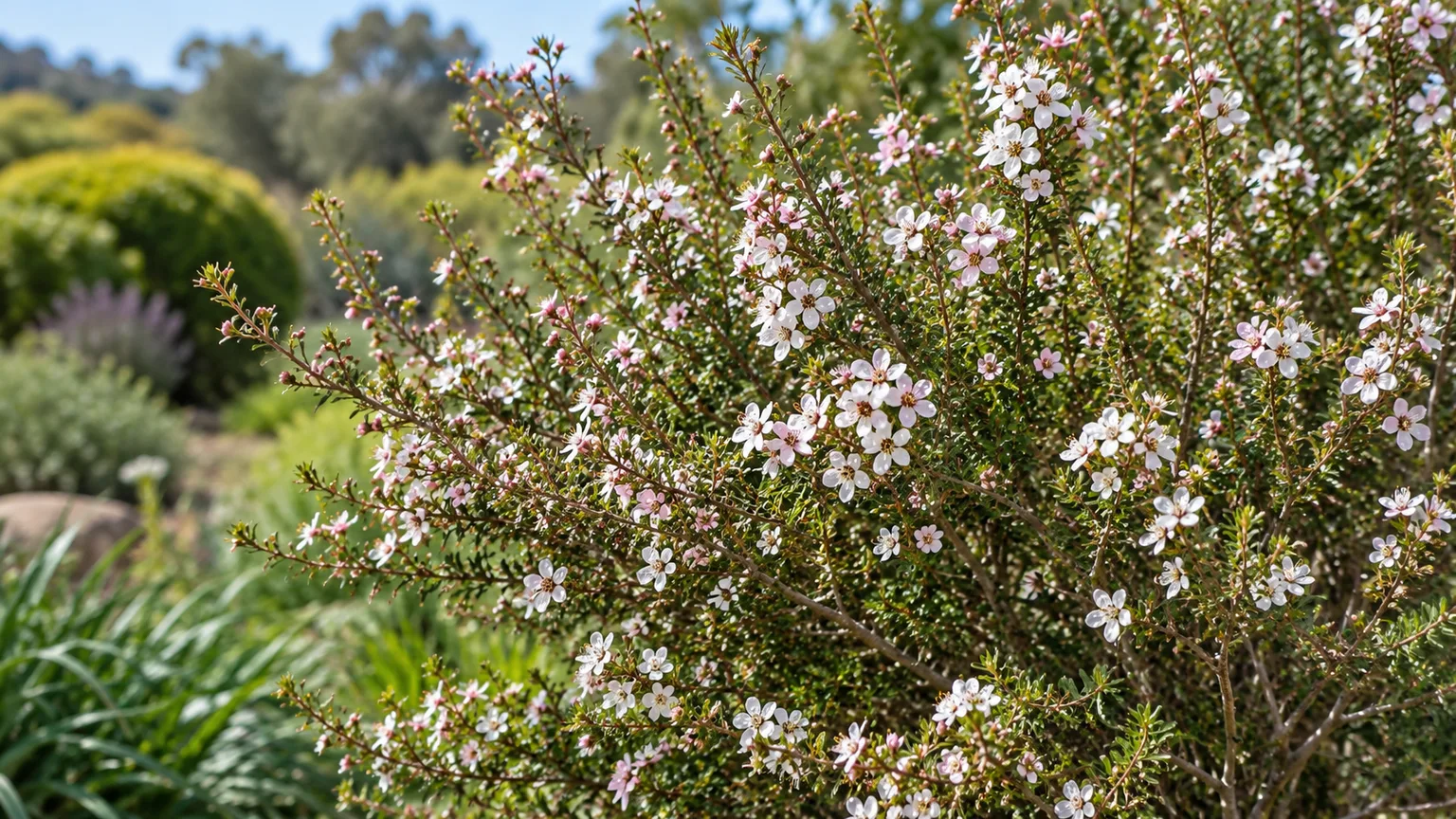
New Zealand tea tree, or mānuka, is an evergreen shrub with small, aromatic leaves and white, pink, or red flowers. Its neat, fine-textured foliage makes it useful as a specimen, informal screen, or container accent, but the plant is not equally easy in every climate. The two decisions that matter most are whether your winters suit the cultivar and whether water can drain quickly from its roots.
The botanical name is Leptospermum scoparium. It is native to New Zealand and southeastern Australia, where the shrub can vary from a low, compact form to a larger, upright plant (RHS; Australian National Botanic Gardens). Treat the common name as a starting point, not a care instruction: identify the species on the nursery label, check the named cultivar’s mature spread, and confirm that it is suitable for your region before planting.
Start with the site: is mānuka a good fit?
New Zealand tea tree is a good choice when you can offer a bright, open site with fast-draining soil and a mild enough winter for the cultivar you buy. It tolerates some variation in soil and can handle dry spells once established, but it is not a shrub to install in a low spot that stays wet after rain. Poor drainage can turn an otherwise resilient plant into a root-rot problem.
Before buying, answer three questions: Does the site get several hours of direct sun? Does water drain away instead of collecting around the root ball? And can the plant reach its full labeled width without being squeezed against a wall, path, or neighboring shrub? If one answer is no, consider a raised planting area, a large pot, or a different plant better adapted to the site.
Identify the plant and its mature size
A typical mānuka has narrow, small leaves on fine, twiggy branches. The flowers may be single or double and range from white and pale pink to deeper red, depending on whether you have a straight species plant or a selected cultivar. The Australian National Botanic Gardens describes the species as a shrub often around 2 meters tall and wide in cultivation, while the Missouri Botanical Garden lists many garden plants at 6 to 10 feet in both height and spread. Those numbers are useful estimates, not a promise: climate, cultivar, and pruning change the final shape.
“Tea tree” is used for more than one plant. Leptospermum scoparium is not Melaleuca alternifolia, the Australian tea tree associated with tea tree oil. The leaves of mānuka have historical uses, but a plant bought as an ornamental is not automatically an identified or prepared food or remedy. Grow it for its flowers and foliage, and do not assume the common name makes it safe to brew or apply.
Choose sun, shelter, and spacing
Full sun gives the most reliable flowering and a dense, well-branched outline. Light shade can be tolerated, especially where afternoons are intensely hot, but deep shade often produces a leafy shrub with fewer flowers and looser growth. The RHS recommends growing the species outdoors in full sun and a sheltered position; the Missouri Botanical Garden likewise lists full sun as the preferred exposure.
Shelter means protection from harsh, drying wind and from the coldest exposure, not a dark corner under a roof. A warm wall can help in a marginal climate, but leave enough air circulation around the plant so foliage dries after rain. Use the cultivar’s mature spread for spacing rather than planting every mānuka at a fixed distance; many standard forms need several feet of room on all sides, while compact or prostrate selections are different.
If you garden outside the plant’s reliable hardiness range, a pot offers control but does not turn mānuka into a year-round indoor houseplant. In a colder region, plan a bright, cool, protected winter position before buying. A warm, dim room is a poor substitute for the bright outdoor conditions the shrub prefers.
Prepare a fast-draining planting site
Mānuka grows best in soil that drains freely; acidic to neutral soil is a safe general target. The RHS notes that the species can grow in well-drained soil across more than one pH and texture, while the Missouri Botanical Garden favors acidic, fertile, well-drained soil and specifically warns against heavy, poorly drained ground. The practical point is drainage first: do not try to solve compacted or waterlogged clay simply by mixing a little sand or compost into the planting hole.
Check the site after a normal rain. If water remains pooled or the soil stays saturated, plant on a broad raised mound or in a raised bed with an open path for excess water to escape. A narrow pocket of amended soil in dense clay can act like a bathtub, keeping the roots wetter than the surrounding ground. If the whole area is poorly drained, choose a container instead.
Dig a hole no deeper than the root ball and wider enough to loosen the surrounding soil. Set the shrub so the top of its root ball sits level with, or just slightly above, the surrounding grade; planting the crown too deep can hold moisture against the base. Backfill, water to settle the soil, and add a modest mulch layer while keeping mulch clear of the stems. Avoid routine fertilizer in the planting hole, which can stress new roots and is unnecessary when the soil is already suitable.
Water differently while it establishes
Water a newly planted shrub thoroughly, then check the root zone before watering again. During establishment, the original nursery root ball and the surrounding soil can dry at different rates, so feel both rather than judging by the surface. The aim is even moisture while roots expand, not constantly wet soil. UC Master Gardeners in San Luis Obispo recommend summer irrigation during the first two years, while noting that established tea trees need little supplemental water when local rainfall and soil conditions are adequate.
After establishment, water during extended dry weather when the root zone is genuinely dry. A deep soak is more useful than frequent splashes that wet only the top layer. Sandy soil, heat, wind, and a plant growing beside pavement can shorten the interval; heavy soil or cool, rainy weather lengthens it. Use the plant and the soil as your guide instead of following a fixed weekly schedule.
A wilted mānuka does not automatically need more water. If the soil is dry several inches below the surface, water slowly and deeply; if it is wet, stop irrigating and investigate drainage or root damage. Adding water to a plant with rotting roots can make the collapse worse. The Missouri Botanical Garden identifies root rot as a risk in overly moist soil, which is why checking moisture before responding to wilt is important.
Protect it through cold and seasonal shifts
The Missouri Botanical Garden lists L. scoparium for USDA Zones 9–10. That range is a useful baseline, not a guarantee for every plant sold under the common name. A named cultivar, exposure, duration of cold, wind, soil moisture, and whether a plant is newly planted can change the result. The RHS uses its own UK hardiness scale, so those ratings cannot be translated directly into USDA zones.
In a mild-winter garden, plant in spring or early fall when roots can settle before heat or cold stress. In a marginal location, choose a sheltered spot, protect a young plant during unusual cold, and avoid cold, wet soil around its crown. Do not assume that a zone number alone accounts for a windy hilltop or a frost pocket.
In colder regions, grow a compact cultivar in a container and move it before a hard freeze to a bright, cool, frost-protected place. Keep the mix just lightly moist through winter; the shrub uses less water in cool conditions, but the root ball should not dry to dust. Return it outdoors gradually after the danger of severe frost has passed. A container that is too large to move or a dim heated room may make this strategy impractical, so decide on winter logistics before you choose the pot-grown route.
Grow New Zealand tea tree in a container
A pot works best with a compact cultivar, a sunny position, and a mix that drains freely. Check the label for mature size because a species plant or vigorous cultivar can eventually outgrow a patio container. Choose a sturdy pot with several open drainage holes and enough volume to support the shrub without making the pot so large that wet mix lingers around a small root system.
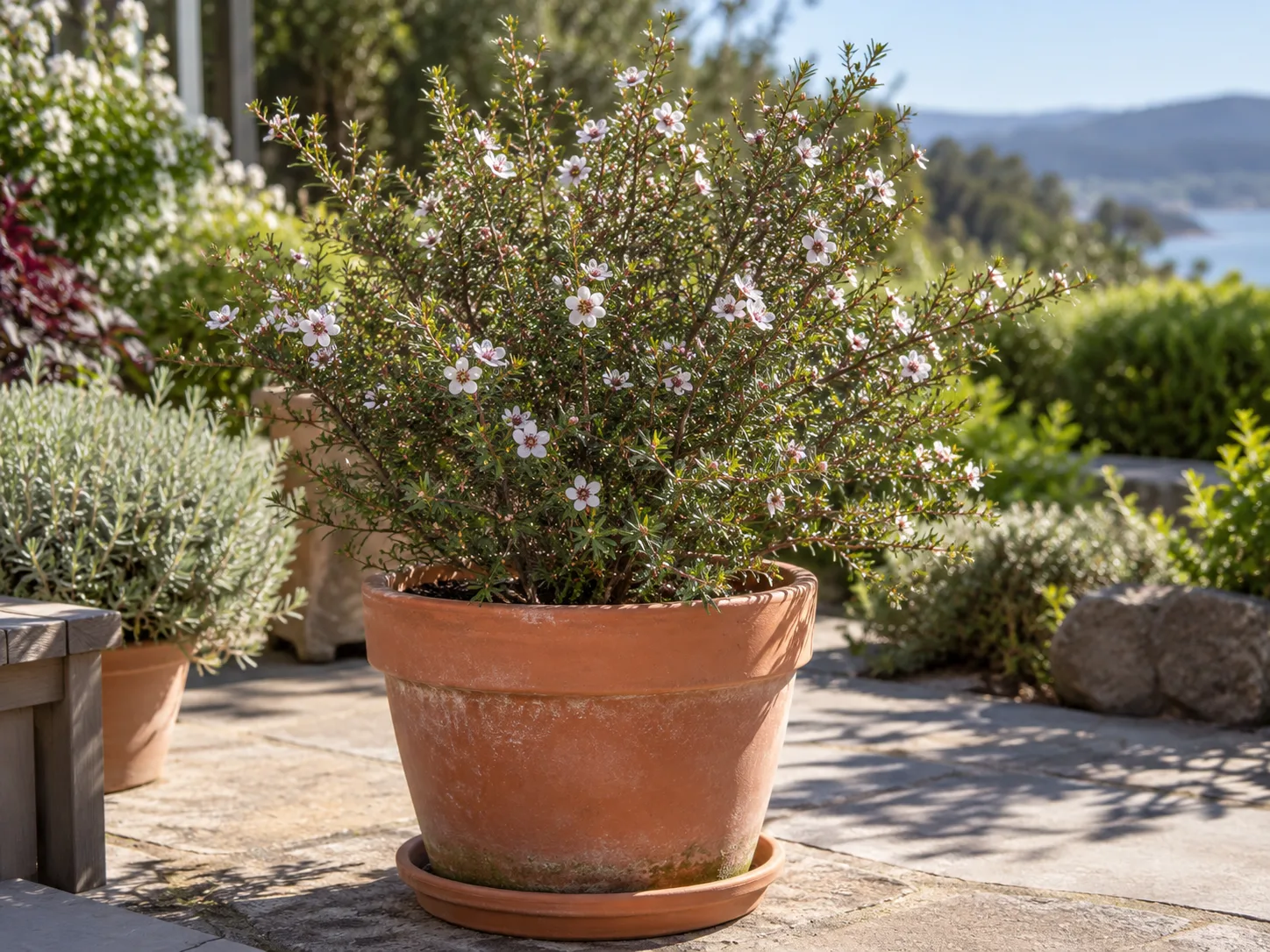
Use a quality container mix suited to shrubs that prefer acidic to neutral conditions, and improve drainage only with ingredients appropriate for container use. Do not put a layer of gravel at the bottom: it does not repair a mix that holds too much water, and it reduces usable root space. Set the plant at the same depth it grew in its nursery pot and water until excess drains from the holes.
Containers dry faster than garden soil, especially in hot weather and wind. Check the mix with a finger or moisture probe below the surface and water thoroughly when the root zone is drying, then empty any water left in a saucer. In winter, reduce watering as growth slows, but do not let the root ball become bone dry. Repot when roots fill the container or water runs straight through without wetting the mix; move up only enough to give the roots fresh room, rather than jumping to an oversized tub.
Feed lightly, if at all
An established shrub in reasonably fertile ground often needs no routine feeding. If growth is weak, first check drainage, sun, pH, and root health; a fertilizer cannot fix a plant whose roots are suffocating or whose site is too shaded. A thin spring layer of compost or a modest, label-directed feed is usually safer than repeated high-nitrogen applications.
Too much nitrogen can push leafy growth at the expense of flowers and may leave tender growth more vulnerable to cold. Container-grown plants lose nutrients as water drains through the mix, but that does not mean they need a strong feed every month. Use the potting mix or product label, feed only during active growth, and stop before the plant enters its cool-season rest.
Prune after flowering without cutting too hard
Prune soon after flowering, while there is time for the shrub to make and mature new growth before cold weather. Remove dead or damaged branches first, then shorten fresh growth lightly to shape the plant or keep it compact. The Australian National Botanic Gardens notes that tip pruning after flowering improves vigor in many Leptospermum species, and UC Master Gardeners advise shaping young plants while avoiding bare wood.
Make cuts just above leafy growth rather than shearing deep into an old, leafless framework. Mānuka may not reliably push new shoots from bare old wood, so a hard cut can leave permanent gaps or an uneven silhouette. If a shrub has become too large, reduce it gradually over more than one season only where there is living foliage to cut back to; replacement with a smaller cultivar is often more predictable than drastic renovation.
Regular light shaping while a plant is young helps preserve foliage low on the shrub and prevents the need for severe pruning later. Avoid pruning before flowering if you want the full display, because the buds form on growth produced during the previous season. Do not use pruning as a substitute for choosing a cultivar whose mature size fits the site.
Propagate the species or preserve a cultivar
The propagation method depends on whether you want any mānuka seedling or an exact copy of a named selection. Seed is appropriate for the straight species and for experimentation, but seedlings vary. A cutting is the better choice when you want to retain a cultivar’s flower color, flower form, or compact habit; the Australian National Botanic Gardens specifically notes that cultivars need vegetative propagation to preserve their clonal characteristics.
Sow mānuka seed
Mānuka seed forms in woody capsules that can stay on the branches after the flowers fade. Tāne’s Tree Trust advises collecting capsules that are splitting or nearly open and keeping the extracted seed dry and cool until sowing. If you are collecting seed rather than buying it, confirm the parent plant’s identity and make sure seed collection is permitted where you live.
Sow in a clean tray filled with a fine, free-draining seed-starting mix. New Zealand’s Ministry for Primary Industries seed guide recommends pressing mānuka seed into the surface without covering it, because germination is reduced in darkness. Distribute the tiny seeds thinly and water with a fine spray so they do not wash into a clump. Keep the mix evenly moist but not waterlogged, and give seedlings bright light after emergence. Germination can be uneven, so do not discard a tray too quickly if only part of the seed batch sprouts.
Pot seedlings individually once they are large enough to handle without damaging the stems. Grow them on until the roots hold the mix together, then harden them gradually to outdoor conditions. Seedlings may not match the parent’s flower color or mature form, and flowering may take time. For a specific double-flowered or dwarf cultivar, buy a labeled plant or root a cutting from a correctly identified parent.
Root semi-hardwood cuttings
Take semi-hardwood cuttings in the growing season from healthy, non-flowering shoots that have begun to firm but are not fully woody; the RHS propagation guidance recommends rooting semi-ripe cuttings with bottom heat in summer. Cut several pieces because not every cutting roots. Use clean pruners, remove leaves from the lower portion, and make a fresh cut just below a node. A rooting hormone is optional; use it only according to its label.
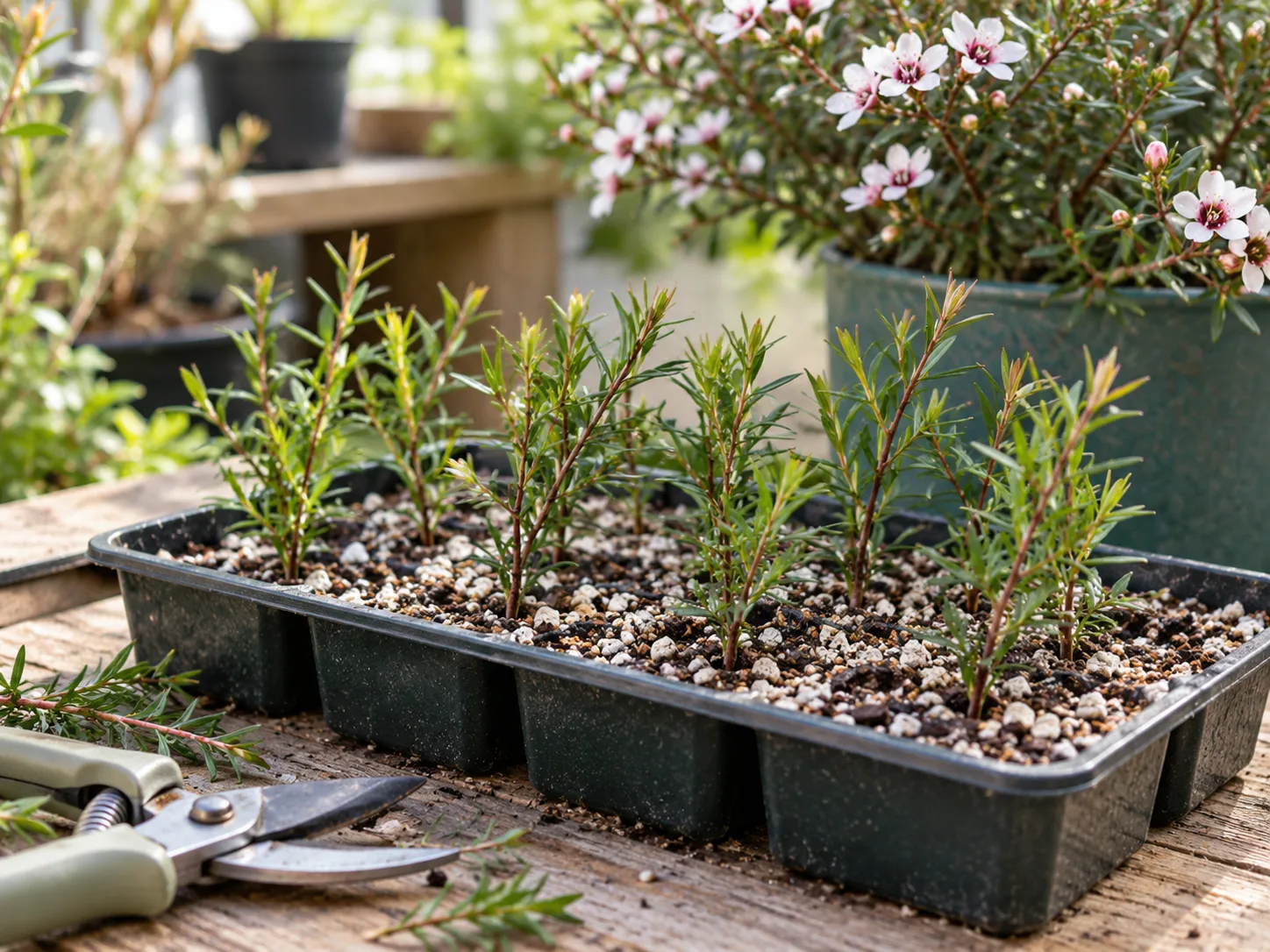
Insert the cuttings into a moist, sterile, free-draining propagation medium such as a perlite-rich mix. Set them deep enough to remain upright, but keep foliage above the surface. Cover the tray loosely to hold humidity, ventilate it so condensation does not stay heavy, and place it in bright indirect light rather than hot direct sun. The medium should stay lightly moist, never saturated.
Check for resistance with a gentle tug after several weeks rather than repeatedly pulling cuttings from the mix to inspect them. Once roots have formed and new growth is steady, pot each cutting separately and acclimate it slowly to outdoor sun and wind. Keep the young plant protected through its first cold season if your climate is marginal. A cutting is a clone of its parent; it does not make the parent plant safer to grow in a region where the species is considered invasive.
Choose a cultivar by size, flower, and climate
Choose the plant by mature dimensions first, then flower color. Leptospermum scoparium includes forms ranging from low, spreading selections to upright shrubs, and Landcare Research’s cultivar key describes substantial variation in flower color, petal form, and growth habit. A plant sold simply as “tea tree” may not tell you enough to plan spacing or winter care.
For example, the RHS lists ‘Red Damask’ as a dense, medium-sized shrub with deep-red double flowers, a mature size around 1.5–2.5 meters, and an H4 rating in UK conditions. The UK rating is not a direct USDA-zone equivalent. If you want a pot plant, look for a named compact or Nanum-group selection and ask the nursery for its mature width, not just the pot size at sale.
Compare several labels before purchasing. Look for a clear botanical name, cultivar name, expected height and spread, and a hardiness statement tied to your climate. If the nursery cannot identify the selection, treat its size and cold tolerance as uncertain and avoid placing it where a large mature shrub would be a problem. Trusted gardening coverage such as Fine Gardening’s discussion of Australian shrubs also emphasizes selecting tea tree cultivars for habitat and garden use rather than assuming all forms perform alike.
Troubleshoot yellowing, wilting, and few flowers
Mānuka problems are easier to solve when you look at the whole plant and its root zone, not just one leaf. Note whether damage affects new or old foliage, whether the soil is wet or dry, how recently the shrub was planted, and whether symptoms began after a cold snap or heat wave. Correct the site or water issue before applying fertilizer or pest treatments.
Check drainage before treating yellow or wilted growth
Yellow leaves can follow wet roots, alkaline soil, nutrient unavailability, or general stress. Start by checking the moisture several inches down and whether water drains from the site or pot. If the soil stays wet, pause irrigation and improve drainage or move a container to a brighter, better-aired location. Do not add fertilizer to a shrub with damaged roots.
If the ground is well drained but growth remains pale, test soil pH before trying to make it more acidic. The RHS lists the species across multiple soil pH categories, while the Missouri Botanical Garden recommends acidic soil; that difference is a reason to test and follow the cultivar’s local guidance rather than adding sulfur blindly. A test also helps distinguish a pH problem from a shortage that needs a specific nutrient.
Wilting in dry soil calls for a thorough watering and follow-up checks; wilting in wet soil calls for less water and a drainage inspection. If stems are dying back, scratch a small area of bark on an affected twig to see whether living green tissue remains, then prune only to healthy, leafy growth. When decline continues despite corrected conditions, consult a local extension or nursery professional who can inspect the roots and site.
Solve poor flowering by correcting the growing conditions
Sparse bloom usually points to insufficient direct sun, pruning at the wrong time, a recent move, or excess feeding. Give the plant a full season after transplanting before judging its flowering; root establishment may take priority over flowers. If it receives only a few hours of sun, moving it to a brighter location may help more than feeding it.
Pruning before or during bud development can remove the next flush of flowers. Shape the shrub after bloom and retain leafy growth below every cut. If the plant is healthy but still does not flower, review its cultivar, age, exposure, and recent fertilizer use together. Avoid “bloom booster” products as a first response; they cannot replace light or repair damage from hard pruning.
Webbing caterpillars, scale, and borers are possible pests. Inspect the plant closely for silk-bound leaves, clusters of small insects, sticky residue, or sawdust-like frass in branch forks. Remove small infestations by hand where practical, improve plant health, and identify the pest before using any treatment. The Australian National Botanic Gardens notes webbing caterpillars and scale among problems seen on some Leptospermum; pest pressure depends on local conditions.
Check local invasive-plant guidance
New Zealand tea tree is native to New Zealand and southeastern Australia, but native status does not follow the plant into other countries. The Missouri Botanical Garden notes that it has escaped cultivation and naturalized in parts of Hawaiʻi. Hawaiʻi Invasive Species Council materials identify Leptospermum scoparium as an aggressive weed tree on Oʻahu and Lānaʻi, so gardeners on those islands should not plant or distribute it without checking current local guidance.
Elsewhere, look up the botanical name in your state, county, or regional invasive-plant list before planting, especially in islands, coastal areas, or places with a similar mild climate. Do not rely on a cultivar’s low seed production as proof that it cannot spread. If it is restricted or an ecological concern in your area, choose a suitable locally recommended alternative.
Use it as a specimen, informal screen, or pollinator shrub
A single mānuka can anchor a sunny border where its evergreen foliage keeps the space structured outside bloom season. An informal screen works only when the chosen cultivar has enough mature width and you can leave room for air and light; a tight hedge that requires repeated hard shearing is a poor match for a shrub that should not be cut back into bare wood. For a small garden, a compact cultivar in a container can provide the same floral detail at a manageable scale.
Flowers provide nectar that attracts bees and other pollinators, and woody capsules can remain after bloom. Fine Gardening highlights tea tree cultivars as useful in habitat-oriented planting, while the RHS describes the species as an evergreen shrub with spring and summer flowers. Pair it with other plants that tolerate sun and free-draining soil rather than placing moisture-loving plants in the same irrigation zone.
Conclusion
New Zealand tea tree is easiest to grow when the site suits its climate and water drains freely. Give it bright sun, shelter from harsh exposure, enough room for the cultivar’s mature size, and regular checks while it establishes; reduce watering once roots are settled and prune lightly after flowering while leafy growth remains below each cut.
For colder climates, make overwintering part of the plan and choose a compact cultivar only if you can provide a bright, protected place. For named flowers or a reliably small form, buy a labeled selection or propagate it by cuttings. Before planting anywhere outside its native range, check local invasive-plant guidance. Those choices do more to keep mānuka healthy than a rigid watering calendar or heavy pruning ever will.



