How to Avoid Tacky Holiday Yard Decor
Learn how to plan cohesive outdoor holiday decor that looks good in daylight and at night, with designer-backed rules for scale, lighting, and placement.
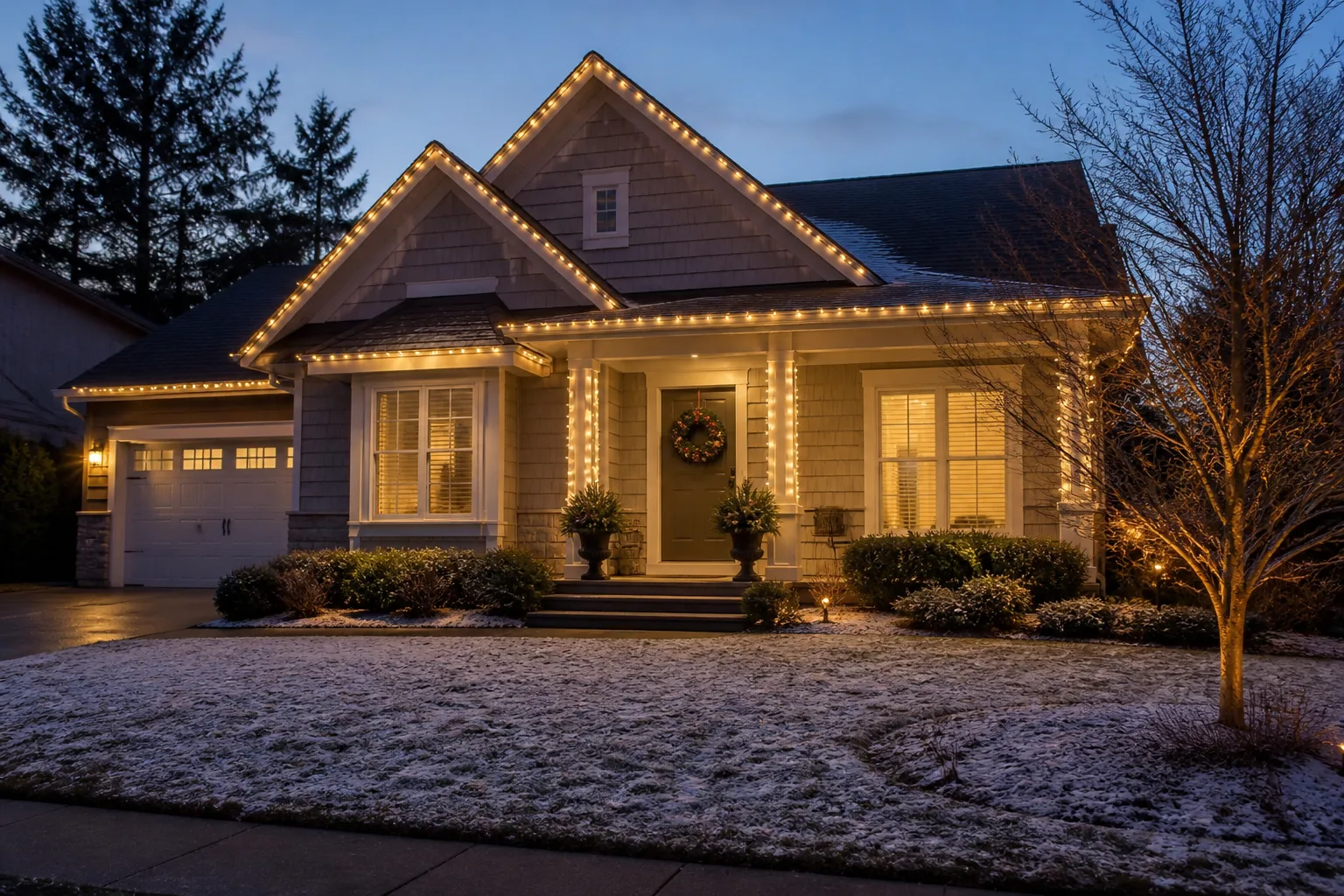
The fastest way to make holiday yard decor look tacky is also the most common: add one more thing. Another inflatable. Another color. Another light strand across a bush that was already doing enough. By the time you step back, the yard is loud at night and awkward in daylight—and you are not sure which piece pushed it over the edge.
Interior designer Alexzandra Aguirre of Phoenix Interior Design and landscape designer Chris Turner of Elevate By Design see the same pattern every December. Homeowners start with good intentions, then lose the plot because they are decorating in pieces instead of editing toward one clear idea. The fix is not buying more. It is choosing less, placing it better, and checking the display when the sun is still up.
What Makes Holiday Yard Decor Look Tacky (And What Doesn’t)
Tacky outdoor holiday decor rarely fails because someone loves Christmas too much. It fails because the display has no hierarchy. Every object competes for attention, so nothing reads as intentional. Designers describe the result as visual noise: too many moving parts, too many unrelated characters, and lighting that flattens the architecture instead of framing it.
Festive yards have a focal point and a supporting cast. Tacky yards treat every item like the star. That is the difference between a display that feels collected and one that feels like a clearance aisle exploded on your lawn.
The Difference Between Festive and Chaotic
Chaotic yards mix scale, theme, and finish without a plan. You might see a twelve-foot inflatable Santa beside a delicate birch-branch wreath, candy-cane stakes in a modern gravel bed, and blinking multicolor nets on every shrub. Each piece might be fine on its own. Together they signal that no one stepped back from the curb.
Festive yards repeat a few visual cues: one palette, one level of formality, and one or two moments that deserve attention. Aguirre compares it to interior styling. A room can hold personality, but it still needs a through-line. Outdoors, that through-line might be warm white lights on architecture, natural greenery at the base, and a single playful accent—not five playful accents fighting for airtime.
If you are unsure which camp you are in, walk to the sidewalk and squint. If your eye bounces everywhere, you are in chaos territory. If it lands somewhere and then travels naturally to the front door, you are closer to festive.
Another quick test: photograph your yard from the curb and look at the image on your phone. Screens flatten contrast and reveal clutter your eyes learned to ignore in person. Designers use photos constantly because they strip away the emotional attachment you have to each piece you bought.
Finally, ask whether your display has a foreground, middle ground, and background. Festive yards usually place the strongest moment near the architecture, use mid-height accents along the path or porch, and keep the far lawn simpler. When every zone shouts at the same volume, the composition collapses.
Start With a Plan You Can See in Daylight and at Night
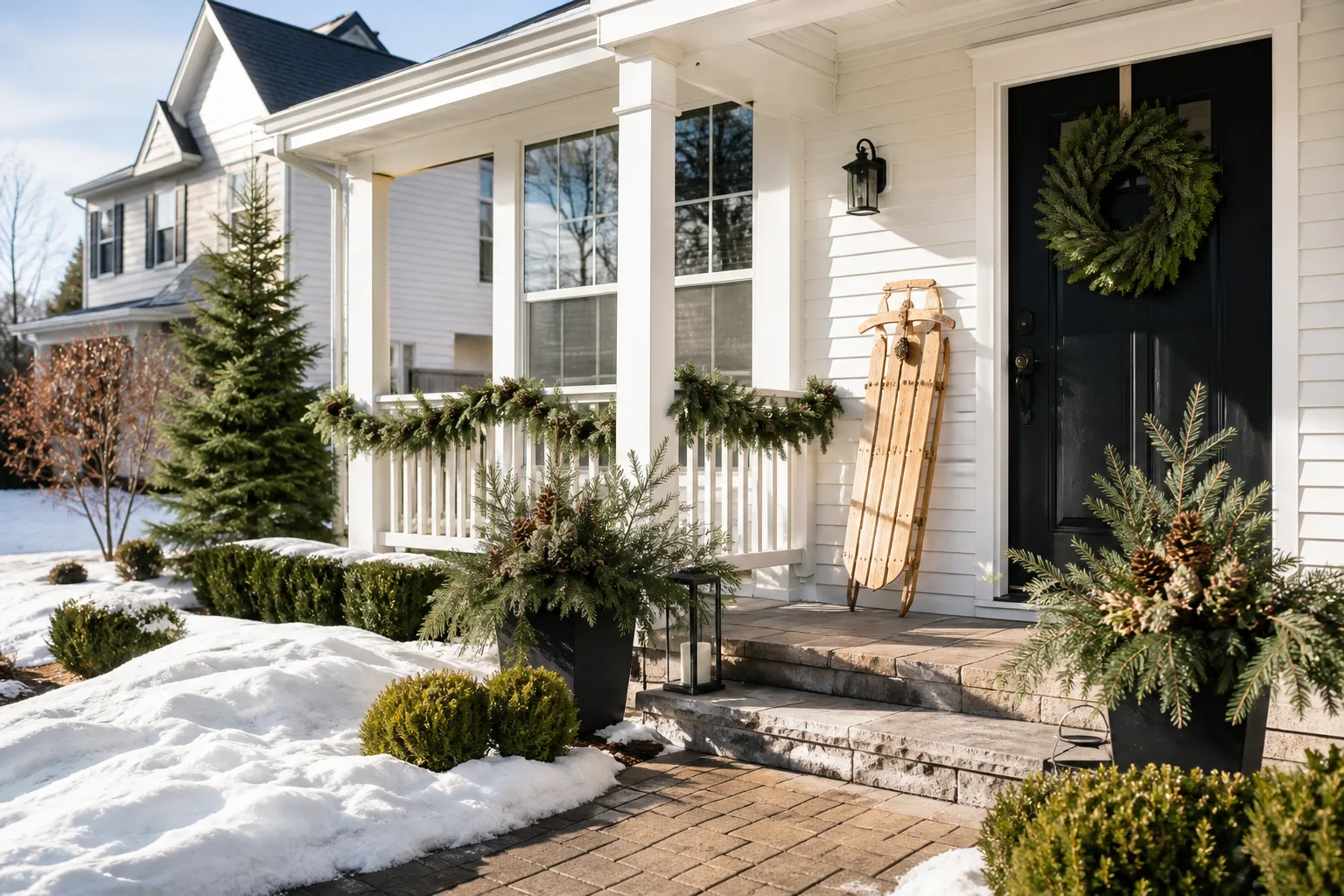
Most yard-decor regret happens because people plan exclusively for darkness. Lights hide a lot. They can make thin materials look magical and crowded layouts feel busy but passable—until morning, when the same yard looks cluttered, faded, or oddly empty in the wrong places.
Aguirre recommends envisioning the arrangement in both conditions before you buy another stake or spool another strand. A display that only works after 5 p.m. is half a display. Your mail carrier, dog walkers, and guests arriving for lunch still see it in natural light.
The Two-View Test Every Designer Uses
Do this before you finalize placement:
- Daylight audit: Stand at the curb around mid-morning. Note faded fabric, cheap plastic shine, empty ground between pieces, cords snaking across beds, and anything that looks like yard clutter instead of decor.
- Night audit: View from the same spot after full dark. Check glare, dead zones, and whether lights draw the eye to your home’s best lines—or to a random bush on the property line.
- Approach test: Walk from the street to the front door the way a guest would. The display should feel welcoming in sequence, not like an obstacle course of stakes and cords.
- Edit pass: Remove the weakest piece and look again. If the yard improves, that piece was noise.
Turner adds a practical rule: if you cannot explain in one sentence what the yard is “about,” the plan needs tightening. “Classic green-and-red with warm lights on the porch” is a plan. “Christmas, but also penguins and also Vegas” is not.
Budget your effort the same way. Aguirre tells clients to decide which view matters most: the street-facing curb shot, the approach from the driveway, or the angle neighbors see from the sidewalk. You do not need to win every angle. You need one strong sightline that repeats your palette and scale choices. Decorating every blank patch of lawn because it exists is how yards tip from generous into chaotic.
Pick One Clear Theme and Edit Ruthlessly
Theme mixing is where good intentions go to die. Turner sees yards that combine reindeer, penguins, candy canes, snowmen, and Santa scenes—all technically winter or Christmas, but visually scattered. The brain reads it as unintentional because the motifs do not share material, color story, or scale.
Aguirre suggests choosing one of three broad outdoor lanes and letting it govern new purchases. That does not mean your yard must look like a catalog. It means new items must earn their place by matching the lane you picked.
Three Outdoor Holiday Styles That Actually Hold Together
Rustic Woodland
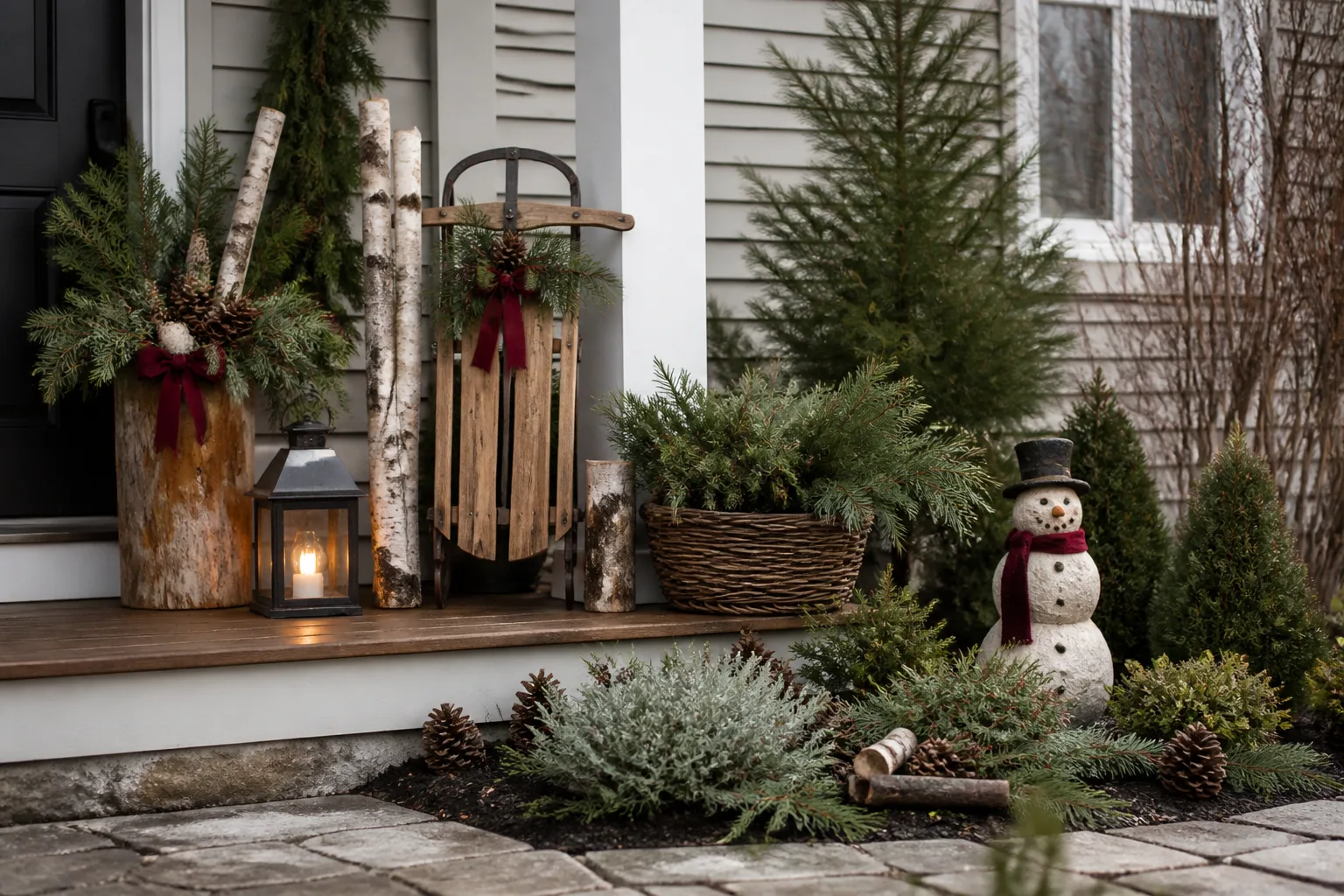
Think natural textures: evergreen boughs, birch logs, wooden sleds, warm bulbs in lanterns, and muted red accents. Inflatables can work here if they are few and tucked near planting beds so greenery grounds the shape. This style forgives imperfection because materials already feel handmade.
Classic Holiday Elegance
This lane favors symmetry, wreaths, garlands, candlelight-toned LEDs, and restrained red, gold, or deep green. Light the roofline and columns; keep lawn ornaments minimal. One polished focal point—a lit doorway, a pair of urns, a single elegant figure—reads richer than a crowd of medium-quality pieces.
Modern Minimal
Crisp geometry wins: single-color LEDs, sculptural trees, black metal frames, or uniform spheres along a path. Skip cartoon characters unless you are deliberately running a playful sub-theme in one zone only. Negative space is part of the look. If your yard already has clean lines and gravel, this theme will feel native instead of forced.
When shopping, ask a simple question: Does this piece belong to the lane I chose? If not, admire it and walk away. The yard you already started is not a thrift store rack. It is one composition.
Within a theme, repeat materials instead of motifs. Rustic woodland can include a deer figure and a pinecone basket if both use natural texture and muted color. It falls apart when the deer is glossy plastic beside a faux-antique lantern beside a neon candy cane. Turner recommends limiting yourself to three recurring materials—such as evergreen, wood, and warm metal—and letting characters be optional extras rather than the main cast.
Scale Your Decor to Your House and Lot
Proportion is the quiet reason some yards look expensive and others look chaotic. A small cottage buried behind a parade of oversized figures reads as accidental, not joyful. A large home with tiny scattered stakes looks unfinished, like you ran out of time.
Measure height against your first story roofline and porch columns. Lawn decor that tops the eaves without a design reason will dominate the scene. Turner recommends keeping tall vertical elements near the architecture—not floating alone in the middle of the lawn unless you are deliberately building a single focal island.
Why Oversized Inflatables Backfire
Inflatables are not the enemy. Low-quality, oversized inflatables in quantity are. Aguirre notes that big blow-ups can swallow a yard’s charm and make the house feel like a backdrop instead of the main event. Wind, deflation, and daytime sagging make the problem worse.
If you love inflatables, use one or two better-made pieces and surround them with real greenery, planters, or subtle ground lighting so they feel anchored. Place them off-center rather than blocking the front walk. A single well-lit snowman beside a porch stair reads charming. Three giants in a row read like a rental lot.
Scale also applies to light density. A short fence line needs fewer bulbs than a two-story wraparound porch. Match energy to structure, not ego.
Wind and weather punish scale mistakes quickly. Oversized inflatables tip, drag anchors through wet soil, and pull extension cords into paths. Turner stores lightweight figures closer to the house or behind windbreak planting when possible. If a piece needs constant reinflation to look respectable, it is working against your curb appeal instead of supporting it.
Light With Restraint, Not Every Surface at Once
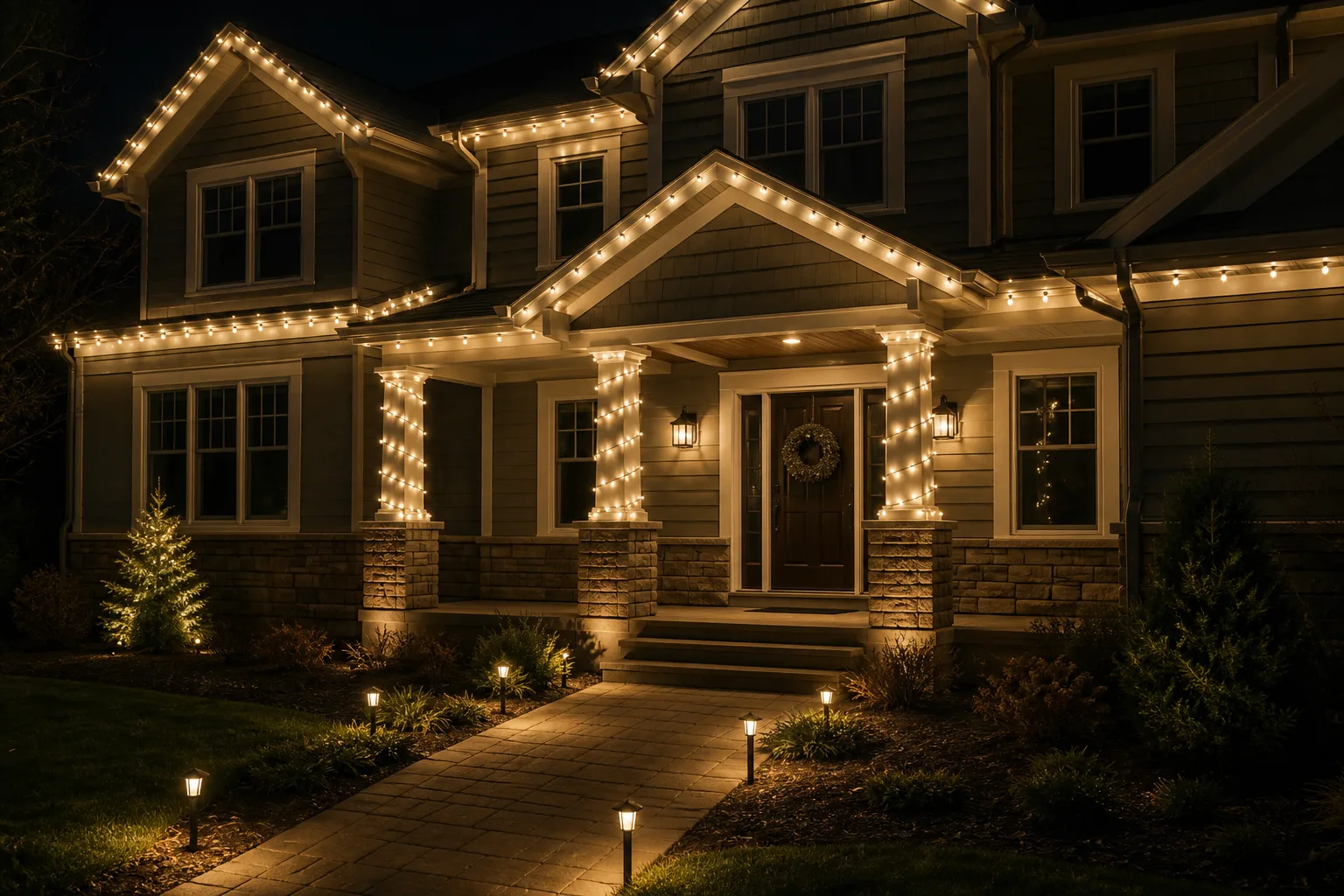
Holiday movies reward excess. Real curb appeal rewards selectivity. Turner compares over-lighting to shouting: every surface lit at equal intensity creates glare, not wonder. The yard flattens into a bright blob, and neighbors notice the light spill more than the composition.
Borst Landscape and other landscape professionals often emphasize highlighting architecture first—roof edges, window frames, columns, and paths—before adding sparkle to random shrubs. Atlantic Hardscape frames the same idea as cohesion: choose a color temperature and repeat it so the display feels designed, not accumulated.
Where to Put Lights—and Where to Stop
Strong outdoor lighting plans usually follow a priority order:
- Roofline and eaves to outline the house
- Front door and porch for guest welcome
- Walkway or stairs for safety and guidance
- One accent tree or anchor shrub if the yard needs vertical interest
- Everything else only if steps 1–4 still look balanced
Stop when adding another strand does not improve the silhouette. If you are lighting bushes because you have extra boxes, you are decorating inventory, not the house.
Frugal Gardening’s holiday lighting roundup makes a useful distinction: one cohesive color can look sophisticated, while mixed flashing colors need a lighter touch and fewer total elements. Warm white on architecture plus a single accent color in the yard often succeeds where full rainbow does not.
If you are torn between white and color, use white on the house and one accent hue in the yard. That hierarchy keeps the architecture timeless while still allowing playfulness near the ground. Reversing the formula—multicolor roofline with plain shrubs—rarely looks as polished because the largest surface becomes the loudest.
Anchor Displays to Your Home’s Architecture
Yard decor looks tacked-on when it ignores the bones of the property. Aguirre advises using porch lines, windows, paths, and garden edges as the skeleton of the display. Decor should feel like it grew from the landscape plan, not like it landed from a moving truck.
That means fewer random lawn stakes and more repetition along existing geometry: garland following a railing, pots flanking the door, lights tracing the roof pitch, a wreath sized to the window behind it.
Porch, Roofline, Walkway, and Garden Zones
Think in zones instead of a free-for-all:
- Porch zone: Wreaths, urns, door decor, column wraps. This is your personality at close range.
- Roofline zone: Clean lines only. This is your signature from the street.
- Walkway zone: Low path lights or uniform stakes for safety. Keep heights consistent.
- Garden zone: Greenery, natural accents, or one figurative piece integrated with planting.
Turner suggests stepping back and checking whether the eye travels porch → path → door. If it detours to a plastic scene on the side lawn, move or remove the detour.
Small homes benefit from concentrating decor near the entry rather than spreading thin accents across a wide lawn. Large homes can carry roofline lighting and symmetrical urns because the facade gives the display a frame. Match symmetry to architecture, too: a centered colonial reads well with balanced wreaths and paired pots, while an asymmetrical craftsman may look more natural with one strong porch moment and a simpler garden bed.
Quality and Condition Matter More Than Quantity
A smaller display of solid pieces beats a sprawling collection of cracked plastic every time. Turner is blunt about condition: broken antlers, faded paint, torn fabric, and half-dead light strands make the whole yard look neglected, even if most items are fine.
Retire pieces that cannot be repaired cleanly. A sentimental decoration with a visible crack can live indoors. Outdoors, weather will widen the damage, and guests will notice the flaw before the charm.
Quality also shows in daylight. Matte finishes, weighted bases, real greenery, and sturdy stakes look intentional at noon. Thin materials that shimmer cheaply under sun undermine the night magic you wanted.
When budgeting, spend on what people see first: the door, porch, and roofline. Secondary lawn accents can be simpler if the architectural layer is strong.
Aguirre also recommends a “one in, one out” rule once the display is up. If a new piece arrives, remove something else rather than expanding the footprint. Yards rarely need more volume. They need clearer hierarchy.
Safety and Practical Checks Before You Flip the Switch
A yard that looks polished but trips a breaker—or worse—is not a win. Holiday displays add electricity, extension cords, and combustible greenery near heat sources. University safety offices treat seasonal decor as a real fire and shock risk, not a footnote.
The University of Idaho Environmental Health and Safety office warns against linking more light strands than manufacturer instructions allow and against running indoor-rated cords or decorations outdoors. UPMC Children’s Hospital winter holiday guidance recommends using lights marked with an independent testing lab seal, checking wires and sockets before installation, using outdoor lights outside only, and plugging outdoor displays into ground-fault-protected circuits.
Practical pre-season checklist:
- Replace frayed cords and cracked bulbs instead of “working around” them.
- Use clips made for lights—not nails through wire insulation.
- Keep cords off walking paths and out of puddles.
- Do not run cords through windows or doors that will pinch insulation.
- Turn displays off when leaving home or going to bed if you can; timers help consistency without all-night waste.
- Secure inflatables and lightweight figures for wind so they do not drag lights down with them.
Safety rules support the aesthetic goal. A clean install with hidden, protected connections looks more professional and lasts longer.
Conclusion
Avoiding tacky holiday yard decor is less about snobbery than about editing. Choose one clear theme, scale decor to your architecture, and run the two-view test in daylight and darkness before you call it done. Light the house first, the whole neighborhood second. Ground playful pieces with greenery and limit their number. Retire broken items without guilt.
Designers like Aguirre and Turner are not asking you to dim your joy. They are asking you to direct it. A yard with one strong idea reads as welcoming, intentional, and memorable. A yard that tries to be every holiday at once reads as noise—and that is the look you can fix this afternoon with a trash bag and a clearer plan.



