How to Identify and Avoid Ragweed
Identify ragweed from seedling to flower, avoid confusing it with goldenrod, and choose safer ways to limit pollen and remove plants before they set seed.
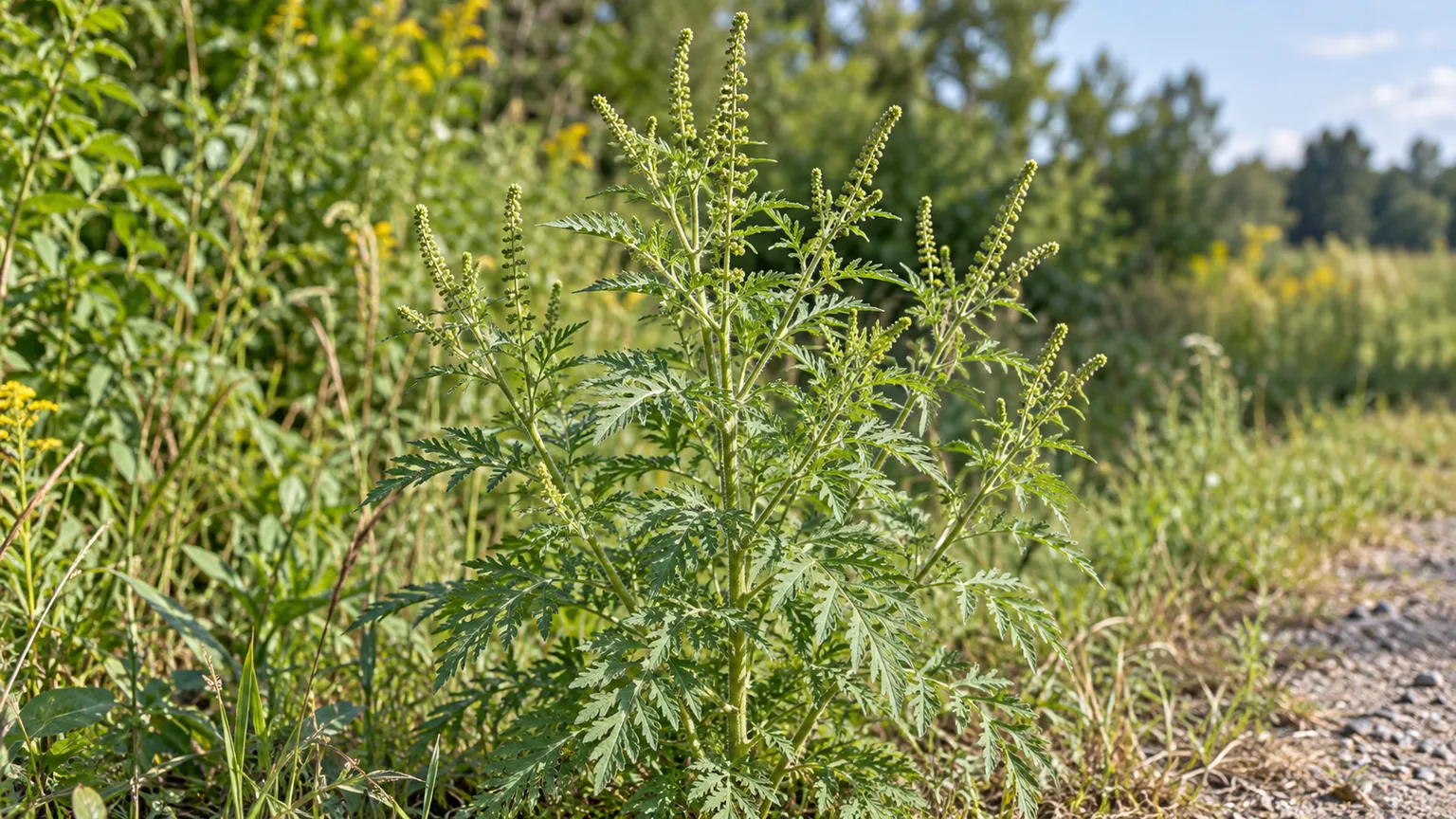
Ragweed is easy to miss until its pollen is in the air. The plant’s flowers are small and greenish, not the bright yellow plumes many people blame for fall sneezing, and the leaves look different on common and giant ragweed. Use more than one feature to check a suspected plant: look at the foliage, stem, flower clusters, and the place where it is growing.
Identification can help you decide whether to remove a weed and how to limit pollen exposure, but it cannot tell you whether you personally have a ragweed allergy. The guide below separates the gardening question from the health question, so you can take a useful first step without treating a visual guess as a diagnosis.
Ragweed at a glance: the fastest reliable clues
Ragweed is the common name for annual weeds in the genus Ambrosia. In much of the United States, the two species gardeners are most likely to encounter are common ragweed (Ambrosia artemisiifolia) and giant ragweed (Ambrosia trifida). Their mature leaves differ, but their flowers share a useful clue: they are small, muted green to yellow-green clusters on upright spikes, rather than conspicuous yellow, daisy-like blooms.
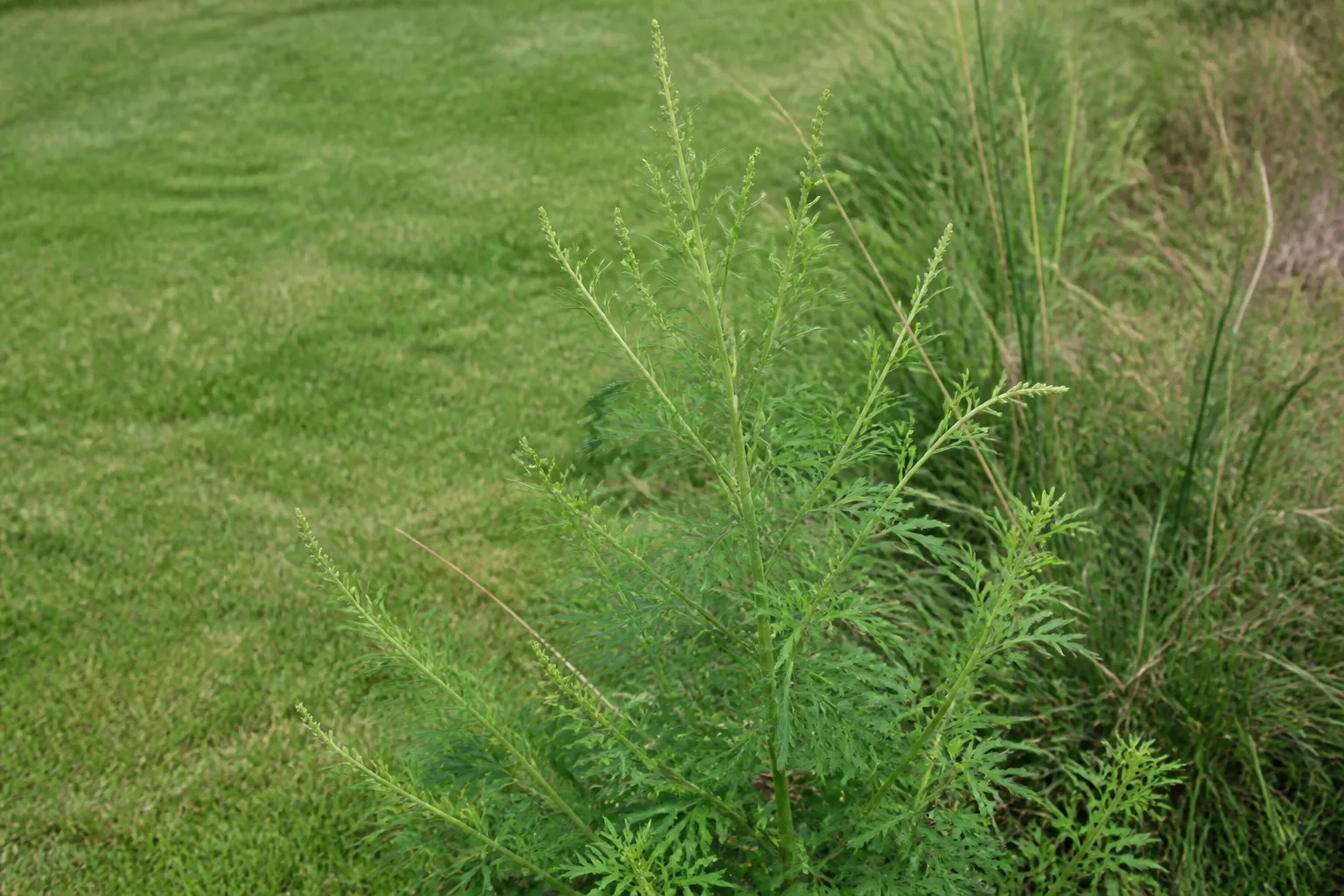
For a quick check, look for a combination of traits:
- Leaves: Common ragweed has finely divided, fern-like foliage. Giant ragweed usually has much larger leaves with three to five broad lobes, like an open hand.
- Flowers: The small, understated male flower heads are carried in spikes near the top of stems. Ragweed does not produce the bright yellow flower sprays associated with goldenrod.
- Growth habit: Plants often branch and form a bushy clump in disturbed soil, such as a field edge, vacant lot, path, or neglected bed.
- Timing: Most ragweed releases pollen in late summer and fall, although the exact period depends on local climate and species.
No single clue is enough. Young plants may not have mature leaves or flowers, and mowing can keep a ragweed plant short enough to hide its usual shape. If the plant matters to your allergy routine or you plan to spray it, compare several features or ask a local extension office for help rather than relying on a phone photo or a single leaf.
Identify ragweed from seedling to mature plant
The best time to identify ragweed is before it flowers, because removing an annual weed before seed production can prevent new plants from appearing in later seasons. That is also when the plant is easiest to pull. Early identification takes attention to leaf shape and arrangement, because the first leaves do not look exactly like the plant’s later growth.
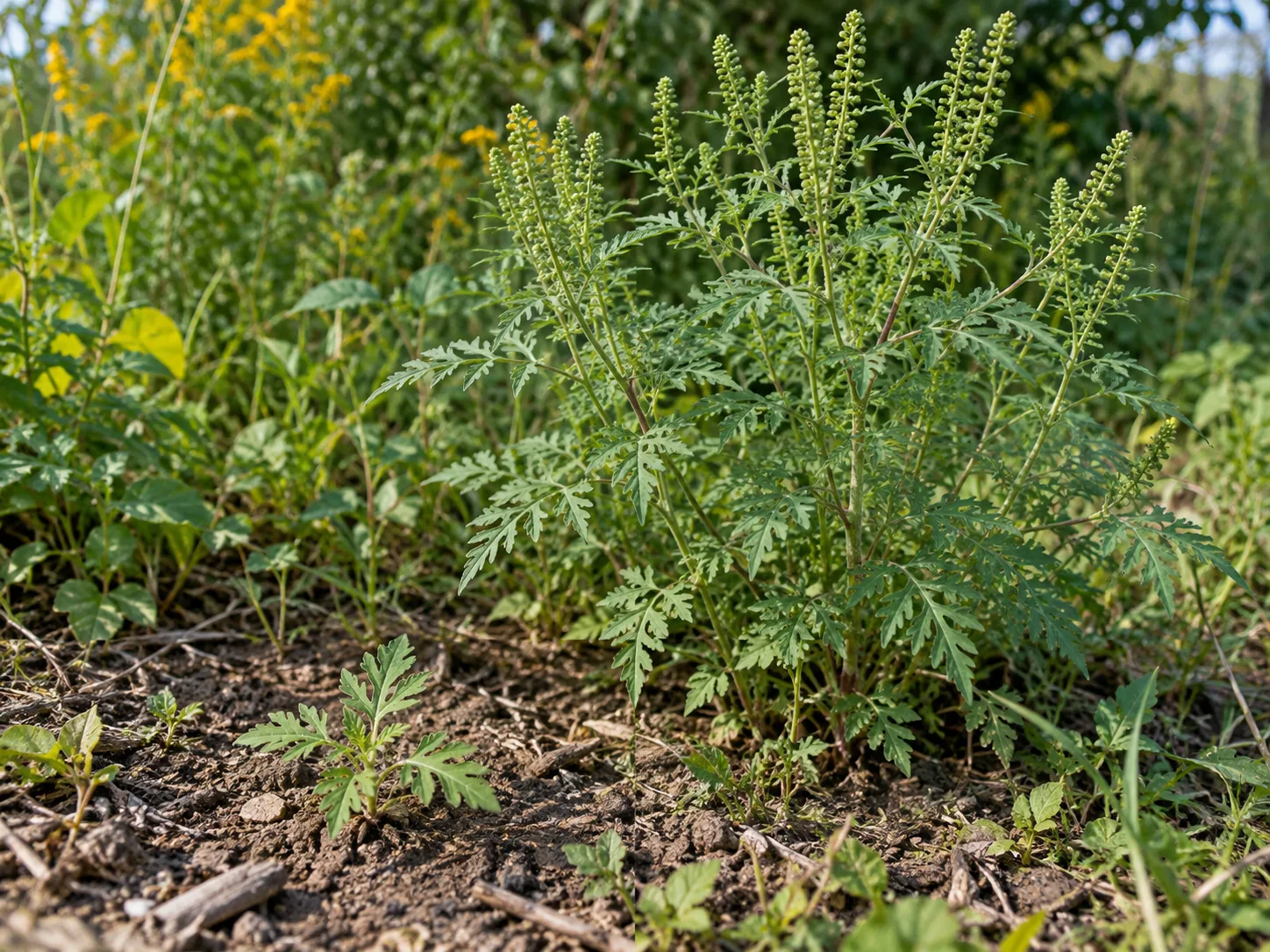
What young ragweed seedlings look like
Common ragweed seedlings emerge in late spring and early summer. At the very earliest stage, they have thick, spoon-shaped seed leaves; the first true leaves are small and hairy and already show the beginnings of the finely cut shape that becomes more obvious as the plant grows.
Cornell’s Weed ID project describes the first true leaves as opposite, while later leaves are alternate. That shift matters: a seedling should not be rejected as ragweed just because its earliest leaf pair does not match the arrangement of an adult plant. Cornell Weed ID
When you inspect a young plant, compare several leaves and check the undersides. Juvenile mugwort can resemble ragweed, but North Carolina State Extension notes that mugwort’s lower leaf surfaces have conspicuous white hairs, while ragweed’s more finely divided leaves lack that white underside. If the plant is tiny, damaged, or growing among similar seedlings, wait for more leaves to develop or seek an extension identification rather than uprooting a wanted plant.
Common ragweed and giant ragweed
Mature common ragweed is usually an upright, branching annual with somewhat hairy stems and deeply divided leaves. Its leaves are fern-like, but not every leaf is equally cut: lower leaves may be more divided, while leaves higher on the stem can be simpler or smaller.
The leaves grow at intervals along the stems rather than forming a single basal rosette. Wisconsin Horticulture Extension’s identification fact sheet and Cornell’s field guide both document these variable features, which is why a plant should be checked as a whole rather than classified by one leaf. Wisconsin Horticulture Extension
Giant ragweed is easier to notice once it has height, but its seedlings can be inconspicuous. Its large leaves are generally broad and palmately lobed, often with three prominent points and sometimes more; the rough, coarse foliage and substantial stem help distinguish it from the finer, lacy look of common ragweed.
In favorable sites a mature giant ragweed can tower over nearby vegetation, yet a plant repeatedly cut by a mower may remain low and branch close to the ground. Height is a clue, not a test: soil disturbance, shade, moisture, and mowing all change how large an annual weed becomes. Northern Gardener notes that ragweed in mowed areas may stay close to the height of surrounding grass.
Both species develop small flower heads on terminal spikes. The pollen-producing male flowers sit high on the plant where wind can carry their pollen; the much smaller female flowers are found lower, close to leaf-stem joints.
Once flowers are present, avoid shaking or handling the upper stems if you are trying to limit exposure. When the flower clusters turn brown and dry, seeds may be maturing, so bag cut material rather than carrying it loosely through the yard. Cornell’s weed profile includes images and life-stage notes for common ragweed and compares its leaves with giant ragweed. Cornell Weed ID
Where ragweed grows and when it releases pollen
Ragweed often gets started where the soil has been opened, moved, compacted, or left bare: garden edges, road verges, empty lots, field borders, riverbanks, construction sites, and thin turf. Its seeds can persist in the soil for years, so a clean patch today does not guarantee the seed bank is gone.
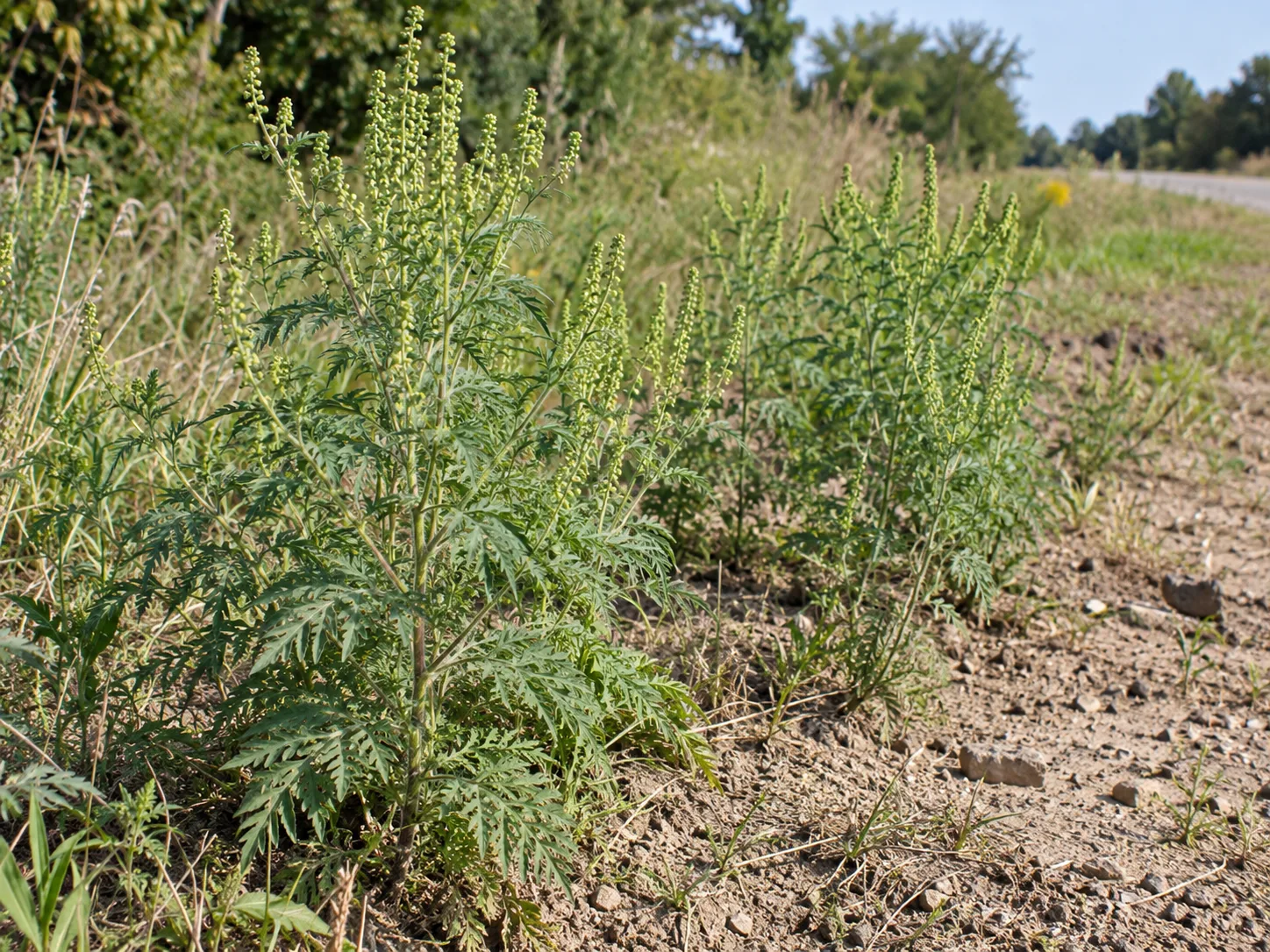
New disturbance can give dormant seeds the light or space they need to germinate. AAFA notes that dormant ragweed seeds can remain in the soil for decades before conditions allow them to grow. AAFA
In much of the United States, ragweed pollen appears from August into the fall and can continue until frost, with many areas seeing a mid-September peak. That is a broad pattern, not a calendar promise: southern and northern locations differ, weather shifts pollen release, and local counts can vary from one neighborhood to another.
The American College of Allergy, Asthma & Immunology (ACAAI) and the Asthma and Allergy Foundation of America (AAFA) both describe a late-summer-to-fall season, with timing that depends on location and conditions. Check a local pollen report for the current day instead of using a national date as your signal. ACAAI and AAFA
A plant can be present before it releases pollen, and pollen can travel beyond the yard where it grew. Removing one patch may reduce a nearby source, especially before flowering, but it cannot clear pollen from the wider air around a home. This distinction keeps yard control realistic: you can prevent a ragweed plant from producing seed and reduce close exposure, while using indoor and outdoor habits to manage pollen arriving from elsewhere.
Ragweed vs. goldenrod: compare the flowers, leaves, and pollen
Goldenrod’s bright yellow sprays often bloom at the same time ragweed pollen rises, which makes goldenrod a convenient but often mistaken target. The plants do not look alike once you compare their flowers and leaves side by side. Ragweed’s flower clusters are small and greenish; goldenrod’s yellow flowers are showy and arranged in plumes, flat clusters, or arching sprays depending on species.
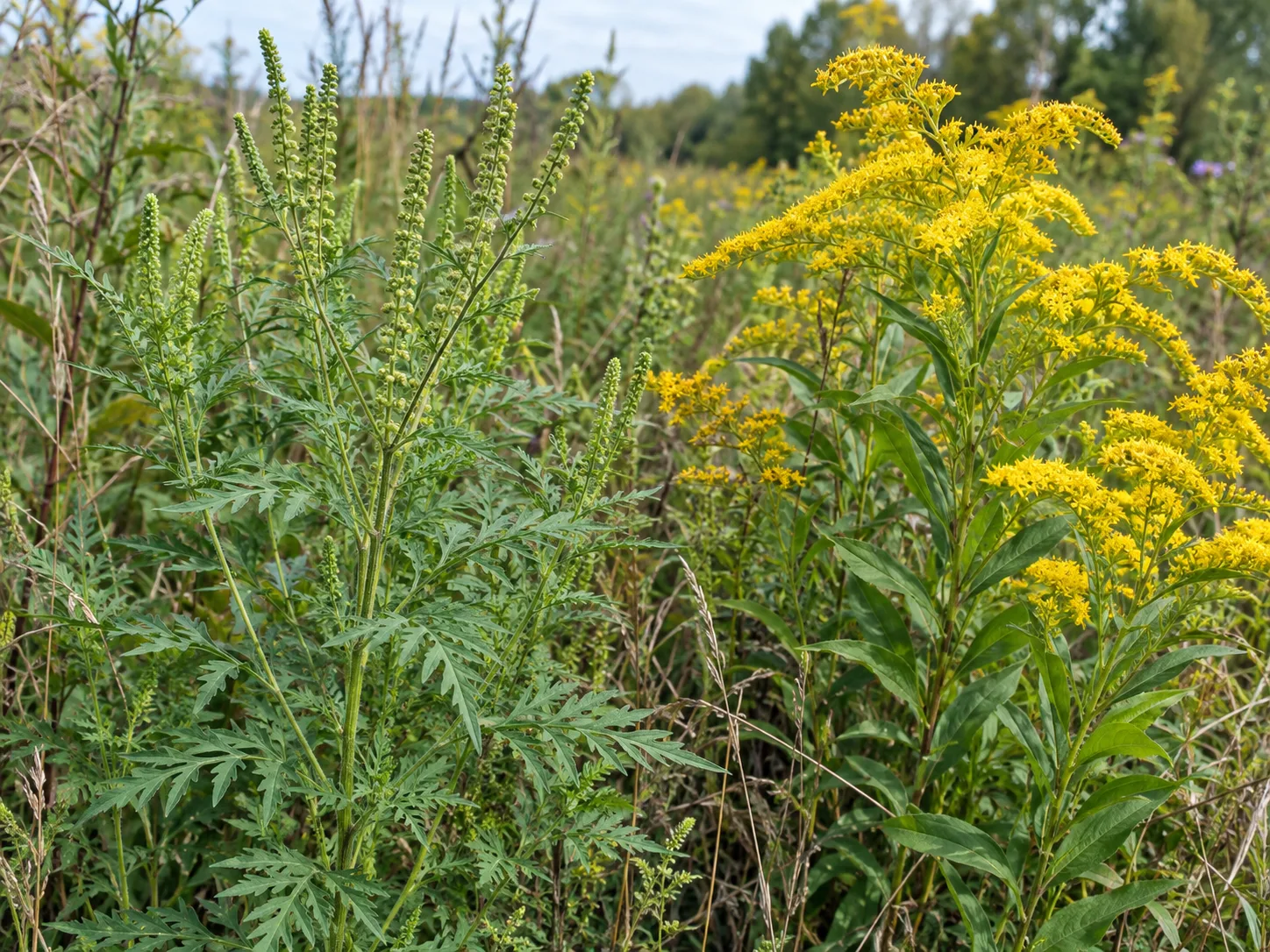
| Feature | Ragweed (Ambrosia) | Goldenrod (Solidago) |
|---|---|---|
| Flowers | Small, greenish clusters on spikes | Bright yellow clusters that are easy to see |
| Leaves | Common ragweed is finely divided; giant ragweed has broad lobes | Usually narrower, simpler leaves |
| Pollen movement | Wind carries abundant, lightweight pollen | Insects visit the flowers and carry pollen |
| What to check | Multiple leaves and upper flower spikes | Yellow flower clusters and pollinators |
Goldenrod is generally insect-pollinated, so its heavier pollen is less likely to become airborne in the way ragweed pollen does. That does not mean goldenrod can never bother anyone: an individual can react to many kinds of pollen, and direct contact may irritate sensitive skin.
The useful distinction is that ragweed is a major source of wind-borne late-season pollen; goldenrod’s conspicuous blooms are not proof that it is the cause of a person’s symptoms. AAFA describes the pollination difference, and Northern Gardener’s side-by-side field guide shows why leaf and flower structure are more useful than bloom season alone. AAFA and Northern Gardener
Unruly Gardening makes a similar practical point: the two plants are blamed together because they flower around the same time, not because their flowers are alike. Its guide also notes that ragweed leaves and branching patterns are useful clues, while goldenrod’s blooms attract visible insect visitors.
Do not use the presence or absence of a bee as your only identification test, though. A flower can be temporarily unvisited, and some plants are growing before their bloom is fully open. Unruly Gardening
Mugwort and other lookalikes
Common ragweed’s finely divided leaves can also bring mugwort or mayweed chamomile to mind. Mugwort is a perennial spreader with rhizomes, and its leaf undersides have a pale, woolly look that ragweed lacks; mayweed chamomile tends to be smaller and eventually produces daisy-like flowers. Cornell’s weed guide describes mayweed’s rosette and bloom, while North Carolina State Extension explains how the white-haired underside helps distinguish mugwort from ragweed. North Carolina State Extension
Young plants and damaged leaves can still be difficult to tell apart. Photograph the whole plant, the stem, both leaf surfaces, and any flowers, then compare those details with a regional weed guide. Avoid using a crushed-leaf smell as your main test: smell varies, requires handling the plant, and is less reliable than a set of visible traits.
What seeing ragweed can—and cannot—tell you about allergies
Seeing ragweed tells you that a potential pollen source is nearby. It does not show that the pollen is causing your symptoms, that you have an allergy, or how severe a reaction might be. Nasal congestion, sneezing, itchy or watery eyes, and throat irritation can have several causes and overlap with other seasonal allergies.
A plant guide cannot diagnose an allergy from symptoms, a location, or a photograph. ACAAI explains that an allergist can evaluate seasonal symptoms and use allergy testing when appropriate; AAFA also describes clinician-led testing.
If symptoms reliably return in late summer or fall, keep a brief record of dates, places, pollen conditions, and symptoms, then bring that pattern to a healthcare professional. If you have asthma or breathing symptoms, ask your clinician how pollen may fit into your existing care plan; sudden or severe difficulty breathing needs urgent medical attention. ACAAI and AAFA
It is also possible to have symptoms on a high-pollen day without a ragweed plant in your own yard. Ragweed pollen is wind-borne and can travel from other areas, so removing a small garden patch may not eliminate exposure. Treat plant removal as one part of a plan, not a substitute for allergy advice or local pollen information.
Reduce ragweed pollen exposure at home and outdoors
A few routine changes can reduce how much pollen comes inside. On days when local counts are high, keep windows and doors closed when practical and use your home’s cooling system rather than pulling outdoor air through open windows. Check that filters are maintained according to the manufacturer’s schedule; no single filter choice fits every building or health situation.

After a long time outdoors, change clothes and wash your hands and face. Showering and rinsing pollen from your hair before bed can help keep it off pillows, and wiping a pet’s coat after outdoor time can reduce pollen tracked through the house. The ACAAI specifically notes that pollen can travel indoors on clothing, hair, and pets; AAFA recommends using local pollen reports and limiting exposure when counts are high. ACAAI and AAFA
Build a routine around local pollen conditions
Use a local forecast as a planning aid, not a guarantee. If pollen is high and you are sensitive, move outdoor exercise, mowing, or weeding to another time or day when possible.
Late-summer ragweed pollen is often highest in the morning, but the exact pattern depends on local weather; a cool, damp spell or a windy, dry day can change what you experience. Your own symptoms and an official local pollen report are more useful than a universal “safe hour.”
If yard work cannot wait, reduce how long you spend near flowering plants and avoid shaking dry flower spikes. Consider asking someone without symptoms to remove actively flowering ragweed, or hire a qualified service for a dense patch.
A mask and glasses may reduce direct exposure for some tasks, but protective gear does not make pollen risk-free and should not be used to justify a job that triggers breathing problems. For personal medication choices or persistent symptoms, speak with a clinician rather than taking a plant guide as treatment advice.
Remove ragweed before it flowers and sets seed
Ragweed is an annual: an individual plant grows, flowers, and dies in one season. The new generation comes from seed, so the highest-value control window is before the flower spikes mature.
A University of Maine Cooperative Extension answer on ragweed management stresses preventing seed set and recommends cover cropping to crowd the weed where a garden will be left unattended. In practice, that means identify first, remove small plants early, and check the same disturbed spots again after rain or soil work. University of Maine Cooperative Extension
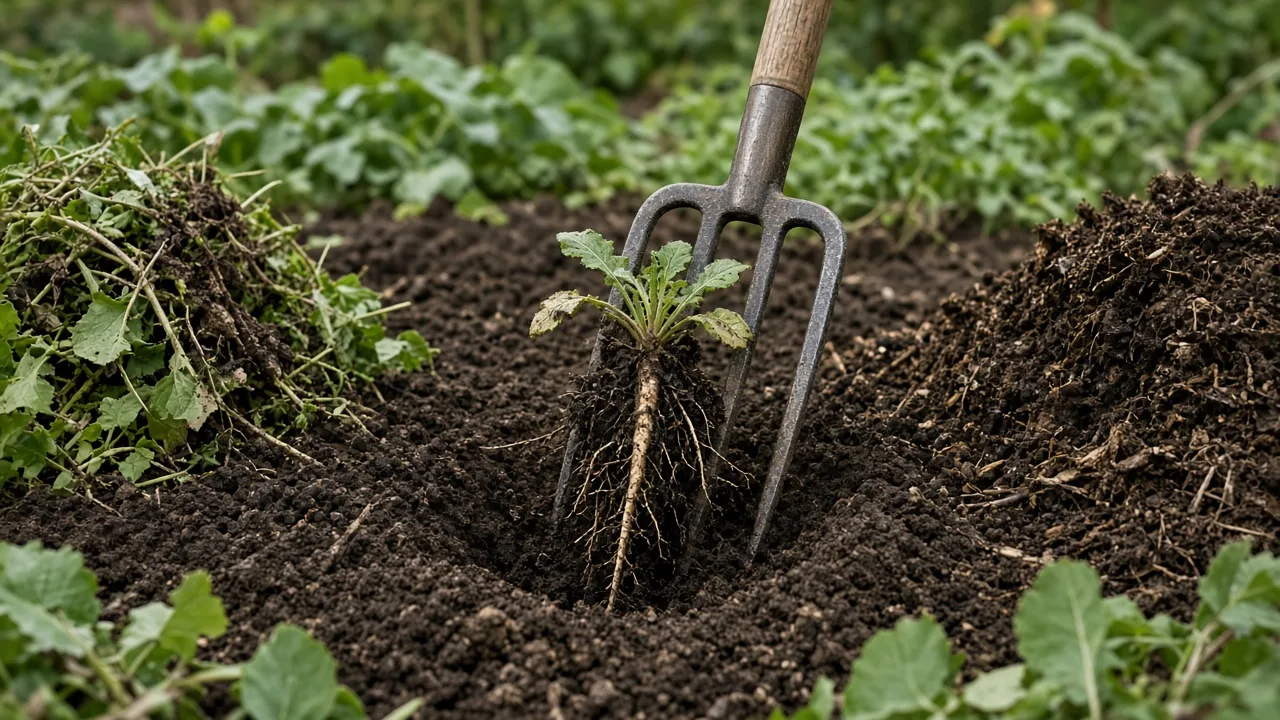
Pull young plants carefully
A single young plant in a bed is usually the simplest case. Work when the soil is slightly moist so a shallow root is easier to lift, grasp the plant low on the stem, and ease it out without shaking soil or foliage over nearby flowers. Wear gloves and sleeves if the plant irritates your skin, then place it directly into a yard-waste bag rather than leaving it on the ground to dry.
Do this before flowers open whenever possible. If the plant already has green flower spikes, avoid snapping or dragging the top through other plants; contain the stems as you cut or lift them and bag them promptly.
Once seed heads are mature and dry, handle them as little as possible because pulling can scatter seed. When the identity is uncertain, pause and check the plant with an extension resource before removing it; a mistaken pull can damage a wanted perennial, especially when goldenrod and other fall flowers are nearby.
A removed plant should not be tossed into a home compost pile if it has mature seed heads. Follow your municipality’s yard-waste guidance for disposal, since local rules differ. Clean soil from tools before using them elsewhere, and revisit the patch in a few weeks: one pass will not remove seeds already in the soil.
Mow or suppress larger patches and monitor regrowth
For a patch too large to pull one plant at a time, repeated cutting before flowering can keep annual ragweed from setting seed. A single late mow may leave low side branches that still flower, so inspect the patch after cutting and repeat as needed. Mowing is most useful where the plants are accessible and where cutting will not damage desirable plants or create a safety problem.
Preventing bare soil also helps. Fill thin lawn areas with suitable turf, and cover empty garden soil with healthy groundcover, mulch, or a planned cover crop suited to the site.
Maine Extension recommends cover crops where a gardener cannot tend the bed through the season, with the important follow-through of terminating the cover crop before it seeds. This approach competes for light and space, while also reducing the disturbed, open soil where new ragweed seedlings establish.
Expect follow-up work. Ragweed seeds can remain viable in soil for years, and disturbance can expose them to conditions for germination.
The practical goal is to stop each new crop from flowering and setting seed, not to promise that one treatment will permanently erase the seed bank. If the same patch returns, note whether it sits beside a road, fence, stream, or regularly disturbed strip; the source may be outside the bed you just cleared.
When herbicides or professional help make sense
Herbicide is not the automatic next step after spotting ragweed. In a small bed, targeted hand removal before flowering is often simpler and avoids exposing nearby ornamentals, pollinator plants, or lawn to drift.
In a large or inaccessible patch, the right product and timing depend on the site, the species, and nearby plants. Before using a product, check current local extension guidance and confirm that its label includes your exact setting; follow the product directions and avoid conditions that could carry spray onto wanted plants. Cornell’s weed profile directs readers to current regional management guidance because herbicide choices and rules vary by location. Cornell Weed ID
A weed identification is especially important before spraying. Broadleaf herbicides can injure other broadleaf plants, and a product that suppresses annual ragweed in turf may not be appropriate for a mixed flower bed, vegetable plot, water edge, or neighboring property. Do not use a homemade mixture as a shortcut: household substances can damage desirable plants and soil, and they do not remove pollen already in the air.
Ask your county extension office or a licensed weed-management professional when the plant is not confidently identified, the patch is extensive, plants are interwoven with wanted perennials, or herbicide could drift to sensitive plants or water. For allergy concerns, a clinician or allergist is the right professional; a lawn service can manage vegetation, but it cannot determine what is triggering an individual’s symptoms.
Conclusion
The most reliable ragweed check uses the whole plant: finely divided leaves on common ragweed, broad hand-like leaves on giant ragweed, and small greenish flower spikes rather than showy yellow blooms. Compare those details before deciding what to remove, especially when goldenrod or mugwort is nearby.
If you find ragweed, target young plants before they flower, prevent later seed set, and recheck disturbed soil through the season. For pollen exposure, follow local counts and limit what comes indoors; for a suspected allergy, get medical guidance instead of trying to diagnose it from a yard or a calendar.



