40 Types of Pine Trees With Identifying Facts
From mugo pine to ponderosa: 40 pine species with field ID marks, USDA zones, mature height, and which pines to plant—or skip—in your yard.
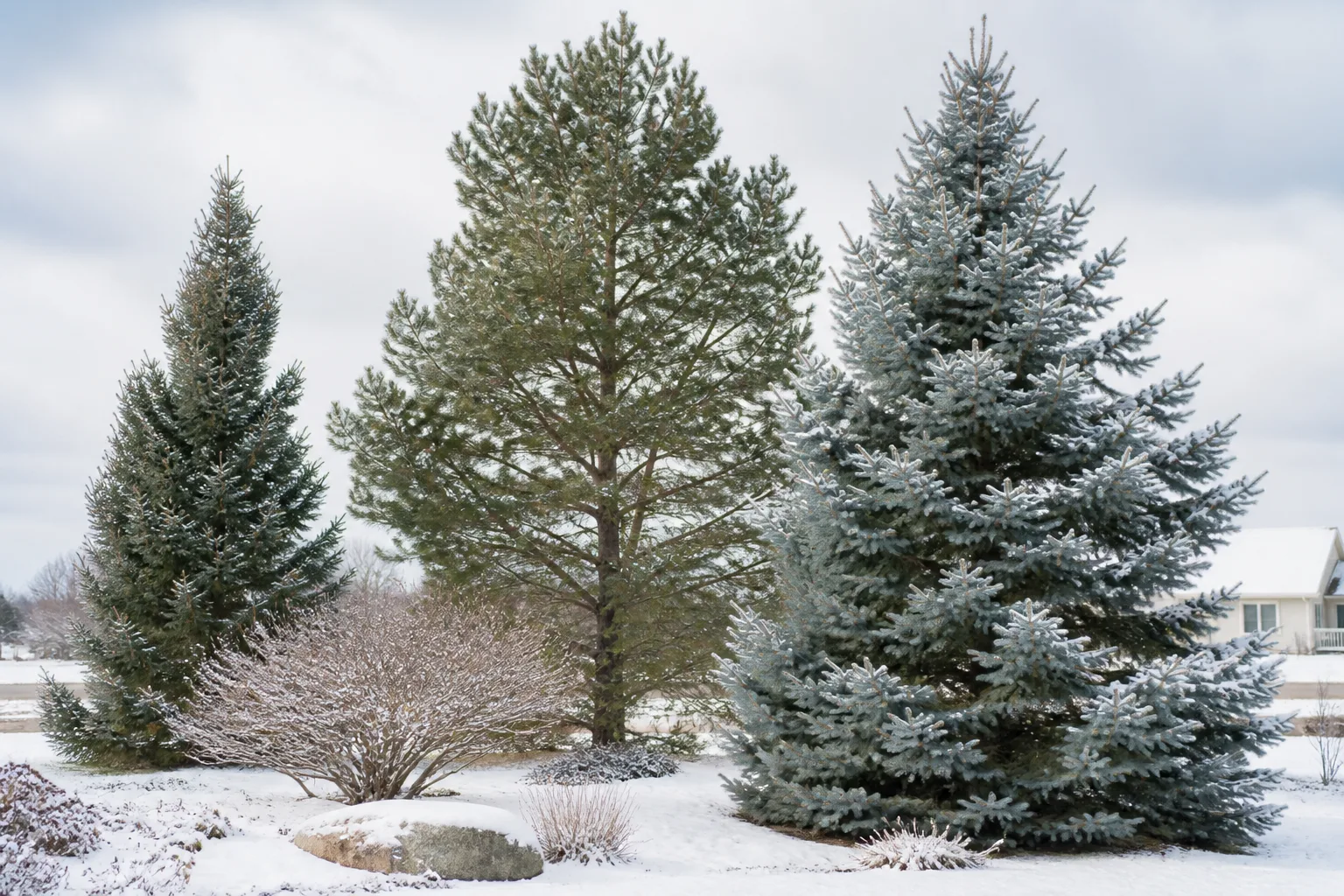
Pines belong to the genus Pinus—roughly 120 species worldwide, all evergreen conifers with needle-like leaves bundled on the twig. The right pine anchors a yard for decades with year-round structure and winter green; the wrong one cracks sidewalks, sheds sticky pitch on your deck, or becomes a 90-foot shade monster you cannot prune back without ruining its form. This guide covers 40 species worth knowing, grouped by how gardeners and hikers actually encounter them—with field identification marks, USDA zones, mature size, and the decision rules thin species lists skip.
How to Choose the Right Pine for Your Yard
Before you buy a sapling because the tag says “evergreen,” answer three questions: How much horizontal and vertical space do you truly have at maturity? What is your hardiness zone and summer heat pattern? Do you want a shade tree, a windbreak, a foundation shrub, or a specimen for bonsai? Pines are not interchangeable. A sugar pine that belongs in a Sierra Nevada forest will suffocate in a humid Atlanta subdivision, while a mugo pine that thrives in a rock garden will look lost in a 40-foot windbreak row.
Space, zone, and what you actually want from the tree
Catalog photos show five-year-old trees. You are buying 40 to 80 years of crown spread and root mass. Most pines are deep-rooting but still wide-spreading at the surface—feeder roots hunt moisture well beyond the drip line. Large pines belong at least one mature crown width from the house foundation, driveway, and septic field. NC State Extension documents eastern white pine reaching 50 to 80 feet with a 20- to 40-foot spread—far too large for a typical suburban front yard unless you commit to decades of structural pruning or choose a dwarf cultivar.
Match hardiness zone to survival and heat and humidity to performance. Zone tells you whether the tree will live through winter; it does not tell you whether it will look good. Aleppo and Turkish pines tolerate Mediterranean heat; red and jack pines handle bitter northern cold. If your main goal is fast shade or a timber windbreak, southern yellow pines and Monterey pine grow quickly but demand acreage. If you need winter structure in a 10-foot planting strip, start with mugo pine or a named Japanese white pine cultivar—not a seedling eastern white pine “because it was cheap.”
How to Identify a Pine (and Rule Out Look-Alikes)
Beginners confuse pines with spruces, firs, and even cedars because all are needle-bearing evergreens. The fix is twig anatomy, not leaf color.
Needle bundles, cones, and bark marks in the field
Pines carry needles in bundles (fascicles) wrapped at the base by a papery sheath. Count the needles per bundle—this is the fastest ID step:
- Five needles per bundle: soft pines—eastern white pine, western white pine, whitebark pine, Japanese white pine, limber pine
- Two needles per bundle: most hard pines—Scots, Austrian, red, jack, lodgepole, ponderosa (sometimes 3), loblolly, Virginia pine
- Three needles per bundle: ponderosa (often), Jeffrey pine, longleaf pine, pitch pine, knobcone relatives
- One needle per bundle: single-leaf pinyon (Pinus monophylla)—the exception
Cones hang down or sit upright depending on species; pine cones are woody and thick-scaled, not papery like spruce cones. Size matters: Coulter pine cones can weigh several pounds; sand pine cones are tiny. Some species hold serotinous cones sealed with resin until fire opens them—lodgepole pine and pond pine are famous examples noted by Mount Rainier National Park’s conifer guide.
Bark shifts with age: young pines are often smooth; mature trunks become plated, furrowed, or orange-brown (ponderosa). Lacebark pine exfoliates in camouflage patches. Whitebark pine starts white and smooth on upper branches.
Pine vs spruce vs fir (quick rule): Spruce needles are single, square, and sharp—they roll easily between fingers. Fir needles are flat, friendly, and usually attached singly to the twig with what looks like tiny suction cups; fir cones stand upright on branches. Pine needles always come in bundles. If you see opposite flat sprays without bundles, you may be looking at a hemlock—not a pine.
Eastern and Western White Pines
Soft pines (five needles per bundle, softer texture) dominate northern and montane forests and include some of the most planted landscape pines in cool climates.
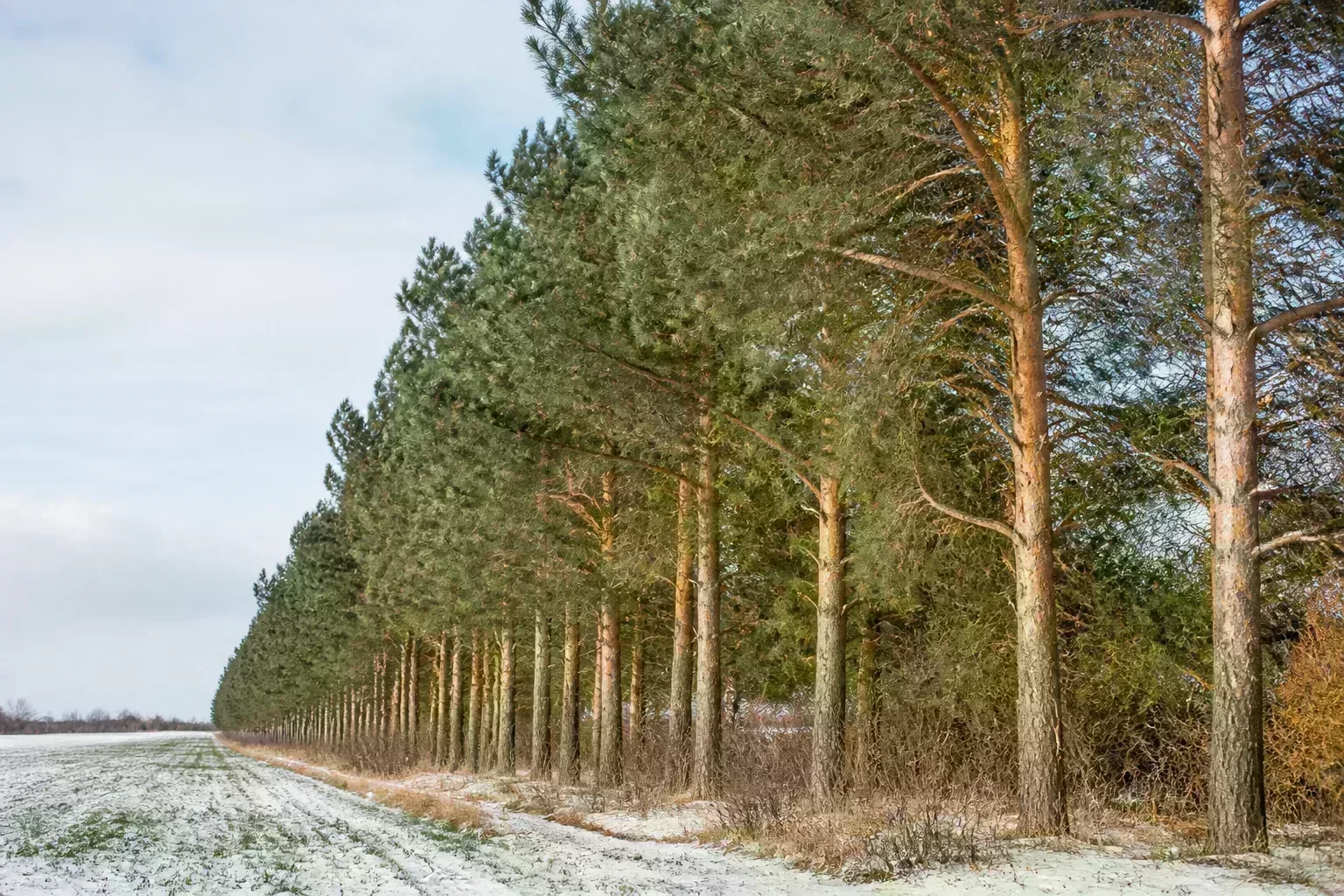
Eastern white pine (Pinus strobus) is the tall, fast-growing soft pine of the Northeast and Appalachians. USDA Forest Service Silvics describes mature heights of 50 to 100 feet with a straight trunk and open crown. Needles are soft blue-green, five per bundle, 2 to 4 inches long. Bark on large trees is gray and deeply furrowed. Zones 3–8; full sun to part shade. Accepts pruning and can be hedged when young—otherwise plan for a forest-scale tree. Popular Christmas tree; does not tolerate urban pollution as well as some hard pines.
Western white pine (Pinus monticola) mirrors eastern white pine in the Pacific Northwest—five needles, large tree to 150 feet in native range, zones 5–7. Too big for most landscapes but magnificent in native mountain settings. Susceptible to white pine blister rust; check local extension guidance before planting near currants or gooseberries (alternate hosts).
Japanese white pine (Pinus parviflora) is the ornamental counterpart—slow, 25 to 50 feet, fine bluish needles, picturesque flat-topped mature form, zones 6–9. A favorite for bonsai and specimen planting where you want structure without loblolly speed.
Whitebark pine (Pinus albicaulis) is a five-needle subalpine pine with smooth white bark on young wood, shrubby or small-tree form 20 to 60 feet, zones 4–8. NPS notes it is often stunted by wind and snow at high elevation. Threatened by blister rust and climate stress—observe in nature; do not collect seed from wild populations.
Southern Yellow Pines for Heat and Humidity
The southern yellow pine group thrives in the Southeast’s heat, humidity, and sandy soils. These are hard pines—mostly two or three needles per bundle—with fast juvenile growth and serious mature size.
Loblolly, longleaf, slash, and pond pine
Loblolly pine (Pinus taeda) is the workhorse of southeastern forestry. Mississippi Forestry Commission documents heights of 80 to 100 feet, straight trunks, and adaptation from poorly drained flats to rolling uplands. Zones 6–9. Among the fastest southern pines; excellent for rural windbreaks and reforestation—not for a 15-foot suburban lot.
Longleaf pine (Pinus palustris) has the longest needles of eastern pines—8 to 18 inches—and large cones. Slow early growth (“grass stage”) then rapid height once established. Native longleaf savannas are ecologically valuable; old-growth stands support red-cockaded woodpecker nesting. Zones 7–9; needs full sun and sandy, well-drained soil.
Slash pine (Pinus elliottii) tolerates wetter sites than loblolly—pond margins and flatwoods. 60 to 100 feet, two or three needles per bundle, zones 8–10. Fast growth; historically important for naval stores and pulp.
Pond pine (Pinus serotina) holds serotinous cones for years until fire opens them. Medium tree 30 to 70 feet, often thin and ragged with age, zones 7–9. Ecologically interesting; poor landscape choice.
Also in this regional cluster: sand pine (Pinus clausa)—scrub pine of Florida and Alabama sandy ridges, 15 to 60 feet, tolerates shade better than most pines, serotinous cones; Virginia pine (Pinus virginiana)—scrubby 10 to 50 feet, twisted habit, zones 4–8, common Christmas tree in the Mid-Atlantic but coarse for formal landscapes.
Cold-Climate Two-Needle Pines
When winters are bitter and summers are moderate, these hard pines dominate nursery rows and windbreak plantings.
Scots, Austrian, red, and jack pine
Scots pine (Pinus sylvestris)—never “Scotch pine” in botanical usage—is a medium tree 20 to 30 feet in many cultivars, up to 60 feet on the species, with orange peeling bark on upper trunk and two stiff blue-green needles per bundle. Zones 3–7. Classic Christmas tree in Europe; dwarf forms like ‘Glauca Nana’ stay shrubby. Susceptible to wind breakage if not sited in a protected spot.
Austrian pine (Pinus nigra)—European black pine—pyramidal when young, rounded with age, 40 to 100 feet, two dark needles per bundle, zones 5–8. USDA SRS notes value for screening but warns of diplodia tip blight and pine wilt in the Midwest—check local extension before mass planting.
Red pine (Pinus resinosa)—Norway pine—is a straight-trunked northern species 50 to 80 feet, two long stiff needles per bundle, orangish bark, zones 2–7. Excellent windbreak in the northern tier; not for hot southern summers.
Jack pine (Pinus banksiana)—gray pine in some regions—is scruffy, 30 to 50 feet, often twisted, two short needles, curved cones. Zones 3–8. Tolerates poor dry sand; useful in harsh rural windbreaks, not ornamental specimens.
Pitch pine (Pinus rigida) exudes sticky resin—messy near cars and decks. 50 to 100 feet, three needles per bundle, crooked habit, zones 5–7. Fire-adapted coastal plain and Appalachian sites; skip for low-maintenance yards.
Western Timber Giants
Western North America hosts the pines that redefine “big tree.”
Ponderosa, sugar, lodgepole, and Jeffrey pine
Ponderosa pine (Pinus ponderosa)—western yellow pine—is a park-scale tree 60 to 100 feet with deeply furrowed bark smelling like vanilla or butterscotch in some regions. Three needles per bundle (sometimes two), zones 5–8. Magnificent in large properties; too large and thirsty for typical suburban lawns.
Sugar pine (Pinus lambertiana) is the tallest pine species—100 to 200 feet—with the longest cones of any pine, nearly 2 feet. Zones 6–7 in montane West. Impractical for home landscapes except on very large mountain properties.
Lodgepole pine (Pinus contorta) varies wildly by subspecies—shrubby shore pine on coasts to 50-foot inland trees. Two needles per bundle, twisted trunks common, serotinous cones. NPS describes lodgepole tolerating poor soil and wide temperature swings—good for difficult rural sites, not suburban front yards.
Jeffrey pine (Pinus jeffreyi) resembles ponderosa but smells of vanilla, three needles, 80 to 100 feet, zones 6–8. Regarded as invasive and undesirable in parts of California outside its native range—verify local guidance before planting.
Foxtail pine (Pinus balfouriana) and bristlecone pine (Pinus aristata) are small, slow, gnarled five-needle pines of high Sierra and Rocky Mountain ridges—8 to 30 feet, zones 4–8. Sacred to hikers; essentially unavailable and unsuitable for home planting.
Gray pine (Pinus sabiniana)—foothill pine—is a fork-trunked California foothill tree 40 to 70 feet, three needles, heavy cones, zones 8–9. Rarely planted; interesting in native chaparral transition zones.
Coulter pine (Pinus coulteri) bears massive spiny cones—an ID hallmark—40 to 100 feet, three needles, zones 7–9. Ornamental in large California gardens with room for cone drop.
Torrey pine (Pinus torreyana) is one of the rarest pines—native only to coastal San Diego County and Santa Rosa Island. Open-crowned, salt-tolerant, 25 to 60 feet, zones 8–10. Protected by law in native stands; cultivated specimens exist but are specialty nursery items.
Dwarf Mugo and Small-Garden Pines
If your usable yard is measured in tens of feet, start here.
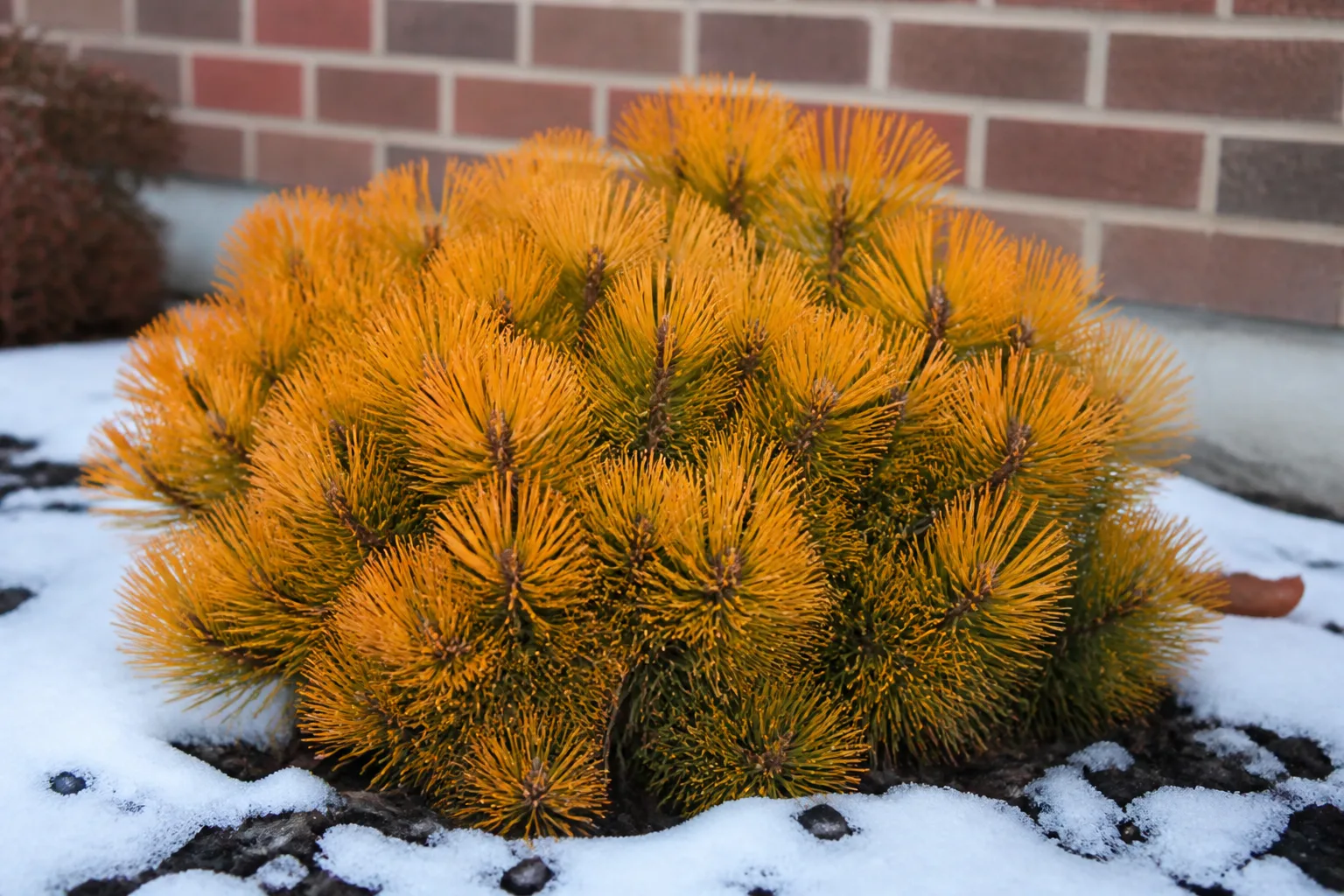
Mugo pine (Pinus mugo) is the default small pine—creeping shrub to small tree depending on cultivar, 3 to 25 feet, two stiff needles per bundle, zones 3–7. ‘Mops,’ ‘Gnome,’ and var. pumilio stay under 5 feet for foundation and rock gardens. Tolerates part shade; slow enough to manage. Read the tag—species seedling mugo can become a tree.
Tanyosho pine (Pinus densiflora) ‘Umbraculifera’—Japanese umbrella pine cultivar—round dwarf 12 to 20 feet, two needles, red-flushed bark, zones 3–7. Excellent specimen where you want Asian-garden structure without mugo’s ground-hug habit.
Virginia pine and two-needle pinyon (Pinus edulis) also fit small lots when sited correctly—Virginia for coarse winter accent in zones 4–8, pinyon for dry western yards under 20 feet with edible nuts.
Mediterranean and Warm-Zone Pines
Hot, dry-summer climates call for a different pine palette.
Aleppo pine (Pinus halepensis)—Jerusalem pine—is extremely drought-tolerant, 30 to 60 feet, two short yellow-green needles, open crown, zones 8–10. Invasive in fire-prone Mediterranean climates outside its native range; use only where appropriate and with fire-safety spacing.
Italian stone pine (Pinus pinea)—umbrella pine—classic domed Mediterranean silhouette, 30 to 60 feet, two needles, edible pignoli nuts in warm regions, zones 9–10. Rare in most U.S. landscapes outside California and the Southwest.
Turkish pine (Pinus brutia) and maritime pine (Pinus pinaster)—cluster pine—tolerate heat and drought; 30 to 100 feet, two needles, deeply fissured bark, zones 7–11 (maritime 7–9). Ornamental in warm coastal and Mediterranean gardens.
Monterey pine (Pinus radiata) is among the most widely planted pines globally for timber. USDA SRS notes fast growth to 50 to 100 feet, thick trunk, bright green foliage, zones 7–9. Native to foggy central California coast; excellent windbreak where humidity moderates heat. Can be short-lived in interior hot-dry sites without moisture.
Canary Island pine (Pinus canariensis) develops a parasol crown, 50 to 80 feet, three needles, zones 9–11—specialty tree in frost-free climates.
Mexican weeping pine (Pinus patula)—jelecote pine—has drooping needle tufts, 60 to 80 feet, zones 8–9, striking specimen in warm regions.
Tenasserim pine (Pinus latteri) and Luchu pine (Pinus luchuensis) are large Asian pines for warm zones 9–11—shoreline and specialty collections, not mainstream nursery stock.
Chir pine (Pinus roxburghii)—Imodi pine—is a Himalayan giant 60 to 180 feet with long fluffy needle clusters, zones 9–11—tropical and subtropical Asian forestry species, not U.S. landscape material.
Pinyon Pines and Edible Pine Nuts
Not every pine produces commercial pine nuts. These two southwestern natives do.
Two-needle pinyon (Pinus edulis)—Colorado pinyon—small tree to 20 feet, two needles, furrowed bark, zones 5–8. Bears edible pine nuts prized in Southwest cuisine. Slow; difficult to transplant—buy container-grown specimens. Christmas tree and xeric landscape use in dry western yards.
Single-leaf pinyon (Pinus monophylla) is the odd one-needle pine—15 to 50 feet, flaky bark, zones 5–9. Nuts edible; hard to find in nursery trade. Attractive bark in arid landscapes when available.
Italian stone pine and some Mediterranean pines also produce pignoli in warm climates, but harvest timing and processing differ from pinyon culture.
Japanese Pines for Specimens and Bonsai
Japanese black pine (Pinus thunbergii)—black pine—is a stiff-needled, conical tree 20 to 50 feet, two dark needles, zones 5–8. Classic bonsai and Japanese-garden specimen. Invasive in Pennsylvania and some Atlantic coastal states—do not plant where listed; choose alternatives if seed dispersal is a local concern.
Japanese white pine (Pinus parviflora)—covered above—pairs with lacebark pine for fine-textured Asian gardens.
Lacebark pine (Pinus bungeana) is the bark star: exfoliating patches of olive, silver, and brown on a slow 30 to 50 foot tree, three needles, zones 5–9. Specimen near a patio where winter bark is visible—one of the best ornamental pines for patient gardeners.
Pines for Windbreaks and Screening
Windbreak design needs density, height, and regional disease resistance—not just fast growth.
Monterey pine, loblolly pine, and red pine rank among the fastest meaningful windbreak trees in their respective climates. Plant rows on the windward side with spacing of 8 to 12 feet between trees in the row for southern pines, wider for huge western species. Mixing one row of hardwoods inside a pine shell reduces pine bark beetle pressure in some regions—ask your county extension office.
Maritime pine and Aleppo pine suit dry coastal windbreaks in zones 7–10. Austrian pine was historically popular for screening but has fallen out of favor in the Midwest due to disease—verify before planting a long row.
Eastern white pine makes a soft, tall screen in cool climates when pruned young or planted with staggered rows; remember pollution sensitivity on salted roadside sites.
Rare and Protected Pines You May See in Nature
Some pines on this list are better admired than planted.
Whitebark pine—threatened; keystone subalpine species. Torrey pine—rarest native U.S. pine; legally protected in natural stands. Foxtail pine and bristlecone pine—high-elevation rarities. Luchu pine and Tenasserim pine—Asian natives essentially absent from U.S. horticulture.
When hiking, use needle bundle count and cone size to confirm IDs. Five-needle subalpine pines with white bark point to whitebark; massive cones on California slopes suggest Coulter; long pendulous needles on Southeast sandhills suggest longleaf.
Pines to Skip in Home Landscapes
Pitch pine—sticky resin on everything. Pond pine and elderly sand pine—ragged form. Jeffrey pine outside native range in California—ecological weed risk. Aleppo pine in fire-prone wildland-urban interface—fire ecology concerns. Sugar pine and western white pine—impossible scale for typical lots. Chir pine and Canary Island pine—wrong climate for most U.S. gardeners.
Also reconsider Austrian pine in Midwest windbreaks without disease monitoring, and eastern white pine on polluted street frontages or tiny urban plots.
Quick Reference: 40 Pines at a Glance
| Common name | Species | Needles/bundle | Zones | Typical height | Best use |
|---|---|---|---|---|---|
| Eastern white pine | P. strobus | 5 | 3–8 | 50–100 ft | Cool-climate shade, Christmas tree |
| Aleppo pine | P. halepensis | 2 | 8–10 | 30–60 ft | Dry warm windbreak (watch invasiveness) |
| Austrian pine | P. nigra | 2 | 5–8 | 40–100 ft | Screen (disease risk in Midwest) |
| Bristlecone pine | P. aristata | 5 | 4–8 | 8–30 ft | Native specimen only |
| Canary Island pine | P. canariensis | 3 | 9–11 | 50–80 ft | Frost-free climates |
| Chir pine | P. roxburghii | 3 | 9–11 | 60–180 ft | Not for U.S. landscapes |
| Coulter pine | P. coulteri | 3 | 7–9 | 40–100 ft | Large CA gardens |
| Foxtail pine | P. balfouriana | 5 | 5–8 | 20–50 ft | Native high-elevation admire only |
| Gray pine | P. sabiniana | 3 | 8–9 | 40–70 ft | CA foothill native |
| Italian stone pine | P. pinea | 2 | 9–10 | 30–60 ft | Warm-climate umbrella form |
| Jack pine | P. banksiana | 2 | 3–8 | 30–50 ft | Poor-soil windbreak |
| Japanese black pine | P. thunbergii | 2 | 5–8 | 20–50 ft | Specimen, bonsai (check invasive lists) |
| Japanese white pine | P. parviflora | 5 | 6–9 | 25–50 ft | Specimen, bonsai |
| Jeffrey pine | P. jeffreyi | 3 | 6–8 | 80–100 ft | Native West only |
| Lacebark pine | P. bungeana | 3 | 5–9 | 30–50 ft | Bark specimen |
| Limber pine | P. flexilis | 5 | 4–7 | 30–60 ft | Difficult soils, Rocky Mountain native |
| Loblolly pine | P. taeda | 2–3 | 6–9 | 50–80 ft | SE forestry, rural windbreak |
| Lodgepole pine | P. contorta | 2 | 6–8 | 15–50 ft | Difficult rural sites |
| Longleaf pine | P. palustris | 3 | 7–9 | 60–100 ft | SE savanna restoration |
| Luchu pine | P. luchuensis | 2 | 9–11 | 50–80 ft | Specialty warm zones |
| Maritime pine | P. pinaster | 2 | 7–9 | 60–100 ft | Dry sandy windbreak |
| Mexican weeping pine | P. patula | 3 | 8–9 | 60–80 ft | Warm specimen |
| Monterey pine | P. radiata | 2 | 7–9 | 50–100 ft | Fast windbreak, coastal humidity |
| Mugo pine | P. mugo | 2 | 3–7 | 3–25 ft | Small yards, foundation |
| Pitch pine | P. rigida | 3 | 5–7 | 50–100 ft | Skip—resin mess |
| Pond pine | P. serotina | 2 | 7–9 | 30–70 ft | Skip—ragged form |
| Ponderosa pine | P. ponderosa | 2–3 | 5–8 | 60–100 ft | Large western properties |
| Red pine | P. resinosa | 2 | 2–7 | 50–80 ft | Northern windbreak |
| Sand pine | P. clausa | 2 | 7–10 | 15–60 ft | FL scrub native |
| Scots pine | P. sylvestris | 2 | 3–7 | 20–60 ft | Christmas tree, cold climates |
| Single-leaf pinyon | P. monophylla | 1 | 5–9 | 15–50 ft | Arid edible nuts |
| Sugar pine | P. lambertiana | 5 | 6–7 | 100–200 ft | Giant West native only |
| Tanyosho pine | P. densiflora | 2 | 3–7 | 12–20 ft (dwarf) | Small specimen |
| Tenasserim pine | P. latteri | 2 | 9–10 | 80–150 ft | Warm Asia specialty |
| Torrey pine | P. torreyana | 5 | 8–10 | 25–60 ft | Protected native, coastal |
| Turkish pine | P. brutia | 2 | 8–11 | 30–80 ft | Heat-tolerant ornamental |
| Two-needle pinyon | P. edulis | 2 | 5–8 | Up to 20 ft | Edible nuts, xeric yards |
| Virginia pine | P. virginiana | 2 | 4–8 | 10–50 ft | Coarse accent, Christmas tree |
| Western white pine | P. monticola | 5 | 5–7 | 60–150 ft | Pacific Northwest native |
| Whitebark pine | P. albicaulis | 5 | 4–8 | 20–60 ft | Threatened—protect in nature |
Conclusion
Forty pine species share the genus Pinus but not the same yard. Start field ID with needle bundle count—two, three, five, or the rare single needle of pinyon—then confirm with cone size and bark. Match climate group to your site: southern yellow pines for Southeastern heat, soft white pines for cool northern lawns, mugo and dwarf cultivars for tight lots, Monterey and maritime pines for fast coastal windbreaks. Skip resin-heavy pitch pine and ragged pond pine in home landscapes, respect protected Torrey and whitebark pines in nature, and give large species the horizontal space their crowns will need in 30 years—not the space their saplings occupy today. Get those decisions right and a pine becomes one of the lowest-maintenance structural plants you can grow; get them wrong and you spend decades fighting a tree that was never suited to your zip code.