Should You Prune Roses in Fall or Wait for Spring?
Should you prune rose bushes in fall? Learn what to remove now, what to leave until spring, and how rose type and frost risk change the answer.
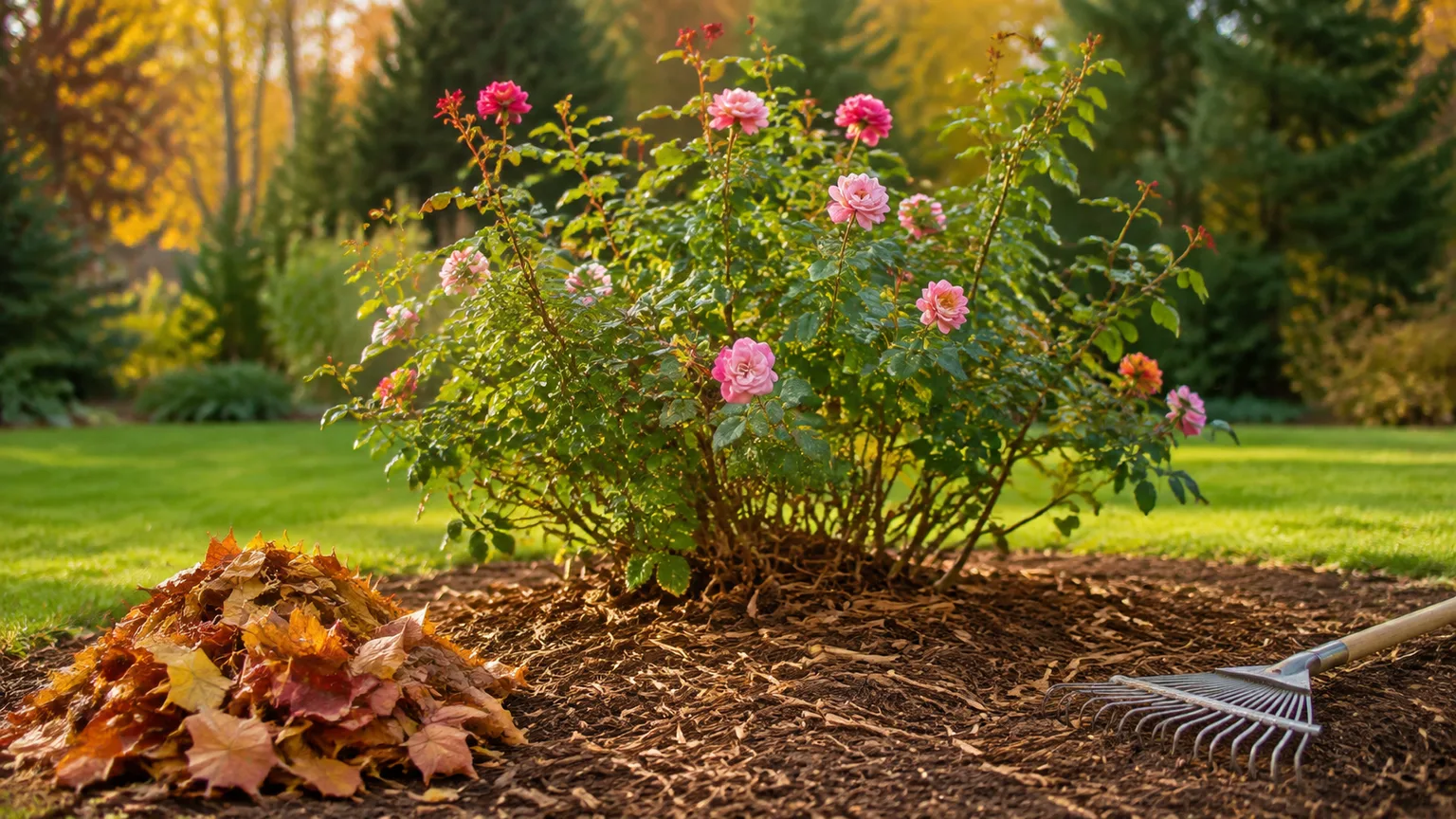
The short answer: prune for safety in fall, structure in spring
For most established rose bushes, fall is the time for a light cleanup, not the main annual prune. Remove dead, diseased, or broken wood whenever you see it, and shorten a long cane only if winter wind, wet snow, or a busy walkway could snap it. Save the major reshaping and height reduction for late winter or early spring, when the rose is dormant or just beginning to wake up.
That answer changes when “rose bush” actually means a rambler, a climbing rose, or an old garden rose. Those plants do not all flower on the same age of wood. A hard fall cut on a repeat-flowering bush may be merely unnecessary; the same cut on a once-blooming rambler can remove the wood carrying next year’s flowers. If you do not know the variety, start by observing how it flowers and how it grows before you reach for the shears.
Fall pruning solves a different problem than spring pruning
Pruning is not one job with one ideal date. It is a set of cuts made for different purposes. In late winter or early spring, pruning sets the framework for the season ahead: you remove winter dieback, thin congested growth, choose the canes that will carry flowers, and direct new shoots toward open space. The RHS places most bush-rose pruning in late winter to early spring, with exact timing adjusted for the rose group and local conditions (RHS general rose-pruning guidance).
Fall pruning has a narrower job. It reduces immediate risk and removes material that should not remain through winter. A tall, flexible cane that whips in wind can rock the plant at its base or break against a support. A diseased cane or a pile of infected leaves can remain a source of trouble. A branch already hanging over a path can be shortened now because waiting does not improve the plant.
The distinction matters because a cut can solve one problem while creating another. Removing a damaged cane is usually sensible in October. Cutting every healthy cane down by half in a warm spell can encourage tender shoots just when temperatures are about to fall. The goal is not to make the rose look finished for winter; it is to leave the plant stable, healthy, and carrying the right flowering wood into the next season.
Identify your rose type before making a major cut
The safest pruning instruction depends on where the rose makes its flowers. Many modern bush roses produce their best display on new growth, while many old garden roses and ramblers rely heavily on older canes that have already overwintered. Labels are useful, but flowering behavior is often the best clue when a plant is inherited or mislabeled.
Repeat-flowering bush roses
Hybrid teas, floribundas, grandifloras, and many landscape roses repeat through the growing season. Hybrid teas tend to make fewer, larger flowers on upright stems; floribundas carry clusters; landscape and shrub roses are usually fuller and less formal. These groups generally tolerate the main prune in late winter to early spring, before strong new growth is underway.
For fall, think in terms of removing hazards and preserving a balanced framework. A light trim to shorten an unusually long stem may be useful, but there is no benefit in forcing a compact spring shape months early. The RHS recommends stronger cuts for hybrid teas and longer retained stems for floribundas during the late-winter pruning window, a difference that illustrates why one universal fall height is misleading (RHS hybrid tea and floribunda guide).
Knock Out and similar landscape roses are vigorous, but “vigorous” does not mean they need a severe autumn haircut. Their new-season shaping can wait. In fall, remove the three Ds, thin an obviously rubbing pair, and shorten only what is likely to break. Do the deliberate size reduction when the plant is close to resuming growth and you can see which buds survived winter.
Climbers and ramblers are not interchangeable
A climbing rose usually repeats for much of summer and into autumn. Its main canes create the permanent framework, while flowering side shoots grow from those canes. Autumn can be a useful time to shorten long, whippy shoots or secure them to their support. Major routine pruning is commonly done in winter after flowering has finished, with the main framework preserved and the flowered side shoots shortened (RHS climbing-rose guide).
A rambler usually gives one spectacular flush, often around early summer, on wood produced the previous year. That makes it the classic fall-pruning trap. Routine pruning is generally done in late summer after flowering, when you can remove some old, flowered canes and train the vigorous new canes that will flower next year. The RHS lists late summer as the routine window for ramblers and late autumn to winter as a renovation window, not a reason to cut every new cane away (RHS rambler-rose guide).
If your climbing or rambling rose has long stems tied to a wall, arch, fence, or trellis, do not treat every stem that looks untidy as expendable. First identify the main framework and the new replacement canes. A few minutes spent tracing a stem back to its base can save a full season of flowers.
Once-flowering shrub and old garden roses
Many old garden roses, species roses, and once-flowering shrub roses bloom on older wood. Their main shaping prune is usually performed after flowering, often in late summer, so the plant has time to grow and harden the wood that will flower the following year. The RHS advises light, regular pruning for shrub roses and separates repeat-flowering groups from single-flush groups (RHS shrub-rose guide).
In practical terms, do not wait for a generic “fall cleanup day” to shear one of these roses into a smaller mound. Remove dead, diseased, damaged, crossing, and weak growth, but preserve healthy canes unless you are following the correct post-flowering or renovation plan. If a rose has hips that you enjoy for winter color or wildlife, leave some of the final spent flowers in place rather than deadheading everything.
Use weather and buds instead of a calendar alone
Hardiness zones can help you estimate winter risk, but they do not tell you exactly when a rose is ready for a cut. Two gardens in the same zone can have different exposure, soil warmth, wind, and frost patterns. A sheltered south-facing wall may push growth earlier than an exposed garden at the same latitude.
In fall, ask whether the plant is still actively extending tender shoots. If it is, heavy pruning is premature. A rose that is still making soft, bright-green growth can respond to a large cut by pushing more. That new growth may not have time to harden before a freeze. The University of Maryland Extension gives a conservative general rule for shrubs: when uncertain, prune in early spring rather than in the late-summer-to-fall period, because new growth may not harden before winter (University of Maryland Extension pruning guidance).
Look for local signals instead. In a cold climate, wait until growth has clearly slowed and the plant has experienced the weather that normally sends it toward dormancy before doing any optional shortening. In a mild climate, roses may continue growing or flowering through much of winter, so a hard-frost rule may not apply. In those regions, the safer default is still to prune by purpose: remove a problem cane, but postpone aesthetic reshaping until the variety’s recommended window.
Spring has a different visual cue. For many repeat-flowering bush roses, late winter pruning is well timed when buds are beginning to swell and new growth is just resuming. Forsythia bloom is a useful regional phenology signal, but it is a prompt to inspect your roses, not a command to cut every rose on the same day.
What you can remove in any season: the three Ds
The three Ds—dead, diseased, and damaged—are the most reliable fall-pruning rule. These cuts are sanitation and safety work rather than an attempt to redesign the plant.
- Dead wood: A dead cane is dry, brittle, and brown or gray through the center. Trace it down and remove it to a healthy junction or to the base if the entire cane is dead.
- Diseased wood: Cankers, spreading dark lesions, and clear dieback are reasons to cut below the affected area into clean, living wood. If the problem runs through the cane, remove the whole cane.
- Damaged wood: Split, storm-broken, cracked, or badly abraded canes are poor candidates for winter. Make a clean cut back to sound wood rather than leaving a ragged stub.
The RHS also recommends removing spindly and crossing stems and aiming for well-spaced canes that allow air to move through the plant. Those cuts can be appropriate in fall when the problem is obvious, but do not use them as an excuse to strip the whole interior. A crowded rose can be refined more intelligently in late winter, when you can see its structure without rushing to beat the weather.
A fall pruning decision test you can use today
Before making a cut, answer four questions: What rose is this? What problem am I solving? Is the plant still actively growing? And would this cane carry flowers if I removed it? The answers point to one of three actions: remove, shorten lightly, or wait.
Prune now when a cane is a real winter liability
Remove a cane now when it is dead, diseased, broken, rubbing hard enough to wound the bark, or growing from below the graft union on a grafted rose. Also act when a long cane is likely to whip against a wall, pull a support loose, snap under wet snow, or catch people walking past it. The cut does not need to be dramatic. You are reducing a specific risk.
Shorten a healthy cane lightly when its length, rather than its health, is the problem. Take off only enough to reduce leverage or keep it inside the support. Leave the bulk of the productive framework intact. Tie a flexible cane to a sturdy support if training it is safer than cutting it.
Stop and wait when the cut would stimulate growth or remove flowers
Put the shears down when you are about to lower a healthy bush to a uniform height simply because the bed looks untidy. Wait if the rose is still making soft new shoots, if a hard frost is still weeks away, or if you cannot tell whether the plant is a once-blooming type. Wait if the only reason for cutting is that you want to see a neat bare framework.
Also wait on major renovation if the plant is stressed by drought, heat, transplanting, or a serious root problem. Removing a large amount of top growth changes the plant’s balance, but it does not repair poor soil, chronic shade, waterlogged roots, or a disease that has not been identified. Stabilize the growing conditions first, then renovate in the proper season.
How to make a safe fall cut
Start by wearing thorn-resistant gloves and clearing leaves away from the base so you can see the canes. Follow each suspect stem downward. A cut made halfway along a dead cane may leave a dead stub; a cut made at a live junction or near the base removes the problem more completely.
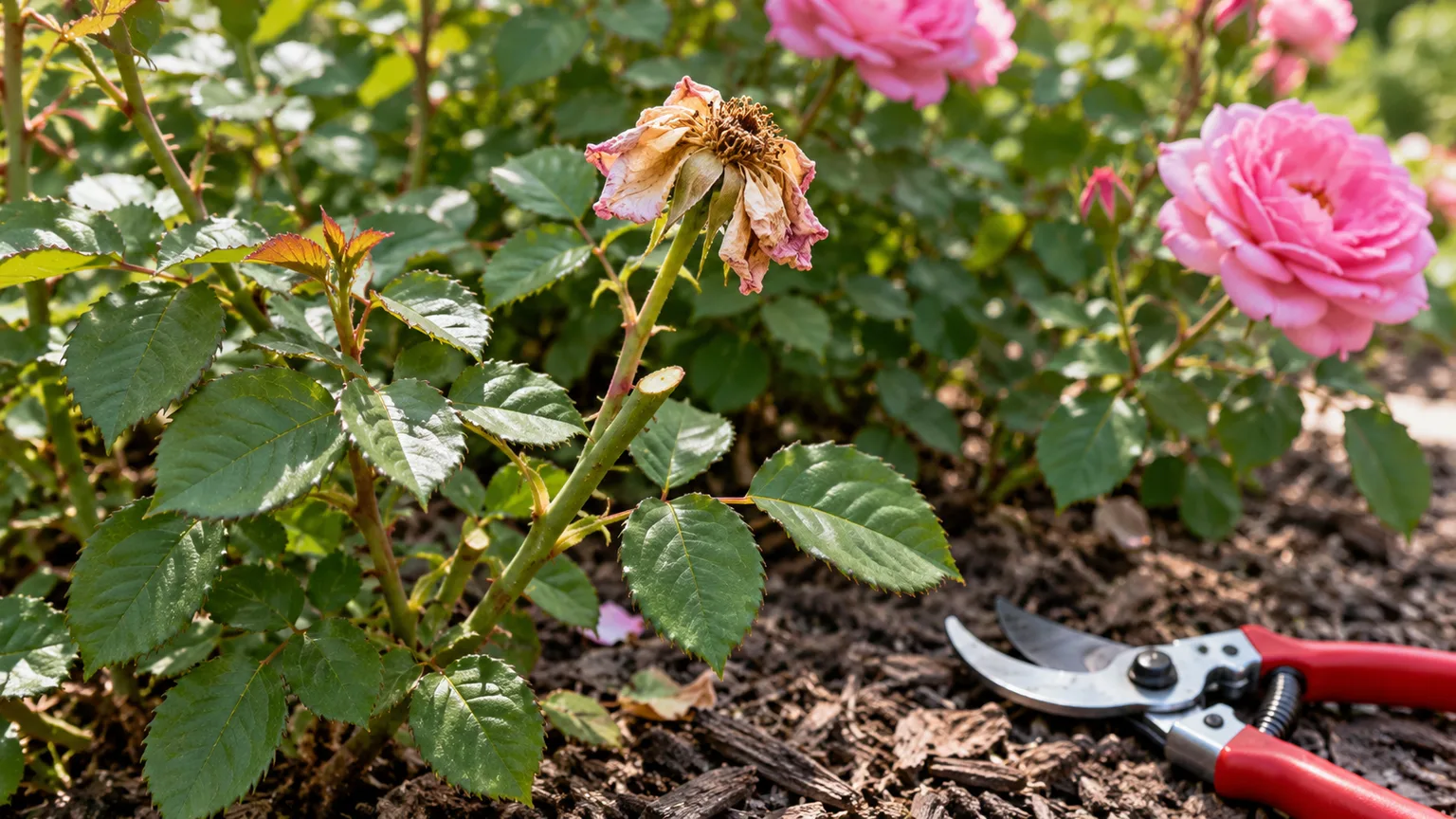
For a live cane that only needs shortening, choose a healthy bud pointing toward open space. Make the cut just above the bud—about a quarter inch is a useful working distance—and slope it slightly away so water does not sit on the bud. An outward-facing bud usually helps keep the center open, but the best bud is the one that sends growth into available space rather than into another cane.
Do not leave a long stub above the bud, and do not cut so close that you damage the bud. Use one decisive motion with a sharp bypass pruner on smaller stems. For a thick cane, use a tool that can cut it cleanly instead of repeatedly crushing the bark. If the center of the bush is crowded, remove the weakest or most poorly placed stem at its origin rather than taking a series of arbitrary bites from every branch.
Tools and sanitation that protect the plant
For most fall work, you need sharp bypass pruners, gauntlet-style gloves, a bucket or tarp for cuttings, and a way to wipe or disinfect the blades. Loppers or a pruning saw are useful for old, woody canes that do not fit comfortably in hand pruners. Bypass blades pass one another and generally make a cleaner cut than anvil-style tools on living stems; the clean cut matters more than the brand.
Clean tools before you begin and between roses when disease is present. Texas A&M AgriLife advises sterilizing between plants or major cuts because contaminated tools can spread pathogens, including rose rosette disease (Texas A&M AgriLife rose-pruning advice). Rubbing alcohol is convenient for wiping blades; if you use a bleach-based solution, follow a properly prepared dilution and rinse or dry the metal afterward to reduce corrosion. Never mix cleaning chemicals.
Collect cuttings as you work, especially if the rose had black spot, canker, or another suspected disease. Do not assume diseased rose debris will be neutralized in a home compost pile. Wash soil and sap from tools after the job, dry the blades, and oil the pivot if the tool’s care instructions call for it.
How much to cut back by rose type
Fall cutback should be measured against the problem, not against a fashionable number. If you cannot confidently identify the rose, use the gentlest option: remove the three Ds, shorten dangerous lengths, and defer the structural prune.
| Rose type | Fall action | Main pruning window |
|---|---|---|
| Hybrid tea | Remove damaged or diseased canes; shorten only wind-risk stems | Late winter to early spring |
| Floribunda or grandiflora | Light cleanup and selective shortening; keep more framework than a spring prune | Late winter to early spring |
| Landscape or repeat-flowering shrub | Clean up, lightly shape if necessary, avoid a severe haircut | Late winter to early spring |
| Repeat-flowering climber | Tie in long canes; remove problem wood; shorten flowered side shoots in the proper winter window | Late autumn or winter, by cultivar and climate |
| Once-flowering rambler | Preserve healthy new canes; routine pruning follows flowering | Late summer after flowering |
| Once-flowering old garden shrub | Remove problem wood; preserve healthy flowering wood | After flowering, often late summer |
For modern bush roses, the spring cut can be much more decisive than the fall cut. The RHS advises hybrid teas to be shortened to a few buds and floribundas to be left taller with more buds, which is why “cut every rose to knee height” is not a dependable rule (RHS modern bush rose recommendations). A strong spring prune can produce longer stems and larger individual blooms; a lighter prune leaves more flowering points and often suits a landscape display. That is a design choice to make in the correct season.
What to do after pruning: mulch, water, and winter protection
After a light fall prune, clean the soil surface. Remove fallen leaves and cuttings that are visibly diseased, then water only if the plant is genuinely dry and the ground is workable. Do not turn a small safety trim into a new-growth cycle by feeding heavily in late fall. A rose entering dormancy does not need a push of nitrogen simply because it has been cut.
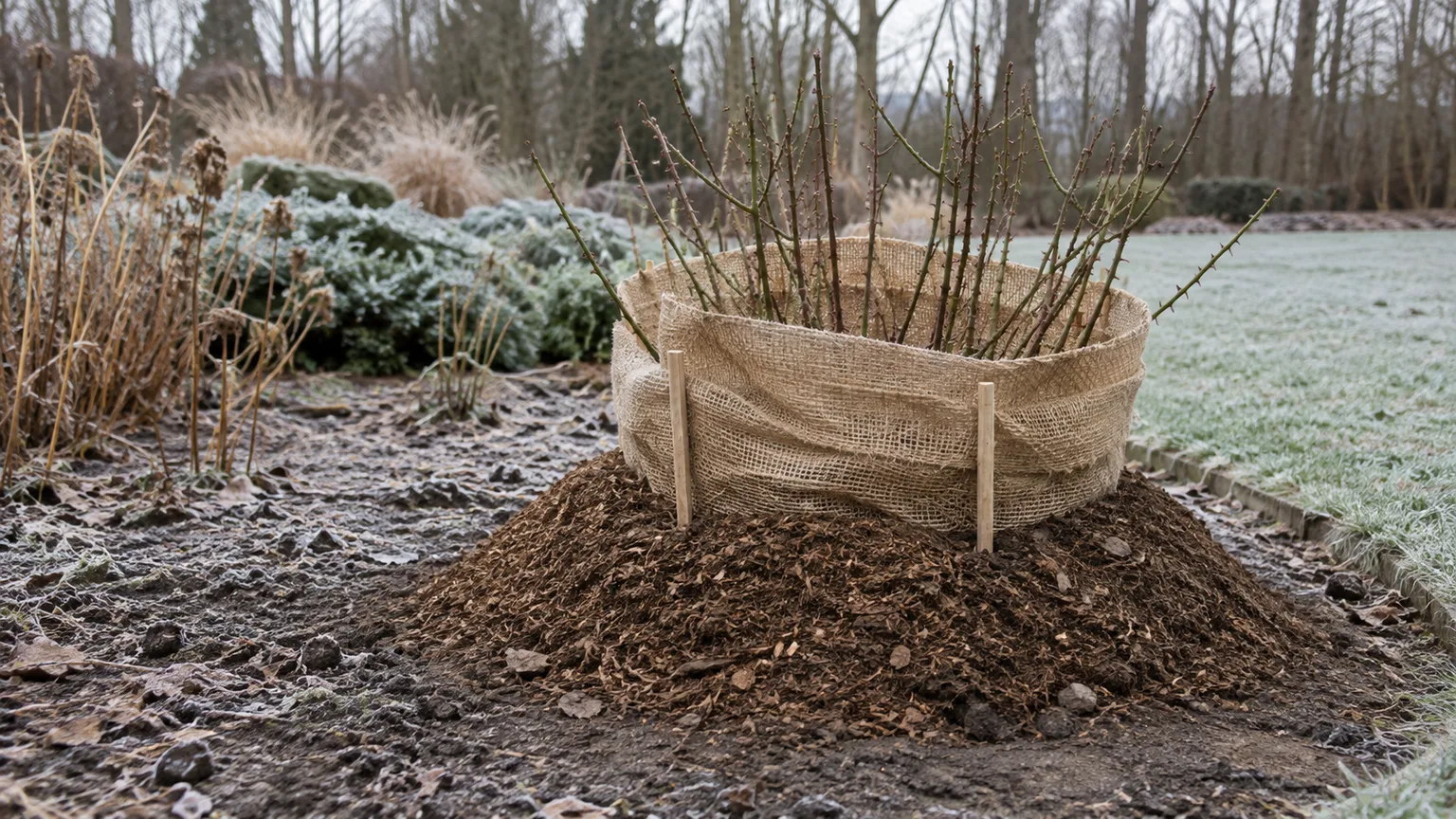
Mulch the root zone with a moderate layer of compost, well-rotted organic matter, or another suitable mulch, keeping it away from direct contact with the canes. Mulch protects soil from temperature swings and helps maintain moisture, but a wet, thick collar against the stems can encourage rot. In cold climates, winter protection is usually more about insulating the bud union and roots than wrapping every branch tightly.
If wind is the bigger threat, tie long canes loosely to a strong support or use a breathable windbreak placed around the plant rather than fastening plastic directly against it. Grafted roses may need special attention to the bud union, and newly planted roses generally deserve gentler treatment than established plants. The right protection depends on the rose’s exposure, local winter temperatures, and whether the plant is grafted or grown on its own roots.
Common fall rose-pruning mistakes
Pruning by month instead of plant signals is the most common error. October, November, or December can mean active growth in one region and deep dormancy in another. Use frost risk, growth stage, and rose type to interpret the calendar.
Giving every rose the same haircut is another. Hybrid teas, floribundas, shrub roses, climbers, ramblers, and old garden roses have different frameworks and flowering habits. If the label is gone, choose conservative cuts until the flowering pattern reveals more.
Cutting before a warm spell can be costly. A large cut may wake buds that would otherwise have remained quiet. New shoots are more vulnerable to cold than mature canes, so the safer fall job is selective removal rather than full reshaping.
Removing all rose hips is not always necessary. On repeat bloomers, deadheading during the season can encourage another flush. At the end of the season, leaving some hips can add winter interest and signals that the plant is moving away from constant flower production. Remove them only when you have a specific reason.
Leaving stubs and debris creates a second problem. Ragged cuts heal poorly, while dead leaves and diseased canes can keep problems close to the plant. Clean cuts, collected trimmings, and disinfected tools are small steps with a large payoff.
Using a sealant automatically is also unnecessary for many home gardens. A clean, correctly placed cut is usually the priority. Consider an optional product only when a local, well-supported recommendation addresses a known problem such as cane borers, and always follow the product label.
If you pruned too early or too heavily
Do not panic if you cut a rose before the ideal window. Roses are resilient, and one imperfect trim rarely decides the plant’s entire future. The best response is to stop cutting, protect the plant from additional stress, and watch what happens.
If the rose pushes tender shoots after an early fall cut, do not keep pinching them back repeatedly. Repeated trimming can prolong the same cycle. Protect the root zone with appropriate mulch, avoid late-season fertilizer, and wait to assess winter damage until spring. A cold-damaged shoot can be removed later, when you can see exactly where healthy wood begins.
If you removed healthy wood from a rambler or once-flowering rose, the likely consequence is fewer flowers next season rather than a dead plant. Let the new growth develop, train it carefully, and move the routine prune to the correct post-flowering window. If you cannot identify the rose, take photographs as it grows and note whether it flowers once or repeats; that record is more useful than guessing from leaf shape alone.
In spring, return to first principles: remove dead and damaged wood, open the structure without hollowing it out, select strong well-placed canes, and make clean cuts above healthy buds. The plant’s response will tell you whether your fall work solved a real problem or simply arrived too early.
Conclusion
So, should you prune rose bushes in fall? Yes for a targeted cleanup; usually no for a major haircut. Remove dead, diseased, broken, or dangerous growth now, and shorten only the healthy canes that could whip, snap, or damage the plant through winter. Save the main shaping cut for late winter or early spring unless your rose type has a different schedule.
The deciding questions are simple: does this rose flower on old or new wood, is it still actively growing, and what specific problem will this cut solve? If the answer is unclear, cut less. A cautious fall trim preserves your options; a severe, poorly timed cut can remove the very canes that would have carried the next flush of flowers.



