7 Common Garden Plants That Can Become Persistent Weeds
Some garden plants spread past their beds or pose a poison risk. Identify seven, check local status, and remove them without leaving live roots behind.
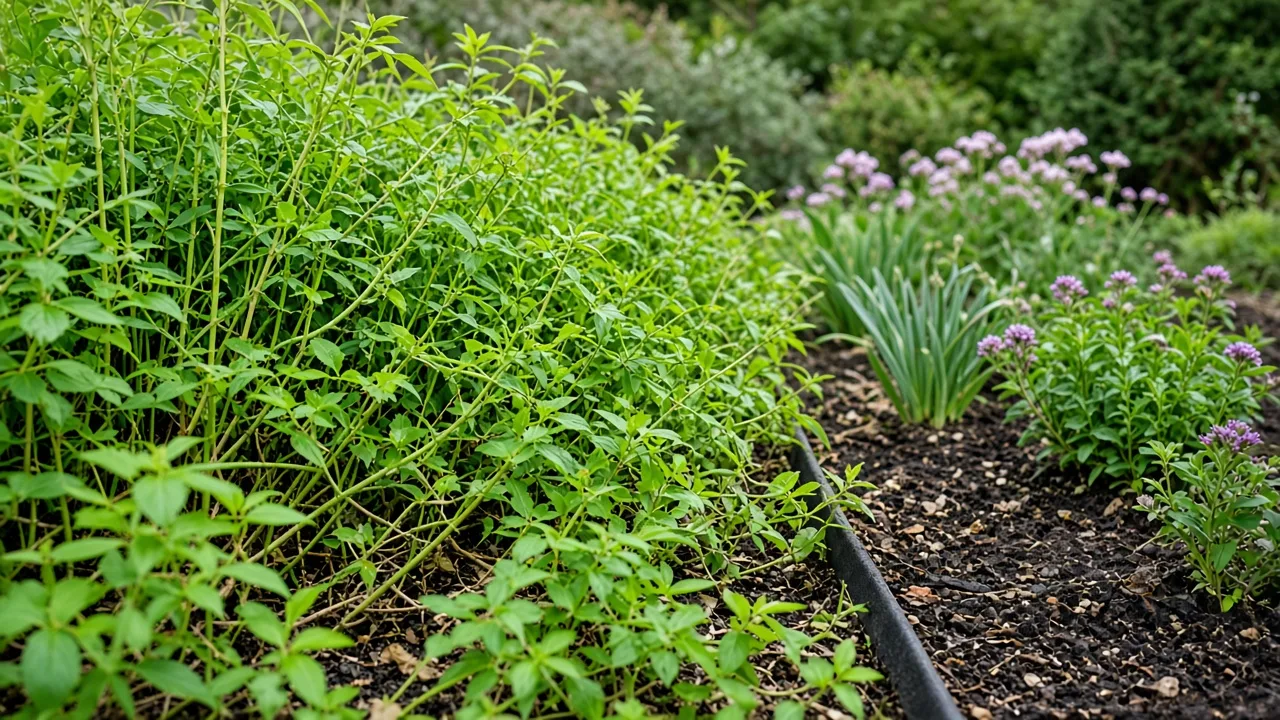
A plant can be beautiful, useful as ground cover, and still become a problem when it crosses a path, invades a woodland edge, or exposes a child or pet to toxic leaves or berries. But “weed” is not a botanical category, and these seven plants do not all deserve the same response.
The key is to separate invasive spread, vigorous growth inside a garden, and toxicity. English ivy and periwinkle can escape into natural areas in parts of North America; bugleweed and spotted deadnettle may simply overrun a nearby bed; mayapple and jack-in-the-pulpit are native woodland plants whose safety concerns do not make them invasive. Identify the plant and check your region before you pull.
What “weed” means before you dig
Gardeners usually call a plant a weed when it grows where it is not wanted. An invasive plant is more specific: it is nonnative to an area and causes ecological, economic, or other harm there. A fast-spreading ground cover may be a nuisance in one flower bed without being invasive in the surrounding region, while a native plant may spread naturally and still be valuable habitat.
That distinction changes the right response. A plant listed as invasive by your state or local invasive-plant council deserves stronger containment or removal than a ground cover that has merely crossed a border. A poisonous native may need a child- or pet-safety plan, but removing every native patch can also erase useful habitat without solving the actual exposure risk.
Before disturbing an unfamiliar plant, take a clear photo of its leaves, stems, flowers, and any fruit. Compare those features with a university extension or botanical garden profile, and check the status for your state or county; common names such as “periwinkle” can refer to different plants.
Which plants need control? A quick decision guide
| Plant | Main concern | First decision |
|---|---|---|
| Periwinkle | Creeping stems root at nodes; invasive in some regions | Check your local invasive list and contain or remove escaped mats |
| English ivy | Spreads as a ground cover and climbs trees | Cut climbing stems at the base; control the ground layer separately |
| Bugleweed | Runners can enter lawns and perennial beds | Keep only where its spread can be contained |
| Spotted deadnettle | Mat-forming stems may escape a bed | Pull or lift unwanted rooted sections before they fill gaps |
| Lily of the valley | Rhizomes spread; plant parts are poisonous | Keep away from ingestion-prone areas or remove the whole patch |
| Mayapple | Native rhizomatous colony; toxic parts | Keep in a suitable woodland garden unless it is unsafe or unwanted |
| Jack-in-the-pulpit | Native woodland plant; calcium oxalate exposure risk | Protect it and people from contact rather than treating it as an invader |
This is a triage tool, not a universal ban list. NC State Extension’s bugleweed profile describes the species as invasive in some parts of the country but a low threat to native plant communities in North Carolina. Your county extension service can help resolve a close call, especially when the plant is mixed with desirable natives.
Seven attractive plants that can cause problems
1. Periwinkle (Vinca minor)
Common periwinkle is a low, evergreen ground cover with glossy oval leaves and small blue or lavender flowers. Its creeping stems root where they touch soil, letting a modest planting knit into a dense mat that can pass under edging, enter a lawn, and continue into nearby woods. The same trait that makes it useful on a slope makes it difficult to keep inside a narrow bed.
Periwinkle is native to Europe and the Caucasus. NC State Extension’s profile notes that it appears on many unwanted-plant lists and is classified as invasive by the North Carolina Invasive Plant Council; other jurisdictions classify it differently. Check your own invasive-plant list rather than assuming that every state has the same status.
The extension profile also lists native alternatives for gardeners who want ground cover without planting this species. A local alternative still needs to match your light, soil, and moisture; “native” does not automatically mean it will stay within a small bed.
For a small escape, lift the mat from the advancing edge and trace rooted nodes back into the bed. Removing only the leafy tips leaves live joints behind, so collect the connected stems and check the border again during the growing season. If you want to keep a contained patch, use a hard boundary and cut runners that reach it before they root on the far side.
2. English ivy (Hedera helix)
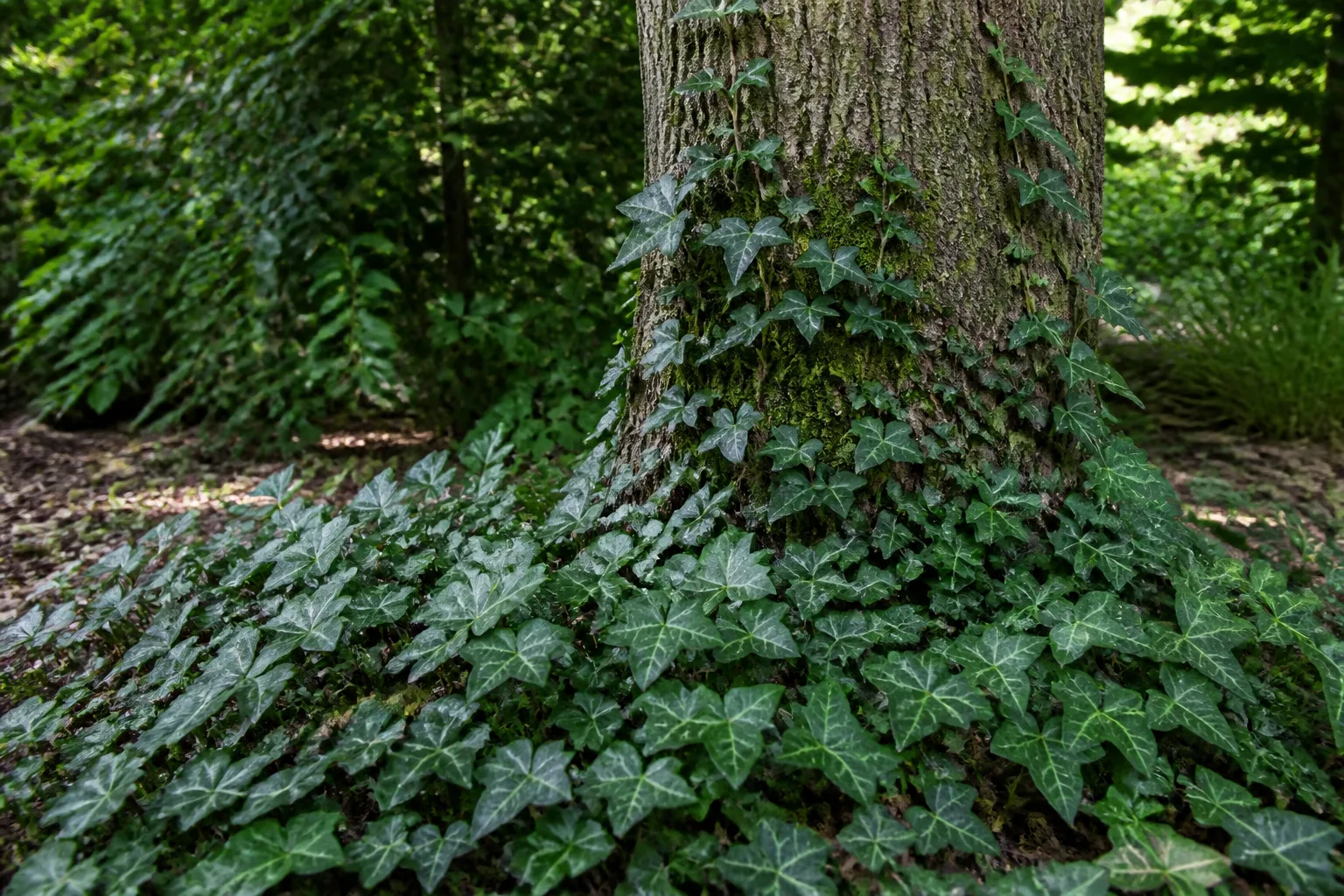
English ivy is recognizable by its evergreen, lobed juvenile leaves and its ability to spread over the soil or climb a tree, fence, or wall. Mature climbing stems can produce a different leaf shape and flowers or berries; birds may carry seed from fruiting vines into new places. A carpet of ivy can look tidy while concealing seedlings and preventing a gardener from seeing what is happening underneath.
In parts of the United States, English ivy is an established invasive plant. NC State Extension’s ivy-control guidance describes it as an introduced vine that invades woodlands and can harm trees. That does not mean a single garden patch will kill a mature tree, but ivy growing up a trunk can add weight, shade the bark, and make inspection harder.
If it reaches a tree, cut the stems at ground level and at a comfortable height; do not yank attached vines from bark, because pulling can tear the tree’s surface. Leave upper growth to die and loosen over time. This preserves bark while removing the live connection to the ground.
For a ground mat, work from the outside inward so you can see what is rooted and what is only trailing. Ivy removal is labor-intensive, and small pieces can regrow; Piedmont Master Gardeners’ removal account describes revisiting the cleared area and keeping fresh vines out of an ordinary compost heap. Wear gloves and long sleeves if you are sensitive to plant sap, and plan follow-up checks rather than expecting one afternoon of pulling to finish the job.
3. Bugleweed (Ajuga reptans)
Bugleweed, also called carpet bugle, forms a low rosette mat and sends up short spikes of blue-purple flowers in spring. The creeping stems spread sideways, and a dense planting can suppress small weeds. It can also move into a lawn or mingle with perennials, where its low foliage and rooted runners make complete removal tedious.
Its status is regional, not absolute. NC State Extension describes bugleweed as invasive in some parts of the country because of its quick growth, while noting that it poses a low threat to native plant communities in North Carolina. The same profile cautions against planting it next to perennial beds or lawns if spread would be a problem.
Treat that as a useful siting rule: a plant can be acceptable in a contained slope planting and a poor choice at the edge of a mixed border. In a practical shade-garden guide, designer Lee Burkhill of Garden Ninja also recommends editing runners before they colonize slower-growing neighbors; that is sound garden maintenance advice, not a substitute for checking local invasive status.
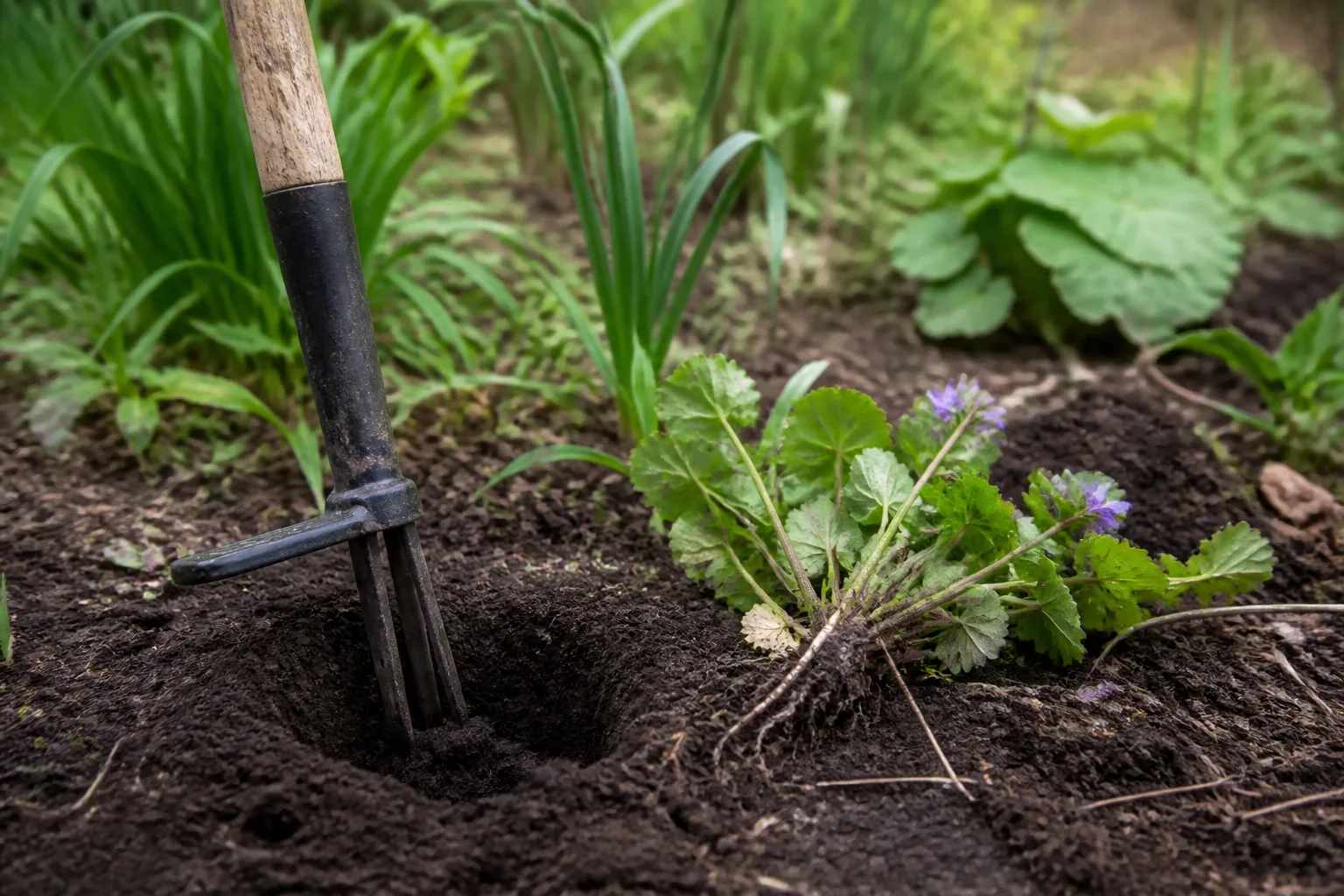
If it has escaped, loosen the soil and lift connected runners with a hand fork, following them to each rooted point. Pulling only the flower spikes will not stop the mat. Check the lawn or border for small rosettes after removal, and avoid rototilling the patch; chopping runners into pieces can leave more sections to inspect.
4. Spotted deadnettle (Lamium maculatum)
Spotted deadnettle is not a stinging nettle. It is a low-growing ornamental with toothed leaves—often silver-marked—and pink, purple, or white flowers. Its fast ground-hugging growth can fill a shaded corner, but stems that contact moist soil may root and extend the planting beyond its intended edge.
“Weedy” is a better description than “invasive everywhere” for many garden situations involving this species. NC State Extension’s profile describes spotted deadnettle as vigorous but easy to control and not generally considered aggressive, while noting that its sprawling stems root as they grow.
Site conditions and cultivars still matter: a contained patch under shrubs may be useful, while runners weaving through a perennial bed can be difficult to separate from plants you want to keep. Do not assume that a decorative cultivar is sterile or permanently compact; inspect its actual spread in your garden.
To remove an unwanted patch, pull or lift the rooted stems while the soil is slightly moist, then collect fragments instead of leaving them under mulch. If you are keeping part of the planting, cut a clean edge and remove any runner that has rooted beyond it. Recheck after rain or irrigation, when fresh creeping stems are easier to see.
5. Lily of the valley (Convallaria majalis)
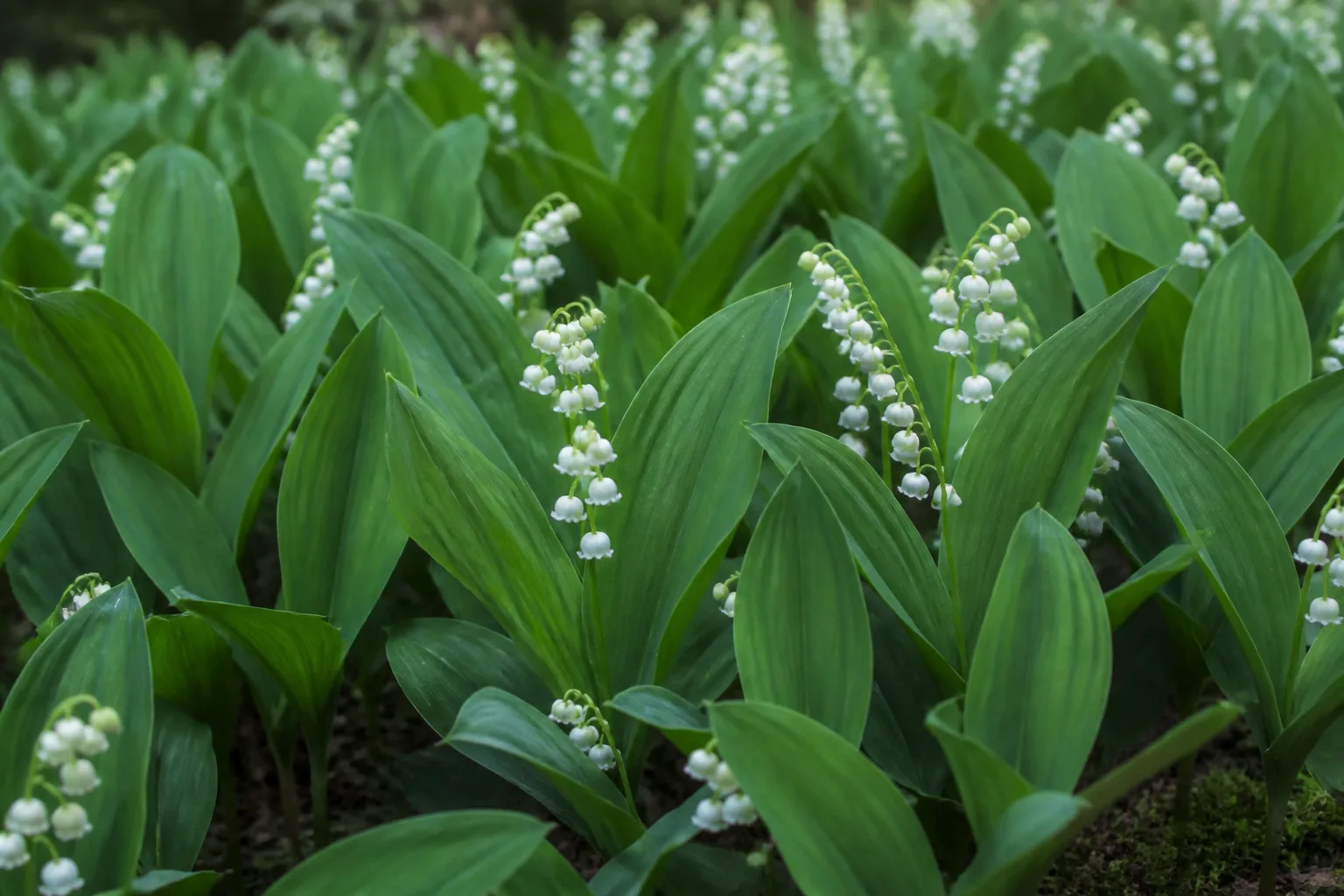
Lily of the valley makes a fragrant spring display of small white bells above broad leaves. It spreads underground by rhizomes, so a patch can reappear beyond the visible clump or push into neighboring plants. Red berries may form later; the flowers, leaves, and berries are not safe to treat as edible.
The species is native to Eurasia, not North America. NC State Extension notes that it naturalizes readily, can crowd other plants in favorable conditions, and is reported as invasive in Wisconsin and Arkansas. Its risk varies by place, but its rhizomes make it a poor choice for a bed where you need a permanent, narrow boundary.
It is poisonous, a separate reason to keep it away from places where young children or pets may chew plants. Do not confuse that safety concern with invasive status: one is about exposure, the other about spread and ecological impact.
To remove a small patch, dig carefully beyond the outer leaves and follow the pale underground rhizomes rather than stopping at the visible stems. Pick out fragments you can see, then revisit the site as new shoots appear; a missed piece can restart the colony. If you are keeping it, site it in a contained area and do not rely on a shallow decorative edging to block underground growth.
6. Mayapple (Podophyllum peltatum)
Mayapple is a native woodland wildflower across much of eastern North America. In spring, its umbrella-shaped leaves unfold over a single stem; the plant may disappear aboveground as summer advances. It spreads by rhizomes and can form a colony, which may surprise someone who planted a few in a shady native garden.
That colony-forming habit does not make mayapple an invasive species in its native range. It can be a useful woodland-garden plant when the site suits it and the spring foliage will not crowd a prized perennial. The real caution is toxicity: NC State Extension warns that roots, leaves, seeds, stems, and unripe fruit are poisonous and that handling may cause skin irritation.
Although ripe yellow fruit is described as edible in limited quantities, that exception is easy to misjudge; do not let children or pets sample any part. Correctly identifying the species and judging maturity are not easy tasks for a casual observer.
If mayapple appears in a place where you do not want it, decide first whether you can tolerate its spring-only presence. If you choose removal, wear gloves, dig the rhizomes rather than cutting off the leaves, and keep the material away from curious children and animals. Since it may be dormant by summer, mark the patch while it is visible so you do not mistake its normal dieback for successful control.
7. Jack-in-the-pulpit (Arisaema triphyllum)
Jack-in-the-pulpit is another native North American woodland plant, not a nonnative invader. Its distinctive spring flower has a hooded spathe around a central spadix; clusters of red berries may appear later in the season. It can be an appealing addition to a moist shade garden, but the berries and other plant parts should not be handled or eaten casually.
The plant contains calcium oxalate crystals. UF Health’s poisoning guidance describes mouth and throat burning, swelling, and blistering after ingestion, with the roots among the more dangerous parts. That makes jack-in-the-pulpit a safety question, not an automatic weed-removal assignment.
If children or pets explore the garden by tasting plants, move access away from the patch or choose a safer planting location. A native plant can be ecologically valuable and still need a barrier in a family garden.
If you remove it, wear gloves and avoid rubbing your eyes or face while working. Do not compost berries or plant material where pets or children might reach it. If you are unsure whether the plant is jack-in-the-pulpit or another woodland species, confirm its identity before disturbing it; spring flowers and mature berries make identification easier than a dormant patch.
How to remove spreading ground covers without spreading them further
Start by deciding how large the patch is and what is growing through it. A few runners at a border are a hand-pulling job; a continuous mat mixed with prized perennials needs slower, selective work. Photograph the patch and mark plants to keep before you dig, especially if the site has native spring ephemerals that may disappear later in the year.
For unfamiliar woodland plants, take photographs from several angles and confirm the identification with an extension office before disturbing roots; a wrong guess can turn a manageable edge problem into needless loss of a native plant. Working while foliage or flowers are visible also gives you a more reliable reference if you need to return after the plant goes dormant.
For a small patch, water the soil lightly the day before if it is dry, then use a hand fork to loosen the mat. Lift the connected stems and follow each point where a runner or rhizome has rooted. Shake soil back into the bed, remove visible living fragments, and bag the material for disposal according to local green-waste rules.
Do not put fresh ivy, rhizomes, seed heads, or rooted cuttings into a cool home compost pile; a fragment that survives can start the problem again. If you are unsure how your municipality handles invasive plant waste, keep the material contained and check its local disposal instructions before transporting it.
For English ivy climbing a tree, cut the stems at ground level and again at a comfortable height. Do not pull the upper vines down while they are attached; let them die and loosen, then remove what comes away without damaging bark. NC State Extension’s control guide favors cutting and leaving attached vines to die rather than tearing them down.
On the ground, clear a manageable strip at a time so you can see the roots and inspect the cleared edge. The smaller work area makes it easier to protect nearby plants and spot regrowth at the boundary.
If the patch is too large to dig in one session, cover the ground with an opaque tarp or other light-blocking cover and secure the edges. Smothering is slow: the cover must remain in place long enough to weaken underground reserves, and shoots may still appear at the edges or through gaps. Do not promise yourself a one-season cure; uncover a small area, remove survivors, and continue monitoring before replanting.
Avoid salt, household vinegar, or boiling water as blanket treatments around mixed garden beds. These can injure nearby plants or affect soil and surface organisms without removing deep roots. For any pesticide, use only a product labeled for that plant and site, follow the label exactly, and consult local extension guidance where native plants, water, or pets are nearby; a broad “weed killer” recommendation is not a safe substitute for diagnosis.
Protect children and pets around toxic plants
The toxicity concerns here are not all the same. Lily of the valley can cause serious poisoning if ingested; mayapple has poisonous roots, leaves, seeds, stems, and unripe fruit; jack-in-the-pulpit can cause painful irritation and swelling from calcium oxalate crystals. NC State Extension’s lily-of-the-valley profile, its mayapple profile, and UF Health’s jack-in-the-pulpit guidance describe these species-specific risks. Check a veterinary poison-control source for the exact plant and animal involved rather than relying on a general garden label.
If a child or pet might chew unknown berries or foliage, remove access first: supervise, use a physical barrier, or replace the plant in a high-traffic area. Wear gloves when digging mayapple or jack-in-the-pulpit, wash tools afterward, and avoid putting questionable berries or roots where animals can reach them. A plant being native or ornamental does not make it safe to eat.
If ingestion is suspected, do not wait for symptoms or induce vomiting unless a poison specialist or veterinarian tells you to. Contact your local poison center for a person; for an animal, call a veterinarian or animal poison-control service and provide the plant name or a clear photo. UF Health’s guidance lists the U.S. Poison Help number as 1-800-222-1222 for human exposures; use veterinary guidance for pets.
What to plant in their place
Do not replace one problem plant with another fast-spreading ground cover simply because it fills bare soil quickly. Start with the site: note sun and shade, summer moisture, soil drainage, slope, and whether the bed borders a lawn, woodland, stream, or neighboring property. Then choose plants native to your own region and suited to that exact setting.
For eastern North American shade gardens, options such as wild strawberry, green-and-gold, heartleaf aster, or golden ragwort may fit some sites, but they are not interchangeable and not every one is native everywhere in the East. NC State Extension’s periwinkle profile lists several regional native alternatives; use a local extension or native-plant society list to match the species to your state and conditions. Even a native ground cover can spread, so decide whether you want a tight clump, a slowly expanding colony, or a ground-hugging mat before planting.
Replant promptly after removal if bare soil would invite erosion or seedling weeds. A layer of leaf mulch can buy time while new plants establish, but keep mulch away from the crowns of perennials and do not use it to hide remaining runners. The goal is a planting that fills the space at a pace you can manage, not one that recreates the same removal job.
Mistakes that let a small patch return
The most common mistake is cutting off what you can see and leaving the rooted network below. Periwinkle and bugleweed can root at nodes; lily of the valley and mayapple grow from rhizomes; ivy can regrow from surviving stems. Lift or sever the growing points, collect viable fragments, and return to the site to catch new shoots.
Another mistake is pulling too aggressively in the wrong place. A climbing vine should be cut at its base rather than ripped off a tree; a native mayapple colony should not be removed solely because its leaves die back in summer; an unidentified woodland plant should not be dug up before you know what it is. A minute spent confirming identity can save a rare native and prevent unnecessary contact with a toxic plant.
Finally, do not assume the same recommendation applies to every region, cultivar, or bed. “Invasive,” “aggressive,” and “poisonous” describe different risks. Check regional status, decide whether the actual spread is causing harm, and match the control effort to the plant’s structure and location.
Conclusion
These seven plants are not all weeds in every garden. English ivy and periwinkle can invade natural areas in parts of North America; bugleweed, spotted deadnettle, and lily of the valley may escape their boundaries; mayapple and jack-in-the-pulpit are native plants whose toxicity deserves respect rather than a blanket invasive label.
Identify the plant, check local status, and decide whether the problem is spread, safety, or simply an unwanted location. Then remove rooted stems or rhizomes carefully, protect trees and people, dispose of live fragments responsibly, and monitor the site for regrowth. That turns a pretty-but-persistent patch into a manageable garden decision.