7 Plants That Can Damage Your Home
Seven popular plants can create costly home and yard problems. See the real risks, warning signs, planting distances, and safer alternatives.
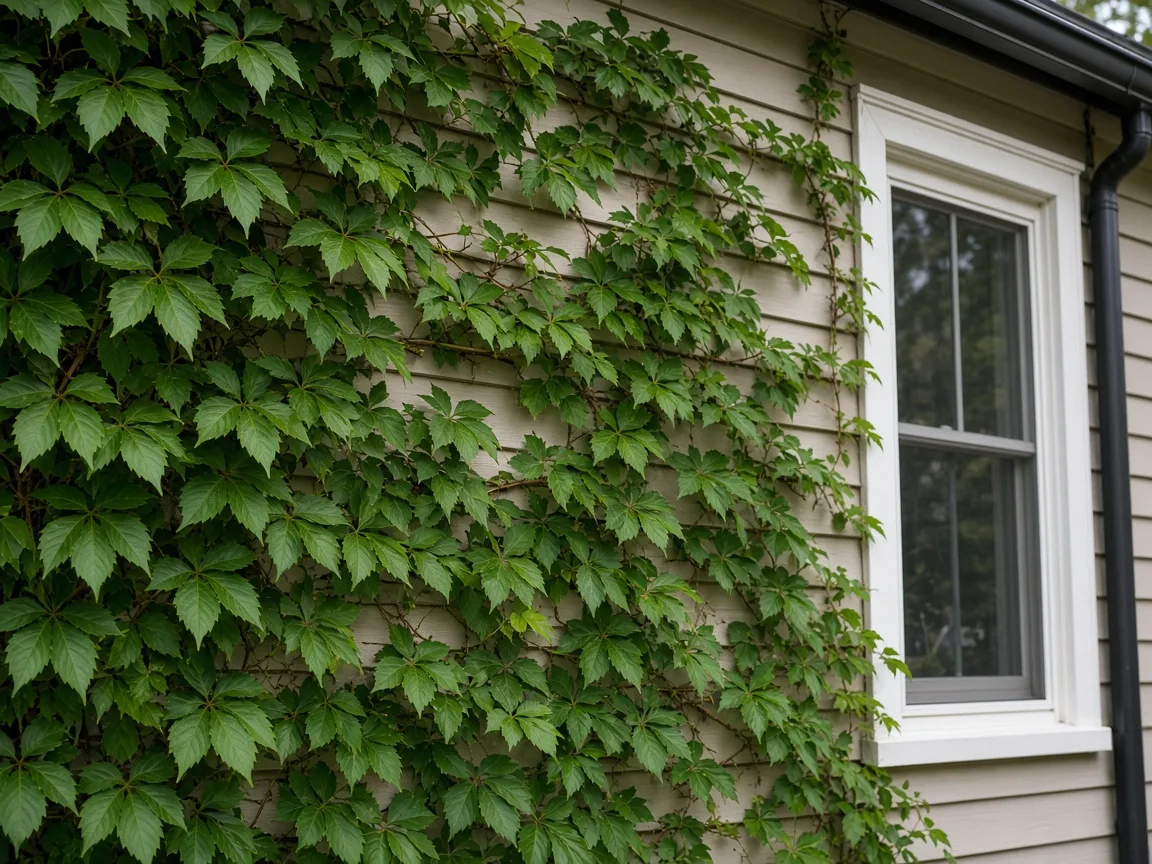
The most troublesome plants around a house are not necessarily poisonous or ugly. They are often vigorous, thirsty, heavy, or simply planted where a mature root system, vine, or canopy has no room to behave naturally. A plant can be perfectly healthy and still be a poor neighbor for siding, masonry, paving, gutters, sewer lines, or a small foundation planting bed.
Here is the useful distinction: roots do not usually punch through an intact concrete foundation like a drill. They exploit cracks, loose joints, leaking pipes, soft backfill, and convenient moisture. Above ground, a vine can hide defects or pull on gutters; a tree can lift paving or drop large limbs. The risk is a combination of plant biology, building condition, soil, mature size, and maintenance.
The real way plants harm buildings
Roots rarely attack a sound foundation first
Most feeder roots are shallow and spread outward where oxygen and moisture are available. University of Minnesota Extension notes that many small roots responsible for water uptake occupy the top 12 to 18 inches of soil, while the root spread can extend well beyond the canopy. That is why a tree can affect a walkway, drain, or compacted strip of soil without ever being close enough to “break” a deep, sound footing. (University of Minnesota Extension: watering established trees and shrubs)
The important exceptions are weak points. A cracked sewer joint leaks water and attracts roots; an old mortar joint offers a path for a self-clinging vine; a thin paving slab can be lifted by an expanding root that is not strong enough to damage a foundation. Treat claims about a plant cracking an entire house with skepticism, but do not dismiss early signs such as widening masonry joints, blocked gutters, heaving pavers, repeated drain backups, or a trunk pressing against the structure.
A quick risk check before you dig
Walk the proposed planting spot and mark four things: the foundation, hardscape, underground utilities, and overhead wires. Then look up the plant’s mature height, mature width, root behavior, invasiveness, and pruning needs rather than judging the nursery container. University of Minnesota Extension recommends choosing a location that accommodates mature size and calling to locate underground utilities before planting; that basic sequence prevents more trouble than any magic number of feet. (University of Minnesota Extension: planting trees and shrubs)
Soil changes the answer. Compacted fill beside a new house, heavy clay, a wet hollow, a septic drain field, and a narrow strip between wall and pavement are all different planting sites. A small shrub in a roomy bed may be safer than a large tree in a lawn, while a vigorous vine on a freestanding pergola may be safer than a slower vine attached directly to fragile brick.
1. Virginia creeper on siding, brick, or gutters
Virginia creeper (Parthenocissus quinquefolia) is valuable wildlife habitat and a handsome native vine in much of eastern and central North America. The problem is not that the species is automatically destructive; it is that its adhesive pads let it climb surfaces the gardener may not be able to inspect or repair easily. Once it reaches a gutter, soffit, window trim, or roof edge, the job becomes a maintenance problem even if the wall itself remains sound.
On intact modern masonry, adhesive pads generally attach to the surface rather than drilling through it. Existing cracks, loose paint, failing render, or open joints are more vulnerable. Penn State Extension cautions that climbing vines planted along foundations can damage brick mortar and that tendrils can work under vinyl siding, loosening it. (Penn State Extension: Perennial vines—friend or foe?)
The safest placement is a freestanding arbor, pergola, sturdy trellis, or fence that you can access on both sides. Keep stems away from gutters and rooflines, inspect the attachment points during the growing season, and cut back before the vine becomes a continuous mat. If you need to remove it from siding, do not yank live stems sideways; cut the main stems near the soil, let the upper growth die, and peel or brush only when it releases easily. Fragile surfaces may need a siding or masonry professional.
2. Chinese wisteria and other heavy vines
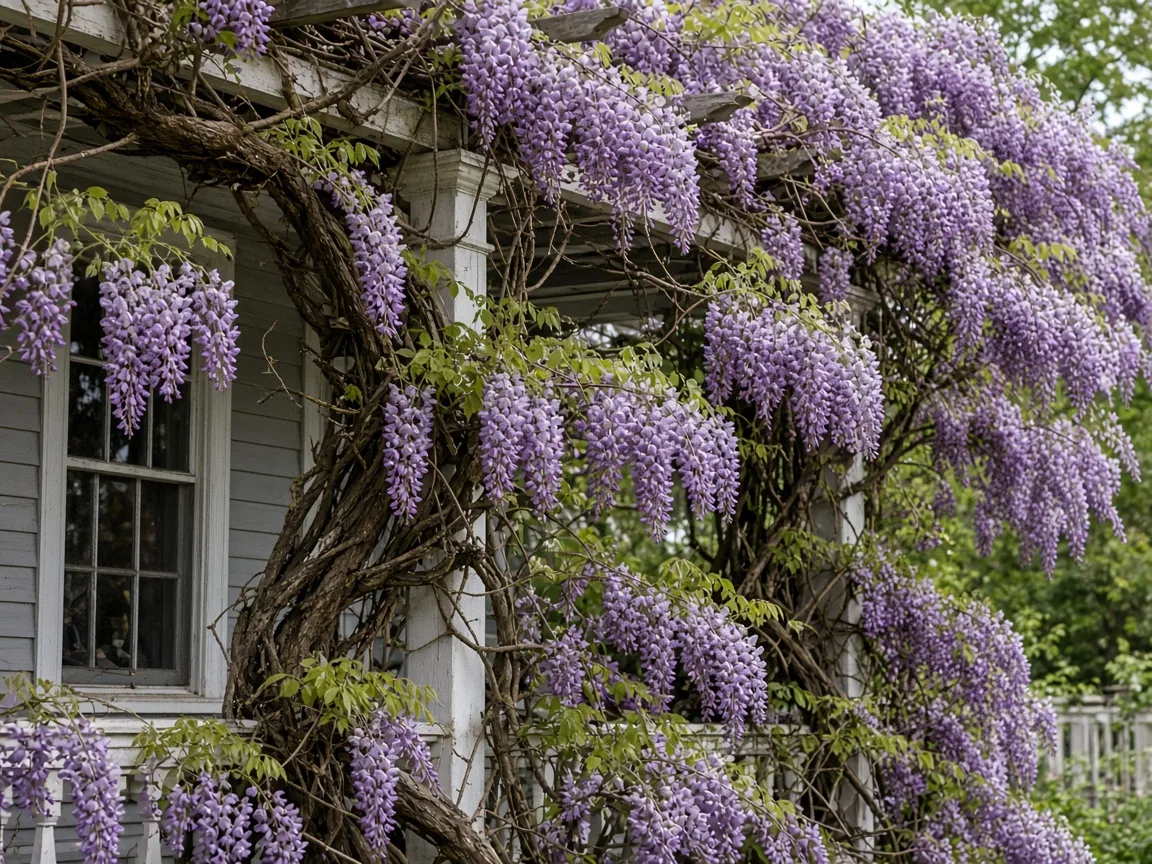
Chinese wisteria (Wisteria sinensis) and Japanese wisteria (Wisteria floribunda) produce spectacular flowers, but they become woody, heavy vines that need engineered support and regular training. Their stems enlarge as they age, and their growth can reach behind trim, around downspouts, across roof edges, and into spaces that were never designed to carry a living load.
The common mistake is fastening a lightweight trellis flat to the house and assuming the plant will remain a decoration. A trellis that bows, a gutter that carries vine weight, or a downspout trapped in a woody stem can fail before the underlying wall does. Wisteria is a twining vine, so a properly spaced wire system or detached pergola lets you inspect and prune behind it. The Royal Horticultural Society’s wisteria growing guide emphasizes the need to grow it with suitable support and manage its vigorous growth.
American wisteria (Wisteria frutescens) is often a more restrained choice where it is locally appropriate, but “native” does not mean “maintenance-free” or safe on a weak structure. Any wisteria needs a support system rated for mature wood, clear access to gutters and windows, and a pruning plan. If your goal is flowers against a wall, install the framework first, keep it separated from the masonry, and plant far enough away that the crown does not immediately disappear under the eaves.
3. English ivy on masonry
English ivy (Hedera helix) is the plant most likely to be oversimplified. It does not automatically destroy every sound brick wall, and the Royal Horticultural Society reports that its aerial roots cannot bore into sound masonry. The risk rises sharply when a wall is already cracked, its mortar is friable, or the plant is removed by force. Ivy can also hide damp, open joints, wood decay, insect activity, and other defects until the wall is harder to diagnose. (RHS: Ivy on buildings and fences)
Historic England’s wall-conservation guidance similarly stresses careful removal from fragile masonry. It warns that simply cutting the base and abandoning the dead upper stems can allow remaining sections to root higher on the wall, and that metal tools can damage delicate surfaces. (Historic England: Ivy on walls)
How to remove a wall-climbing vine safely
First, photograph the wall and inspect for cracked bricks, loose mortar, damaged render, roof gaps, and blocked drainage. If the surface is historic, soft, painted, or already failing, ask a mason or conservation professional for a method before you start.
For a small, accessible patch, cut the main stems at ground level and again where they enter the wall, then leave the upper growth in place until it dries and loosens. Remove sections gradually, supporting your weight from the ground rather than pulling hard against the wall. Brush away residue gently after the attachment material has dried; never pressure-wash fragile mortar just to make the wall look clean.
Do not assume herbicide solves the problem. Dead vines still have to be removed, a waxy leaf may not absorb treatment well, and a product can stain masonry or harm nearby plants. Dig out the root crown where practical, watch for regrowth, and repair the wall once it is visible.
4. Silver maple near paving or utilities
Silver maple (Acer saccharinum) is fast-growing and useful for shade, but its broad, shallow root system is a poor match for a narrow foundation bed or a strip between a driveway and a house. Roots can heave paving, compete aggressively for water, and become exposed in compacted or eroding soil. Fast growth also produces a large canopy and wood that demands more clearance and inspection than the young sapling suggests.
This does not make every silver maple a foundation emergency. Paving lifted by a root is not the same diagnosis as a cracked footing, and a root near a pipe is not proof that it caused the leak. If the tree is healthy and well placed, selective pruning and protection of the root zone may be enough. If it is under power lines, leaning, forked, storm-damaged, or planted in a narrow corridor, have a certified arborist assess it rather than topping it yourself.
For a new shade tree, choose a species whose mature crown fits the available soil volume and overhead clearance. A tree’s purpose matters too: University of Minnesota Extension describes “right plant, right place” as a central part of long-term planting, including keeping the root flare visible and not burying the tree too deeply. (UMN Extension: planting for the future)
5. Running bamboo in a small yard
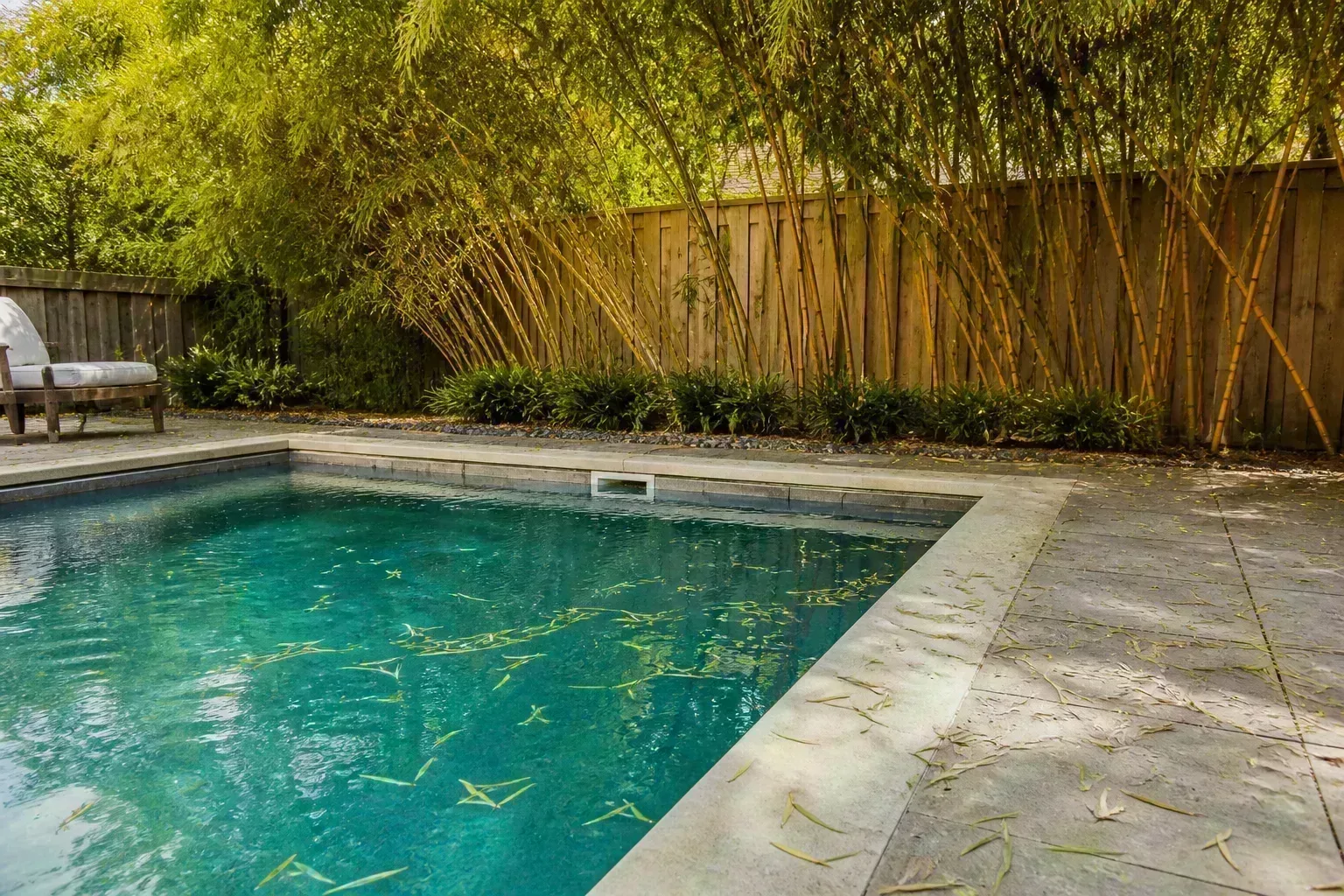
Bamboo is a grass, but running bamboo behaves less like a polite clump and more like a spreading underground network. Species in genera such as Phyllostachys send out rhizomes that can travel horizontally, then produce new culms beyond the bed you intended. Those shoots can appear through cracks or along the far side of a barrier, and small root fragments can complicate removal.
The home damage is usually indirect but real: rhizomes can invade the narrow soil strip beside paving, push into joints, cross property lines, block access, and force expensive excavation. The taller culms also shed leaves, lean into fences, and create a dense screen that is difficult to thin from the inside. The USDA National Invasive Species Information Center lists running bamboo among plants with invasive potential and points readers to regional guidance rather than treating all bamboo as identical. (USDA National Invasive Species Information Center: golden bamboo)
Running bamboo versus clumping bamboo
| Type | Underground habit | Home-site risk | Practical decision |
|---|---|---|---|
| Running bamboo | Long lateral rhizomes | Spreads under beds, fences, and paving | Avoid in small yards; if planted, use a correctly installed, inspectable barrier and local legal guidance |
| Clumping bamboo | Shorter rhizomes that curve around the clump | Expands more slowly but still becomes large | Easier to contain, but still needs mature-size room and annual inspection |
A plastic edging strip is not automatically a root barrier. If you already have running bamboo, do not just cut the visible culms and assume the problem is gone; the rhizomes remain underground. Map the spread, separate it from structures, and get local advice before excavation because disposal and invasive-plant rules vary. For screening, a well-behaved native shrub, a mixed hedge, or a properly supported vine can provide privacy without creating a hidden underground perimeter.
6. Willow trees near drains and septic systems
Willows (Salix spp.) evolved in moist places and grow vigorously where water is available. That makes them excellent choices for the right pond edge, stream buffer, or spacious wetland garden—and risky choices beside leaking drains, septic absorption fields, buried water lines, or a small house lot.
Roots do not normally invade a perfectly sealed pipe because they crave the moisture and nutrients around a defect. But old joints, cracked pipes, and drain fields create exactly that environment. The University of Minnesota drainage guide recommends keeping water-loving trees such as willow and soft maple well away from drain lines unless the lines are sealed or otherwise protected. Oregon State University Extension also advises planting grass rather than trees or shrubs over septic absorption fields because roots can clog the soil treatment area. (UMN Minnesota Drainage Guide; OSU Extension: Why do septic systems fail?)
If you have a willow near plumbing, do not start by cutting roots at the trunk. Root cutting can destabilize a tree, invite decay, and fail to address the leaking pipe that attracted the roots. Have a plumber locate and test the line and have an arborist evaluate the tree’s stability; the correct repair may be pipe replacement, rerouting, removal, or simply better separation.

7. Eucalyptus where falling debris and roots matter
Eucalyptus species vary widely, so a blanket distance claim is unreliable. Some remain modest shrubs; others become tall trees with spreading roots, shedding bark, brittle branches, and a large seasonal cleanup footprint. A tree that fits a spacious rural property may be a poor choice beside a roof, pool, driveway, or narrow side passage.
The most predictable risks are mature size, branch clearance, bark and leaf litter, and drought or wind stress, not a guaranteed ability to crack a house. Roots follow available moisture and can interfere with pipes or paving when the site is constrained. Falling limbs are a separate risk from roots, and a tree can threaten a roof even when its roots are nowhere near the footing.
Before planting, identify the species and its mature dimensions, check local fire and invasive-plant guidance, and look at how wind moves through the site. Keep the crown away from roofs and wires, avoid planting over utility corridors, and schedule professional inspections for large established trees. A smaller ornamental tree or multi-stem shrub may deliver the same evergreen texture with less overhead consequence.
Planting distances that actually make sense
There is no universal “safe distance” that works for every foundation and every plant. Use a layered rule:
- Start with the plant’s mature height and spread, not its sale size. Large trees need a large root zone and overhead clearance.
- Add separation for the building material. Fragile masonry, old mortar, wood siding, render, and roof edges need more caution than a detached steel arbor.
- Trace utilities, drains, septic fields, irrigation, and hardscape before digging. A plant beside a known leak or drain field is a different risk from the same plant in open soil.
- Leave an inspection path. If you cannot see the wall, gutter, downspout, trunk flare, or barrier edge, you cannot catch a problem early.
- Consider the maintenance calendar. A plant that needs twice-yearly training, annual crown inspection, or barrier checks is not low-maintenance just because it survives drought.
Keep planting holes outside the foundation’s drainage zone and never direct irrigation toward the house. For trees, call the utility-locate service before digging and plant with the root flare at the correct level; burying a trunk flare creates its own long-term failure risks. On compacted building sites, improve the planting area broadly rather than digging a narrow, deep hole that leaves roots trapped in poor soil.
What to do if a risky plant is already established
Do not panic and do not immediately reach for a chainsaw. First, document the plant, its base, the direction of spread, nearby cracks, gutter blockages, paving movement, drain backups, and the condition of the wall or tree. Take dated photographs and note whether the problem changes after rain or during active growth.
Next, stop adding stress. Keep vines out of gutters and roof gaps, keep mulch and irrigation away from siding, do not park heavy equipment over a root zone, and do not sever large roots without a professional plan. If bamboo is spreading, contain access and map the perimeter; if a tree is leaning or has hanging limbs, keep people away from the drop zone.
When to call an arborist, mason, or plumber
Call a certified arborist for a large tree, storm damage, a leaning trunk, significant root cutting, overhead wires, or any removal where the fall path reaches a structure. Call a mason or building professional for widening cracks, loose brick, friable mortar, damaged render, or historic surfaces. Call a plumber when drains back up, a sewer camera shows roots, or a pipe leak may be attracting roots.
These specialists answer different questions. An arborist assesses tree stability and biology; a plumber finds and repairs the water source; a mason determines whether movement is cosmetic, moisture-related, or structural. A garden-center suggestion cannot replace those inspections when the house itself is at risk.
Better alternatives for screening and vertical color
The best alternative depends on the job. For privacy, consider a mixed hedge of locally appropriate shrubs with mature widths that fit the bed. For a climber, use a plant that can be tied to a detached trellis rather than a self-clinging vine on the wall, and choose a species whose pruning schedule you can actually maintain. For a wet area, select plants suited to the water regime while keeping septic fields and foundations clear.
American wisteria can be a better choice than Chinese or Japanese wisteria in regions where it grows well, but it still needs strong support. A non-running bamboo or a clumping ornamental grass may be easier to manage than running bamboo, but confirm the identification and local restrictions. The safest choice is often not a “safe plant” label; it is a plant that stays within its mature footprint, allows inspection, and matches the soil and moisture already present.
Conclusion: match the plant to the site
Virginia creeper, wisteria, English ivy, silver maple, running bamboo, willow, and eucalyptus can all create trouble when their growth habit meets a weak wall, narrow bed, buried utility, drain field, or roof edge. None deserves a blanket verdict in every landscape, and a scary claim about roots destroying a sound foundation is less useful than a careful inspection.
Before planting, locate utilities, check mature size, protect masonry with a separate support, and keep water-loving or invasive plants away from drains and constrained spaces. If a plant is already established, identify the actual failure—wall attachment, root spread, leaking pipe, unstable tree, or blocked drainage—then choose the professional or removal method that addresses that cause.



