How to Prune a Fig Tree for a Better Harvest
Learn when to prune a fig tree, which branches to keep for breba or main-crop figs, and how to shape young, mature, potted, or overgrown trees.
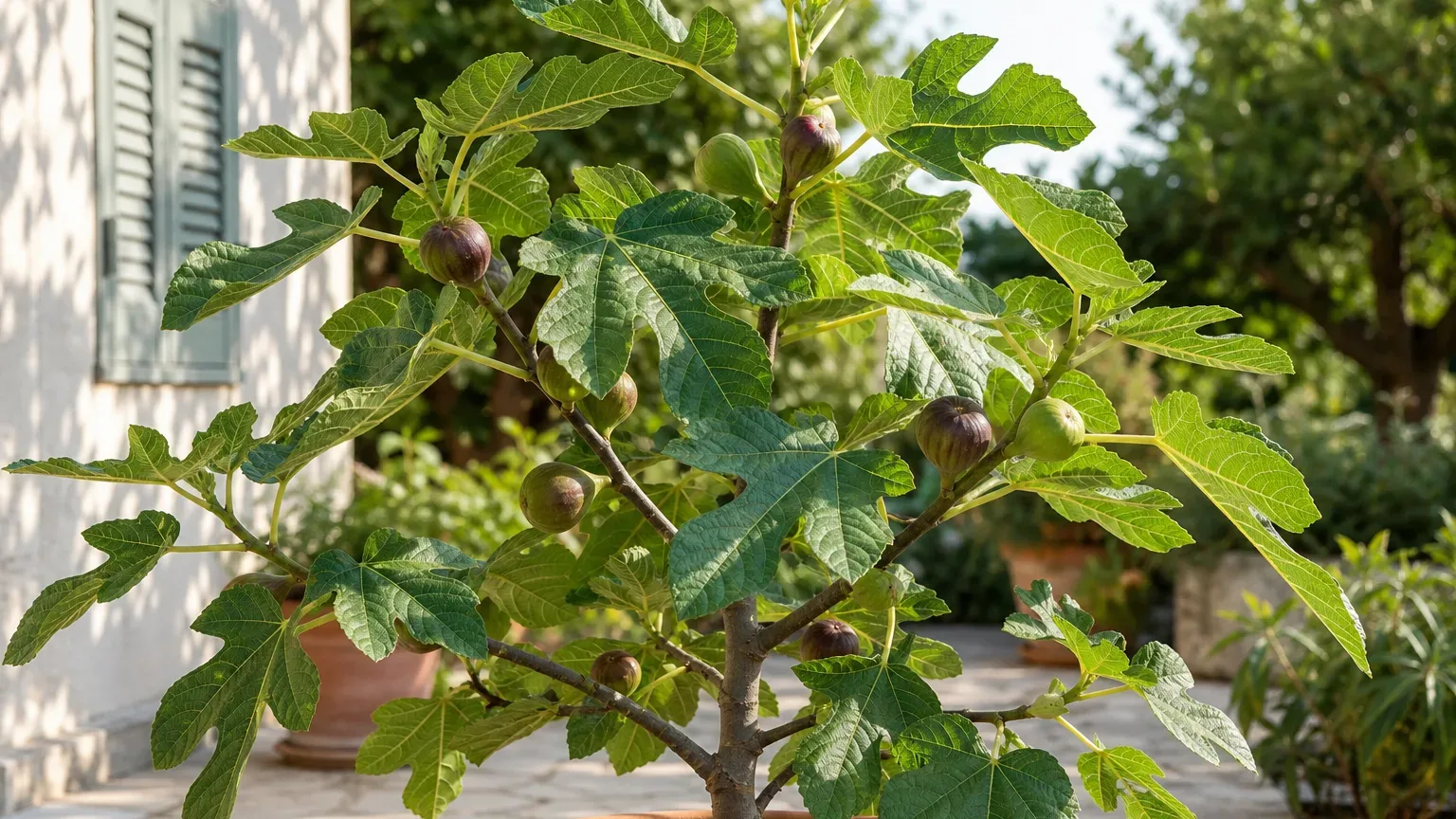
A fig tree does not need a severe annual haircut to produce fruit. Pruning is most useful when it solves a specific problem: a young tree needs a strong framework, a mature canopy is too crowded, branches have outgrown the harvest zone, or cold damage has left dead wood. The wrong cuts can remove fruiting shoots, expose limbs to winter injury, or provoke a flush of leafy growth instead of a better crop.
Before cutting, decide which harvest you want to protect. Many common figs carry the main crop on shoots that grow during the current season; some varieties also make an earlier breba crop on the tips of shoots from the previous year. This distinction is why blanket advice to shorten every branch by a third can cost fruit. Your climate, variety, training form, and the condition of the tree matter more than a fixed calendar date or percentage.
Quick answer: prune for a purpose, not by a fixed rule
For routine shaping, wait until the tree is dormant or nearly dormant, then make light, selective cuts after the most severe local frosts have passed and before strong spring growth begins. In regions where figs are pruned after harvest to support local crop timing, follow regional extension guidance. First remove dead, broken, diseased, crossing, and badly placed growth; then make only the additional cuts needed to improve structure, access, or light.
| Your situation | First move | Main caution |
|---|---|---|
| Newly planted or young tree | Choose a bush, single-trunk, or trained form and build a few sturdy branches | Avoid repeated hard heading that delays establishment |
| Productive mature tree | Remove dead or interfering wood, then thin only where the canopy is crowded | Keep last year’s shoots if you value a breba crop |
| Cold-winter region | Wait until the risk of hard frost has passed before removing questionable wood | Some apparently dead tips may still leaf out; severe winter cuts can remove breba fruit |
| Container fig | Maintain a compact, balanced crown and clear the path to winter storage | Do not confuse canopy pruning with a need to cut roots |
| Overgrown tree | Renovate in stages, starting with the worst conflicts and dead wood | A hard reset can reduce the crop and trigger vigorous regrowth |
Pruning can make fruit easier to reach and can help light reach a dense canopy, but it does not guarantee a larger harvest. The University of Florida IFAS notes that figs do not require pruning to be productive and cautions that heavy winter pruning can eliminate the following year’s crop (UF/IFAS Extension). Treat pruning as a way to manage structure and fruit access; if a healthy tree is already the right size and cropping well, a light cleanup may be all it needs.
Choose the crop and tree form before you cut
Stand back and identify the permanent trunk or trunks, the strongest framework branches, and the smaller shoots that grew last season. Look for tiny fruitlets near the tips of older shoots if your variety produces an early crop. Decide whether your priority is the earliest figs, the main summer or fall crop, a manageable shape, or recovery from damage; one pruning plan cannot maximize every goal at once.
Breba versus main-crop figs
A breba fig develops on the previous year’s wood, often near the tips of those shoots. The main crop generally develops on new shoots in the current growing season. University of California’s Statewide IPM Program explains that mature figs set fruit on current-season growth, while Rutgers Cooperative Extension notes that breba figs form at the ends of the previous year’s shoots (UC IPM, Rutgers Cooperative Extension). Cultivar and climate affect which crop matters most and whether both crops ripen reliably in your garden.
If you want to keep breba fruit, retain a good share of healthy, full-length shoots from the previous season. A heavy dormant heading cut removes their tips and can sacrifice that early crop. If you chiefly want the main crop, selective dormant pruning may encourage fresh shoots, but cutting harder than necessary can still produce excess vegetative growth, remove useful branches, and postpone the harvest while the tree rebuilds.
Do not assume that every tiny fig will ripen. In a short, cool season, a late fruit set may remain hard and green until frost; preserving a great deal of growth solely for fruit that cannot mature can make the canopy less manageable. Fine Gardening’s cold-climate fig guidance recommends balancing crop potential with season length and notes that gardeners may pinch off late figs that are unlikely to ripen (Fine Gardening). Use several seasons of your own harvest records to decide whether breba or main-crop wood is worth preserving.
Bush, standard, container, or fan-trained form
In a warm climate with little winter dieback, a fig can be trained as a small tree with one trunk and a raised crown. In a colder area where the top can freeze back, a multi-stem bush is often more practical: surviving stems can carry the tree forward if one is damaged, and a low form is easier to protect. Fine Gardening describes keeping several strong stems as a form of insurance in colder climates; the right number depends on available space and how you plan to protect the plant.
A container-grown fig needs a compact crown that stays balanced over the pot and can pass through a doorway if you move it to winter storage. A fig trained flat against a sunny wall needs a permanent fan or espalier framework, with shoots tied into open spaces instead of allowed to jut forward or crowd the center. RHS guidance separates these forms because a wall-trained fig, a container bush, and a free-standing tree do not need identical cuts (RHS fig pruning and training).
Choose one form while the tree is young and make small corrections as it grows. Trying to convert a mature standard into a fan—or reducing a tall tree to a short bush in one session—creates large wounds and a strong regrowth response. If you inherited a tree with a useful, balanced shape, maintaining that form is usually easier than rebuilding it for appearance alone.
When to prune a fig tree in your climate
“Dormant season” is a useful starting point, not a universal date. The safe window depends on whether the tree has finished fruiting, whether hard freezes are still likely, and which crop you want to retain. Regional recommendations can differ because a mild-winter garden and a cold-climate garden face different risks.
Dormant-season pruning and frost timing
For most structural work, prune while the tree is leafless or just before growth resumes, but wait until the worst winter weather has passed if exposed cuts or new growth could be damaged by a hard freeze. This late-winter-to-early-spring window lets you see the branch structure and assess winter injury before the canopy fills in. In very cold areas, delay removal of questionable branches until buds break or new growth begins; a brittle-looking tip is not always dead down to the point where it first appears brown.
Warm-region schedules may be different. UF/IFAS recommends pruning, if needed, after harvest in late summer in Florida, while UC IPM describes dormant-season pruning as a way to remove interfering or broken branches and manage structure. Neither recommendation should be imposed on every climate or cultivar. If your local extension service gives a specific window, use that advice and state your crop goal when comparing recommendations.
Avoid large cuts during active spring growth unless you are removing damage or correcting an immediate hazard. Fig cuts can release milky latex sap, and RHS advises wearing gloves and protective clothing. The more important harvest issue is that a spring cut can remove small fruitlets already forming on older branch tips; inspect before shortening a shoot.
Summer pinching and the mid-summer cutoff
Summer work is usually a light adjustment, not a second severe pruning session. On a fan-trained or compact bush, tying a useful new shoot into the framework and pinching a soft tip after it has made several leaves can limit a long, unproductive extension and encourage side shoots. RHS recommends pinching selected shoots after about five leaves in early summer, then stopping by mid-summer because new fruit embryos form at shoot tips and later growth may not have time to develop them before the season ends (RHS fig pruning and training).
You do not need to pinch every shoot. If a branch is filling an open space, replacing a damaged scaffold, or carrying a crop you want, leave it to grow. Use pinching selectively on vigorous shoots that will otherwise shade the interior or extend beyond a trained shape. If the best time has passed, do not make a late cut simply because a calendar says the tree needs summer pruning; allow the shoot to mature and reassess during the next suitable window.
Tools and preparation for clean, safe cuts
Use sharp bypass pruners for pencil-thin shoots, loppers for branches within their capacity, and a pruning saw for thicker limbs. A clean tool makes a controlled cut without twisting the branch; forcing small pruners through a large limb can tear bark and leave a ragged wound. Clean tools before starting and disinfect them between cuts when working with known diseased wood or when local plant-health guidance recommends it.
Wear gloves, long sleeves, and eye protection because fig latex can irritate skin and eyes. Keep your face out of the path of sap and falling material, particularly when cutting above shoulder height. If a limb is heavy, overhead, near a structure, or close to a power line, stop and use a qualified tree professional rather than balancing on a ladder with a saw.
Before you cut, take a full-tree look and point out the branch you plan to remove. For an entire branch, preserve the branch collar—the slightly swollen tissue where it joins the parent limb—and cut just outside it. Do not cut flush against the trunk, and do not leave a long dead stub. For a heavy branch, use a three-cut sequence: make a small undercut farther out, remove the branch weight with a top cut beyond it, then make the final collar-preserving cut. This prevents the branch from tearing a strip of bark as it falls.
How to prune a young fig tree
A young fig needs time to establish roots and a clear framework. Your first goal is not to make it look like a miniature mature tree; it is to select a form that fits the site and keep a small number of well-spaced branches that can carry future growth. Avoid removing half of a healthy young plant automatically. A drastic reduction may be appropriate in a deliberate training system, but it should not be treated as a universal first-pruning rule.
First-year cuts: establish roots before a hard reset
At planting, remove broken or badly damaged material and any shoot that cannot be part of the chosen framework. If the nursery tree is a single whip and you want to train a low bush or open crown, a formative heading cut may be part of the local extension system; Rutgers’ guidance, for example, starts certain in-ground trees at roughly 2 to 3 feet to encourage scaffold growth. That is a specific training approach, not a height every gardener needs to copy.
If the tree arrived with healthy branches and is already a good size, let it settle before imposing additional cuts. Water and establishment are more important than forcing a particular shape during its first season. Remove basal suckers that you do not want as permanent trunks while they are small, but retain selected suckers if you are deliberately building a multi-stem bush for cold protection.
Select a framework that fits your space
During the first dormant season, choose a few strong branches that point in different directions and are spaced along the trunk rather than clustered at one point. Rutgers recommends selecting three or four evenly distributed main branches as the young tree’s framework; cold-climate bush forms may retain more stems. Think of those counts as a starting range, not a quota—the tree’s natural branching and your training form decide what stays.
Remove a competing leader, inward-growing shoot, or branch that rubs another before it becomes thick and difficult to remove. On a wall, tie a well-positioned shoot gently into an open part of the fan rather than cutting it off just because it is not perfectly horizontal. Use small, purposeful corrections over several seasons; broad branch angles and good spacing are more valuable than a perfectly symmetrical silhouette.
How to prune a mature fig tree for access and light
A productive mature tree often needs less pruning than a young one. UC IPM advises reducing pruning intensity as figs mature; dormant cuts should focus on interfering or broken branches, low limbs that weep too far down, and growth that is excessive rather than opening the tree until it is bare (UC IPM). The goal is a stable canopy with enough light and room to harvest, not maximum air space at any cost.
Remove dead, damaged, crowded, and unwanted shoots
Start with dead, broken, diseased, or winter-killed wood. Then remove crossing branches that rub, suckers that compete with the chosen trunks, and shoots growing into a wall or the center of a crowded canopy. A cut at the branch origin removes the whole unwanted shoot; do not shorten it to an arbitrary stub unless you need a replacement shoot to grow from that position.
Work from the outside inward and pause after each cut. A single branch may be shading several fruiting laterals, while a dense-looking cluster may actually contain the shoots needed for your next crop. If the canopy still has a clear route for light and air after the obvious conflicts are gone, stop. There is no benefit in removing sound, well-spaced wood just to make the tree look sparse.
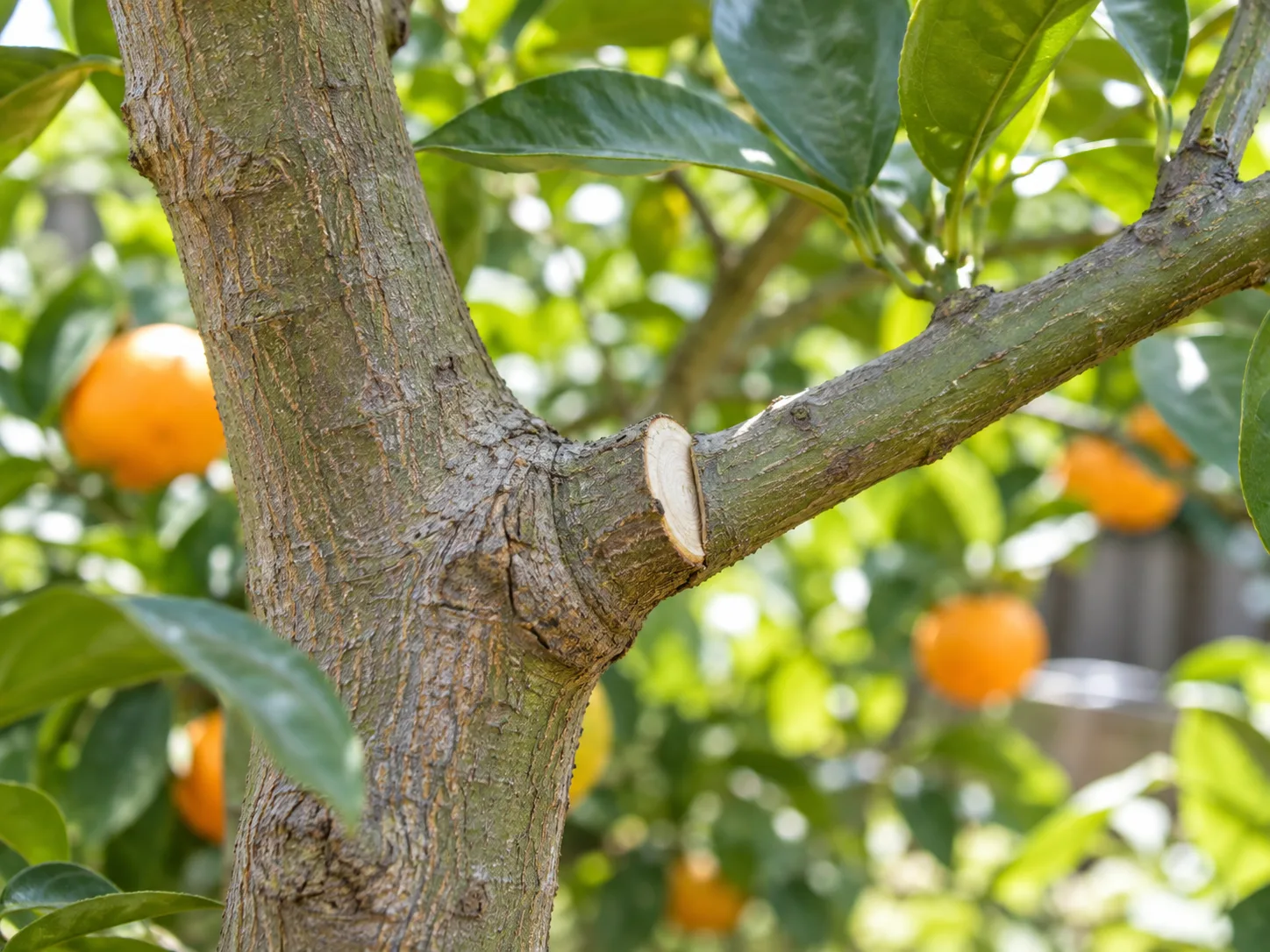
Preserve the branch collar at a proper removal cut; this citrus-tree example shows the same cut anatomy used on a fig.
Control height while preserving fruiting wood
If you cannot reach the fruit, reduce a tall shoot to a well-placed side branch that can continue its direction. Avoid topping the central trunk or cutting every upper branch to the same height; those heading cuts often produce a dense flush of upright shoots near the cuts. Reduce the tree in stages, keeping enough leafy canopy to support the roots and enough fruiting wood to carry the next crop.
Before shortening last year’s shoots, look for small breba figs at their tips and decide whether you want that crop. If you need to reduce the height but want to preserve some breba, retain selected full-length shoots in accessible positions and remove or redirect other growth. This selective approach gives you a harvest compromise: not every branch must remain, and not every branch should be shortened by the same fraction.
A mature fig that is already compact and fruitful may need only a handful of cuts each year. The University of Florida IFAS guidance is especially useful here: figs are naturally bushy and pruning is not a prerequisite for fruiting. If a tree’s current size is acceptable and the crop is reliable, leave healthy branches alone.
Adjust the method for pots, walls, and winter injury
A container fig is pruned to balance its crown, clear dead wood, and keep it manageable for moving—not to compensate for the container by cutting away a fixed amount of canopy. Keep a compact outline, remove shoots that make the pot unstable or block access, and retain healthy fruiting branches. Gardening Know How’s container guidance likewise recommends light shaping for young potted figs and removal of dead or broken stems from established plants, while warning against cutting off the previous season’s terminal fruiting growth (Gardening Know How).
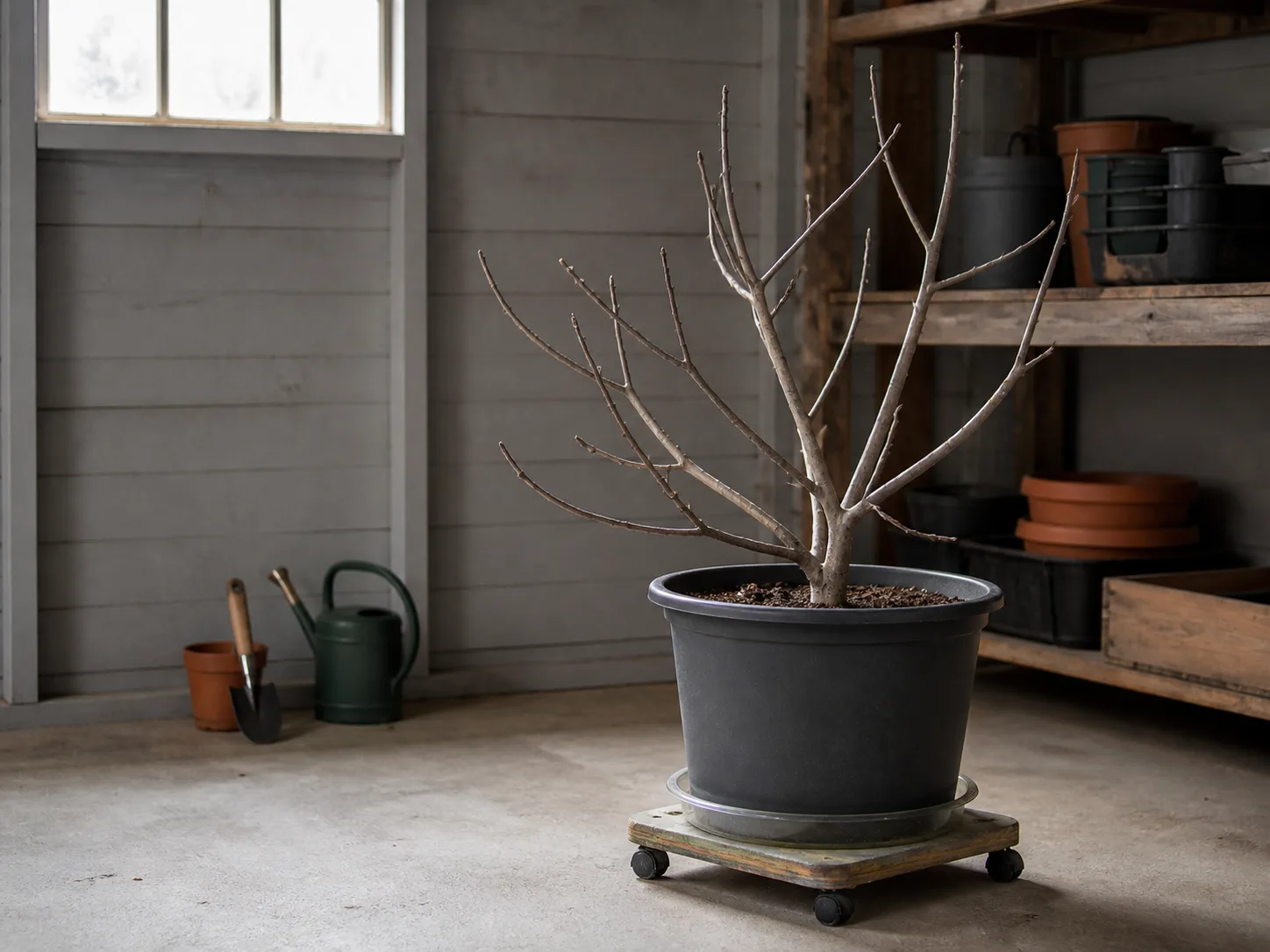
A leafless potted fig is easy to inspect, but retain the branches that carry the crop you want.
For a wall-trained fan, the support—not the shape of an open-center tree—guides each cut. Remove shoots growing toward the wall or projecting into a walkway, then tie useful replacements into empty sections of the support. The RHS advises leaving compact shoots that carry tiny fruitlets, thinning crowded new growth, and pinching selected shoots during early summer; if no tie-in point remains, remove a badly placed replacement rather than building a dense knot.
After a cold winter, wait until regrowth begins before deciding how far to cut back suspect wood. A damaged tip may be dead while the lower branch remains viable, and the boundary between live and dead tissue can become clearer as buds swell. UF/IFAS advises removing freeze-damaged wood after regrowth commences. In a cold region, this delay protects living framework and can prevent a premature hard cut that sacrifices breba shoots.
Restore an overgrown fig tree gradually
If you inherited a tall, tangled fig, do not try to solve every problem in one afternoon. First identify the permanent trunks, mark the limbs that are dead or unsafe, and decide on a manageable final height over several seasons. Then remove dead wood and the worst crossing or rubbing branches; leave sound fruiting shoots until you can see how the tree responds.
RHS notes that figs tolerate hard renovation but respond with vigorous regrowth, so it recommends staggering major work rather than taking the whole canopy at once (RHS fig pruning and training). A practical plan is to remove one group of badly placed or overlong branches in the first year, assess the new shoots during summer, and select replacements before making another major reduction the following dormant period. For an unusually large mature tree, an in-person arborist assessment is sensible if cuts involve heavy limbs or uncertain structure.
Expect the crop to change after renovation. A large reduction may lower fruit production temporarily because the tree has less mature wood and must rebuild leaves and shoots. Do not respond to that first smaller harvest by cutting more; keep the new framework healthy, avoid encouraging rank growth with excessive fertilizer, and judge the result over more than one season.
Mistakes to avoid and what to do after pruning
Do not prune by a fixed fraction. A rule like “remove one-third” may be reasonable in a specific training system, but it ignores tree vigor, fruiting type, winter injury, and what you want to harvest. Identify the branch’s job first, then make the smallest cut that improves the tree.
Do not strip all last year’s growth. Those shoot tips may carry breba fruit, and the entire previous season’s framework may be important in a cold climate where new growth needs time to mature. If your goal is to retain the early crop, keep selected full-length shoots; if not, still avoid removing healthy wood without a clear reason.
Do not prune immediately after a freeze or late in the season just to tidy. Wait to distinguish live from dead wood, and avoid stimulating tender regrowth that will not have time to harden before winter. Likewise, summer tip pinching is not a license to keep cutting after mid-summer, when the next crop’s fruitlets may already be forming.
Do not seal ordinary cuts or overfeed to “make up” for pruning. Make clean cuts at the right point and let the tree respond naturally; wound paint does not repair a flush cut or a long stub. Resume normal watering for your soil and weather, keep the area around the trunk clear enough to inspect, and do not add extra nitrogen simply to force quick shoots. Excessively vigorous growth is not the same as productive growth.
After the session, note the date, what you removed, and whether you kept previous-year tips for breba fruit. When the tree leafs out, check which buds survived, whether the remaining framework is balanced, and where fruit sets. Those observations make next year’s cuts more accurate than any universal pruning calendar.
Conclusion
To prune a fig tree well, begin with the crop and the shape you want, then choose the smallest set of cuts that makes that goal possible. Keep selected last-year shoots if breba figs matter, allow room for new growth that will carry the main crop, and time structural pruning around local frost and harvest conditions. A healthy mature fig that already fits its space may need little more than deadwood removal and a few careful thinning cuts.
Young trees benefit from gradual framework training; mature trees benefit from restraint; overgrown trees benefit from staged renovation. Use sharp tools, protect your skin from latex, and stop before a cut becomes unsafe or the plan would remove most of the canopy. That measured approach keeps the tree manageable while preserving the wood and energy it needs for future fruit.



