Coffee Table Book Alternatives for 2026
Looking for coffee table book alternatives? Compare puzzles, chess, backgammon, and tactile games by room, hosting style, space, and upkeep.
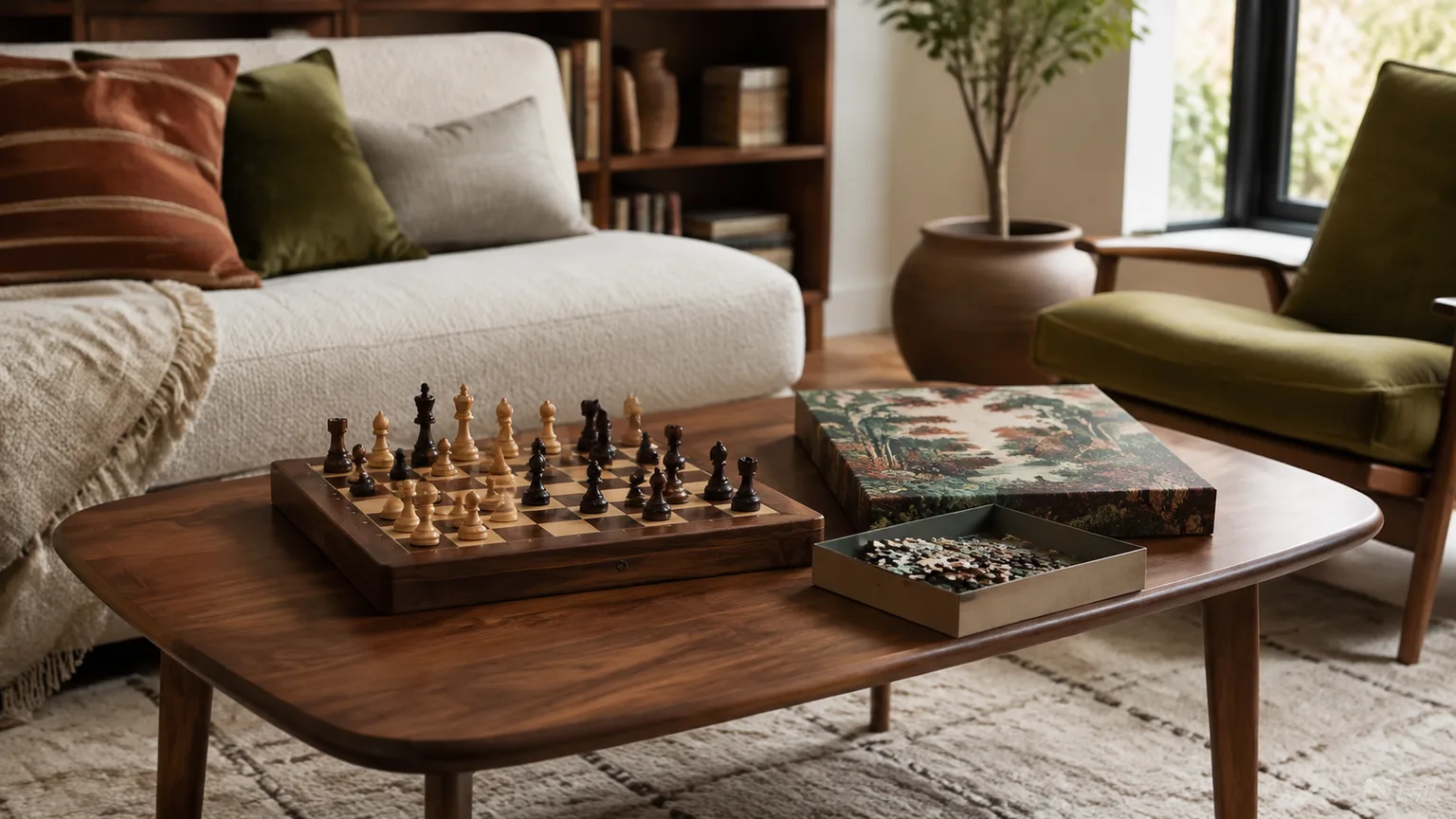
If you are wondering what is replacing the coffee table book in 2026, the short answer is a beautiful object that gives people something to do. Design-forward puzzles, chess sets, backgammon boards, mahjong cases, and small tabletop games are moving into the display role once held by oversized books.
That does not mean coffee table books have suddenly become useless. It means the living room is asking more of its center surface. A book can signal taste, but a game can signal taste and make the next person who walks in feel welcome enough to sit down.
The short answer: games and puzzles are taking the display role
The strongest coffee table book alternatives share three qualities: they look intentional when idle, they are easy to reach when someone wants to use them, and they fit the scale of the table. A polished chessboard, a lidded puzzle box, or a small marble tic-tac-toe set can carry visual weight without becoming a permanent pile of accessories.
The distinction is important. The trend is not “put any board game on the table.” A battered box with a missing rule sheet and loose pieces spilling into the walkway is not decor; it is a storage problem. The useful version is a playable centerpiece: an object chosen for its materials and proportions, then kept accessible enough that it earns its place through use.
This is also why the idea works beyond one decorating style. A walnut chess set suits a collected room. A leather or raffia backgammon case feels relaxed and travel-inspired. A graphic puzzle box can add color to a neutral room, while a restrained stone or acrylic game can echo a modern interior without looking like a toy left behind.
Why an interactive object feels more current than a static book
Interior design coverage in 2025 and 2026 has repeatedly emphasized warmer rooms, tactile surfaces, personal stories, and spaces that support more than one activity. Good Housekeeping’s designer survey, for example, pairs warm minimalism with texture, deeper woods, cozy nooks, and rooms that help people disconnect from screens. Its larger point is useful here: a lived-in room is not empty or perfectly staged; it is edited around how people spend time in it. (Good Housekeeping’s interior design trend coverage)
Games and puzzles fit that shift because they are decor with a built-in story. A coffee table book says, “This subject interests me.” A game says, “This is something we might do together.” A puzzle says, “You can stay for ten minutes or return to this tomorrow.” That invitation makes the room feel less like a showroom and more like a place where ordinary rituals happen.
The design case: material, shape, and patina
A book’s visual contribution usually comes from its cover, height, and color block. A well-designed game can add those same layers through a board grid, a box silhouette, carved pieces, a fabric case, or a satisfying stack of components. The best versions have an obvious geometry that reads cleanly from across the room and enough tactile detail to reward a closer look.
Materials are doing much of the work. Warm wood, leather, woven raffia, lacquer, stone, metal, and acrylic each tell the room something different. Current color and interior forecasts also lean into personal palettes, nostalgic references, warmer browns, and nature-linked greens rather than one universal neutral. That makes a game useful as a small, reversible way to test a richer color or material before you repaint a room or replace furniture. (Veranda’s 2026 color-trend coverage)
Look for visual coherence, not luxury for its own sake. A heavy marble board can be handsome but awkward to lift every week. Glossy acrylic may suit a crisp modern room but show fingerprints and scratches faster than matte wood. A woven case may soften a formal room, while a high-contrast board can compete with patterned upholstery. “Premium” should mean the finish supports your home and the object survives the way you plan to use it.
The social case: an invitation instead of a prop
The social appeal is real, but it deserves a precise explanation. A game does not magically improve a gathering, and a puzzle is not automatically social. What it does is lower the effort required to begin an activity. Guests do not need a special occasion, a screen, or a long explanation to pick up a familiar game and make a move.
Research supports that narrower claim. A 2025 observational study of 11 older-adult and child dyads found positive affect during intergenerational board-game sessions and observed prosocial behavior; it also found that the older participants faced meaningful difficulty and effort. That combination matters for home styling: choose games that invite connection, but do not confuse an attractive set with universal accessibility or guaranteed ease. (The PubMed abstract for the intergenerational board-game study)
Puzzles work differently. In a University of Toronto interview, semiotics professor Marcel Danesi described their tactile quality and the satisfaction of moving from disorder toward a solvable result. He also noted that puzzles can be solitary, with connection often forming when people share the interest through clubs or conversation. That is a better design lesson than calling every puzzle a group activity: leave room for someone to work alone, and let sociability happen without pressure. (The University of Toronto puzzle interview)
Choose the object by how your room is actually used
Start with behavior, not aesthetics. Ask who will use the piece, how long a typical session lasts, whether the coffee table must be cleared for dinner or homework, and where the components will go between uses. Then choose the format that matches those answers.
If the room is mostly a conversation space, favor a quick, recognizable game. If it is a quiet reading or crafting space, a puzzle may be the better fit. If the table is narrow, prioritize a small footprint over an impressive board that leaves nowhere for a mug or a pair of feet.
Choose a two-player classic for casual hosting
Chess, checkers, backgammon, cribbage, and simple strategy games are strong choices when guests arrive unpredictably. Their appeal is legibility: people can usually identify the game, understand the basic invitation, and decide quickly whether they want to play. You do not need to plan a full game night for a board that supports a ten-minute challenge.
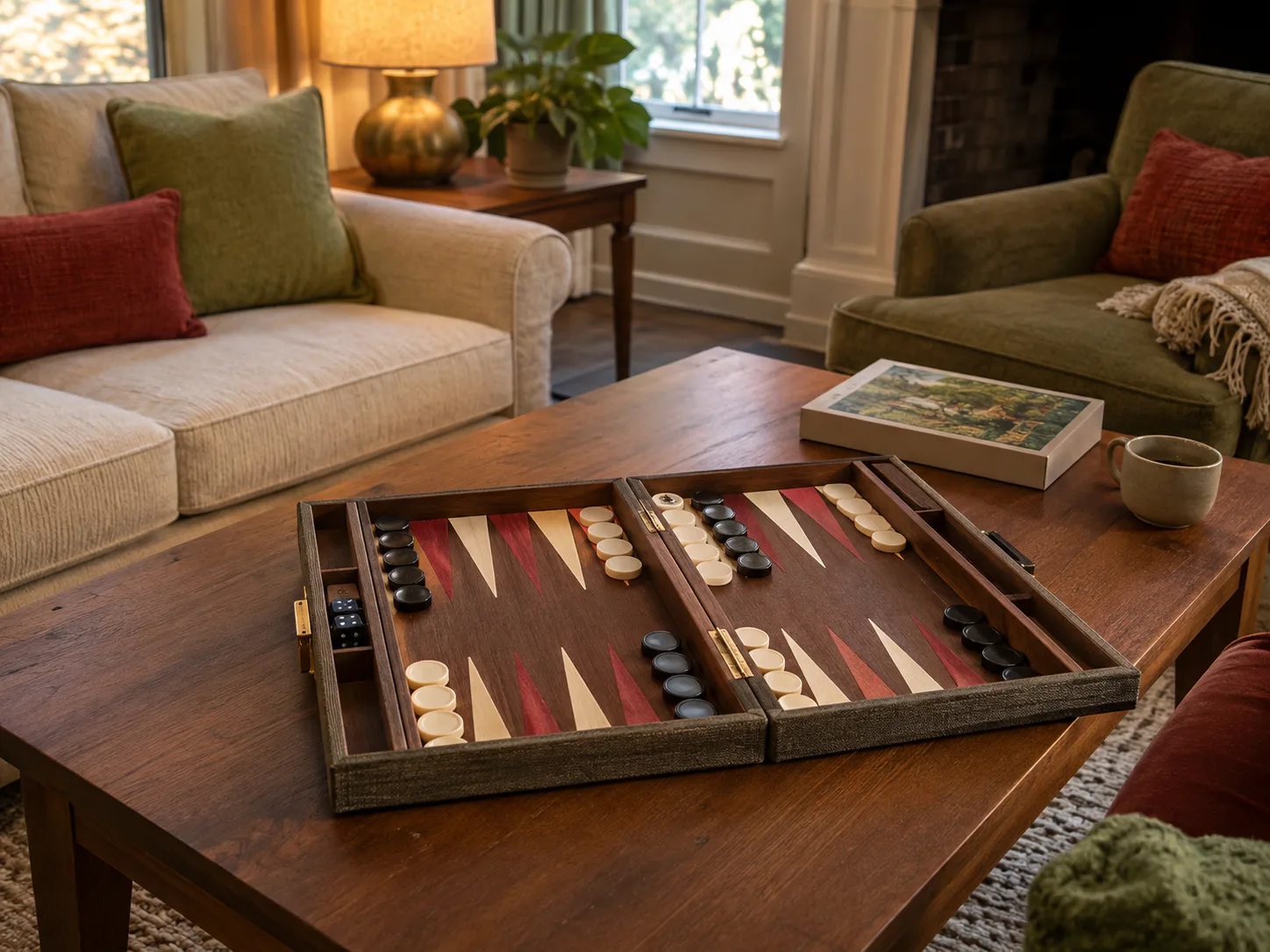
Chess makes the clearest architectural statement because its grid and pieces read as a composed arrangement even when nobody is playing. Checkers is friendlier for mixed groups because the rules are familiar and the play is quicker. Backgammon brings more material presence through its folding case, contrasting points, and satisfying pieces, but the open board needs more table depth than a compact chessboard.
Use the household test before buying: can a child, an older relative, or a first-time guest reach the pieces without feeling they are touching something precious? If the answer is no, the set may be better on a shelf or sideboard. A centerpiece that discourages contact undermines the reason to choose an interactive object.
Choose a jigsaw puzzle for quiet, ongoing focus
A puzzle is the best coffee table book alternative when you want an activity that can remain in progress. It supports a slower rhythm: sort pieces today, work on an edge tomorrow, and leave the table with a partial image that still looks intentional if the box and tray are tidy.
The key decision is not only the image. Choose the commitment level. A small puzzle with clear color blocks is easier to start and easier to clear. A large, subtle image with many similar pieces can become a beautiful project, but it needs a dedicated surface or a puzzle mat. If your coffee table is the only place to eat, work, or host, choose a format that can slide onto a nearby console or under-sofa storage without breaking apart.
Puzzle art also gives you a low-cost way to bring in a color story. A botanical illustration can echo greenery, a vintage travel image can reinforce a collected room, and a monochrome abstract can add pattern without another framed print. Rotate the image when you are ready for change; you do not have to redecorate the entire room to refresh the center.
Choose a compact tactile game for a small table
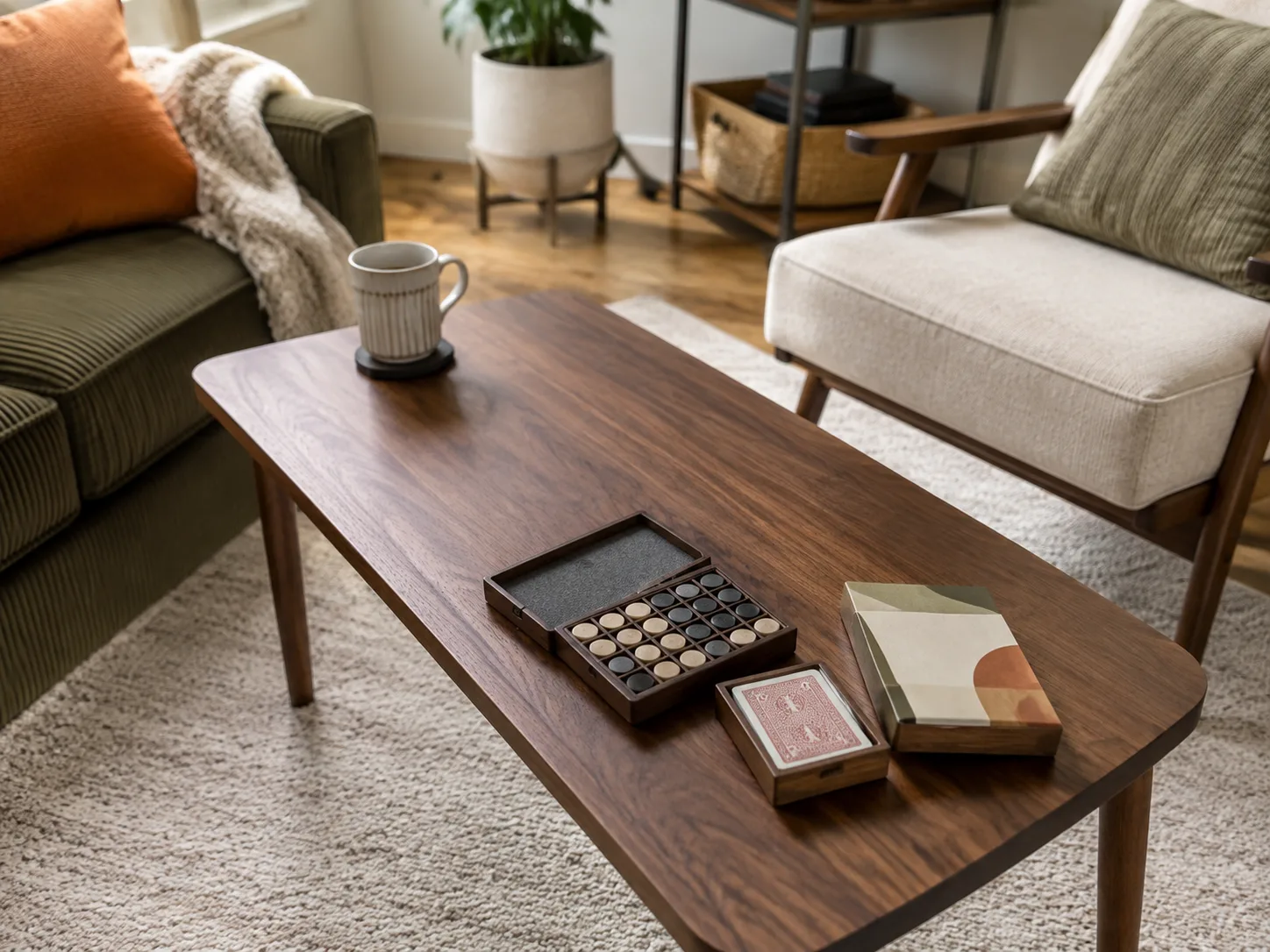
Small rooms need objects that are generous in personality but modest in footprint. Tic-tac-toe, four-in-a-row, dominoes, a deck of cards in a handsome case, or a compact magnetic game can occupy the visual center without consuming the usable center.
Look for a lidded box, stackable pieces, or a board that folds flat. These details reduce what I think of as reset friction: the number of steps between “we are finished” and “the table is ready for daily life.” A game that takes thirty seconds to close is more likely to stay in rotation than one that requires sorting six trays of components.
Use the same rule for decorative trays. The tray should gather the game, not create a second layer of clutter around it. Leave enough exposed table surface for a drink and enough clearance around the edge that the piece does not become a collision hazard when someone sits down.
Choose a statement set only when the room can carry it
A dramatic set can replace a coffee table book stack, but scale has to be earned. Oversized chess pieces, a wide board, or a saturated lacquered case should be the room’s one strong tabletop note, not one more loud object beside a large vase, a candle cluster, and a bowl full of accessories.
Give a statement set breathing room. A square board usually reads best when its edges are visible, while a case can sit slightly off-center with one lower, quieter object nearby. If you need to stack things under the board to make it visible, the set may be too small for the table or too visually timid for the room.
Remember weight. Stone and dense hardwood look substantial, but they can scratch a soft wood finish or strain a narrow table when moved. Add discreet felt pads where appropriate, lift rather than drag, and check the manufacturer’s care guidance before placing a porous or polished material on an heirloom surface.
What to look for before you buy
Shopping for this trend is less about finding the most photogenic set and more about preventing buyer’s remorse. Treat the object as a small piece of furniture: inspect how it opens, where it rests, how it ages, and how it behaves when several people are using it.
Playability is part of the design
Check the rule burden first. A game can be beautifully made and still be a poor centerpiece if nobody in the household knows how to start it. For casual hosting, choose recognizable rules or a clear instruction card that can be stored with the set. For dedicated players, complexity may be the point, but then the board belongs near a real game surface rather than on a purely decorative coffee table.
Check the component experience, too. Are the pieces easy to distinguish? Does the board glare under your room’s lighting? Can a person with limited grip strength move the pieces? Are the pieces small enough to be a choking risk for young children? These questions are not fussy extras; they determine whether the object can function as an invitation.
Materials and finish should fit your real household
Choose materials by contact and maintenance, not just mood. Wood warms a room and can develop character, but it may show rings or scratches. Leather and woven cases add softness but need protection from spills and pet claws. Marble provides visual weight and natural variation but is heavy and can be vulnerable to staining or chips at the corners. Acrylic is light and graphic, though it can show smudges.
The room’s existing palette should guide the finish. The most reliable approach is to repeat one material already present—a walnut board near a walnut frame, a leather case near a leather chair, or warm brass details near a brass lamp—then introduce one small contrast. You do not need the game to match the coffee table exactly; you need it to belong to the same visual conversation.
Storage, accessibility, and reset time matter
Storage is where the pretty idea either becomes a habit or fails. Decide in advance whether the game will live in a drawer, an ottoman, a nearby cabinet, or a lidded tray. Measure the actual space, including the lid and any pieces that sit above the board. A set that technically fits only when turned diagonally will become annoying quickly.
Accessibility is equally practical. Keep the most-used game between seated eye and hand level, avoid placing fragile pieces at the edge, and leave a clear route around the table. If someone in the home has low vision, strong contrast between board and pieces may matter more than a subtle monochrome palette. If someone has tremors or limited dexterity, larger pieces and a stable surface may make the difference between joining and watching.
Build a simple reset rule: play on the table, store beside the table. A basket or drawer within one step is better than a beautiful cabinet across the room. This is why the best set is rarely the most elaborate one; it is the one that is easy to start and easy to put away.
Style games and puzzles without making clutter
The goal is not to turn the coffee table into a game store. It is to give one object enough space to look intentional and enough access to be used. Current design advice around warm minimalism makes the same distinction: simplicity does not require stripping a room bare; it requires choosing fewer things with better relationships between them. (Good Housekeeping’s designer guidance on warm minimalism)
Build around one focal object
Start by removing everything from the table. Put the game or puzzle in the position where it will be used, then add only what supports its scale: one low bowl, one small candle, or one short vase, not all three by default. If the board has a strong pattern, let the surrounding objects be quiet. If the box is neutral, a single colorful book or ceramic object can give the arrangement a reason to exist.
Use height carefully. A coffee table is viewed from above and from the sofa, so tall objects can block conversation and make the display feel like a barrier. Keep the playable object low and reserve height for one supporting piece placed toward the far side. The arrangement should still feel open when two people sit opposite each other.
Leave a clear play zone
A table can be styled and usable at the same time. Keep at least one area clear for a board, a puzzle tray, or a few cards, and avoid arranging objects in a ring that forces every player to reach across the decor. If the table is small, the correct styling move may be to display the closed case on top and move it to a side table when play begins.
Daylight is the best editing tool. Walk into the room from the entry, sit on the sofa, and look at the table from the side. Then open the game and imagine four hands reaching for it. If the first view says “pretty pile” and the second says “please move everything,” the setup needs less decoration and more clearance.
Common mistakes that make the trend feel forced
The first mistake is buying for the photograph instead of the household. A game can have beautiful leather, stone, or wood and still be wrong if its rules are too demanding, its pieces are too delicate, or its footprint takes over the only useful surface. Ask what people will do with it on an ordinary Tuesday, not just how it will look before guests arrive.
The second is treating “interactive” as permission to leave everything out. Open puzzle boxes, scattered cards, and multiple games stacked together create visual noise unless the room has a dedicated game zone. Curate one active invitation and store the rest.
The third is ignoring age and ability. An object can be socially warm in theory but excluding in practice if it requires tiny pieces, low contrast, bending, or fast hand movement. Offer formats with different levels of effort and let participation be flexible; watching, sorting, or choosing the next move can all count as joining.
The fourth is choosing a material that conflicts with maintenance. A glossy board beside a family snack area will collect fingerprints. A porous stone set beside an unprotected drink zone invites stains. A light-colored puzzle on a dark coffee table may look beautiful until every missing piece disappears into the grain. The more visible the object, the more its care routine matters.
Finally, do not force a trend label onto a room that already has a stronger story. If the coffee table is a circulation route, a puzzle is dangerous clutter. If the home has young children or pets who will scatter small pieces, choose a lidded game or keep the activity on a high sideboard. Good decor responds to the room instead of asking the room to pretend.
When a coffee table book is still the better choice
Keep the book when reading is genuinely part of the household’s life or when the room benefits from a quiet visual anchor. A well-chosen book can create a slower, more contemplative mood, and it does not require rules, setup, or a clear storage plan after use. It can also be the better choice for a narrow table where an open board would make the surface feel busy.
Books are especially useful when the coffee table sits in a formal sitting room, a waiting area, or a space where people are unlikely to play. They also work when your collection carries personal history that a newly purchased game cannot replicate. A travel book from a place you love, a gardening book with notes in the margin, or a monograph connected to family work has the same storytelling power as an heirloom game.
The strongest compromise is often a rotation. Keep one or two books below a closed game case, or move the game to a side table when you want the room to feel quieter. You can switch the center object with the season, a gathering, or your actual mood. The point of the 2026 shift is not to ban coffee table books; it is to make the surface reflect life rather than a styling formula.
Conclusion
Games and puzzles are replacing coffee table books because they combine visual personality with an invitation to participate. The winning choice is not necessarily the most expensive, rare, or elaborate set. It is the one that suits your room’s scale, your household’s abilities, your guests’ comfort, and the amount of effort you are willing to spend putting it away.
Choose a familiar two-player game for spontaneous hosting, a puzzle for quiet ongoing focus, or a compact tactile format when space is tight. Give it one clear focal position, keep the play zone open, and store the pieces close enough that use feels easier than avoidance. If a coffee table book still tells your story better, keep it. The most current room is the one that makes room for the way you actually live.